Past Exam Questions
← Back9231 P32 - Nov 2021 - Q6 - 9 marks
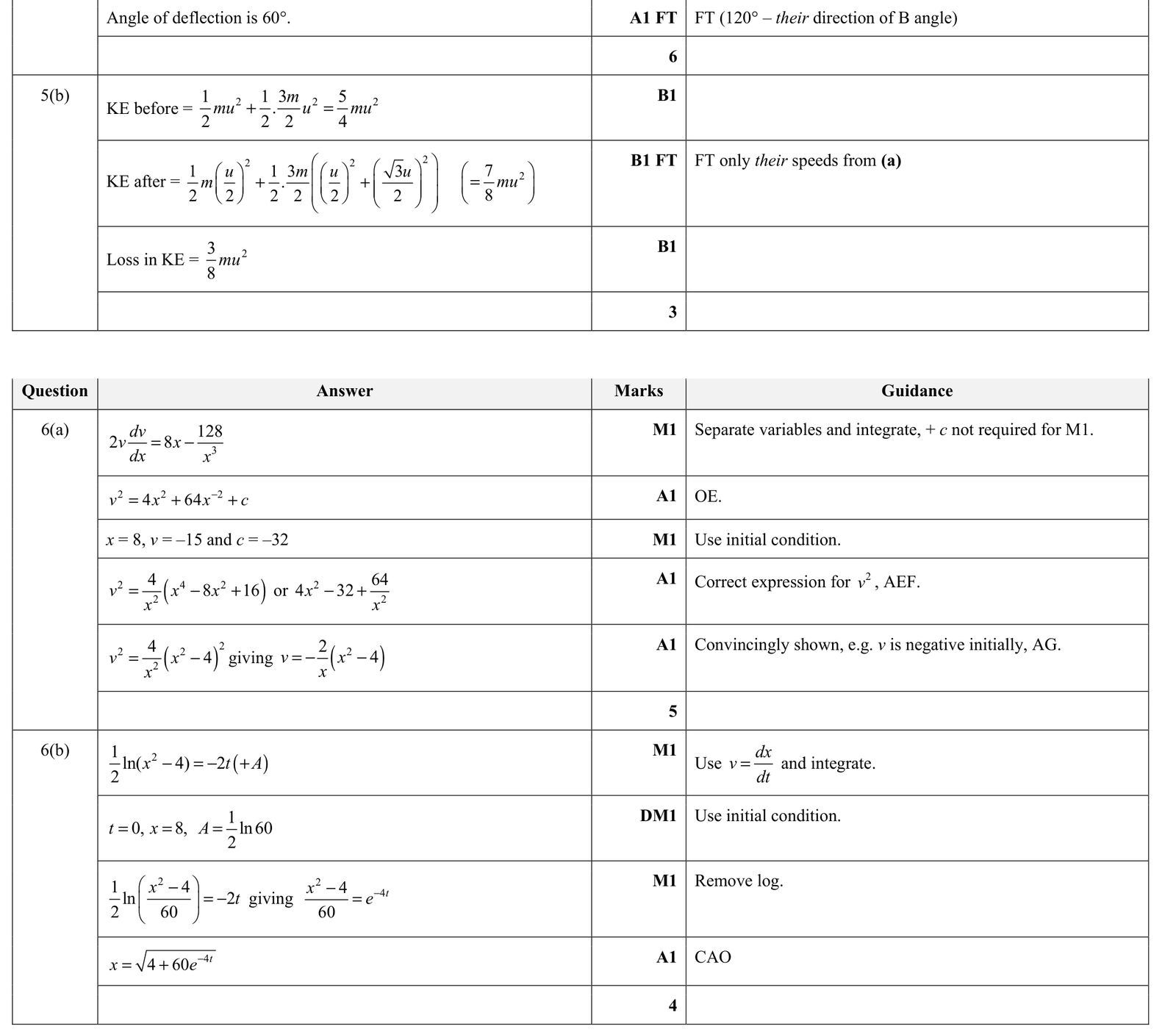
A particle \(P\) of mass 2 kg moves along a horizontal straight line. The point \(O\) is a fixed point on this line. At time \(t \mathrm{~s}\) the velocity of \(P\) is \(v \mathrm{~ms}^{-1}\) and the displacement of \(P\) from \(O\) is \(x \mathrm{~m}\).
A force of magnitude \(\left(8 x-\frac{128}{x^{3}}\right) \mathrm{N}\) acts on \(P\) in the direction \(O P\). When \(t=0, x=8\) and \(v=-15\).
(a) Show that \(v=-\frac{2}{x}\left(x^{2}-4\right)\).
(b) Find an expression for \(x\) in terms of \(t\).
9231 P31 - Nov 2020 - Q7 - 10 marks
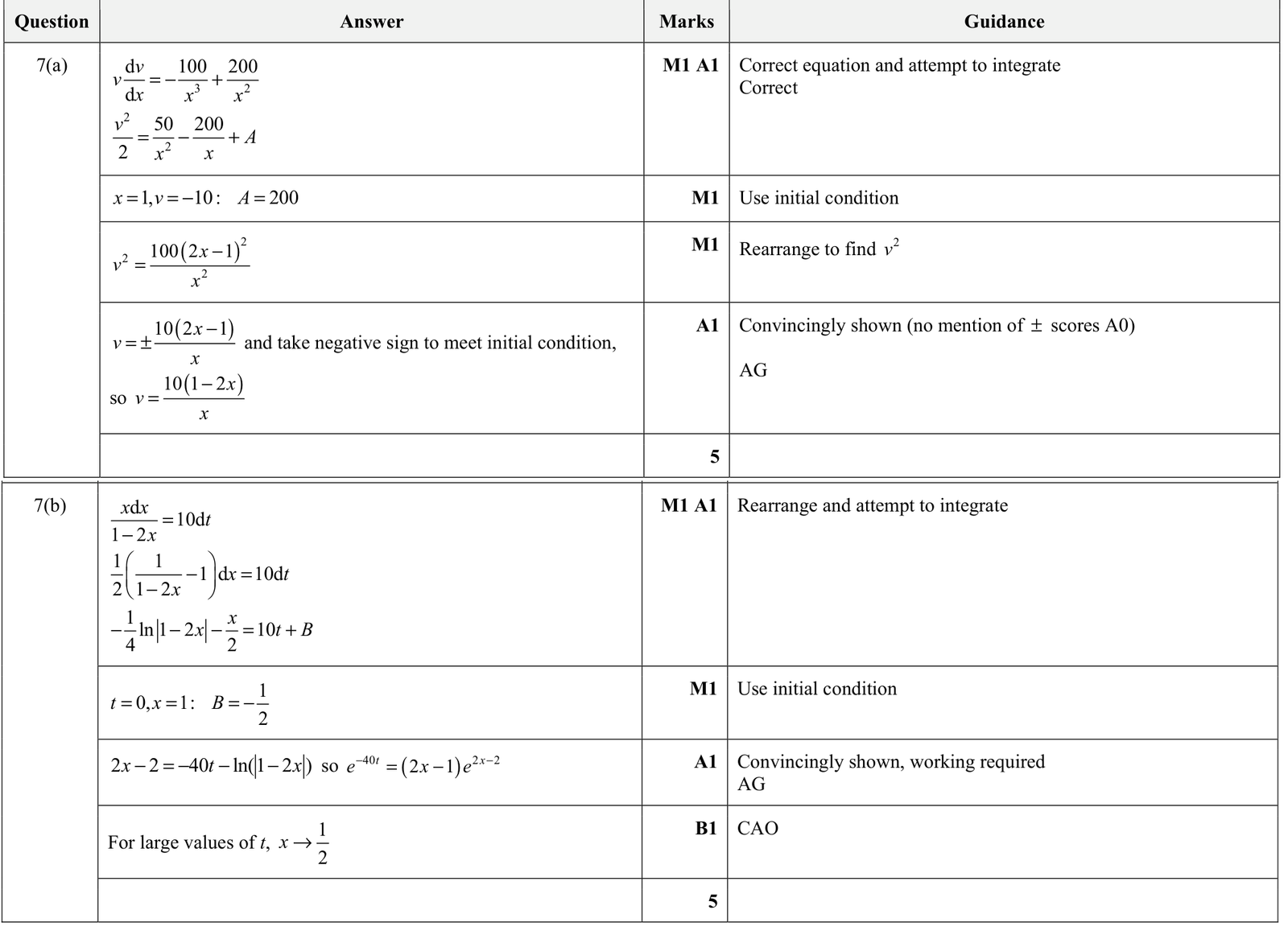
A particle \(P\) moving in a straight line has displacement \(x \mathrm{~m}\) from a fixed point \(O\) on the line at time \(t \mathrm{~s}\). The acceleration of \(P\), in \(\mathrm{ms}^{-2}\), is given by \(\frac{200}{x^{2}}-\frac{100}{x^{3}}\) for \(x\gt 0\). When \(t=0, x=1\) and \(P\) has velocity \(10 \mathrm{~ms}^{-1}\) directed towards \(O\).
(a) Show that the velocity \(v \mathrm{~m} \mathrm{~s}^{-1}\) of \(P\) is given by \(v=\frac{10(1-2 x)}{x}\).
(b) Show that \(x\) and \(t\) are related by the equation \(\mathrm{e}^{-40 t}=(2 x-1) \mathrm{e}^{2 x-2}\) and deduce what happens to \(x\) as \(t\) becomes large.
9231 P32 - Nov 2020 - Q7 - 11 marks
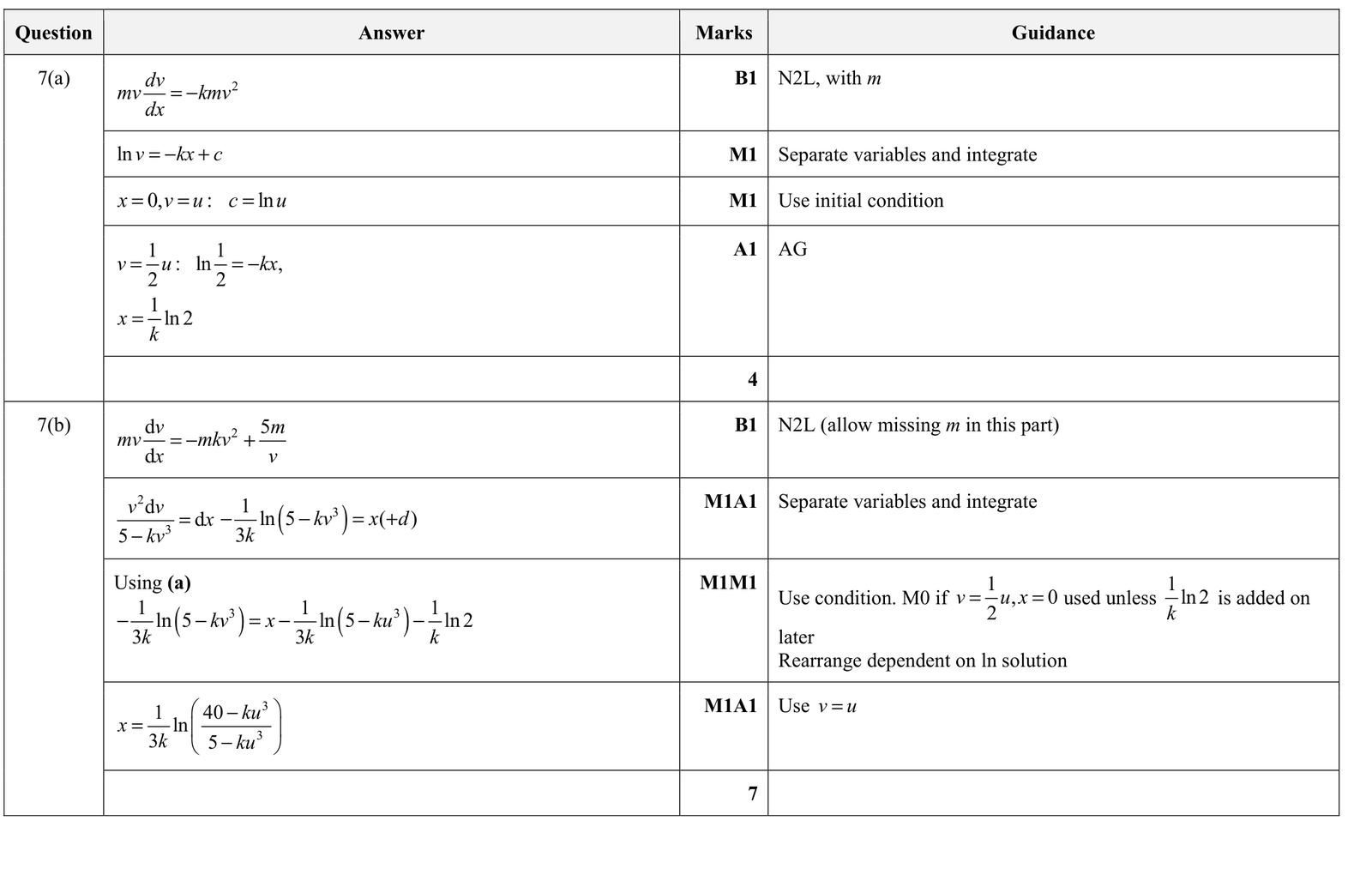
A particle \(P\) of mass \(m \mathrm{~kg}\) moves in a horizontal straight line against a resistive force of magnitude \(m k v^{2} \mathrm{~N}\), where \(v \mathrm{~ms}^{-1}\) is the speed of \(P\) after it has moved a distance \(x \mathrm{~m}\) and \(k\) is a positive constant. The initial speed of \(P\) is \(u \mathrm{~ms}^{-1}\).
(a) Show that \(x=\frac{1}{k} \ln 2\) when \(v=\frac{1}{2} u\).
Beginning at the instant when the speed of \(P\) is \(\frac{1}{2} u\), an additional force acts on \(P\). This force has magnitude \(\frac{5 m}{v} \mathrm{~N}\) and acts in the direction of increasing \(x\).
(b) Show that when the speed of \(P\) has increased again to \(u \mathrm{~ms}^{-1}\), the total distance travelled by \(P\) is given by an expression of the form
\(\frac{1}{3 k} \ln \left(\frac{A-k u^{3}}{B-k u^{3}}\right),\)
stating the values of the constants \(A\) and \(B\).
9231 P21 - Nov 2018 - Q2 - 9 marks
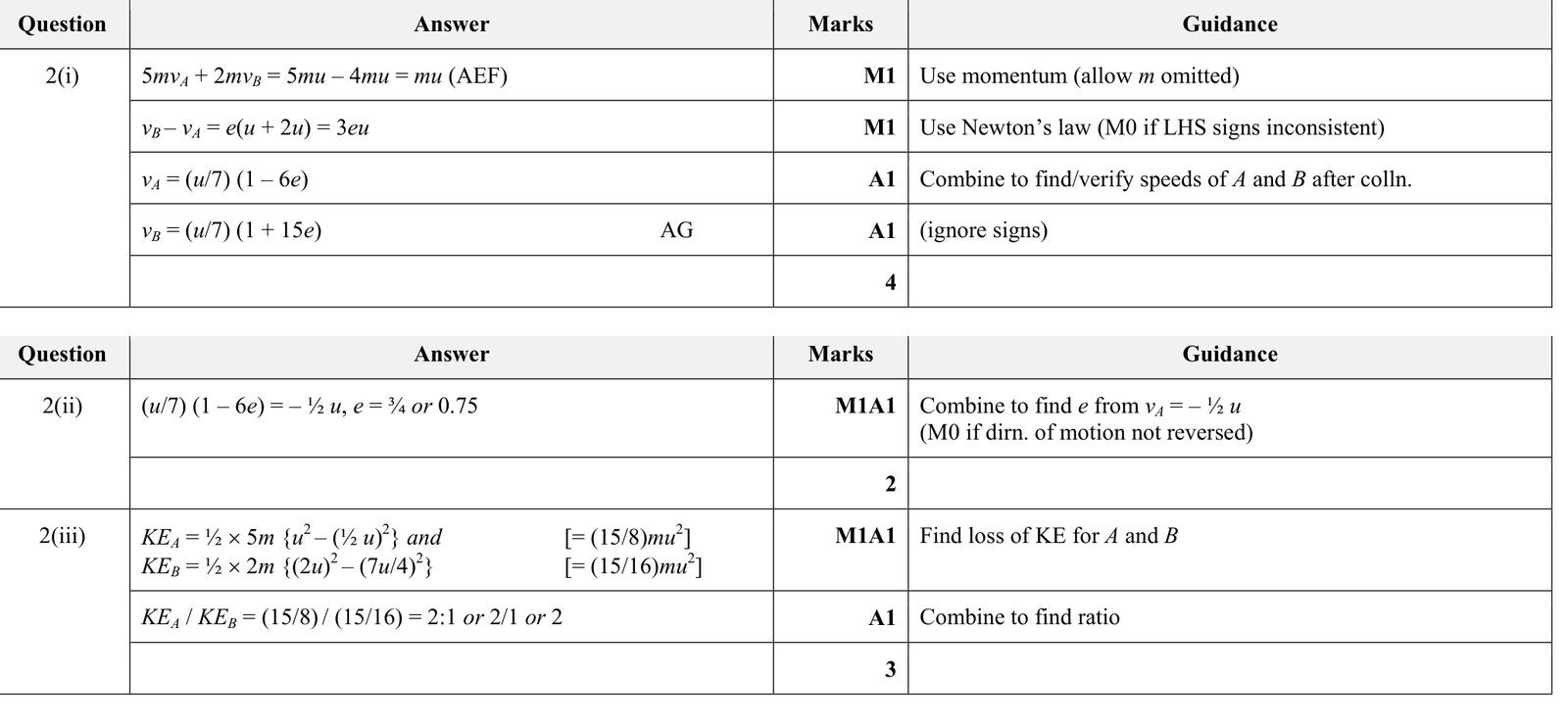
Two uniform small smooth spheres \(A\) and \(B\) have equal radii and masses \(5 m\) and \(2 m\) respectively. Sphere \(A\) is moving with speed \(u\) on a smooth horizontal surface when it collides directly with sphere \(B\) which is moving towards it with speed \(2 u\). The coefficient of restitution between the spheres is \(e\).
(i) Show that the speed of \(B\) after the collision is \(\frac{1}{7} u(1+15 e)\) and find an expression for the speed of \(A\).
In the collision, the speed of \(A\) is halved and its direction of motion is reversed.
(ii) Find the value of \(e\).
(iii) For this collision, find the ratio of the loss of kinetic energy of \(A\) to the loss of kinetic energy of \(B\).
9231 P21 - Nov 2019 - Q3 - 9 marks
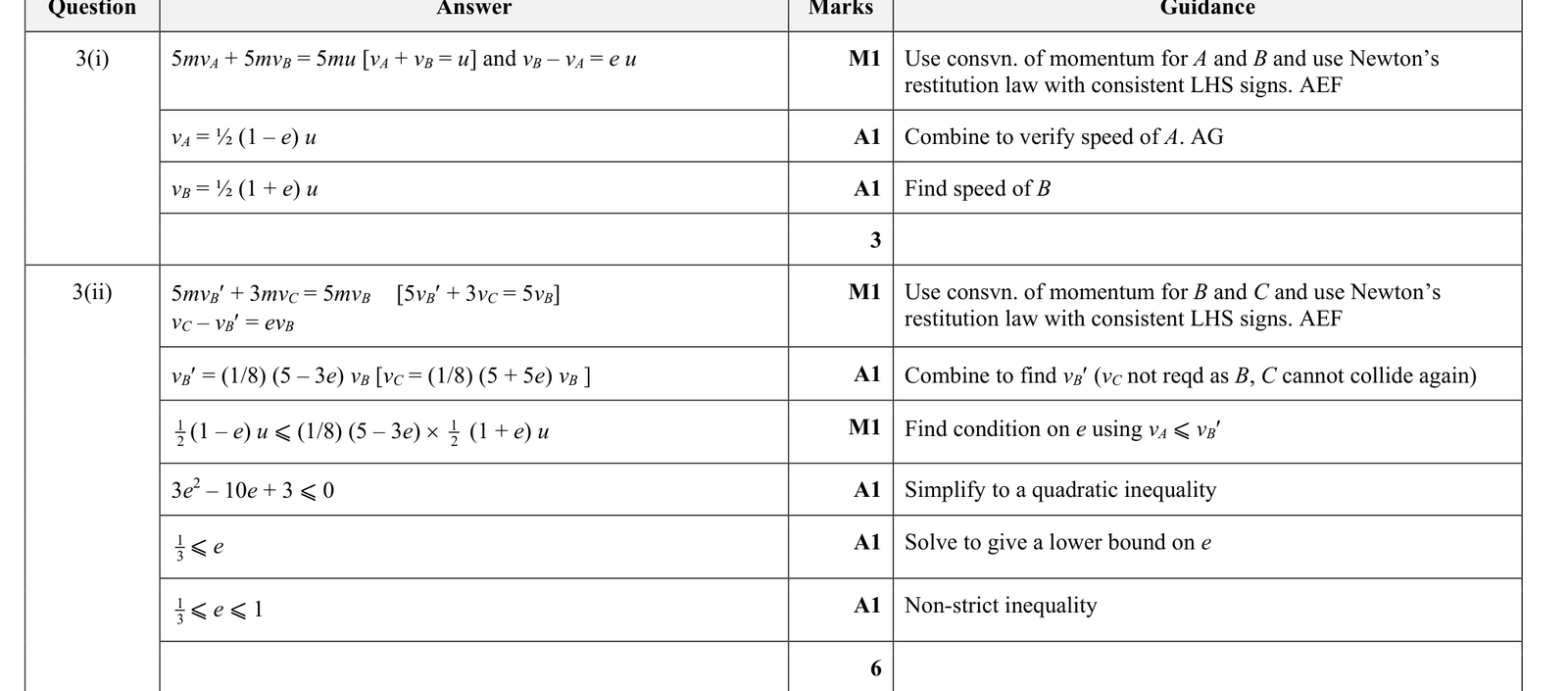
Three uniform small spheres \(A, B\) and \(C\) have equal radii and masses \(5 m, 5 m\) and \(3 m\) respectively. The spheres are at rest on a smooth horizontal surface, in a straight line, with \(B\) between \(A\) and \(C\). The coefficient of restitution between each pair of spheres is \(e\). Sphere \(A\) is projected directly towards \(B\) with speed \(u\).
(i) Show that the speed of \(A\) after its collision with \(B\) is \(\frac{1}{2} u(1-e)\) and find the speed of \(B\).
Sphere \(B\) now collides with sphere \(C\). Subsequently there are no further collisions between any of the spheres.
(ii) Find the set of possible values of \(e\).
9231 P23 - Jun 2019 - Q1 - 4 marks
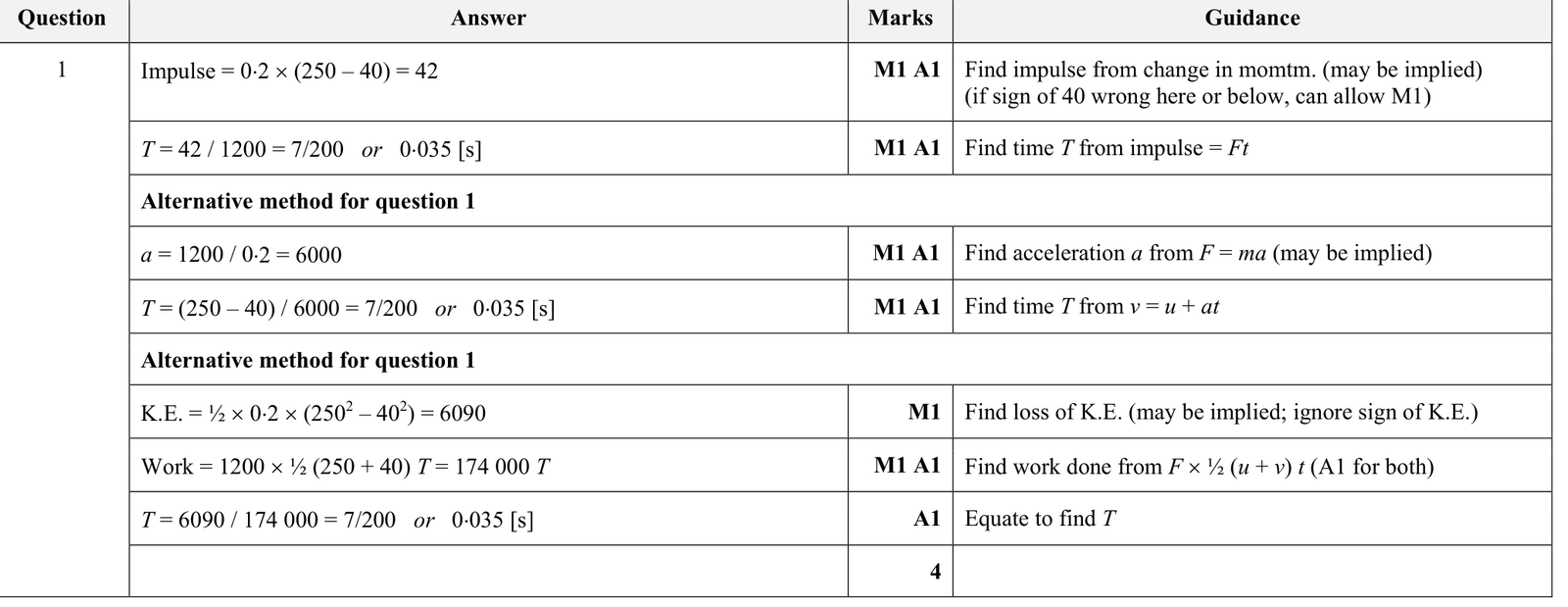
A bullet of mass 0.2 kg is fired into a fixed vertical barrier. It enters the barrier horizontally with speed \(250 \mathrm{~m} \mathrm{~s}^{-1}\) and emerges horizontally after a time \(T\) seconds with speed \(40 \mathrm{~m} \mathrm{~s}^{-1}\). There is a constant horizontal resisting force of magnitude 1200 N . Find \(T\).
9231 P23 - Jun 2019 - Q3 - 9 marks
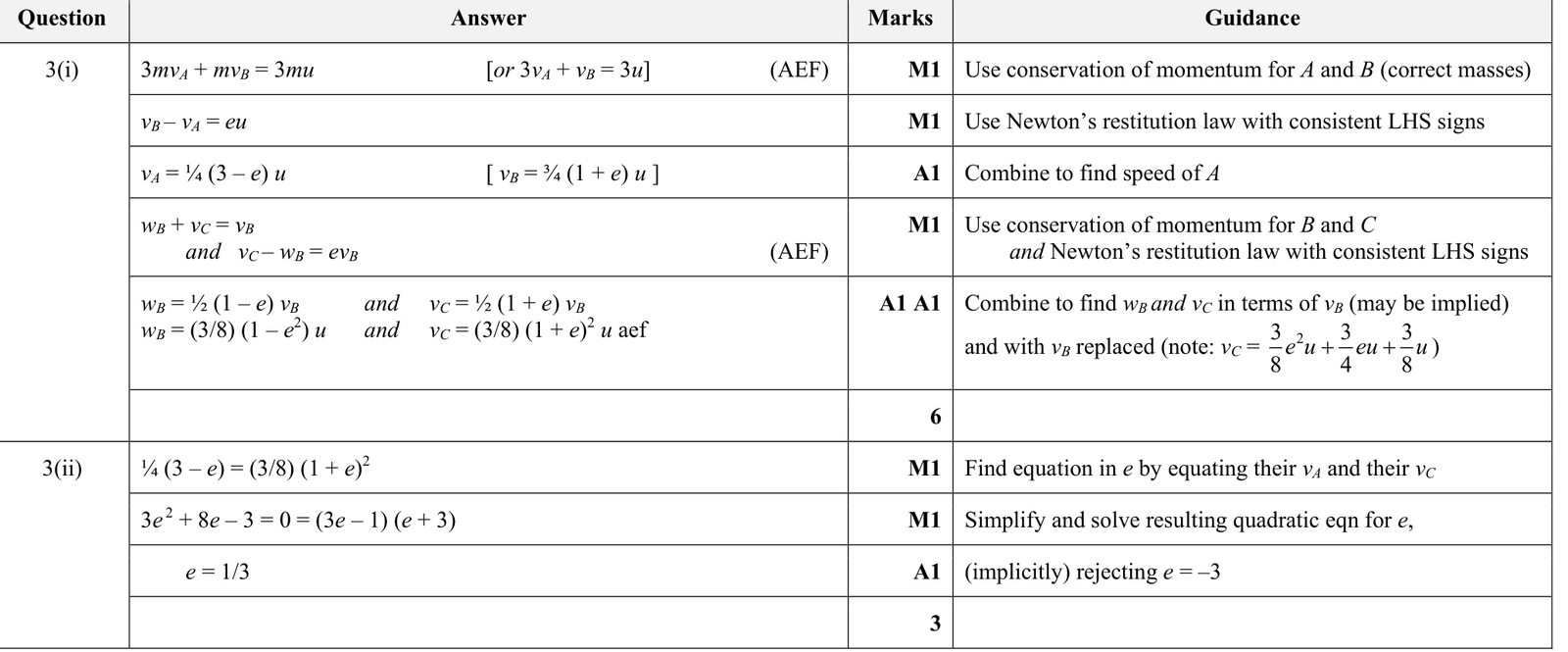
Three uniform small spheres \(A, B\) and \(C\) have equal radii and masses \(3 m, m\) and \(m\) respectively. The spheres are at rest in a straight line on a smooth horizontal surface, with \(B\) between \(A\) and \(C\). The coefficient of restitution between each pair of spheres is \(e\). Sphere \(A\) is projected directly towards \(B\) with speed \(u\).
(i) Find, in terms of \(u\) and \(e\), expressions for the speeds of \(A, B\) and \(C\) after the first two collisions.
(ii) Given that \(A\) and \(C\) are moving with equal speeds after these two collisions, find the value of \(e\).
9231 P21 - Jun 2019 - Q3 - 10 marks
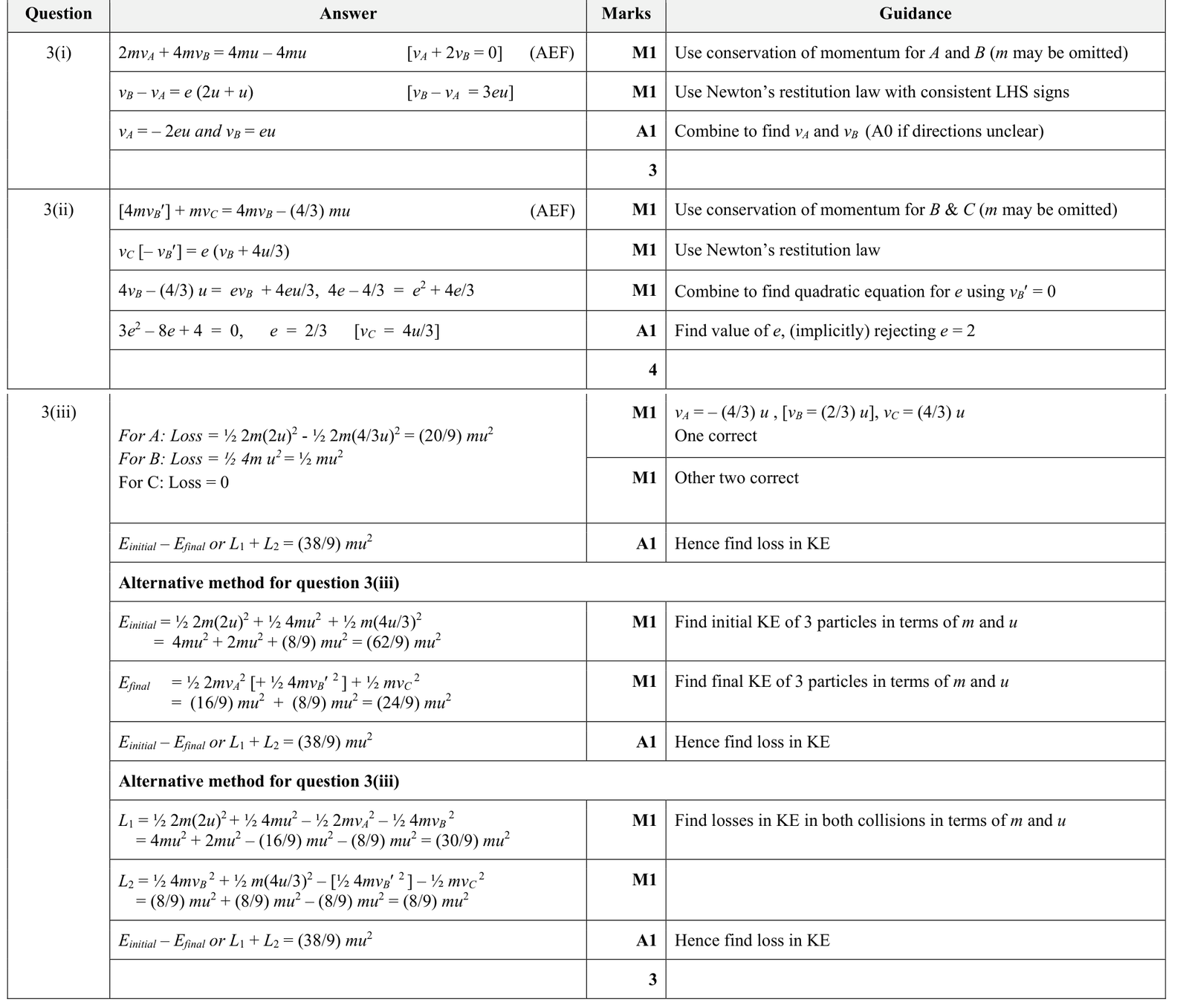
Three uniform small spheres \(A, B\) and \(C\) have equal radii and masses \(2 m, 4 m\) and \(m\) respectively. The spheres are moving in a straight line on a smooth horizontal surface, with \(B\) between \(A\) and \(C\). The coefficient of restitution between each pair of spheres is \(e\). Spheres \(A\) and \(B\) are moving towards each other with speeds \(2 u\) and \(u\) respectively. The first collision is between \(A\) and \(B\).
(i) Find the velocities of \(A\) and \(B\) after this collision.
Sphere \(C\) is moving towards \(B\) with speed \(\frac{4}{3} u\) and now collides with it. As a result of this collision, \(B\) is brought to rest.
(ii) Find the value of \(e\).
(iii) Find the total kinetic energy lost by the three spheres as a result of the two collisions.
9231 P22 - Nov 2018 - Q2 - 9 marks
Two uniform small smooth spheres \(A\) and \(B\) have equal radii and masses \(2 m\) and \(m\) respectively. Sphere \(A\) is moving with speed \(u\) on a smooth horizontal surface when it collides directly with sphere \(B\) which is at rest. The coefficient of restitution between the spheres is \(\frac{2}{3}\).
(i) Find, in terms of \(u\), the speeds of \(A\) and \(B\) after this collision.
Sphere \(B\) is initially at a distance \(d\) from a fixed smooth vertical wall which is perpendicular to the direction of motion of \(A\). The coefficient of restitution between \(B\) and the wall is \(\frac{1}{2}\).
(ii) Find, in terms of \(d\) and \(u\), the time that elapses between the first and second collisions between \(A\) and \(B\).

9231 P21 - Jun 2017 - Q1 - 3 marks
A bullet of mass 0.08 kg is fired horizontally into a fixed vertical barrier. It enters the barrier horizontally with speed \(300 \mathrm{~m} \mathrm{~s}^{-1}\) and emerges horizontally after 0.02 s . There is a constant horizontal resisting force of magnitude 1000 N . Find the speed with which the bullet emerges from the barrier.

9231 P21 - Jun 2017 - Q3 - 10 marks
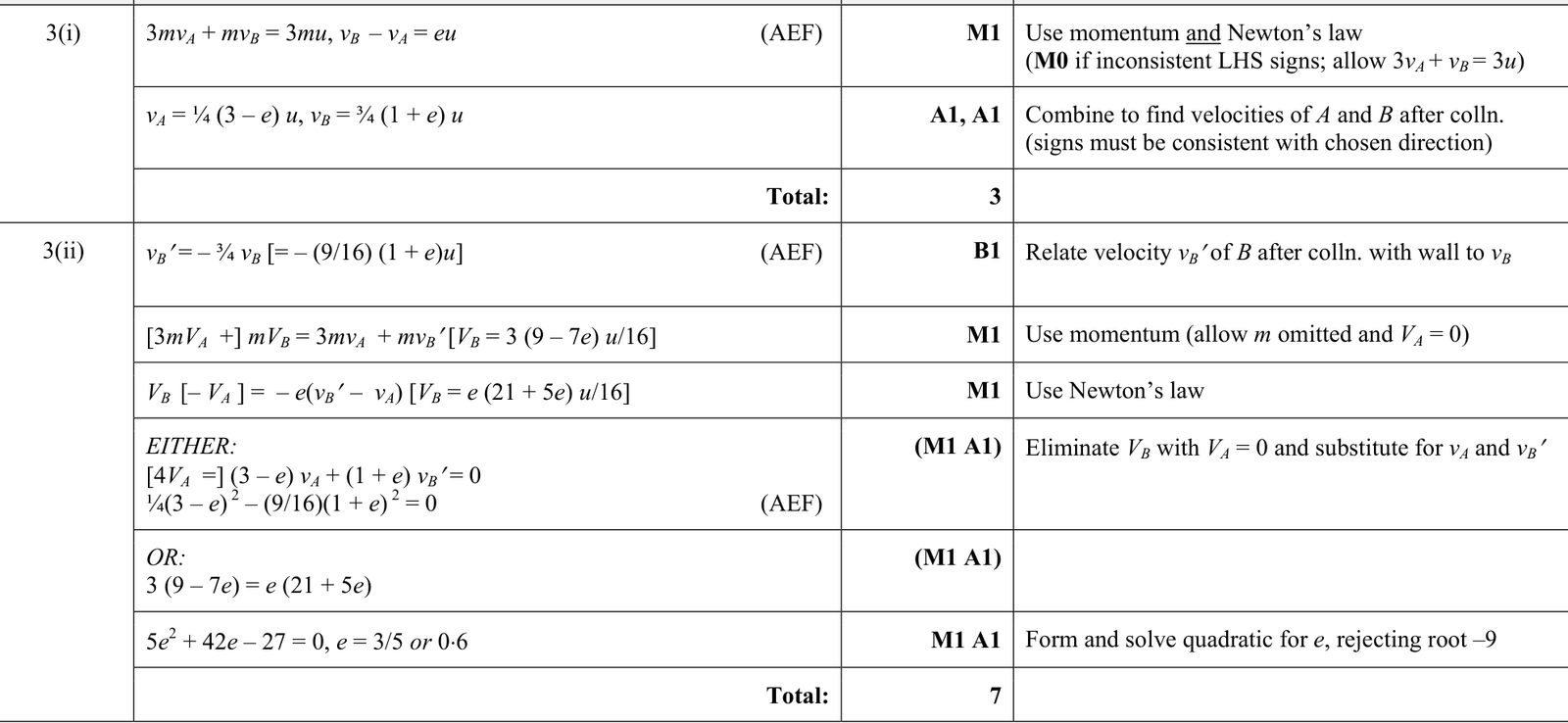
Two uniform small smooth spheres \(A\) and \(B\) have equal radii and masses \(3 m\) and \(m\) respectively. Sphere \(A\) is moving with speed \(u\) on a smooth horizontal surface when it collides directly with sphere \(B\) which is at rest. The coefficient of restitution between the spheres is \(e\).
(i) Find, in terms of \(u\) and \(e\), expressions for the velocities of \(A\) and \(B\) after the collision.
Sphere \(B\) continues to move until it strikes a fixed smooth vertical barrier which is perpendicular to the direction of motion of \(B\). The coefficient of restitution between \(B\) and the barrier is \(\frac{3}{4}\). When the spheres subsequently collide, \(A\) is brought to rest.
(ii) Find the value of \(e\).
9231 P23 - Jun 2017 - Q3 - 10 marks
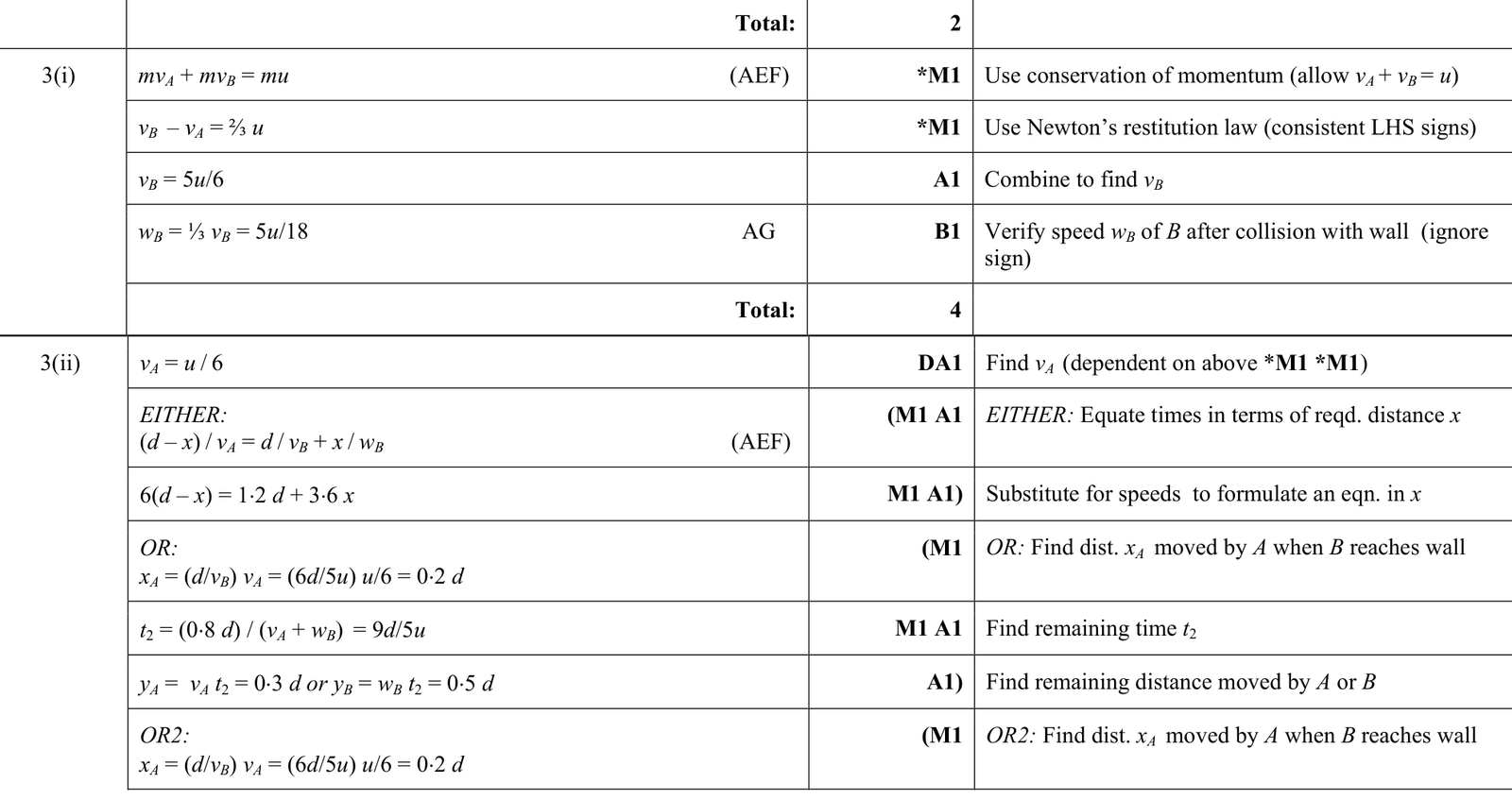
Two uniform small smooth spheres \(A\) and \(B\) have equal radii and each has mass \(m\). Sphere \(A\) is moving with speed \(u\) on a smooth horizontal surface when it collides directly with sphere \(B\) which is at rest. The coefficient of restitution between the spheres is \(\frac{2}{3}\). Sphere \(B\) is initially at a distance \(d\) from a fixed smooth vertical wall which is perpendicular to the direction of motion of \(A\). The coefficient of restitution between \(B\) and the wall is \(\frac{1}{3}\).
(i) Show that the speed of \(B\) after its collision with the wall is \(\frac{5}{18} u\).
(ii) Find the distance of \(B\) from the wall when it collides with \(A\) for the second time.
9231 P21 - Nov 2017 - Q3 - 10 marks
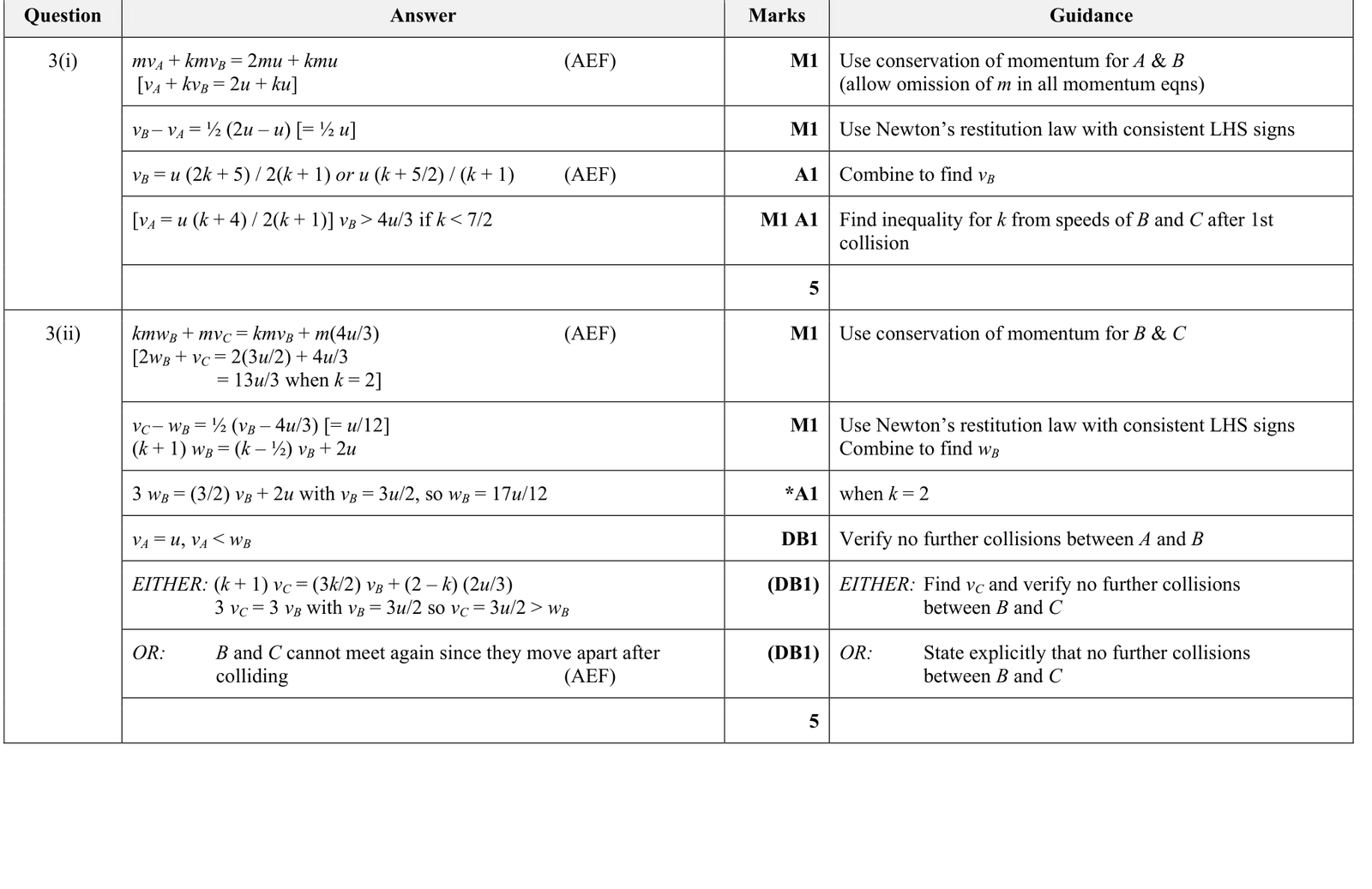
Three uniform small smooth spheres \(A, B\) and \(C\) have equal radii and masses \(m, k m\) and \(m\) respectively, where \(k\) is a constant. The spheres are moving in the same direction along a straight line on a smooth horizontal surface, with \(B\) between \(A\) and \(C\). The speeds of \(A, B\) and \(C\) are \(2 u, u\) and \(\frac{4}{3} u\) respectively. The coefficient of restitution between any pair of the spheres is \(\frac{1}{2}\). After sphere \(A\) has collided with sphere \(B\), sphere \(B\) collides with sphere \(C\).
(i) Find an inequality satisfied by \(k\).
(ii) Given that \(k=2\), show that after \(B\) has collided with \(C\) there are no further collisions between any of the three spheres.
9231 P21 - Jun 2018 - Q1 - 3 marks
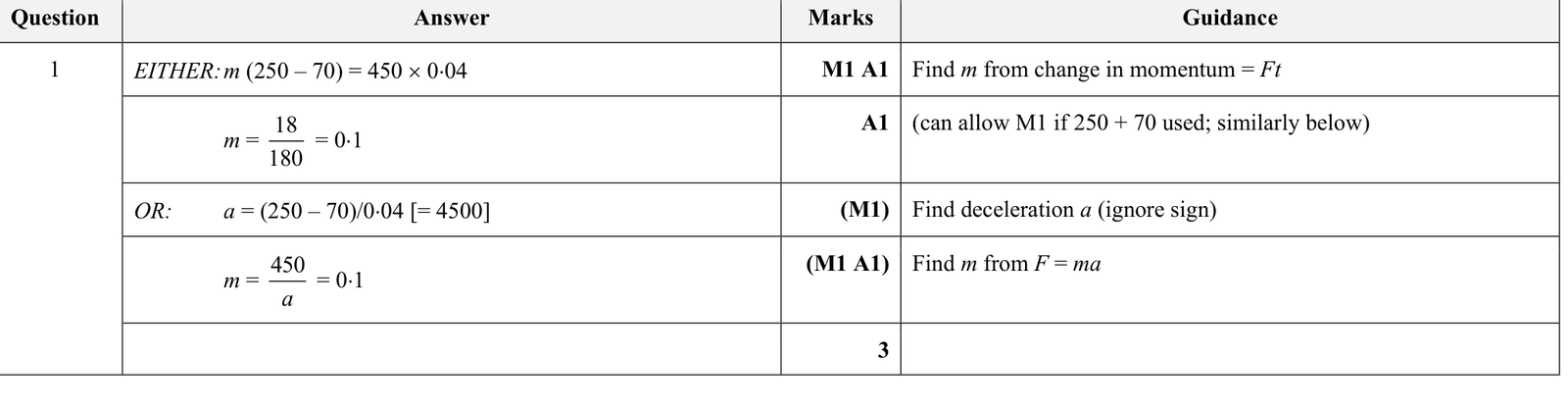
A bullet of mass \(m \mathrm{~kg}\) is fired horizontally into a fixed vertical block of material. It enters the block horizontally with speed \(250 \mathrm{~m} \mathrm{~s}^{-1}\) and emerges horizontally with speed \(70 \mathrm{~m} \mathrm{~s}^{-1}\) after 0.04 s . The block offers a constant horizontal resisting force of magnitude 450 N . Find the value of \(m\).
9231 P21 - Jun 2018 - Q3 - 9 marks
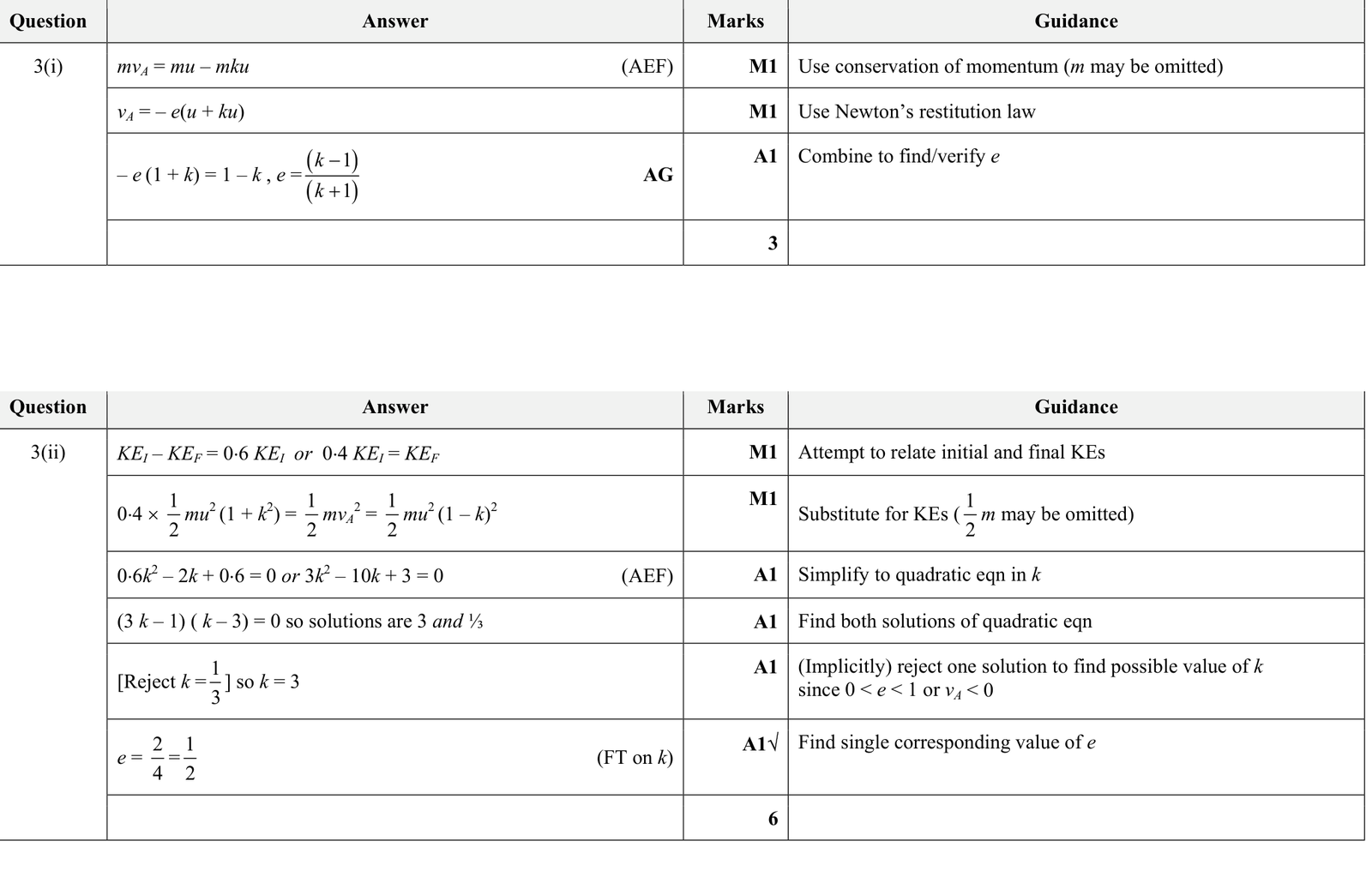
Two identical uniform small spheres \(A\) and \(B\), each of mass \(m\), are moving towards each other in a straight line on a smooth horizontal surface. Their speeds are \(u\) and \(k u\) respectively, and they collide directly. The coefficient of restitution between the spheres is \(e\). Sphere \(B\) is brought to rest by the collision.
(i) Show that \(e=\frac{k-1}{k+1}\).
(ii) Given that \(60 \%\) of the total initial kinetic energy is lost in the collision, find the values of \(k\) and \(e\).
9231 P23 - Jun 2018 - Q2 - 9 marks
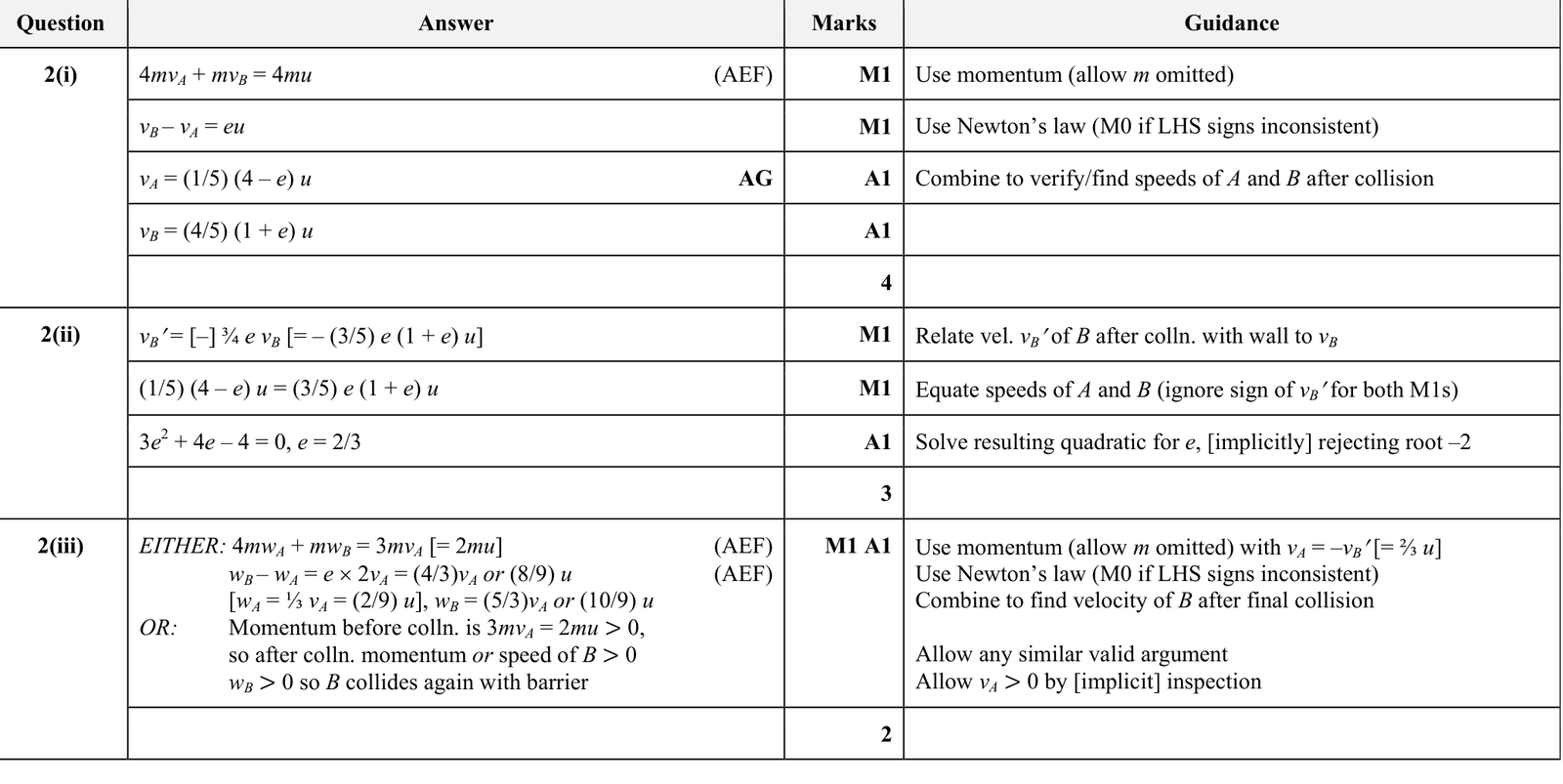
Two uniform small spheres \(A\) and \(B\) have equal radii and masses \(4 m\) and \(m\) respectively. Sphere \(A\) is moving with speed \(u\) on a smooth horizontal surface when it collides directly with sphere \(B\) which is at rest. The coefficient of restitution between the spheres is \(e\).
(i) Show that after the collision \(A\) moves with speed \(\frac{1}{5} u(4-e)\) and find the speed of \(B\).
Sphere \(B\) continues to move until it collides with a fixed smooth vertical barrier which is perpendicular to the direction of motion of \(B\). The coefficient of restitution between \(B\) and the barrier is \(\frac{3}{4} e\). After this collision, the speeds of \(A\) and \(B\) are equal.
(ii) Find the value of \(e\).
The spheres \(A\) and \(B\) now collide directly again.
(iii) Determine whether sphere \(B\) collides with the barrier for a second time.
9231 P31 - Nov 2025 - Q1 - 4 marks
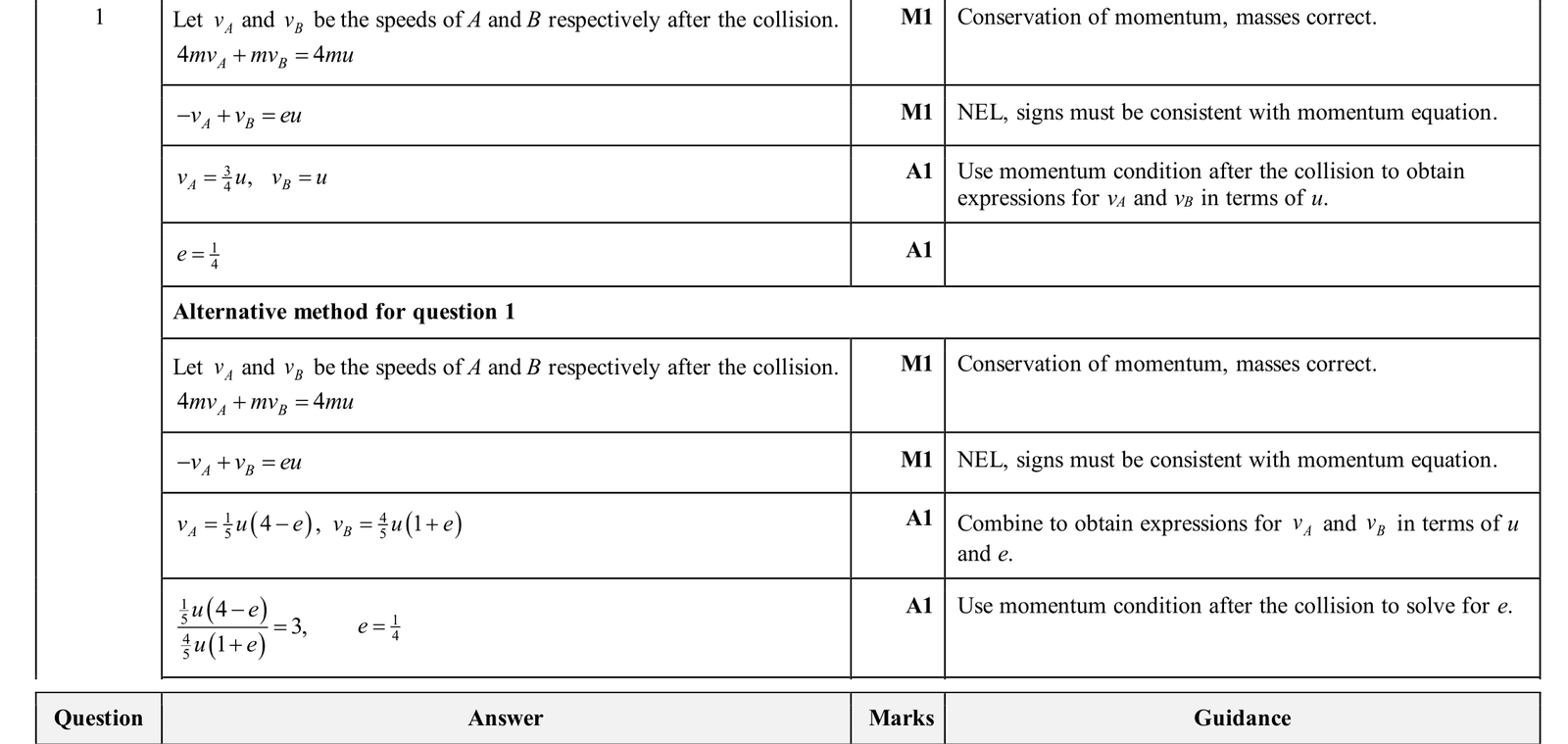
Two uniform smooth spheres \(A\) and \(B\) of equal radii have masses \(4 m\) and \(m\) respectively. Sphere \(B\) is at rest on a smooth horizontal surface. Sphere \(A\) is moving on the surface with speed \(u\) and collides directly with sphere \(B\). After the collision, the momentum of \(A\) is three times the momentum of \(B\).
Find the value of the coefficient of restitution \(e\).
9231 P32 - Nov 2025 - Q5 - 9 marks
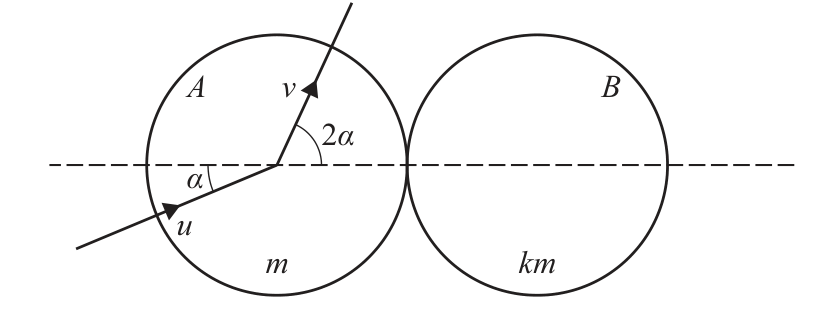
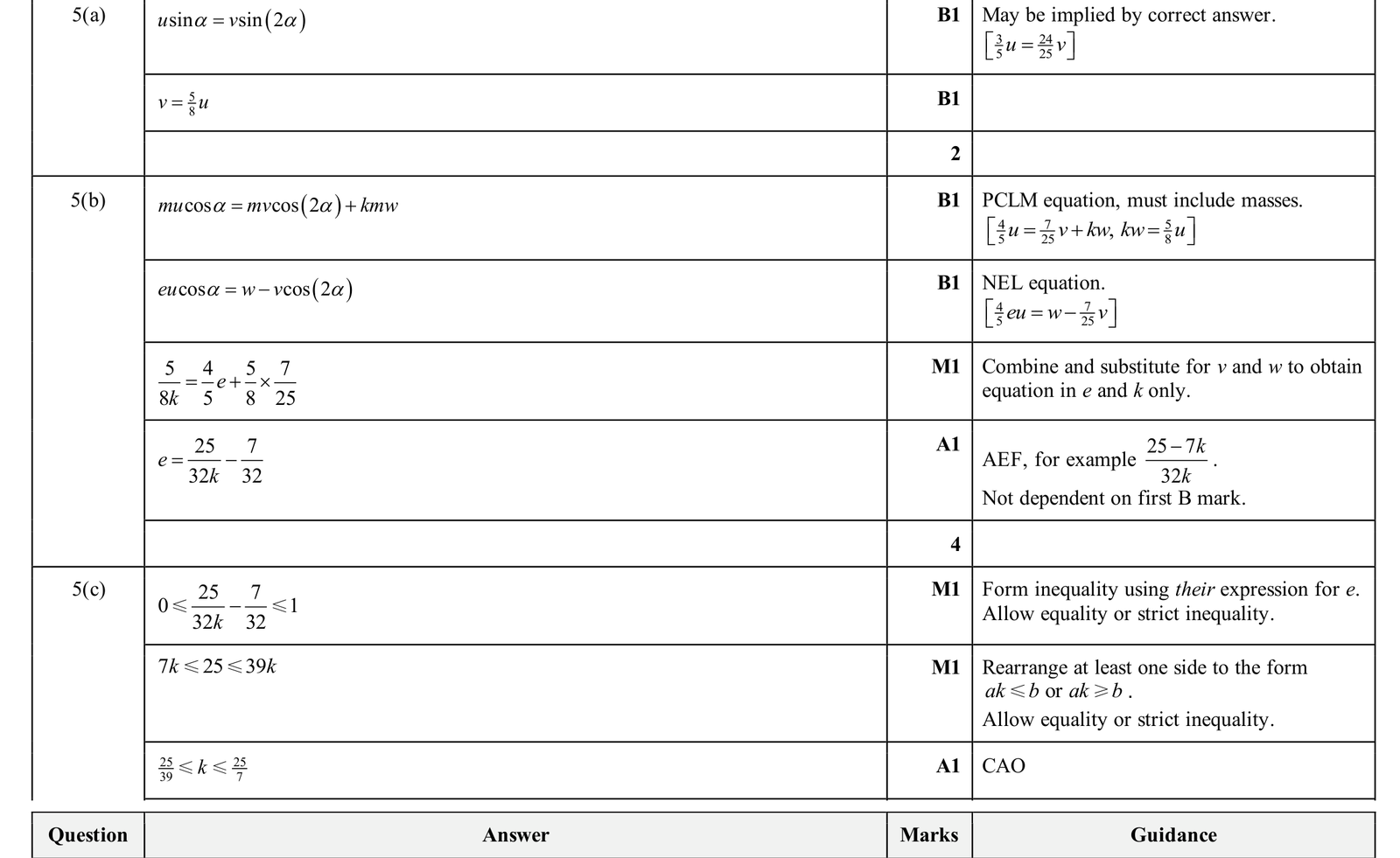
Two uniform smooth spheres, \(A\) and \(B\), of equal radii are on a horizontal surface. They have masses of \(m\) and \(k m\) respectively. Sphere \(A\) is moving with speed \(u\) at an angle \(\alpha\) with the line of centres when it collides with sphere \(B\) which is stationary. Immediately after the collision, sphere \(A\) moves with speed \(v\) at an angle \(2 \alpha\) with the line of centres (see diagram).
It is given that \(\tan \alpha=\frac{3}{4}\). (a) Find \(v\) in terms of \(u\).
(b) Find the coefficient of restitution between the spheres in terms of \(k\).
(c) Find the range of possible values of \(k\).
9231 P34 - Nov 2025 - Q7 - 8 marks
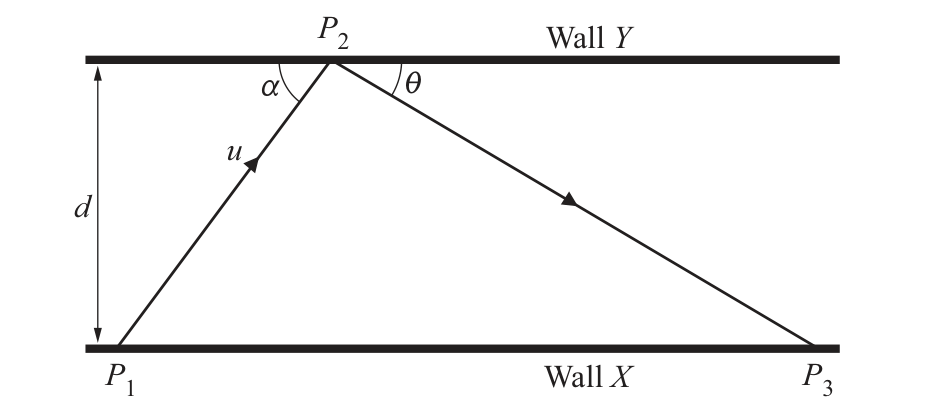
\(X\) and \(Y\) are two fixed smooth vertical walls on a smooth horizontal surface. The walls are parallel and at a distance \(d\) apart. The points \(P_{1}, P_{2}\) and \(P_{3}\) all lie on the surface.
A particle \(Q\) is projected horizontally from the point \(P_{1}\) on Wall \(X\) with speed \(u\), and moves along the surface. The particle \(Q\) strikes Wall \(Y\) at the point \(P_{2}\). Immediately before the collision, the direction of motion of \(Q\) makes an angle \(\alpha\) with Wall \(Y\), where \(\sin \alpha=\frac{4}{5}\). Immediately after the collision, the direction of motion of \(Q\) makes an angle \(\theta\) with Wall \(Y\). The particle \(Q\) then strikes Wall \(X\) at the point \(P_{3}\) (see diagram).
The time that it takes \(Q\) to travel the distance \(P_{1} P_{2}\) is \(T\). The time that it takes \(Q\) to travel the distance \(P_{2} P_{3}\) is \(k T\).
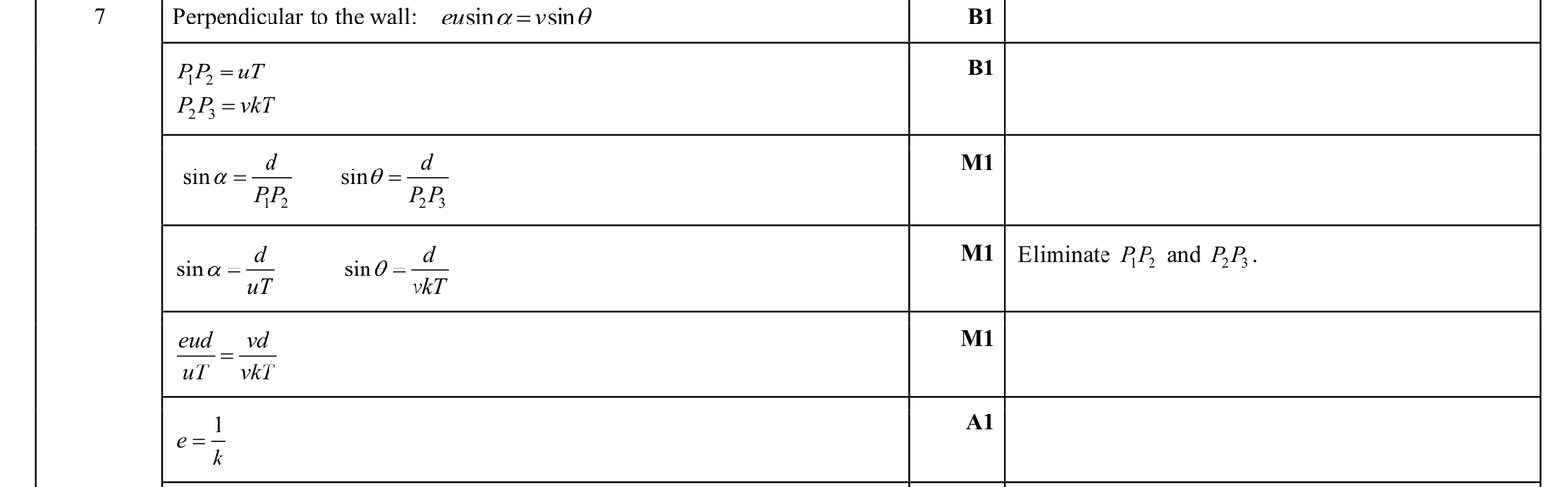
Find, in terms of \(k\), the coefficient of restitution between \(Q\) and wall \(Y\).
9231 P31 - Jun 2025 - Q6 - 9 marks
Two uniform smooth spheres \(A\) and \(B\), with equal radii and masses \(2m\) and \(m\), collide directly. Initially \(A\) moves with speed \(u\), and \(B\) is stationary. After the collision, both move in the same direction with speeds \(v_A\) and \(v_B\). The kinetic energy of \(B\) is \(\frac92\) times the kinetic energy of \(A\).
(a) Show that \(v_B=\frac65u\).
Sphere \(B\) then collides with a fixed vertical barrier. Immediately before the collision, its direction makes angle \(\alpha\) with the barrier; immediately after, its direction makes angle \(\beta\) with the barrier. The coefficient of restitution is \(\frac45\), and its speed is reduced to \(\frac{12\sqrt5}{25}u\).
(b) Find \(\sin(\alpha+\beta)\).
