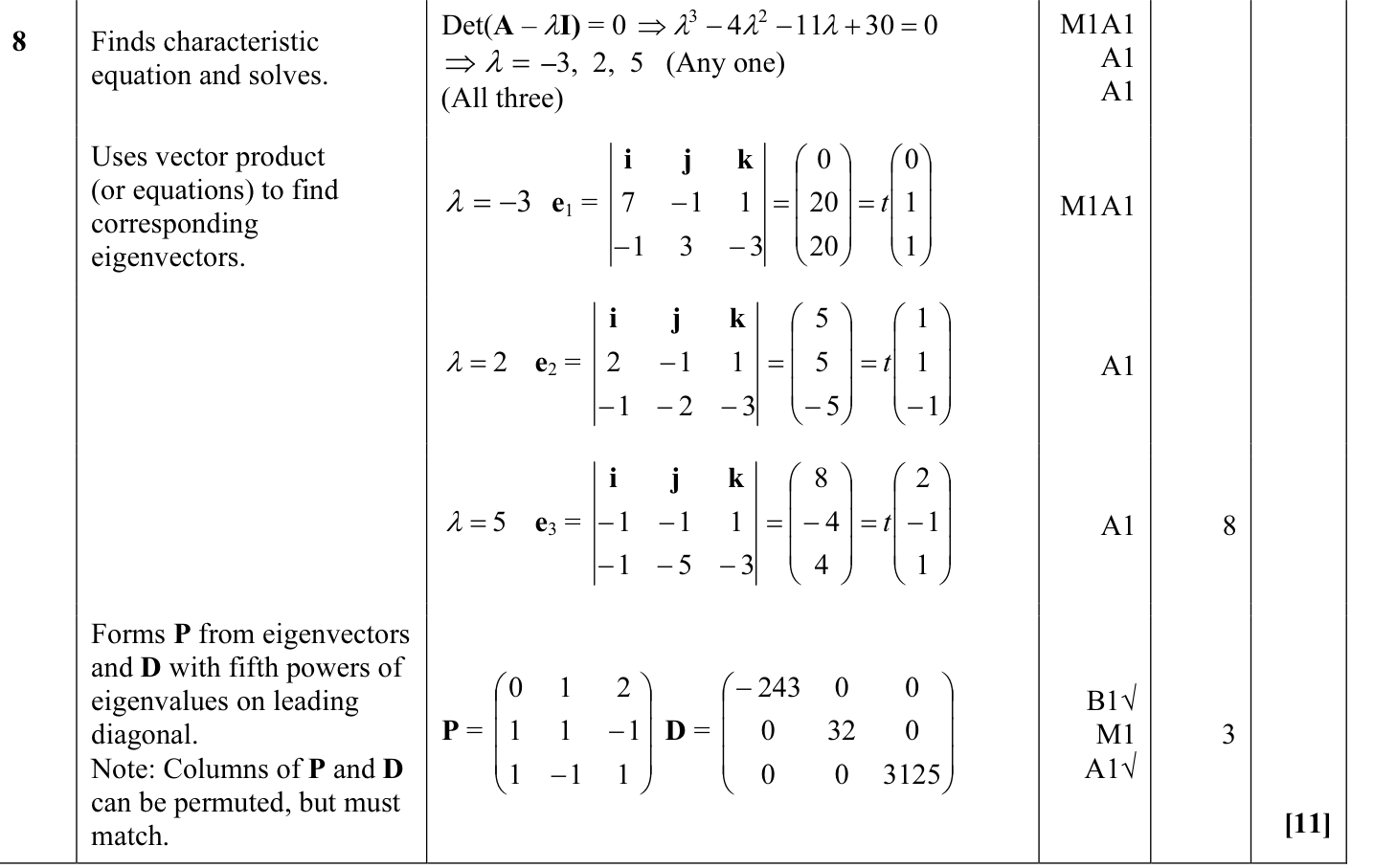
Answer: The eigenvalues are \(-3, 2, 5\).
Corresponding eigenvectors may be taken as
- for \(\lambda=-3\): \(\begin{pmatrix}0\\1\\1\end{pmatrix}\)
- for \(\lambda=2\): \(\begin{pmatrix}1\\1\\-1\end{pmatrix}\)
- for \(\lambda=5\): \(\begin{pmatrix}2\\-1\\1\end{pmatrix}\)
One suitable choice is
\(\mathbf{P}=\begin{pmatrix}0&1&2\\1&1&-1\\1&-1&1\end{pmatrix}\), \(\mathbf{D}=\begin{pmatrix}-243&0&0\\0&32&0\\0&0&3125\end{pmatrix}\).
Hence \(\mathbf{A}^5=\mathbf{P D P}^{-1}\).
Let \(\lambda\) be an eigenvalue of \(\mathbf{A}\). We solve \(\det(\mathbf{A}-\lambda \mathbf{I})=0\):
\(\det\begin{pmatrix}4-\lambda&-1&1\\-1&-\lambda&-3\\1&-3&-\lambda\end{pmatrix}=0\).
Expanding gives
\(\lambda^3-4\lambda^2-11\lambda+30=0\).
Factoring,
\(\lambda^3-4\lambda^2-11\lambda+30=(\lambda+3)(\lambda-2)(\lambda-5)\).
So the eigenvalues are \(\lambda=-3,2,5\).
Now find an eigenvector for each eigenvalue.
For \(\lambda=-3\), solve \((\mathbf{A}+3\mathbf{I})\mathbf{x}=0\):
\(\begin{pmatrix}7&-1&1\\-1&3&-3\\1&-3&3\end{pmatrix}\begin{pmatrix}x\\y\\z\end{pmatrix}=\begin{pmatrix}0\\0\\0\end{pmatrix}\).
From the first two rows, one convenient solution is \(x=0, y=1, z=1\), so an eigenvector is
\(\begin{pmatrix}0\\1\\1\end{pmatrix}\).
For \(\lambda=2\), solve \((\mathbf{A}-2\mathbf{I})\mathbf{x}=0\):
\(\begin{pmatrix}2&-1&1\\-1&-2&-3\\1&-3&-2\end{pmatrix}\begin{pmatrix}x\\y\\z\end{pmatrix}=\begin{pmatrix}0\\0\\0\end{pmatrix}\).
A convenient solution is \(x=1, y=1, z=-1\), so an eigenvector is
\(\begin{pmatrix}1\\1\\-1\end{pmatrix}\).
For \(\lambda=5\), solve \((\mathbf{A}-5\mathbf{I})\mathbf{x}=0\):
\(\begin{pmatrix}-1&-1&1\\-1&-5&-3\\1&-3&-5\end{pmatrix}\begin{pmatrix}x\\y\\z\end{pmatrix}=\begin{pmatrix}0\\0\\0\end{pmatrix}\).
A convenient solution is \(x=2, y=-1, z=1\), so an eigenvector is
\(\begin{pmatrix}2\\-1\\1\end{pmatrix}\).
Form the matrix \(\mathbf{P}\) using these eigenvectors as columns, and the diagonal matrix \(\mathbf{D}\) using the corresponding fifth powers of the eigenvalues:
\(\mathbf{P}=\begin{pmatrix}0&1&2\\1&1&-1\\1&-1&1\end{pmatrix},\qquad \mathbf{D}=\begin{pmatrix}(-3)^5&0&0\\0&2^5&0\\0&0&5^5\end{pmatrix}=\begin{pmatrix}-243&0&0\\0&32&0\\0&0&3125\end{pmatrix}.\)
Since the columns of \(\mathbf{P}\) are eigenvectors of \(\mathbf{A}\), we have \(\mathbf{A}=\mathbf{P}\\,\operatorname{diag}(-3,2,5)\\,\mathbf{P}^{-1}\). Therefore
\(\mathbf{A}^5=\mathbf{P}\\,\operatorname{diag}((-3)^5,2^5,5^5)\\,\mathbf{P}^{-1}=\mathbf{P D P}^{-1}.\)