Past Exam Questions
← Back9231 P33 - Jun 2025 - Q6 - 8 marks
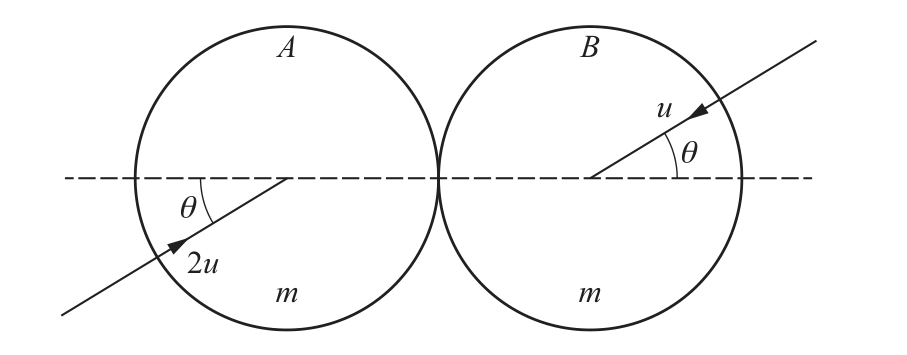
Two identical smooth spheres \(A\) and \(B\), each of mass \(m\), move on a horizontal surface with speeds \(2u\) and \(u\) respectively when they collide. Immediately before collision, their directions of motion are parallel and opposite, and each makes angle \(\theta\) with the line of centres. After collision, \(B\) moves perpendicular to its initial direction. The coefficient of restitution is \(e\).
(a) Find \(\tan\theta\) in terms of \(e\).
(b) Given that after the collision \(A\) moves perpendicular to the line of centres, find \(\theta\).

9231 P34 - Jun 2025 - Q6 - 9 marks
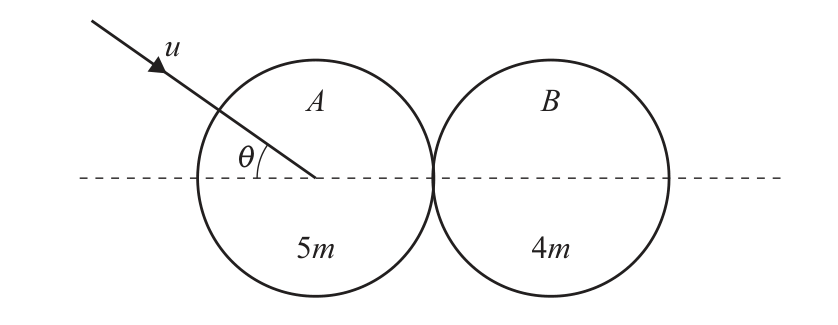
Two uniform smooth spheres \(A\) and \(B\) of equal radii have masses \(5m\) and \(4m\), respectively. Sphere \(A\) is moving with speed \(u\) on a horizontal surface when it collides with sphere \(B\), which is at rest. Immediately before the collision, \(A\)'s direction of motion makes an angle \(\theta\) with the line of centres. The coefficient of restitution between the spheres is \(e\).
(a) Show that the speed of \(B\) after the collision is \(\dfrac{5u(1+e)\cos\theta}{9}\).
After the collision the kinetic energy of \(A\) is equal to the kinetic energy of \(B\).
(b) Given that \(\tan\theta=\dfrac{2}{3}\), find the value of \(e\).

9231 P31 - Nov 2024 - Q7 - 10 marks
A particle \(P\) is projected with speed \(u\) at an angle \(\tan^{-1}\left(\dfrac43\right)\) above the horizontal from a point \(O\) on a horizontal plane and moves freely under gravity.
When \(P\) is moving horizontally, it strikes a smooth inclined plane at point \(A\). The plane is inclined to the horizontal at an angle \(\alpha\), and the line of greatest slope through \(A\) lies in the vertical plane through \(O\) and \(A\).
As a result of the impact, \(P\) moves vertically upwards. The coefficient of restitution between \(P\) and the inclined plane is \(e\).
(a) Show that \(e\tan^2\alpha=1\).
In its subsequent motion, the greatest height reached by \(P\) above \(A\) is \(\dfrac3{16}\) of the vertical height of \(A\) above the horizontal plane.
(b) Find \(e\).

9231 P32 - Nov 2024 - Q3 - 7 marks
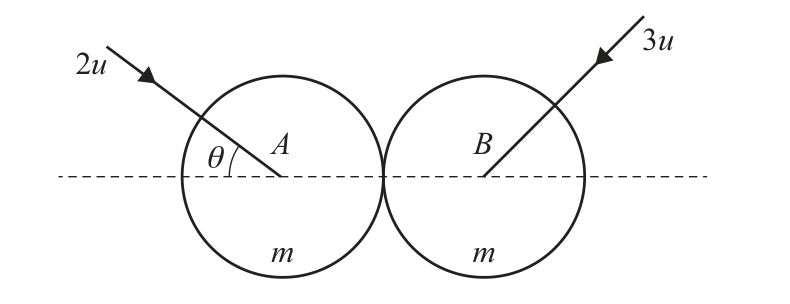
Two identical smooth uniform spheres \(A\) and \(B\), of equal radii and each of mass \(m\), move on a smooth horizontal surface and collide. Immediately before collision, their speeds are \(2u\) and \(3u\) respectively.
Sphere \(A\)'s direction of motion makes an angle \(\theta\) with the line of centres, and sphere \(B\)'s direction of motion is perpendicular to that of \(A\). After the collision, \(B\) moves perpendicular to the line of centres. The coefficient of restitution between the spheres is \(\dfrac13\).
(a) Find \(\tan\theta\).
(b) Find the total loss of kinetic energy as a result of the collision.
(c) Find, in degrees, the angle through which the direction of motion of \(A\) is deflected.

9231 P31 - Jun 2024 - Q1 - 6 marks
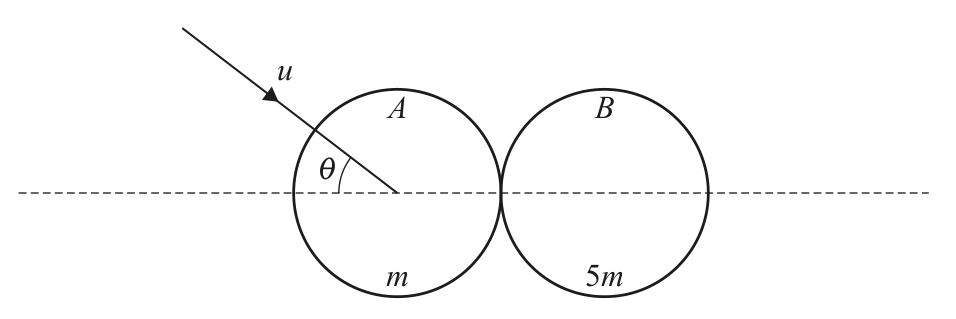
Two smooth uniform spheres \(A\) and \(B\), of equal radii, have masses \(m\) and \(5m\) respectively. Sphere \(A\) moves on a smooth horizontal surface with speed \(u\) and collides with sphere \(B\), which is initially at rest.
Immediately before impact, the direction of motion of \(A\) makes an angle \(\theta\) with the line of centres. After the collision, the kinetic energies of \(A\) and \(B\) are equal. The coefficient of restitution between the spheres is \(\dfrac12\).
Find \(\tan\theta\).

9231 P33 - Jun 2024 - Q1 - 4 marks
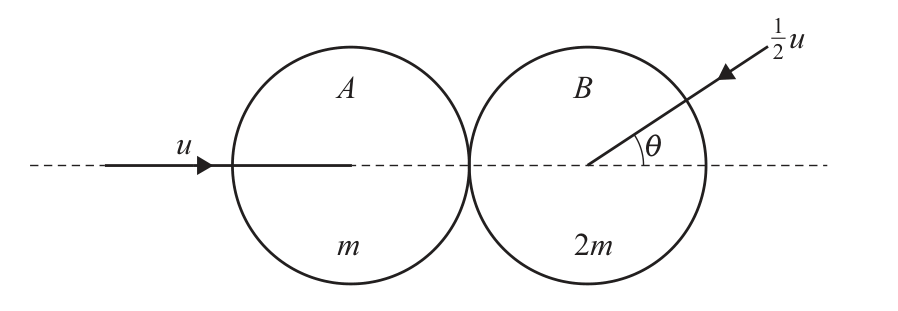
Two smooth uniform spheres \(A\) and \(B\), of equal radii, have masses \(m\) and \(2m\) respectively. They collide on a smooth horizontal surface.
Before impact, sphere \(A\) has speed \(u\) along the line of centres, and sphere \(B\) has speed \(\dfrac12u\) with its direction making an angle \(\theta\) with the line of centres.
After the collision, the direction of motion of \(A\) is reversed and its speed is reduced to \(\dfrac14u\). The direction of motion of \(B\) again makes an angle \(\theta\) with the line of centres, but on the opposite side of the line of centres. The speed of \(B\) is unchanged.
Find the coefficient of restitution between the spheres.

9231 P31 - Nov 2023 - Q1 - 7 marks
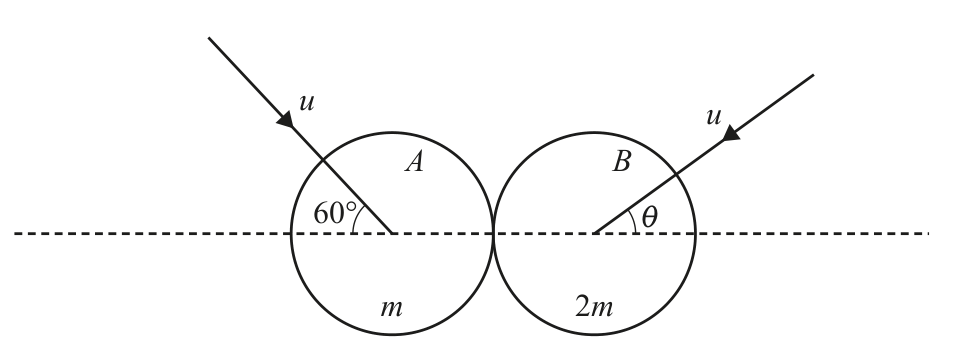
Two uniform smooth spheres \(A\) and \(B\), of equal radii, have masses \(m\) and \(2m\) respectively. The two spheres are moving with equal speeds \(u\) on a smooth horizontal surface when they collide.
Immediately before the collision, \(A\)'s direction of motion makes an angle of \(60^\circ\) with the line of centres, and \(B\)'s direction of motion makes an angle \(\theta\) with the line of centres. The coefficient of restitution between the spheres is \(e\).
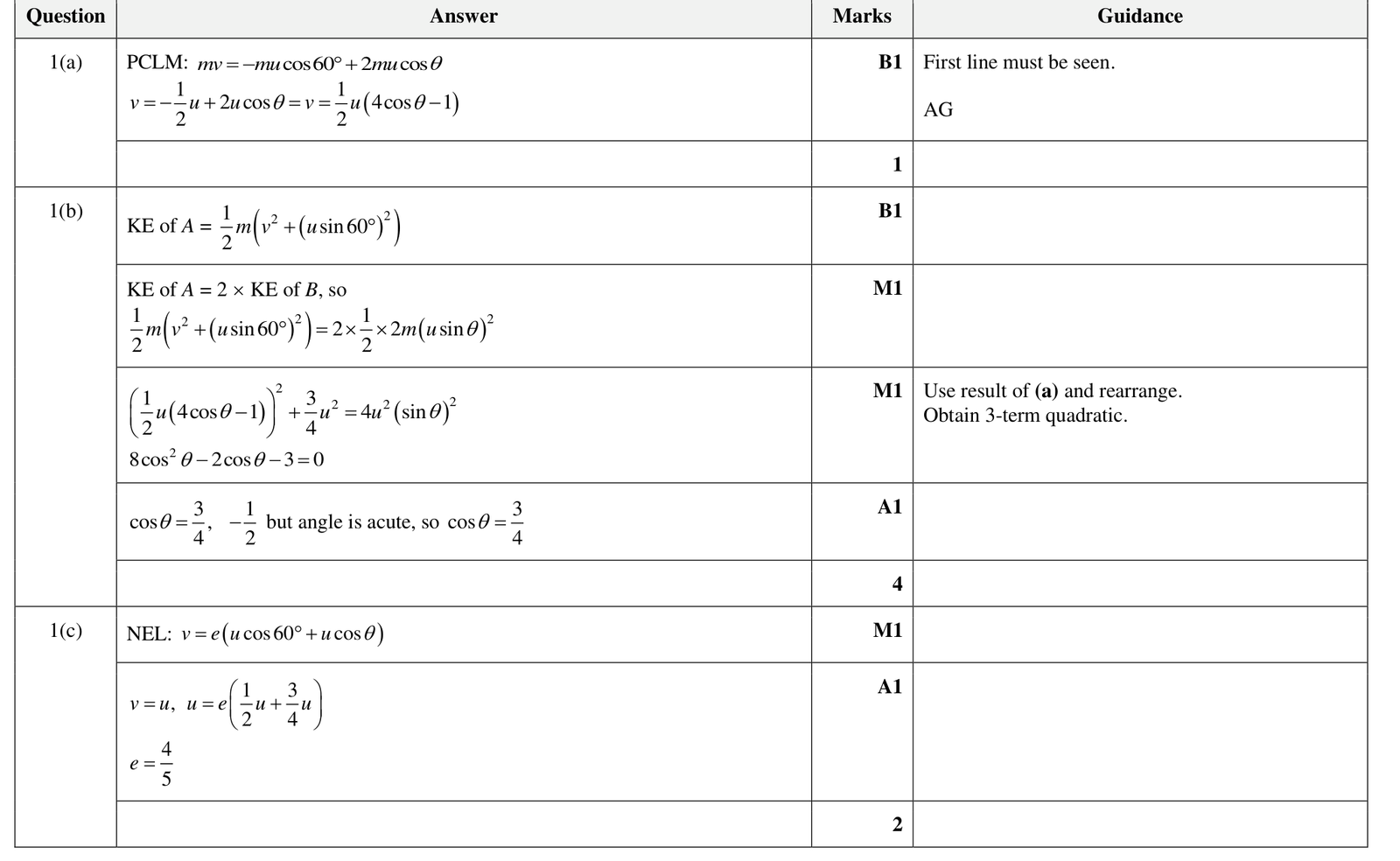
After the collision, the component of the velocity of \(A\) along the line of centres is \(v\), and \(B\) moves perpendicular to the line of centres. Sphere \(A\) now has twice as much kinetic energy as sphere \(B\).
(a) Show that \(v=\dfrac12u(4\cos\theta-1)\).
(b) Find the value of \(\cos\theta\).
(c) Find the value of \(e\).
9231 P32 - Nov 2023 - Q4 - 7 marks
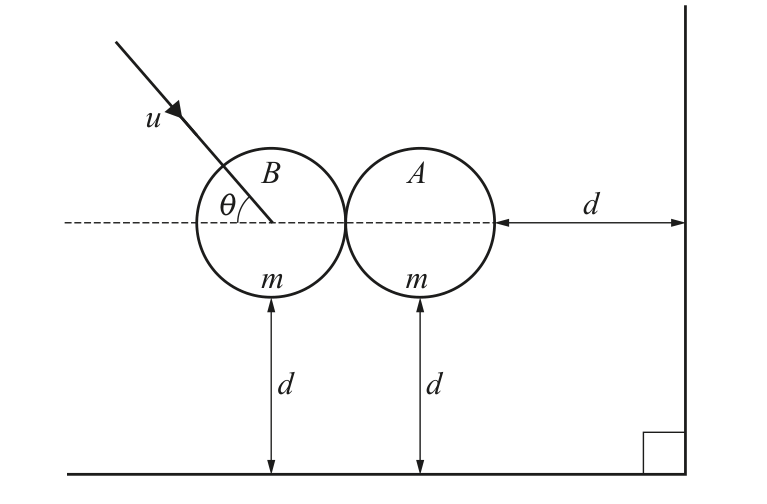
Two smooth vertical walls meet at right angles. The smooth sphere \(A\), with mass \(m\), is at rest on a smooth horizontal surface and is at a distance \(d\) from each wall. An identical smooth sphere \(B\) is moving on the horizontal surface with speed \(u\) at an angle \(\theta\) with the line of centres when the spheres collide.
After the collision, the spheres take the same time to reach a wall. The coefficient of restitution between the spheres is \(\dfrac12\).
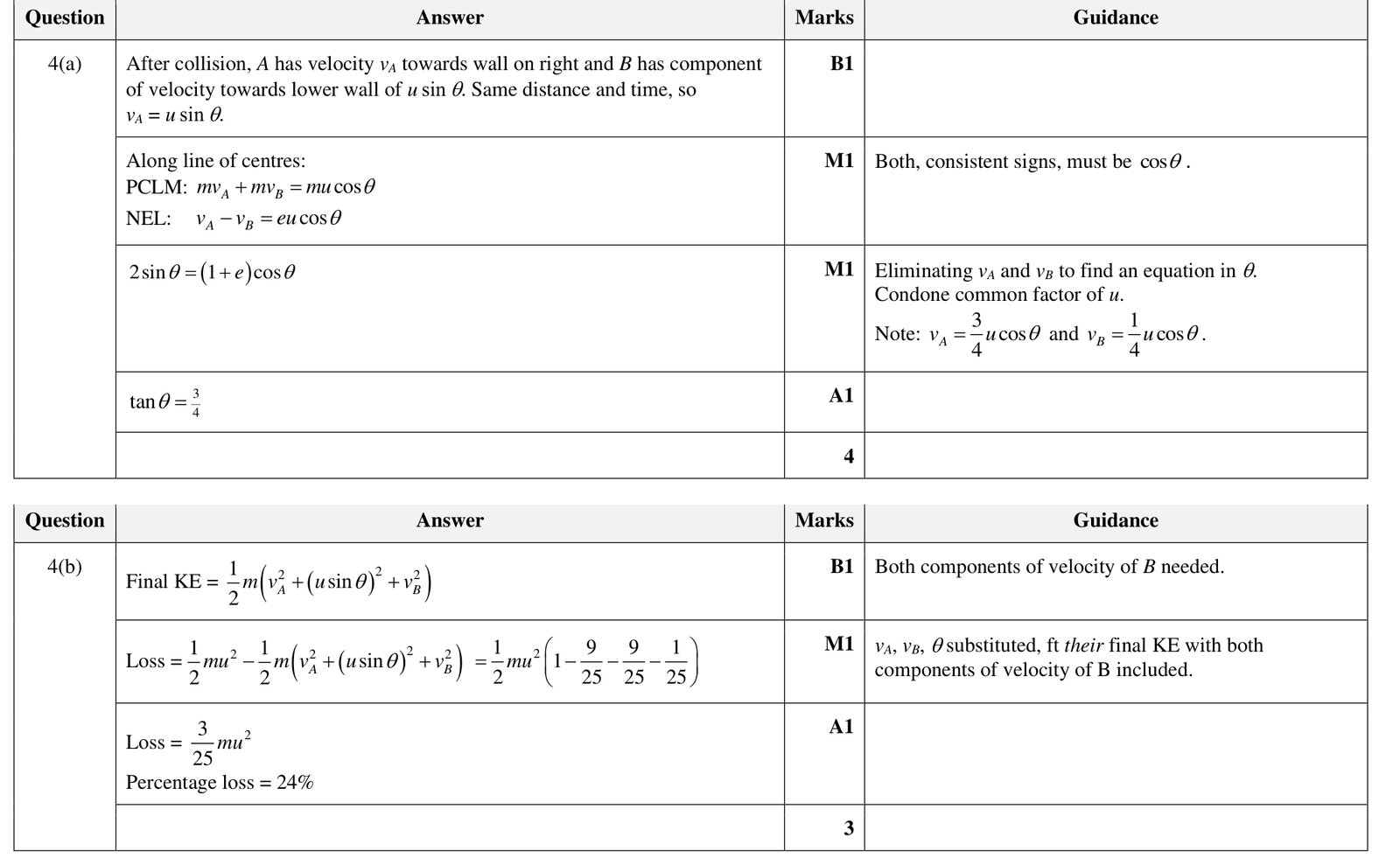
(a) Find the value of \(\tan\theta\).
(b) Find the percentage loss in the total kinetic energy of the spheres as a result of this collision.
9231 P31 - Jun 2023 - Q2 - 5 marks
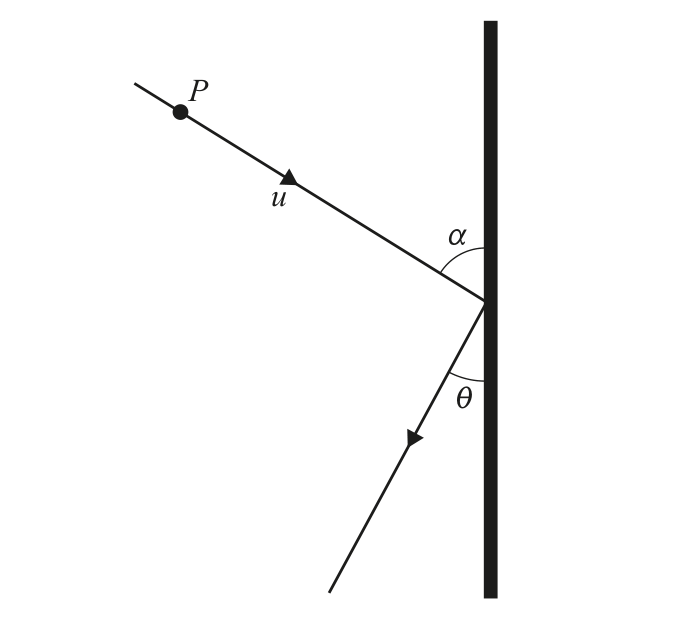
A particle \(P\) of mass \(m\) is moving with speed \(u\) on a fixed smooth horizontal surface. It collides at an angle \(\alpha\) with a fixed smooth vertical barrier. After the collision, \(P\) moves at an angle \(\theta\) with the barrier, where \(\tan \theta=\frac{1}{2}\) (see diagram). The coefficient of restitution between \(P\) and the barrier is \(e\). The particle \(P\) loses 20\% of its kinetic energy as a result of the collision.
Find the value of \(e\).

9231 P33 - Jun 2023 - Q4 - 8 marks
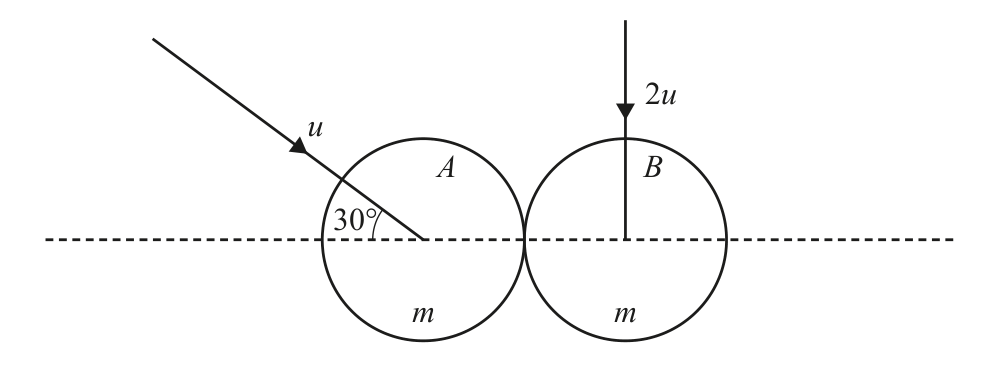
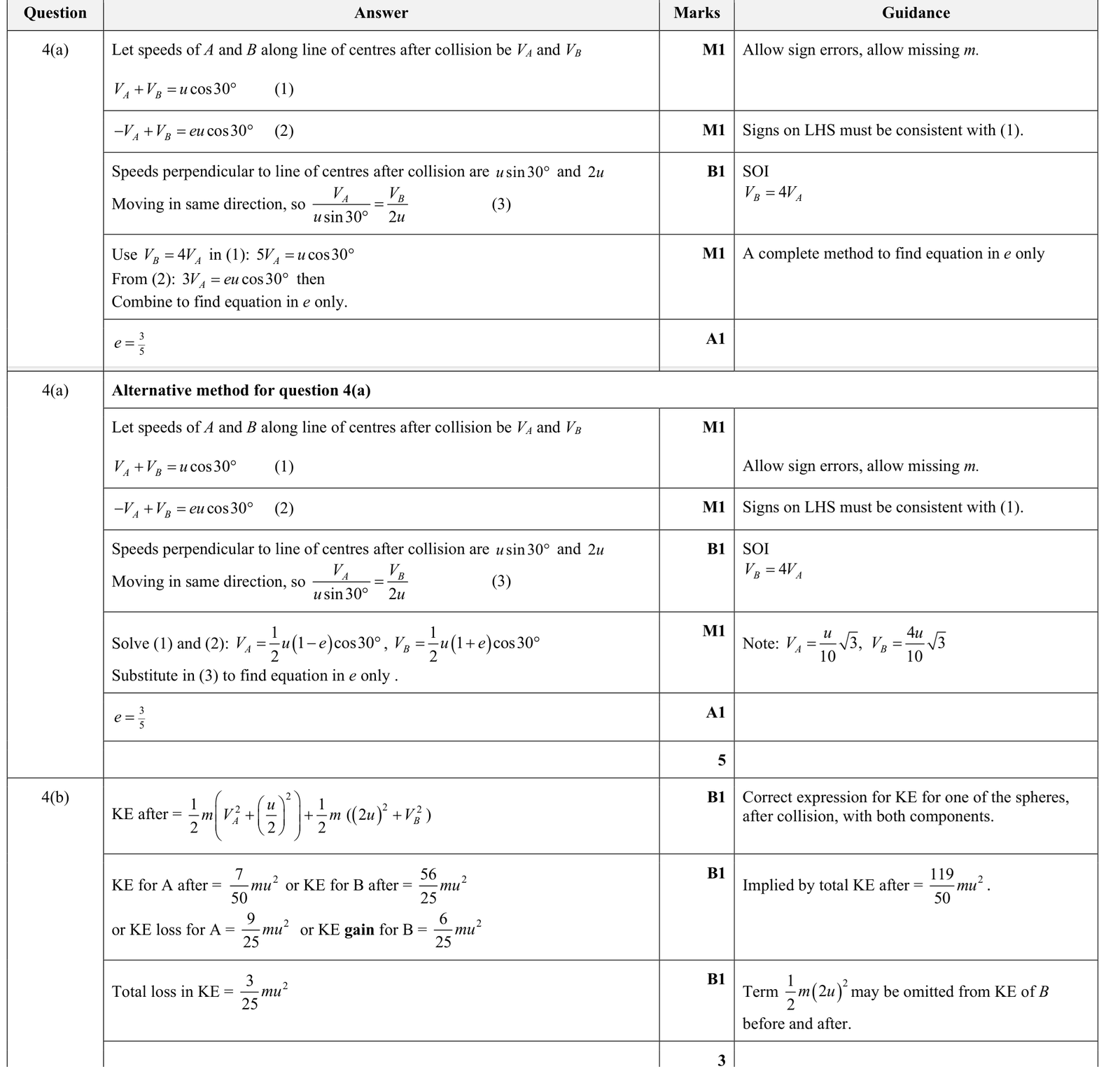
Two identical smooth uniform spheres \(A\) and \(B\) each have mass \(m\). The two spheres are moving on a smooth horizontal surface when they collide with speeds \(u\) and \(2 u\) respectively. Immediately before the collision, \(A\) 's direction of motion makes an angle of \(30^{\circ}\) with the line of centres, and \(B\) 's direction of motion is perpendicular to the line of centres (see diagram). After the collision, \(A\) and \(B\) are moving in the same direction. The coefficient of restitution between the spheres is \(e\).
(a) Find the value of \(e\).
(b) Find the loss in the total kinetic energy of the spheres as a result of the collision.
9231 P31 - Jun 2022 - Q6 - 9 marks
Two uniform smooth spheres \(A\) and \(B\) of equal radii have masses \(m\) and \(k m\) respectively. The two spheres are on a horizontal surface. Sphere \(A\) is travelling with speed \(u\) towards sphere \(B\) which is at rest. The spheres collide. Immediately before the collision, the direction of motion of \(A\) makes an angle \(\alpha\) with the line of centres. The coefficient of restitution between the spheres is \(\frac{1}{2}\).
(a) Show that the speed of \(B\) after the collision is \(\frac{3 u \cos \alpha}{2(1+k)}\) and find also an expression for the speed of \(A\) along the line of centres after the collision, in terms of \(k, u\) and \(\alpha\).
After the collision, the kinetic energy of \(A\) is equal to the kinetic energy of \(B\).
(b) Given that \(\tan \alpha=\frac{2}{3}\), find the possible values of \(k\).

9231 P33 - Jun 2022 - Q6 - 8 marks
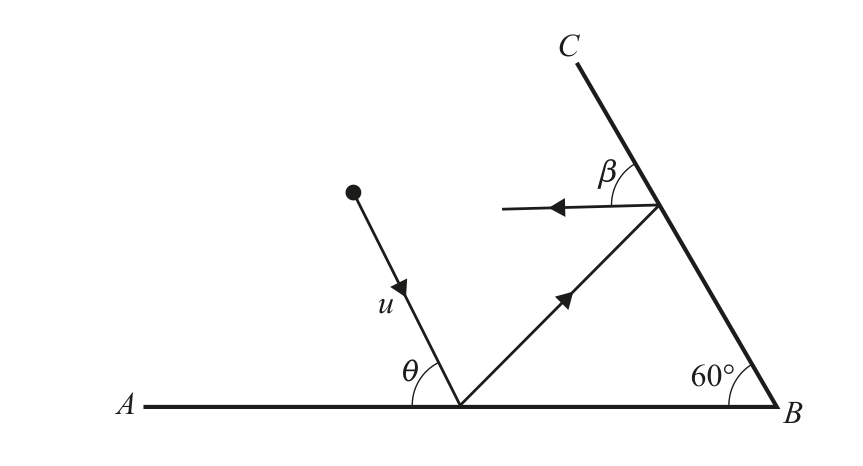
\(A B\) and \(B C\) are two fixed smooth vertical barriers on a smooth horizontal surface, with angle \(A B C=60^{\circ}\). A particle of mass \(m\) is moving with speed \(u\) on the surface. The particle strikes \(A B\) at an angle \(\theta\) with \(A B\). It then strikes \(B C\) and rebounds at an angle \(\beta\) with \(B C\) (see diagram). The coefficient of restitution between the particle and each barrier is \(e\) and \(\tan \theta=2\).
The kinetic energy of the particle after the first collision is \(40 \%\) of its kinetic energy before the first collision.
(a) Find the value of \(e\).
(b) Find the size of angle \(\beta\).

9231 P31 - Nov 2022 - Q6 - 8 marks
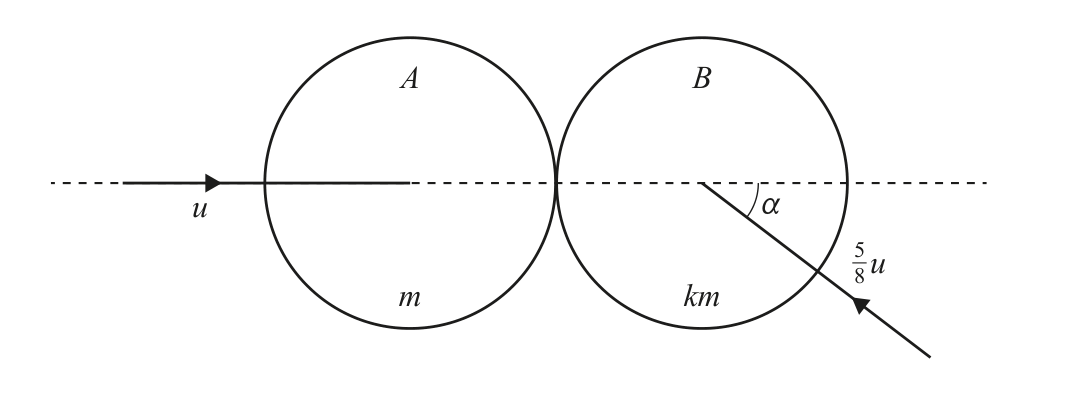
Two uniform smooth spheres \(A\) and \(B\) of equal radii have masses \(m\) and \(k m\) respectively. The two spheres are moving on a horizontal surface with speeds \(u\) and \(\frac{5}{8} u\) respectively. Immediately before the spheres collide, \(A\) is travelling along the line of centres, and \(B\) 's direction of motion makes an angle \(\alpha\) with the line of centres (see diagram). The coefficient of restitution between the spheres is \(\frac{2}{3}\) and \(\tan \alpha=\frac{3}{4}\).
After the collision, the direction of motion of \(B\) is perpendicular to the line of centres.
(a) Find the value of \(k\).
(b) Find the loss in the total kinetic energy as a result of the collision.

9231 P32 - Nov 2022 - Q7 - 9 marks
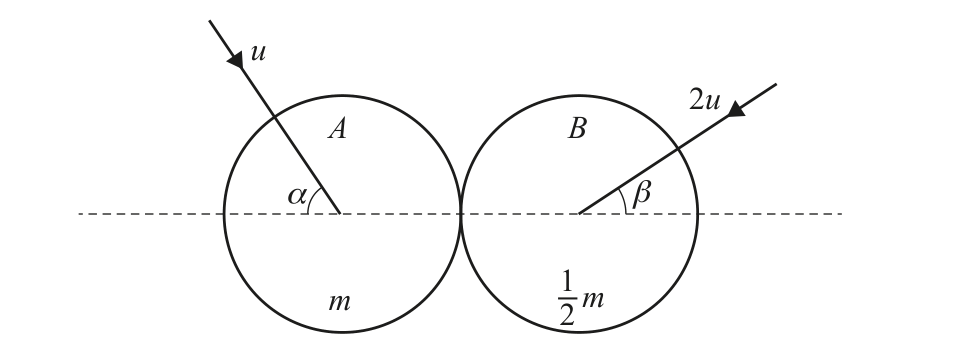
Two uniform smooth spheres \(A\) and \(B\) of equal radii have masses \(m\) and \(\frac{1}{2} m\) respectively. The two spheres are moving on a horizontal surface when they collide. Immediately before the collision, sphere \(A\) is travelling with speed \(u\) and its direction of motion makes an angle \(\alpha\) with the line of centres. Sphere \(B\) is travelling with speed \(2 u\) and its direction of motion makes an angle \(\beta\) with the line of centres (see diagram). The coefficient of restitution between the spheres is \(\frac{5}{8}\) and \(\alpha+\beta=90^{\circ}\).
(a) Find the component of the velocity of \(B\) parallel to the line of centres after the collision, giving your answer in terms of \(u\) and \(\alpha\).
The direction of motion of \(B\) after the collision is parallel to the direction of motion of \(A\) before the collision.
(b) Find the value of \(\tan \alpha\).

9231 P31 - Jun 2021 - Q6 - 8 marks
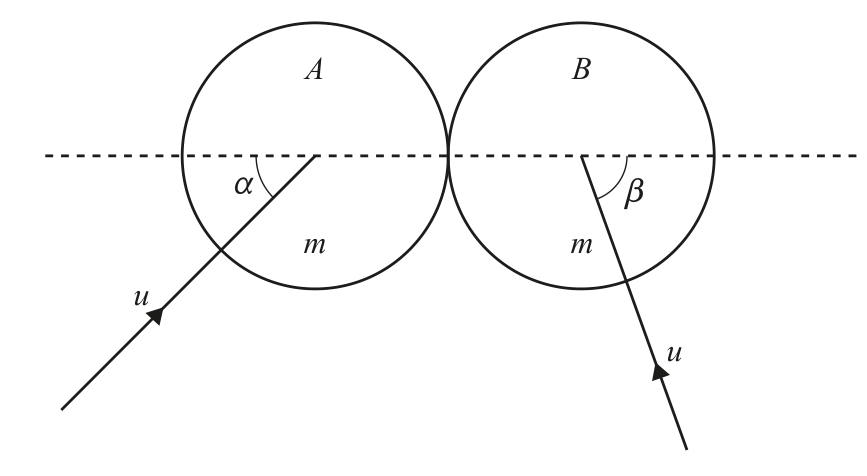
Two uniform smooth spheres \(A\) and \(B\) of equal radii each have mass \(m\). The two spheres are each moving with speed \(u\) on a horizontal surface when they collide. Immediately before the collision, \(A\) 's direction of motion makes an angle \(\alpha\) with the line of centres, and \(B\) 's direction of motion makes an angle \(\beta\) with the line of centres (see diagram). The coefficient of restitution between the spheres is \(\frac{1}{3}\) and \(2 \cos \beta=\cos \alpha\).
(a) Show that the direction of motion of \(A\) after the collision is perpendicular to the line of centres.
The total kinetic energy of the spheres after the collision is \(\frac{3}{4} m u^{2}\).
(b) Find the value of \(\alpha\).

9231 P33 - Jun 2021 - Q6 - 9 marks
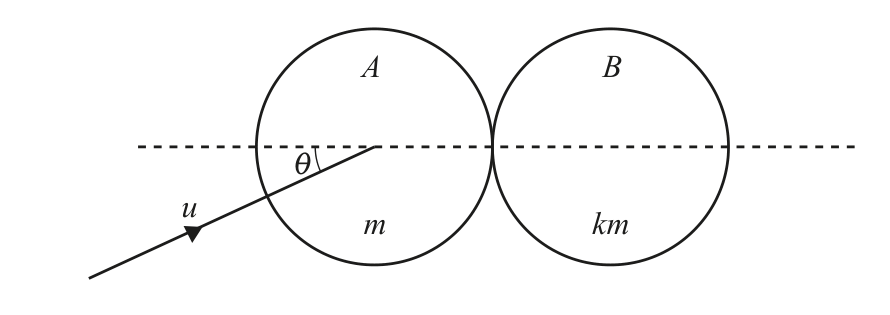
Two uniform smooth spheres \(A\) and \(B\) of equal radii have masses \(m\) and \(k m\) respectively. Sphere \(A\) is moving with speed \(u\) on a smooth horizontal surface when it collides with sphere \(B\) which is at rest. Immediately before the collision, \(A\) 's direction of motion makes an angle \(\theta\) with the line of centres (see diagram). The coefficient of restitution between the spheres is \(\frac{1}{3}\).
(a) Show that the speed of \(B\) after the collision is \(\frac{4 u \cos \theta}{3(1+k)}\).
\(70 \%\) of the total kinetic energy of the spheres is lost as a result of the collision.
(b) Given that \(\tan \theta=\frac{1}{3}\), find the value of \(k\).

9231 P31 - Nov 2021 - Q7 - 11 marks
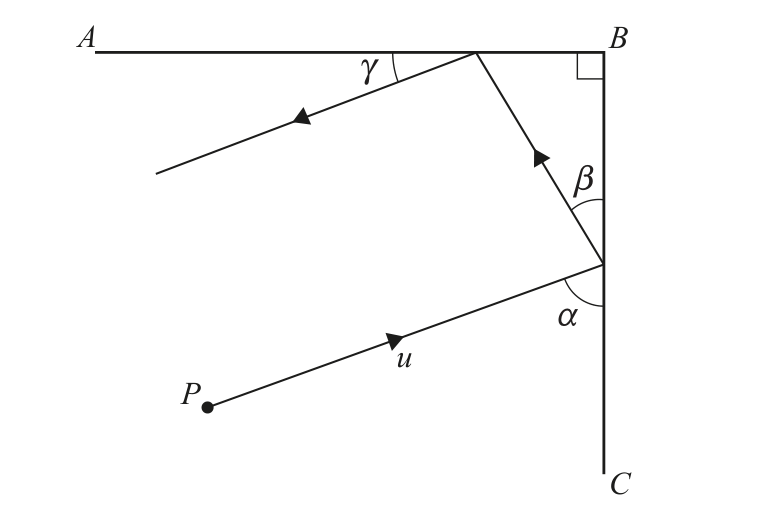
The smooth vertical walls \(A B\) and \(C B\) are at right angles to each other. A particle \(P\) is moving with speed \(u\) on a smooth horizontal floor and strikes the wall \(C B\) at an angle \(\alpha\). It rebounds at an angle \(\beta\) to the wall \(C B\). The particle then strikes the wall \(A B\) and rebounds at an angle \(\gamma\) to that wall (see diagram). The coefficient of restitution between each wall and \(P\) is \(e\).
(a) Show that \(\tan \beta=e \tan \alpha\).
(b) Express \(\gamma\) in terms of \(\alpha\) and explain what this result means about the final direction of motion of \(P\).
As a result of the two impacts the particle loses \(\frac{8}{9}\) of its initial kinetic energy.
(c) Given that \(\alpha+\beta=90^{\circ}\), find the value of \(e\) and the value of \(\tan \alpha\).

9231 P32 - Nov 2021 - Q5 - 9 marks
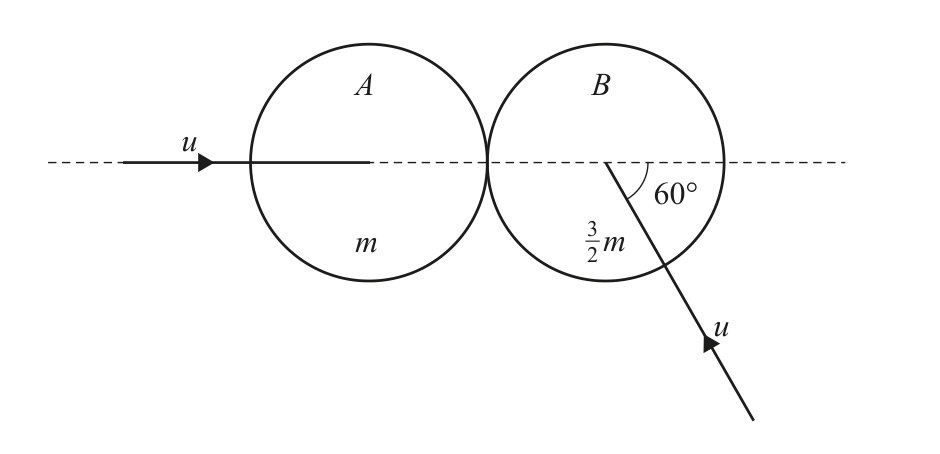
Two uniform smooth spheres \(A\) and \(B\) of equal radii have masses \(m\) and \(\frac{3}{2} m\) respectively. The two spheres are each moving with speed \(u\) on a horizontal surface when they collide. Immediately before the collision \(A\) 's direction of motion is along the line of centres, and \(B\) 's direction of motion makes an angle of \(60^{\circ}\) with the line of centres (see diagram). The coefficient of restitution between the spheres is \(\frac{2}{3}\).
(a) Find the angle through which the direction of motion of \(B\) is deflected by the collision.
(b) Find the loss in the total kinetic energy of the system as a result of the collision.

9231 P31 - Jun 2020 - Q6 - 8 marks
A particle \(P\) of mass \(m\) is moving with speed \(u\) on a fixed smooth horizontal surface. The particle strikes a fixed vertical barrier. At the instant of impact the direction of motion of \(P\) makes an angle \(\alpha\) with the barrier. The coefficient of restitution between \(P\) and the barrier is \(e\). As a result of the impact, the direction of motion of \(P\) is turned through \(90^{\circ}\).
(a) Show that \(\tan ^{2} \alpha=\frac{1}{e}\).
The particle \(P\) loses two-thirds of its kinetic energy in the impact.
(b) Find the value of \(\alpha\) and the value of \(e\).

9231 P33 - Jun 2020 - Q5 - 8 marks
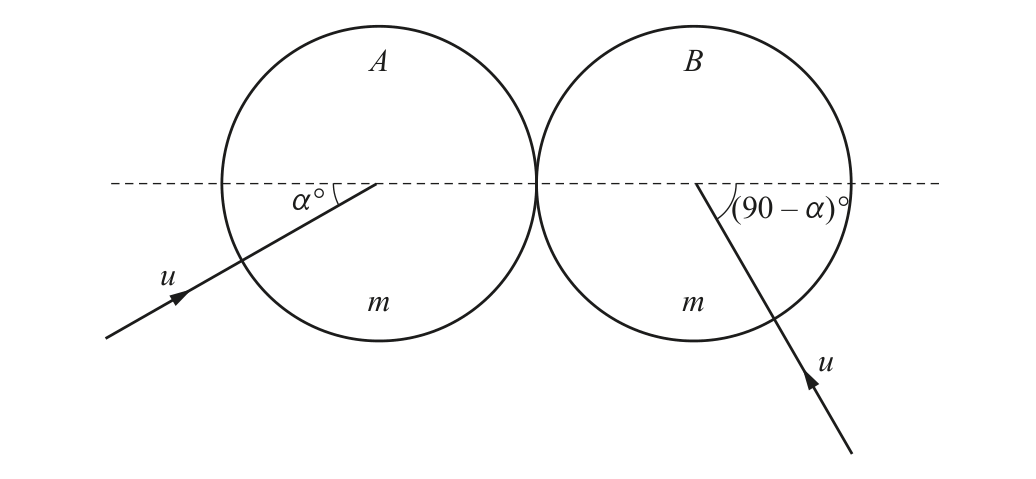
Two uniform smooth spheres \(A\) and \(B\) of equal radii each have mass \(m\). The two spheres are each moving with speed \(u\) on a horizontal surface when they collide. Immediately before the collision \(A\) 's direction of motion makes an angle of \(\alpha^{\circ}\) with the line of centres, and \(B\) 's direction of motion is perpendicular to that of \(A\) (see diagram). The coefficient of restitution between the spheres is \(e\).
Immediately after the collision, \(B\) moves in a direction at right angles to the line of centres.
(a) Show that \(\tan \alpha=\frac{1+e}{1-e}\).
(b) Given that \(\tan \alpha=2\), find the speed of \(A\) after the collision.