Past Exam Questions
← Back9231 P31 - Jun 2021 - Q1 - 5 marks
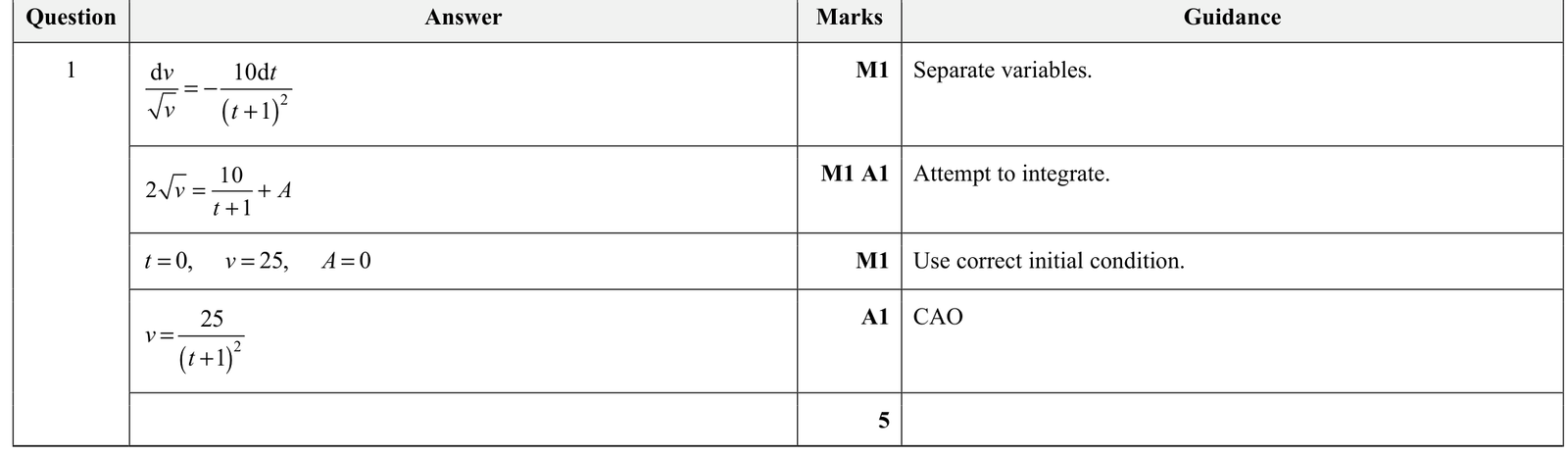
A particle \(P\) of mass 1 kg is moving along a straight line against a resistive force of magnitude \(\frac{10 \sqrt{v}}{(t+1)^{2}} \mathrm{~N}\), where \(v \mathrm{~m} \mathrm{~s}^{-1}\) is the speed of \(P\) at time \(t \mathrm{~s}\). When \(t=0, v=25\).
Find an expression for \(v\) in terms of \(t\).
9231 P33 - Jun 2021 - Q5 - 10 marks
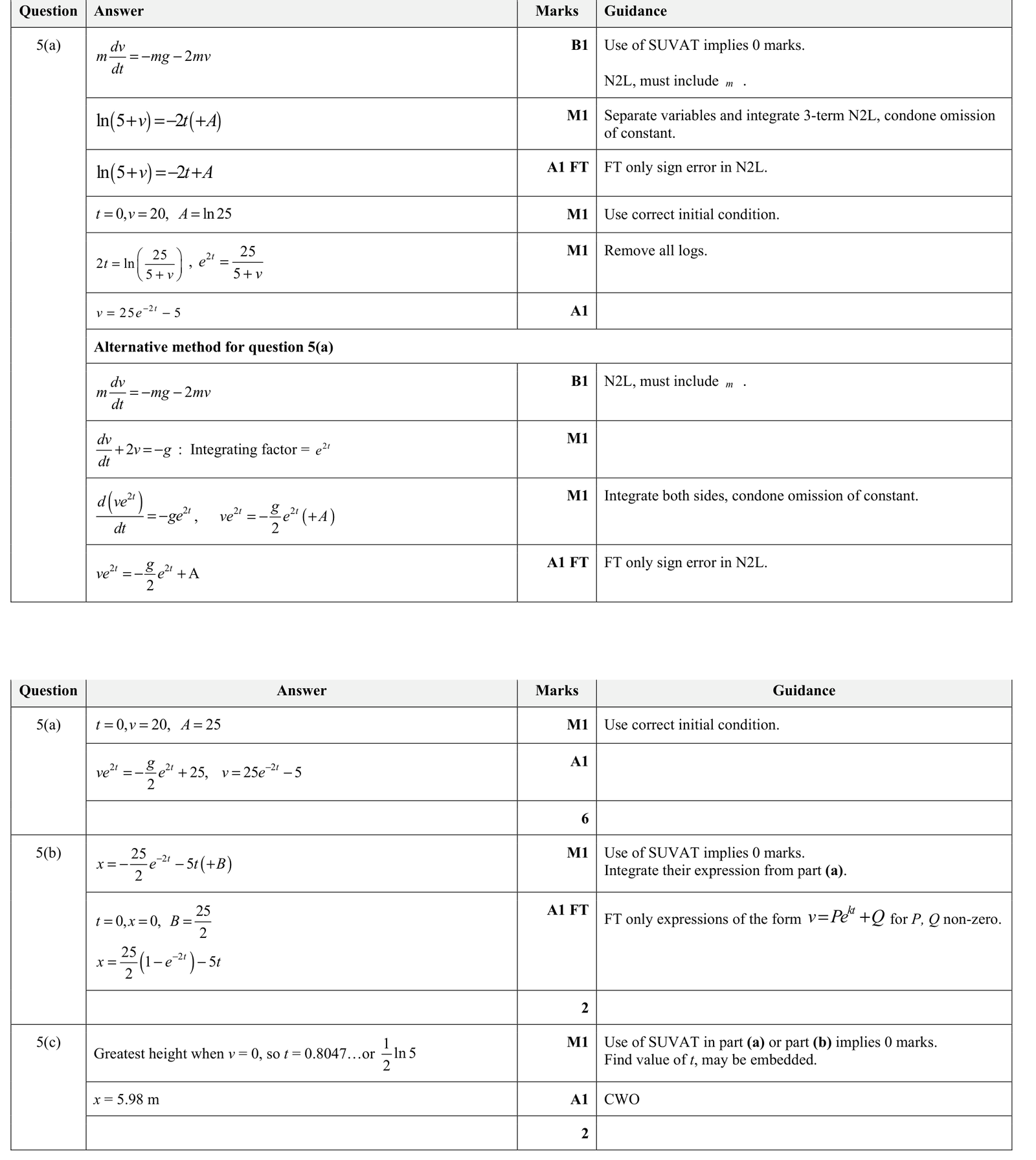
A particle \(P\) of mass \(m \mathrm{~kg}\) is projected vertically upwards from a point \(O\), with speed \(20 \mathrm{~ms}^{-1}\), and moves under gravity. There is a resistive force of magnitude \(2 m v \mathrm{~N}\), where \(v \mathrm{~ms}^{-1}\) is the speed of \(P\) at time \(t \mathrm{~s}\) after projection.
(a) Find an expression for \(v\) in terms of \(t\), while \(P\) is moving upwards.
The displacement of \(P\) from \(O\) is \(x \mathrm{~m}\) at time \(t \mathrm{~s}\).
(b) Find an expression for \(x\) in terms of \(t\), while \(P\) is moving upwards.
(c) Find, correct to 3 significant figures, the greatest height above \(O\) reached by \(P\).
9231 P31 - Nov 2021 - Q2 - 6 marks
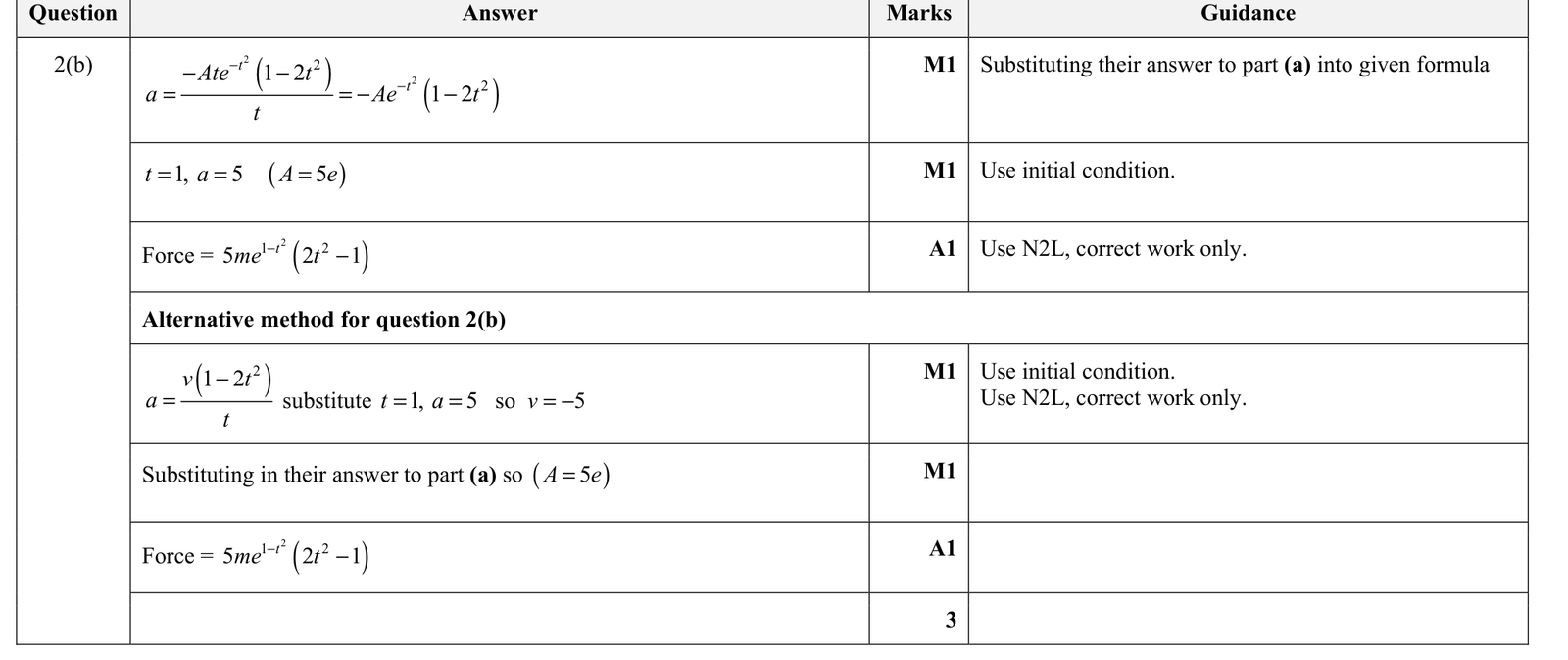
A particle \(P\) of mass \(m \mathrm{~kg}\) moves along a horizontal straight line with acceleration \(a \mathrm{~ms}^{-2}\) given by
\(a=\frac{v\left(1-2 t^{2}\right)}{t},\)
where \(v \mathrm{~m} \mathrm{~s}^{-1}\) is the velocity of \(P\) at time \(t \mathrm{~s}\).
(a) Find an expression for \(v\) in terms of \(t\) and an arbitrary constant.
(b) Given that \(a=5\) when \(t=1\), find an expression, in terms of \(m\) and \(t\), for the horizontal force acting on \(P\) at time \(t\).
9231 P31 - Jun 2020 - Q5 - 8 marks
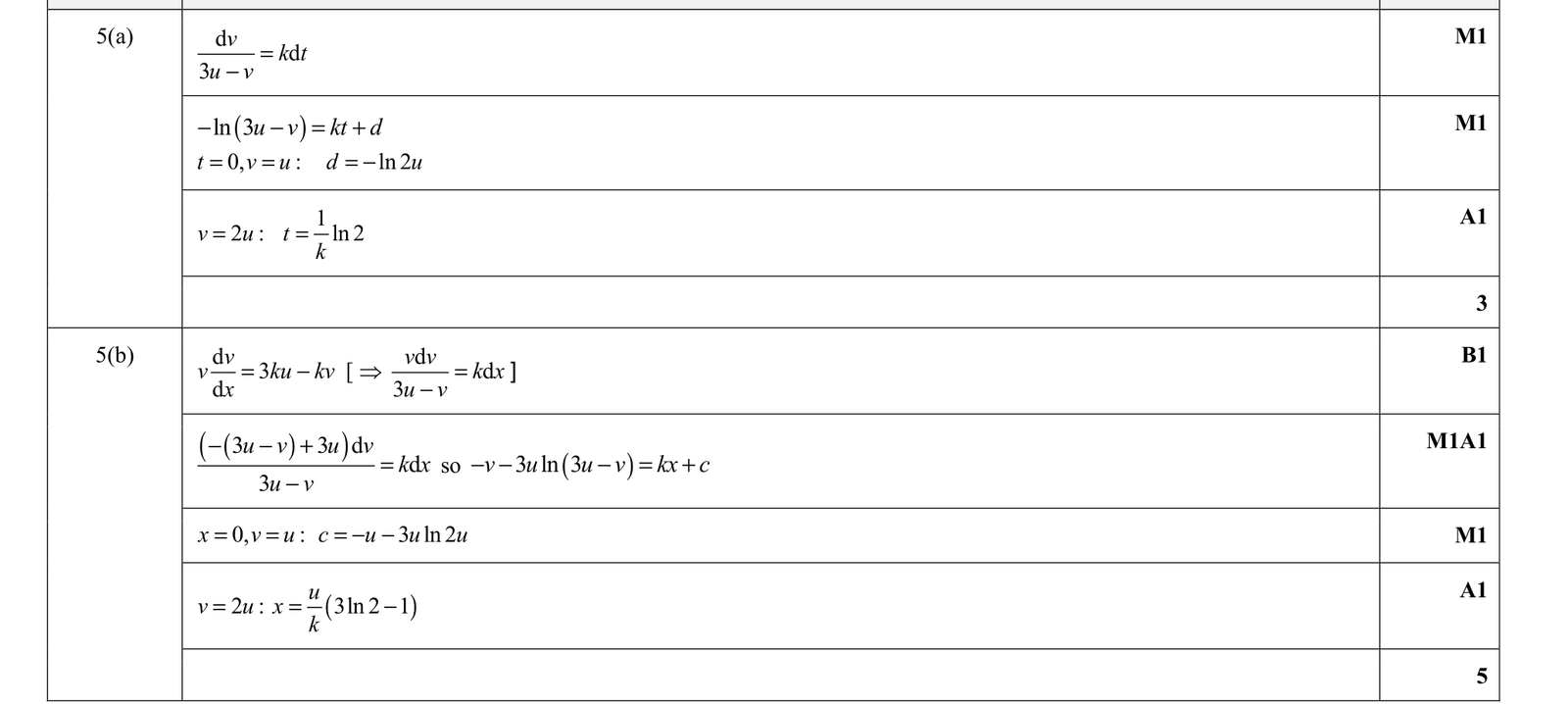
A particle \(P\) is moving along a straight line with acceleration \(3 k u-k v\) where \(v\) is its velocity at time \(t\), \(u\) is its initial velocity and \(k\) is a constant. The velocity and acceleration of \(P\) are both in the direction of increasing displacement from the initial position.
(a) Find the time taken for \(P\) to achieve a velocity of \(2 u\).
(b) Find an expression for the displacement of \(P\) from its initial position when its velocity is \(2 u\).
9231 P33 - Jun 2020 - Q2 - 6 marks
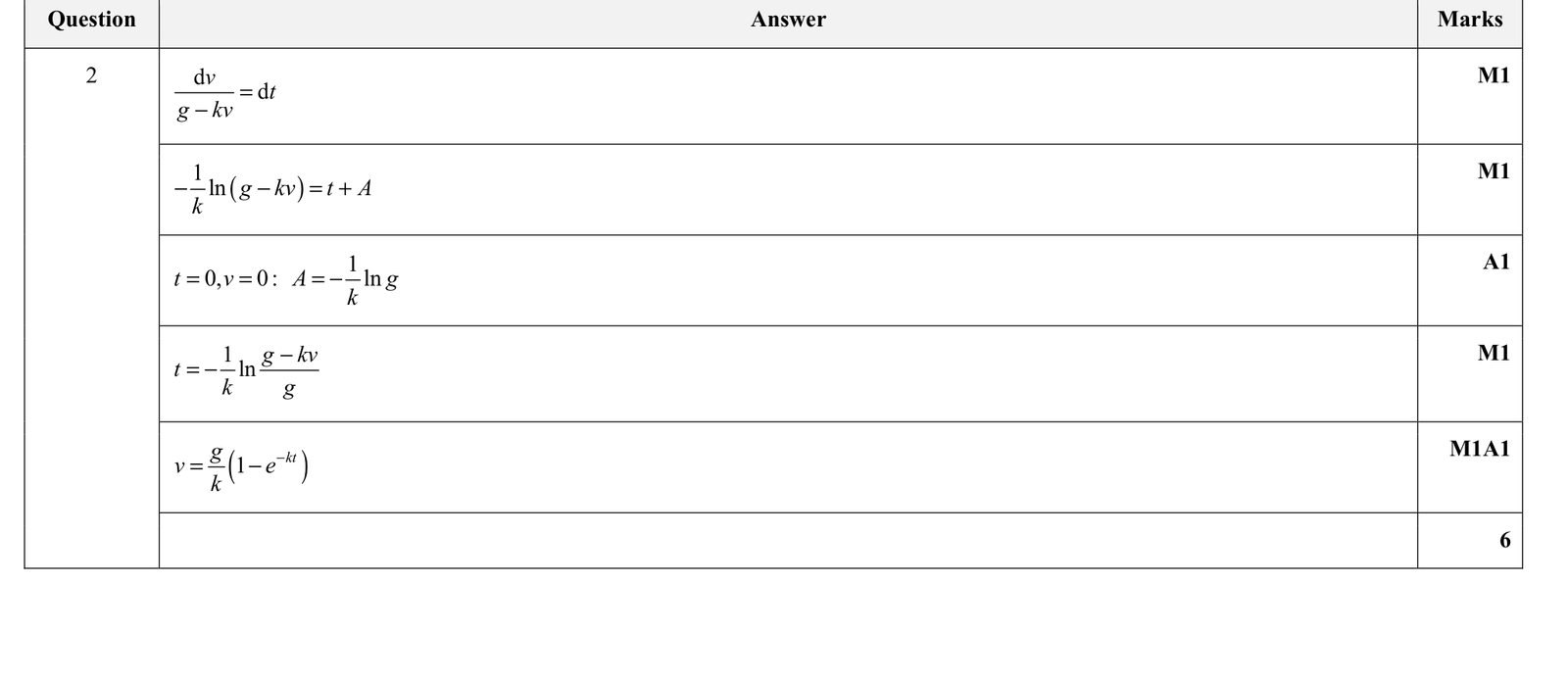
A particle \(Q\) of mass \(m \mathrm{~kg}\) falls from rest under gravity. The motion of \(Q\) is resisted by a force of magnitude \(m k v \mathrm{~N}\), where \(v \mathrm{~ms}^{-1}\) is the speed of \(Q\) at time \(t \mathrm{~s}\) and \(k\) is a positive constant.
Find an expression for \(v\) in terms of \(g, k\) and \(t\).
9231 P21 - Nov 2018 - Q1 - 3 marks
A particle \(P\) oscillates in simple harmonic motion between the points \(A\) and \(B\), where \(A B=6 \mathrm{~m}\). The period of the motion is \(\frac{1}{2} \pi \mathrm{~s}\). Find the speed of \(P\) when it is 2 m from \(B\).

9231 P21 - Jun 2019 - Q2 - 8 marks
A particle \(P\) moves on a straight line in simple harmonic motion. The centre of the motion is \(O\). The points \(A\) and \(B\) are on the line on opposite sides of \(O\) such that \(O A=3.5 \mathrm{~m}\) and \(O B=1 \mathrm{~m}\). The speed of \(P\) when it is at \(B\) is twice its speed when it is at \(A\). The maximum acceleration of \(P\) is \(1 \mathrm{~m} \mathrm{~s}^{-2}\).
(i) Find the speed of \(P\) when it is at \(O\).
(ii) Find the time taken by \(P\) to travel directly from \(A\) to \(B\).

9231 P22 - Nov 2018 - Q1 - 3 marks
The point \(O\) is on the fixed horizontal line \(l\). Points \(A\) and \(B\) on \(l\) are such that \(O A=0.1 \mathrm{~m}\) and \(O B=0.5 \mathrm{~m}\), with \(A\) between \(O\) and \(B\). A particle \(P\) oscillates on \(l\) in simple harmonic motion with centre \(O\). The kinetic energy of \(P\) when it is at \(A\) is twice its kinetic energy when it is at \(B\). Find the amplitude of the motion.

9231 P23 - Jun 2017 - Q2 - 9 marks
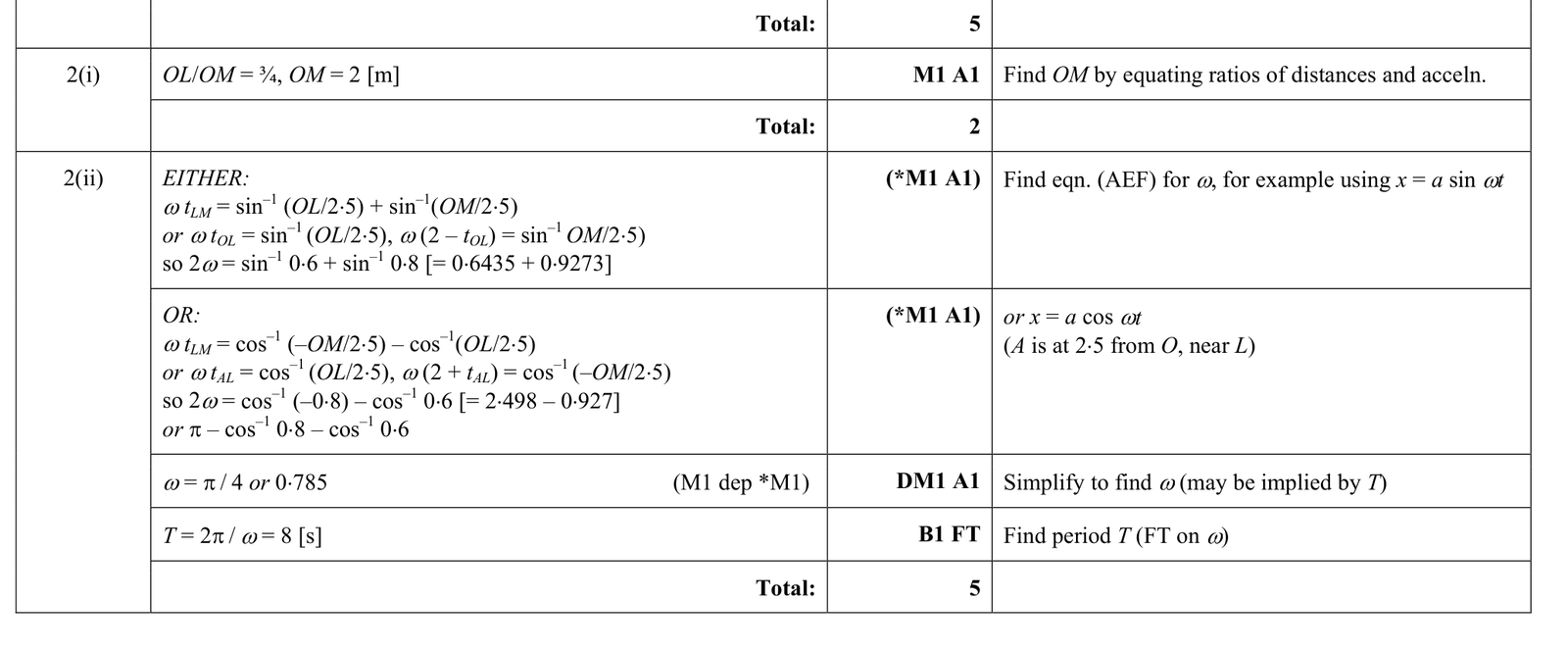
A particle \(P\) moves on a straight line in simple harmonic motion. The centre of the motion is \(O\), and the amplitude of the motion is 2.5 m . The points \(L\) and \(M\) are on the line, on opposite sides of \(O\), with \(O L=1.5 \mathrm{~m}\). The magnitudes of the accelerations of \(P\) at \(L\) and at \(M\) are in the ratio 3:4.
(i) Find the distance \(O M\).
The time taken by \(P\) to travel directly from \(L\) to \(M\) is 2 s .
(ii) Find the period of the motion.
(iii) Find the speed of \(P\) when it passes through \(L\).
9231 P21 - Nov 2017 - Q2 - 7 marks
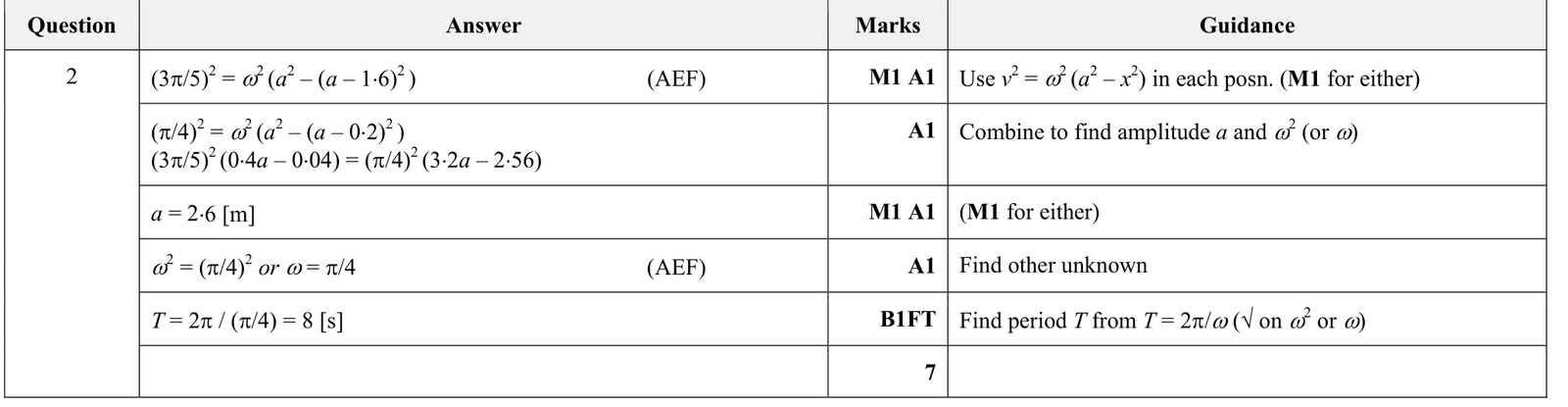
The piston in a large engine rises and falls in simple harmonic motion. When the piston is 1.6 m below its highest level, the rate of change of its height is \(\frac{3}{5} \pi\) metres per second. When the piston is 0.2 m below its highest level, the rate of change of its height is \(\frac{1}{4} \pi\) metres per second. Find the amplitude and period of the motion.
9231 P21 - Jun 2018 - Q2 - 9 marks
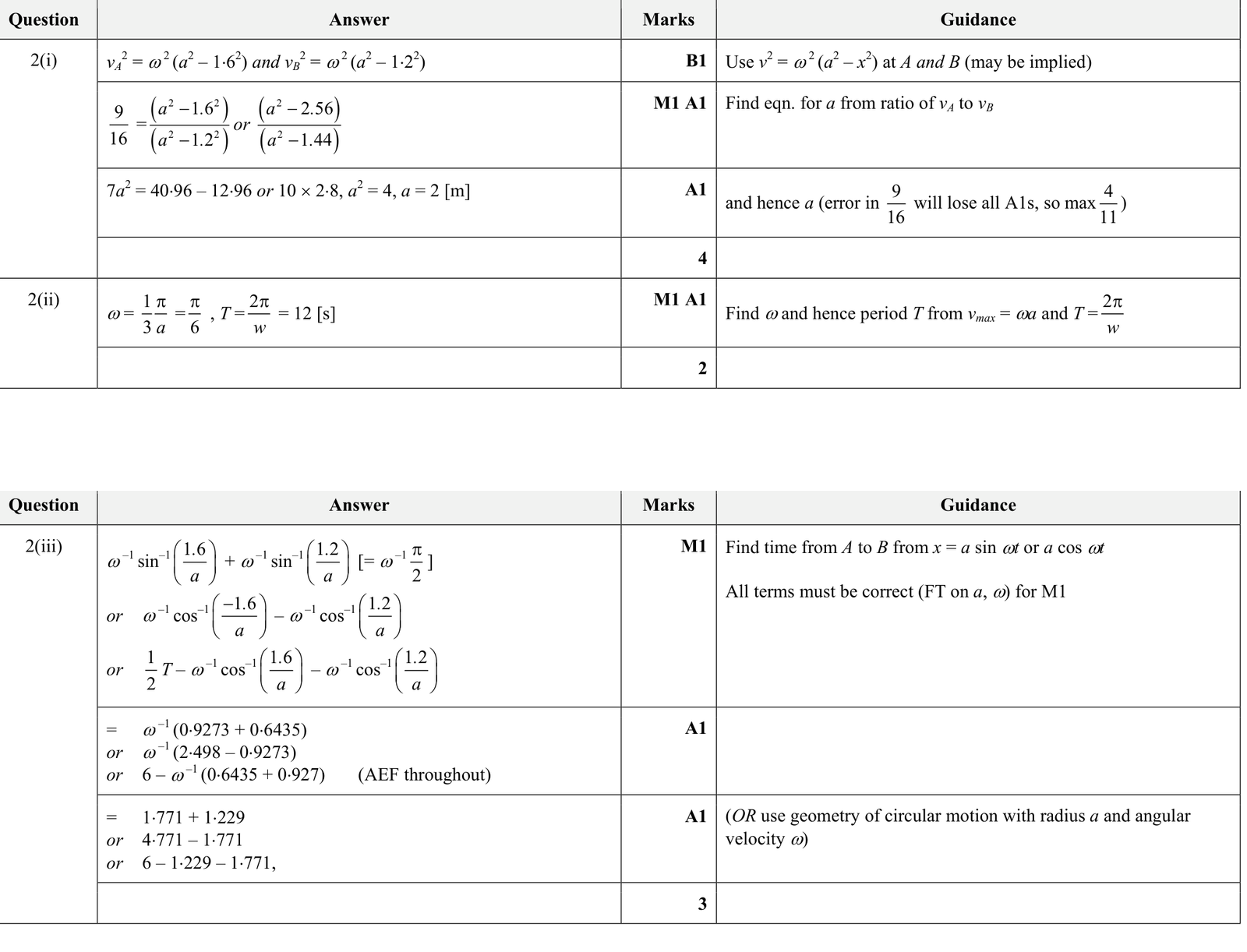
A particle \(P\) moves on a straight line in simple harmonic motion. The centre of the motion is \(O\). The points \(A\) and \(B\) are on the line, on opposite sides of \(O\), with \(O A=1.6 \mathrm{~m}\) and \(O B=1.2 \mathrm{~m}\). The ratio of the speed of \(P\) at \(A\) to its speed at \(B\) is \(3: 4\).
(i) Find the amplitude of the motion.
The maximum speed of \(P\) during its motion is \(\frac{1}{3} \pi \mathrm{~m} \mathrm{~s}^{-1}\).
(ii) Find the period of the motion.
(iii) Find the time taken for \(P\) to travel directly from \(A\) to \(B\).
9231 P23 - Jun 2018 - Q3 - 10 marks
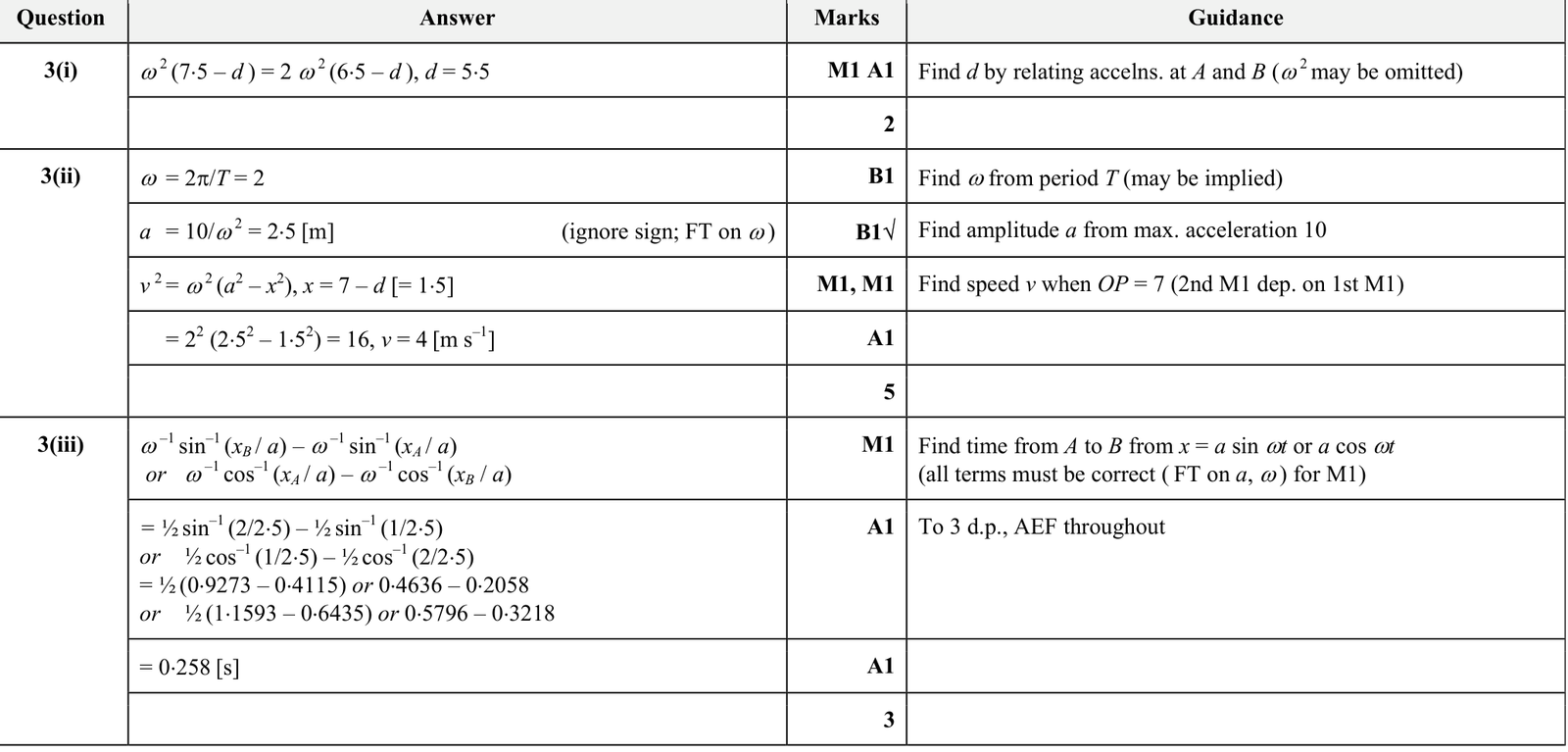
A particle \(P\) moves on the positive \(x\)-axis in simple harmonic motion. The centre of the motion is a distance \(d \mathrm{~m}\) from the origin \(O\), where \(0<d<6.5\). The points \(A\) and \(B\) are on the positive \(x\)-axis, with \(O A=6.5 \mathrm{~m}\) and \(O B=7.5 \mathrm{~m}\). The magnitude of the acceleration of \(P\) when it is at \(B\) is twice the magnitude of the acceleration of \(P\) when it is at \(A\).
(i) Find \(d\).
The period of the motion is \(\pi \mathrm{s}\) and the maximum acceleration of \(P\) during the motion is \(10 \mathrm{~m} \mathrm{~s}^{-2}\).
(ii) Find the speed of \(P\) when it is 7 m from \(O\).
(iii) Find the time taken by \(P\) to travel directly from \(A\) to \(B\).
9231 P34 - Nov 2025 - Q5 - 9 marks
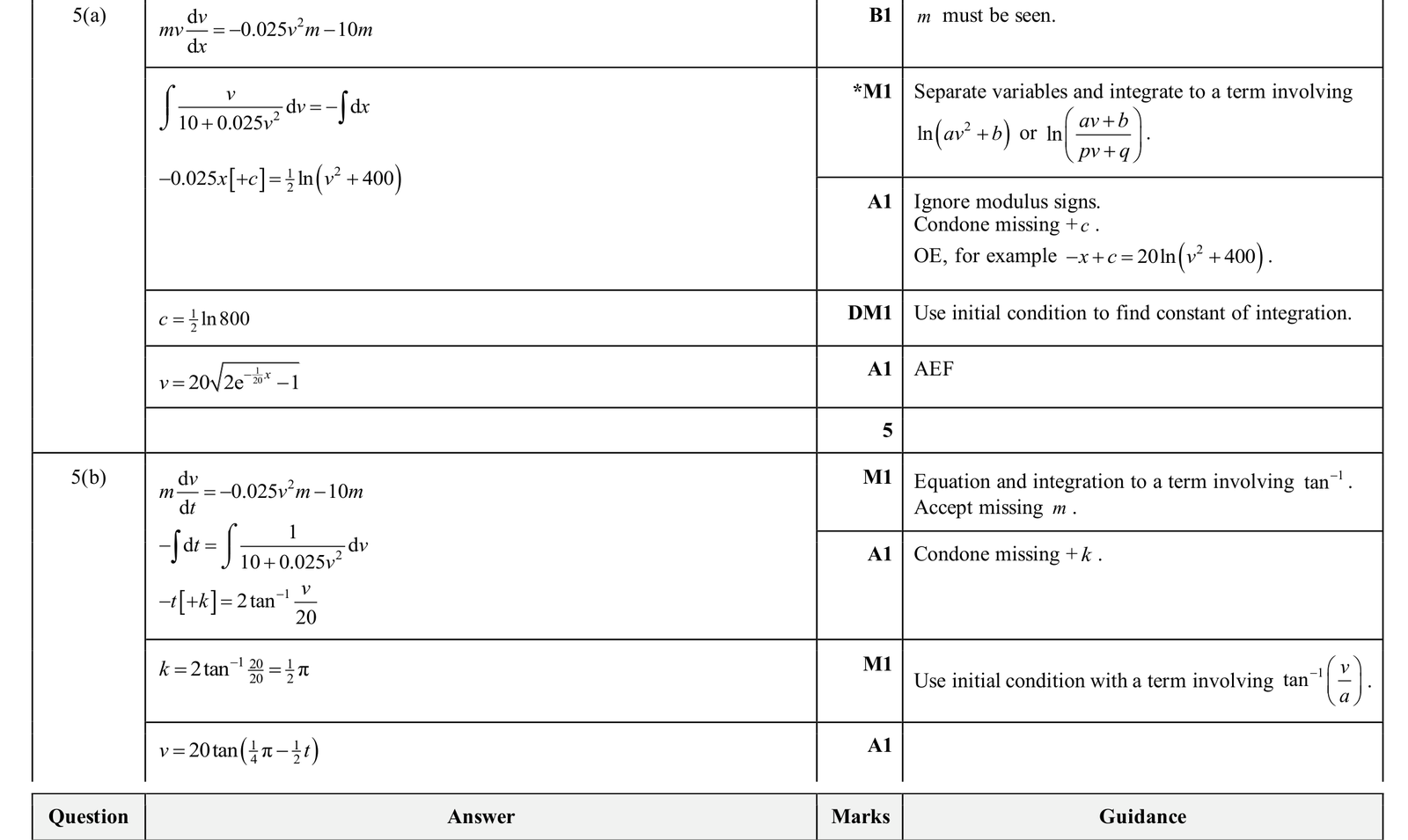
A particle \(P\) of mass \(m \mathrm{~kg}\) is projected vertically upwards from a point \(O\) with an initial speed of \(20 \mathrm{~ms}^{-1}\) and moves under gravity. There is a resistive force of magnitude \(0.025 m v^{2} \mathrm{~N}\), where \(v \mathrm{~ms}^{-1}\) is the speed of \(P\) at time \(t \mathrm{~s}\) after projection. The displacement of \(P\) from \(O\) is \(x \mathrm{~m}\) at time \(t \mathrm{~s}\) after projection. (a) Find an expression for \(v\) in terms of \(x\), while \(P\) is moving upwards. (b) Find an expression for \(v\) in terms of \(t\), while \(P\) is moving upwards.
9231 P31 - Jun 2025 - Q1 - 5 marks
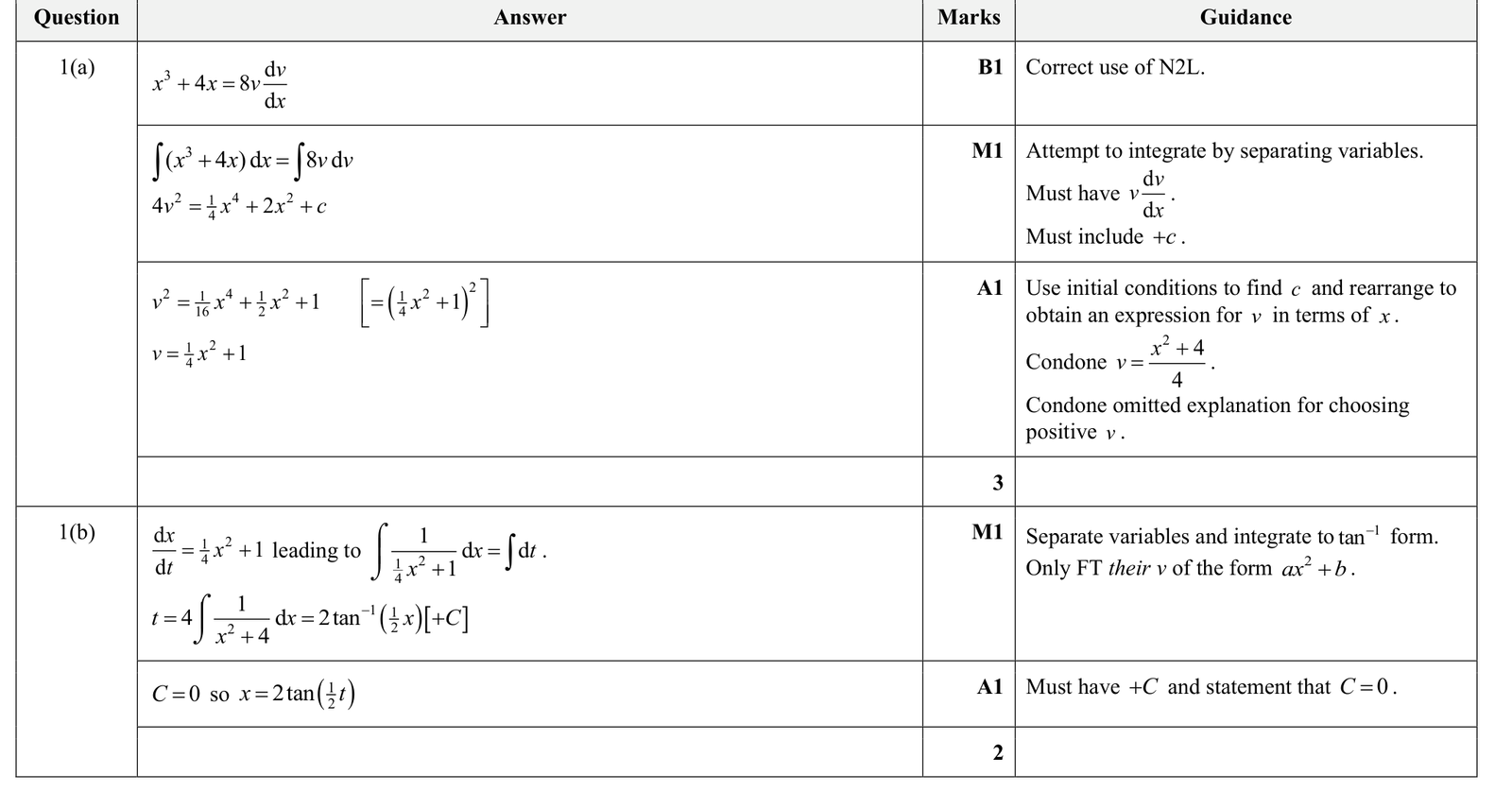
A particle \(P\) of mass \(8\,\text{kg}\) moves in a straight horizontal line. At time \(t\) s it has displacement \(x\) m from \(O\) and velocity \(v\,\text{m s}^{-1}\). The only horizontal force has magnitude \(x^3+4x\) N and acts in the direction \(OP\). Initially, \(t=0\), \(x=0\), and \(v=1\).
(a) Find \(v\) in terms of \(x\), in the form \(v=ax^2+b\).
(b) Find \(x\) in terms of \(t\).
9231 P33 - Jun 2025 - Q3 - 8 marks
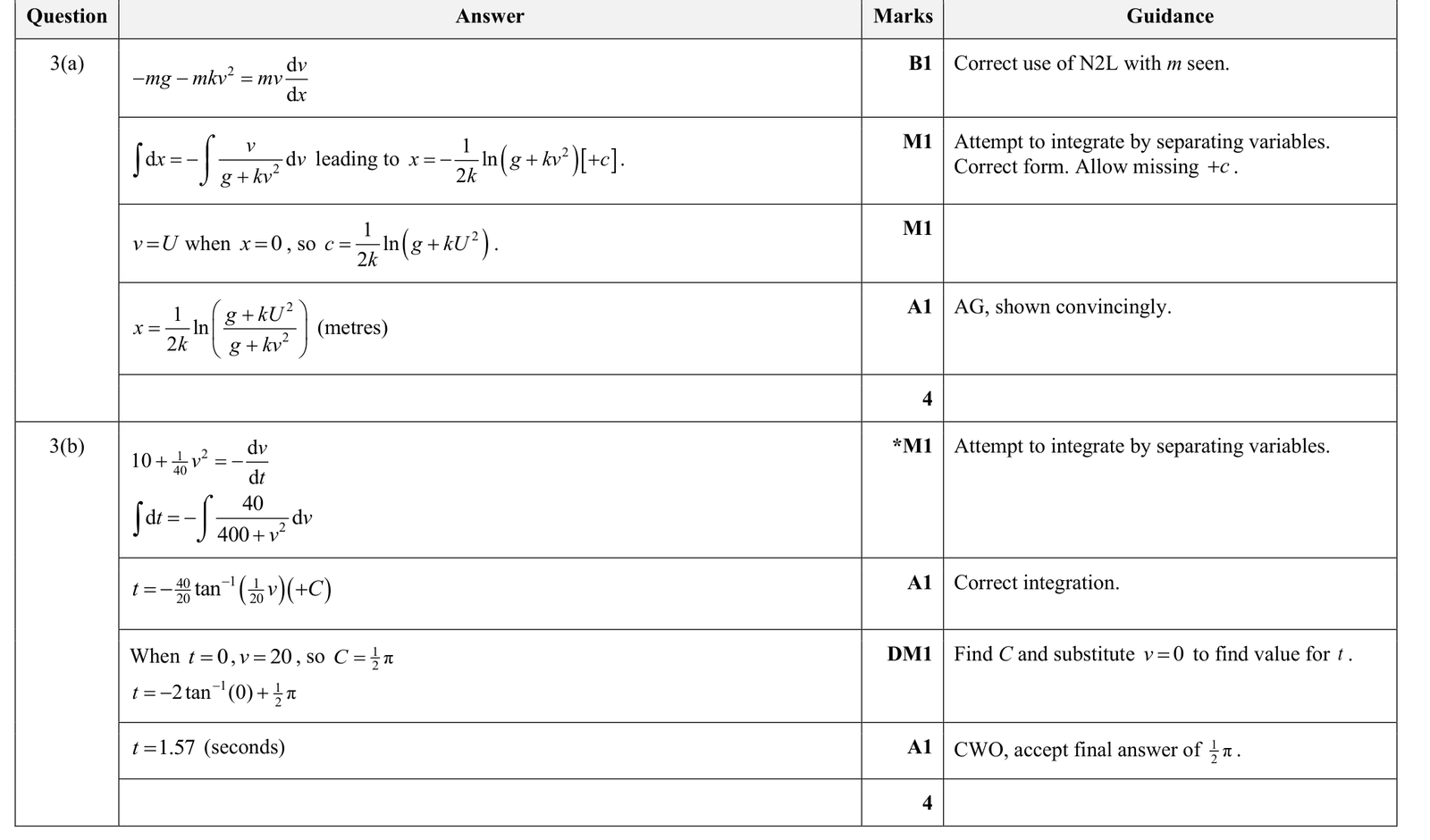
A ball of mass \(m\) kg is projected vertically upwards with initial speed \(U\,\text{m s}^{-1}\). At time \(t\), it has travelled distance \(x\) m and has speed \(v\,\text{m s}^{-1}\). There is a resistive force of magnitude \(mkv^2\) N, where \(k\gt0\).
(a) Show that, while the ball is moving upwards,
(b) Given \(k=0.025\) and \(U=20\), find the time taken to reach maximum height.
9231 P32 - Nov 2024 - Q7 - 11 marks
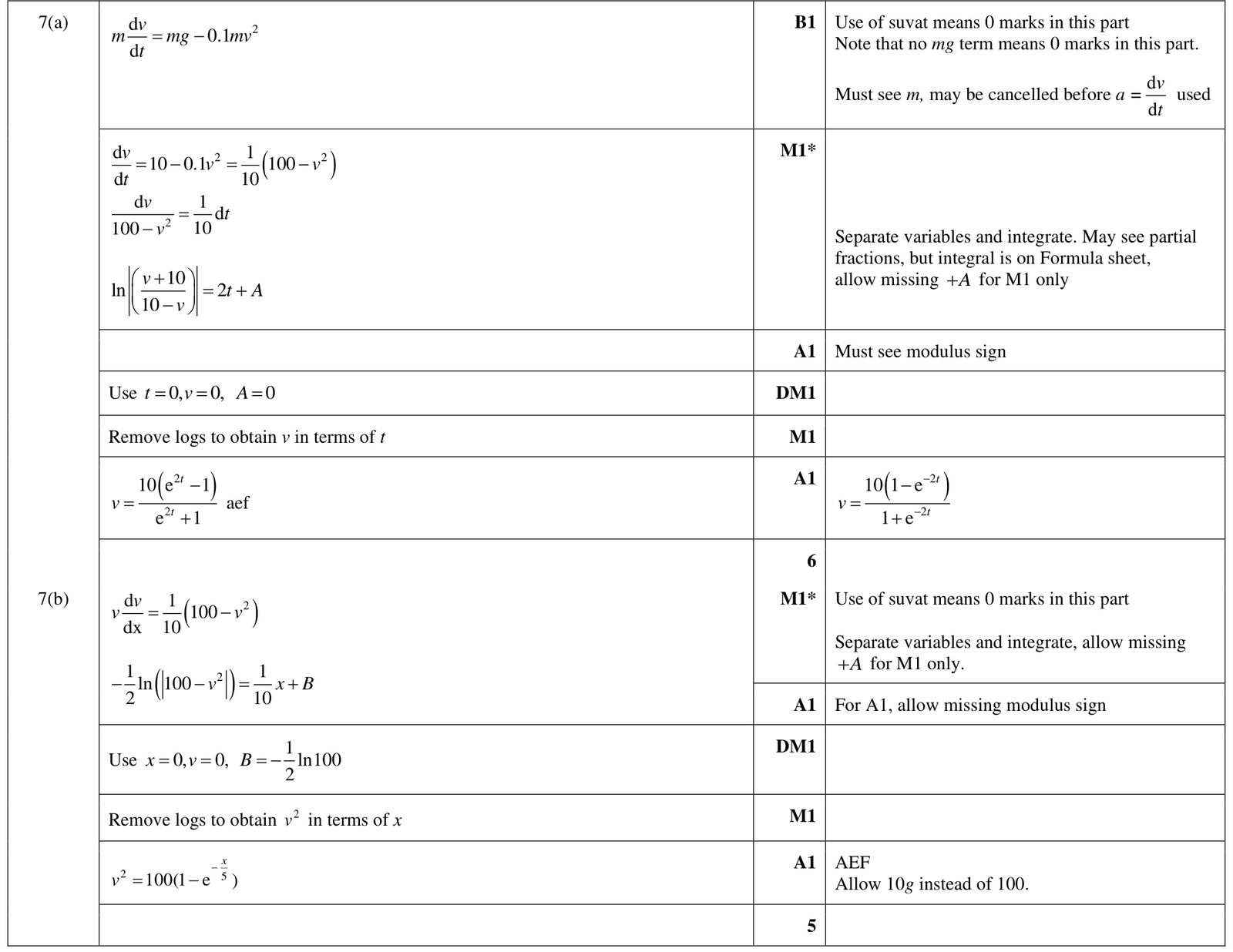
A particle \(P\) of mass \(m\,\text{kg}\) is held at rest at a point \(O\) and released so that it moves vertically under gravity against a resistive force of magnitude \(0.1mv^2\) N, where \(v\,\text{m s}^{-1}\) is the velocity of \(P\) at time \(t\) s.
(a) Find an expression for \(v\) in terms of \(t\).
The displacement of \(P\) from \(O\) at time \(t\) is \(x\) m.
(b) Find an expression for \(v^2\) in terms of \(x\).
9231 P32 - Nov 2023 - Q2 - 6 marks
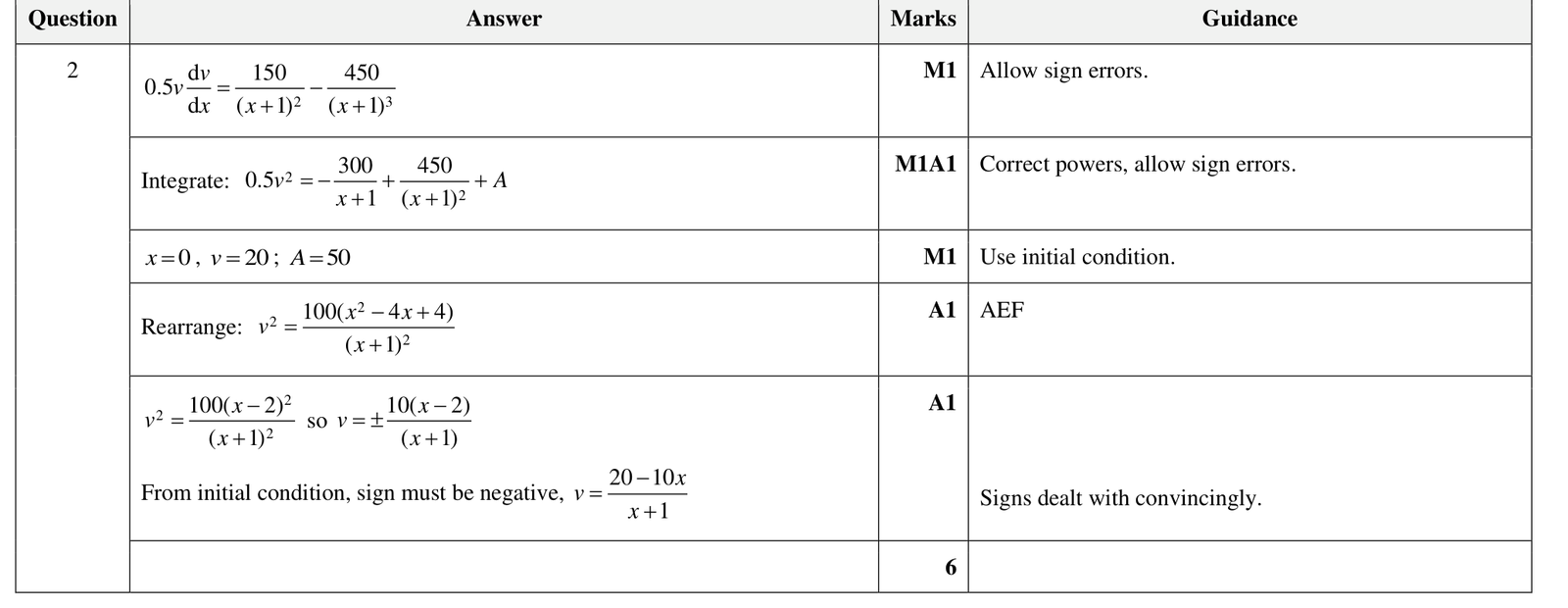
A particle \(P\) of mass \(0.5\,\text{kg}\) moves in a straight line. At time \(t\) seconds, the velocity of \(P\) is \(v\,\text{m s}^{-1}\), and its displacement from a fixed point \(O\) on the line is \(x\) metres.
The only forces acting on \(P\) are a force of magnitude \(\dfrac{150}{(x+1)^2}\,\text{N}\) in the direction of increasing displacement and a resistive force of magnitude \(\dfrac{450}{(x+1)^3}\,\text{N}\).
When \(t=0\), \(x=0\) and \(v=20\).
Find \(v\) in terms of \(x\), giving your answer in the form \(v=\dfrac{Ax+B}{x+1}\), where \(A\) and \(B\) are constants to be determined.
9231 P31 - Jun 2023 - Q6 - 9 marks
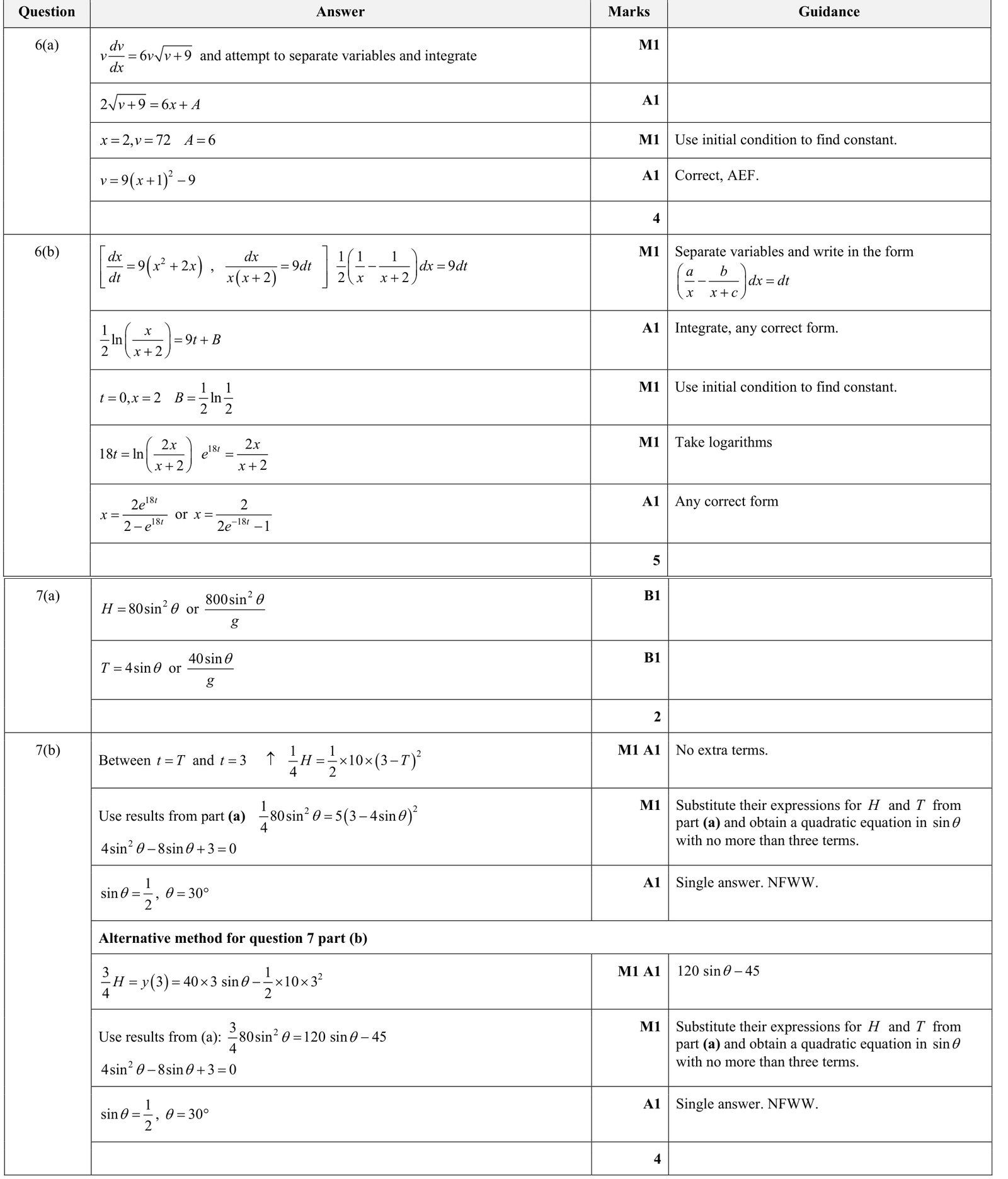
A particle \(P\) moving in a straight line has displacement \(x \mathrm{~m}\) from a fixed point \(O\) on the line and velocity \(v \mathrm{~m} \mathrm{~s}^{-1}\) at time \(t \mathrm{~s}\). The acceleration of \(P\), in \(\mathrm{ms}^{-2}\), is given by \(6 v \sqrt{v+9}\). When \(t=0, x=2\) and \(v=72\).
(a) Find an expression for \(v\) in terms of \(x\).
(b) Find an expression for \(x\) in terms of \(t\).
9231 P33 - Jun 2022 - Q5 - 8 marks
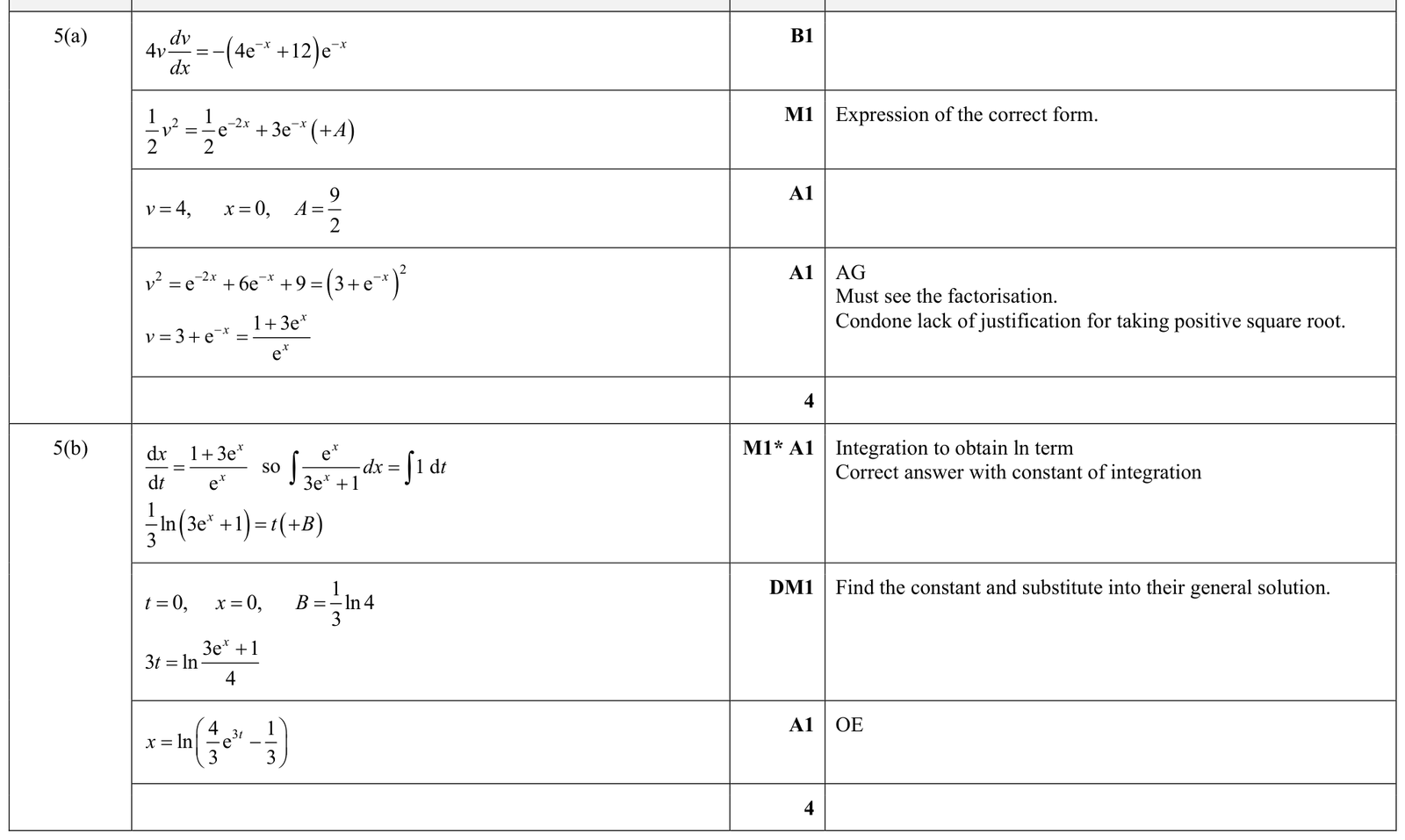
A particle \(P\) of mass 4 kg is moving in a horizontal straight line. At time \(t \mathrm{~s}\) the velocity of \(P\) is \(v \mathrm{~m} \mathrm{~s}^{-1}\) and the displacement of \(P\) from a fixed point \(O\) on the line is \(x \mathrm{~m}\). The only force acting on \(P\) is a resistive force of magnitude \(\left(4 \mathrm{e}^{-x}+12\right) \mathrm{e}^{-x} \mathrm{~N}\). When \(t=0, x=0\) and \(v=4\).
(a) Show by integration that \(v=\frac{1+3 \mathrm{e}^{x}}{\mathrm{e}^{x}}\).
(b) Find an expression for \(x\) in terms of \(t\).
9231 P32 - Nov 2022 - Q4 - 7 marks
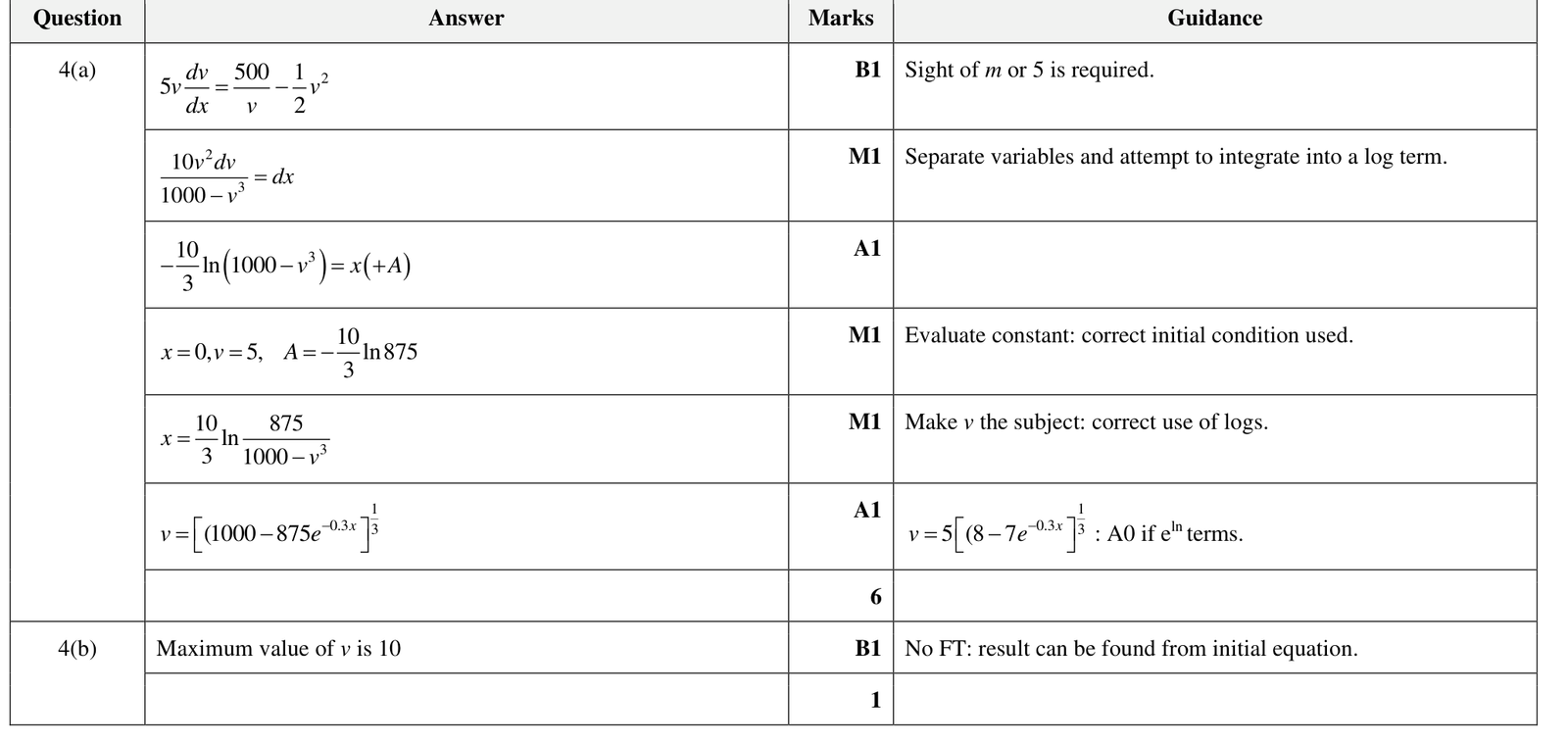
A particle \(P\) of mass 5 kg moves along a horizontal straight line. At time \(t \mathrm{~s}\), the velocity of \(P\) is \(v \mathrm{~m} \mathrm{~s}^{-1}\) and its displacement from a fixed point \(O\) on the line is \(x \mathrm{~m}\). The forces acting on \(P\) are a force of magnitude \(\frac{500}{v} \mathrm{~N}\) in the direction \(O P\) and a resistive force of magnitude \(\frac{1}{2} v^{2} \mathrm{~N}\). When \(t=0, x=0\) and \(v=5\).
(a) Find an expression for \(v\) in terms of \(x\).
(b) State the value that the speed approaches for large values of \(x\).