Past Exam Questions
← Back0606 P12 - Jun 2020 - Q9 - 12 marks
(a) A particle \(P\) moves in a straight line such that its displacement, \(x\) m, from a fixed point \(O\) at time \(t\) s is given by
\(x=10\sin2t-5.\)
(i) Find the speed of \(P\) when \(t=\pi\).
(ii) Find the value of \(t\) for which \(P\) is first at rest.
(iii) Find the acceleration of \(P\) when it is first at rest.
(b) The diagram shows the velocity-time graph for a particle \(Q\) travelling in a straight line with velocity \(v\text{ m s}^{-1}\) at time \(t\) s. The particle accelerates at \(3.5\text{ m s}^{-2}\) for the first \(10\) s of its motion and then travels at constant velocity, \(V\text{ m s}^{-1}\), for \(10\) s. The particle then decelerates at a constant rate and comes to rest. The distance travelled during the interval \(20\leq t\leq25\) is \(112.5\) m.
(i) Find the value of \(V\).
(ii) Find the velocity of \(Q\) when \(t=25\).
(iii) Find the value of \(t\) when \(Q\) comes to rest.


0606 P13 - Jun 2020 - Q3 - 7 marks
At time \(t\) s, a particle travelling in a straight line has acceleration
\((2t+1)^{-\frac12}\text{ m s}^{-2}.\)
When \(t=0\), the particle is \(4\) m from a fixed point \(O\) and is travelling with velocity \(8\text{ m s}^{-1}\) away from \(O\).
(a) Find the velocity of the particle at time \(t\) s.
(b) Find the displacement of the particle from \(O\) at time \(t\) s.

0606 P21 - Jun 2020 - Q9 - 7 marks
A particle travels in a straight line. As it passes through a fixed point \(O\), the particle is travelling at a velocity of \(3\text{ m s}^{-1}\). The particle continues at this velocity for 60 seconds then decelerates at a constant rate for 15 seconds to a velocity of \(1.6\text{ m s}^{-1}\). The particle then decelerates again at a constant rate for 5 seconds to reach point \(A\), where it stops.
(a) Sketch the velocity-time graph for this journey.
(b) Find the distance between \(O\) and \(A\).
(c) Find the deceleration in the last 5 seconds.

0606 P12 - Nov 2020 - Q12 - 10 marks
The diagram shows the velocity-time graph for the motion of a car during the first \(90\) seconds of a journey. The total distance travelled in this time is \(2775\) m.
(a)(i) Find the value of \(V\).
(a)(ii) Find the acceleration of the car when \(t=40\).
(b) The acceleration of a particle is given by
\(a=6\cos 2t.\)
When \(t=0\), the velocity is \(10\) and the displacement is \(0\). Find expressions for the velocity and displacement at time \(t\).


0606 P12 - Mar 2019 - Q8 - 8 marks
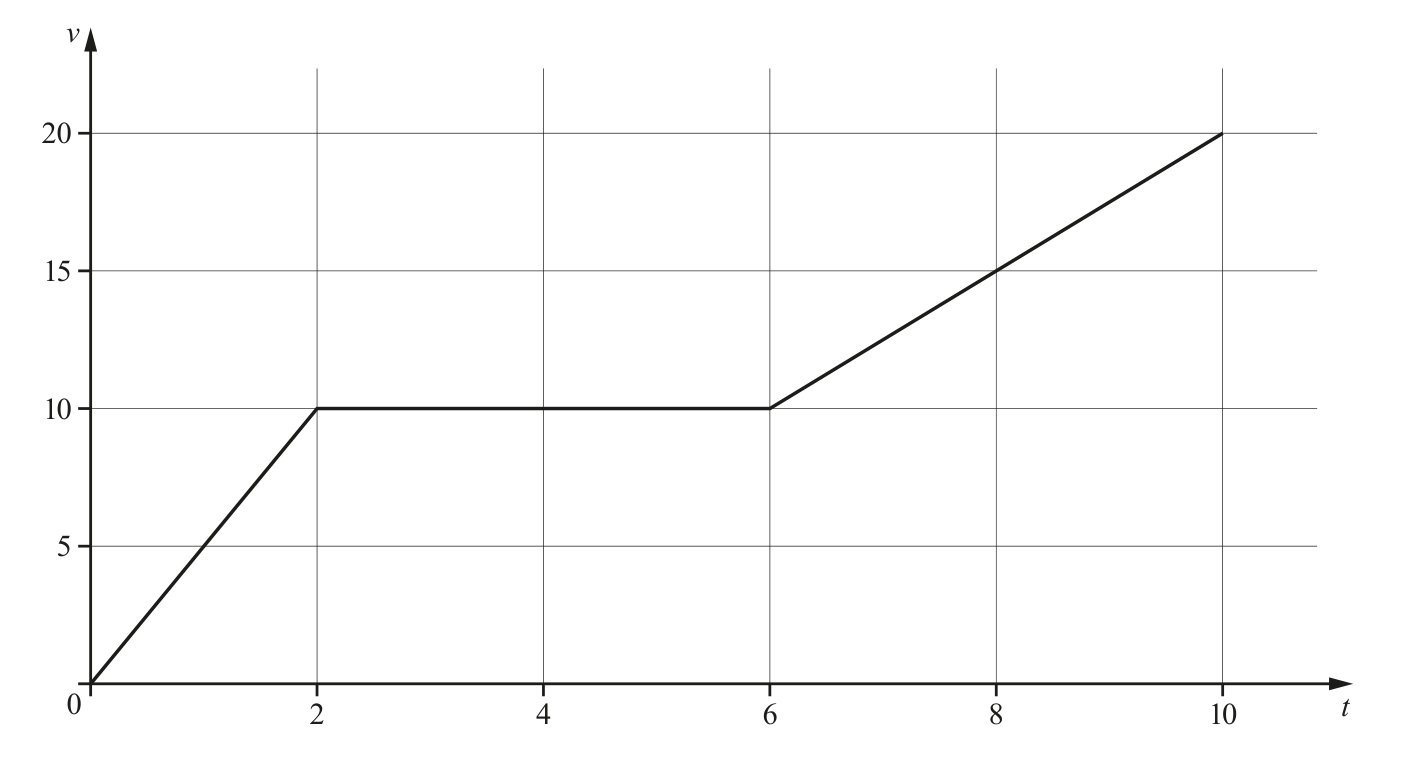
The velocity-time graph for a particle \(P\) travelling in a straight line is shown.
(a) Find
(i) the acceleration of \(P\) at \(t=5\),
(ii) the distance travelled by \(P\) in the first 10 seconds.
A second particle \(Q\) moves with velocity \(v=3\sin2t-1\), where \(t\) is measured in seconds and \(v\) in metres per second.
(b) Find
(i) the speed of \(Q\) when \(t=\dfrac{7\pi}{12}\),
(ii) the first positive value of \(t\) for which \(Q\) has zero acceleration.

0606 P21 - Jun 2019 - Q5 - 5 marks
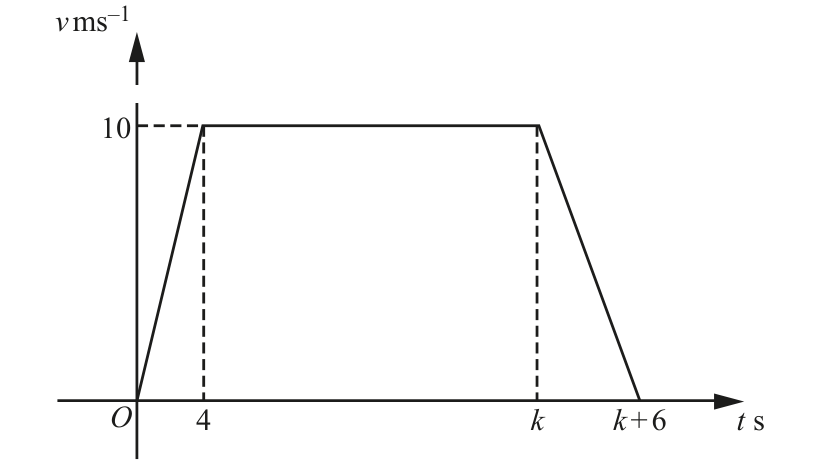
The velocity-time graph represents the motion of a particle travelling in a straight line.
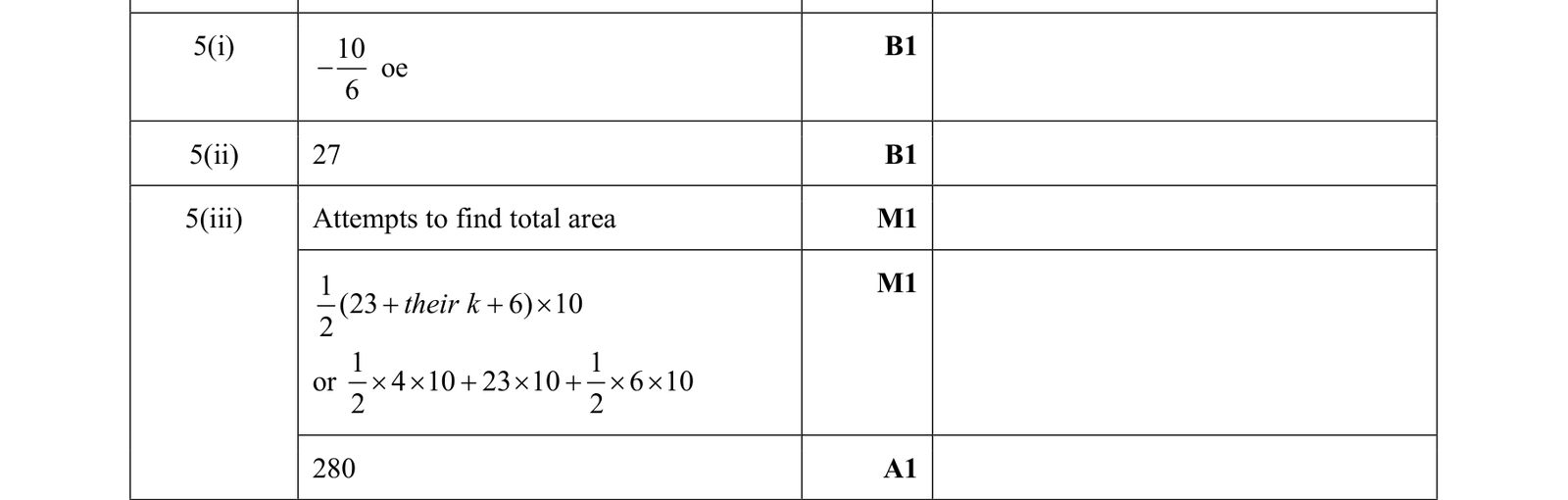
(i) Find the acceleration during the last 6 seconds of the motion.
(ii) The particle travels with constant velocity for 23 seconds. Find \(k\).
(iii) Using your answer to part (ii), find the total distance travelled by the particle.
0606 P22 - Jun 2019 - Q11 - 9 marks
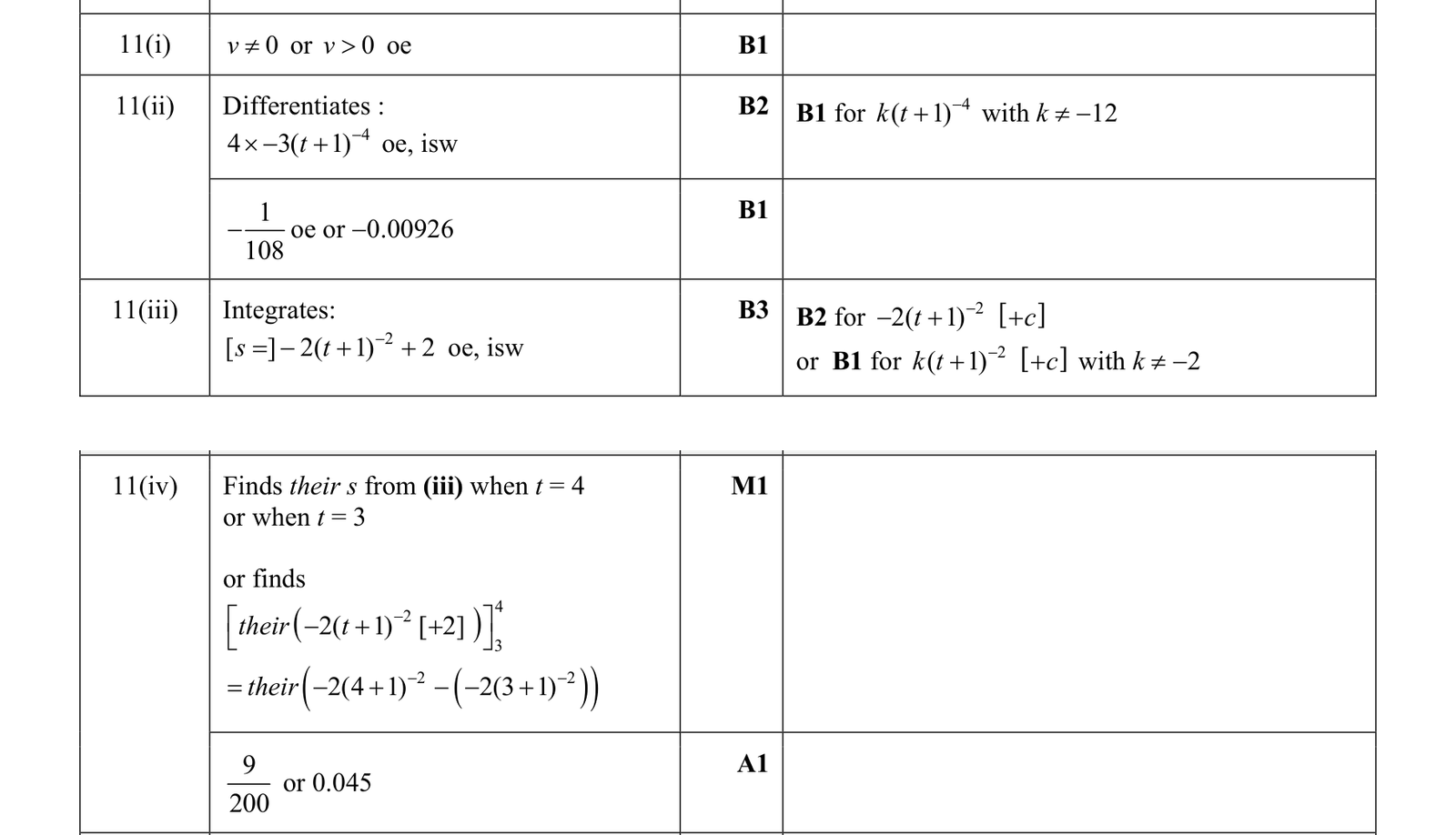
The velocity \(v\text{ m s}^{-1}\) of a particle \(t\) seconds after passing through a fixed point \(O\) is given by \(v=\dfrac{4}{(t+1)^3}\).
(i) Explain why the particle never changes direction.
(ii) Find the acceleration of the particle when \(t=5\).
(iii) Find an expression for the displacement of the particle from \(O\) after \(t\) seconds.
(iv) Find the distance travelled by the particle in the fourth second.
0606 P13 - Nov 2019 - Q10 - 11 marks
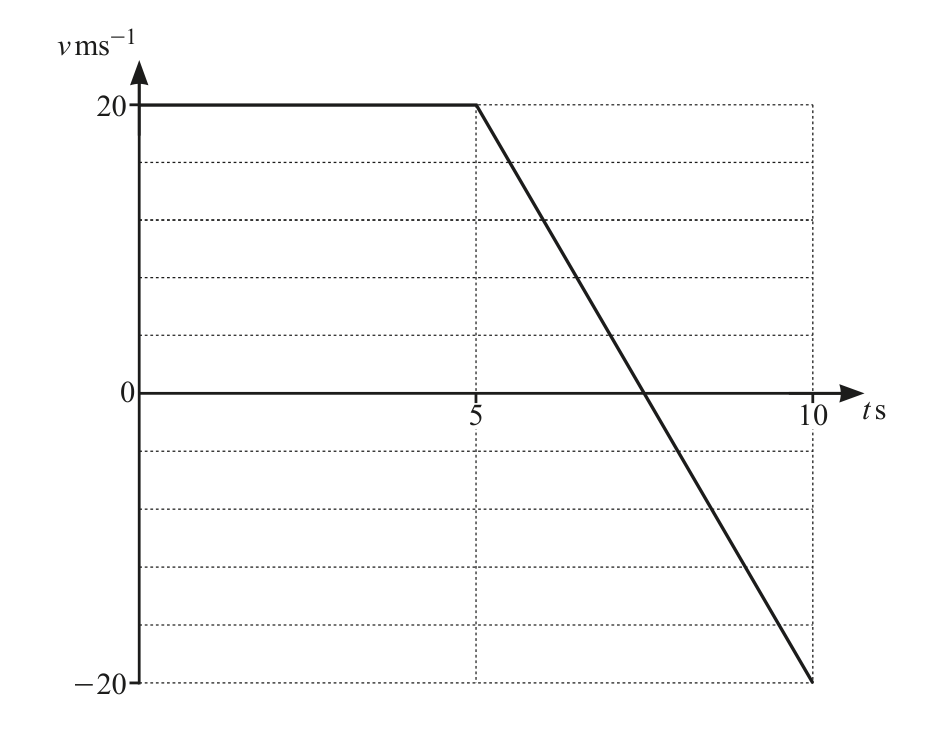
(a) The velocity-time graph for a particle \(P\) is shown by the two straight lines in the diagram.
(i) Find the deceleration of \(P\) for \(5\leq t\leq10\).
(ii) Write down the value of \(t\) when the speed of \(P\) is zero.
(iii) Find the distance \(P\) has travelled for \(0\leq t\leq10\).
(b) A particle \(Q\) has a displacement of \(x\) m from a fixed point \(O\), \(t\) s after leaving \(O\). The velocity, \(v\text{ m s}^{-1}\), of \(Q\) at time \(t\) s is given by
\(v=6e^{2t}+1.\)
(i) Find an expression for \(x\) in terms of \(t\).
(ii) Find the value of \(t\) when the acceleration of \(Q\) is \(24\text{ m s}^{-2}\).

0606 P12 - Mar 2018 - Q8 - 9 marks
A particle \(P\) moves in a straight line. The displacement of \(P\) from a fixed point \(O\) is \(x\) metres at time \(t\) seconds. The particle passes through \(O\) when \(t=0\), and its velocity \(v\) metres per second is given by
\(v=12e^{2t}-48t,\qquad t\geq0.\)
(i) Find \(x\) in terms of \(t\).
(ii) Find the value of \(t\) for which the acceleration of \(P\) is zero.
(iii) Find the velocity of \(P\) when its acceleration is zero.

0606 P13 - Jun 2017 - Q12 - 9 marks
A particle moves in a straight line, such that its velocity, \(v\text{ ms}^{-1}\), \(t\) s after passing a fixed point \(O\), is given by
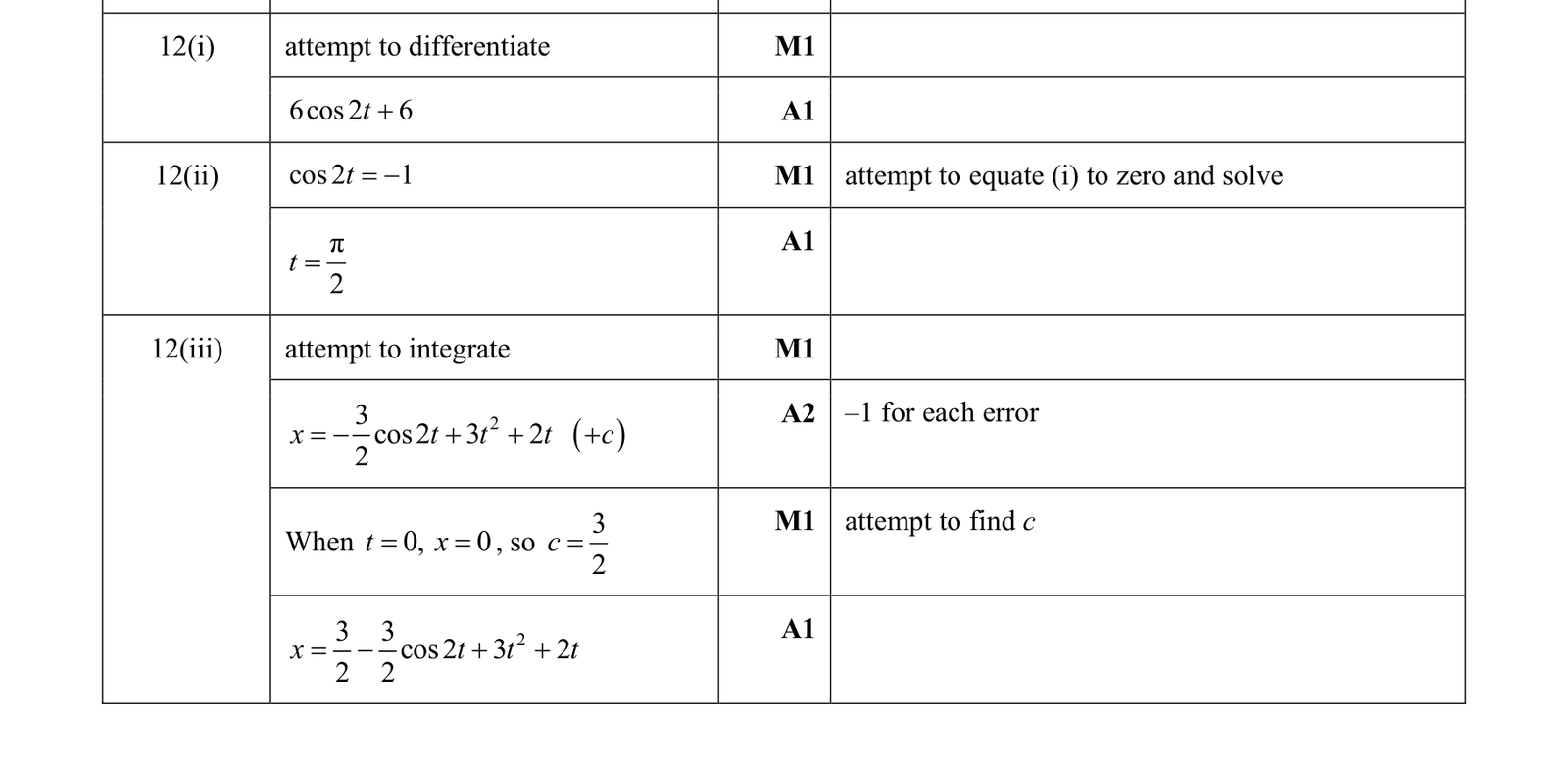
\(v=2+6t+3\sin2t.\)
(i) Find the acceleration of the particle at time \(t\).
(ii) Hence find the smallest value of \(t\) for which the acceleration of the particle is zero.
(iii) Find the displacement, \(x\) m from \(O\), of the particle at time \(t\).
0606 P12 - Mar 2019 - Q6 - 7 marks
(a) Given
\(A=\begin{pmatrix}1&2\\0&-1\end{pmatrix},\quad B=\begin{pmatrix}1&-4\\2&5\\3&1\end{pmatrix},\quad C=\begin{pmatrix}3&-2&0\end{pmatrix},\)
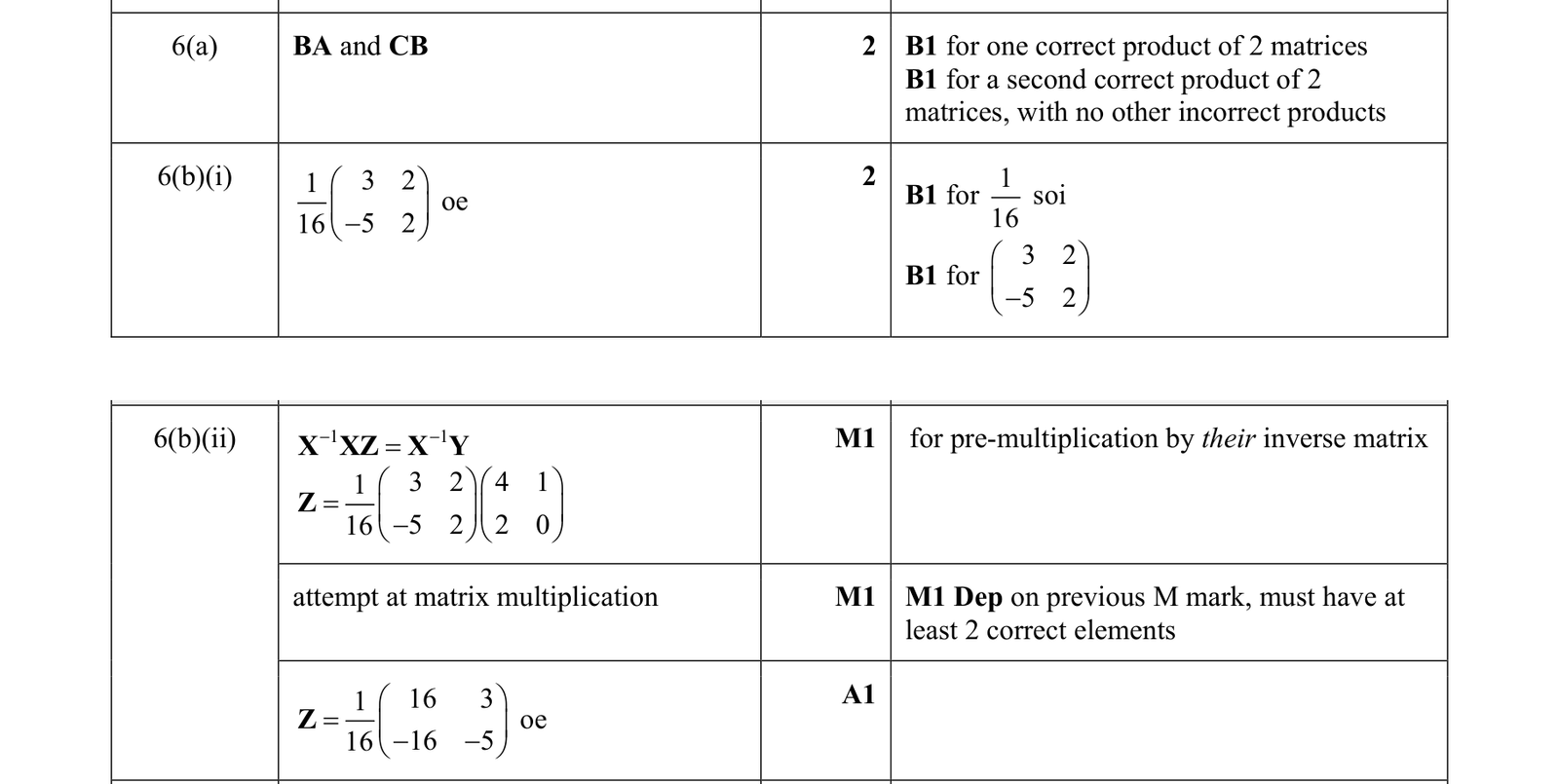
write down all the possible products that can be formed by multiplying two of these matrices.
(b) Given
\(X=\begin{pmatrix}2&-2\\5&3\end{pmatrix},\qquad Y=\begin{pmatrix}4&1\\2&0\end{pmatrix},\)
(i) find \(X^{-1}\),
(ii) solve the matrix equation \(XZ=Y\).
0606 P21 - Jun 2019 - Q6 - 6 marks
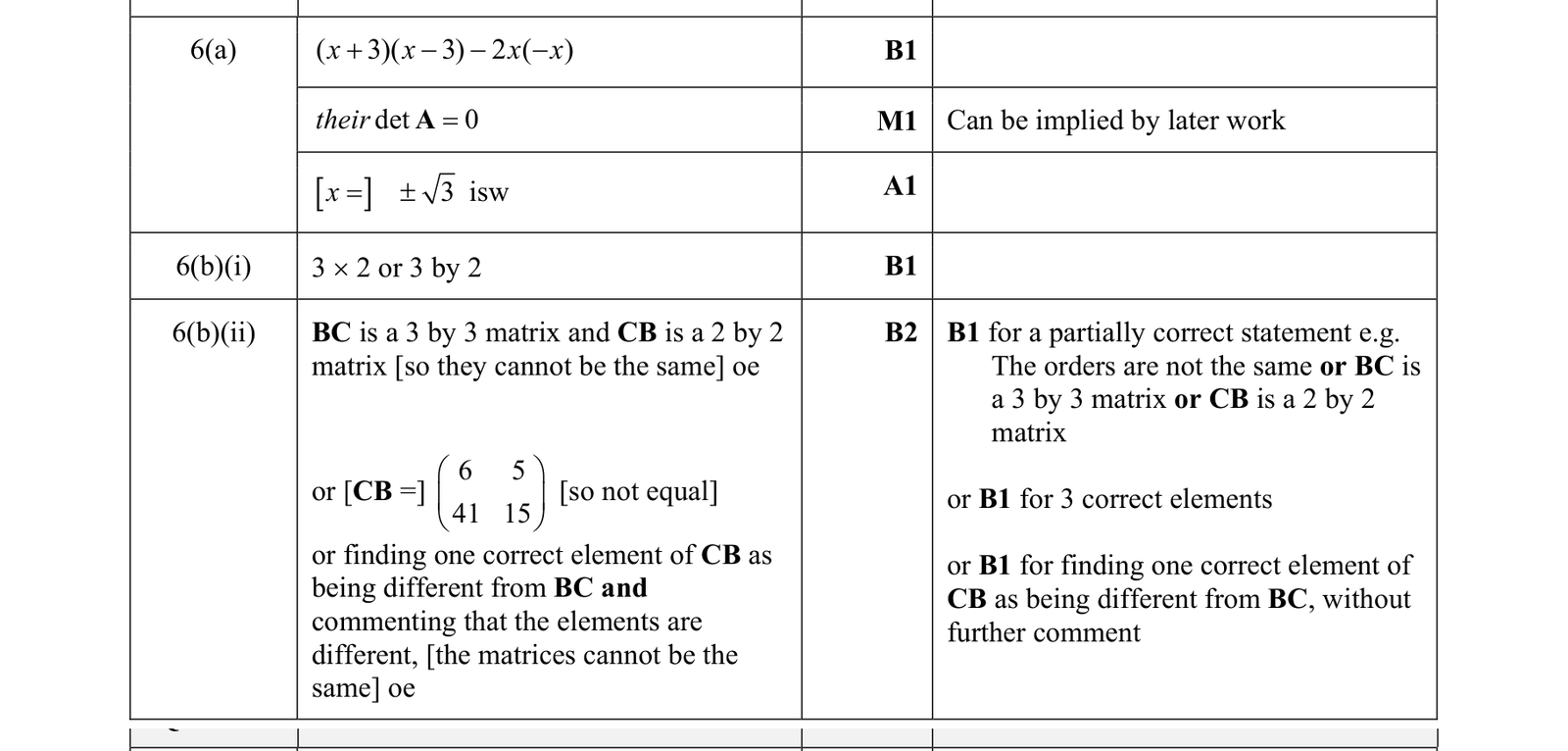
(a) \(A=\begin{pmatrix}x+3&-x\\2x&x-3\end{pmatrix}\). Given that \(A\) does not have an inverse, find the exact values of \(x\).
(b) \(B=\begin{pmatrix}0&3\\-4&1\\5&2\end{pmatrix}\) and \(C=\begin{pmatrix}0&1&2\\3&-4&5\end{pmatrix}\).
(i) Write down the order of matrix \(B\).
(ii) Explain why \(CB\ne BC\).
0606 P22 - Jun 2019 - Q6 - 5 marks
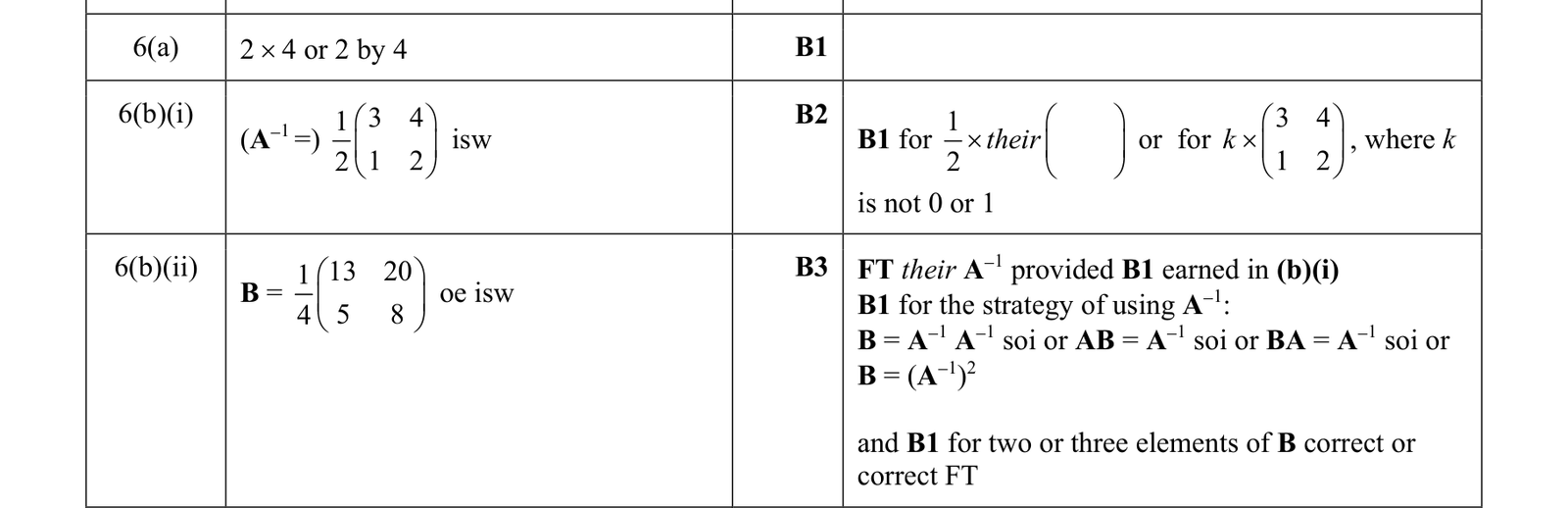
(a) State the order of the matrix \(\begin{pmatrix}0&1&4&8\\5&8&1&6\end{pmatrix}\).
(b) The matrix \(A\) is given by \(A=\begin{pmatrix}2&-4\\-1&3\end{pmatrix}\).
(i) Find \(A^{-1}\).
(ii) Hence, given that \(ABA=I\), find \(B\).
0606 P23 - Jun 2019 - Q5 - 6 marks
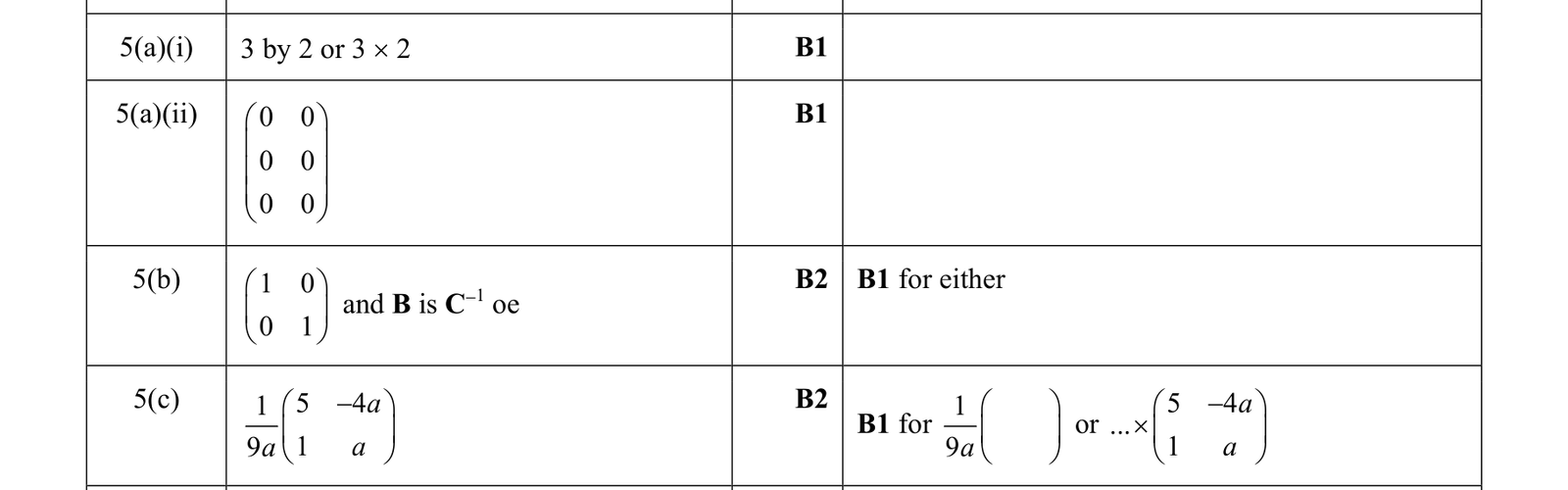
(a) Given that \(A=\begin{pmatrix}2&5\\0&-1\\6&4\end{pmatrix}\) and that \(A+O=A\),
(i) state the order of the matrix \(A\),
(ii) write down the matrix \(O\).
(b) \(B=\begin{pmatrix}1&-1\\3&2\end{pmatrix}\) and \(C=\begin{pmatrix}0.4&0.2\\-0.6&0.2\end{pmatrix}\). Find the matrix product \(BC\) and state a relationship between \(B\) and \(C\).
(c) \(D=\begin{pmatrix}a&4a\\-1&5\end{pmatrix}\), where \(a\) is a positive integer. Find \(D^{-1}\) in terms of \(a\).
0606 P12 - Nov 2019 - Q8 - 9 marks
(a) Five teams took part in a competition in which each team played each of the other \(4\) teams. The following table represents the results after all the matches had been played.
| Team | Won | Drawn | Lost |
|---|---|---|---|
| A | 2 | 1 | 1 |
| B | 1 | 3 | 0 |
| C | 1 | 1 | 2 |
| D | 0 | 1 | 3 |
| E | 3 | 0 | 1 |
Points in the competition were awarded to the teams as follows:
\(4\text{ for each match won},\qquad 2\text{ for each match drawn},\qquad 0\text{ for each match lost}.\)
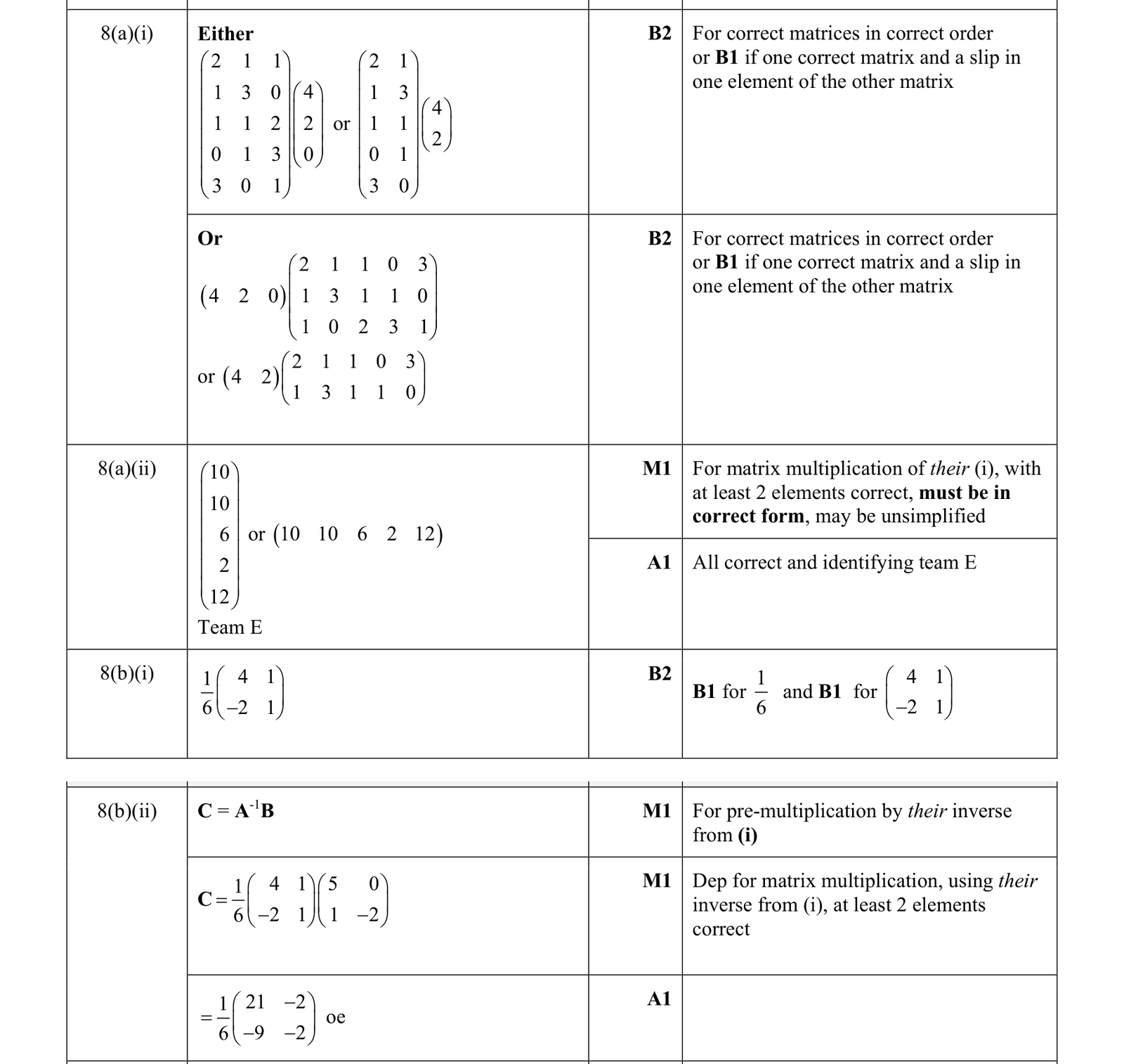
(i) Write down two matrices whose product under matrix multiplication will give the total number of points awarded to each team.
(ii) Evaluate the matrix product from part (i) and hence state which team was awarded the most points.
(b) It is given that
\(A=\begin{pmatrix}1&-1\\2&4\end{pmatrix},\qquad B=\begin{pmatrix}5&0\\1&-2\end{pmatrix}.\)
(i) Find \(A^{-1}\).
(ii) Hence find the matrix \(C\) such that \(AC=B\).
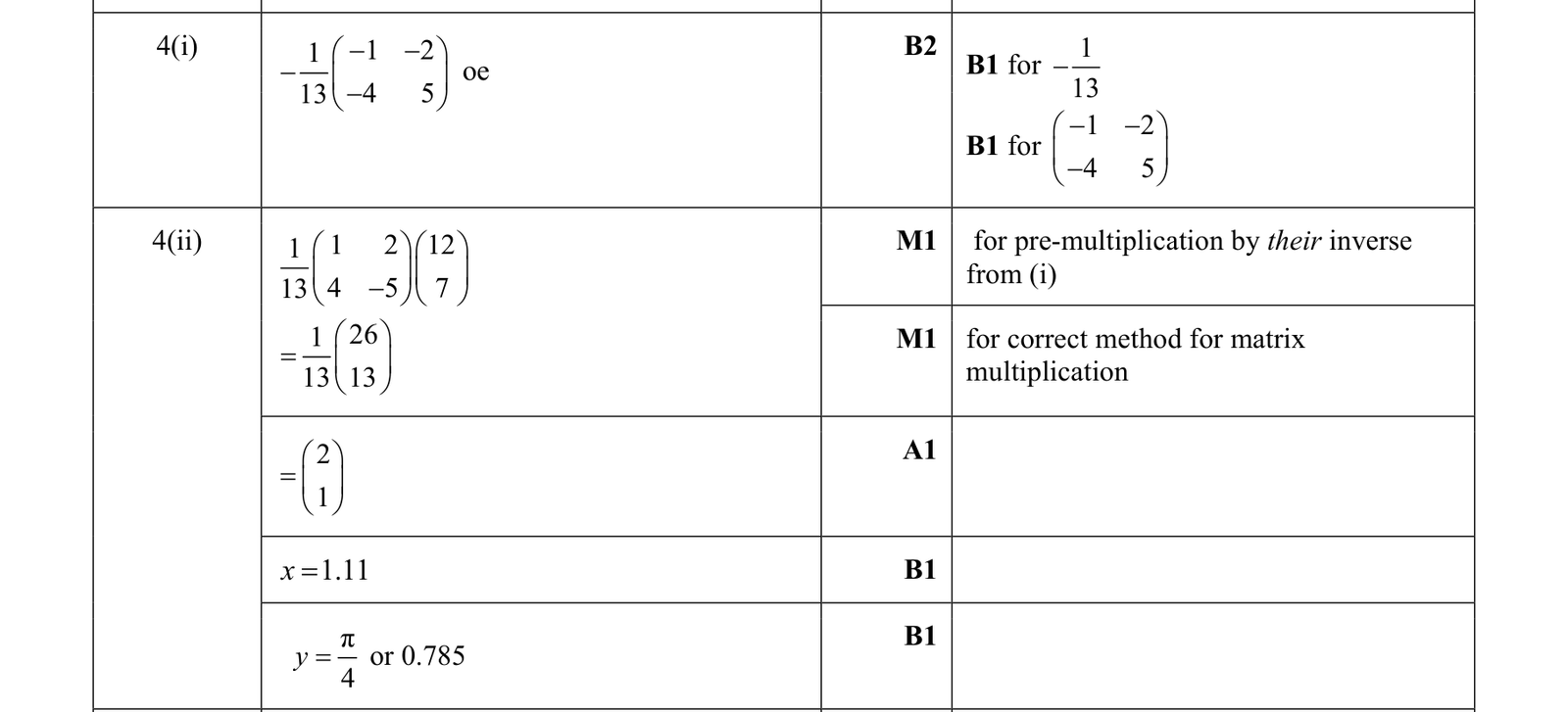
0606 P13 - Nov 2019 - Q4 - 7 marks
It is given that
\(A=\begin{pmatrix}5&2\\4&-1\end{pmatrix}.\)
(i) Find \(A^{-1}\).
(ii) Hence find, in radians, the acute angles \(x\) and \(y\) such that
\(5\tan x+2\tan y=12,\)
\(4\tan x-\tan y=7.\)
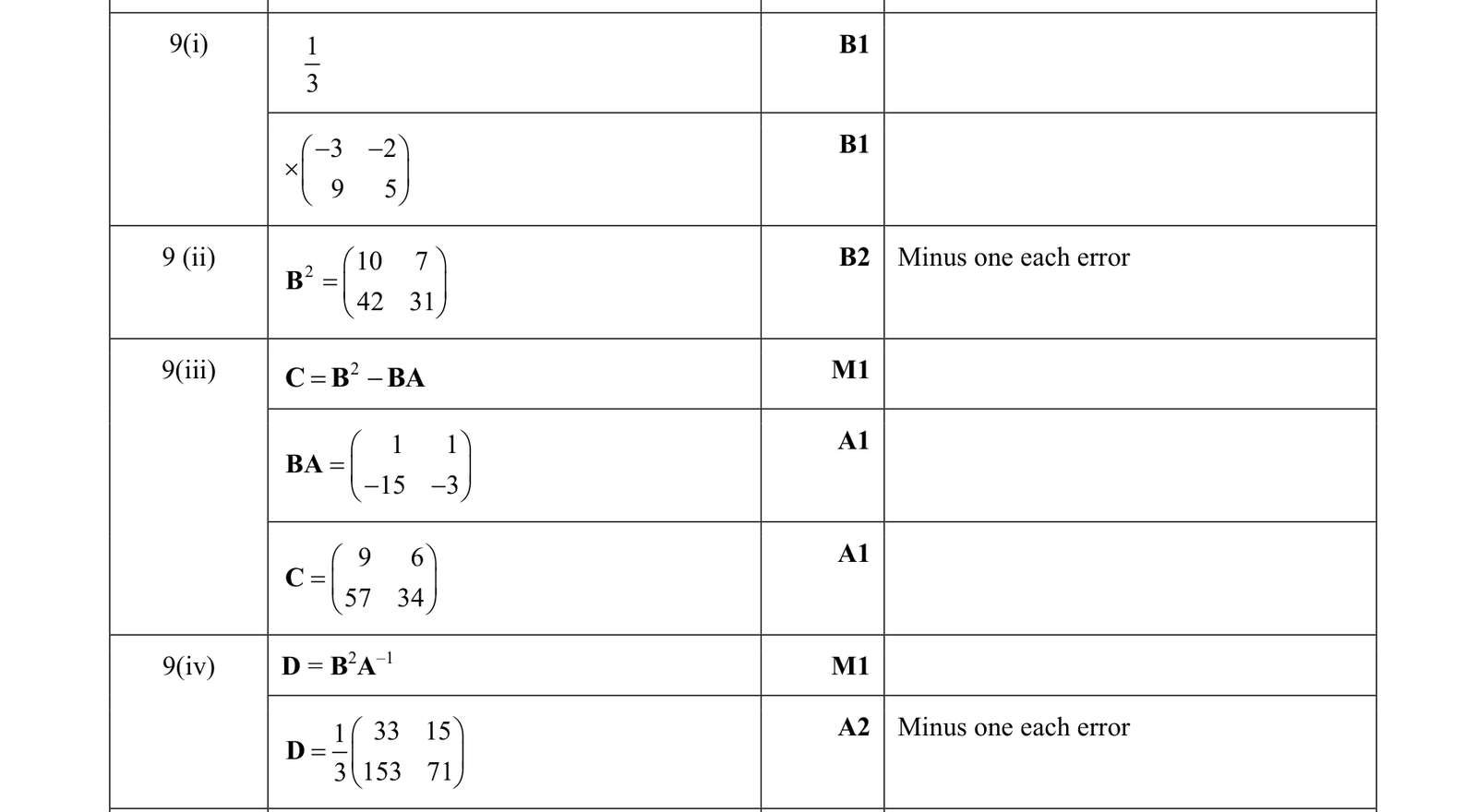
0606 P21 - Nov 2019 - Q9 - 10 marks
Given that
\(A=\begin{pmatrix}5&2\\-9&-3\end{pmatrix},\qquad B=\begin{pmatrix}2&1\\6&5\end{pmatrix},\)
find
(i) \(A^{-1}\),
(ii) \(B^2\),
(iii) the matrix \(C\), where \(B^{-1}C+A=B\),
(iv) the matrix \(D\), where \(B^{-2}DA=I\).
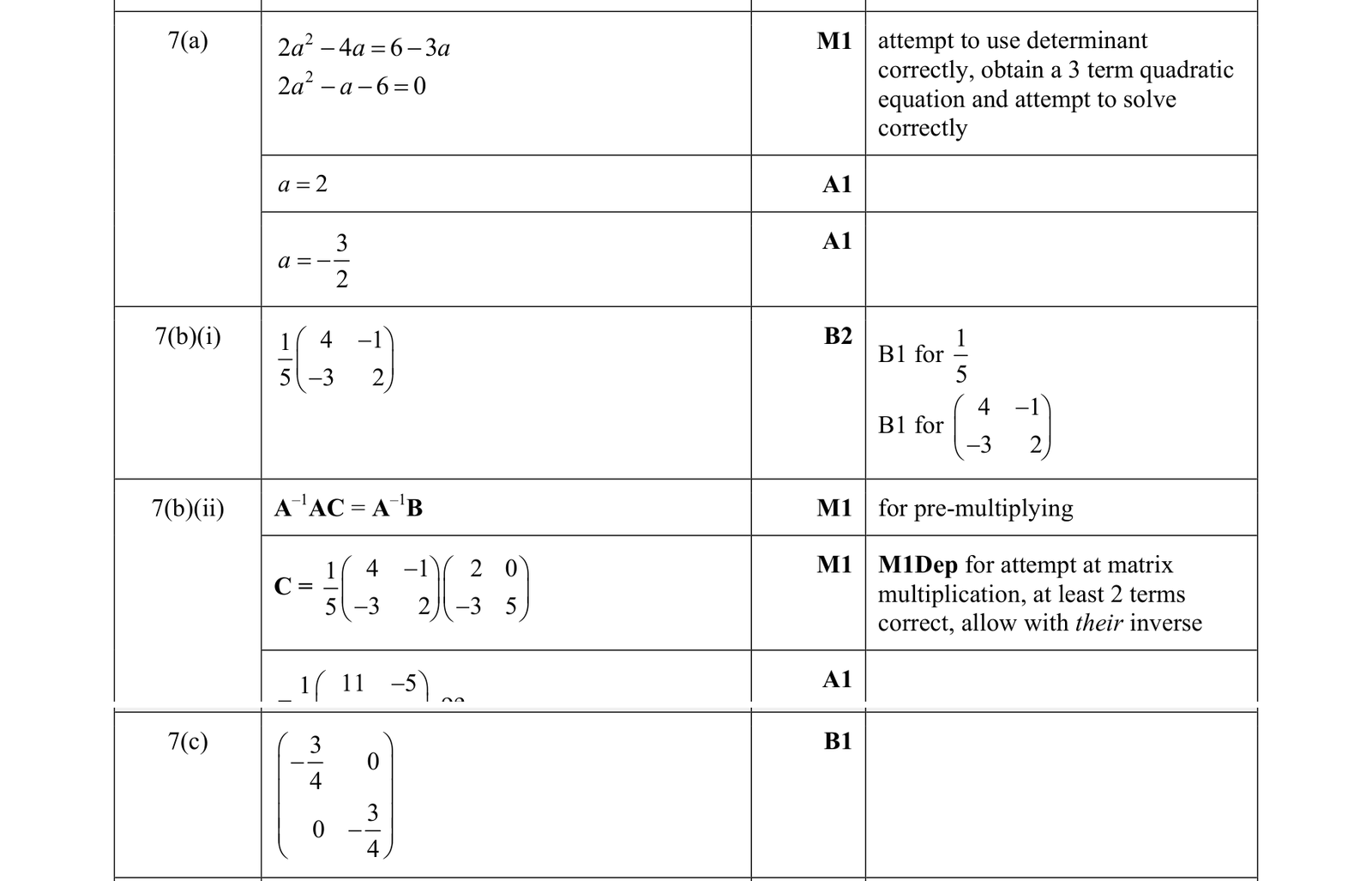
0606 P12 - Mar 2018 - Q7 - 9 marks
(a) Find the values of \(a\) for which the determinant of \(\begin{pmatrix}2a&1\\4a&a\end{pmatrix}\) is \(6-3a\).
(b) Let \(A=\begin{pmatrix}2&1\\3&4\end{pmatrix}\) and \(B=\begin{pmatrix}2&0\\-3&5\end{pmatrix}\).
(i) Find \(A^{-1}\).
(ii) Hence find the matrix \(C\) such that \(AC=B\).
(c) Find the \(2\times2\) matrix \(D\) such that \(4D+3I=O\), where \(I\) is the identity matrix and \(O\) is the zero matrix.
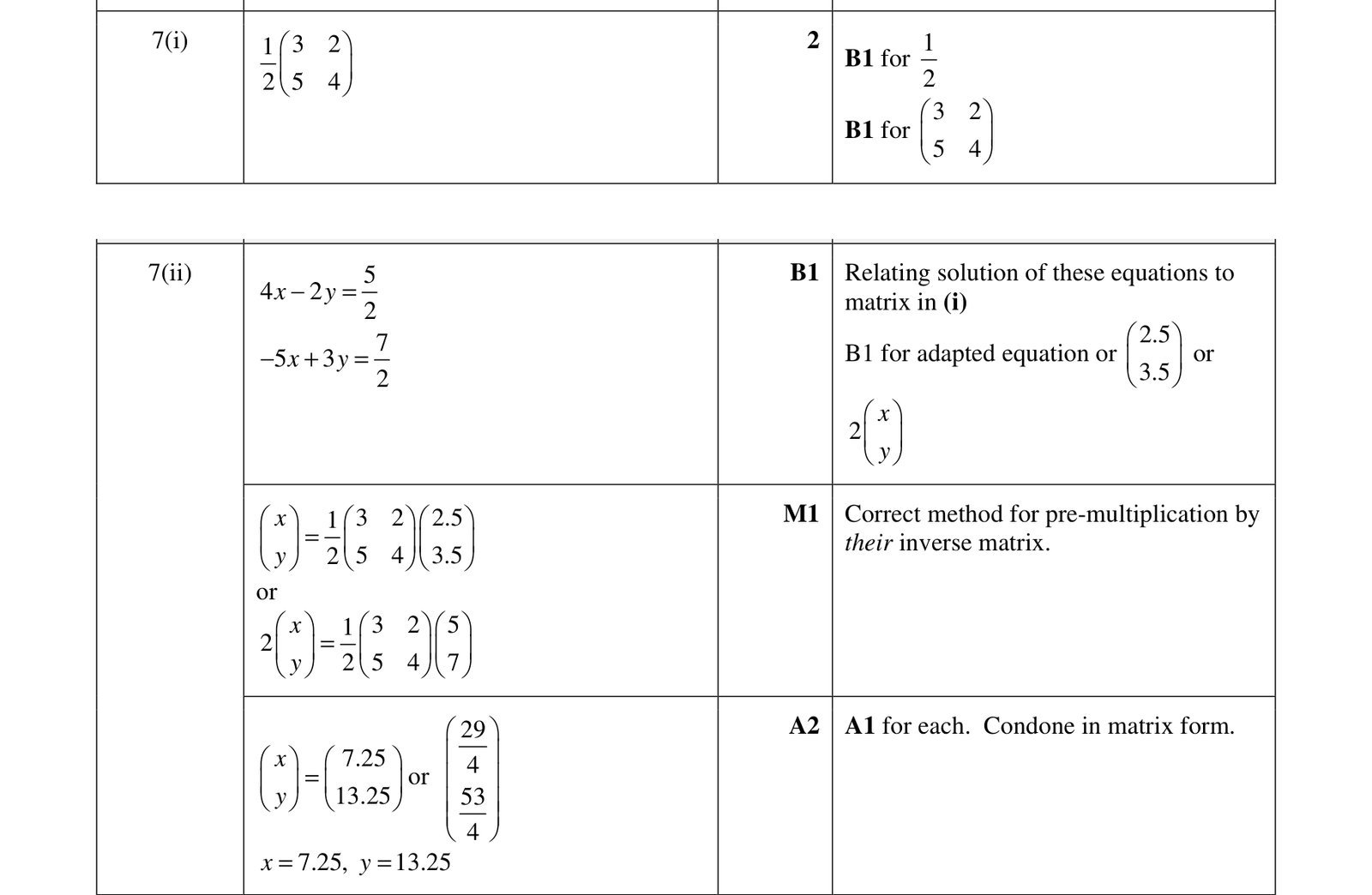
0606 P11 - Jun 2018 - Q7 - 6 marks
(i) Find the inverse of the matrix
\(\begin{pmatrix}4&-2\\-5&3\end{pmatrix}.\)
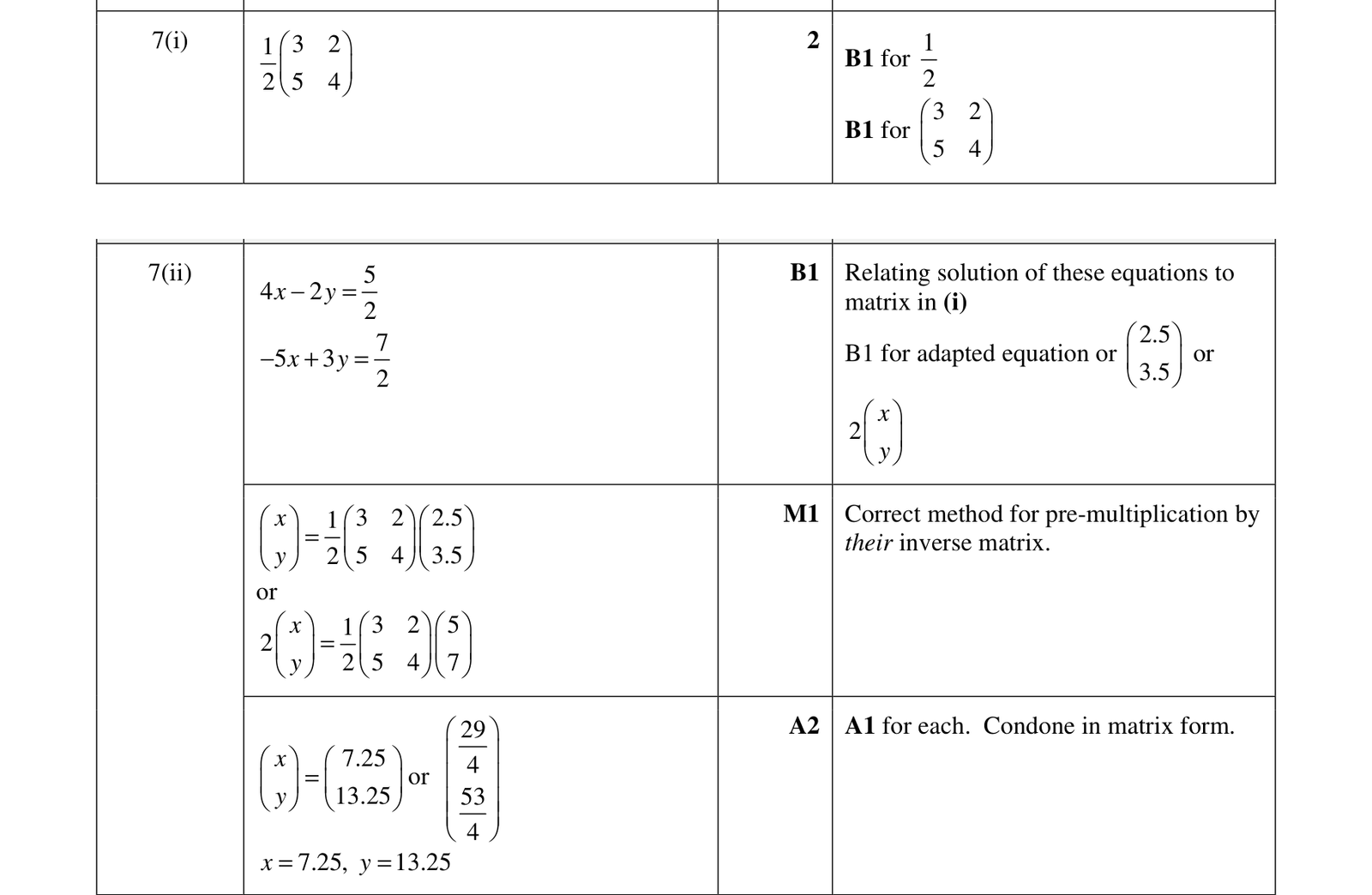
(ii) Hence solve the simultaneous equations
\(8x-4y-5=0,\qquad -10x+6y-7=0.\)
0606 P13 - Jun 2018 - Q7 - 6 marks
(i) Find the inverse of the matrix
\(\begin{pmatrix}4&-2\\-5&3\end{pmatrix}.\)
(ii) Hence solve the simultaneous equations
\(8x-4y-5=0,\qquad -10x+6y-7=0.\)