9231 P34 - Nov 2025 - Q7 - 8 marks
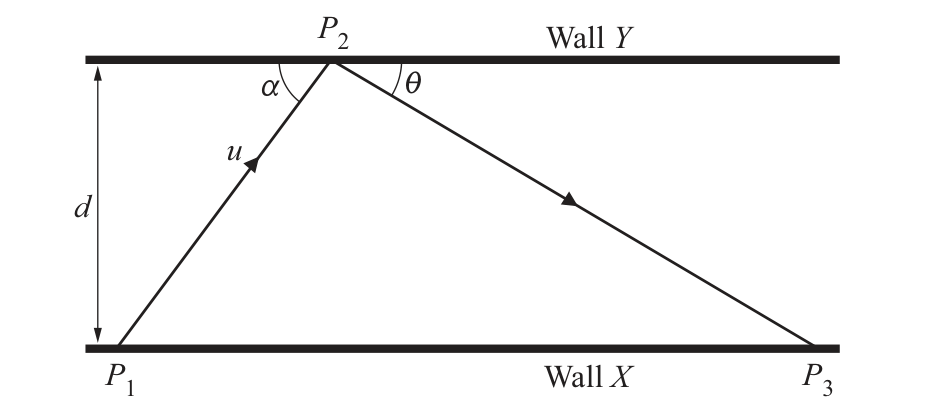
\(X\) and \(Y\) are two fixed smooth vertical walls on a smooth horizontal surface. The walls are parallel and at a distance \(d\) apart. The points \(P_{1}, P_{2}\) and \(P_{3}\) all lie on the surface.
A particle \(Q\) is projected horizontally from the point \(P_{1}\) on Wall \(X\) with speed \(u\), and moves along the surface. The particle \(Q\) strikes Wall \(Y\) at the point \(P_{2}\). Immediately before the collision, the direction of motion of \(Q\) makes an angle \(\alpha\) with Wall \(Y\), where \(\sin \alpha=\frac{4}{5}\). Immediately after the collision, the direction of motion of \(Q\) makes an angle \(\theta\) with Wall \(Y\). The particle \(Q\) then strikes Wall \(X\) at the point \(P_{3}\) (see diagram).
The time that it takes \(Q\) to travel the distance \(P_{1} P_{2}\) is \(T\). The time that it takes \(Q\) to travel the distance \(P_{2} P_{3}\) is \(k T\).
Find, in terms of \(k\), the coefficient of restitution between \(Q\) and wall \(Y\).