Past Exam Questions
← Back0606 P21 - Jun 2017 - Q12 - 9 marks
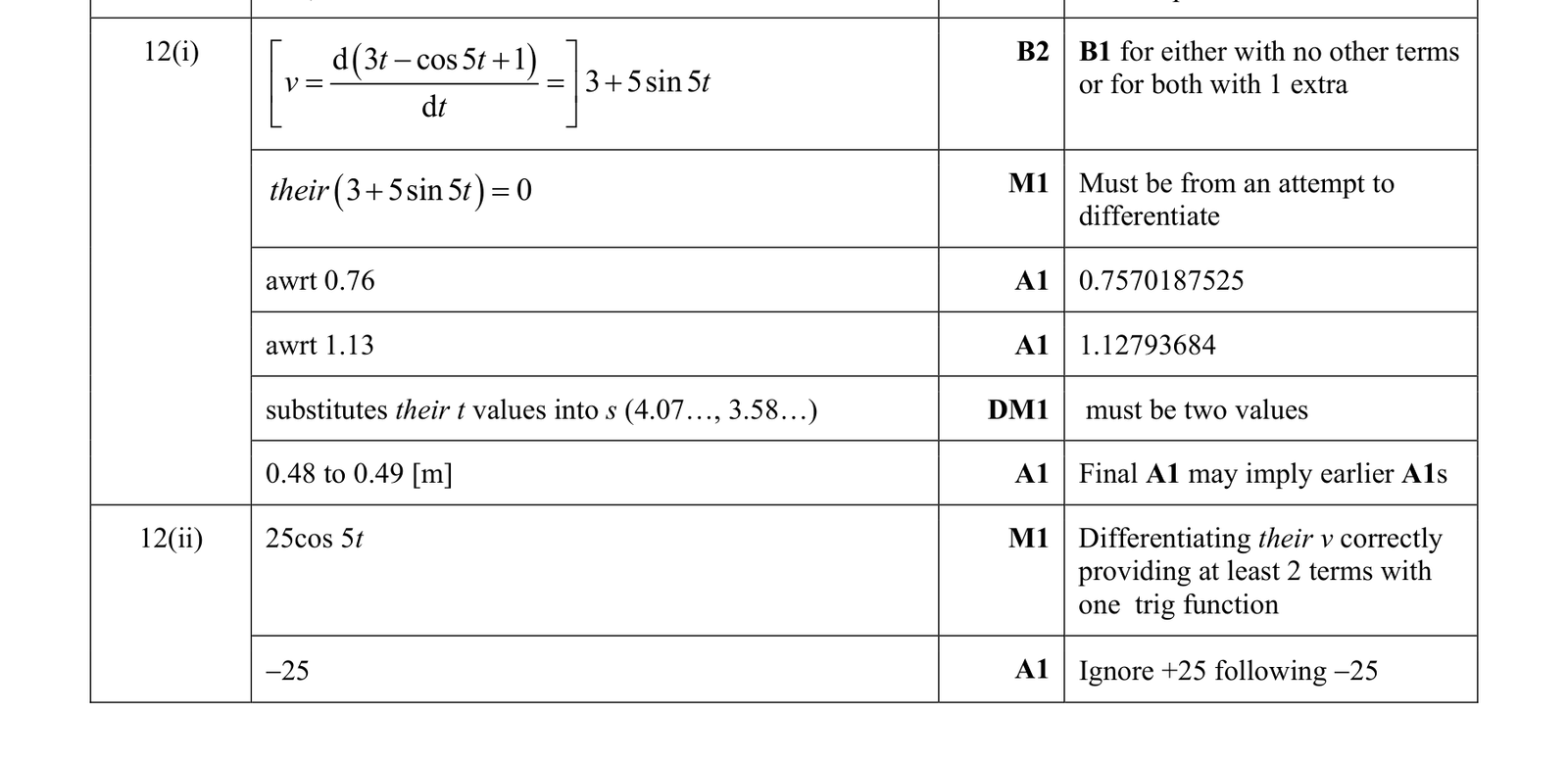
A particle moves in a straight line so that, \(t\) seconds after passing a fixed point \(O\), its displacement, \(s\) m, from \(O\) is given by
\(s=1+3t-\cos5t.\)
(i) Find the distance between the particle's first two positions of instantaneous rest.
(ii) Find the acceleration when \(t=\pi\).
0606 P12 - Nov 2017 - Q9 - 11 marks
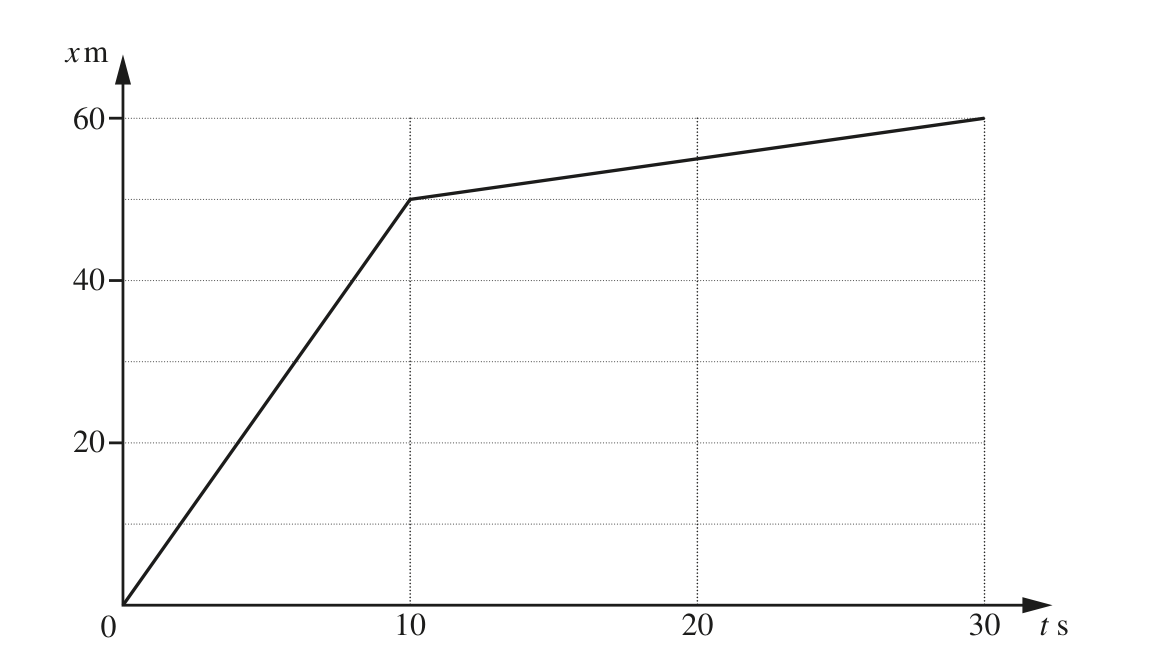
(a) The diagram shows the displacement-time graph of a particle \(P\). On the axes provided, draw the velocity-time graph of \(P\).
(b) A particle \(Q\) moves in a straight line such that its velocity, \(v\text{ m s}^{-1}\), \(t\) seconds after passing through a fixed point \(O\), is given by \(v=3e^{-5t}+\dfrac32t\), for \(t\geq0\).
(i) Find the velocity of \(Q\) when \(t=0\).
(ii) Find the value of \(t\) when the acceleration of \(Q\) is zero.
(iii) Find the distance of \(Q\) from \(O\) when \(t=0.5\).

0606 P23 - Nov 2017 - Q7 - 8 marks
A particle moving in a straight line passes through a fixed point \(O\). Its velocity, \(v\text{ m s}^{-1}\), \(t\) seconds after passing through \(O\), is given by
\(v=3\cos 2t-1\), for \(t\ge0\).
(i) Find the value of \(t\) when the particle is first at rest.
(ii) Find the displacement from \(O\) when \(t=\dfrac{\pi}{4}\).
(iii) Find the acceleration of the particle when it is first at rest.

0606 P21 - Nov 2025 - Q8 - 13 marks
In this question, the units are metres and seconds. A particle \(P\) is travelling in a straight line through a fixed point \(O\).
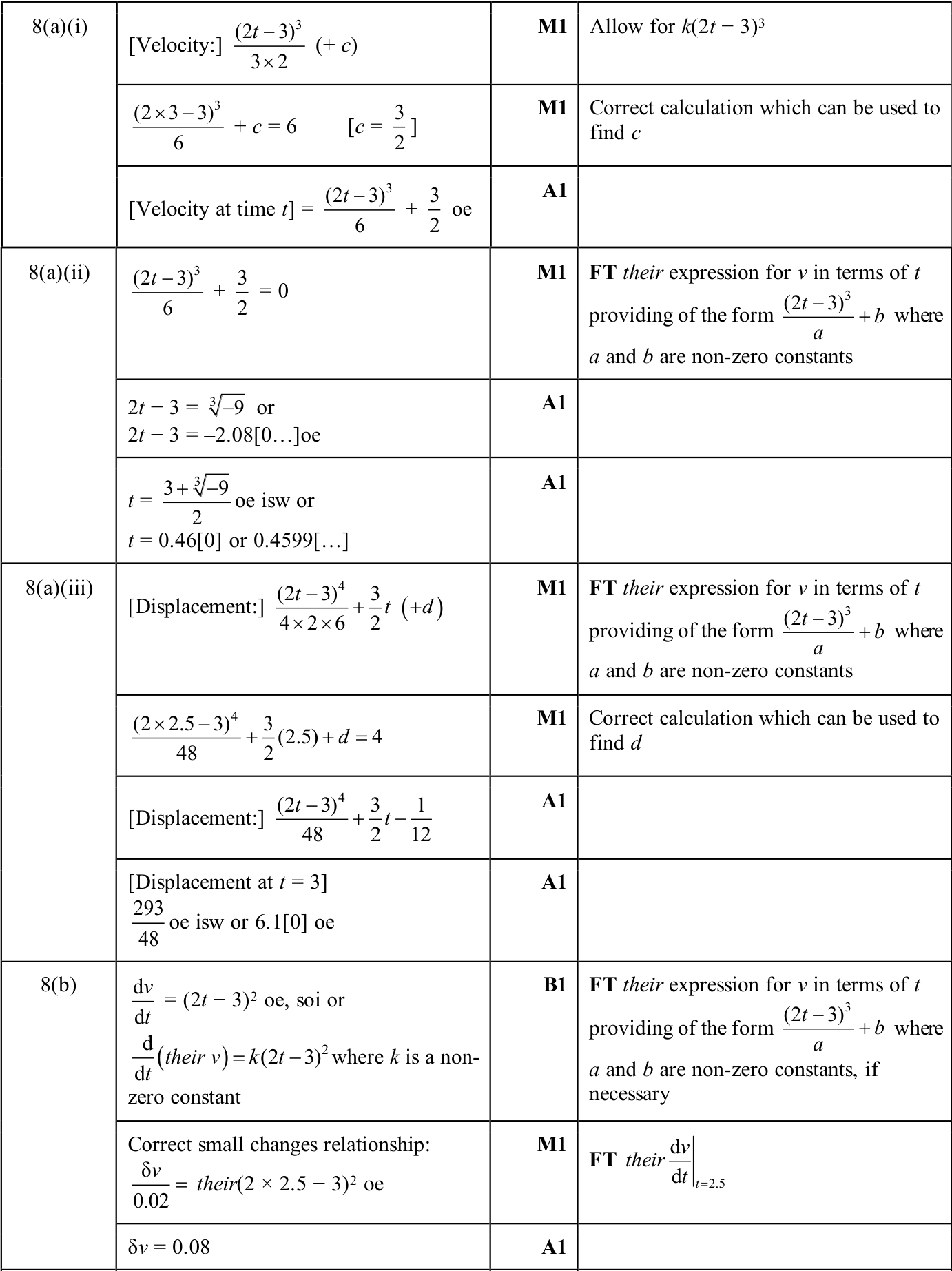
At time \(t\) its acceleration, \(a\), is given by \(a=(2t-3)^2\), where \(t\geqslant0\). When \(t=3\), \(P\) has a velocity of \(6\).
(a)(i) Find an expression for the velocity, \(v\), of \(P\) at time \(t\).
(ii) Find the time when \(P\) is at rest.
When \(t=\frac52\), the displacement of \(P\) from \(O\) is \(4\).
(iii) Find the displacement of \(P\) from \(O\) when \(t=3\).
(b) Use calculus to find the approximate change in \(v\) when \(t\) increases from \(\frac52\) by the small amount \(0.02\).
0606 P21 - Jun 2025 - Q10 - 11 marks
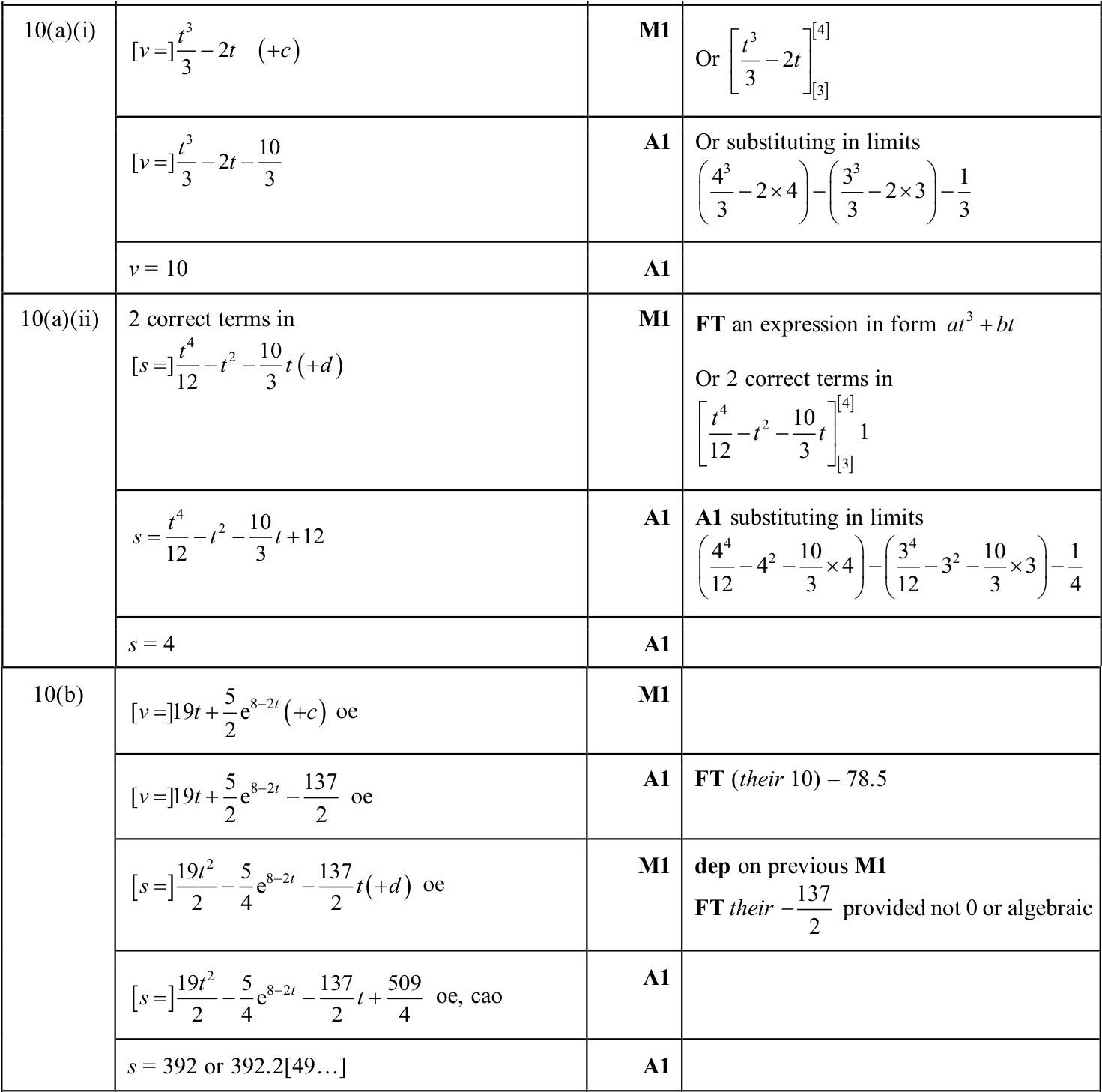
A particle \(P\) moves in a straight line. \(t\) seconds after passing a fixed point, \(O\), the acceleration of \(P\), \(a\text{ m s}^{-2}\), is given by
\(a=t^2-2\) for \(0\leqslant t\leqslant4\).
\(a=19-5\mathrm{e}^{8-2t}\) for \(4\leqslant t\leqslant10\).
When \(t=3\), the velocity of \(P\) is \(-\frac13\text{ m s}^{-1}\) and its displacement from \(O\) is \(-\frac14\text{ m}\).
(a)(i) Find the velocity of \(P\) when \(t=4\).
(a)(ii) Find the displacement of \(P\) from \(O\) when \(t=4\).
(b) Find the displacement of \(P\) from \(O\) when \(t=10\).
0606 P23 - Nov 2024 - Q12 - 9 marks
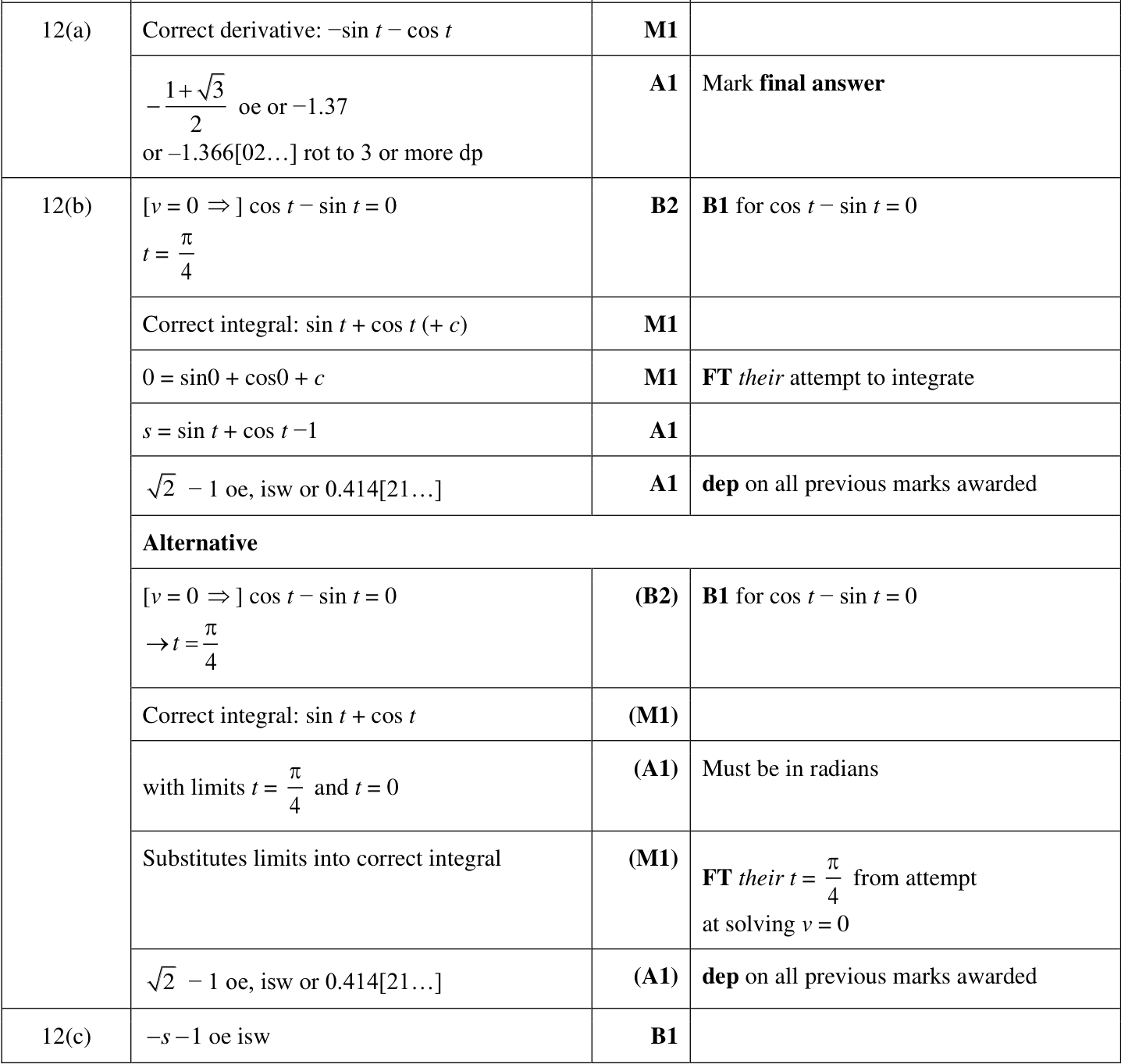
A particle moves in a straight line. Its velocity, \(v \mathrm{~ms}^{-1}\), at time \(t\) seconds is given by \(v=\cos t-\sin t\) (a) Find the acceleration, \(a \mathrm{~ms}^{-2}\), when \(t=\frac{\pi}{3}\).
The displacement of the particle from a fixed point \(O\) at time \(t\) is \(s\) metres. The particle passes through \(O\) when \(t=0\). (b) Find the displacement at the time when the particle first changes direction after passing through \(O\). (c) Find an expression for \(a\) in terms of \(s\).
0606 P11 - Jun 2024 - Q10 - 9 marks
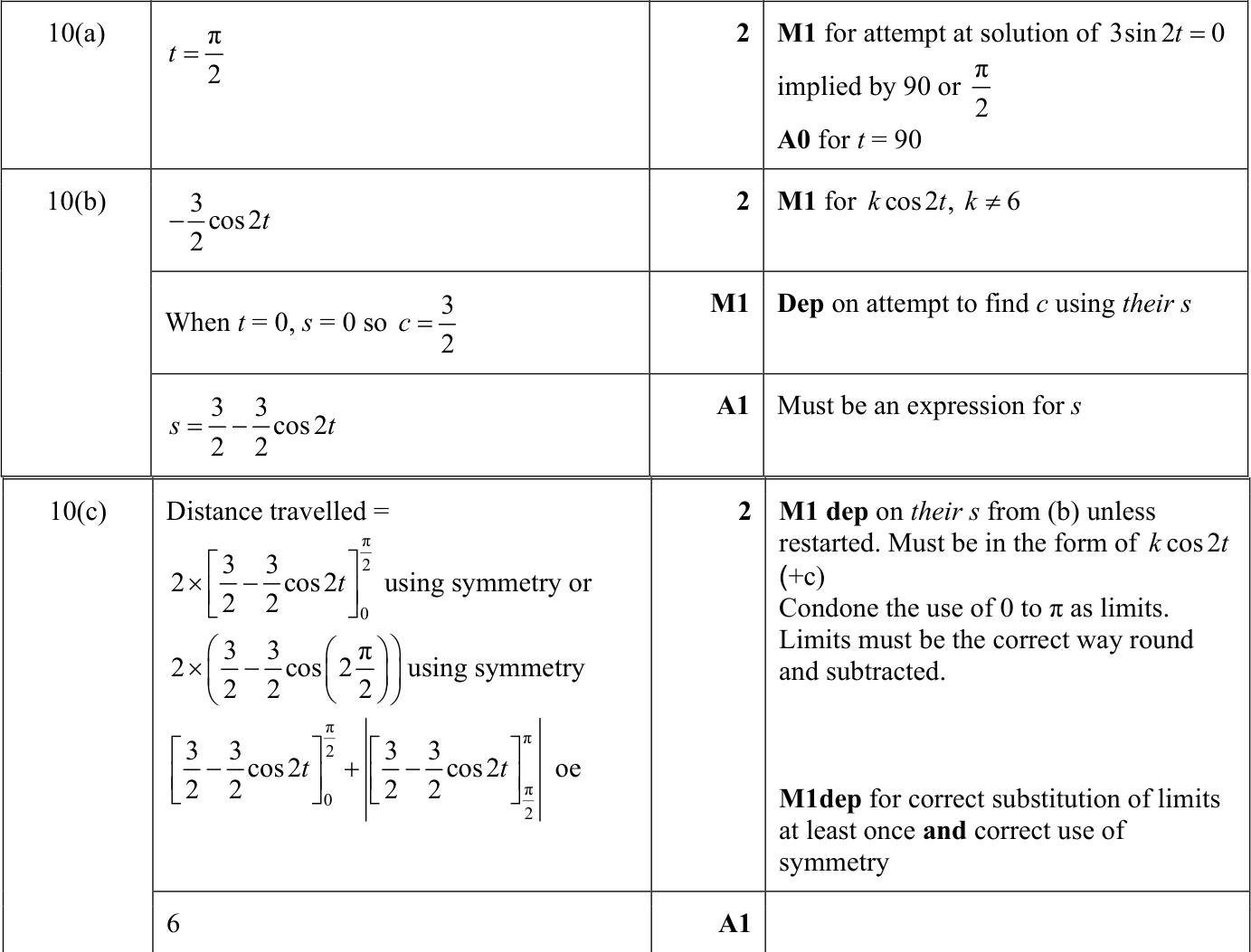
In this question, all distances are in metres and time, \(t\), is in seconds. A particle \(P\) is at a fixed point \(O\) at time \(t=0\). The velocity, \(v\), of \(P\) is given by \(v=3 \sin 2 t\) for \(t \geqslant 0\). (a) Find the exact value of \(t\) for which the velocity is zero for the first time after \(P\) leaves \(O\).
(b) Find an expression, in terms of \(t\), for the displacement of \(P\) from \(O\) at time \(t\).
(c) Find the distance travelled by \(P\) for \(0 \leqslant t \leqslant \pi\).
0606 P21 - Nov 2023 - Q7 - 10 marks
A particle moves in a straight line. At time \(t\) seconds after passing through a fixed point \(O\), its velocity, \(v\text{ m s}^{-1}\), is given by
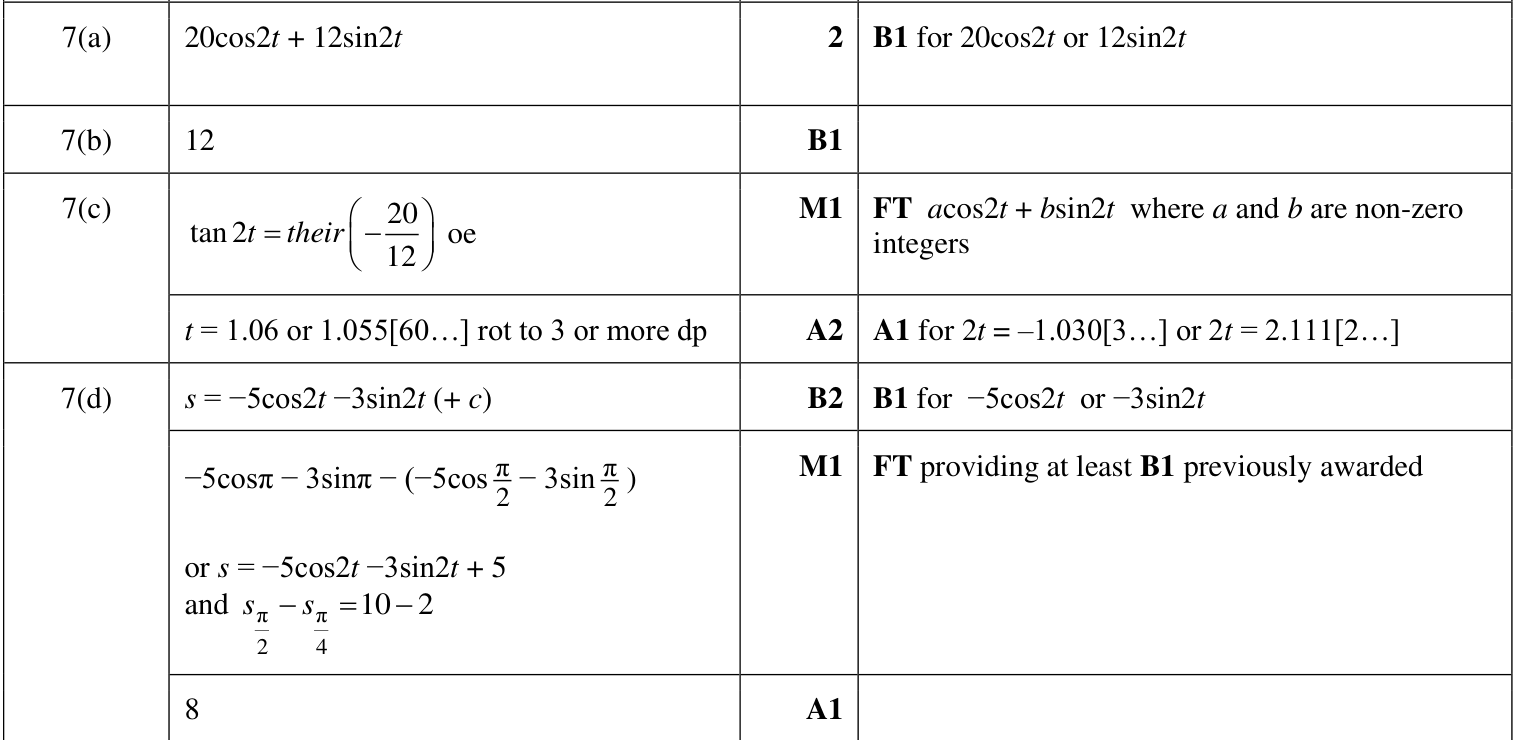
\(v=10\sin2t-6\cos2t.\)
(a) Find an expression for the acceleration of the particle.
(b) Find the acceleration when \(t=\frac\pi4\).
(c) Find the first time at which the acceleration is zero.
(d) Find the displacement of the particle between \(t=\frac\pi4\) and \(t=\frac\pi2\).
0606 P11 - Jun 2023 - Q4 - 4 marks
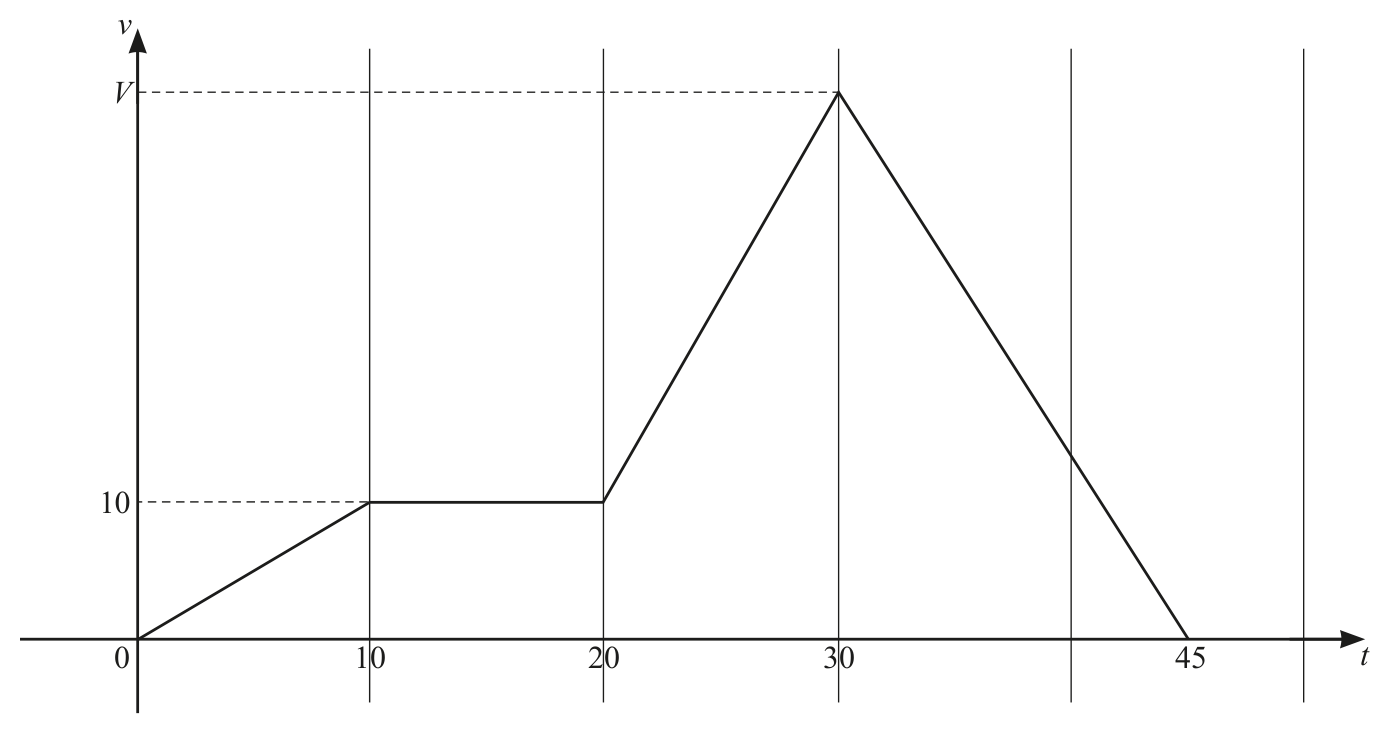
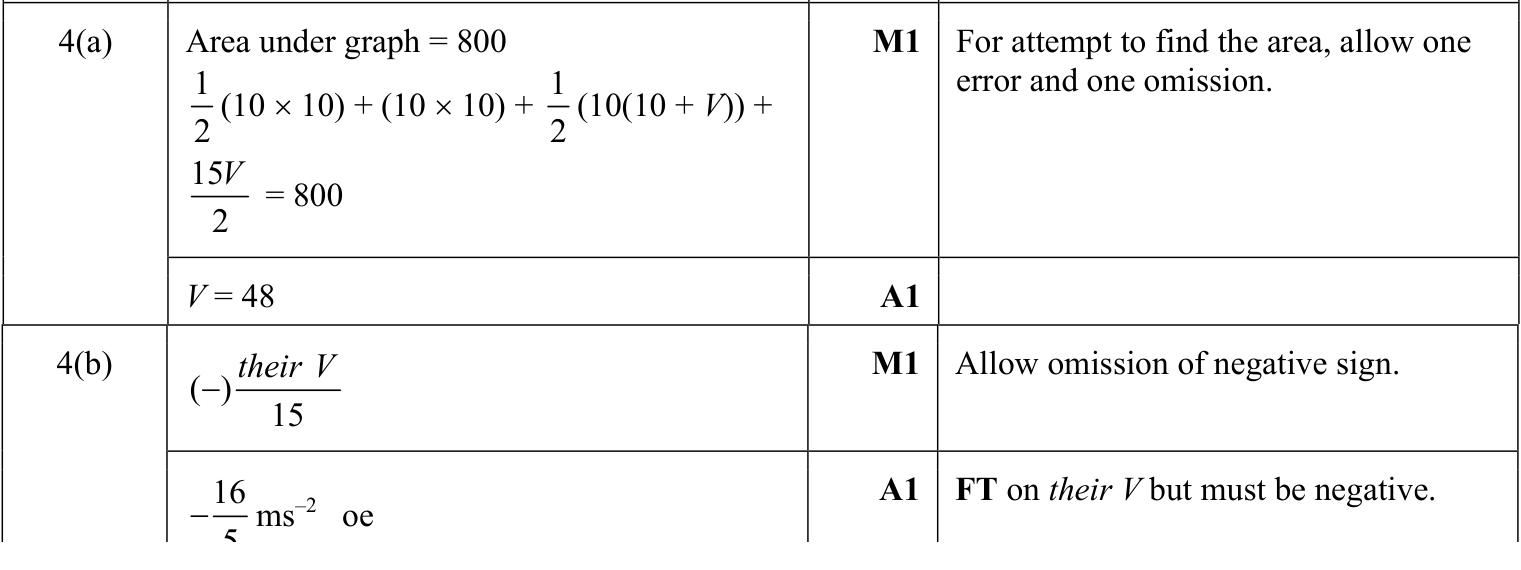
The diagram shows the velocity-time graph for the motion of a particle over a period of 45 seconds. The velocity of the particle at \(t=30\) is \(V\text{ m s}^{-1}\). The distance travelled by the particle in the 45 seconds is 800 m.
(a) Find the value of \(V\).
(b) Find the acceleration of the particle when \(t=35\).
0606 P22 - Jun 2023 - Q9 - 6 marks
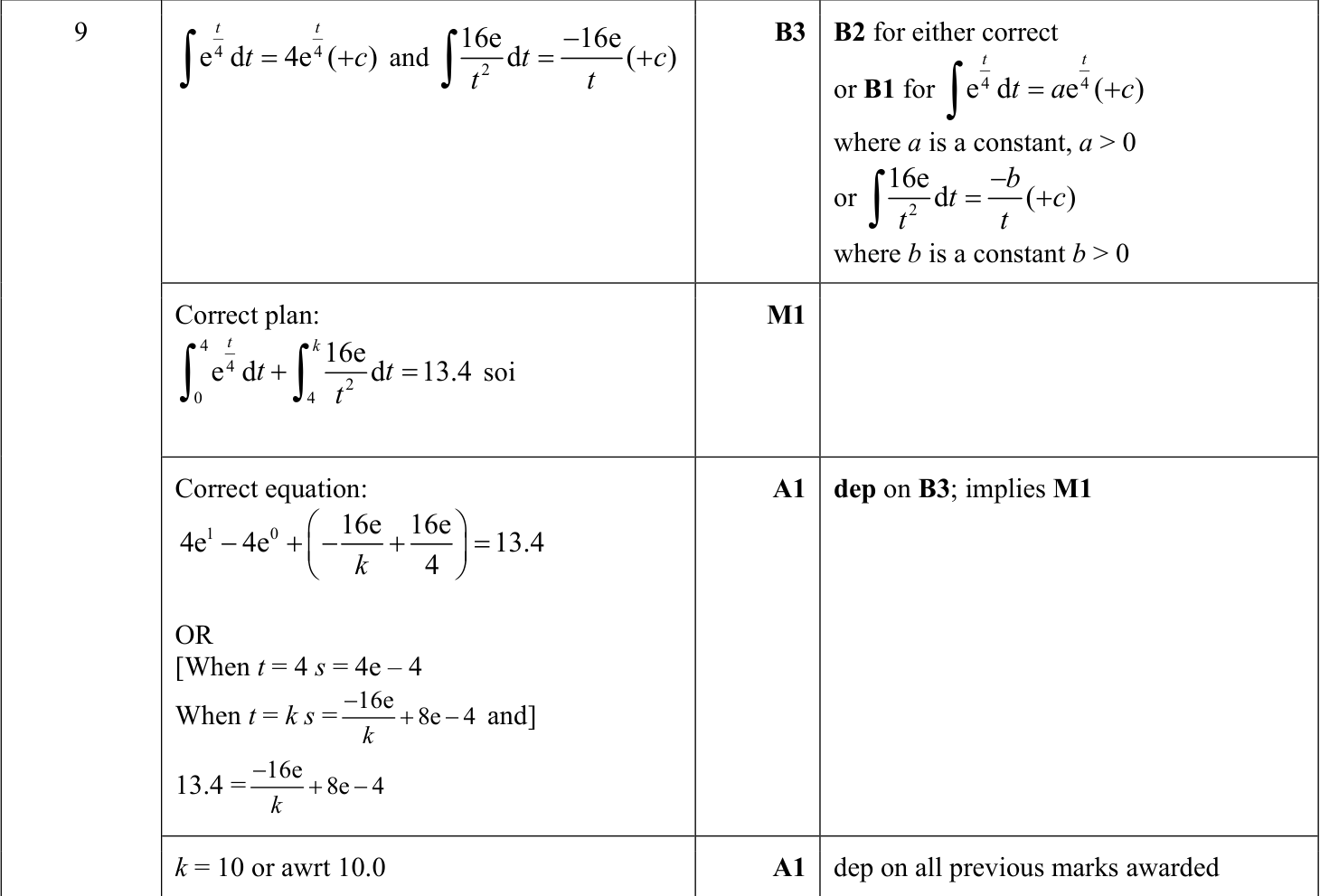
A particle travels in a straight line so that, \(t\) seconds after passing a fixed point, its velocity, \(v\text{ m s}^{-1}\), is given by
\(v=e^{t/4}\quad\text{for }0\leq t\leq4,\)
\(v=\frac{16e}{t^2}\quad\text{for }4\leq t\leq k.\)
The total distance travelled by the particle between \(t=0\) and \(t=k\) is \(13.4\) metres. Find the value of \(k\).
0606 P22 - Mar 2022 - Q9 - 12 marks
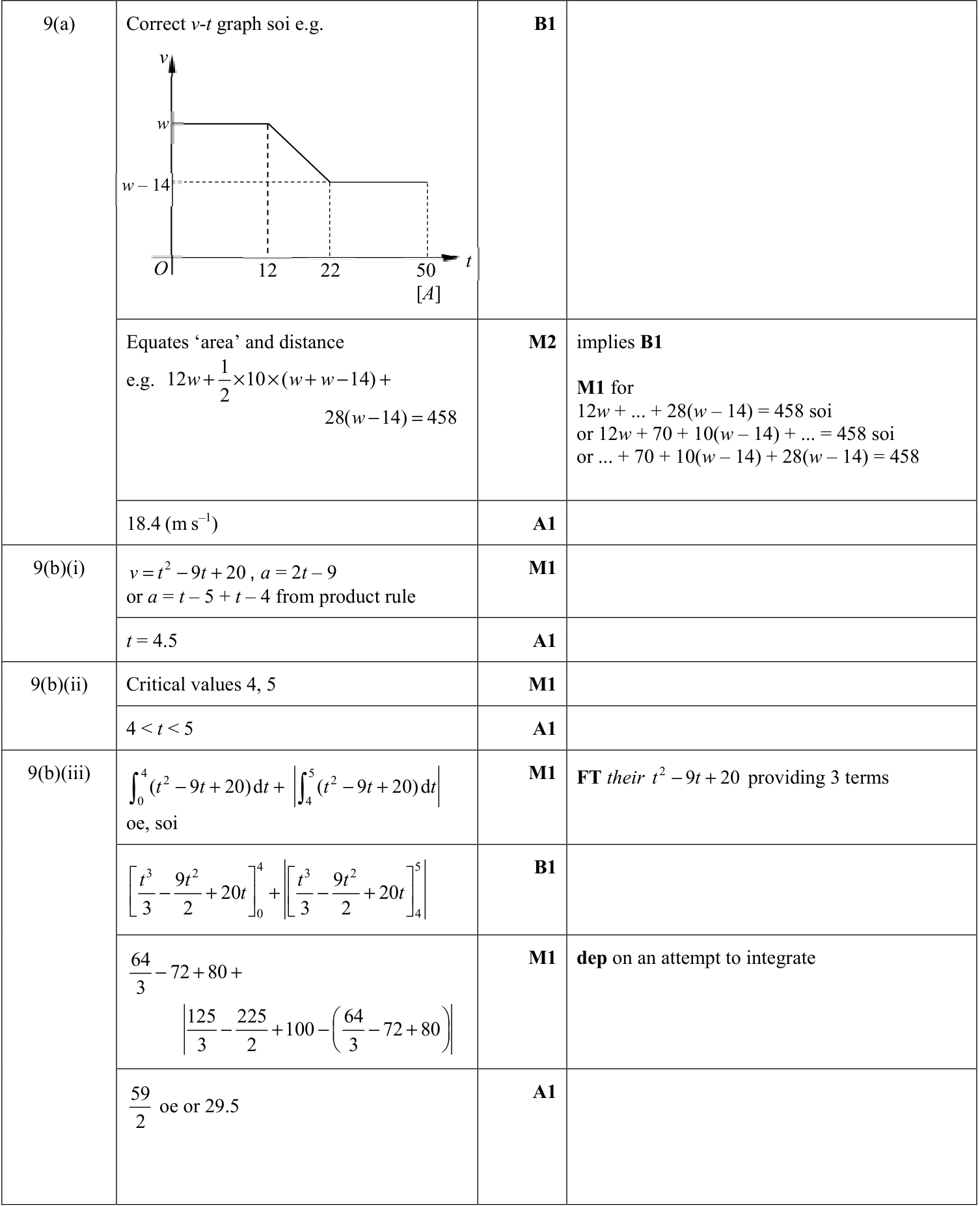
(a) A vehicle travels along a straight, horizontal road. At time \(t=0\) seconds, the vehicle, travelling at a velocity of \(w\,\mathrm{m\,s^{-1}}\), passes point \(O\). The vehicle travels at this constant velocity for \(12\) seconds. It then slows down, with constant deceleration, for \(10\) seconds until it reaches a velocity of \((w-14)\,\mathrm{m\,s^{-1}}\). It continues to travel at this velocity for \(28\) seconds until it reaches point \(A\), \(458\) m from \(O\).
Find the value of \(w\).
(b) A particle moves in a straight line. The velocity, \(v\,\mathrm{m\,s^{-1}}\), of the particle at time \(t\) seconds, where \(t\geq0\), is given by
\(v=(t-4)(t-5).\)
(i) Find the value of \(t\) for which the acceleration of the particle is \(0\,\mathrm{m\,s^{-2}}\).
(ii) Find the set of values of \(t\) for which the velocity of the particle is negative.
(iii) Find the distance travelled by the particle in the first \(5\) seconds of its motion.
0606 P22 - Mar 2023 - Q10 - 10 marks
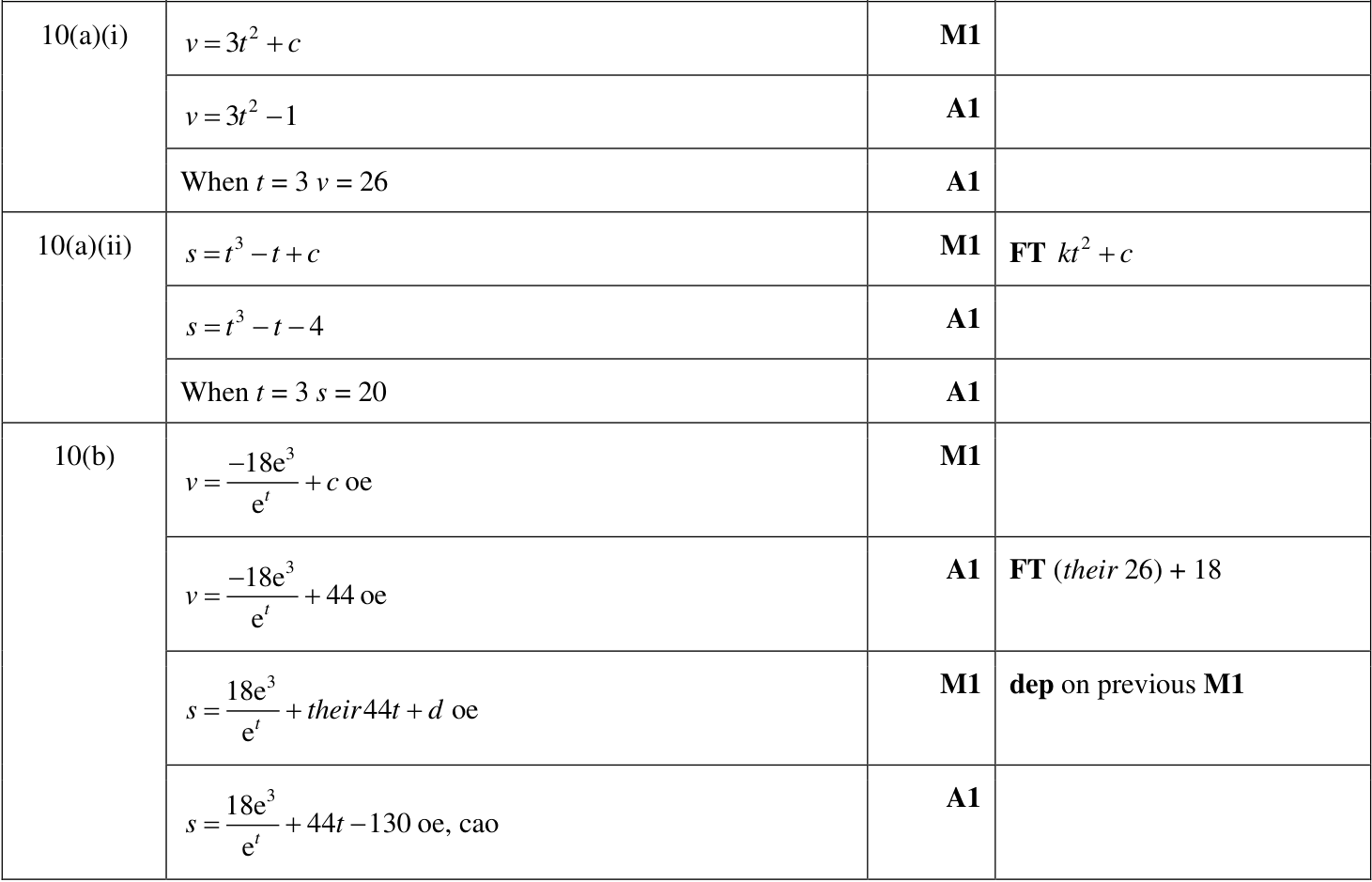
A particle \(P\) moves in a straight line. Its acceleration, \(a\,\mathrm{m\,s^{-2}}\), is given by
\(a=6t\quad\text{for }0\leq t\leq3,\)
and
\(a=\frac{18\mathrm e^3}{\mathrm e^t}\quad\text{for }t\geq3.\)
When \(t=1\), the velocity of \(P\) is \(2\,\mathrm{m\,s^{-1}}\) and the displacement of \(P\) from \(O\) is \(-4\) metres.
(a)(i) Find the velocity of \(P\) when \(t=3\).
(a)(ii) Find the displacement of \(P\) from \(O\) when \(t=3\).
(b) Find an expression, in terms of \(t\), for the displacement of \(P\) from \(O\) when \(t\geq3\).
0606 P13 - Jun 2022 - Q5 - 8 marks
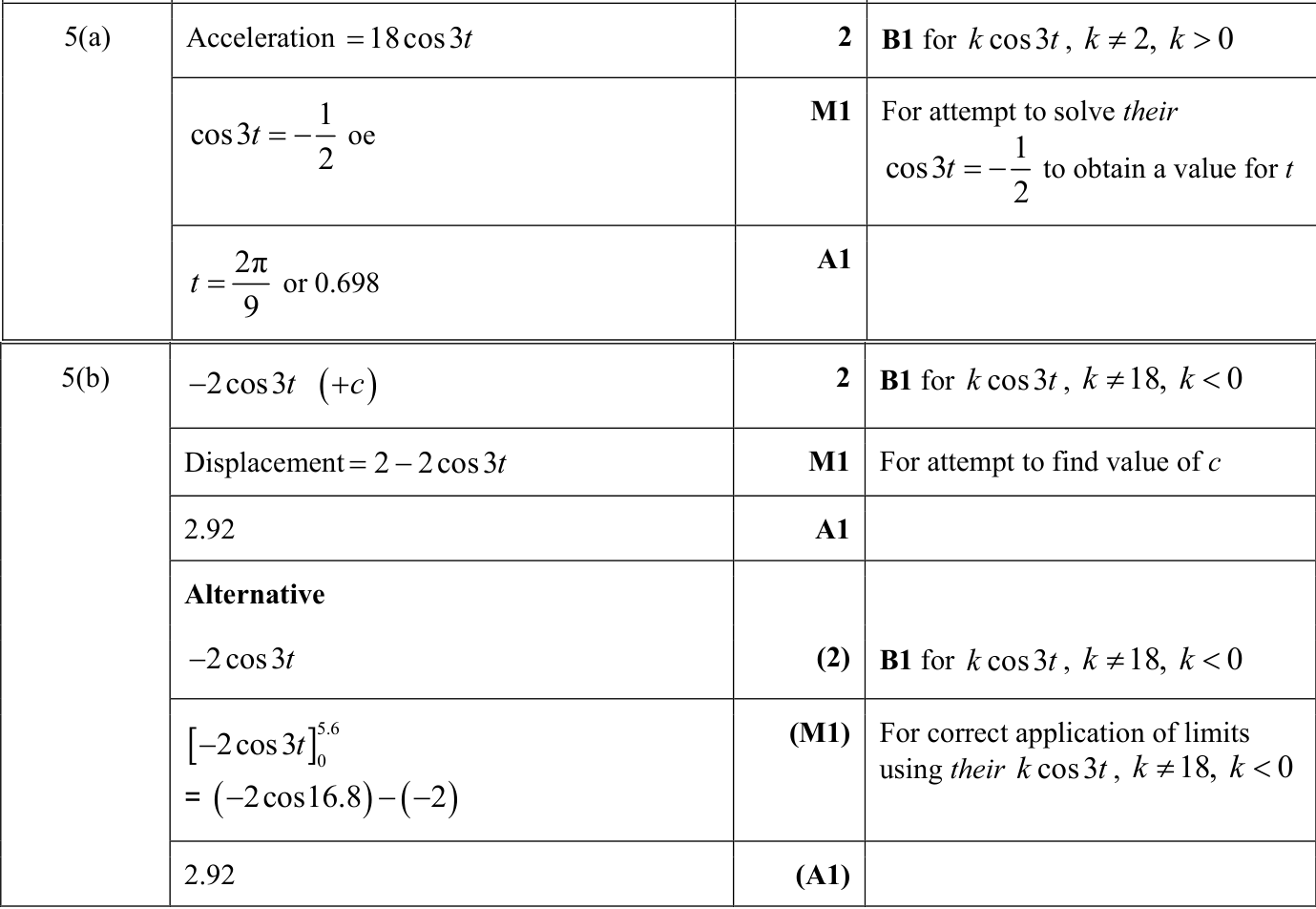
The velocity, \(v\text{ m s}^{-1}\), of a particle moving in a straight line, \(t\) seconds after passing through a fixed point \(O\), is given by
\(v=6\sin3t.\)
(a) Find the time at which the acceleration of the particle is first equal to \(-9\text{ m s}^{-2}\).
(b) Find the displacement of the particle from \(O\) when \(t=5.6\).
0606 P21 - Nov 2022 - Q10 - 8 marks
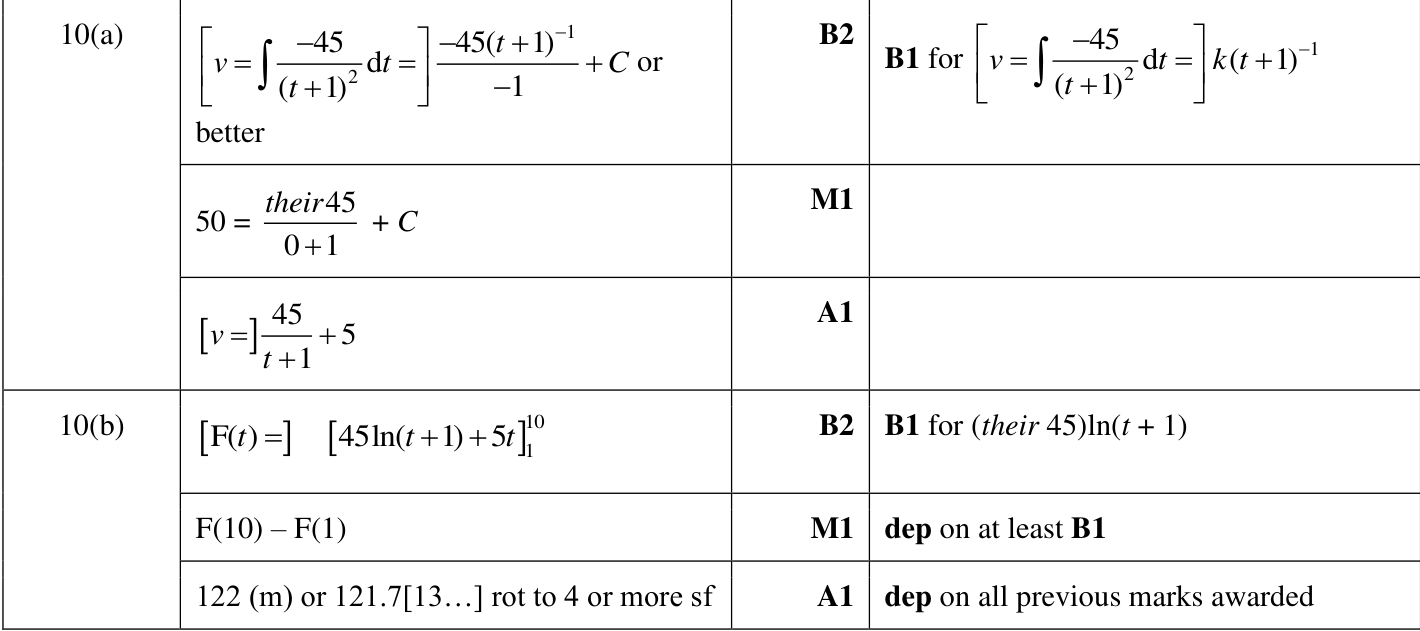
The acceleration, \(a\text{ m s}^{-2}\), of a particle at time \(t\) seconds is given by
\(a=-\frac{45}{(t+1)^2}.\)
When \(t=0\), the velocity of the particle is \(50\text{ m s}^{-1}\).
(a) Find an expression for the velocity of the particle in terms of \(t\).
(b) Find the distance travelled by the particle between \(t=1\) and \(t=10\).
0606 P22 - Mar 2021 - Q12 - 6 marks
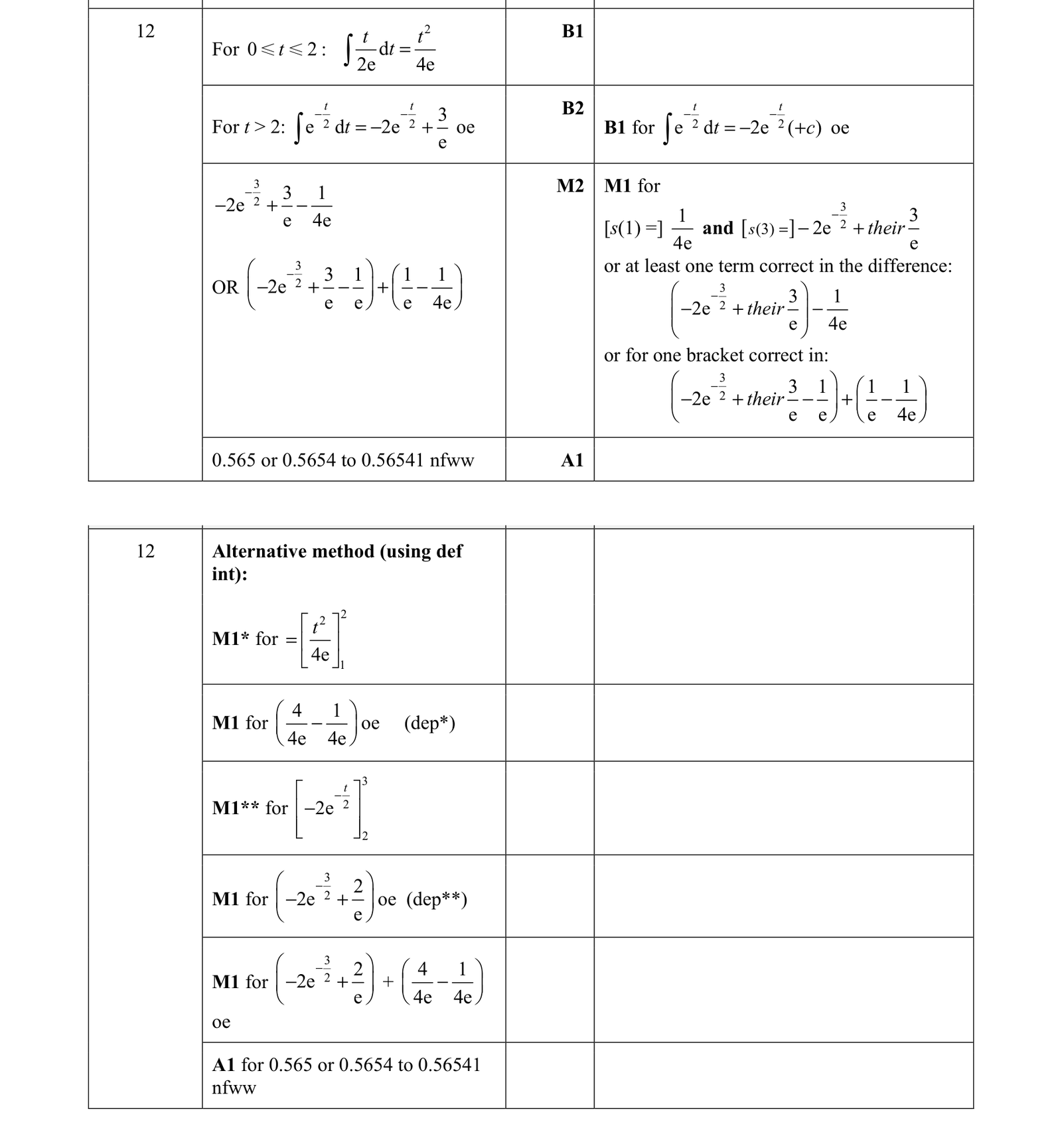
A particle \(P\) travels in a straight line so that, \(t\) seconds after passing through a fixed point \(O\), its velocity, \(v\text{ ms}^{-1}\), is given by
\(v=\frac{t}{2e}\quad\text{for }0\leqslant t\leqslant2,\)
\(v=e^{-t/2}\quad\text{for }t\gt 2.\)
Given that, after leaving \(O\), particle \(P\) is never at rest, find the distance it travels between \(t=1\) and \(t=3\).
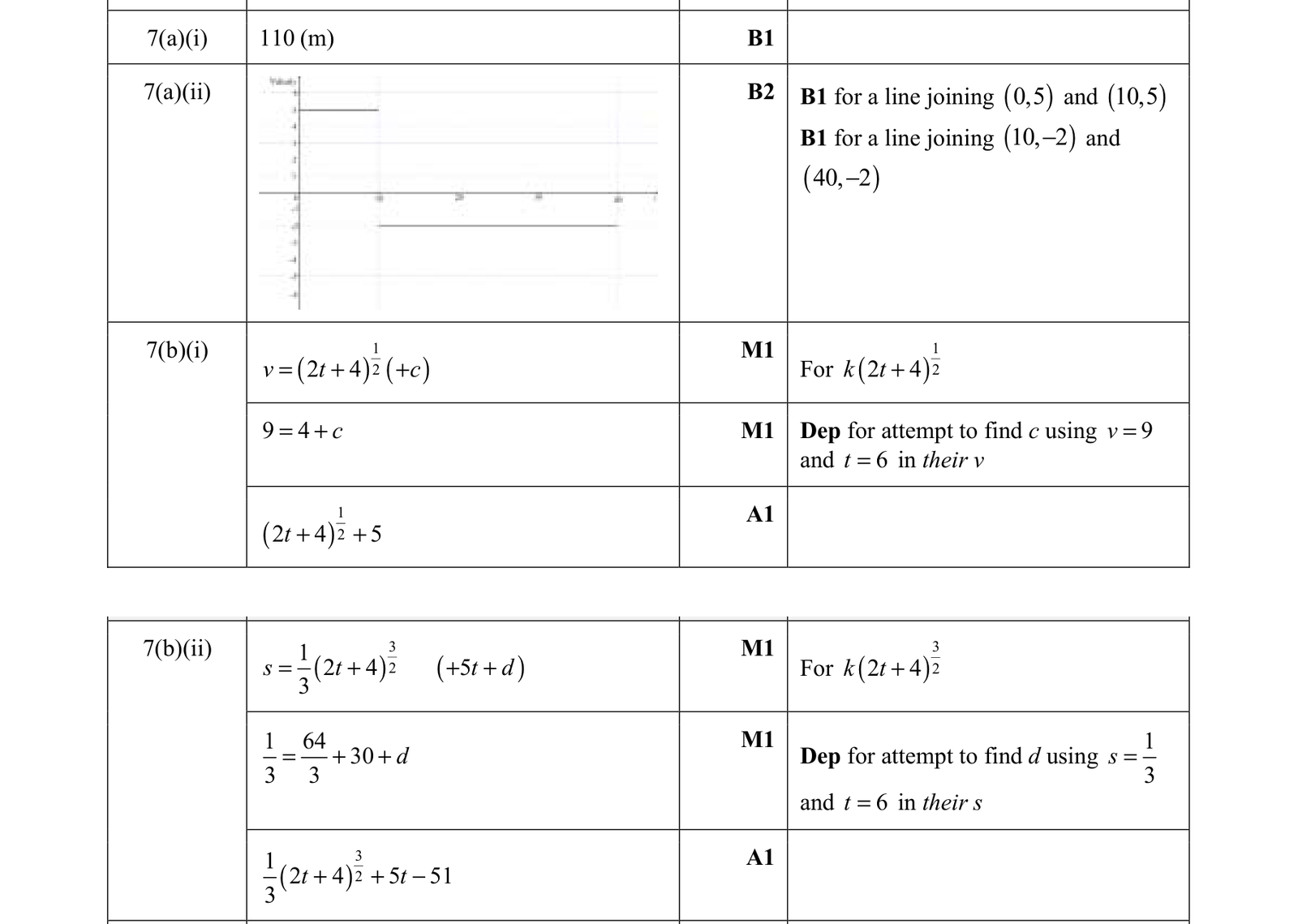
0606 P11 - Jun 2021 - Q7 - 9 marks
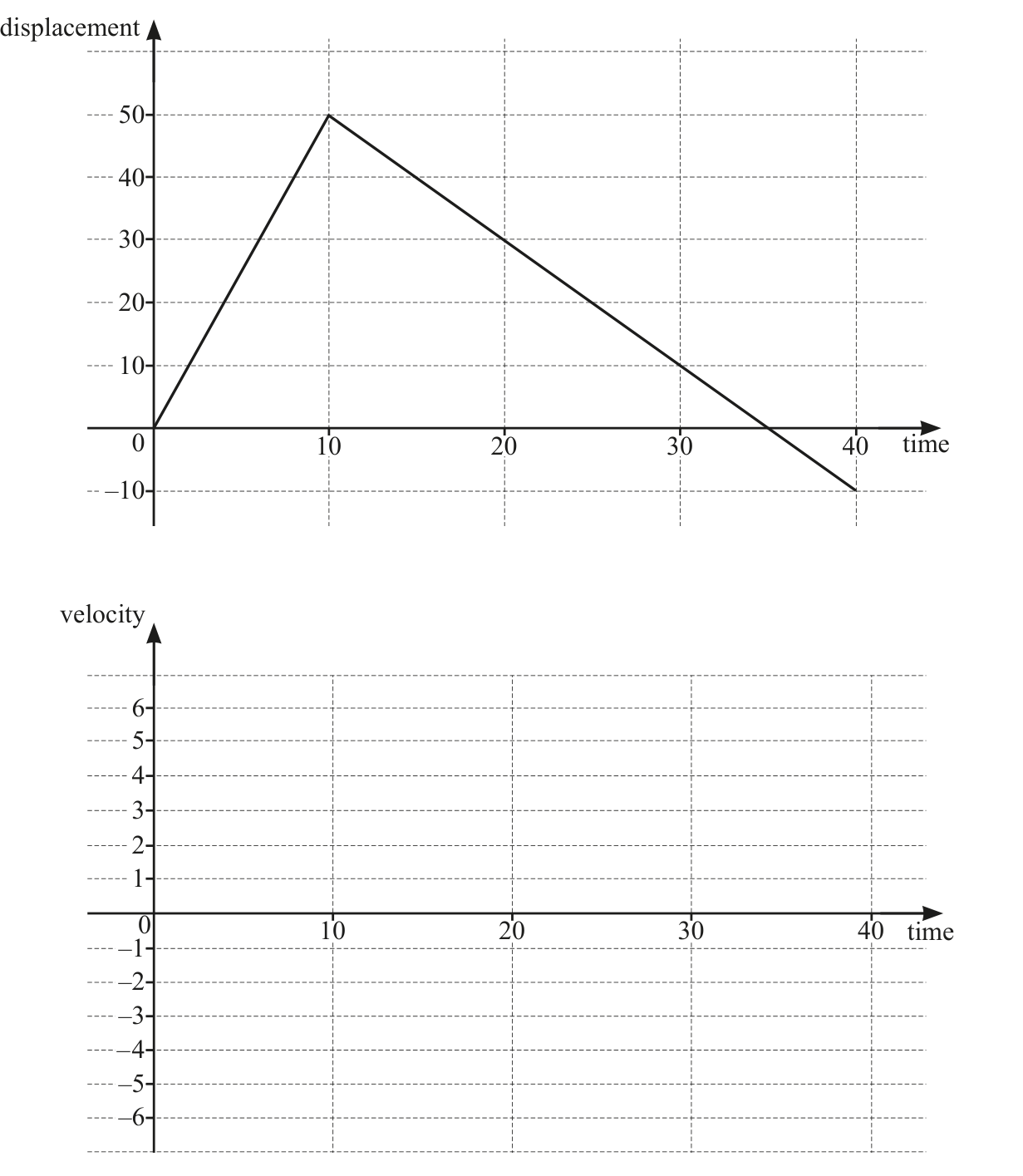
(a) The diagram shows the displacement-time graph for a runner, for \(0\leq t\leq40\).
(i) Find the distance the runner has travelled when \(t=40\).
(ii) On the axes, draw the corresponding velocity-time graph for the runner, for \(0\leq t\leq40\).
(b) A particle \(P\), moves in a straight line such that its displacement from a fixed point at time \(t\) is \(s\). The acceleration of \(P\) is given by
\((2t+4)^{-1/2},\quad t\gt0.\)
(i) Given that \(P\) has a velocity of \(9\) when \(t=6\), find the velocity of \(P\) at time \(t\).
(ii) Given that \(s=\frac13\) when \(t=6\), find the displacement of \(P\) at time \(t\).
0606 P22 - Jun 2021 - Q8 - 8 marks
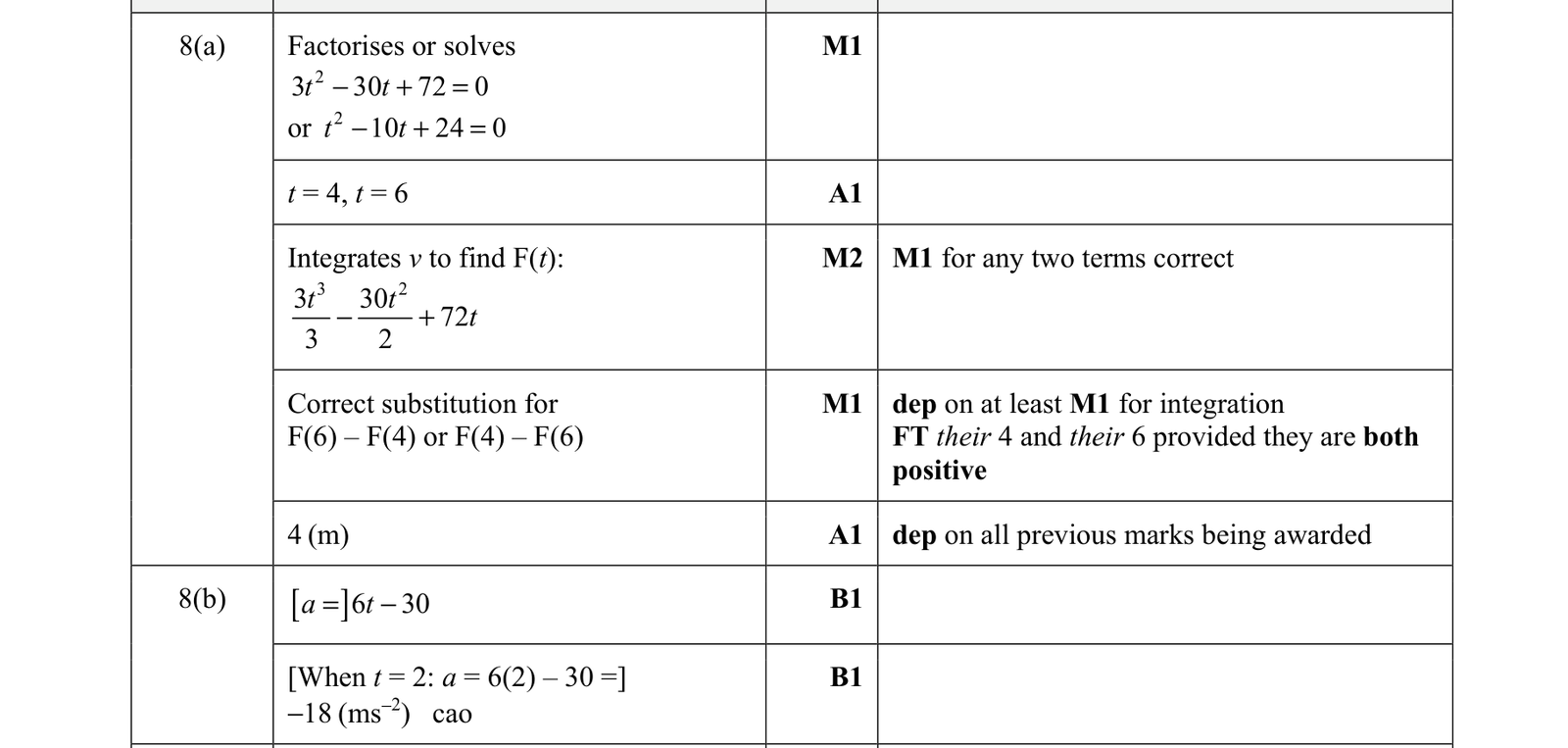
A particle moves in a straight line so that, \(t\) seconds after passing through a fixed point \(O\), its velocity, \(v\text{ m s}^{-1}\), is given by
\(v=3t^2-30t+72.\)
(a) Find the distance between the particle's two positions of instantaneous rest.
(b) Find the acceleration of the particle when \(t=2\).
0606 P23 - Jun 2021 - Q12 - 8 marks
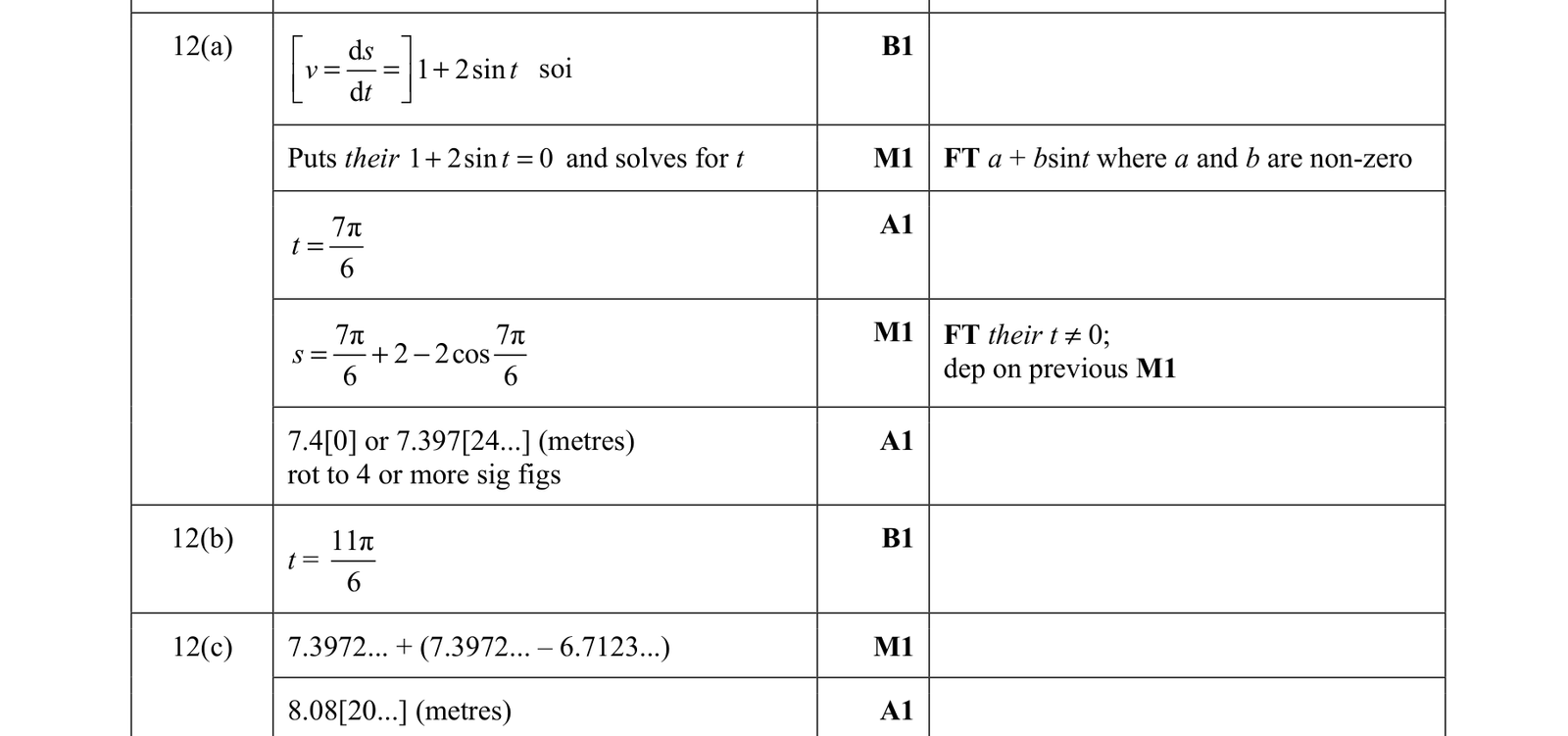
A particle moves in a straight line such that its displacement, \(s\) metres, from a fixed point \(O\) at time \(t\) seconds, is given by
\(s=2+t-2\cos t,\quad t\geq0.\)
(a) Find the displacement of the particle from \(O\) at the time when it first comes to instantaneous rest.
(b) Find the time when the particle next comes to rest.
(c) Find the distance travelled by the particle for
\(0\leq t\leq\frac{3\pi}{2}.\)
0606 P12 - Nov 2021 - Q11 - 12 marks
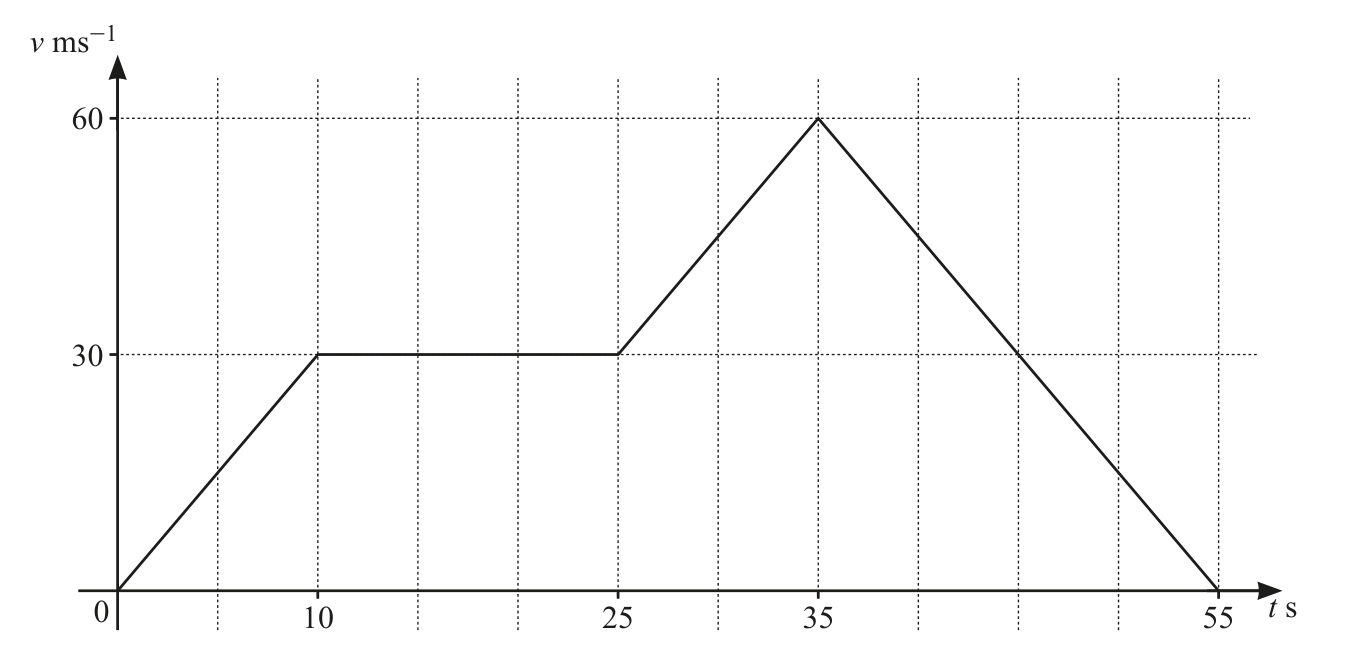
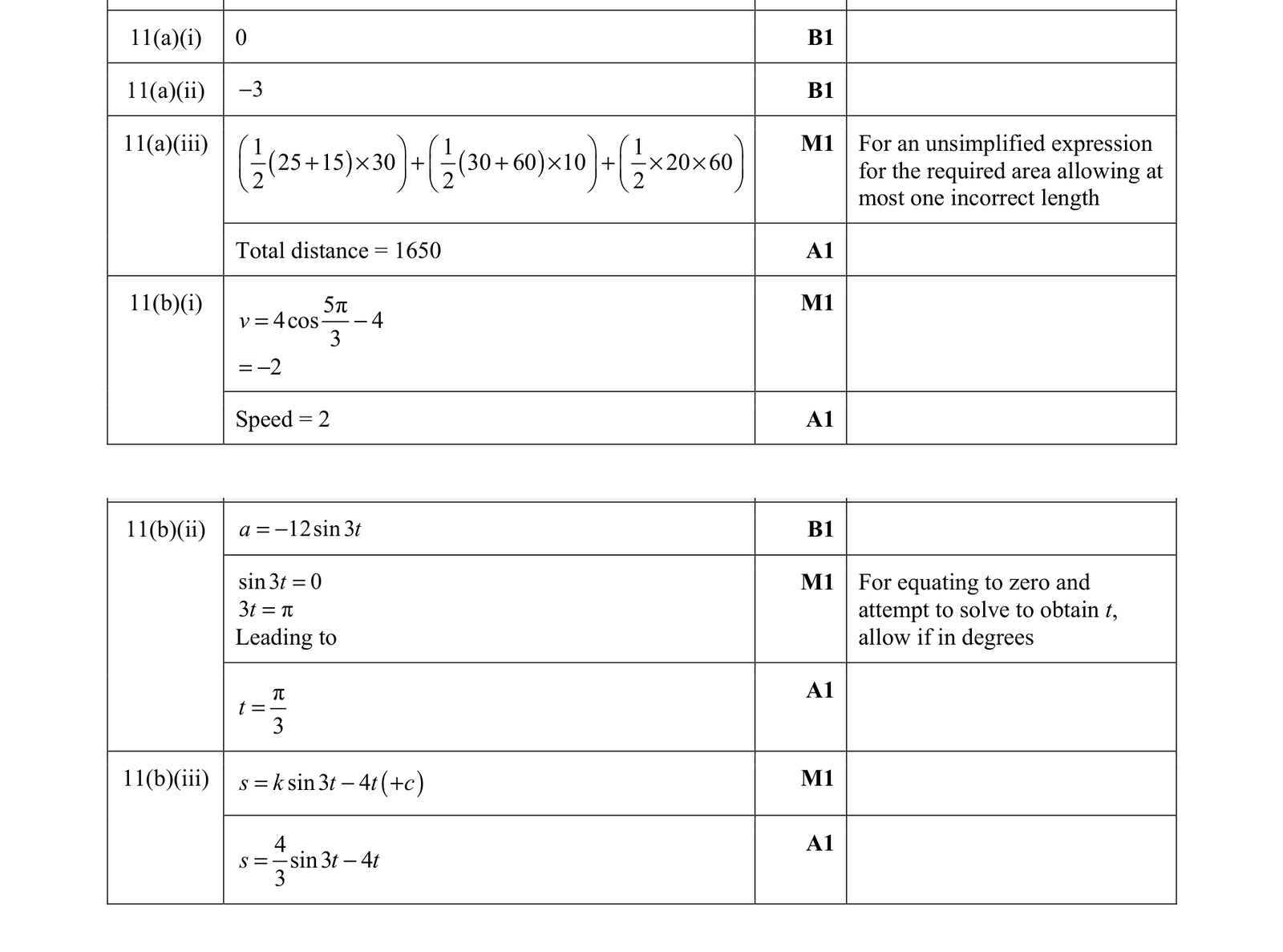
(a) The diagram shows the velocity-time graph for a particle \(P\), travelling in a straight line with velocity \(v\text{ ms}^{-1}\) at a time \(t\) seconds. \(P\) accelerates at a constant rate for the first \(10\) seconds of its motion, and then travels at constant velocity, \(30\text{ ms}^{-1}\), for another \(15\) seconds. \(P\) then accelerates at a constant rate for a further \(10\) seconds and reaches a velocity of \(60\text{ ms}^{-1}\). \(P\) then decelerates at a constant rate and comes to rest when \(t=55\).
(i) Find the acceleration when \(t=12\).
(ii) Find the acceleration when \(t=50\).
(iii) Find the total distance travelled by the particle \(P\).
(b) A particle \(Q\) travels in a straight line such that its velocity, \(v\text{ ms}^{-1}\), at time \(t\) seconds after passing through a fixed point \(O\) is given by \(v=4\cos3t-4\).
(i) Find the speed of \(Q\) when \(t=\frac{5\pi}{9}\).
(ii) Find the smallest positive value of \(t\) for which the acceleration of \(Q\) is zero.
(iii) Find an expression for the displacement of \(Q\) from \(O\) at time \(t\).
0606 P22 - Mar 2020 - Q12 - 6 marks
A particle moves in a straight line. Its acceleration is constant and equal to \(-6\text{ m s}^{-2}\). Initially, the particle is at \(O\) and has velocity \(18\text{ m s}^{-1}\).
(a) Find the time at which the particle is instantaneously at rest.
(b) Find the distance travelled by the particle in the third second.
