Past Exam Questions
← Back9231 P32 - Nov 2023 - Q7 - 9 marks
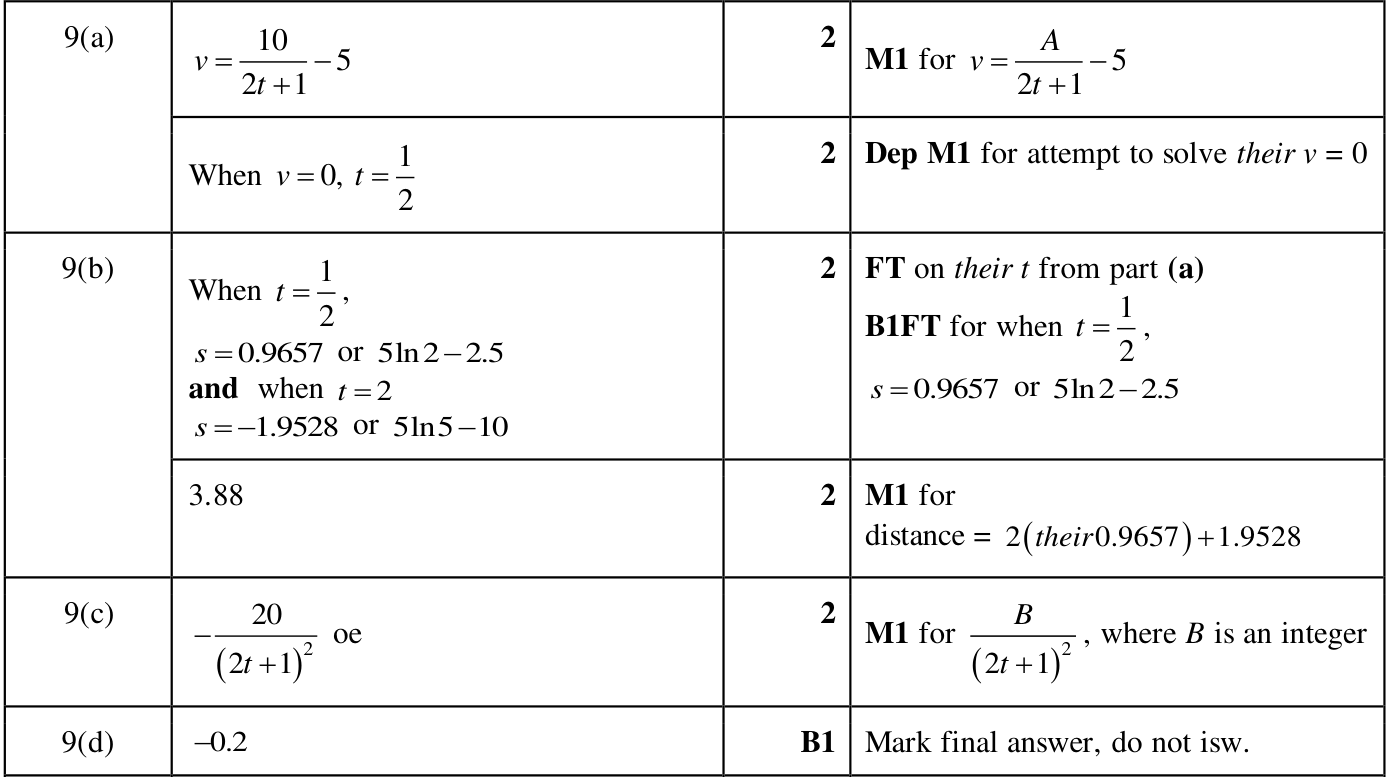
A particle \(P\) of mass \(m\) is attached to one end of a light rod of length \(3a\). The other end of the rod is able to pivot smoothly about the fixed point \(A\). The particle is also attached to one end of a light spring of natural length \(a\) and modulus of elasticity \(kmg\). The other end of the spring is attached to a fixed point \(B\).
The points \(A\) and \(B\) are in a horizontal line, a distance \(5a\) apart, and these two points and the rod are in a vertical plane.
Initially, \(P\) is held in equilibrium by a vertical force \(F\), with the stretched length of the spring equal to \(4a\). The particle is released from rest in this position and has a speed of \(\dfrac65\sqrt{2ag}\) when the rod becomes horizontal.
(a) Find the value of \(k\).
(b) Find \(F\) in terms of \(m\) and \(g\).
(c) Find, in terms of \(m\) and \(g\), the tension in the rod immediately before it is released.

9231 P31 - Jun 2023 - Q1 - 5 marks
One end of a light elastic string, of natural length \(a\) and modulus of elasticity \(3 m g\), is attached to a fixed point \(O\). The other end of the string is attached to a particle \(P\) of mass \(m\). The string hangs with \(P\) vertically below \(O\). The particle \(P\) is pulled vertically downwards so that the extension of the string is \(2 a\). The particle \(P\) is then released from rest.
(a) Find the speed of \(P\) when it is at a distance \(\frac{3}{4} a\) below \(O\).
(b) Find the initial acceleration of \(P\) when it is released from rest.

9231 P33 - Jun 2023 - Q2 - 4 marks
One end of a light elastic string, of natural length \(a\) and modulus of elasticity \(\lambda m g\), is attached to a fixed point \(O\). The string lies on a smooth horizontal surface. A particle \(P\) of mass \(m\) is attached to the other end of the string. The particle \(P\) is projected in the direction \(O P\). When the length of the string is \(\frac{4}{3} a\), the speed of \(P\) is \(\sqrt{2 a g}\). When the length of the string is \(\frac{5}{3} a\), the speed of \(P\) is \(\frac{1}{2} \sqrt{2 a g}\).
Find the value of \(\lambda\).

9231 P33 - Jun 2022 - Q2 - 5 marks
A particle \(P\) of mass \(m\) is attached to one end of a light elastic string of natural length \(a\) and modulus of elasticity \(\frac{4}{3} m g\). The other end of the string is attached to a fixed point \(O\) on a rough horizontal surface. The particle is at rest on the surface with the string at its natural length. The coefficient of friction between \(P\) and the surface is \(\frac{1}{3}\). The particle is projected along the surface in the direction \(O P\) with a speed of \(\frac{1}{2} \sqrt{g a}\).
Find the greatest extension of the string during the subsequent motion.

9231 P31 - Nov 2022 - Q2 - 6 marks
A light elastic string has natural length \(a\) and modulus of elasticity \(4 m g\). One end of the string is fixed to a point \(O\) on a smooth horizontal surface. A particle \(P\) of mass \(m\) is attached to the other end of the string. The particle \(P\) is projected along the surface in the direction \(O P\). When the length of the string is \(\frac{5}{4} a\), the speed of \(P\) is \(v\). When the length of the string is \(\frac{3}{2} a\), the speed of \(P\) is \(\frac{1}{2} v\).
(a) Find an expression for \(v\) in terms of \(a\) and \(g\).
(b) Find, in terms of \(g\), the acceleration of \(P\) when the stretched length of the string is \(\frac{3}{2} a\).

9231 P32 - Nov 2022 - Q3 - 6 marks
One end of a light elastic string, of natural length \(a\) and modulus of elasticity \(\frac{16}{3} M g\), is attached to a fixed point \(O\). A particle \(P\) of mass \(4 M\) is attached to the other end of the string and hangs vertically in equilibrium. Another particle of mass \(2 M\) is attached to \(P\) and the combined particle is then released from rest. The speed of the combined particle when it has descended a distance \(\frac{1}{4} a\) is \(v\).
Find an expression for \(v\) in terms of \(g\) and \(a\).

9231 P31 - Jun 2021 - Q3 - 7 marks
One end of a light elastic string, of natural length \(a\) and modulus of elasticity \(k m g\), is attached to a fixed point \(A\). The other end of the string is attached to a particle \(P\) of mass \(4 m\). The particle \(P\) hangs in equilibrium a distance \(x\) vertically below \(A\).
(a) Show that \(k=\frac{4 a}{x-a}\).
An additional particle, of mass \(2 m\), is now attached to \(P\) and the combined particle is released from rest at the original equilibrium position of \(P\). When the combined particle has descended a distance \(\frac{1}{3} a\), its speed is \(\frac{1}{3} \sqrt{g a}\).
(b) Find \(x\) in terms of \(a\).

9231 P33 - Jun 2021 - Q2 - 5 marks
One end of a light elastic string of natural length 0.8 m and modulus of elasticity 36 N is attached to a fixed point \(O\) on a smooth plane. The plane is inclined at an angle \(\alpha\) to the horizontal, where \(\sin \alpha=\frac{3}{5}\). A particle \(P\) of mass 2 kg is attached to the other end of the string. The string lies along a line of greatest slope of the plane with the particle below the level of \(O\). The particle is projected with speed \(\sqrt{2} \mathrm{~ms}^{-1}\) directly down the plane from the position where \(O P\) is equal to the natural length of the string.
Find the maximum extension of the string during the subsequent motion.

9231 P31 - Nov 2021 - Q3 - 6 marks
A light elastic string has natural length \(a\) and modulus of elasticity \(12 m g\). One end of the string is attached to a fixed point \(O\). The other end of the string is attached to a particle of mass \(m\). The particle hangs in equilibrium vertically below \(O\). The particle is pulled vertically down and released from rest with the extension of the string equal to \(e\), where \(e\gt \frac{1}{3} a\). In the subsequent motion the particle has speed \(\sqrt{2 g a}\) when it has ascended a distance \(\frac{1}{3} a\).
Find \(e\) in terms of \(a\).

9231 P32 - Nov 2021 - Q2 - 6 marks
A light spring \(A B\) has natural length \(a\) and modulus of elasticity \(5 m g\). The end \(A\) of the spring is attached to a fixed point on a smooth horizontal surface. A particle \(P\) of mass \(m\) is attached to the end \(B\) of the spring. The spring and particle \(P\) are at rest on the surface.
Another particle \(Q\) of mass \(k m\) is moving with speed \(\sqrt{4 g a}\) along the horizontal surface towards \(P\) in the direction \(B A\). The particles \(P\) and \(Q\) collide directly and coalesce. In the subsequent motion the greatest amount by which the spring is compressed is \(\frac{1}{5} a\).
Find the value of \(k\).

9231 P31 - Jun 2020 - Q3 - 7 marks
One end of a light elastic spring, of natural length \(a\) and modulus of elasticity 5 mg , is attached to a fixed point \(A\). The other end of the spring is attached to a particle \(P\) of mass \(m\). The spring hangs with \(P\) vertically below \(A\). The particle \(P\) is released from rest in the position where the extension of the spring is \(\frac{1}{2} a\).
(a) Show that the initial acceleration of \(P\) is \(\frac{3}{2} g\) upwards.
(b) Find the speed of \(P\) when the spring first returns to its natural length.

9231 P33 - Jun 2020 - Q7 - 10 marks
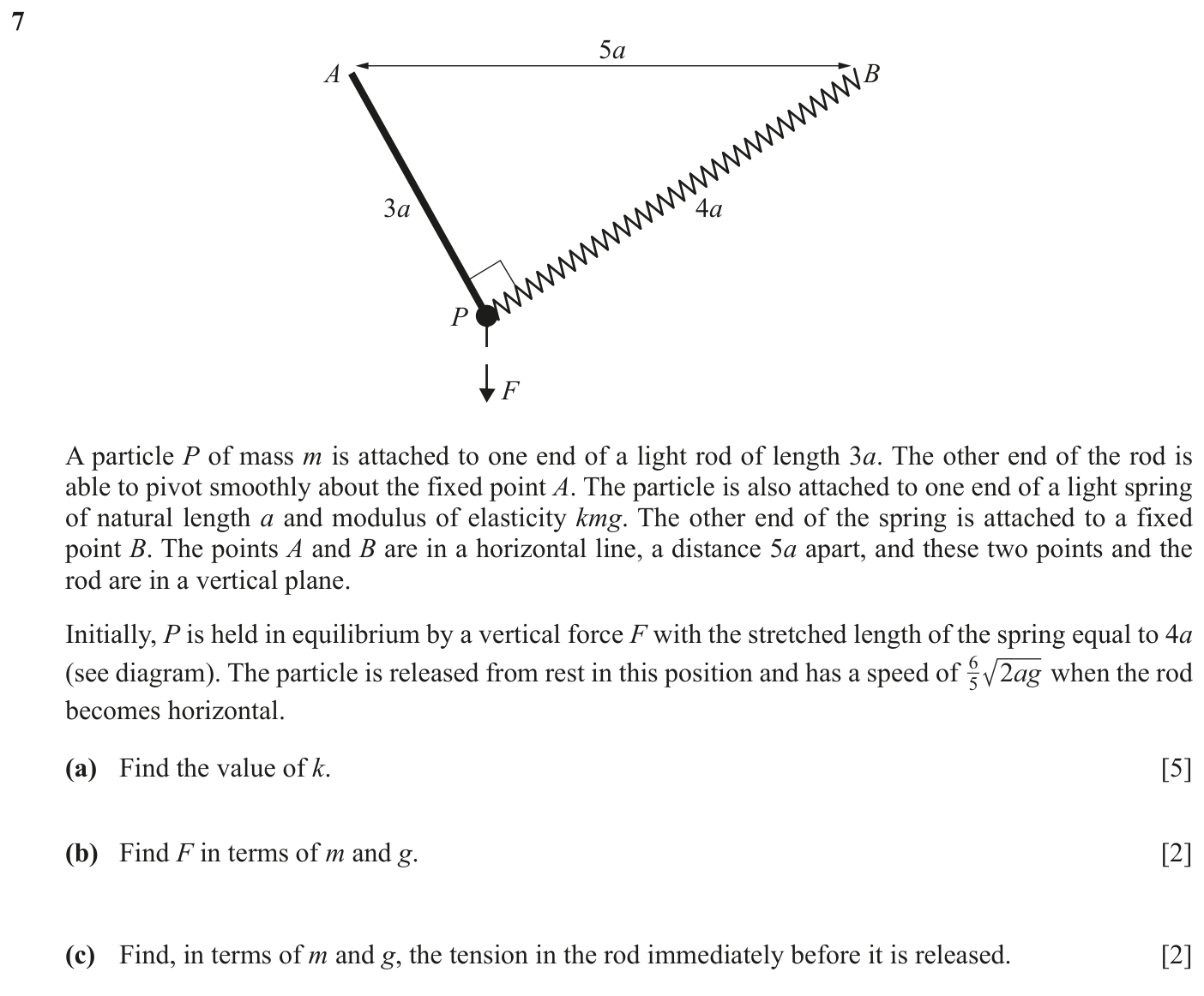
One end of a light spring of natural length \(a\) and modulus of elasticity \(4 m g\) is attached to a fixed point \(O\). The other end of the spring is attached to a particle \(A\) of mass \(k m\), where \(k\) is a constant. Initially the spring lies at rest on a smooth horizontal surface and has length \(a\). A second particle \(B\), of mass \(m\), is moving towards \(A\) with speed \(\sqrt{\frac{4}{3} g a}\) along the line of the spring from the opposite direction to \(O\) (see diagram).
The particles \(A\) and \(B\) collide and coalesce. At a point \(C\) in the subsequent motion, the length of the spring is \(\frac{3}{4} a\) and the speed of the combined particle is half of its initial speed.
(a) Find the value of \(k\).
At the point \(C\) the horizontal surface becomes rough, with coefficient of friction \(\mu\) between the combined particle and the surface. The deceleration of the combined particle at \(C\) is \(\frac{9}{20} g\).
(b) Find the value of \(\mu\).

9231 P31 - Nov 2020 - Q1 - 3 marks
A particle \(P\) of mass \(m\) is placed on a fixed smooth plane which is inclined at an angle \(\theta\) to the horizontal. A light spring, of natural length \(a\) and modulus of elasticity \(3 m g\), has one end attached to \(P\) and the other end attached to a fixed point \(O\) at the top of the plane. The spring lies along a line of greatest slope of the plane. The system is released from rest with the spring at its natural length.
Find, in terms of \(a\) and \(\theta\), an expression for the greatest extension of the spring in the subsequent motion.

9231 P32 - Nov 2020 - Q6 - 8 marks
One end of a light elastic string, of natural length \(a\) and modulus of elasticity \(k\), is attached to a particle \(P\) of mass \(m\). The other end of the string is attached to a fixed point \(Q\). The particle \(P\) is projected vertically upwards from \(Q\). When \(P\) is moving upwards and at a distance \(\frac{4}{3} a\) directly above \(Q\), it has a speed \(\sqrt{2 g a}\). At this point, its acceleration is \(\frac{7}{3} g\) downwards.
Show that \(k=4 m g\) and find in terms of \(a\) the greatest height above \(Q\) reached by \(P\).

0606 P23 - Nov 2025 - Q10 - 11 marks
In this question the units are metres and seconds.
A particle moves along a straight line through a point \(A\).
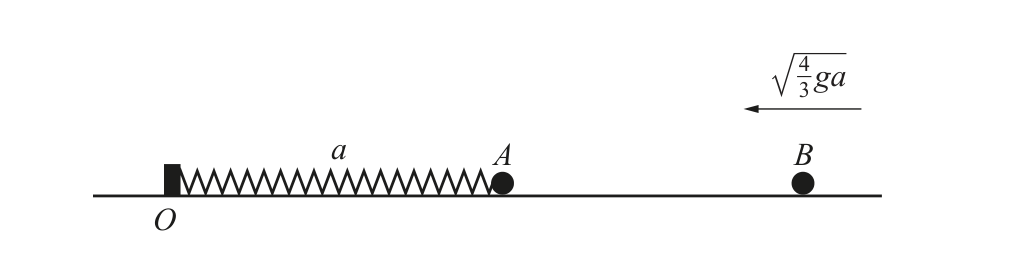
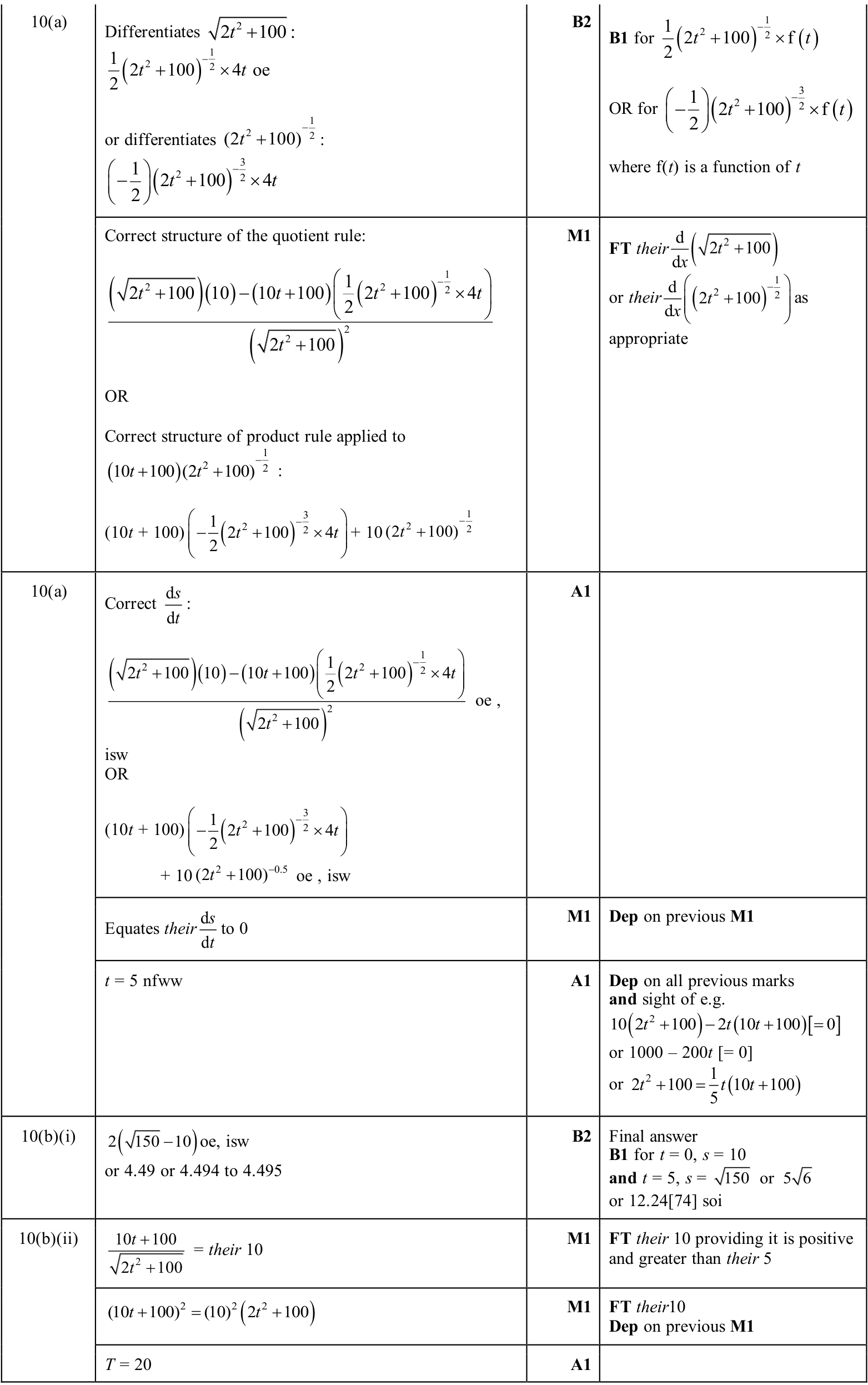
Its displacement, \(s\), from \(A\) at time \(t\) is given by \(s=\frac{10 t+100}{\sqrt{2 t^{2}+100}}\).
The diagram shows the displacement-time graph for the first 30 seconds of the motion.
(a) Find the value of \(t\) when \(s\) is a maximum.
(b) The particle passes through its starting point again at time \(t=T\).
(i) Find the total distance travelled by the particle during the first \(T\) seconds of its motion.
(ii) Use algebra to find \(T\).
0606 P13 - Nov 2025 - Q4 - 6 marks
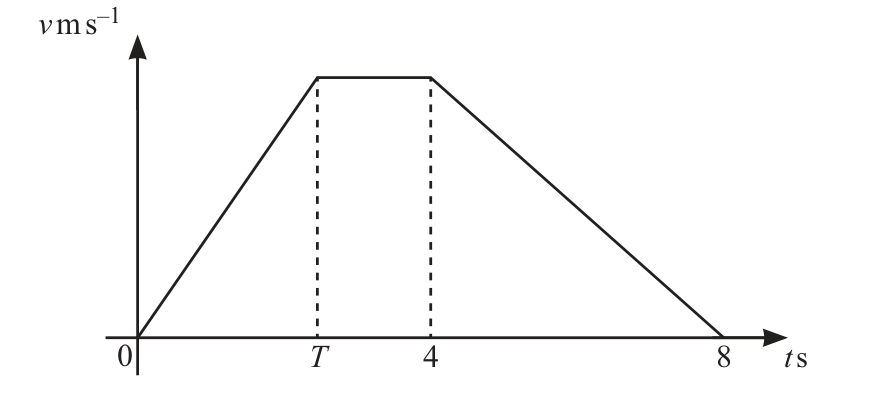
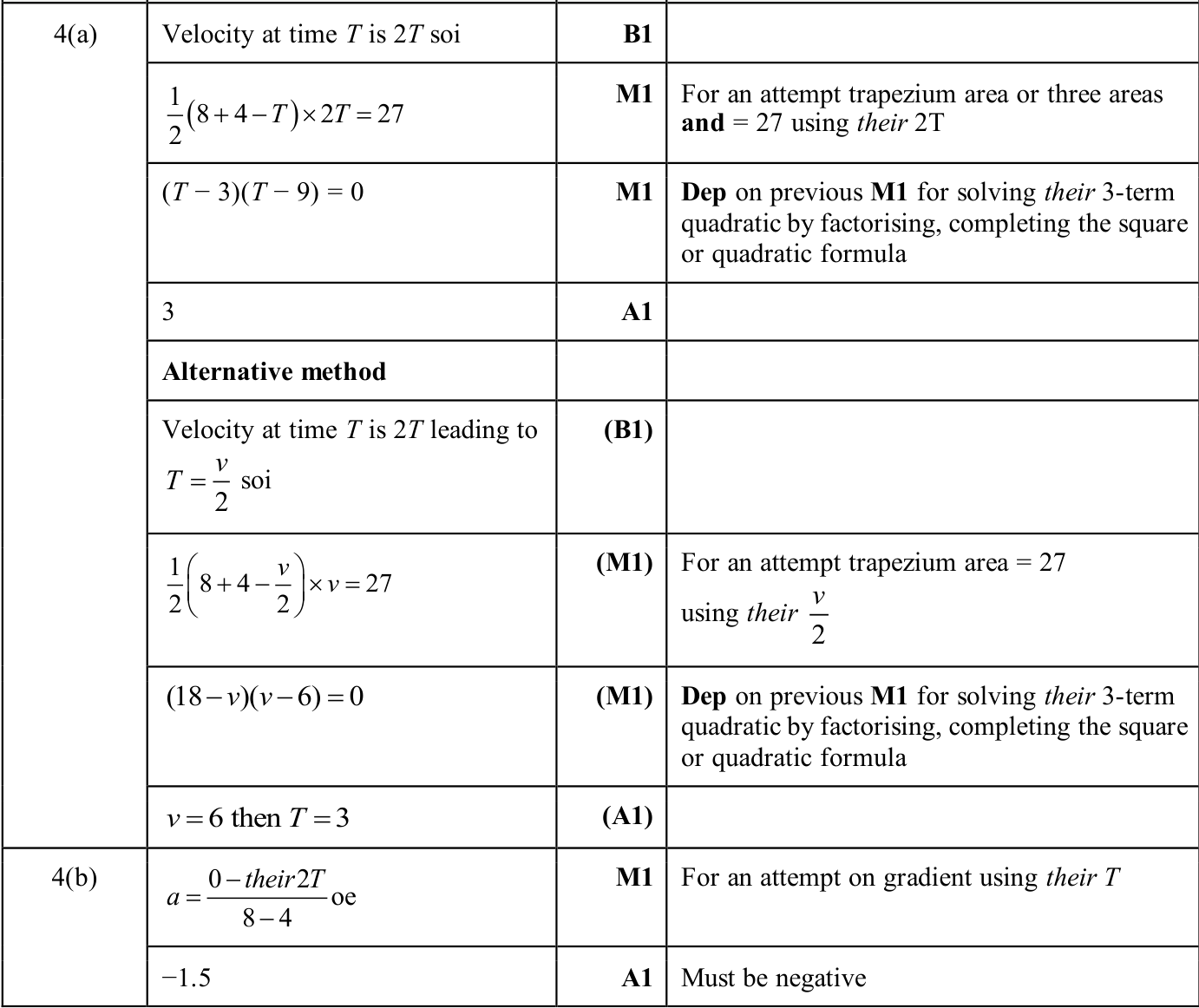
The velocity-time graph represents the motion of a particle moving in a straight line. The acceleration during the first \(T\) seconds of the motion is \(2\text{ m s}^{-2}\). The total distance travelled is \(27\text{ m}\).
(a) Calculate \(T\).
(b) Calculate the acceleration during the last 4 seconds of the motion.
0606 P11 - Nov 2025 - Q9 - 3 marks
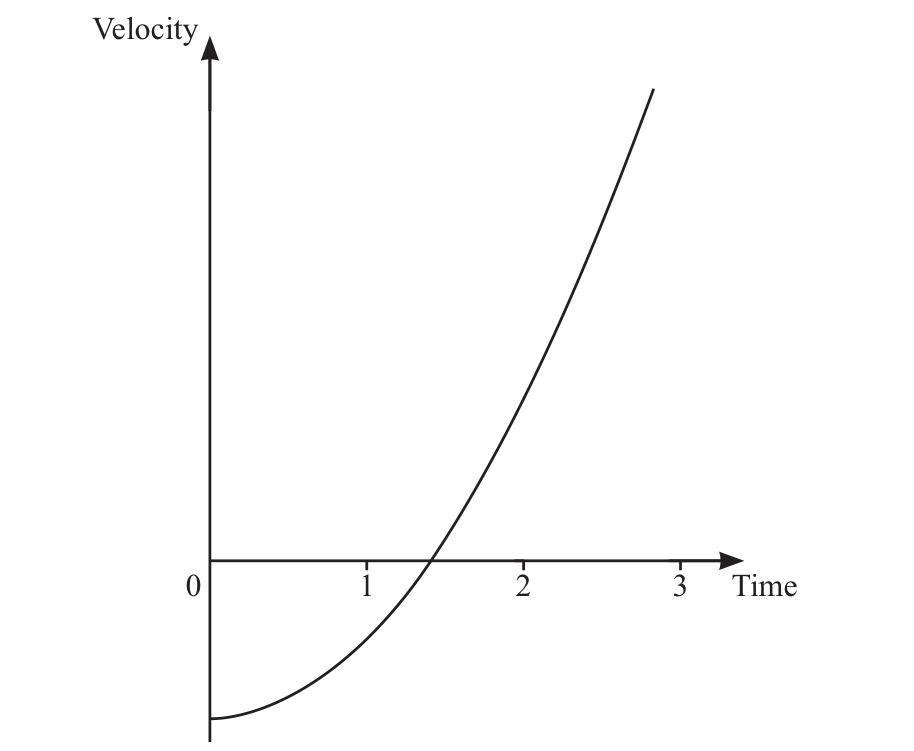
The diagram shows the velocity-time graph of a particle. The graph is part of a quadratic curve and the gradient is zero when \(t=0\).
(a) Sketch the corresponding speed-time graph.
(b) Sketch the corresponding acceleration-time graph.

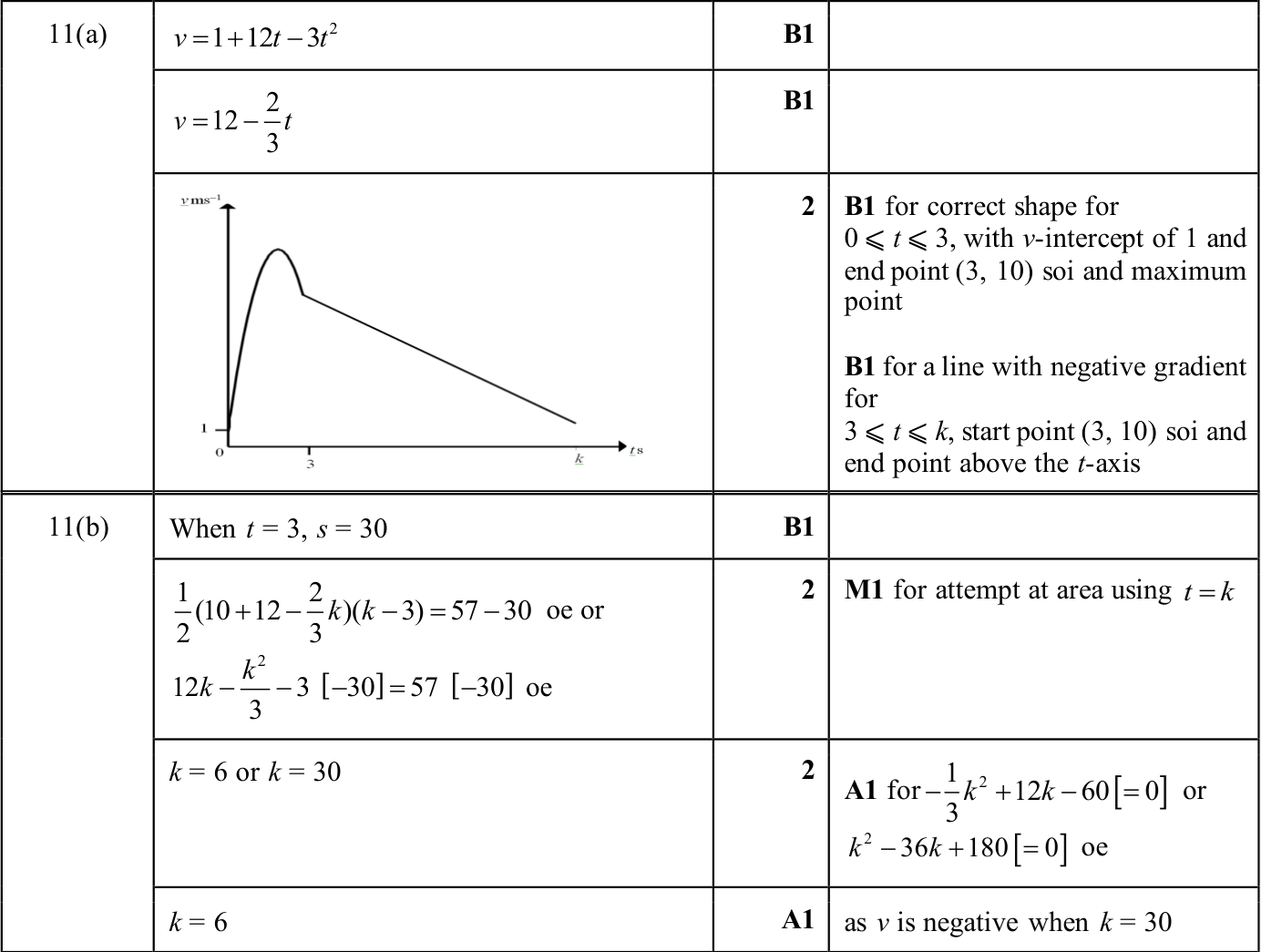
0606 P13 - Jun 2025 - Q11 - 10 marks
A particle \(P\) moves in a straight line and passes through a fixed point \(O\). At time \(t\) seconds, its displacement from \(O\), \(s\) metres, is given by
\(s=t+6t^2-t^3\) for \(0\leqslant t\leqslant3\).
\(s=12t-\frac13t^2-3\) for \(3\leqslant t\leqslant k\), where \(k\) is a constant.
It is given that, for \(3\leqslant t\leqslant k\), the velocity of \(P\) is positive and its acceleration is negative.
(a) The maximum velocity of \(P\) occurs when \(t=2\). On the axes below, sketch a velocity-time graph for the first \(k\) seconds of the motion of \(P\).
(b) The total distance travelled by \(P\) for \(0\leqslant t\leqslant k\) is 57 metres. Given that when \(t=3\) the distance and displacement of \(P\) from \(O\) are equal, find the value of \(k\).
0606 P22 - Jun 2025 - Q2 - 10 marks
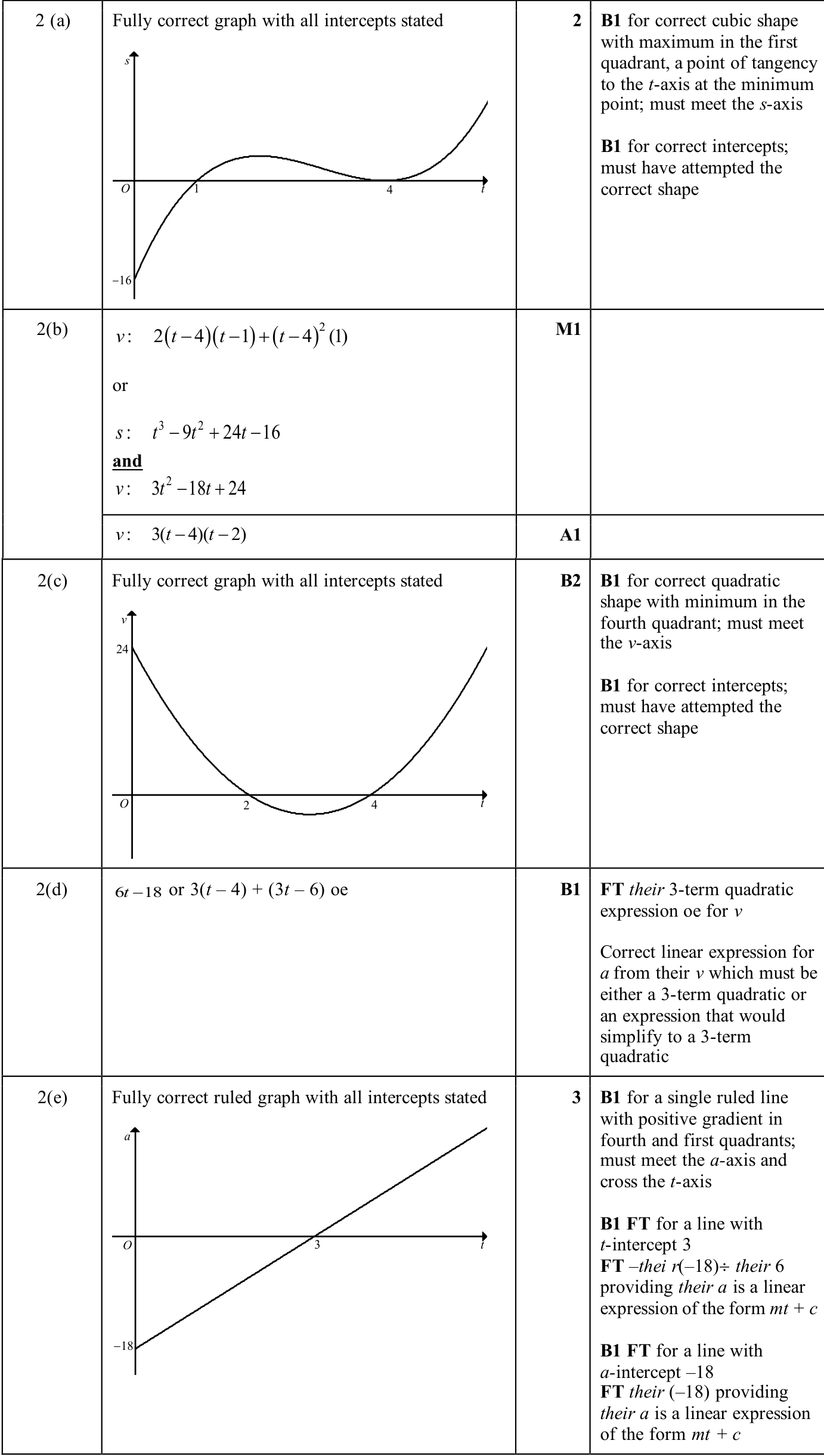
In this question, all lengths are in metres and time is in seconds. A particle \(P\) moves in a straight line such that its displacement \(s\) from a fixed point \(O\) at time \(t\) is given by \(s=(t-4)^{2}(t-1)\) for \(t \geqslant 0\). (a) On the axes, sketch the displacement-time graph of \(P\), stating the intercepts with the axes.
(b) Find an expression for the velocity, \(v\), of \(P\).
Give your answer in a factorised form.
(c) On the axes, sketch the velocity-time graph of \(P\), stating the intercepts with the axes.
(d) Find an expression for the acceleration, \(a\), of \(P\).
(e) On the axes, sketch the acceleration-time graph of \(P\), stating the intercepts with the axes.
0606 P22 - Mar 2025 - Q9 - 11 marks
In this question, all lengths are in metres and time is in seconds.
A particle, \(P\), moves in a straight line such that \(t\) seconds after passing through a fixed point \(O\) its displacement, \(s\), is given by \(s=5\ln(2t+1)-5t\).
(a) Find the value of \(t\) for which \(P\) is instantaneously at rest.
(b) Find the distance \(P\) travels between \(t=0\) and \(t=2\).
(c) Find an expression for the acceleration of \(P\) in terms of \(t\).
(d) Find the acceleration when \(t=4.5\).