Past Exam Questions
← Back0606 P22 - Jun 2017 - Q11 - 10 marks
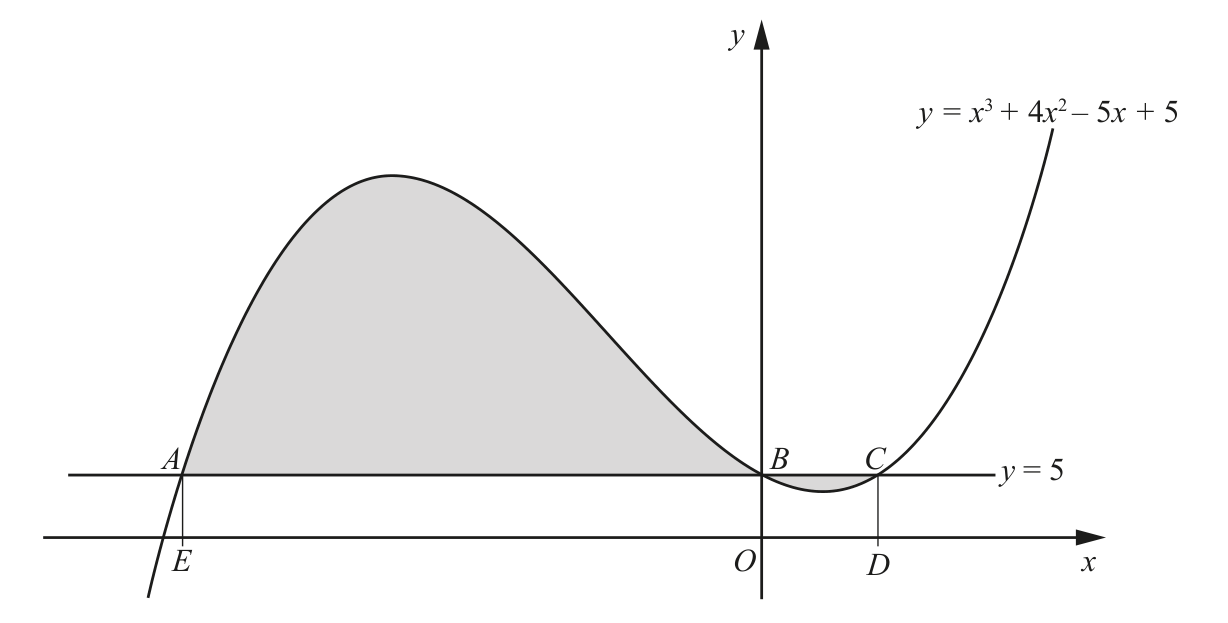
The diagram shows part of the curve \(y=x^3+4x^2-5x+5\) and the line \(y=5\).
The curve and the line intersect at the points \(A\), \(B\) and \(C\).
The points \(D\) and \(E\) are on the \(x\)-axis and the lines \(AE\) and \(CD\) are parallel to the \(y\)-axis.
(i) Find \(\int(x^3+4x^2-5x+5)\,dx\).
(ii) Find the area of each of the rectangles \(OEAB\) and \(OBCD\).
(iii) Hence calculate the total area of the shaded regions enclosed between the line and the curve. You must show all your working.
0606 P23 - Jun 2017 - Q11 - 10 marks
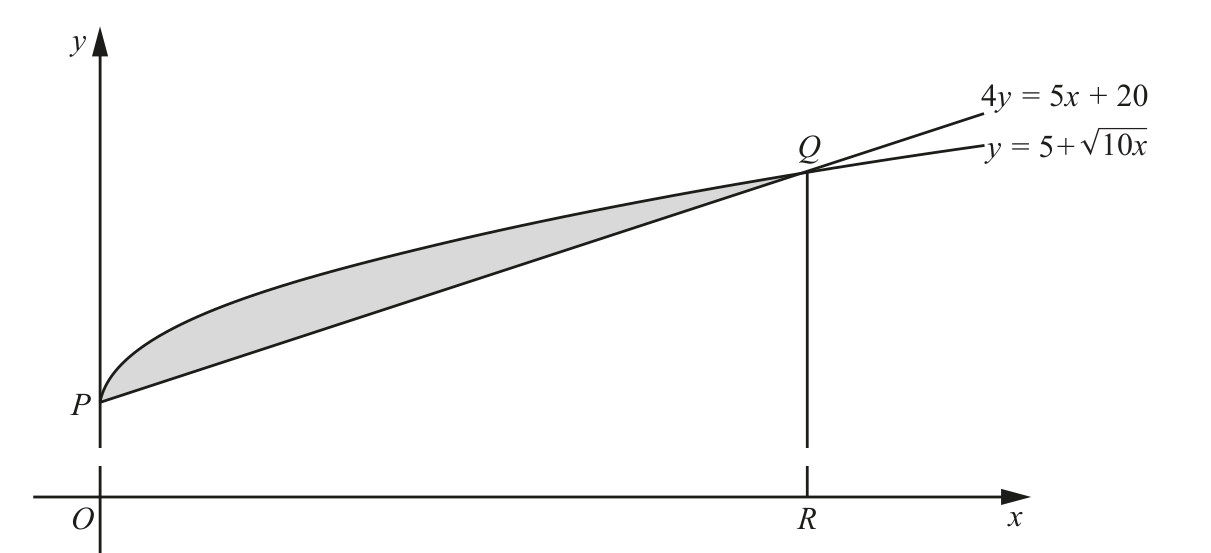
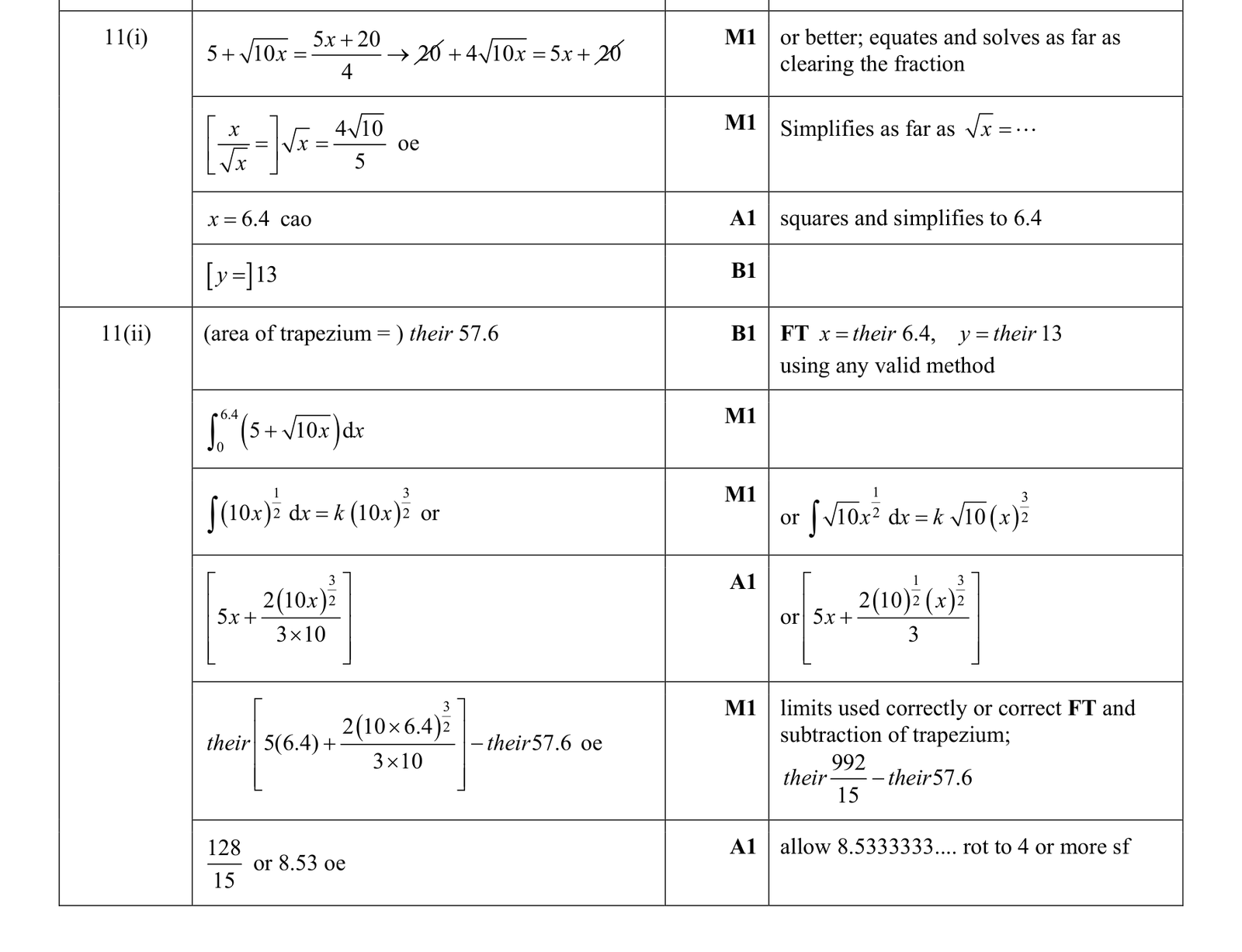
The diagram shows part of the curve \(y=5+\sqrt{10x}\) and the line \(4y=5x+20\). The line and curve intersect at the points \(P(0,5)\) and \(Q\). The line \(QR\) is parallel to the \(y\)-axis.
(i) Find the coordinates of \(Q\).
(ii) Find the area of the shaded region. You must show all your working.
0606 P22 - Nov 2017 - Q11 - 12 marks
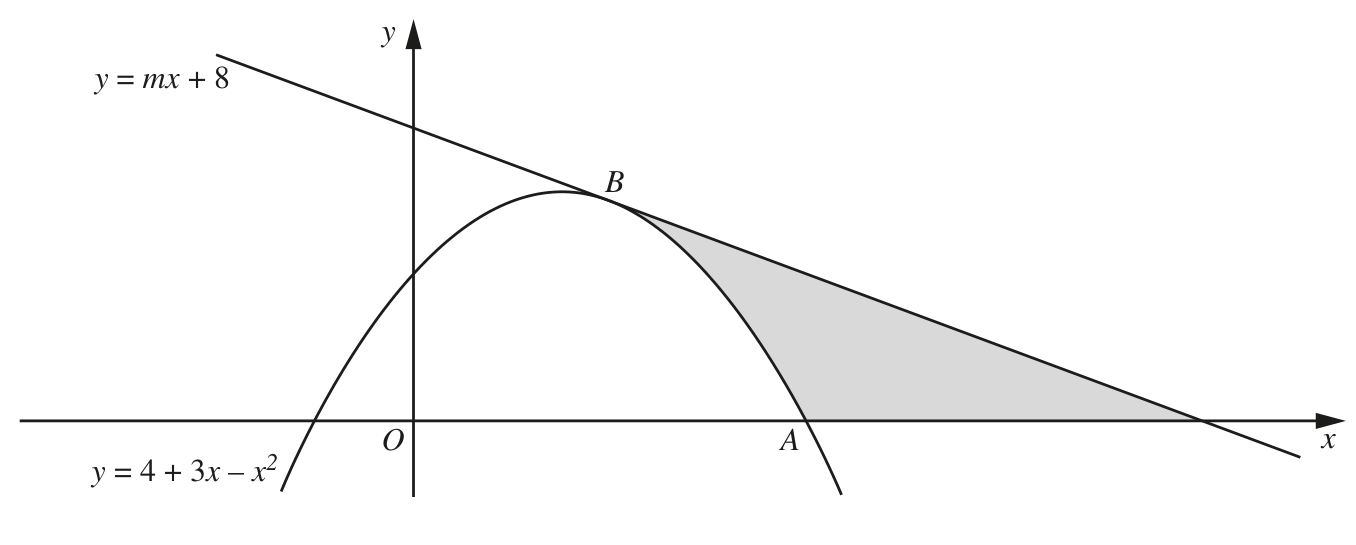
The diagram shows the curve \(y=4+3x-x^2\) intersecting the positive \(x\)-axis at the point \(A\). The line \(y=mx+8\) is a tangent to the curve at the point \(B\). Find
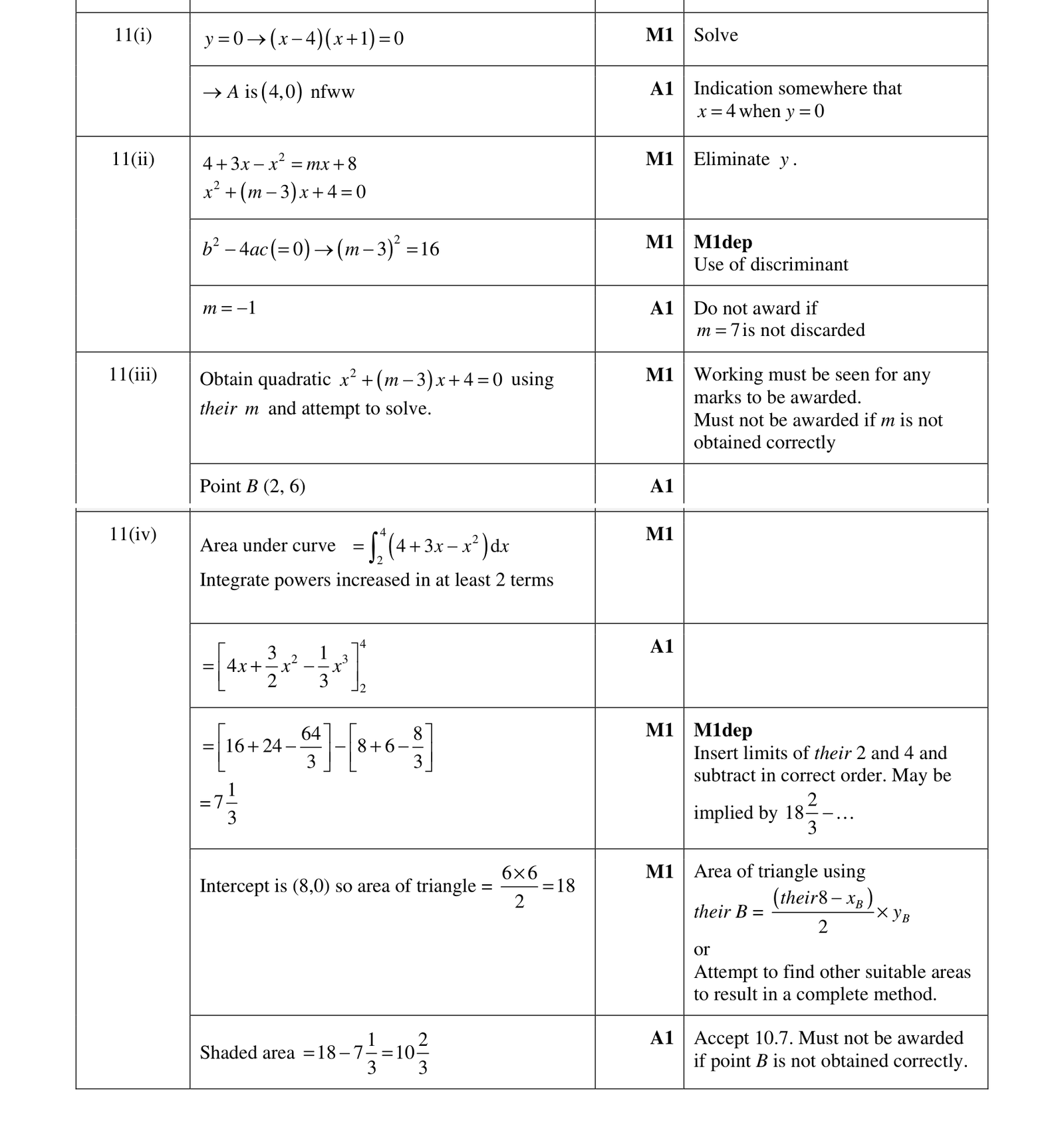
(i) the coordinates of \(A\),
(ii) the value of \(m\),
(iii) the coordinates of \(B\),
(iv) the area of the shaded region, showing all your working.
9231 P21 - Nov 2018 - Q5 - 12 marks
The fixed points \(A\) and \(B\) are on a smooth horizontal surface with \(A B=2.6 \mathrm{~m}\). One end of a light elastic spring, of natural length 1.25 m and modulus of elasticity \(\lambda \mathrm{N}\), is attached to \(A\). The other end is attached to a particle \(P\) of mass 0.4 kg . One end of a second light elastic spring, of natural length 1.0 m and modulus of elasticity \(0.6 \lambda \mathrm{~N}\), is attached to \(B\); its other end is attached to \(P\). The system is in equilibrium with \(P\) on the surface at the point \(E\).
(i) Show that \(A E=1.4 \mathrm{~m}\).
The particle \(P\) is now displaced slightly from \(E\), along the line \(A B\).
(ii) Show that, in the subsequent motion, \(P\) performs simple harmonic motion.
(iii) Given that the period of the motion is \(\frac{1}{7} \pi \mathrm{~s}\), find the value of \(\lambda\).

9231 P21 - Nov 2019 - Q11E - 14 marks
Question 11 EITHER alternative.
The points \(A\) and \(B\) are a distance 1.2 m apart on a smooth horizontal surface. A particle \(P\) of mass \(\frac{2}{3}\ \mathrm{kg}\) is attached to one end of a light spring of natural length 0.6 m and modulus of elasticity 10 N. The other end of the spring is attached to the point \(A\). A second light spring, of natural length 0.4 m and modulus of elasticity 20 N, has one end attached to \(P\) and the other end attached to \(B\).
(i) Show that when \(P\) is in equilibrium \(AP=0.75\ \mathrm{m}\).
The particle \(P\) is displaced by 0.05 m from the equilibrium position towards \(A\) and then released from rest.
(ii) Show that \(P\) performs simple harmonic motion and state the period of the motion.
(iii) Find the speed of \(P\) when it passes through the equilibrium position.
(iv) Find the speed of \(P\) when its acceleration is equal to half of its maximum value.

9231 P23 - Jun 2019 - Q11E - 12 marks
Question 11 EITHER alternative.
A light spring has natural length \(a\) and modulus of elasticity \(k m g\). The spring lies on a smooth horizontal surface with one end attached to a fixed point \(O\). A particle \(P\) of mass \(m\) is attached to the other end of the spring. The system is in equilibrium with \(O P=a\). The particle is projected towards \(O\) with speed \(u\) and comes to instantaneous rest when \(O P=\frac{3}{4} a\).
(i) Use an energy method to show that \(k=\frac{16 u^{2}}{a g}\).
(ii) Show that \(P\) performs simple harmonic motion and find the period of this motion, giving your answer in terms of \(u\) and \(a\).
(iii) Find, in terms of \(u\) and \(a\), the time that elapses before \(P\) first loses 25% of its initial kinetic energy.

9231 P22 - Nov 2018 - Q11E - 14 marks
Question 11 EITHER alternative.
One end of a light elastic spring, of natural length \(0.8\ \mathrm{m}\) and modulus of elasticity \(40\ \mathrm{N}\), is attached to a fixed point \(O\). The spring hangs vertically, at rest, with particles of masses \(2\ \mathrm{kg}\) and \(M\ \mathrm{kg}\) attached to its free end. The \(M\ \mathrm{kg}\) particle becomes detached from the spring, and as a result the \(2\ \mathrm{kg}\) particle begins to move upwards.
(i) Show that the \(2\ \mathrm{kg}\) particle performs simple harmonic motion about its equilibrium position with period \(\frac25\pi\ \mathrm{s}\). State the distance below \(O\) of the centre of the oscillations.
The speed of the \(2\ \mathrm{kg}\) particle is \(0.4\ \mathrm{m\ s^{-1}}\) when its displacement from the centre of oscillation is \(0.06\ \mathrm{m}\).
(ii) Find the amplitude of the motion.
(iii) Deduce the value of \(M\).

9231 P21 - Jun 2017 - Q11E - 14 marks
Question 11 EITHER alternative.
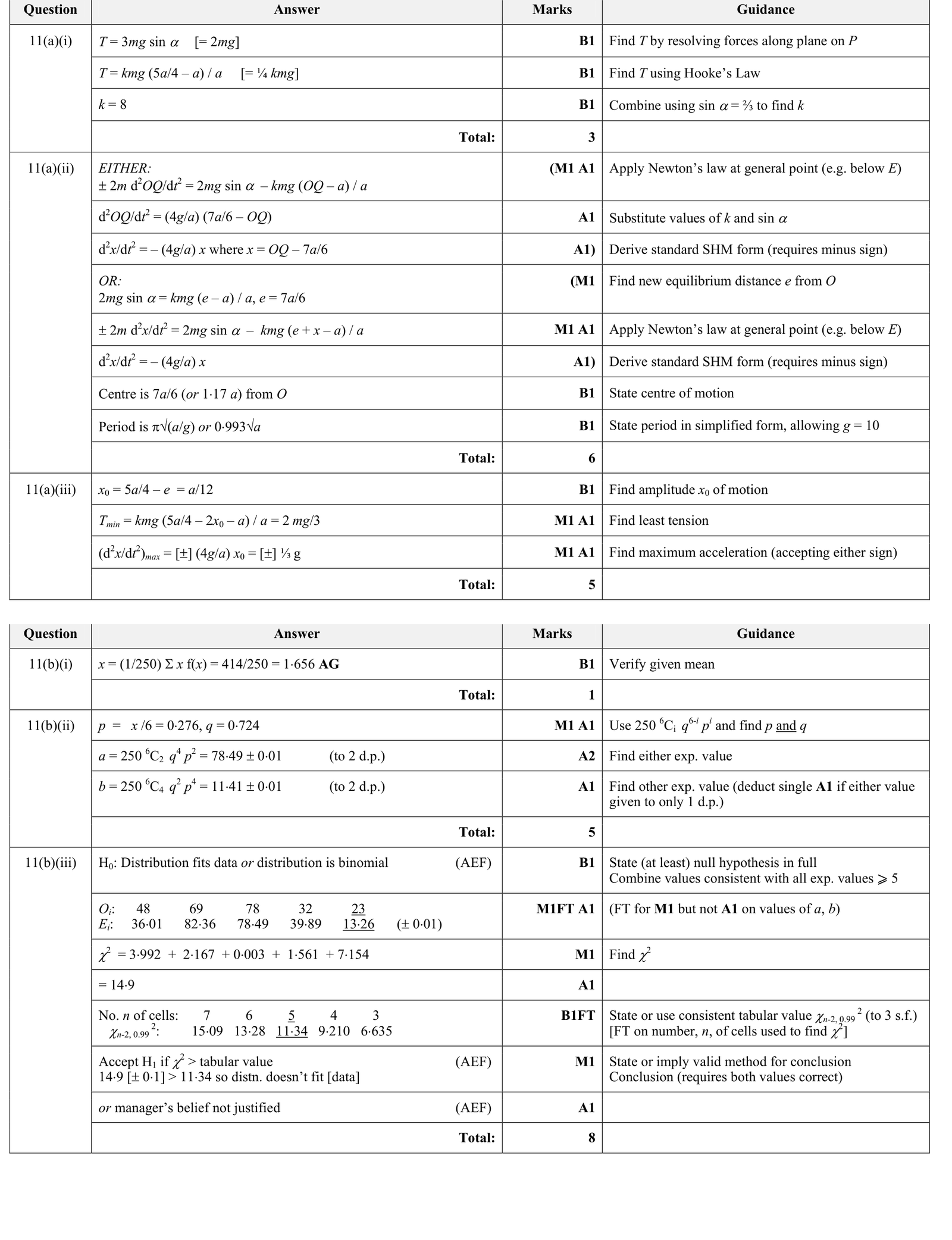
A particle \(P\) of mass \(3 m\) is attached to one end of a light elastic spring of natural length \(a\) and modulus of elasticity \(k m g\). The other end of the spring is attached to a fixed point \(O\) on a smooth plane that is inclined to the horizontal at an angle \(\alpha\), where \(\sin \alpha=\frac{2}{3}\). The system rests in equilibrium with \(P\) on the plane at the point \(E\). The length of the spring in this position is \(\frac{5}{4} a\).
(i) Find the value of \(k\).
The particle \(P\) is now replaced by a particle \(Q\) of mass \(2 m\) and \(Q\) is released from rest at the point \(E\).
(ii) Show that, in the resulting motion, \(Q\) performs simple harmonic motion. State the centre and the period of the motion.
(iii) Find the least tension in the spring and the maximum acceleration of \(Q\) during the motion.
9231 P34 - Nov 2025 - Q6 - 7 marks
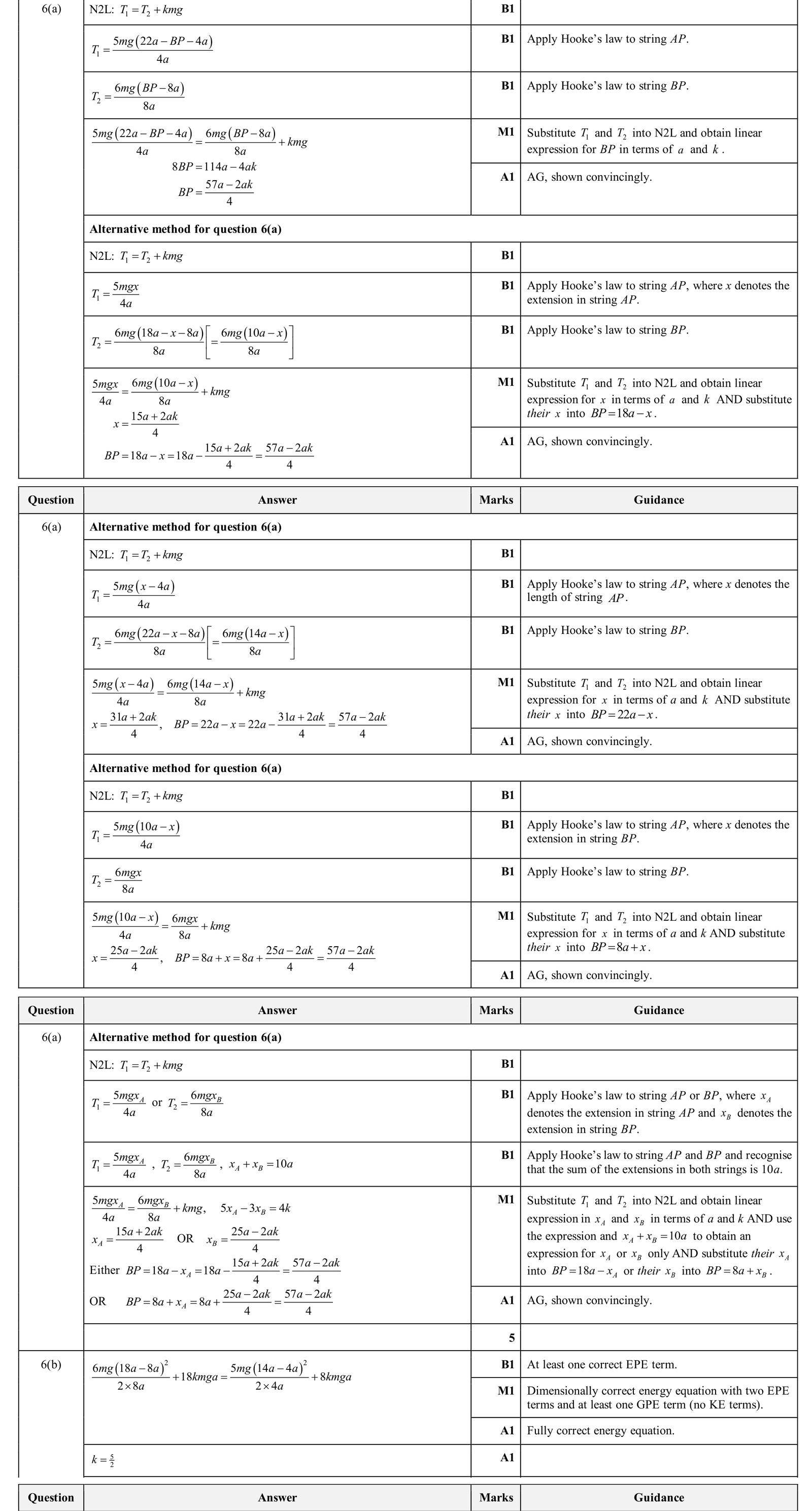
\(6 \quad A\) and \(B\) are two fixed points at a distance \(22 a\) apart, with \(B\) vertically below \(A\). A light elastic string of natural length \(4 a\) and modulus of elasticity \(5 m g\) has one end attached to \(A\) and the other end attached to a particle \(P\) of mass km . Another light elastic string of natural length \(8 a\) and modulus of elasticity \(6 m g\) has one end attached to \(B\) and the other end attached to \(P\). Particle \(P\) is vertically above \(B\). (a) Show that, when the system is in equilibrium, \(B P=\frac{57 a-2 a k}{4}\).
The particle \(P\) is pulled vertically upwards so that \(B P=18 a\), and is then released from rest. In its subsequent motion, \(P\) first comes to instantaneous rest at the point where \(B P=8 a\). (b) Find the value of \(k\).
9231 P31 - Jun 2022 - Q1 - 5 marks
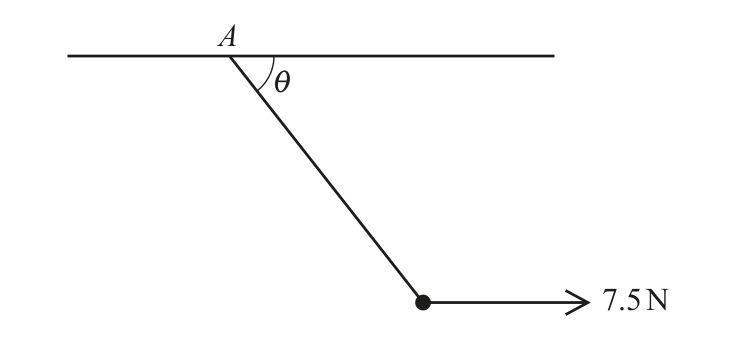
A particle of weight 10 N is attached to one end of a light elastic string. The other end of the string is attached to a fixed point \(A\) on a horizontal ceiling. A horizontal force of 7.5 N acts on the particle. In the equilibrium position, the string makes an angle \(\theta\) with the ceiling (see diagram). The string has natural length 0.8 m and modulus of elasticity 50 N .
(a) Find the tension in the string.
(b) Find the vertical distance between the particle and the ceiling.

9231 P32 - Nov 2025 - Q2 - 6 marks
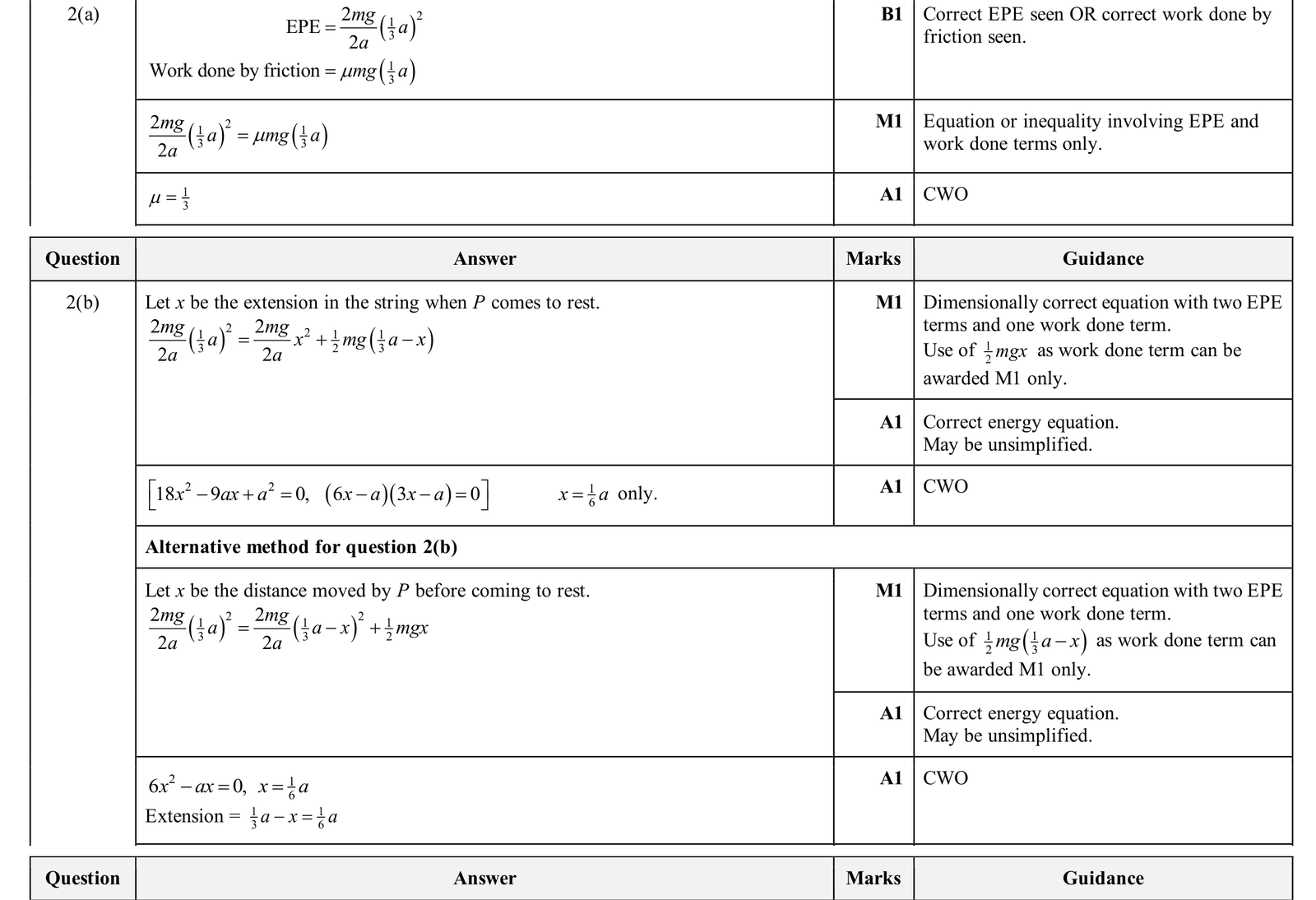
One end of a light elastic string of natural length \(a\) and modulus of elasticity \(2 m g\) is attached to a fixed point \(A\) on a rough horizontal surface. The other end of the string is attached to a particle \(P\) of mass \(m\). The particle and string rest on the surface. The coefficient of friction between \(P\) and the surface is \(\mu\). The particle \(P\) is initially held in equilibrium at a distance \(\frac{4}{3} a\) from \(A\). The particle is then released from rest. (a) Given that the string never becomes slack, find the minimum value of \(\mu\).
It is now given that \(\mu=\frac{1}{2}\). (b) Find the extension of the string when the particle comes to rest.
9231 P34 - Jun 2025 - Q1 - 5 marks
A light spring of natural length \(a\) and modulus of elasticity \(20mg\) stands vertically on a horizontal plane. The lower end of the spring is fixed to the plane. A particle of mass \(m\) is attached to the upper end of the spring.
The particle is pushed vertically downwards until the length of the spring is \(\dfrac{3a}{5}\). The system is then released from rest.
Find the maximum extension of the spring in the subsequent motion.

9231 P32 - Nov 2024 - Q2 - 4 marks
A particle \(P\) of mass \(m\) is attached to one end of a light elastic spring of natural length \(a\) and modulus of elasticity \(5mg\). The other end of the spring is attached to a fixed point \(O\). The spring hangs vertically with \(P\) below \(O\).
The particle is pulled down vertically and released from rest when the length of the spring is \(\dfrac32a\).
Find the distance of \(P\) below \(O\) when \(P\) first comes to instantaneous rest.

9231 P31 - Nov 2025 - Q4 - 6 marks
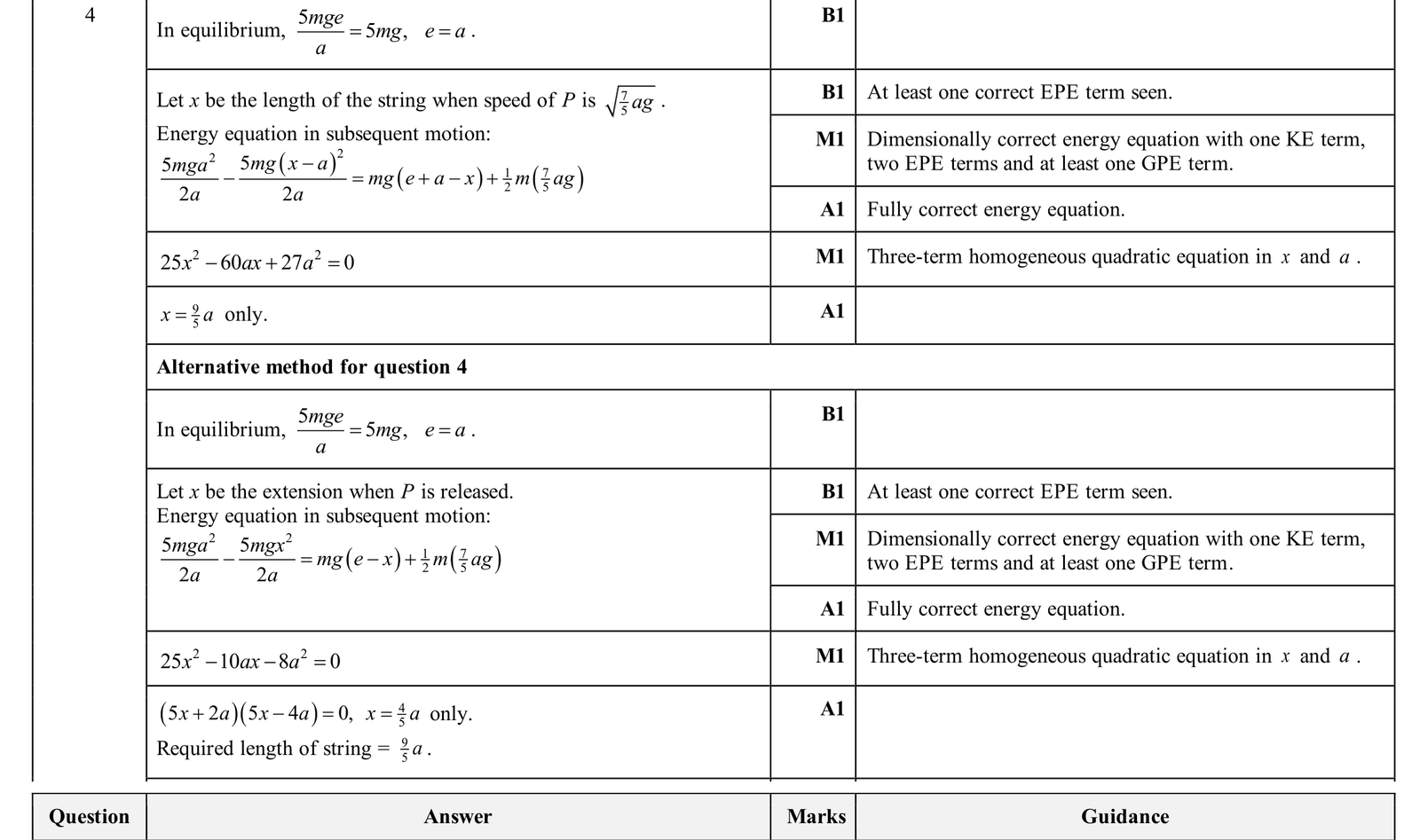
One end of a light elastic string of natural length \(a\) and modulus of elasticity 5 mg is attached to a fixed point \(O\). Two particles, \(P\) and \(Q\), of masses \(m\) and \(4 m\) respectively are attached to the other end of the string and they hang vertically in equilibrium. Particle \(Q\) is then detached from the string, hence releasing particle \(P\) from rest.
Find, in terms of \(a\), the length of the string when the speed of particle \(P\) is first equal to \(\sqrt{\frac{7}{5} a g}\).
9231 P31 - Jun 2025 - Q5 - 6 marks
One end of a light elastic string of natural length \(0.5\) m and modulus \(14\) N is attached to a fixed point \(A\) on a smooth plane. The plane makes an angle \(\alpha\) with the horizontal, where \(\tan\alpha=\frac{7}{24}\). A particle \(P\) of mass \(2\) kg is attached to the other end. The string lies along a line of greatest slope. Initially, \(P\) is held above the level of \(A\), where \(AP=0.8\) m, and is then released from rest.
Find the maximum velocity of \(P\) during the subsequent motion.

9231 P33 - Jun 2025 - Q2 - 8 marks
A particle \(P\) of mass \(m\) is attached to a light elastic string of natural length \(a\) and modulus \(mg\). The other end is fixed at \(O\) on a rough plane inclined at \(30^\circ\) to the horizontal. The particle is held at rest at \(O\) and released. The frictional force while it slides down the plane is \(\frac{11}{30}mg\).
(a) Find, in terms of \(a\), the distance moved down the plane before coming to rest.
(b) Given that \(P\) remains at rest in this new position, find the magnitude of the frictional force.

9231 P31 - Nov 2024 - Q3 - 8 marks
A particle \(P\) of mass \(m\,\text{kg}\) is attached to one end of a light elastic string of natural length \(2\) m and modulus of elasticity \(2mg\) N. The other end is attached to a fixed point \(O\). The particle hangs in equilibrium vertically below \(O\).
The particle is pulled vertically downwards a distance \(d\) m below its equilibrium position and released from rest.
(a) Given that the particle just reaches \(O\) in the subsequent motion, find \(d\).
(b) Hence find the speed of \(P\) when it is \(2\) m below \(O\).

9231 P31 - Jun 2024 - Q2 - 7 marks
The points \(A\) and \(B\) are at the same horizontal level and are \(4a\) apart. The ends of a light elastic string, of natural length \(4a\) and modulus of elasticity \(\lambda\), are attached to \(A\) and \(B\). A particle \(P\) of mass \(m\) is attached to the midpoint of the string.
The system is in equilibrium with \(P\) at a distance \(\dfrac32a\) below \(M\), the midpoint of \(AB\).
(a) Find \(\lambda\) in terms of \(m\) and \(g\).
The particle \(P\) is then pulled down vertically and released from rest at a distance \(\dfrac83a\) below \(M\).
(b) Find, in terms of \(a\) and \(g\), the speed of \(P\) as it passes through \(M\) in the subsequent motion.

9231 P33 - Jun 2024 - Q4 - 7 marks
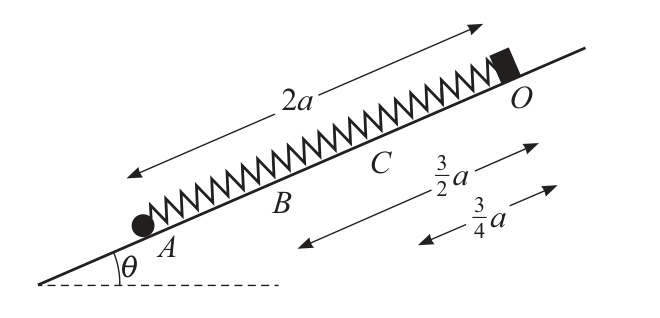
A light spring of natural length \(a\) and modulus of elasticity \(kmg\) is attached to a fixed point \(O\) on a smooth plane inclined at angle \(\theta\) to the horizontal, where \(\sin\theta=\dfrac34\). A particle of mass \(m\) is attached to the lower end of the spring and is held at point \(A\), where \(OA=2a\) and \(OA\) is along a line of greatest slope of the plane.
The particle is released from rest. It is moving with speed \(V\) when it passes through point \(B\), where \(OB=\dfrac32a\). Its speed is \(\dfrac12V\) when it passes through point \(C\), where \(OC=\dfrac34a\).
Find \(k\).

9231 P31 - Nov 2023 - Q4 - 8 marks
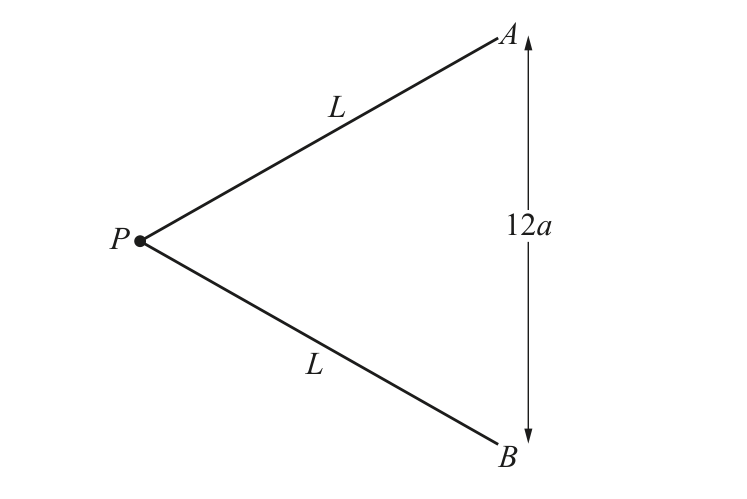
A light elastic string has natural length \(8a\) and modulus of elasticity \(5mg\). A particle \(P\) of mass \(m\) is attached to the midpoint of the string. The ends of the string are attached to points \(A\) and \(B\), which are a distance \(12a\) apart on a smooth horizontal table.
The particle \(P\) is held on the table so that \(AP=BP=L\). The particle \(P\) is released from rest. When \(P\) is at the midpoint of \(AB\), it has speed \(\sqrt{80ag}\).
(a) Find \(L\) in terms of \(a\).
(b) Find the initial acceleration of \(P\) in terms of \(g\).