Past Exam Questions
← Back0606 P22 - Nov 2025 - Q10 - 10 marks
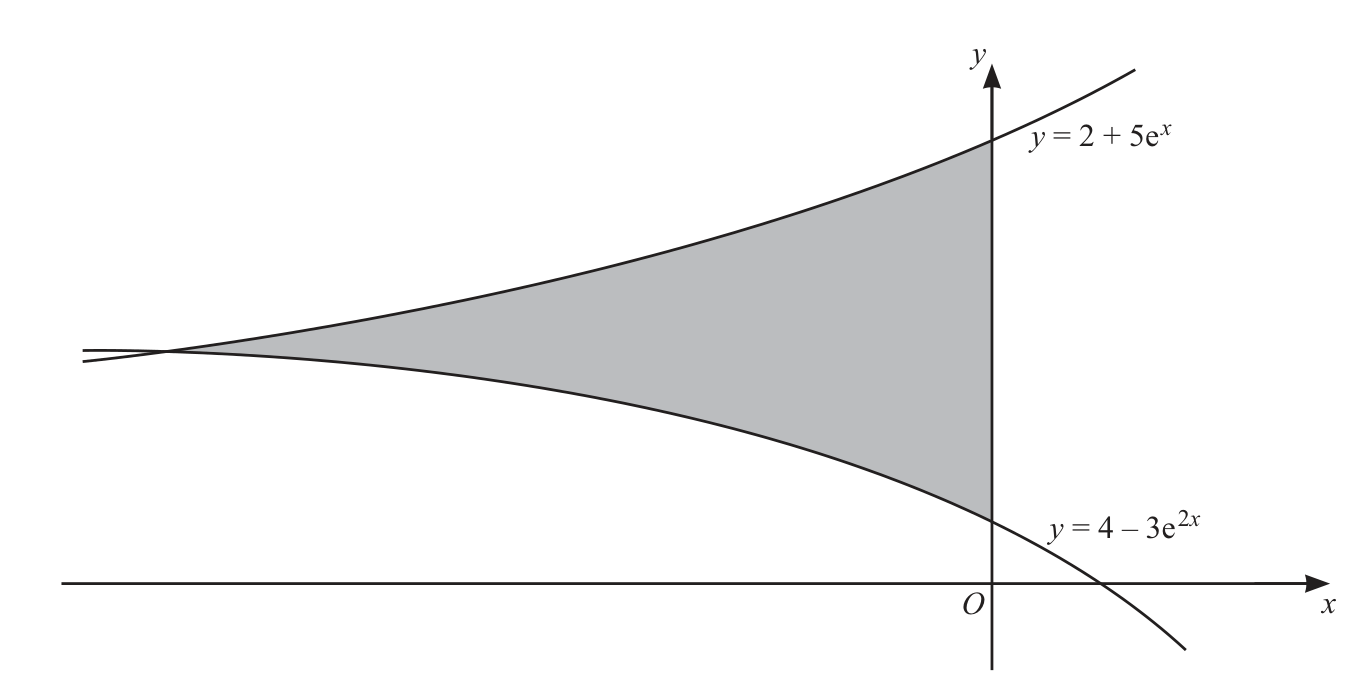
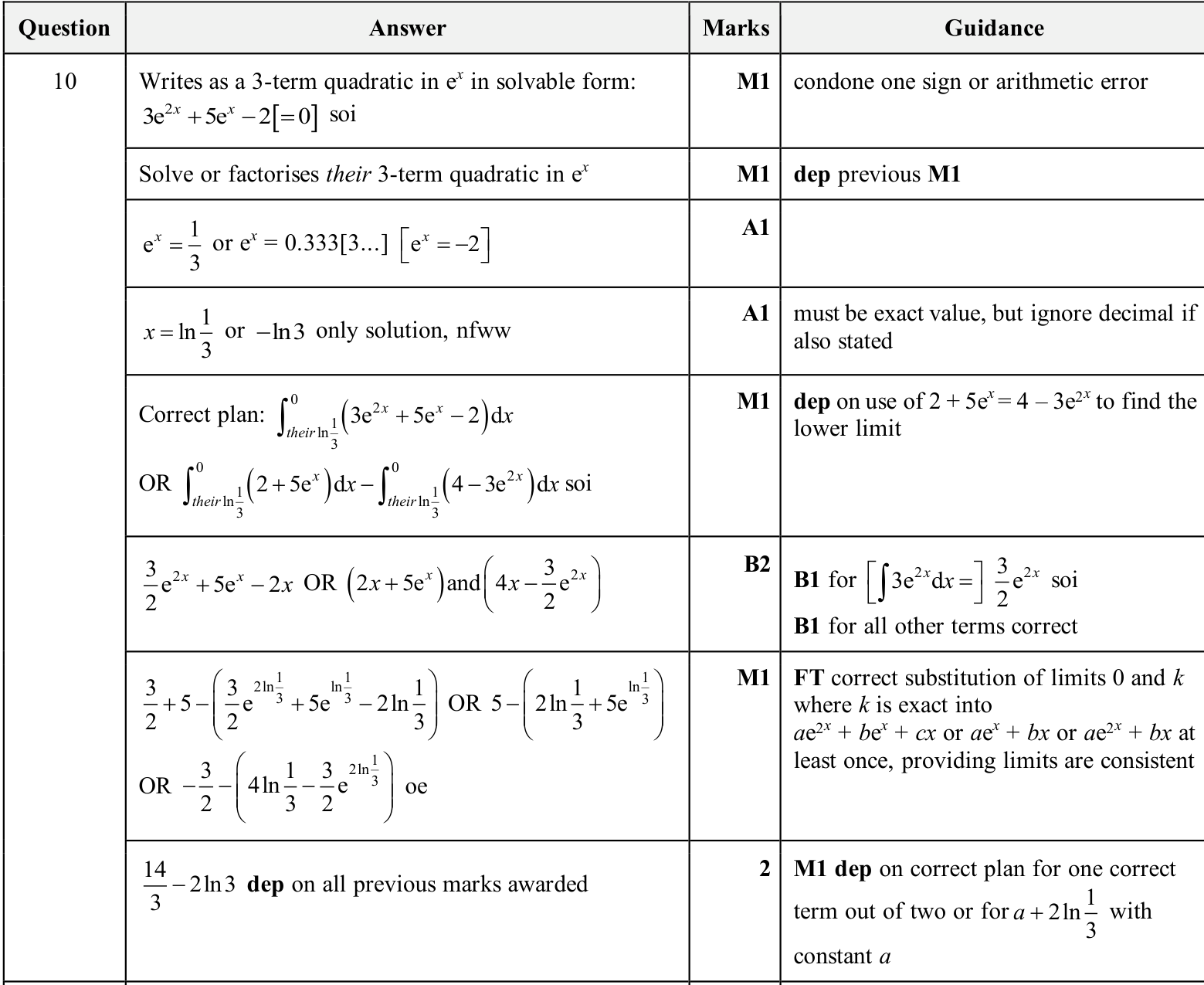
The diagram shows parts of the graphs of \(y=2+5\mathrm{e}^x\) and \(y=4-3\mathrm{e}^{2x}\).
Find the area of the shaded region. Give your answer in the form \(a+b\ln 3\), where \(a\) and \(b\) are exact constants.
0606 P13 - Nov 2025 - Q8 - 7 marks
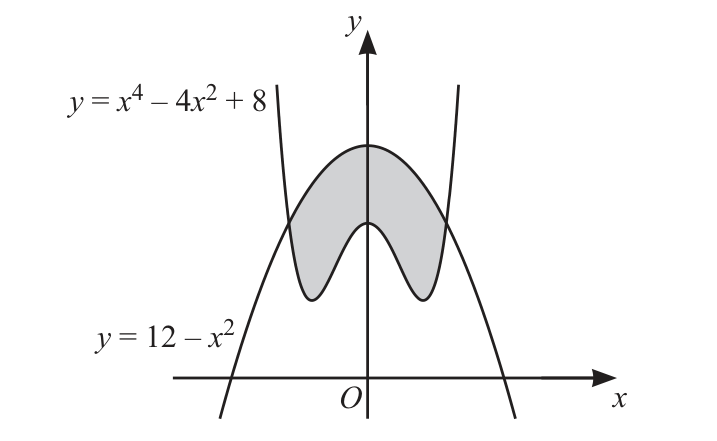
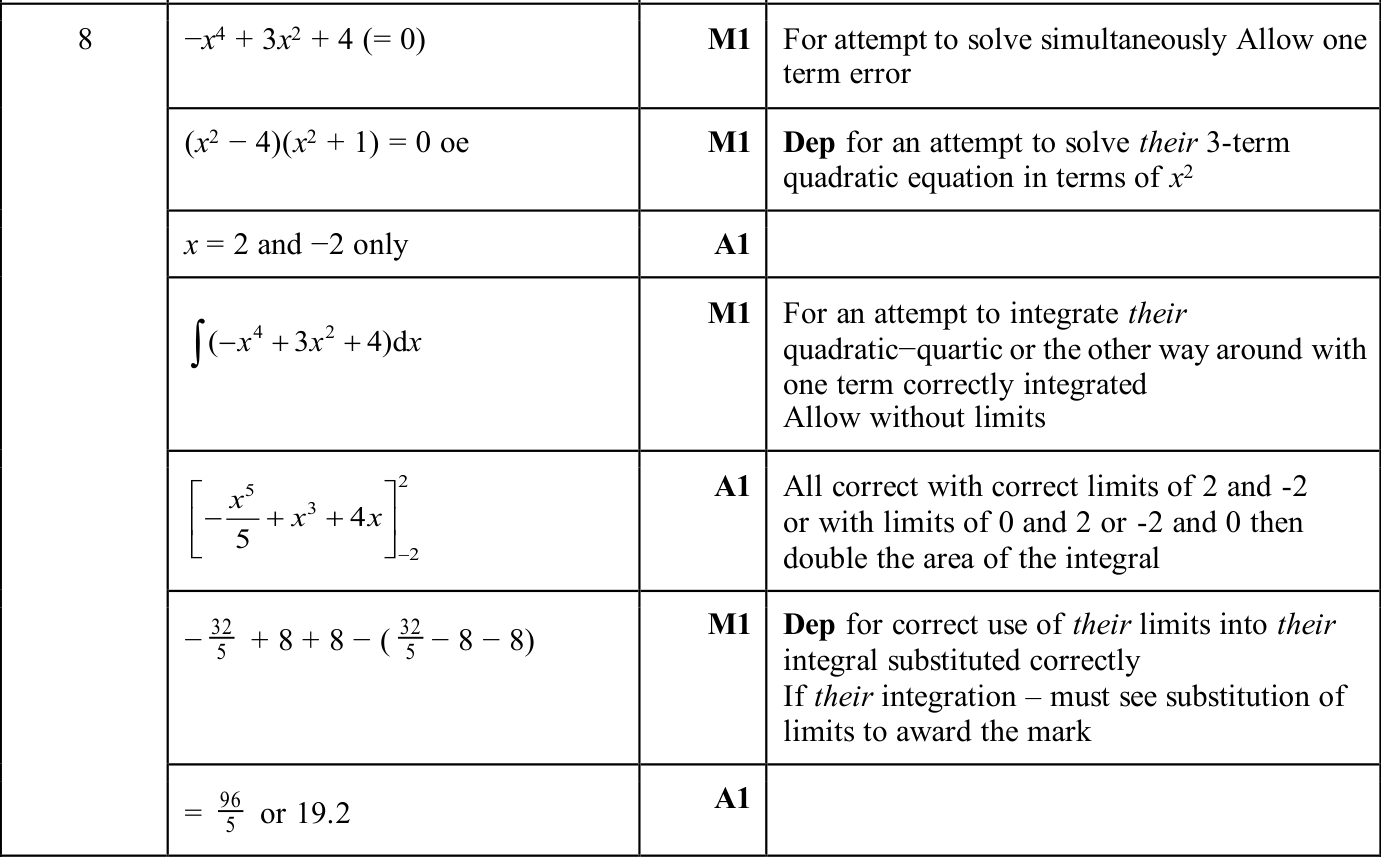
The diagram shows part of each of the curves \(y=12-x^2\) and \(y=x^4-4x^2+8\).
Find the area of the shaded region enclosed by the two curves.
0606 P11 - Nov 2025 - Q10 - 11 marks
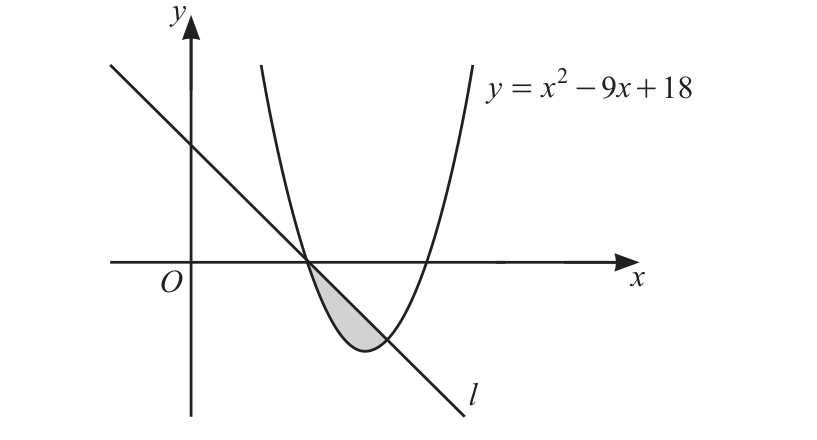
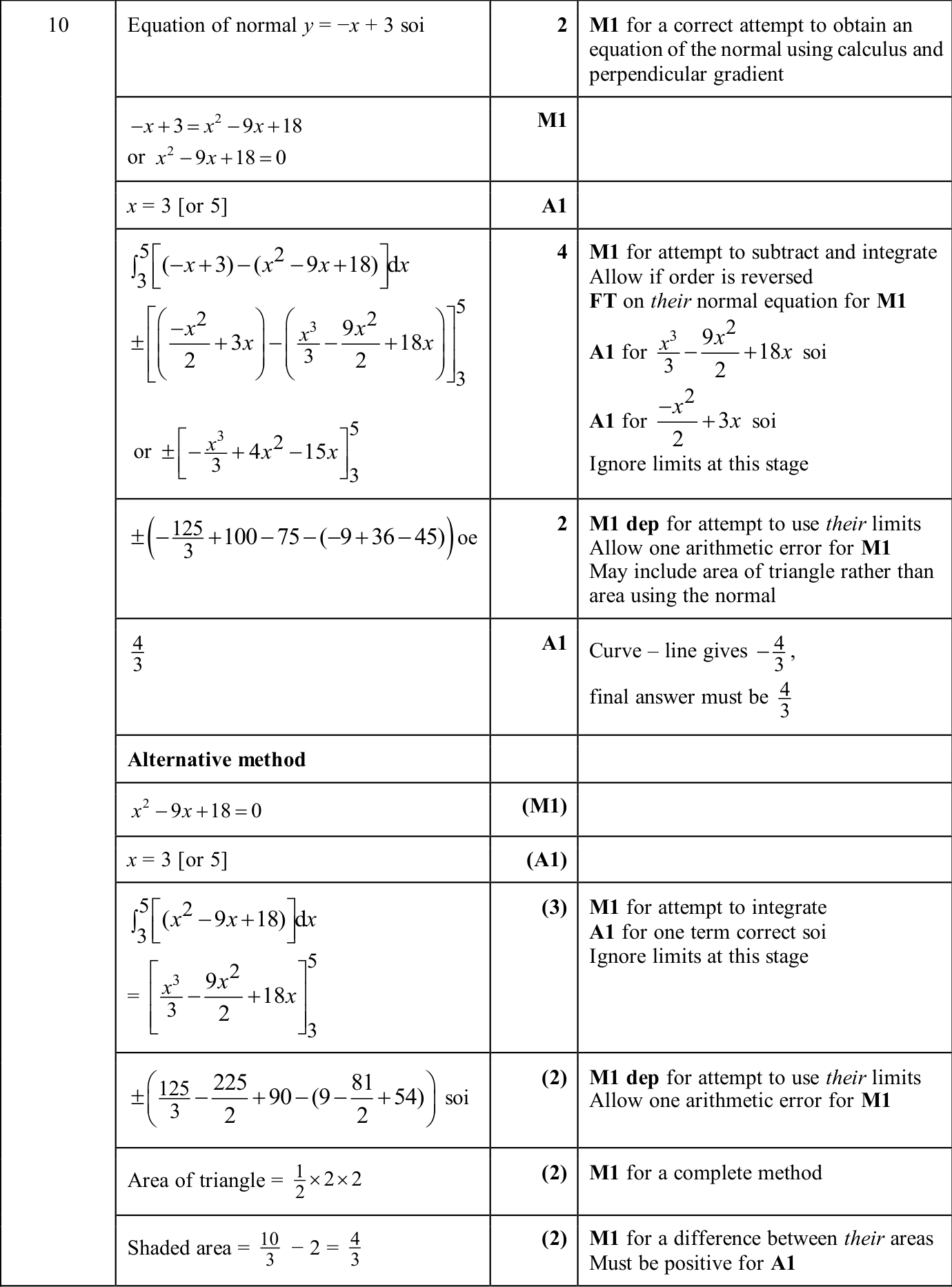
The curve \(y=x^2-9x+18\) has a normal at the point where \(x=5\). This normal meets the curve again. Find the area of the shaded region enclosed by the normal and the curve.
0606 P11 - Jun 2025 - Q9 - 10 marks
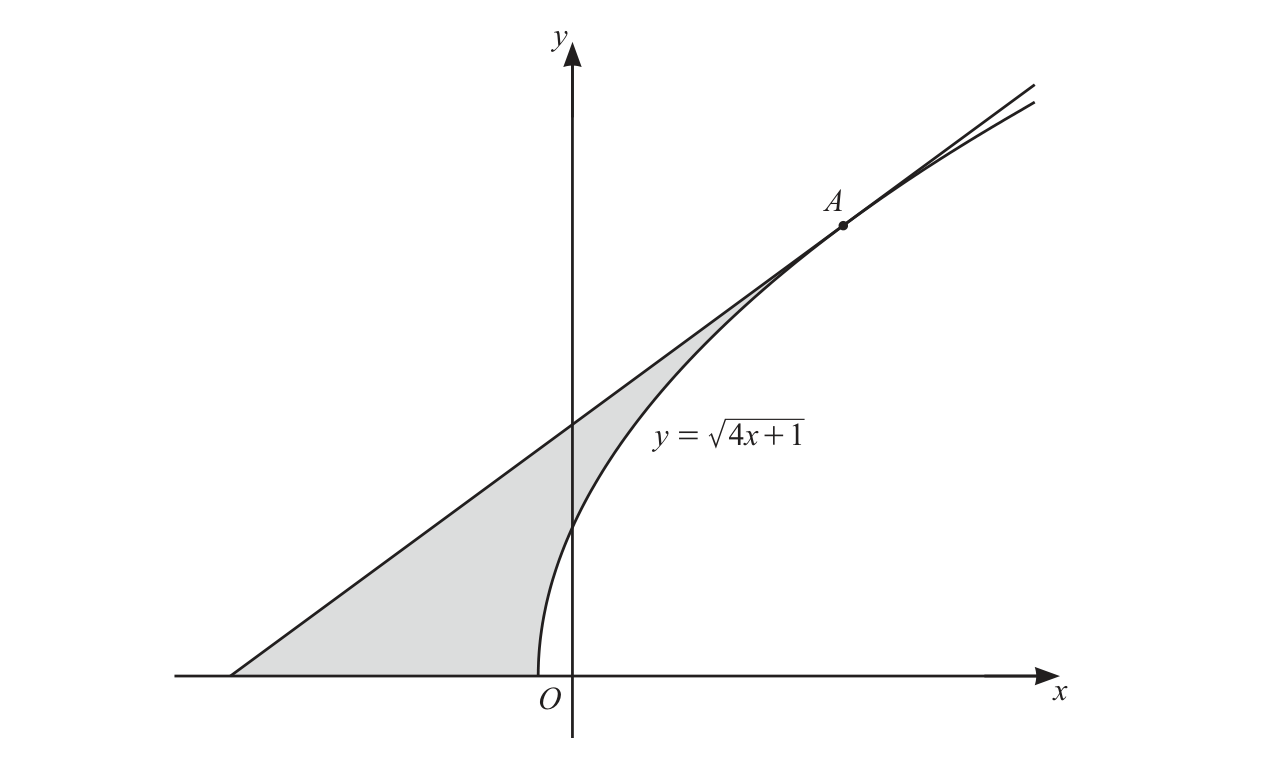
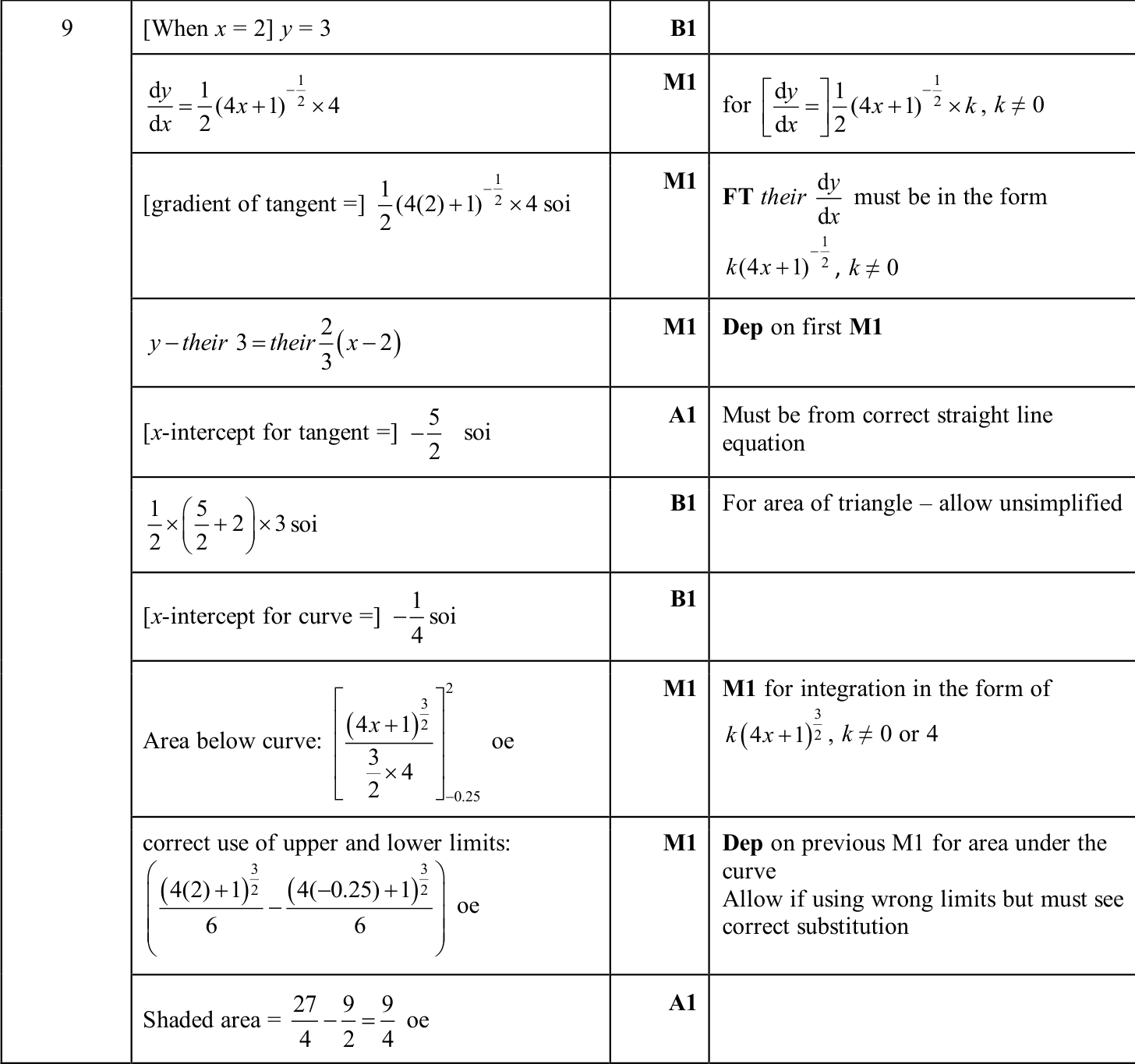
The point \(A\) with \(x\)-coordinate \(2\) lies on the curve \(y=\sqrt{4x+1}\). The diagram shows part of this curve and the tangent to the curve at \(A\).
Find the area of the shaded region enclosed by the curve, the tangent and the \(x\)-axis.
0606 P13 - Jun 2025 - Q8 - 8 marks
д№™
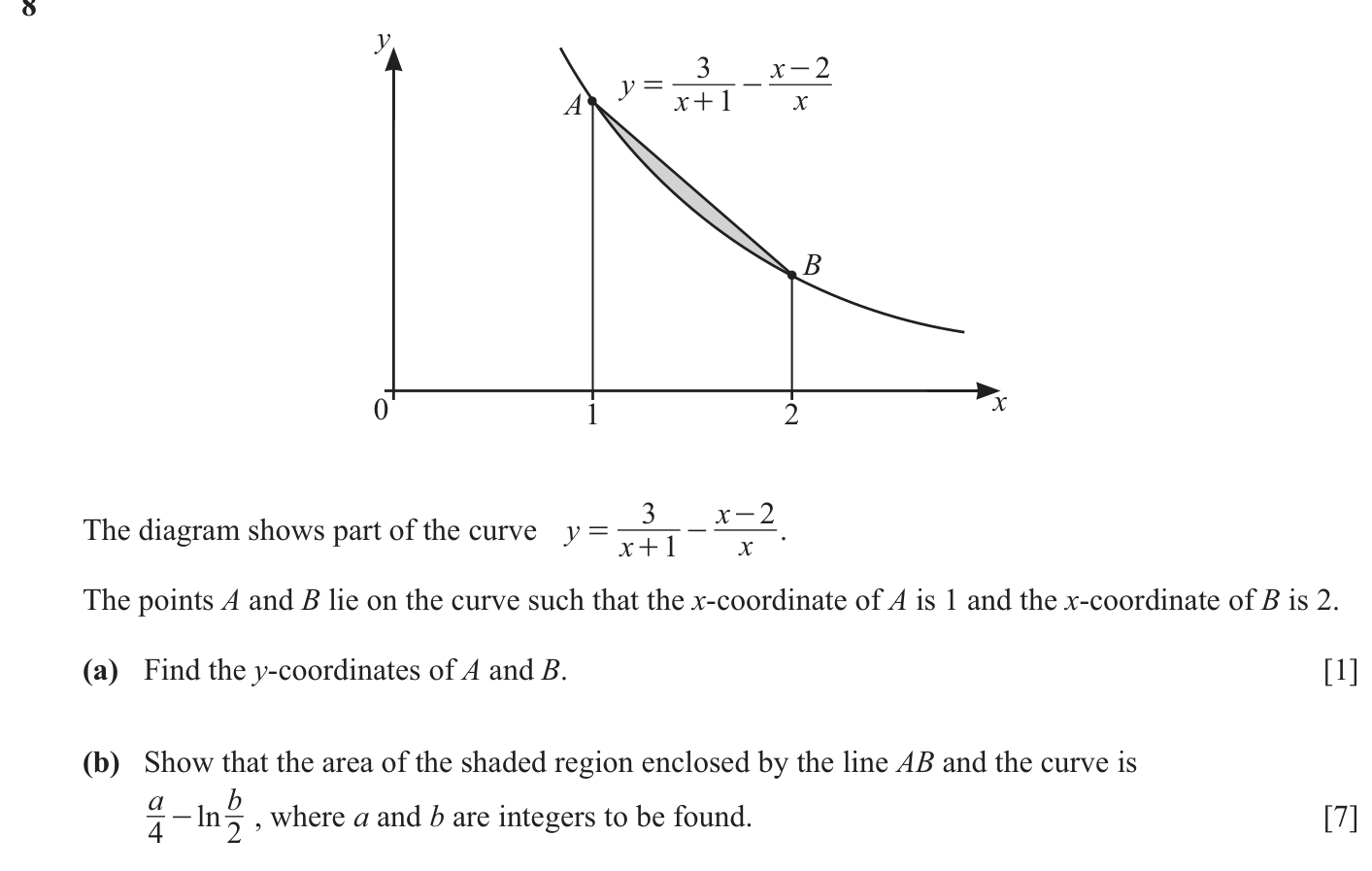
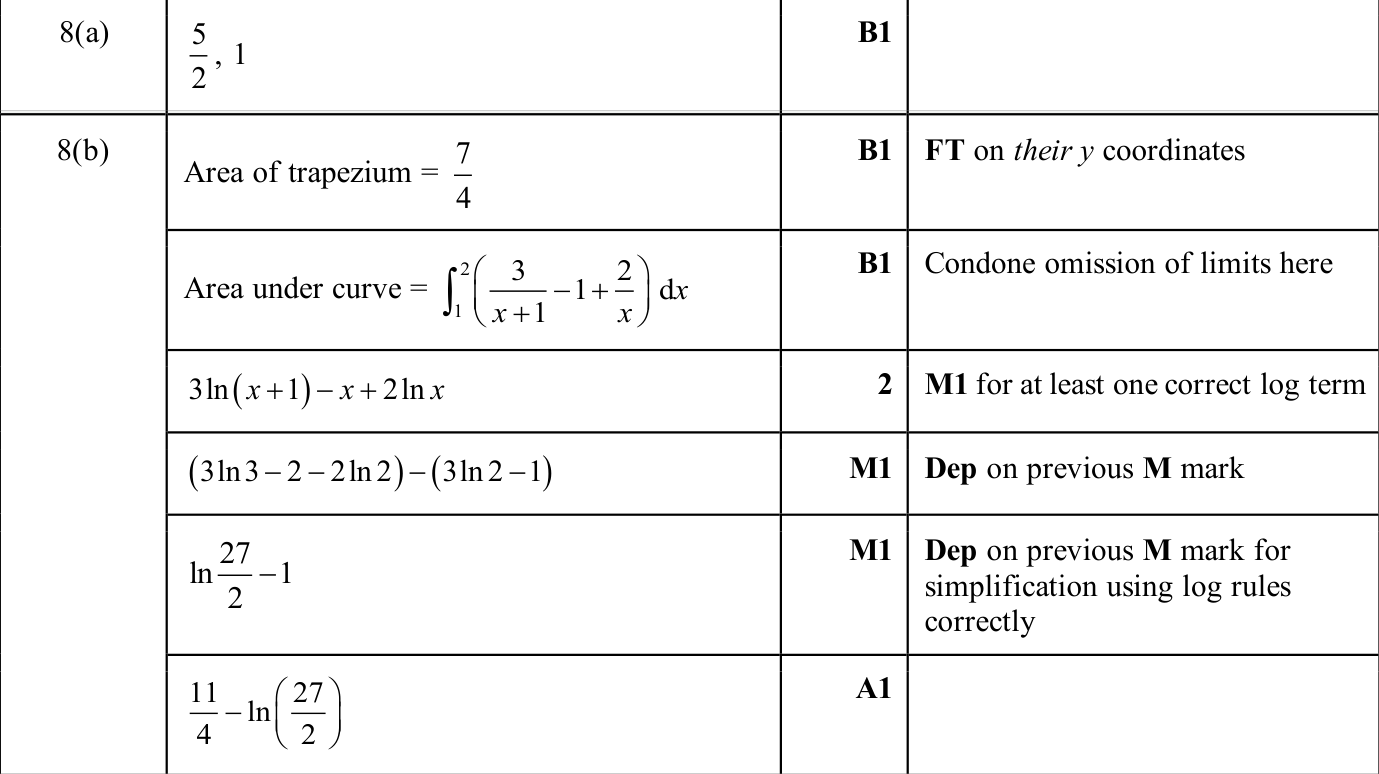
The diagram shows part of the curve \(y=\frac{3}{x+1}-\frac{x-2}{x}\). The points \(A\) and \(B\) lie on the curve such that the \(x\)-coordinate of \(A\) is 1 and the \(x\)-coordinate of \(B\) is 2 . (a) Find the \(y\)-coordinates of \(A\) and \(B\).
(b) Show that the area of the shaded region enclosed by the line \(A B\) and the curve is \(\frac{a}{4}-\ln \frac{b}{2}\), where \(a\) and \(b\) are integers to be found.
0606 P22 - Jun 2025 - Q8 - 11 marks
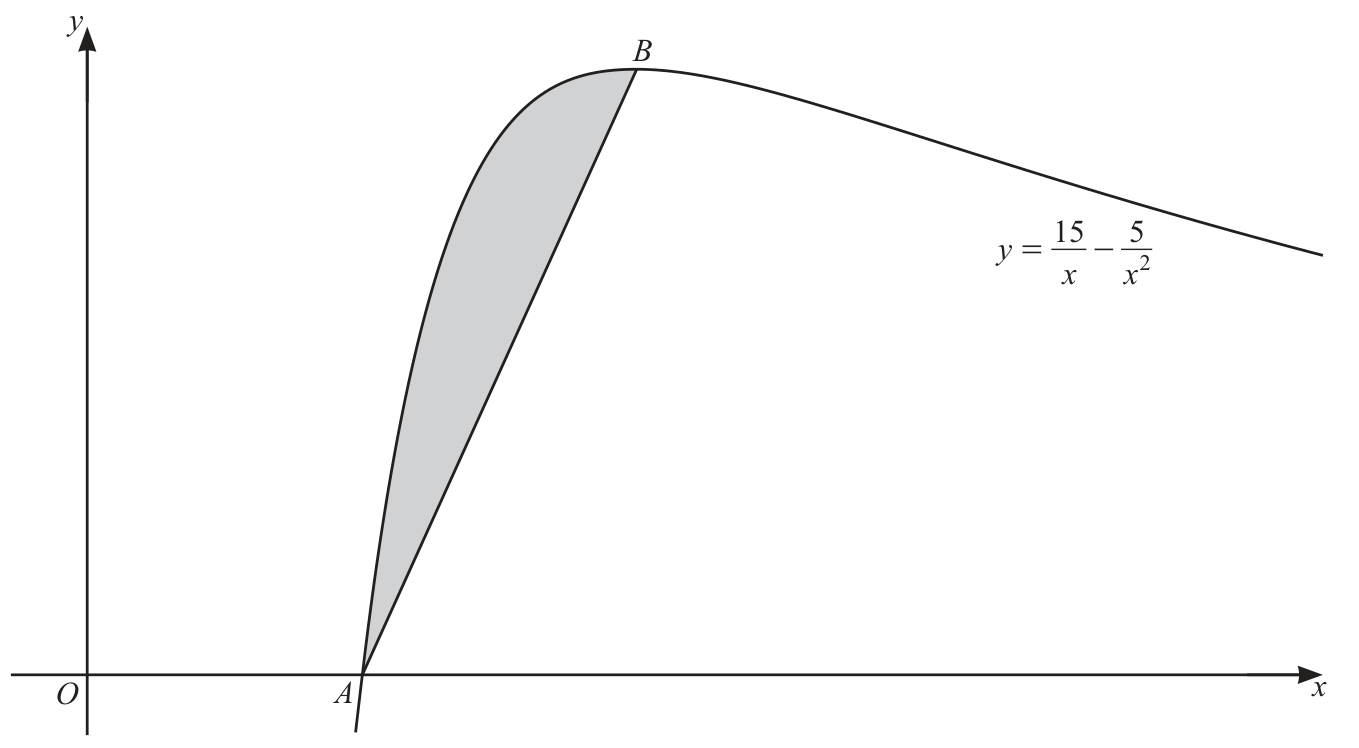
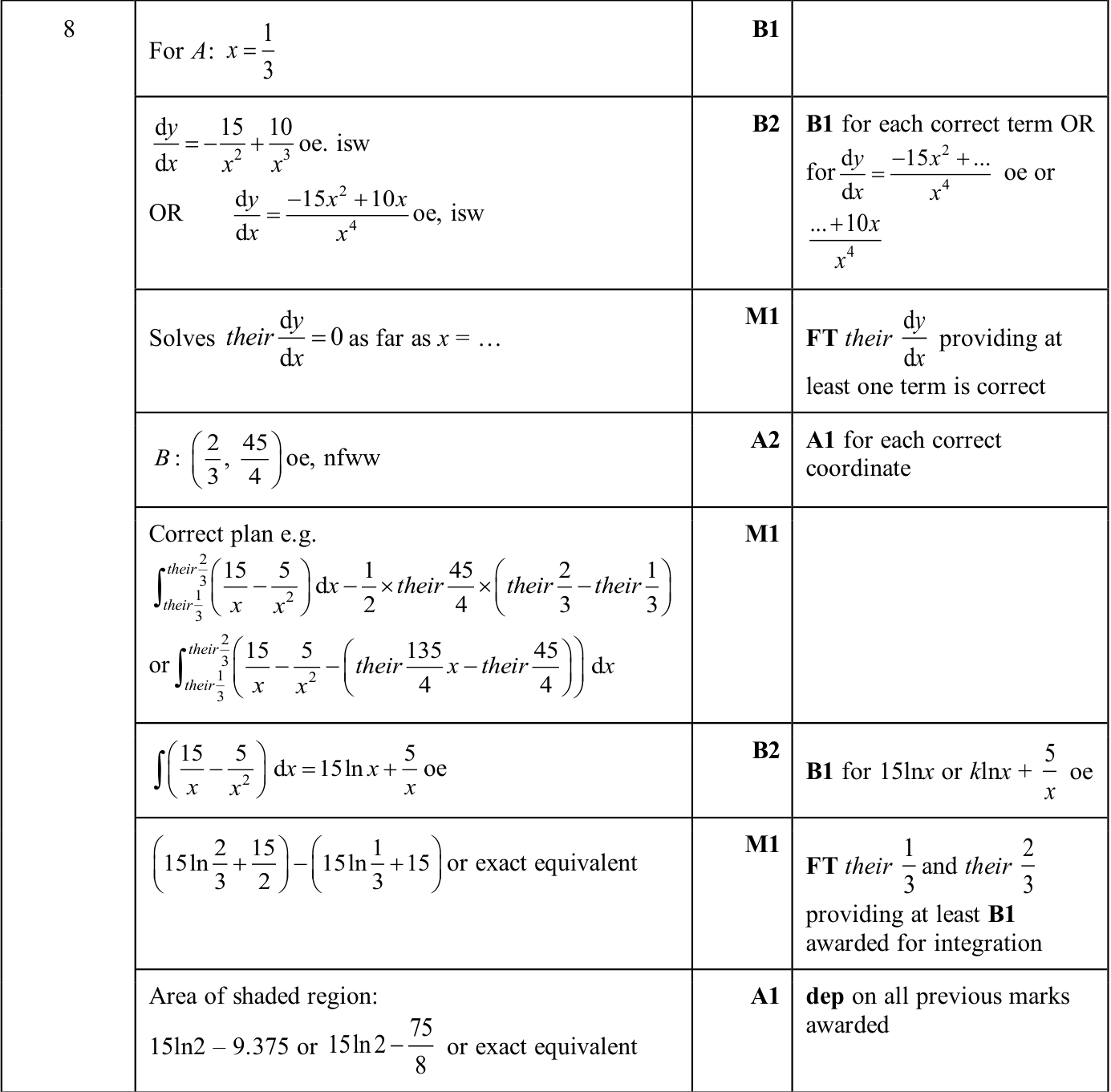
The diagram shows part of the curve \(y=\frac{15}{x}-\frac{5}{x^{2}}\). The curve meets the \(x\)-axis at the point \(A\). The curve has a maximum at the point \(B\).
Find the area of the shaded region enclosed by the line \(A B\) and the curve. Give your answer in exact form.
0606 P12 - Mar 2025 - Q7 - 10 marks
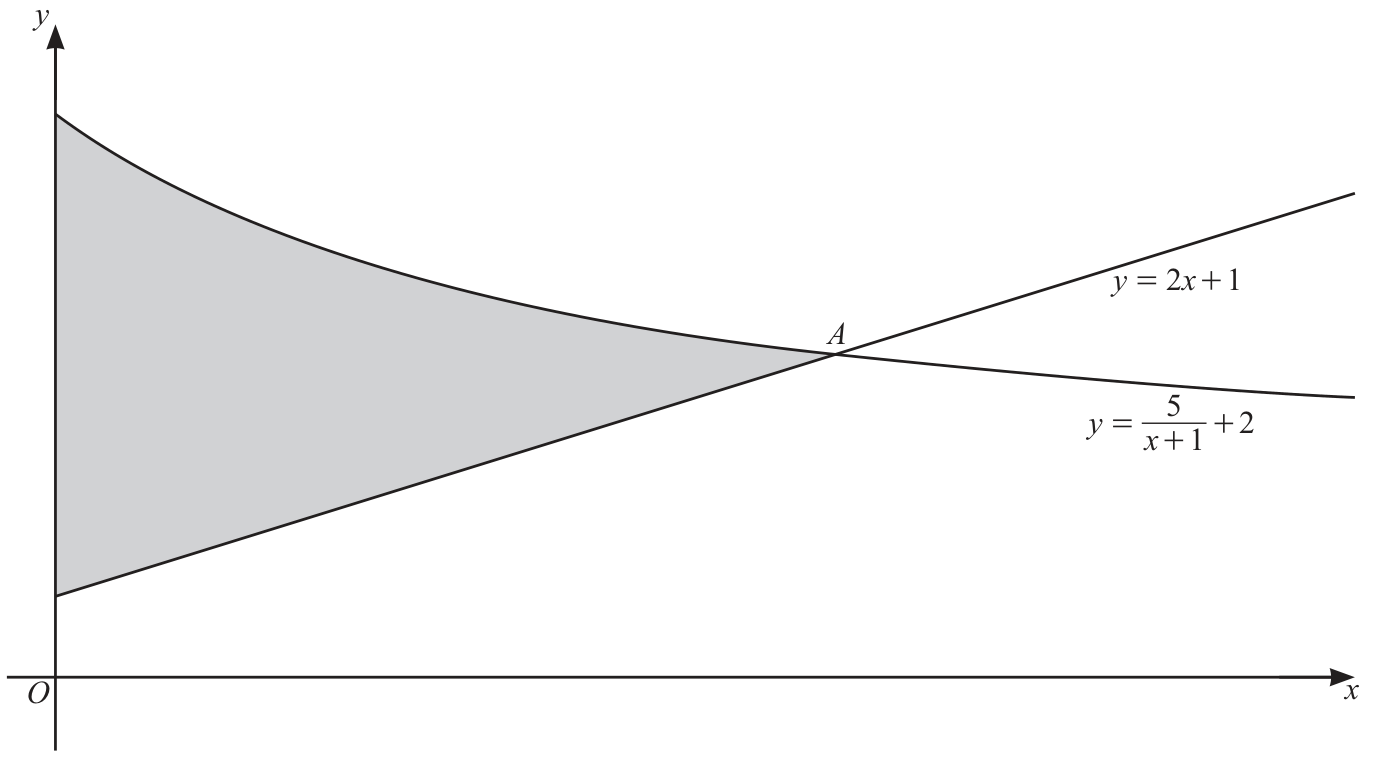
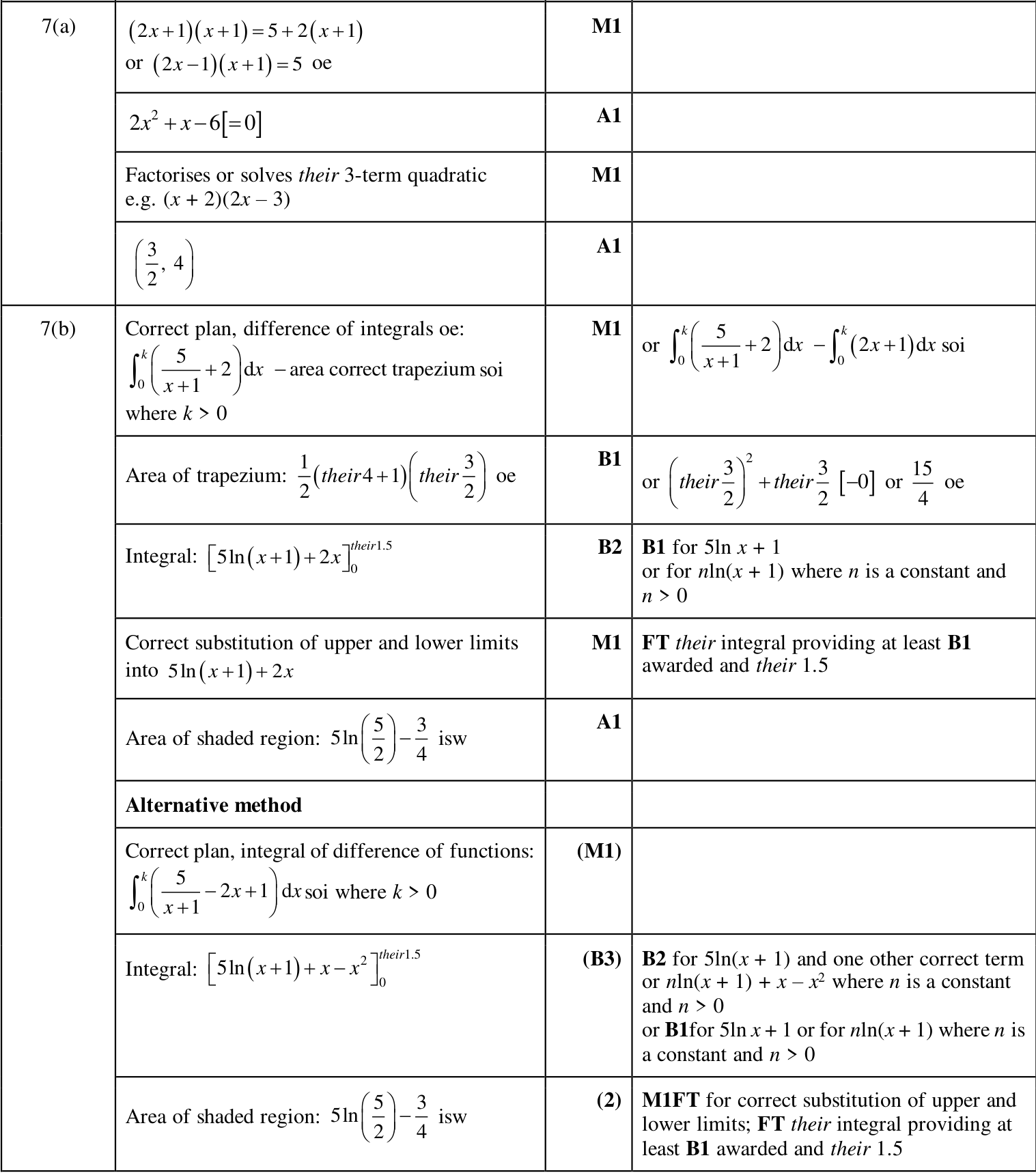
The diagram shows part of the curve \(y=\frac{5}{x+1}+2\) and part of the line \(y=2x+1\) intersecting at the point \(A\).
(a) Find the coordinates of \(A\).
(b) Find the exact area of the shaded region.
0606 P11 - Nov 2024 - Q11 - 9 marks
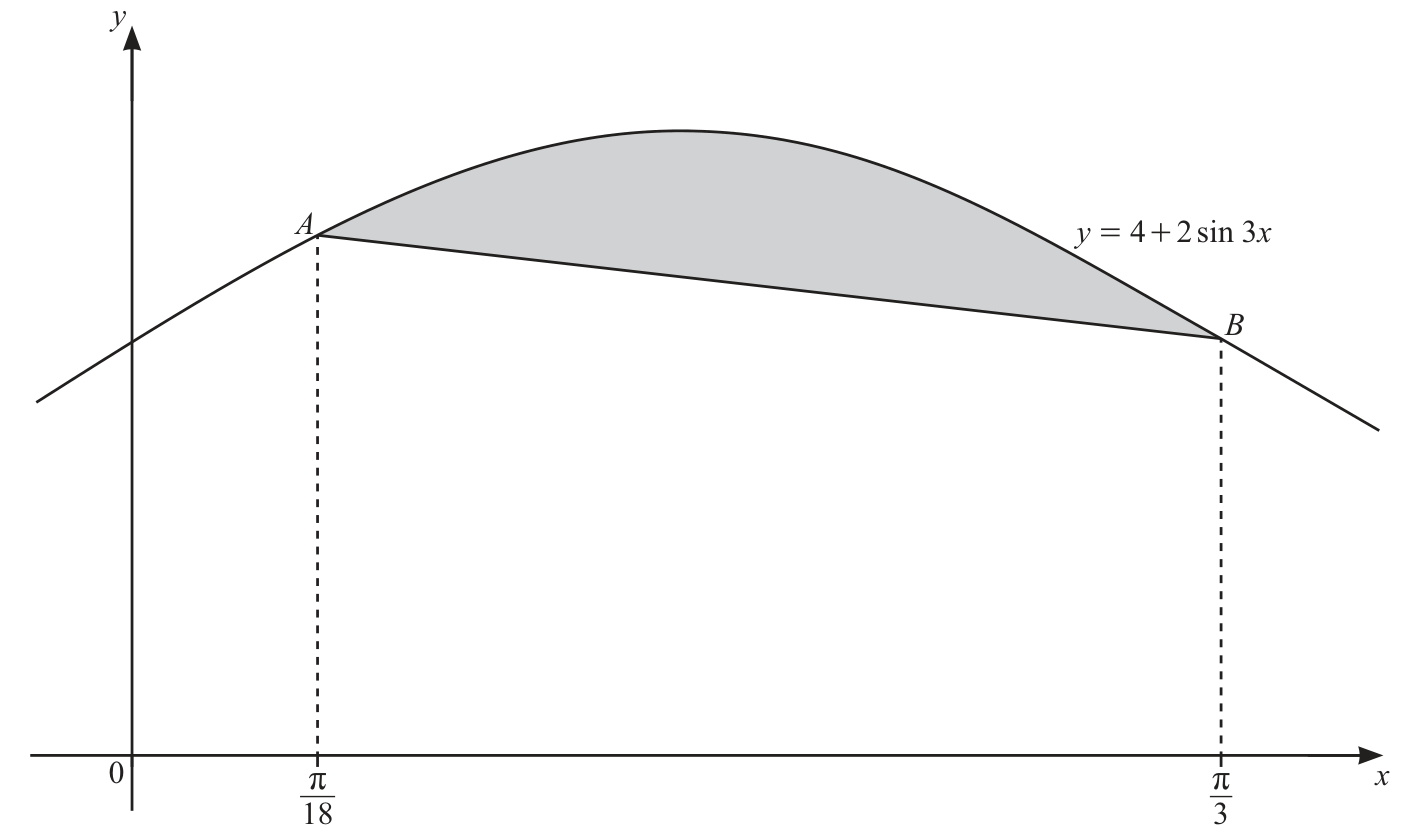
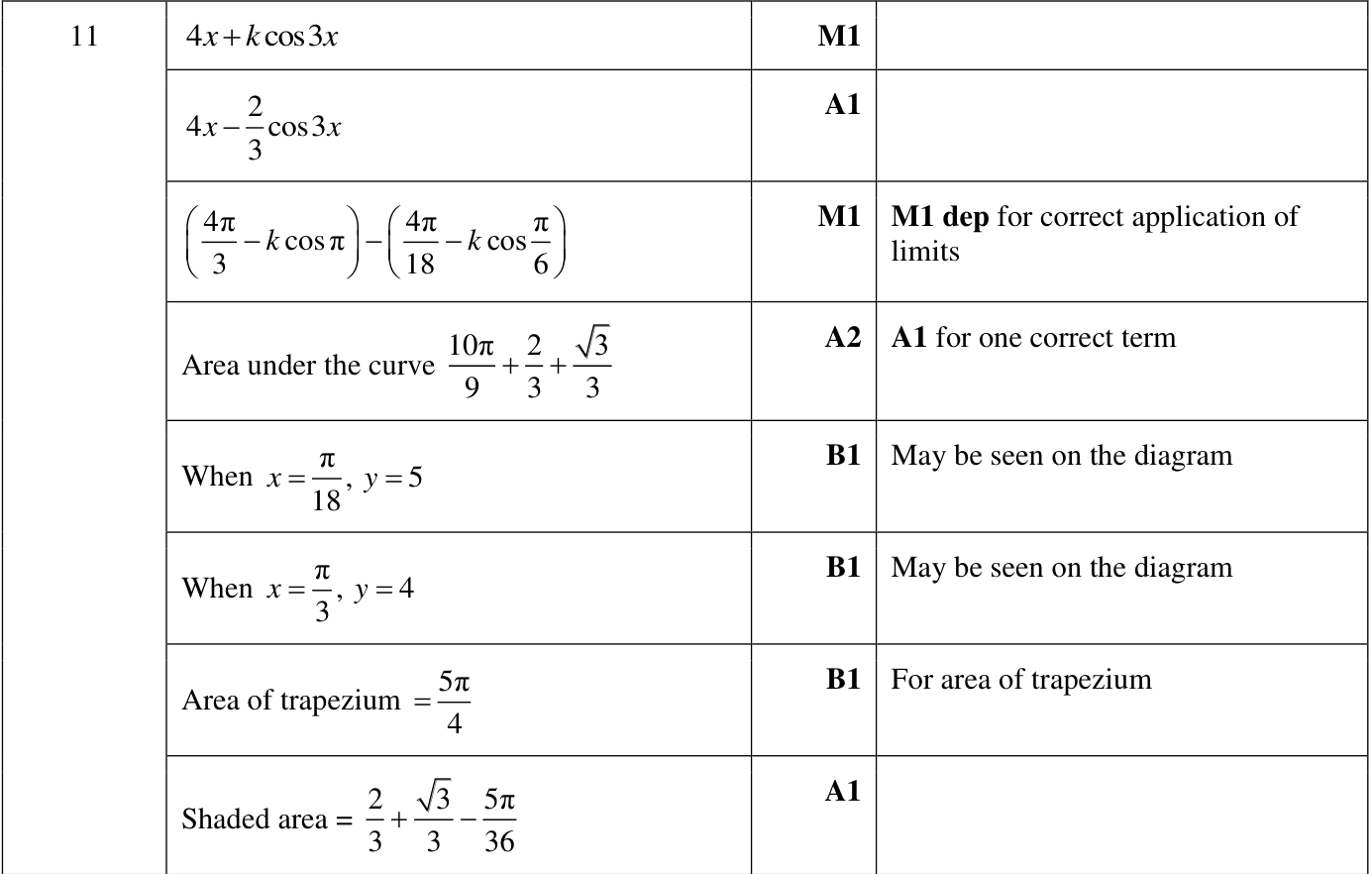
The diagram shows part of the curve \(y=4+2 \sin 3 x\) and the straight line \(A B\). The points \(A\) and \(B\) lie on the curve. The \(x\)-coordinate of \(A\) is \(\frac{\pi}{18}\) and the \(x\)-coordinate of \(B\) is \(\frac{\pi}{3}\). Find the area of the shaded region, giving your answer in exact form.
Continuation of working space for Question 11.
0606 P12 - Nov 2024 - Q9 - 8 marks
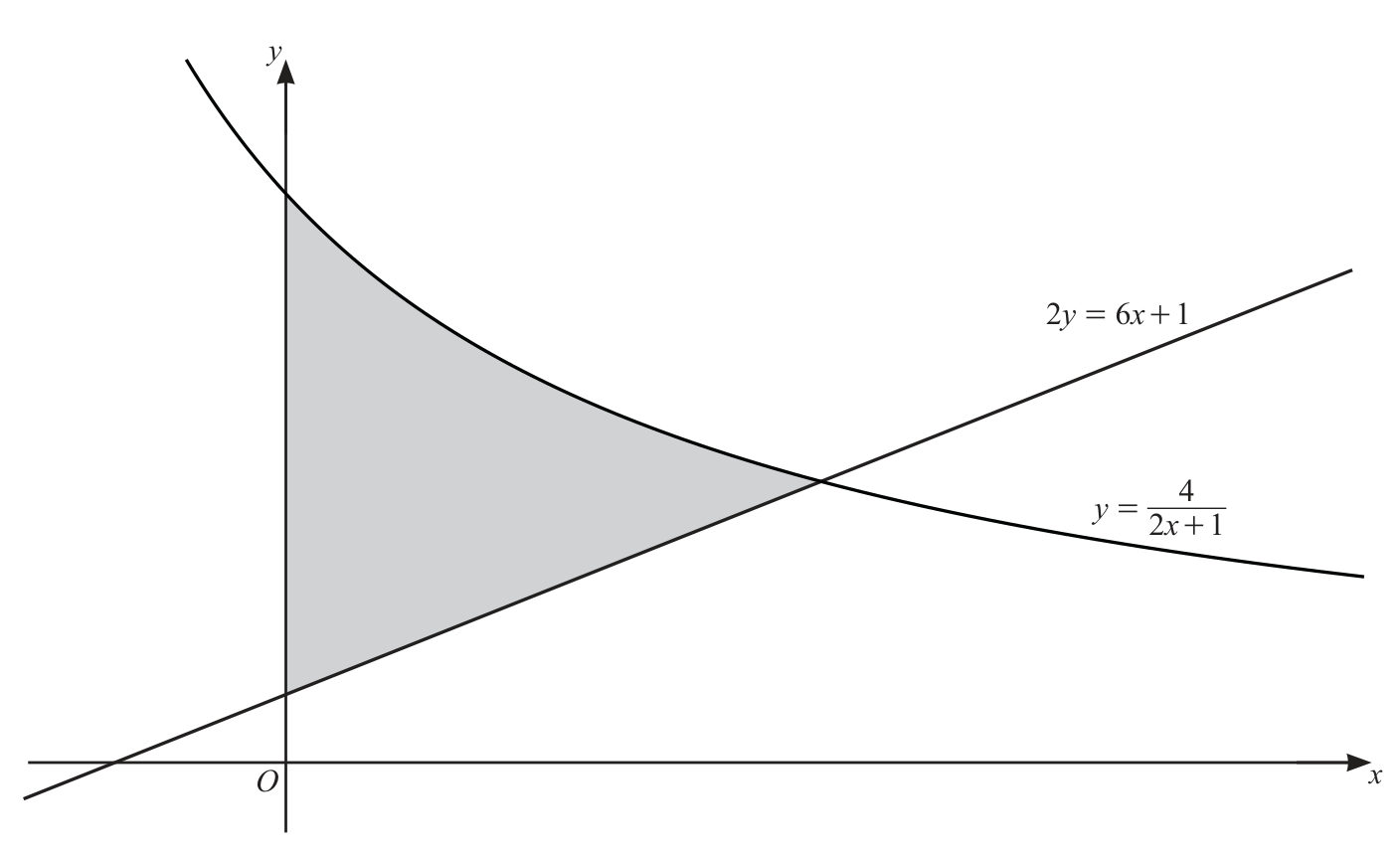
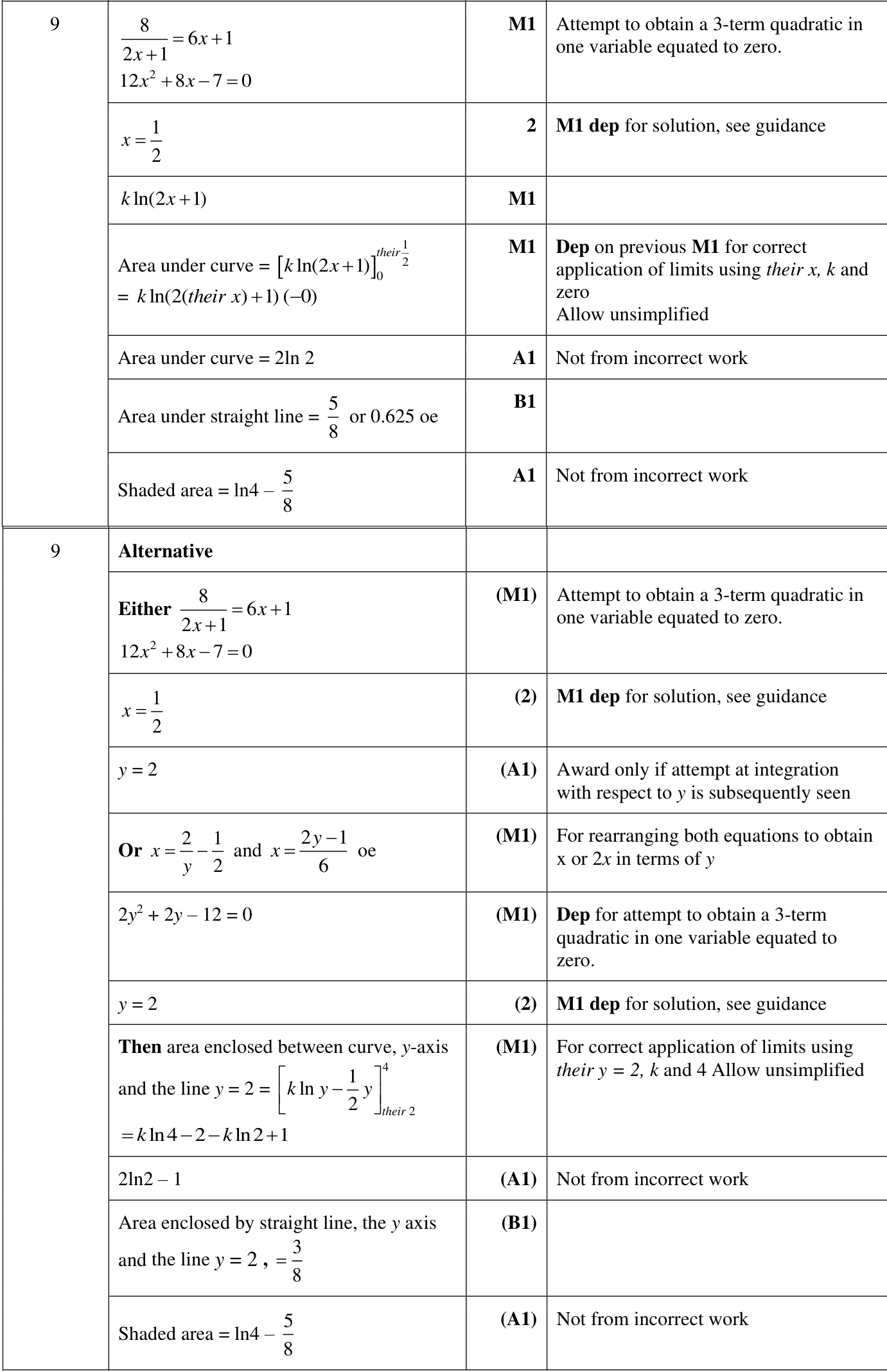
The diagram shows part of the curve \(y=\frac{4}{2 x+1}\) and the straight line \(2 y=6 x+1\). Find the area of the shaded region, giving your answer in the form \(\ln a+b\), where \(a\) is an integer and \(b\) is a rational number.
Continuation of working space for question 9.
0606 P23 - Nov 2024 - Q8 - 7 marks
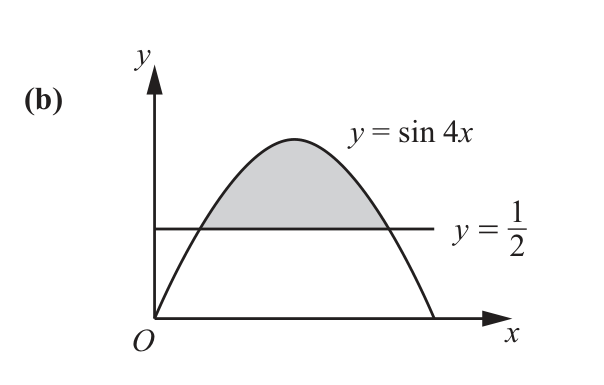
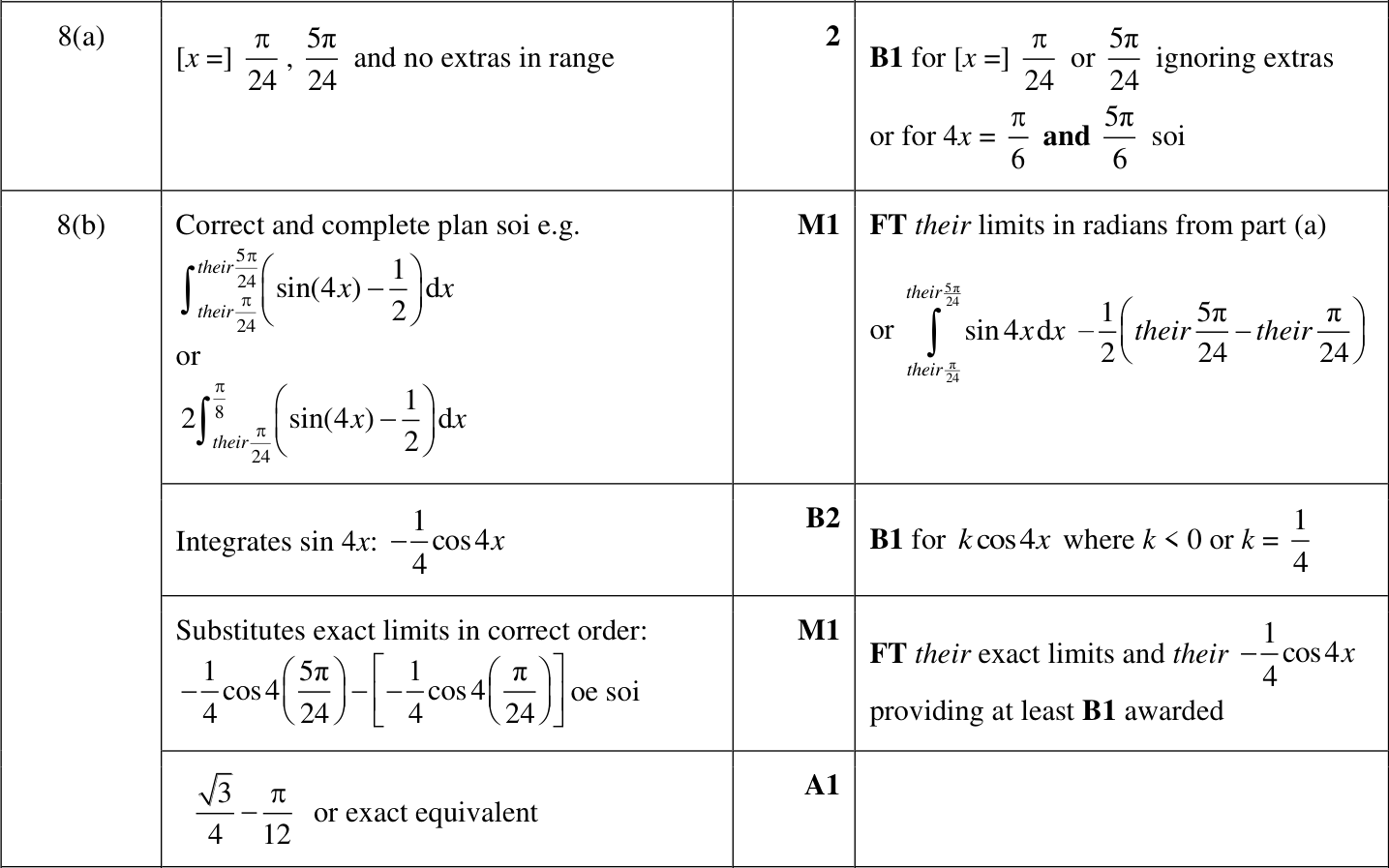
(a) Solve the equation \(\sin 4 x=\frac{1}{2}\) for \(0 \leqslant x \leqslant \frac{\pi}{4}\), giving your answers in terms of \(\pi\).
(b)
The diagram shows parts of the graphs of \(y=\sin 4 x\) and \(y=\frac{1}{2}\). Find the exact area of the shaded region enclosed by the curve and the line.
0606 P22 - Jun 2024 - Q9 - 9 marks
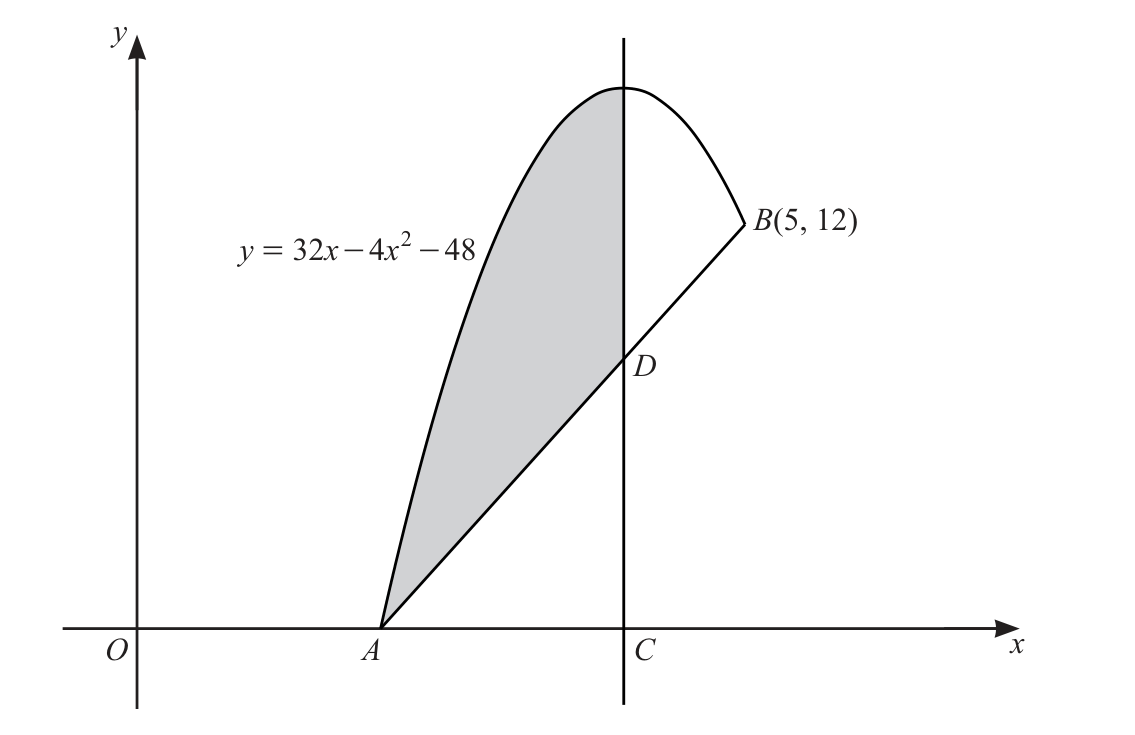
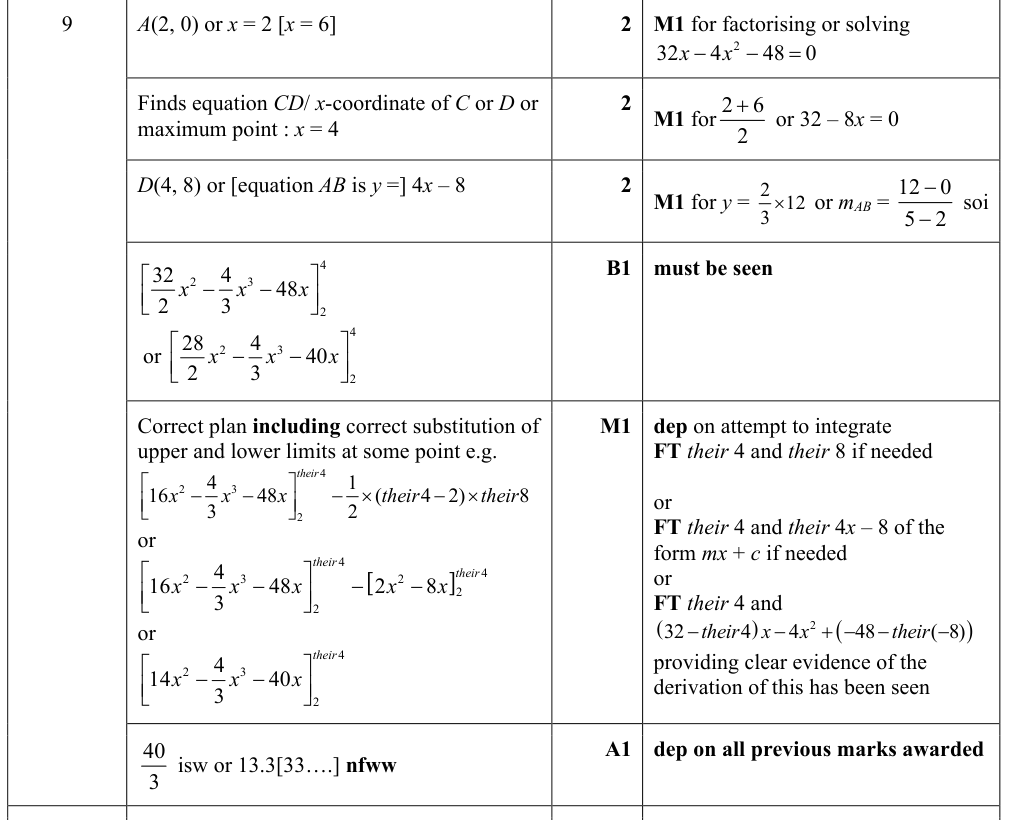
The diagram shows part of the curve \(y=32 x-4 x^{2}-48\) and the line \(A B\). The curve and the line \(A B\) meet the \(x\)-axis at \(A\) and meet again at the point \(B(5,12)\). The line \(C D\) extended is parallel to the \(y\)-axis and passes through the maximum point of the curve. Find the area of the shaded region.
Continuation of working space for Question 9.
0606 P23 - Jun 2024 - Q9 - 10 marks
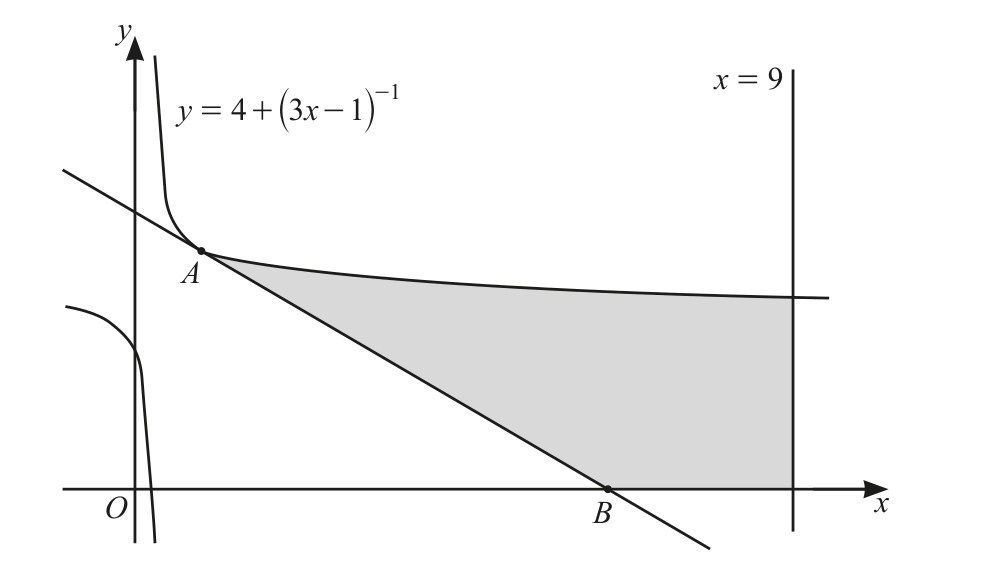
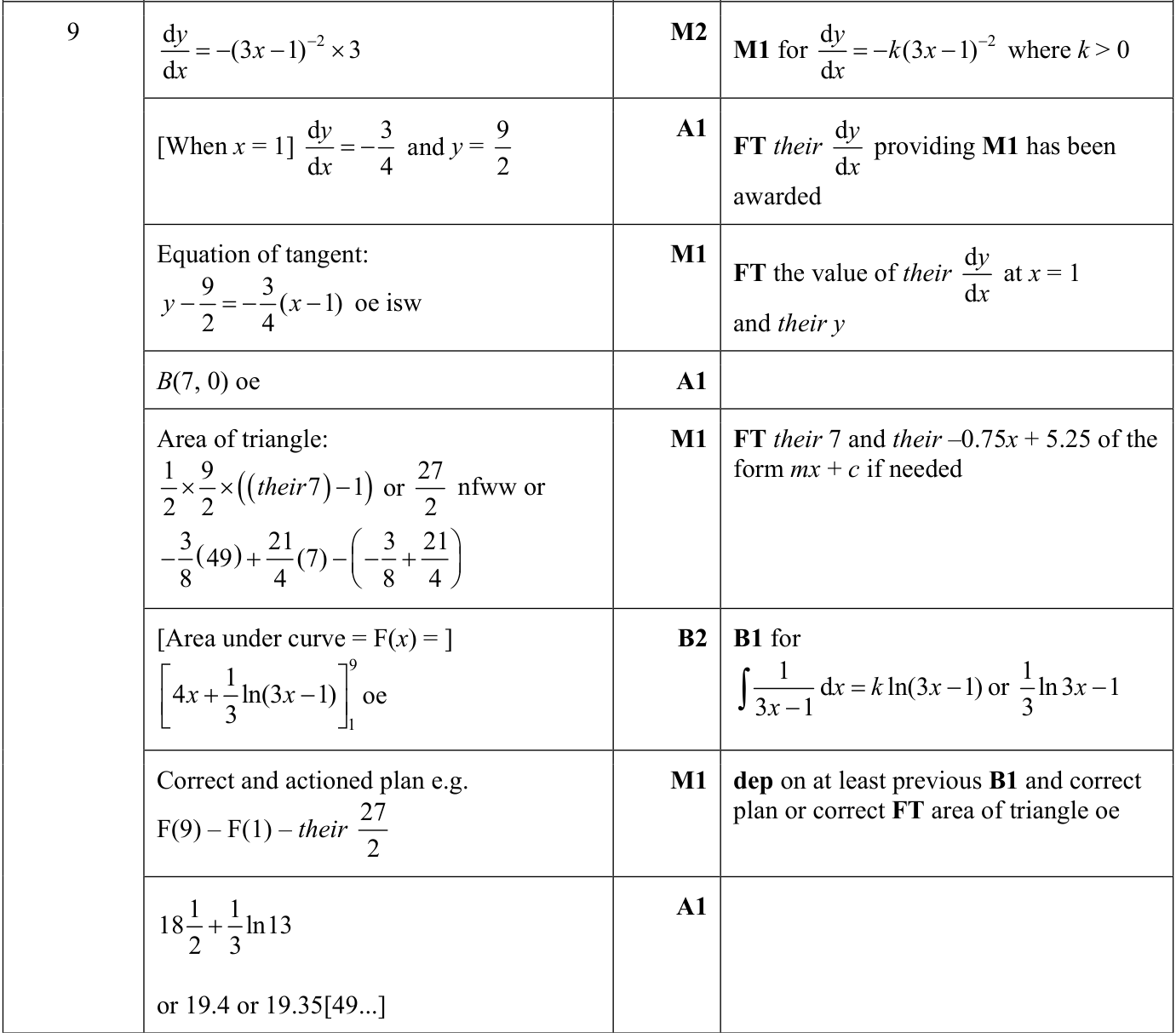
The diagram shows a sketch of part of the curve \(y=4+(3 x-1)^{-1}\) and the line \(x=9\). The point \(A\) has \(x\)-coordinate 1 . The tangent to the curve at \(A\) meets the \(x\)-axis at the point \(B\). Find the area of the shaded region.
0606 P12 - Mar 2023 - Q8 - 11 marks
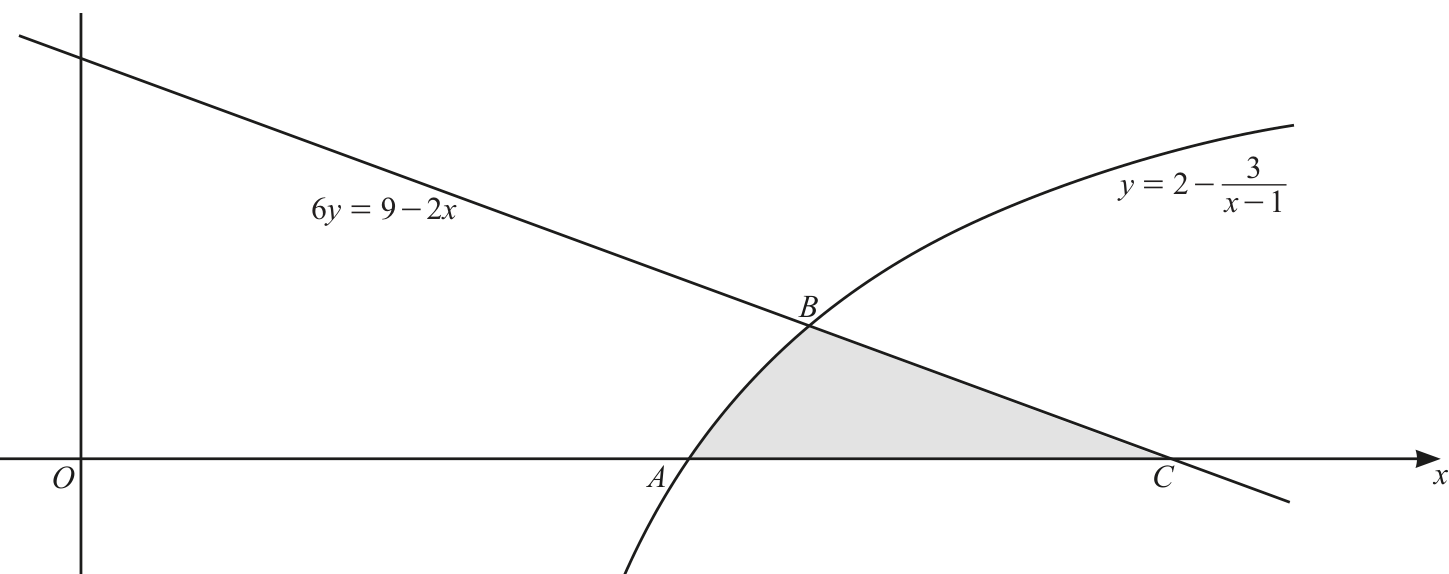
The diagram shows part of the curve
\(y=2-\frac{3}{x-1}\)
and the straight line
\(6y=9-2x.\)
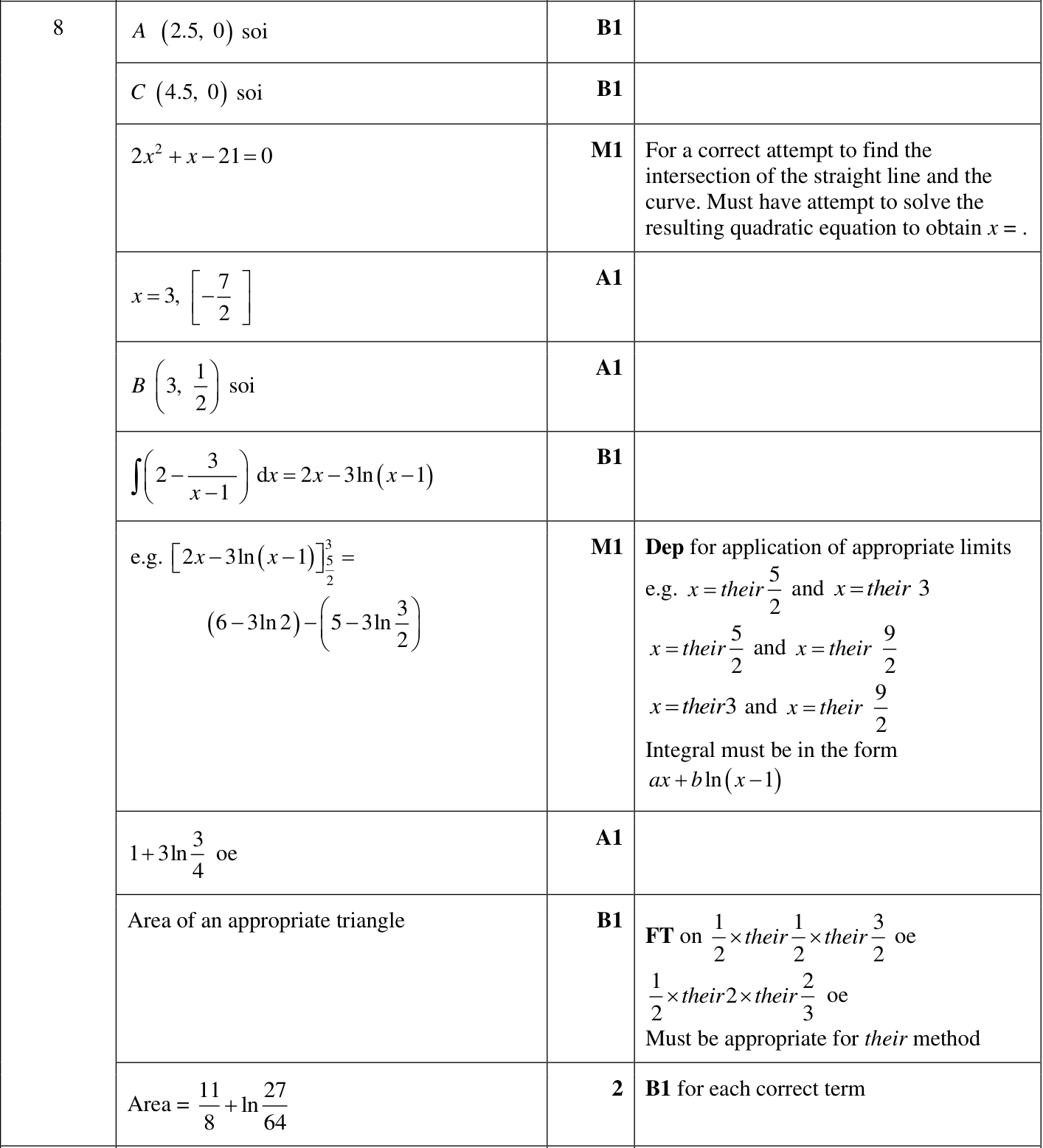
The curve intersects the \(x\)-axis at point \(A\), and the line at point \(B\). The line intersects the \(x\)-axis at point \(C\). Find the area of the shaded region \(ABC\), giving your answer in the form
\(p+\ln q,\)
where \(p\) and \(q\) are rational numbers.
0606 P12 - Jun 2023 - Q9 - 10 marks
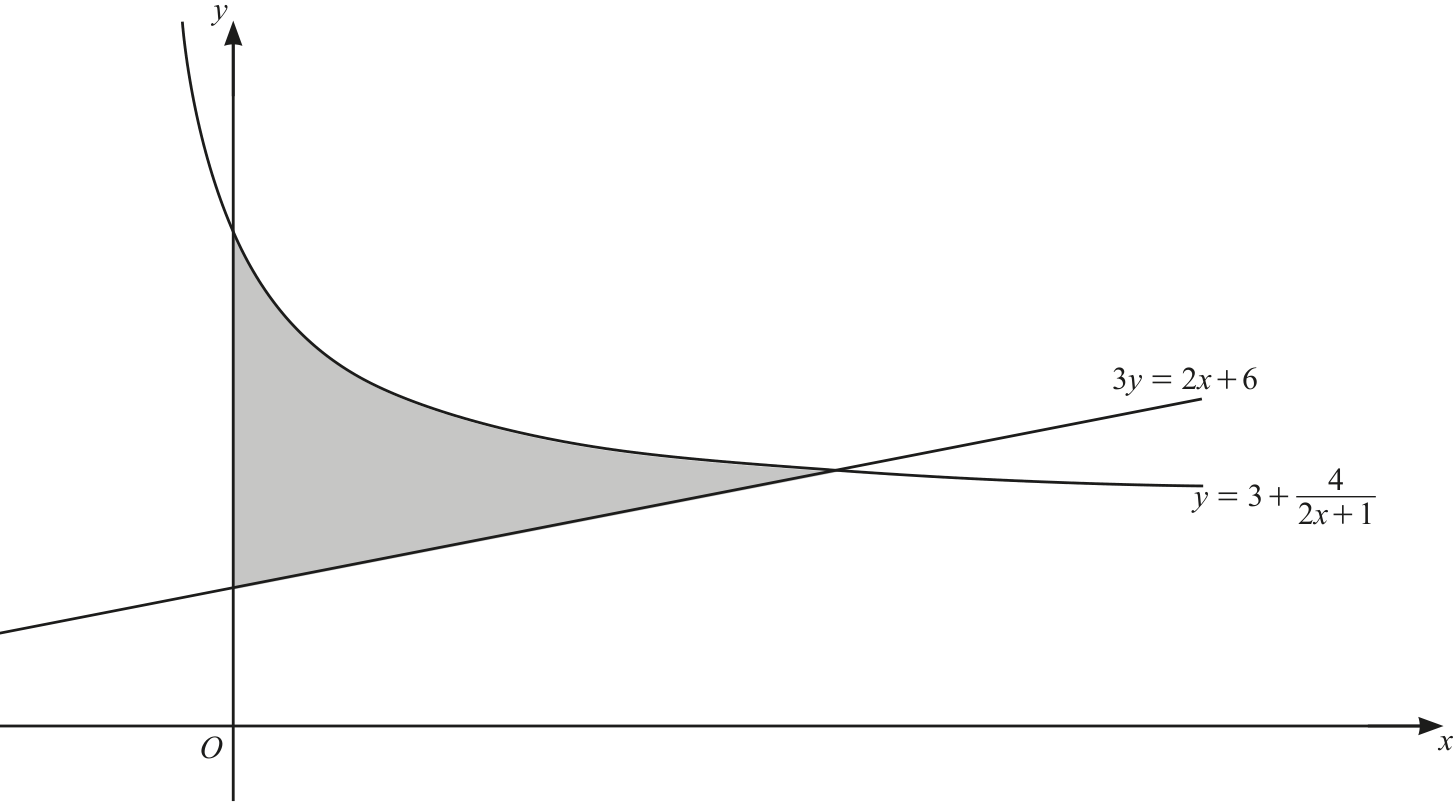
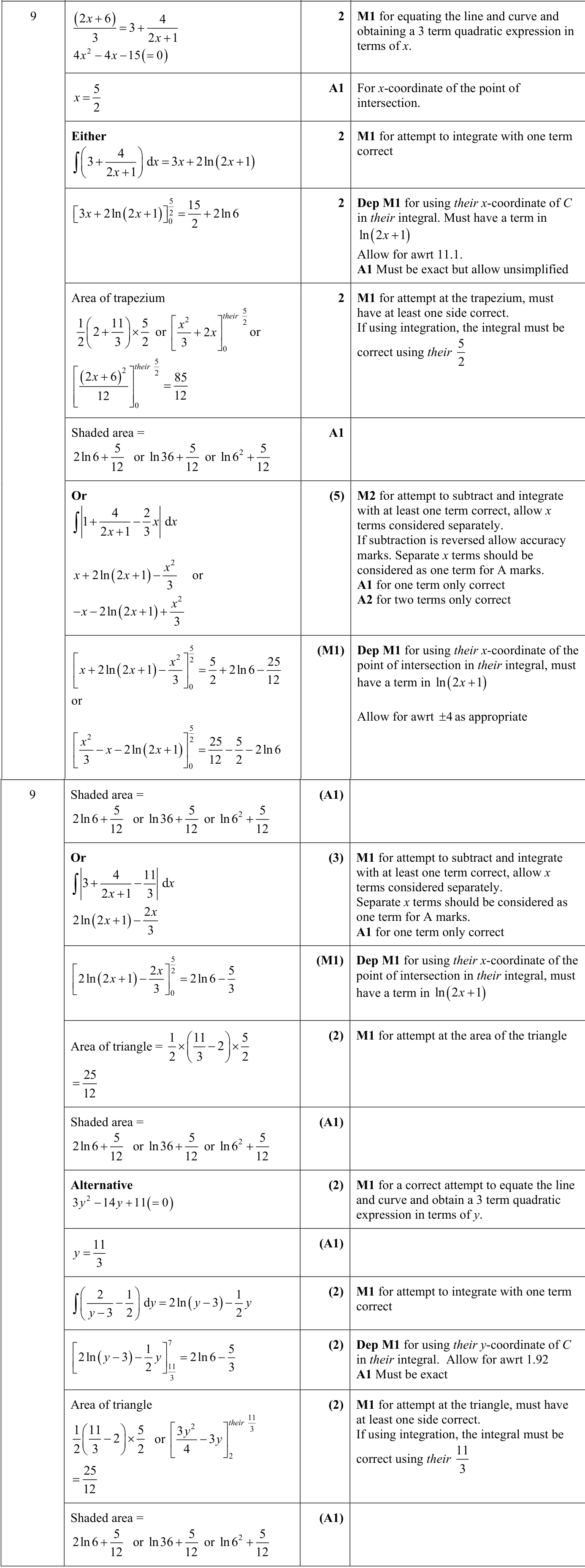
The diagram shows part of the curve
\(y=3+\frac{4}{2x+1}\)
and the straight line
\(3y=2x+6.\)
Find the area of the shaded region, giving your answer in exact form.
0606 P21 - Jun 2023 - Q7 - 10 marks
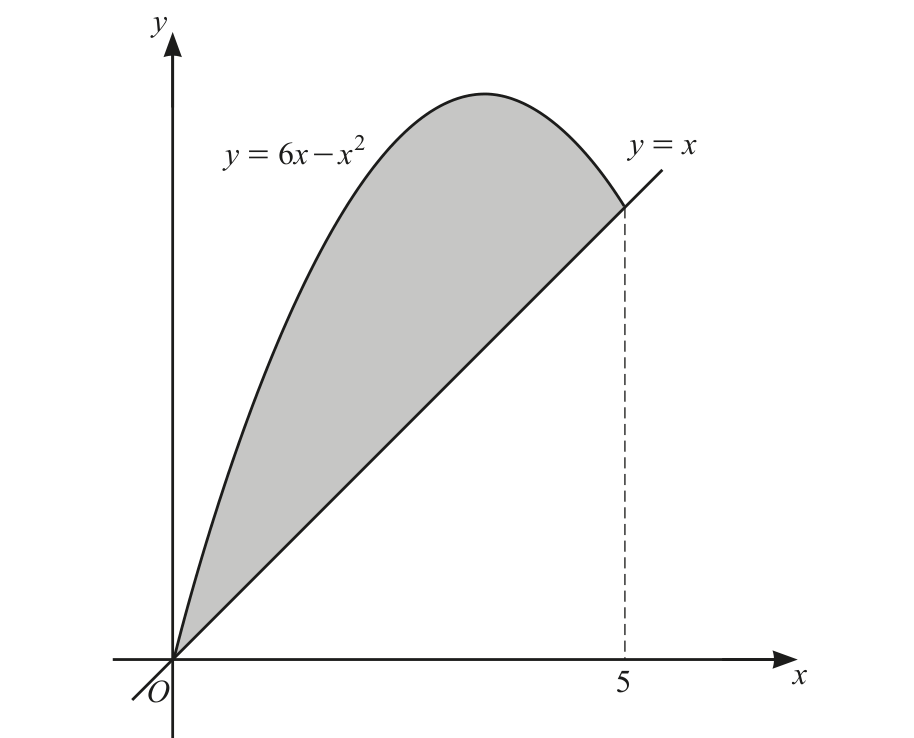
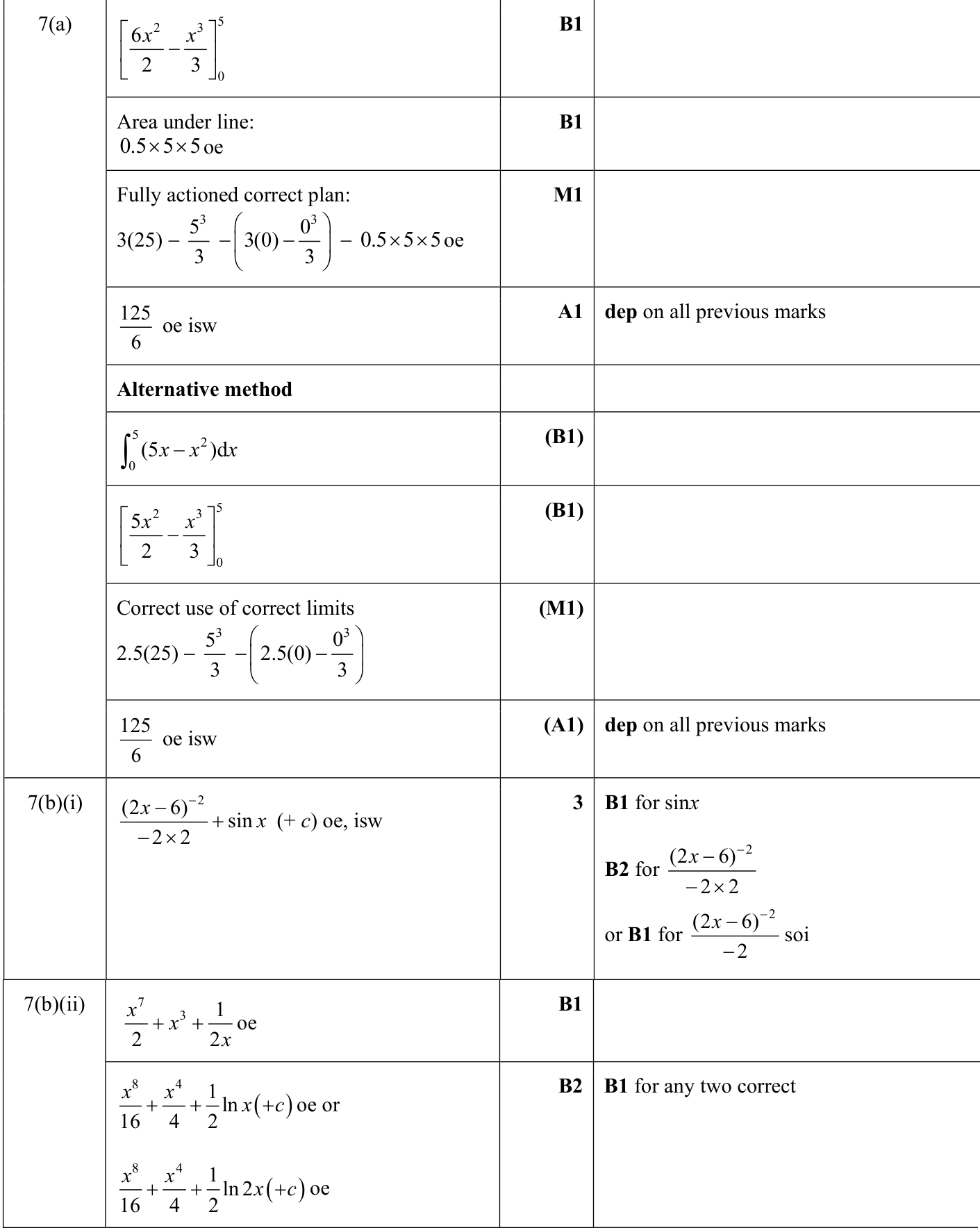
(a) The diagram shows the curve \(y=6x-x^2\), for \(0\leq x\leq5\), and the line \(y=x\). Find the area of the shaded region.
(b) Find:
(i)
\(\int\left(\frac{1}{(2x-6)^3}+\cos x\right)\,dx.\)
(ii)
\(\int\frac{(x^4+1)^2}{2x}\,dx.\)
0606 P23 - Jun 2023 - Q9 - 11 marks
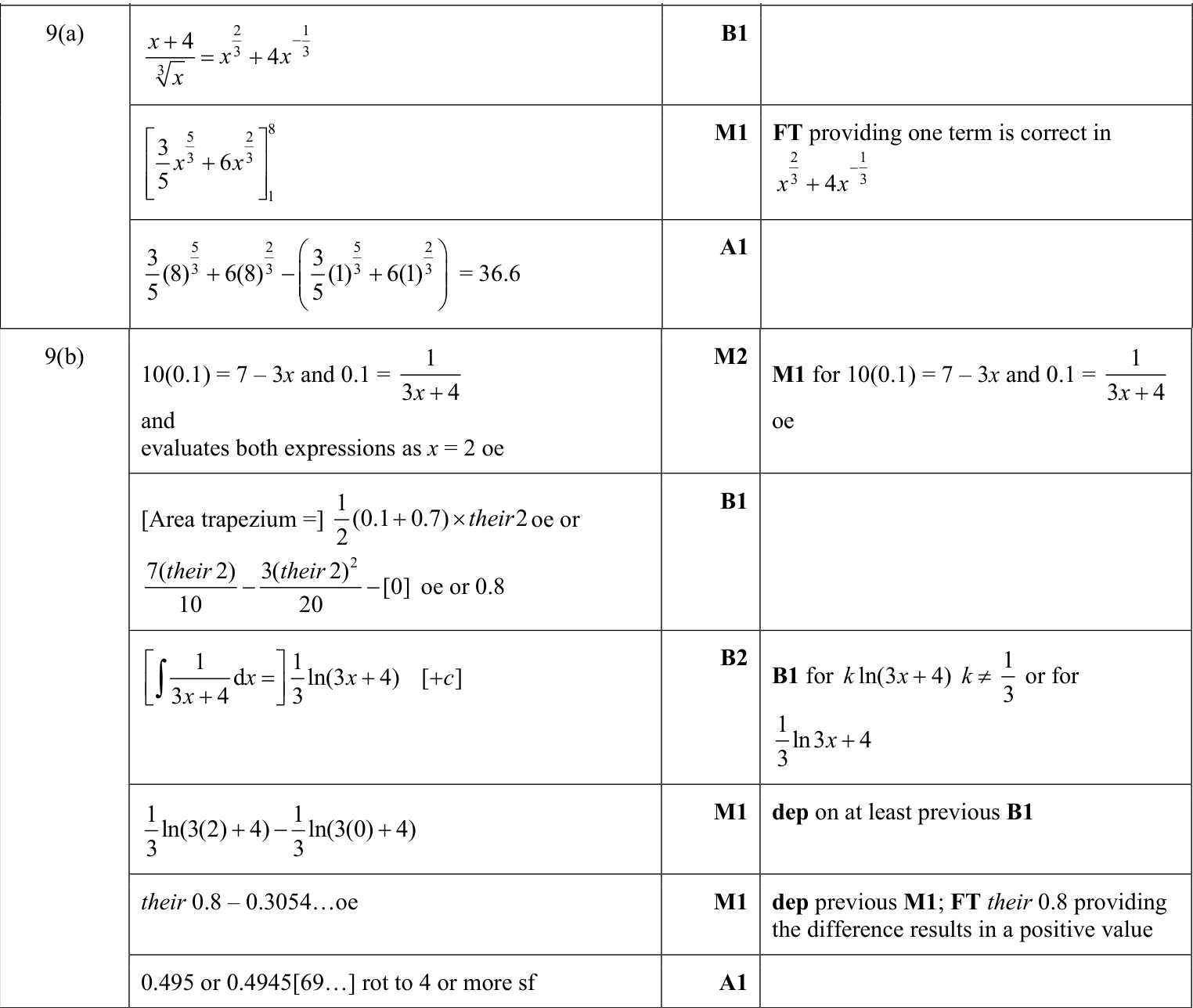
(a) Show that
\(\int_1^8\frac{x+4}{\sqrt x}\,dx=36.6.\)
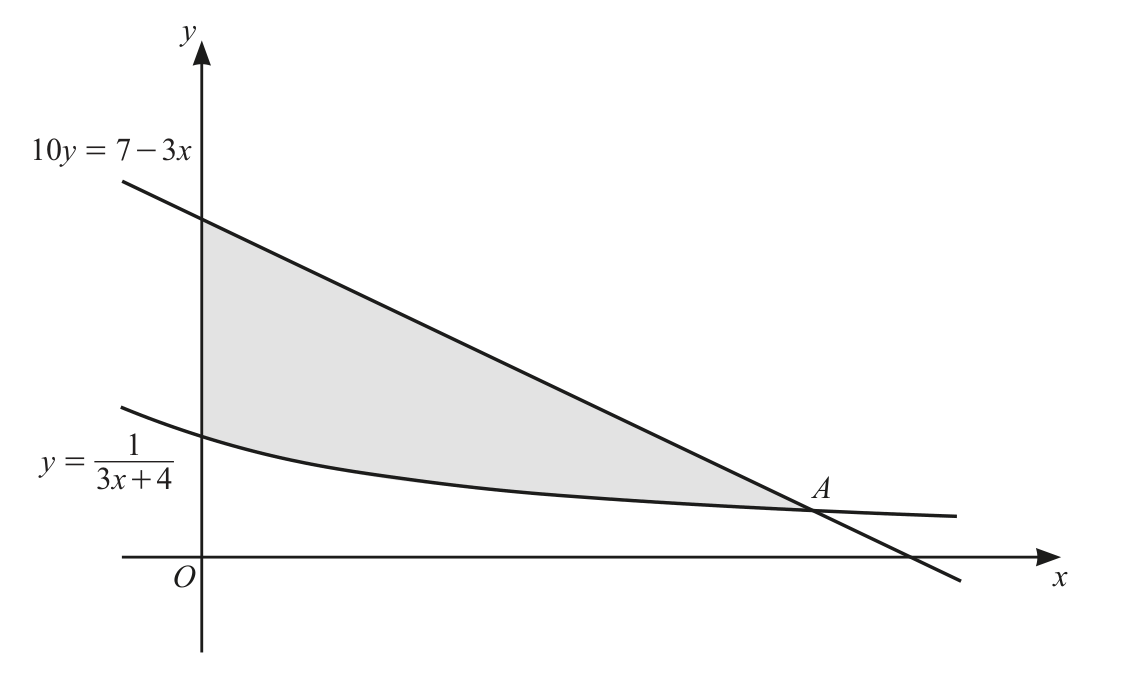
(b) The diagram shows the line
\(10y=7-3x\)
and the curve
\(y=\frac{1}{3x+4}.\)
The line and curve intersect at the point \(A\).
Verify that the \(y\)-coordinate of \(A\) is \(0.1\), and calculate the shaded area.
0606 P22 - Mar 2022 - Q11 - 7 marks
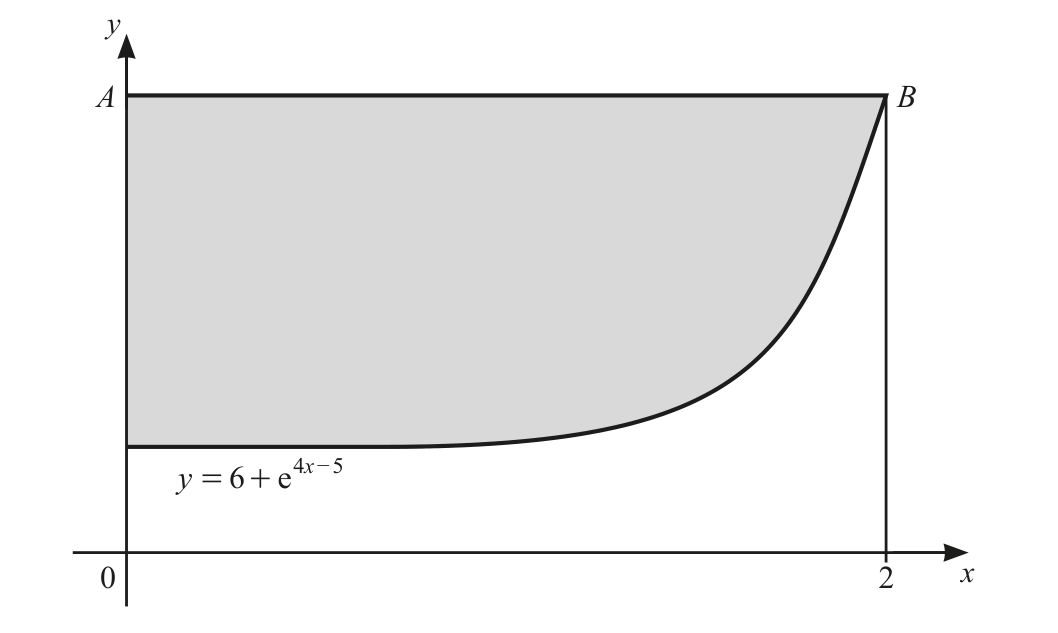
The diagram shows part of the graphs of
\(y=6+e^{4x-5} \quad\text{and}\quad x=2.\)
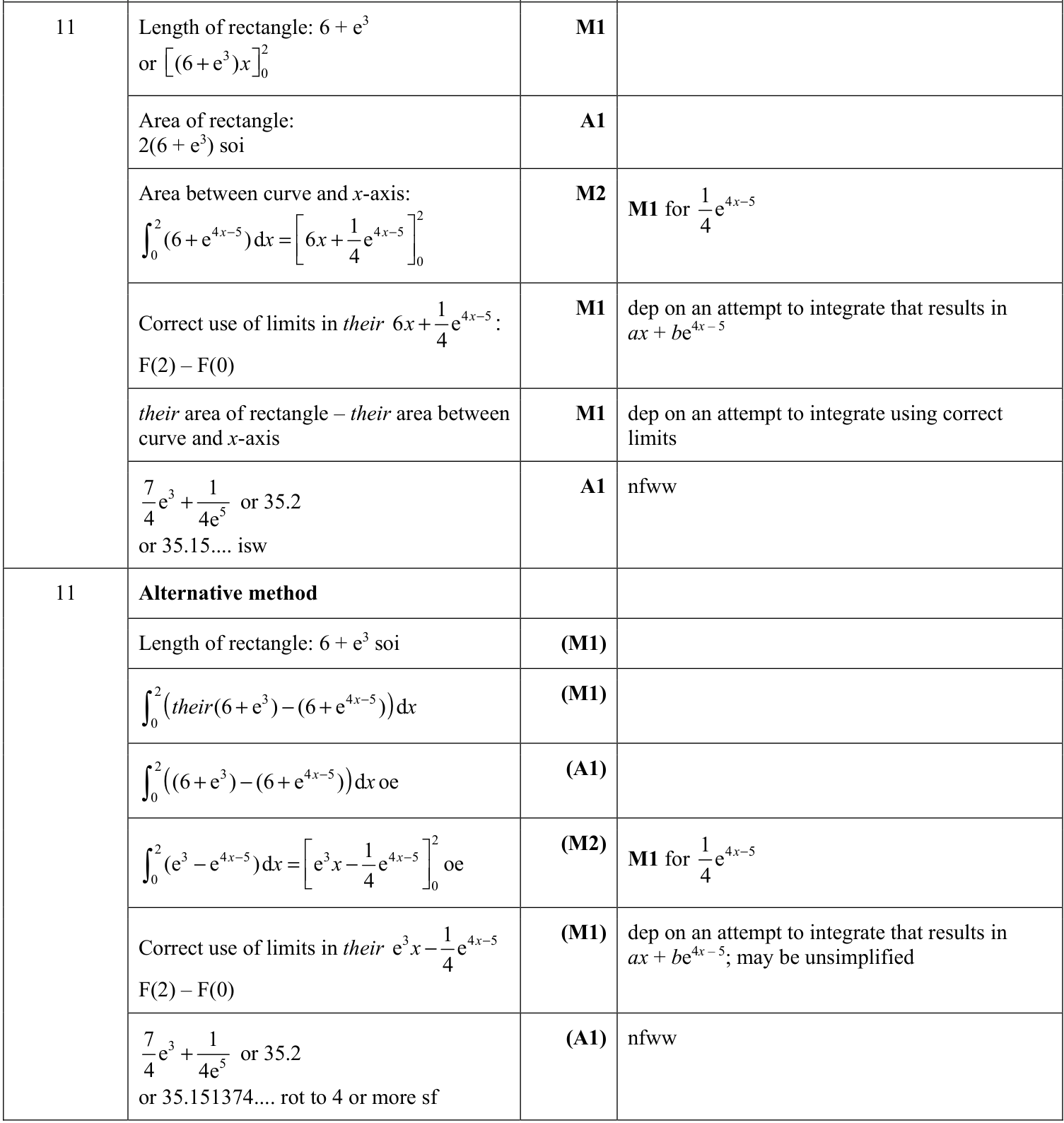
The line \(x=2\) meets the curve at the point \(B(2,b)\), and the line \(AB\) is parallel to the \(x\)-axis. Find the area of the shaded region.
0606 P21 - Jun 2022 - Q11 - 7 marks
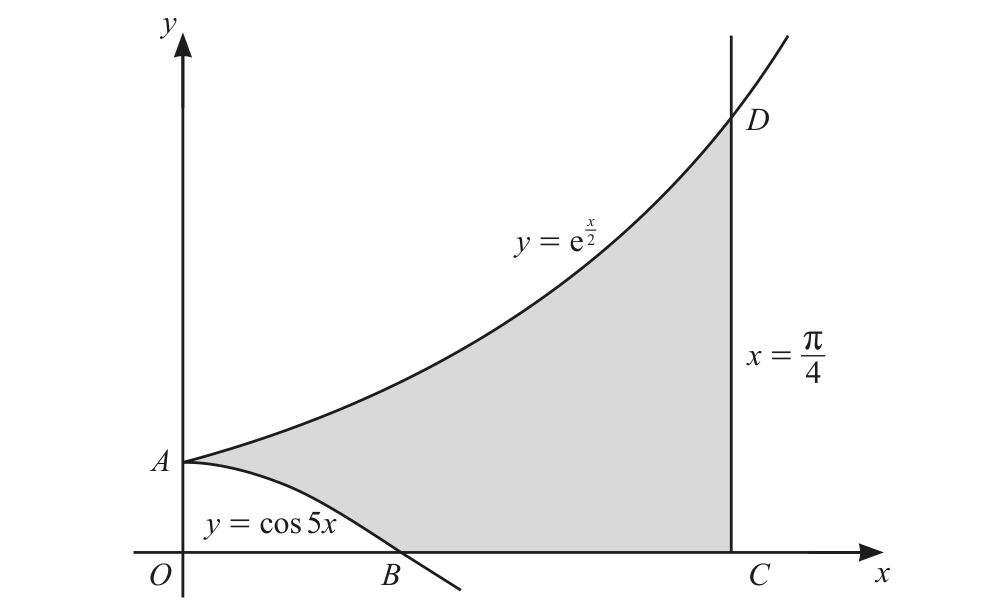
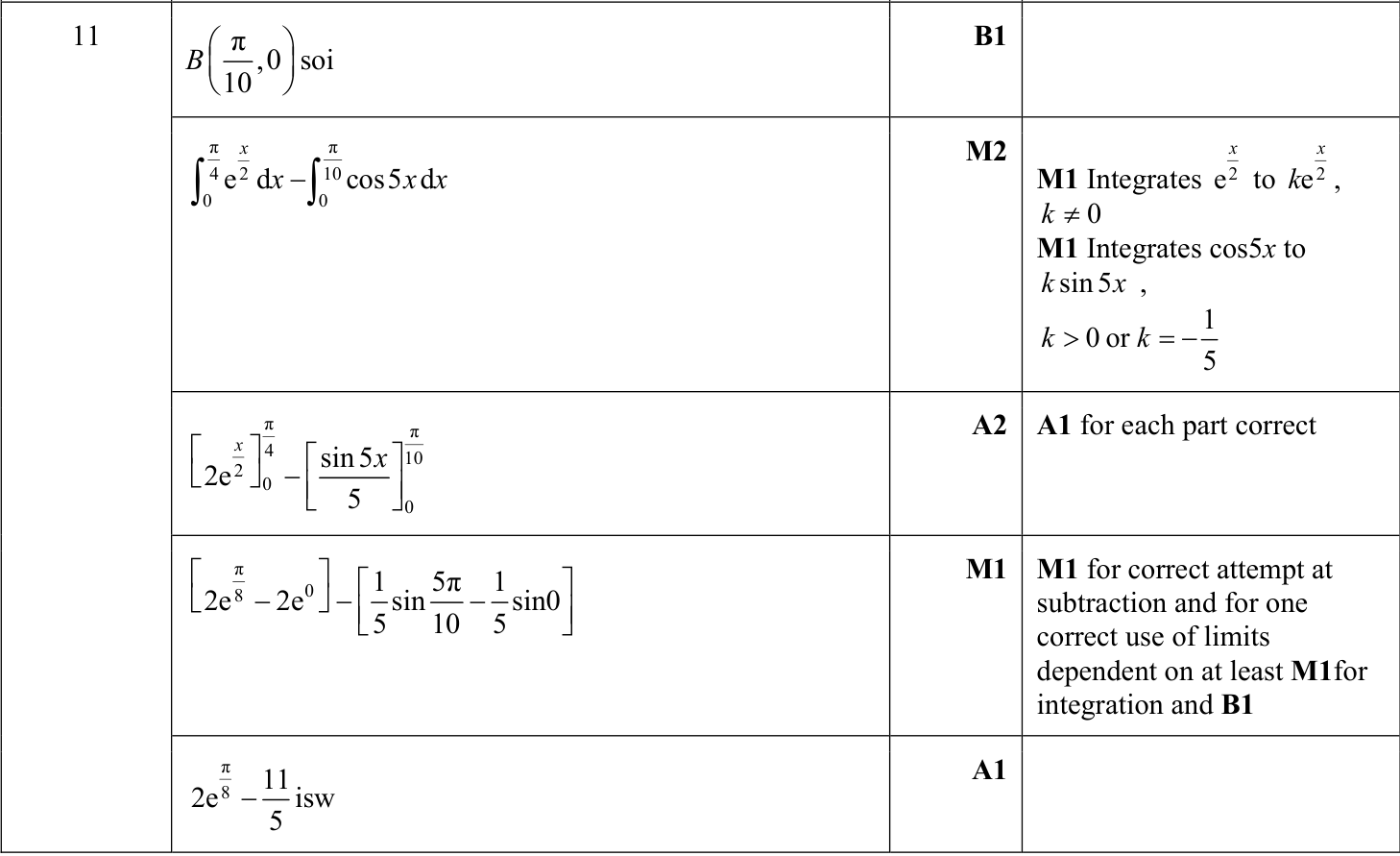
The diagram shows part of the curves \(y=\mathrm{e}^{x/2}\) and \(y=\cos5x\), and part of the line \(x=\frac{\pi}{4}\). The curves intersect at \(A\). The curve \(y=\cos5x\) cuts the \(x\)-axis at \(B\). The line \(x=\frac{\pi}{4}\) cuts the \(x\)-axis at \(C\) and the curve \(y=\mathrm{e}^{x/2}\) at \(D\). Find the exact area of the shaded region \(ABCD\).
0606 P22 - Jun 2022 - Q11 - 9 marks
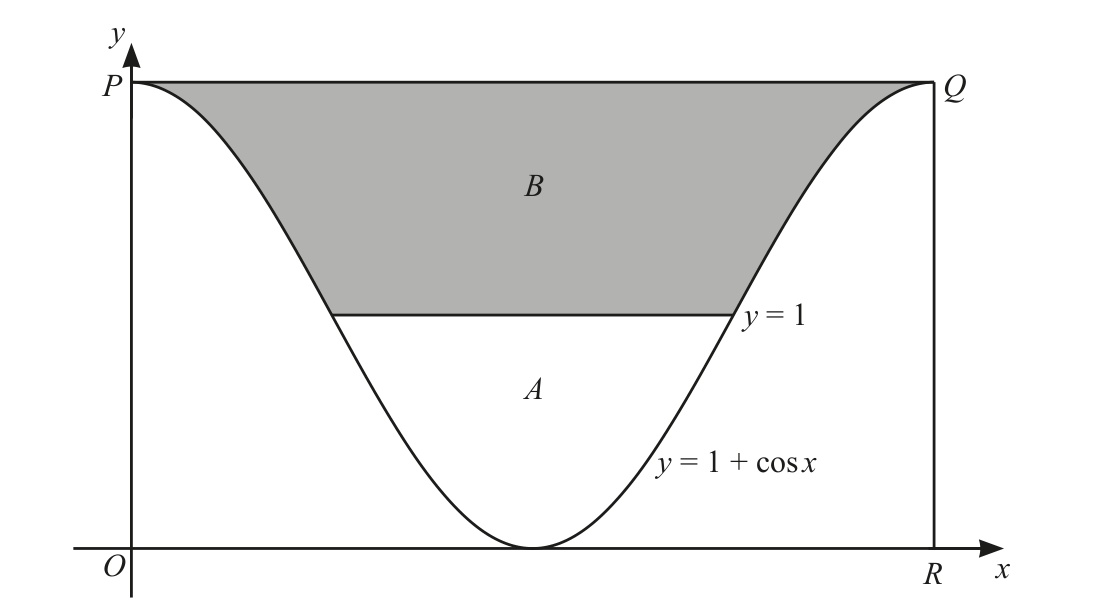
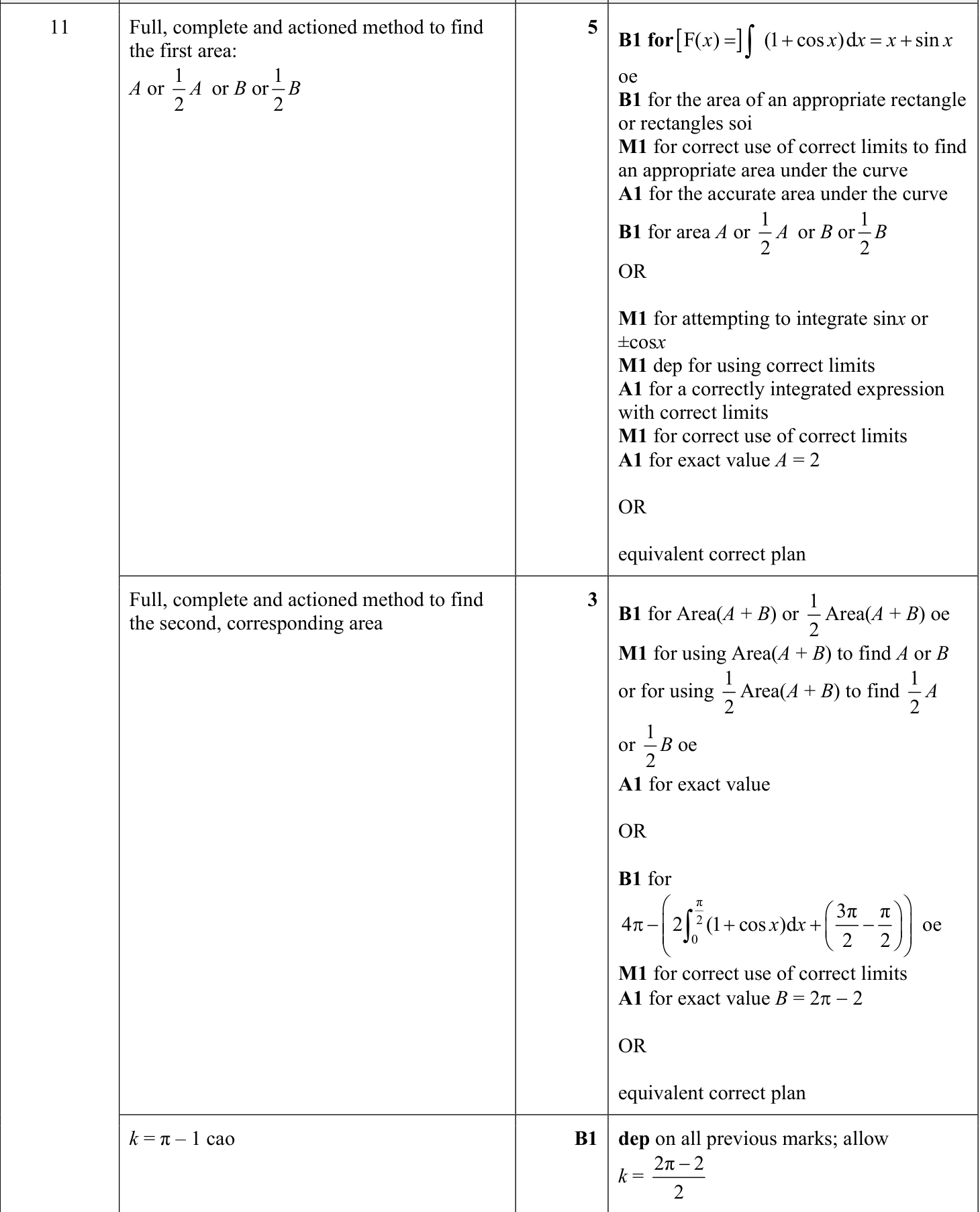
The diagram shows part of the line \(y=1\) and one complete period of the curve \(y=1+\cos x\), where \(x\) is in radians. The line \(PQ\) is a tangent to the curve at \(P\) and at \(Q\). The line \(QR\) is parallel to the \(y\)-axis. Area \(A\) is enclosed by the line \(y=1\) and the curve. Area \(B\) is enclosed by the line \(y=1\), the line \(PQ\) and the curve. Given that area \(A\) : area \(B\) is \(1:k\), find the exact value of \(k\).
0606 P23 - Jun 2022 - Q10 - 10 marks
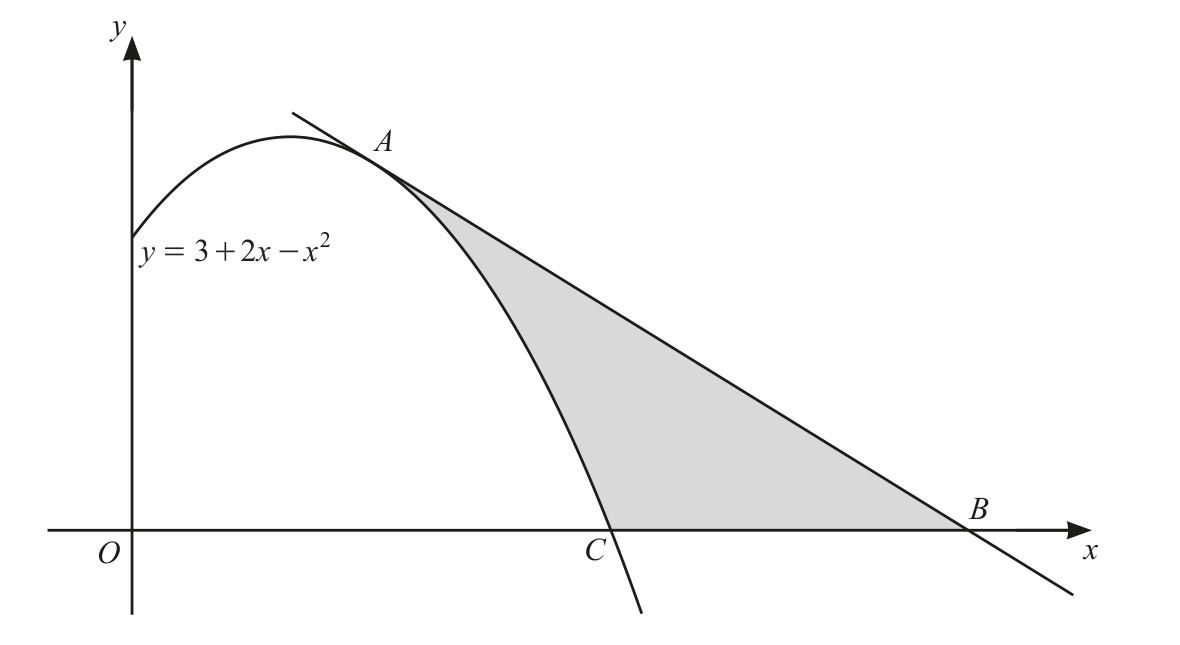
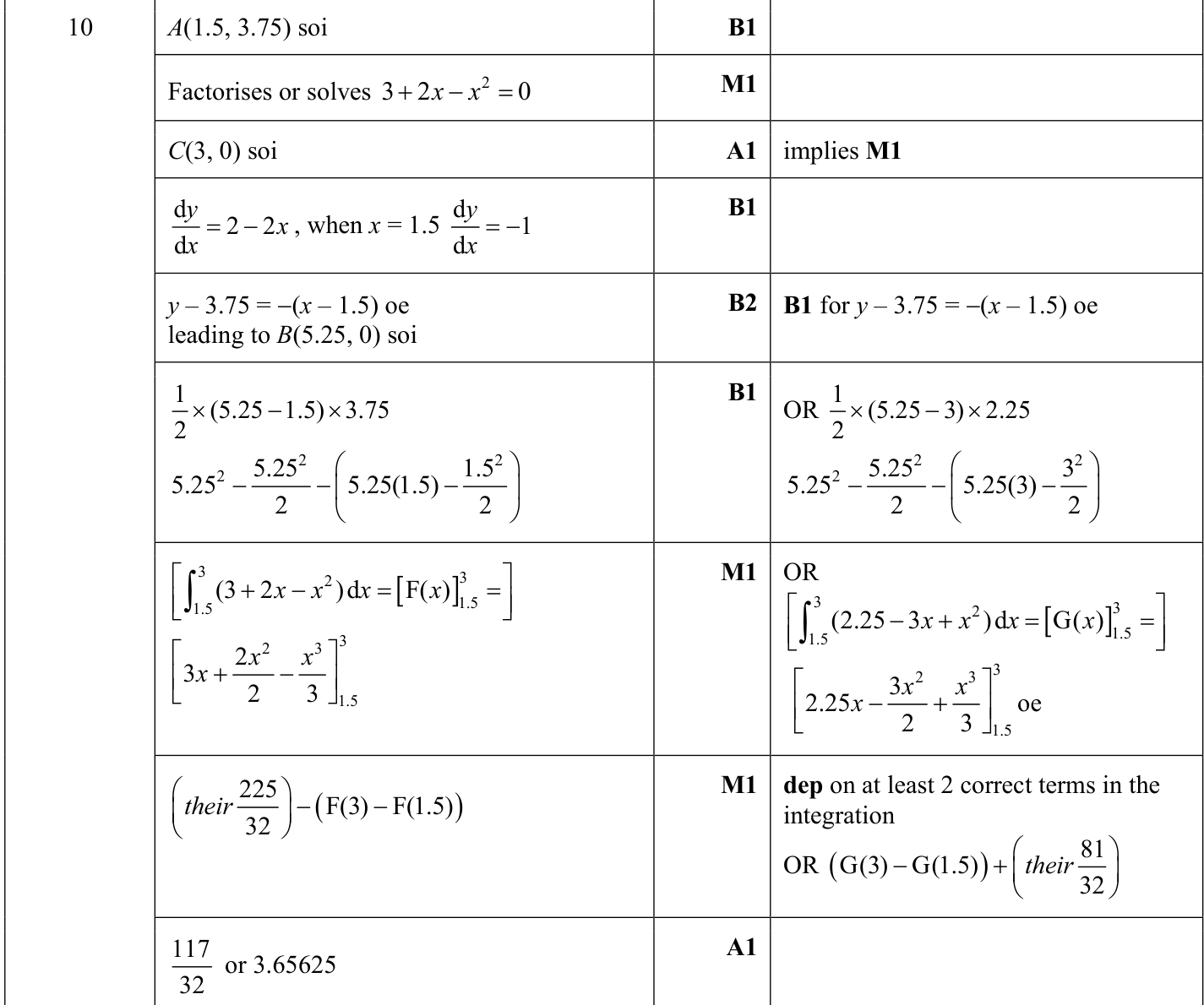
The diagram shows part of the curve \(y=3+2x-x^2\). The point \(A\) on the curve has \(x\)-coordinate \(1.5\). The tangent to the curve at \(A\) meets the \(x\)-axis at \(B\). The curve meets the \(x\)-axis at \(C\). Find the area of the shaded region.