9231 P33 - Jun 2020 - Q7 - 10 marks
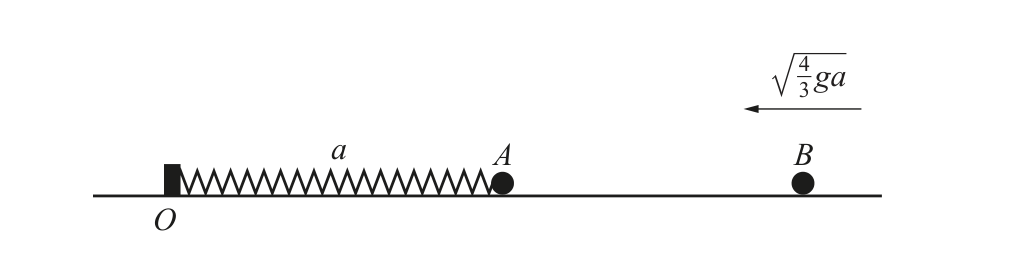
One end of a light spring of natural length \(a\) and modulus of elasticity \(4 m g\) is attached to a fixed point \(O\). The other end of the spring is attached to a particle \(A\) of mass \(k m\), where \(k\) is a constant. Initially the spring lies at rest on a smooth horizontal surface and has length \(a\). A second particle \(B\), of mass \(m\), is moving towards \(A\) with speed \(\sqrt{\frac{4}{3} g a}\) along the line of the spring from the opposite direction to \(O\) (see diagram).
The particles \(A\) and \(B\) collide and coalesce. At a point \(C\) in the subsequent motion, the length of the spring is \(\frac{3}{4} a\) and the speed of the combined particle is half of its initial speed.
(a) Find the value of \(k\).
At the point \(C\) the horizontal surface becomes rough, with coefficient of friction \(\mu\) between the combined particle and the surface. The deceleration of the combined particle at \(C\) is \(\frac{9}{20} g\).
(b) Find the value of \(\mu\).