Past Exam Questions
← Back0606 P21 - Nov 2024 - Q2 - 4 marks
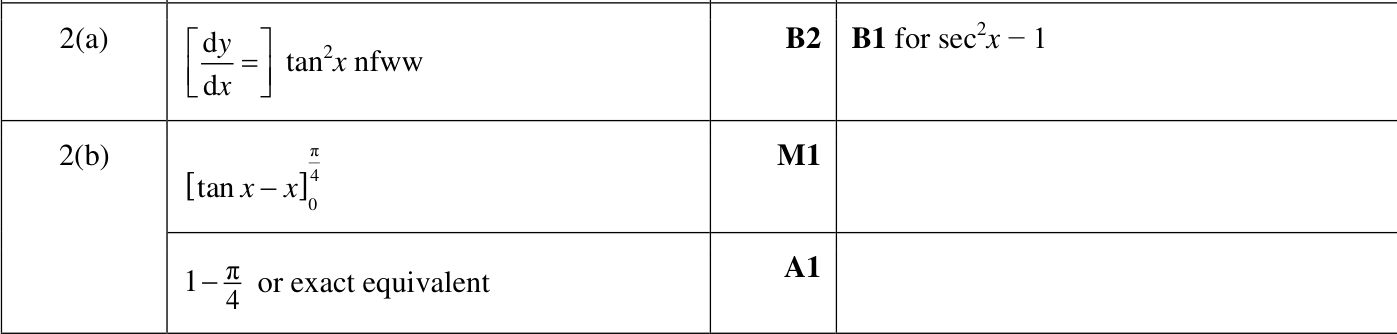
(a) Given that \(y=\tan x-x\), find \(\frac{\mathrm{d} y}{\mathrm{~d} x}\). Write your answer in terms of \(\tan x\). (b) Hence find \(\int_{0}^{\frac{\pi}{4}} \tan ^{2} x \mathrm{~d} x\). Give your answer in exact form.
0606 P11 - Jun 2024 - Q12 - 8 marks
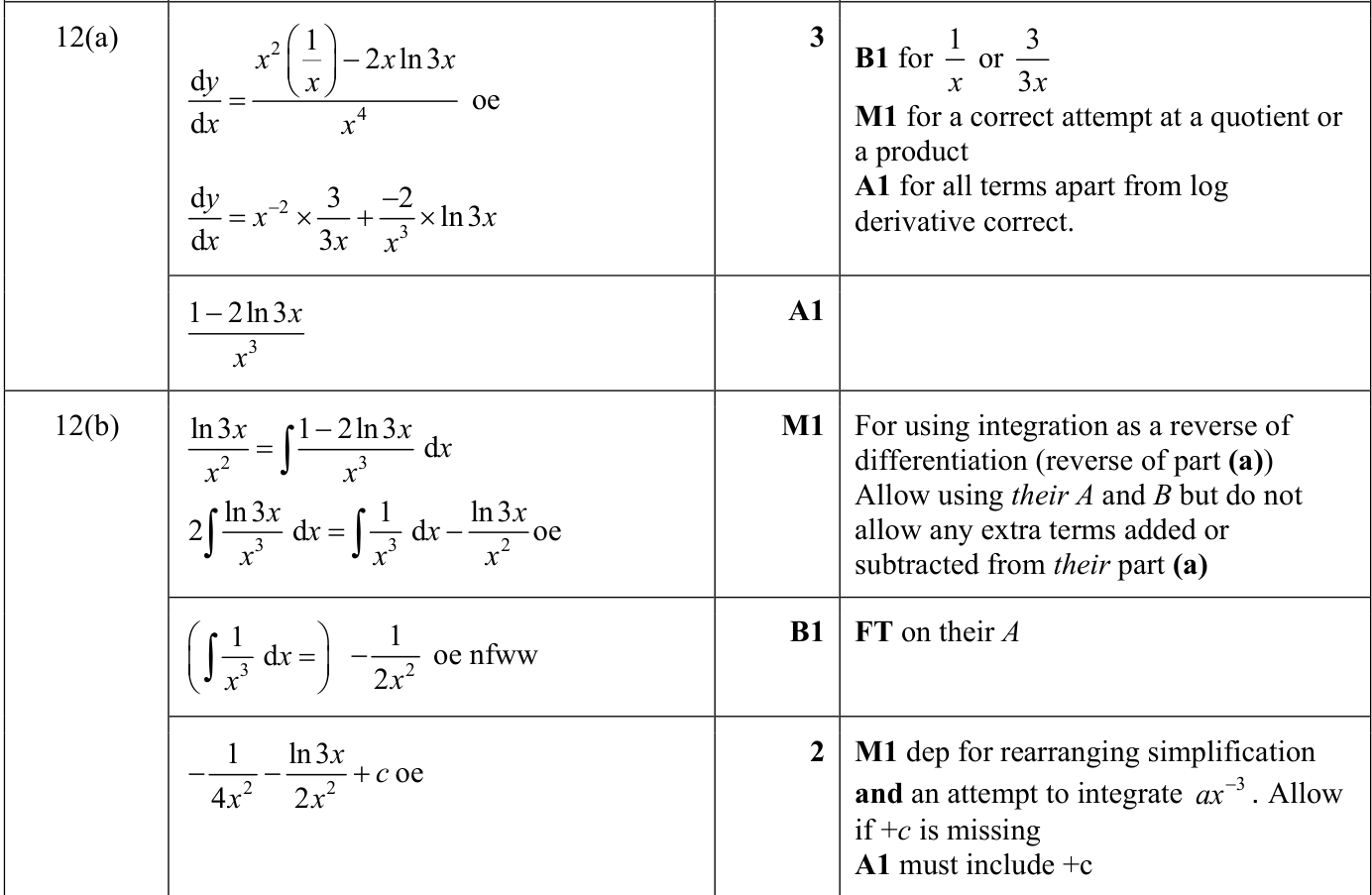
(a) It is given that \(y=\frac{\ln 3 x}{x^{2}}\) for \(x\gt 0\). Find \(\frac{\mathrm{d} y}{\mathrm{~d} x}\). Give your answer in the form \(\frac{A+B \ln 3 x}{x^{3}}\), where \(A\) and \(B\) are integers. (b) Hence find \(\int \frac{\ln 3 x}{x^{3}} \mathrm{~d} x\).
0606 P11 - Jun 2023 - Q10 - 7 marks
Given that
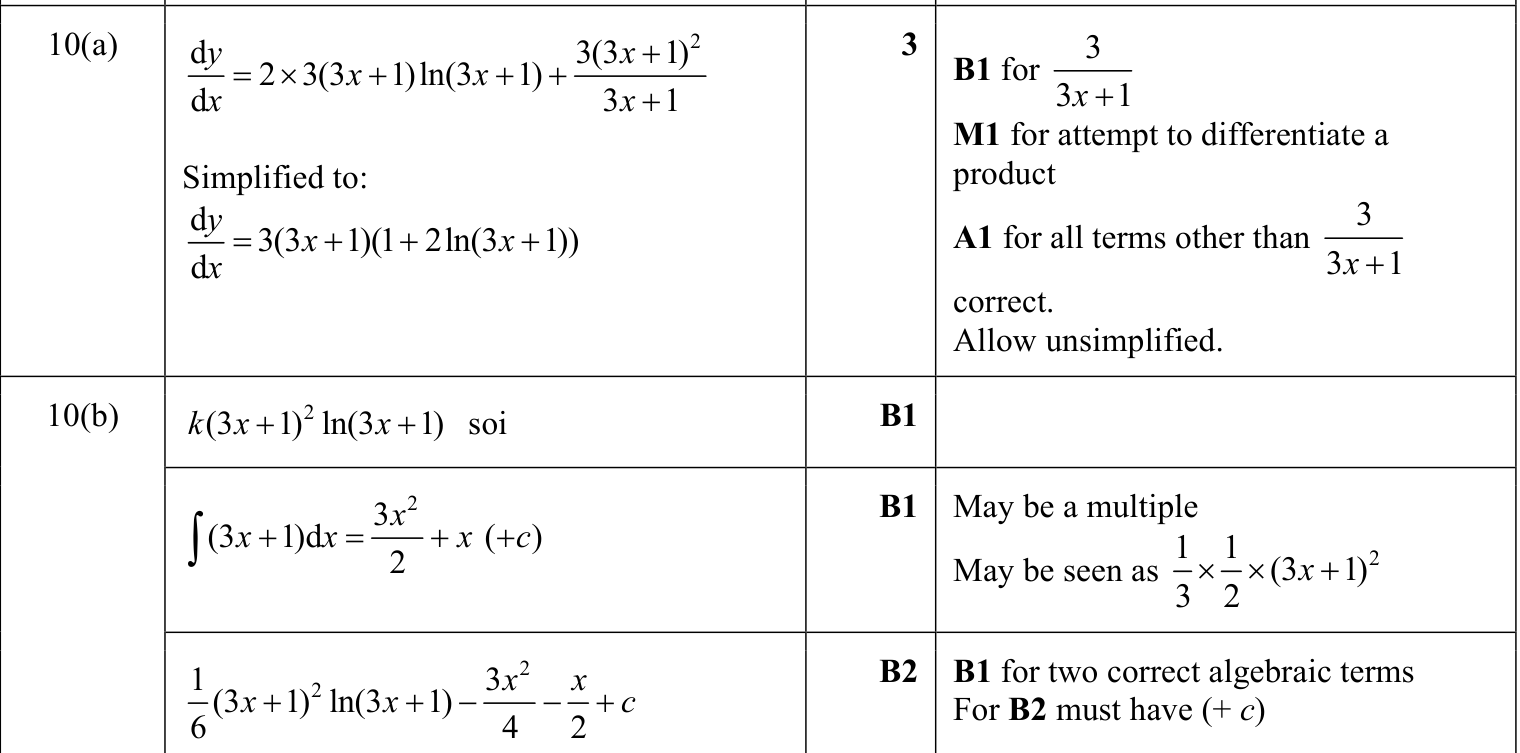
\(y=(3x+1)^2\ln(3x+1),\)
(a) find \(\frac{\mathrm dy}{\mathrm dx}\),
(b) hence find \(\displaystyle \int (3x+1)\ln(3x+1)\,\mathrm dx\).
0606 P12 - Jun 2022 - Q7 - 8 marks
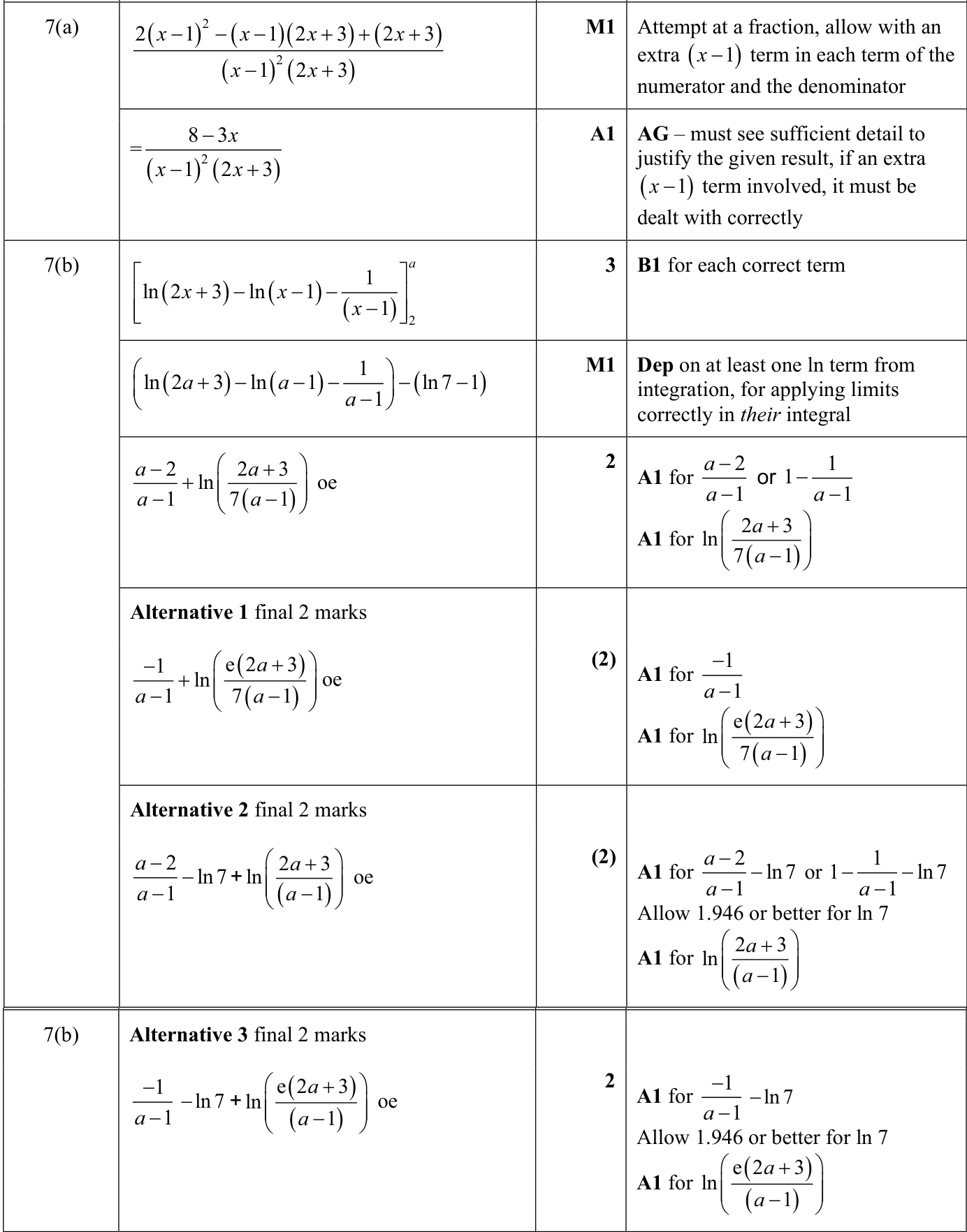
(a) Show that
\(\frac{2}{2x+3}-\frac{1}{x-1}+\frac{1}{(x-1)^2}\)
can be written as
\(\frac{8-3x}{(x-1)^2(2x+3)}.\)
(b) Find
\(\int_2^a \frac{8-3x}{(x-1)^2(2x+3)}\,dx,\)
where \(a\gt2\). Give your answer in the form \(c+\ln d\), where \(c\) and \(d\) are functions of \(a\).
0606 P21 - Jun 2022 - Q10 - 10 marks
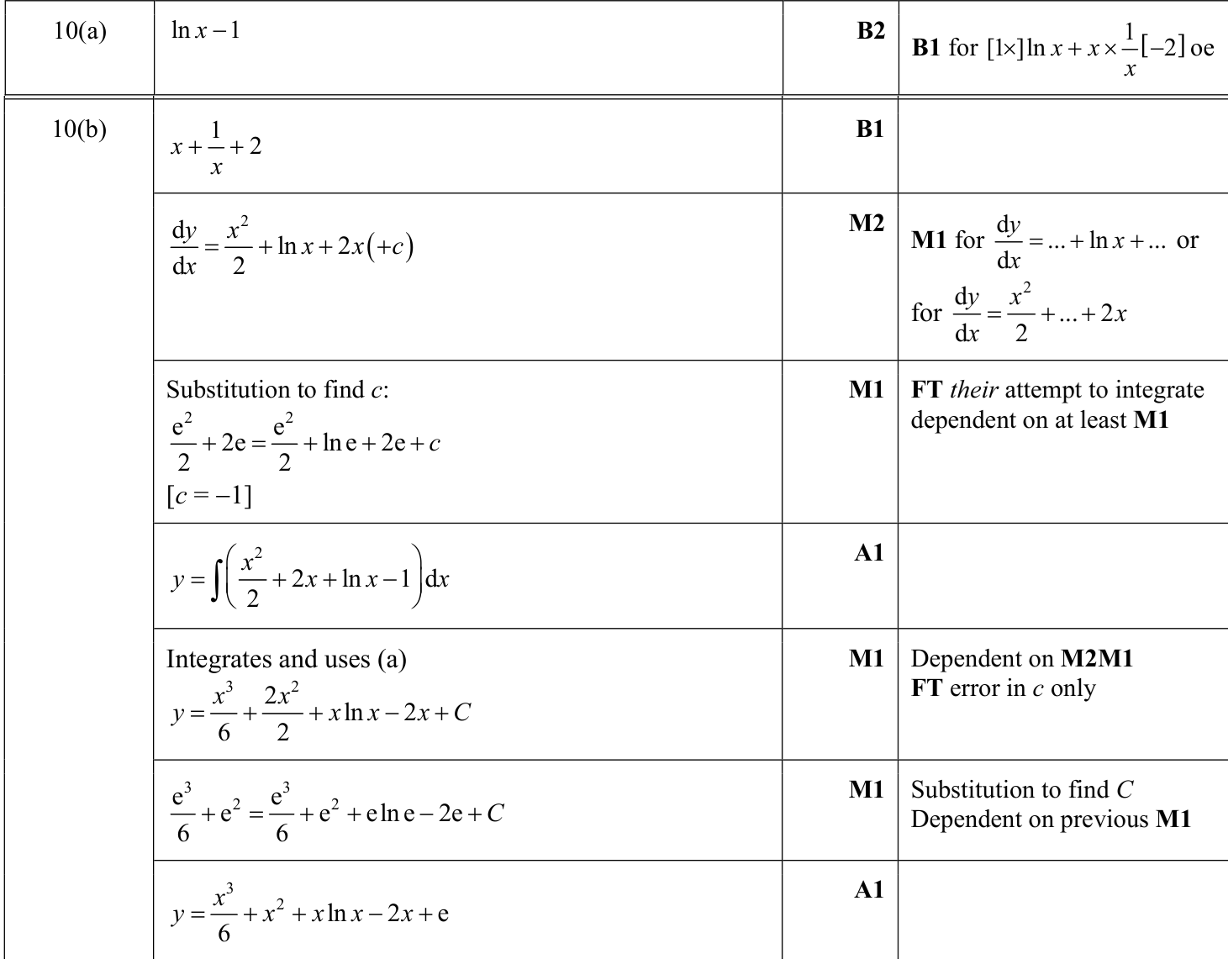
(a) Differentiate \(x\ln x-2x\) with respect to \(x\), simplifying your answer.
(b) A curve is such that
\(\displaystyle \frac{d^2y}{dx^2}=\left(\frac{x+1}{\sqrt{x}}\right)^2\).
At the point \(\left(\mathrm{e},\frac{\mathrm{e}^3}{6}+\mathrm{e}^2\right)\), the gradient of the curve is \(\frac{\mathrm{e}^2}{2}+2\mathrm{e}\). Using your answer to part (a), find the exact equation of the curve.
0606 P22 - Jun 2022 - Q12 - 7 marks
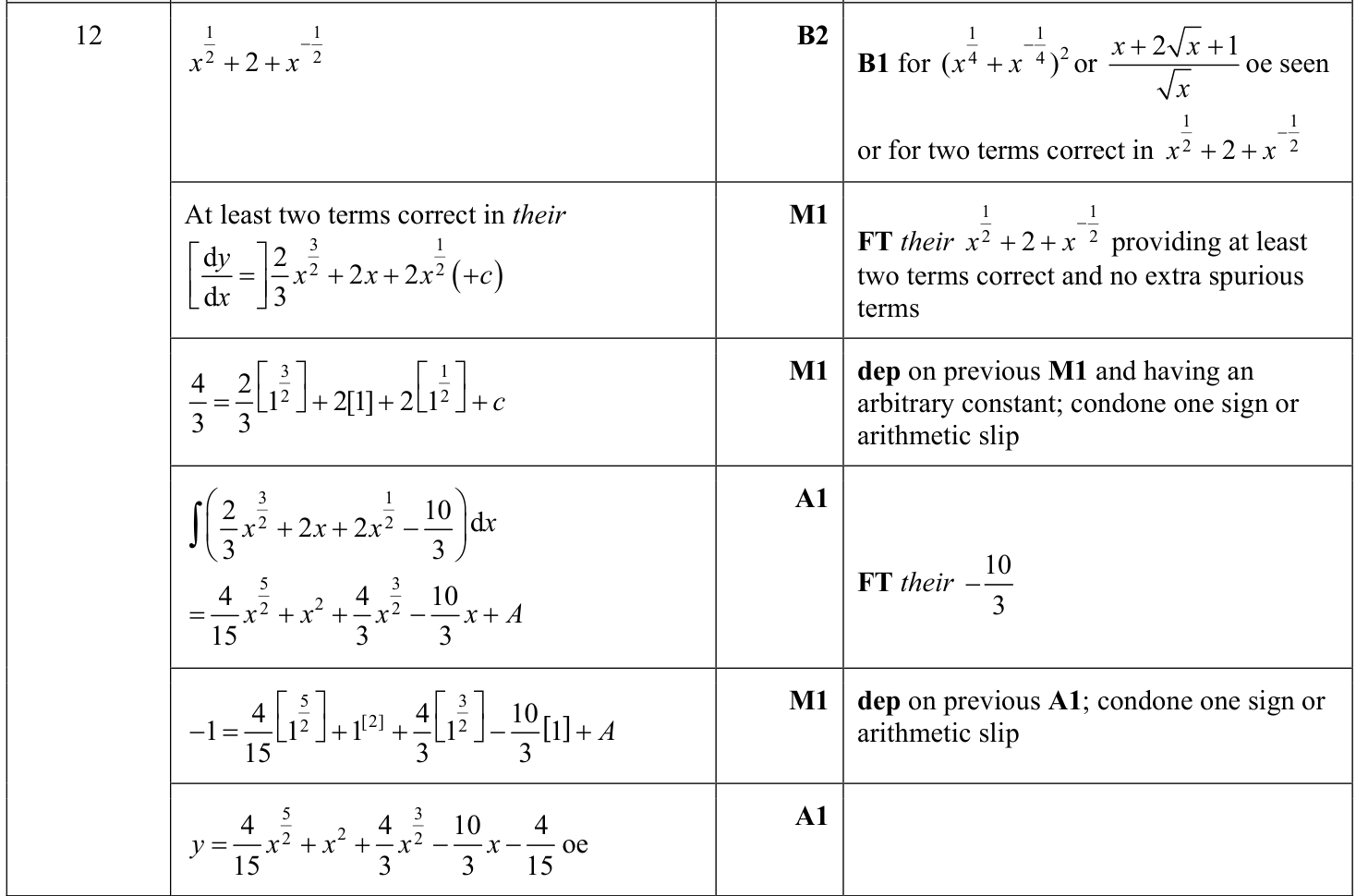
A curve is such that \(\displaystyle \frac{d^2y}{dx^2}=\left(\frac{\sqrt{x}+1}{\sqrt[4]{x}}\right)^2\). Given that the gradient of the curve is \(\frac43\) at the point \((1,-1)\), find the equation of the curve.
0606 P23 - Nov 2022 - Q9 - 10 marks
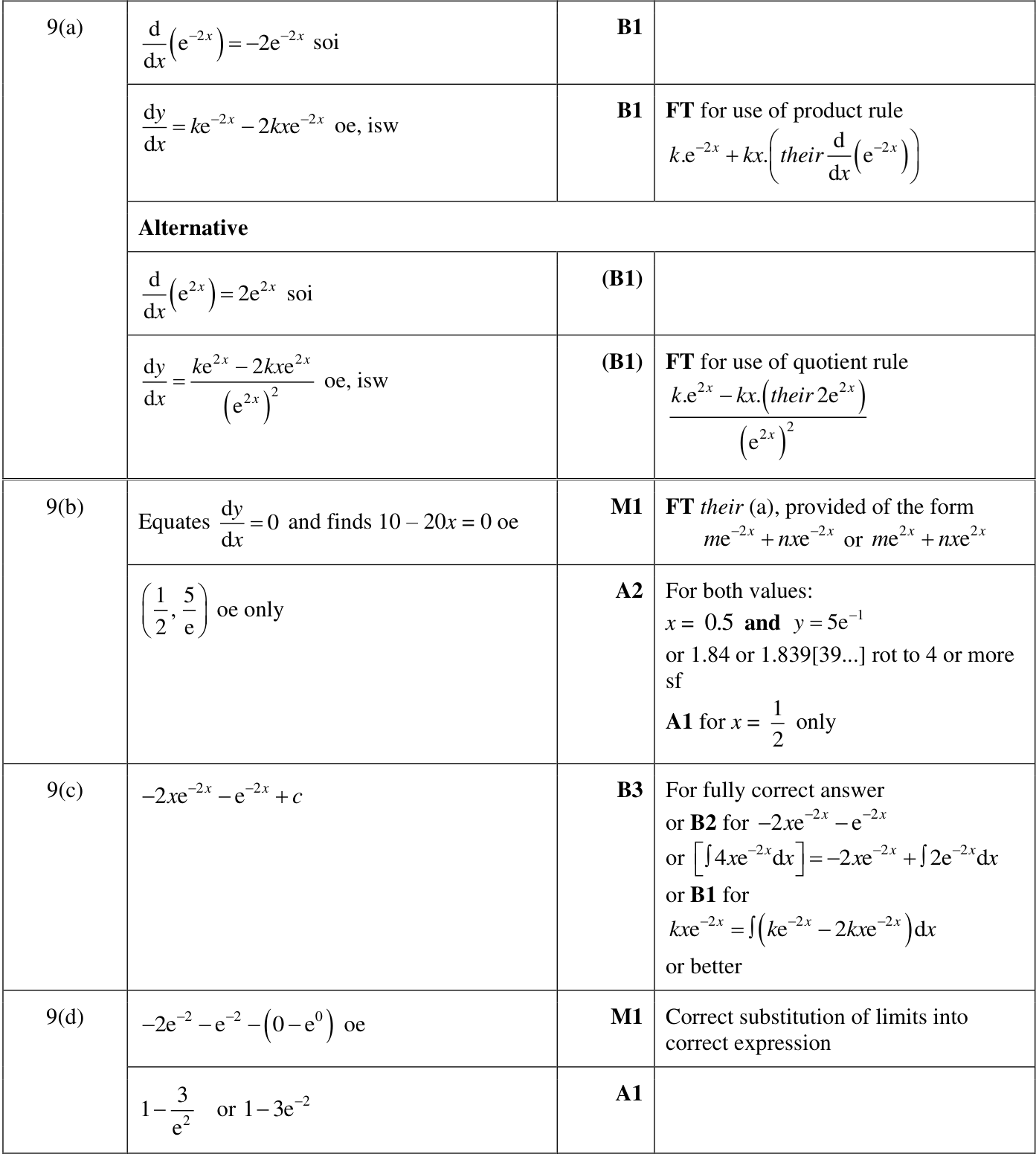
The curve has equation
\(y=kxe^{-2x},\)
where \(k\) is a constant.
(a) Find \(\frac{dy}{dx}\).
(b) The curve \(y=10xe^{-2x}\) has one stationary point. Find the coordinates of this stationary point.
(c) Use your answer to part (a) to find \(\int 4xe^{-2x}\,dx\).
(d) Hence find the exact value of \(\int_0^1 4xe^{-2x}\,dx\).
0606 P22 - Mar 2021 - Q11 - 11 marks
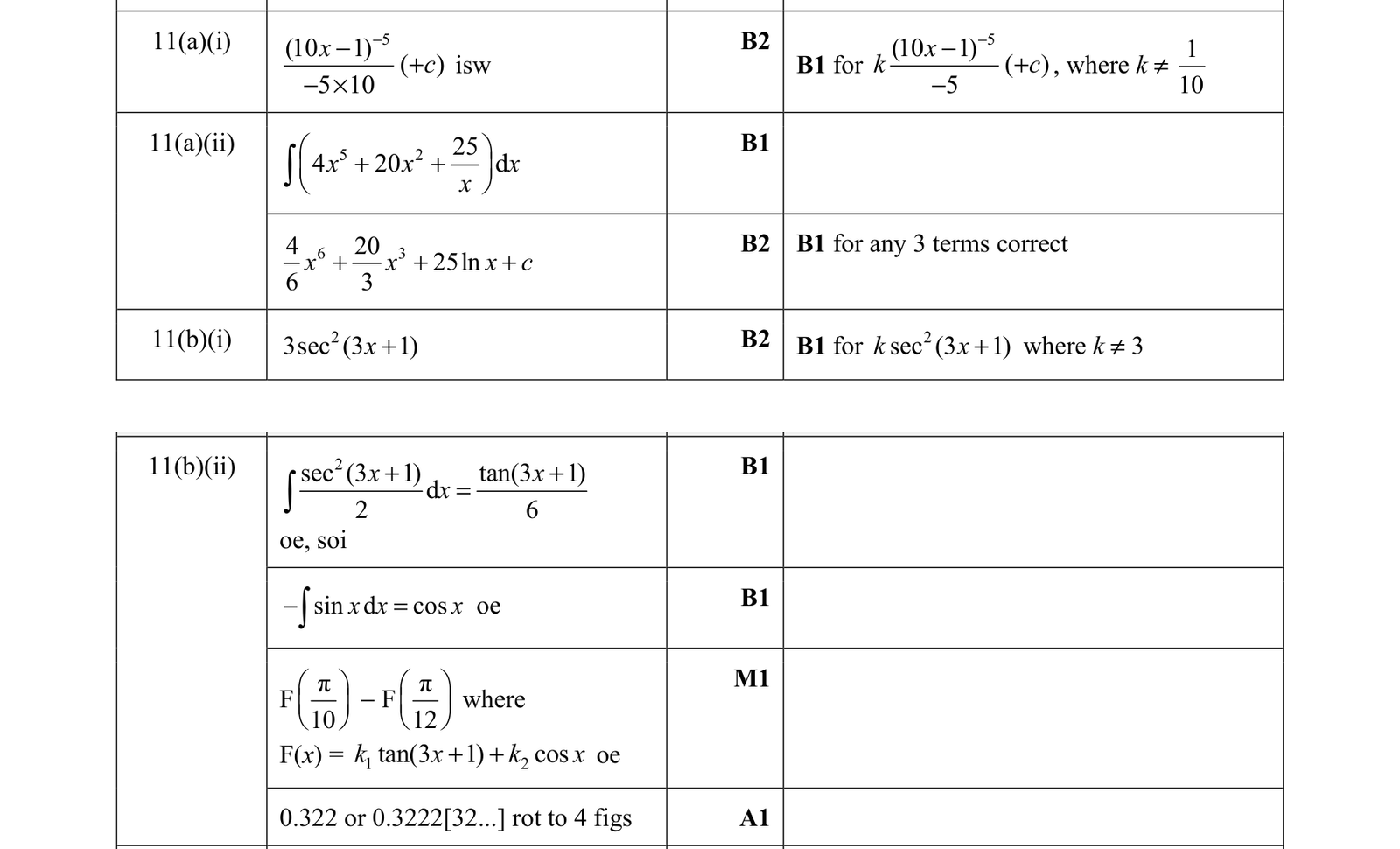
(a)
(i) Find
\(\int\frac1{(10x-1)^6}\,dx.\)
(ii) Find
\(\int\frac{(2x^3+5)^2}{x}\,dx.\)
(b)
(i) Differentiate \(y=\tan(3x+1)\) with respect to \(x\).
(ii) Hence find
\(\int_{\pi/12}^{\pi/10}\left(\frac{\operatorname{sec}^2(3x+1)}2-\sin x\right)\,dx.\)
0606 P23 - Jun 2021 - Q8 - 8 marks
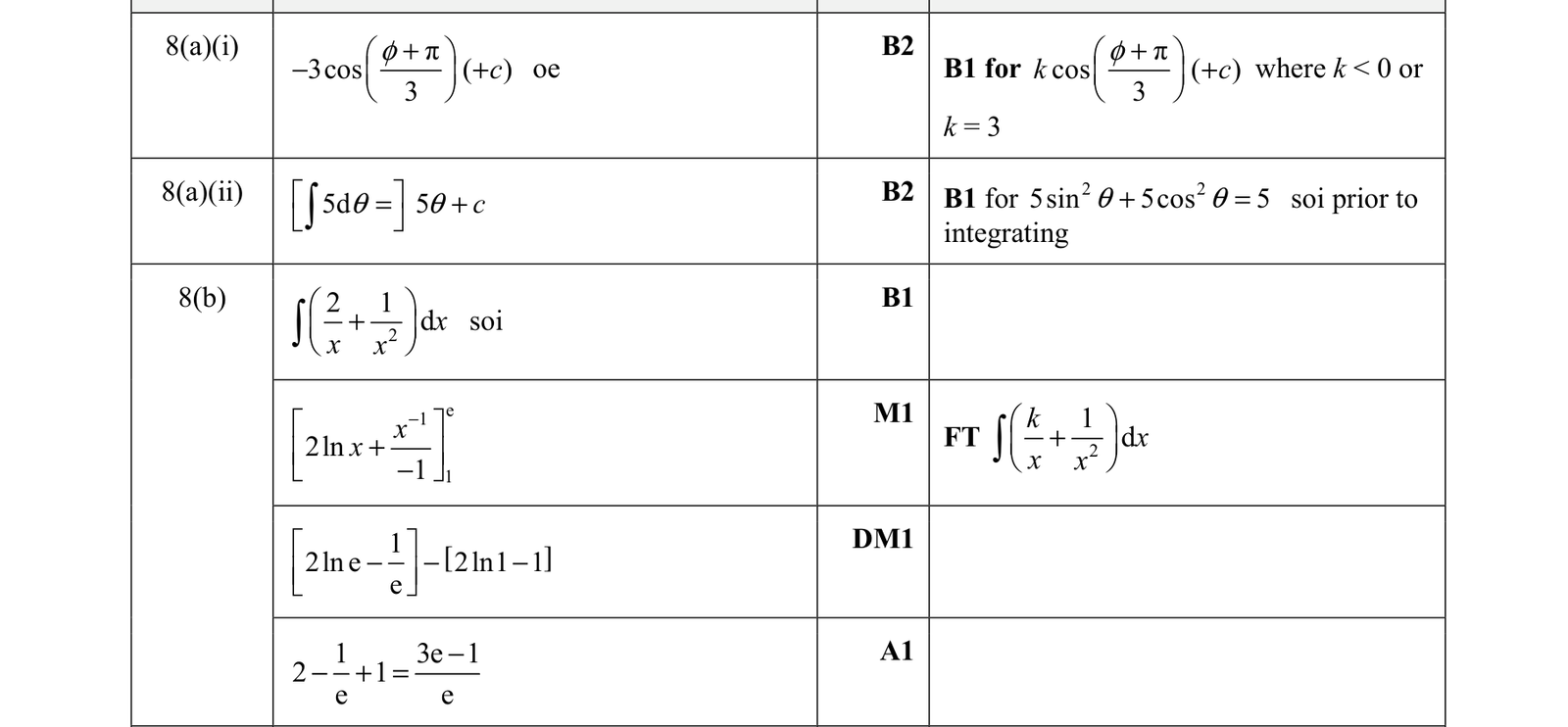
(a)
(i) Find
\(\int \sin\left(\frac{\phi+\pi}{3}\right)\,d\phi.\)
(ii) Find
\(\int(5\sin^2\theta+5\cos^2\theta)\,d\theta.\)
(b) Show that
\(\int_1^e\left(\left(1+\frac1x\right)^2-1\right)\,dx=\frac{3e-1}{e}.\)
0606 P12 - Mar 2019 - Q10 - 10 marks
A curve is such that \(\dfrac{d^2y}{dx^2}=4e^{2x}+3\). When \(x=0\), \(y=-5\) and \(\dfrac{dy}{dx}=10\).
(i) Find the equation of the curve.
(ii) Find the equation of the normal to the curve at the point where \(x=\dfrac14\).

0606 P22 - Nov 2019 - Q10 - 11 marks
(i) Given that \(\displaystyle y=\frac{\ln x}{x^2}\), find \(\displaystyle \frac{dy}{dx}\).
(ii) Find the coordinates of the stationary point on the curve \(\displaystyle y=\frac{\ln x}{x^2}\).
(iii) Using your answer to part (i), find \(\displaystyle \int \frac{\ln x}{x^3}\,dx\).
(iv) Hence evaluate \(\displaystyle \int_1^2 \frac{\ln x}{x^3}\,dx\).

0606 P22 - Jun 2018 - Q9 - 7 marks
(i) Differentiate \(x^4\sqrt{\sin x}\) with respect to \(x\).
(ii) Hence find
\(\int\left(x+\frac{x^4\cos x}{\sqrt{\sin x}}+8x^3\sqrt{\sin x}\right)\,dx.\)

0606 P13 - Jun 2017 - Q10 - 9 marks
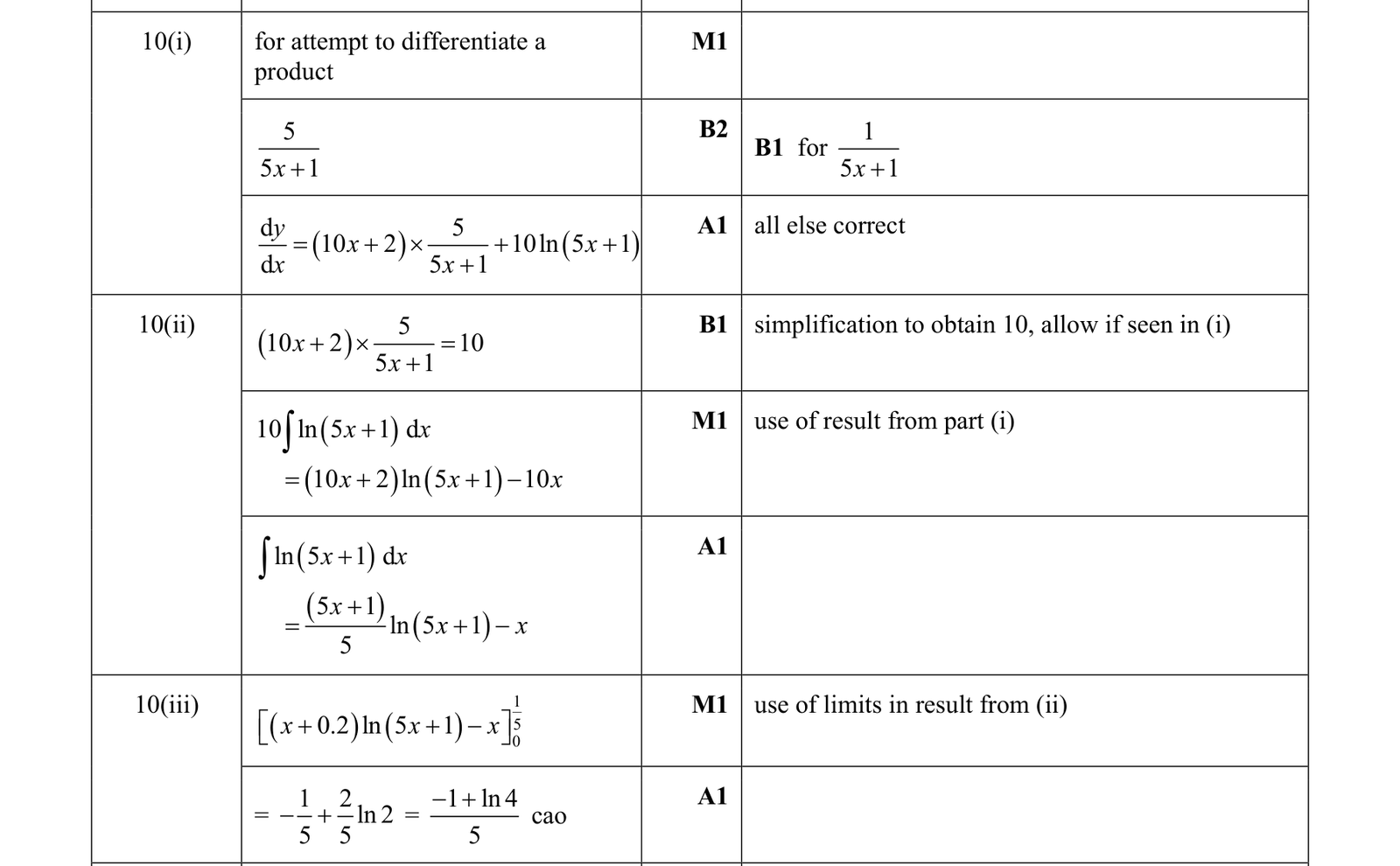
It is given that
\(y=(10x+2)\ln(5x+1).\)
(i) Find \(\dfrac{dy}{dx}\).
(ii) Hence show that
\(\int \ln(5x+1)\,dx=\frac{ax+b}{5}\ln(5x+1)-x+c,\)
where \(a\) and \(b\) are integers and \(c\) is a constant of integration.
(iii) Hence find
\(\int_0^{1/5}\ln(5x+1)\,dx,\)
giving your answer in the form \(\dfrac{d+\ln f}{5}\), where \(d\) and \(f\) are integers.
0606 P22 - Jun 2017 - Q5 - 5 marks
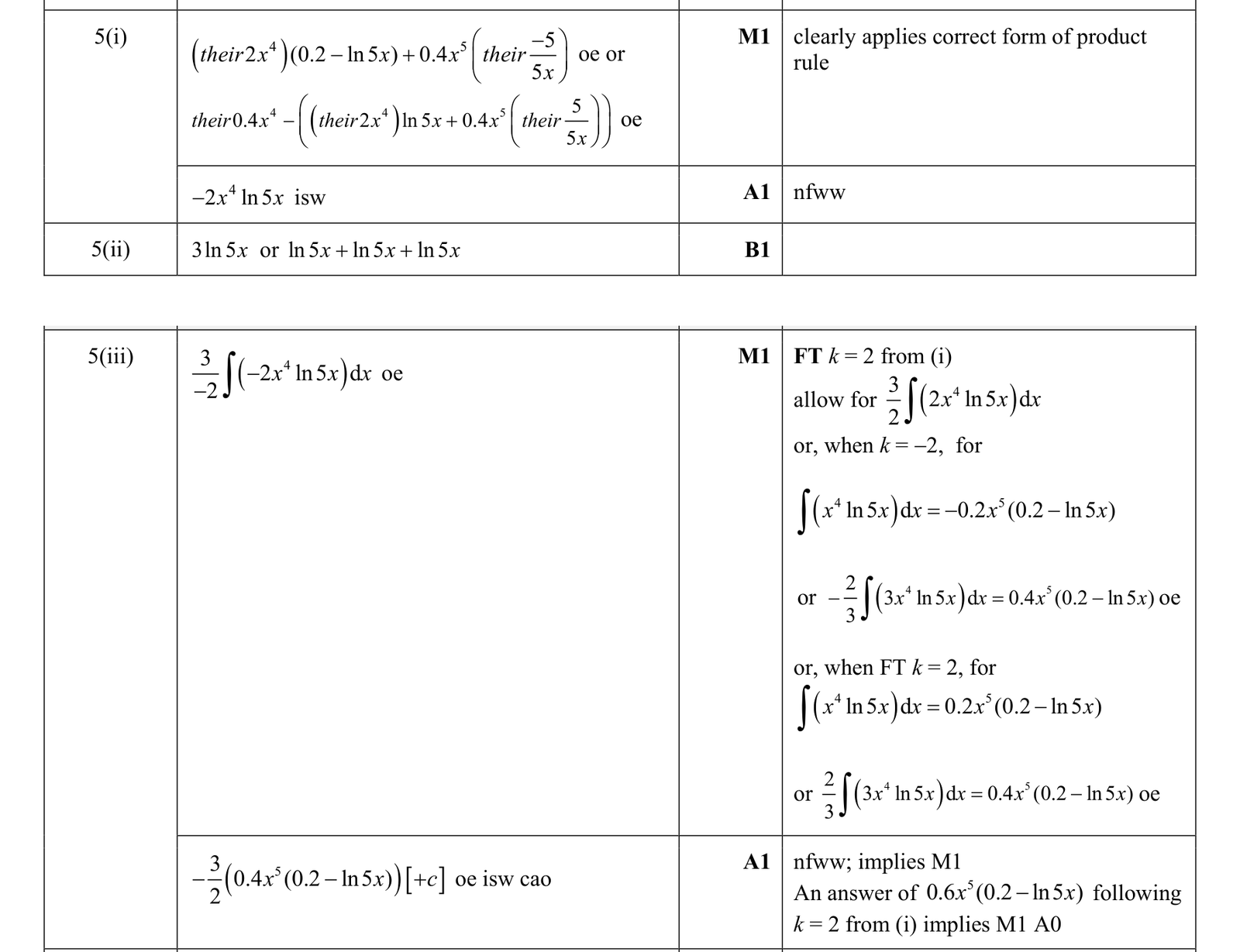
(i) Show that
\(\frac{d}{dx}\left[0.4x^5\left(0.2-\ln(5x)\right)\right]=kx^4\ln(5x),\)
where \(k\) is an integer to be found.
(ii) Express \(\ln(125x^3)\) in terms of \(\ln(5x)\).
(iii) Hence find \(\int x^4\ln(125x^3)\,dx\).
0606 P22 - Nov 2017 - Q9 - 8 marks
(i) Find \(\dfrac{d}{dx}(x\ln x)\).
(ii) Hence find \(\displaystyle\int\ln x\,dx\).
(iii) Hence, given that \(k\gt 0\), show that \(\displaystyle\int_k^{2k}\ln x\,dx=k(\ln4k-1)\).

0606 P23 - Nov 2017 - Q9 - 10 marks
(i) Show that
\(\frac{d}{dx}\left(\frac{\ln x}{x^3}\right)=\frac{1-3\ln x}{x^4}.\)
(ii) Find the exact coordinates of the stationary point of the curve \(y=\dfrac{\ln x}{x^3}\).
(iii) Use the result from part (i) to find \(\displaystyle\int \dfrac{\ln x}{x^4}\,dx\).

0606 P12 - Nov 2025 - Q10 - 5 marks
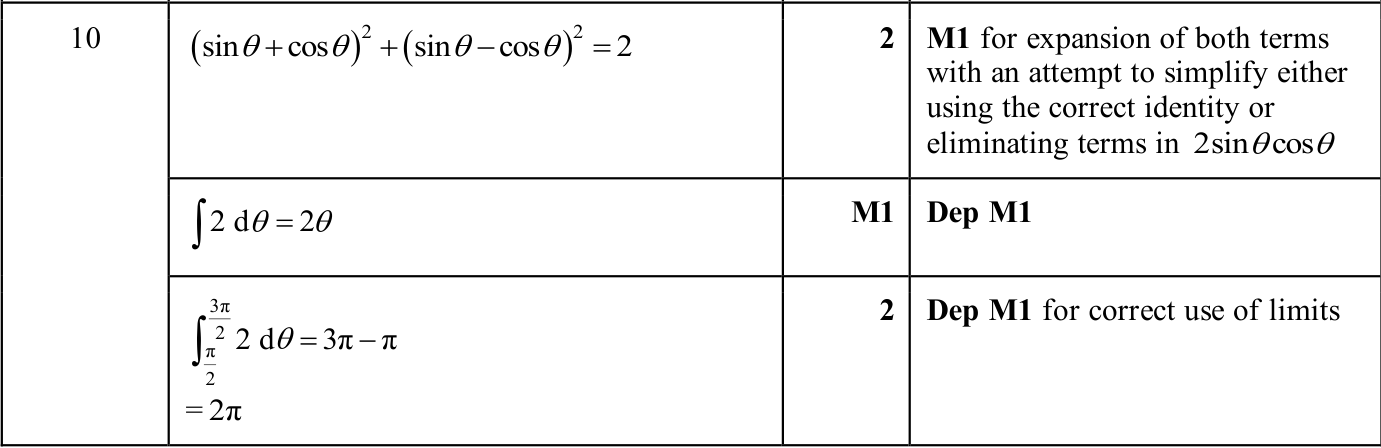
Show that \(\displaystyle \int_{\frac{\pi}{2}}^{\frac{3\pi}{2}}\left((\sin\theta+\cos\theta)^2+(\sin\theta-\cos\theta)^2\right)\,\mathrm{d}\theta=k\pi\), where \(k\) is an integer to be found.
0606 P13 - Jun 2024 - Q4 - 5 marks
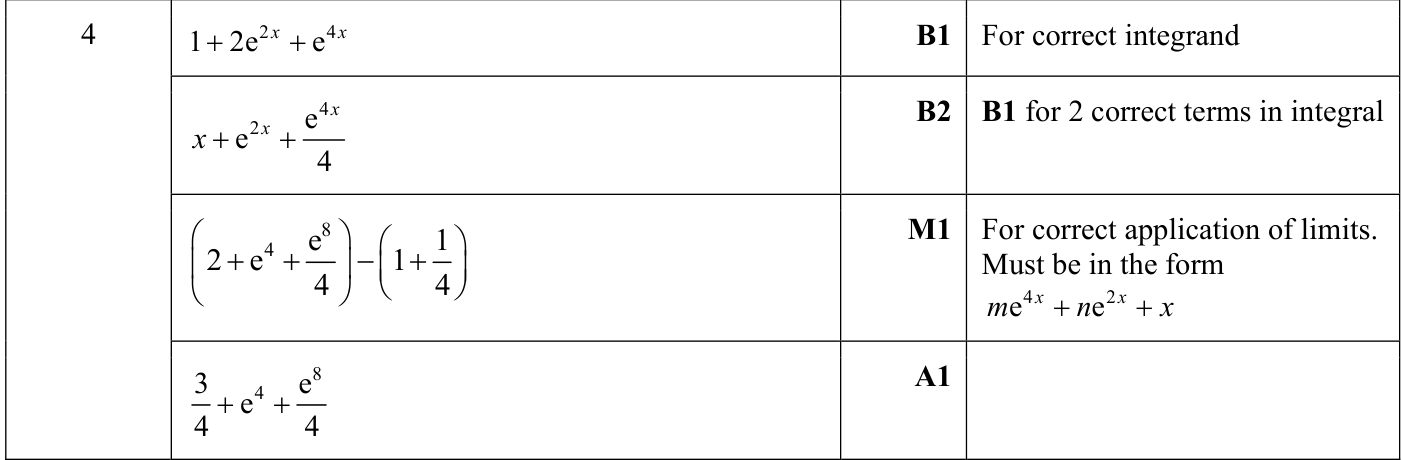
Find \(\int_{0}^{2}\left(1+\mathrm{e}^{2 x}\right)^{2} \mathrm{~d} x\), giving your answer in exact form.
0606 P23 - Nov 2023 - Q4 - 6 marks
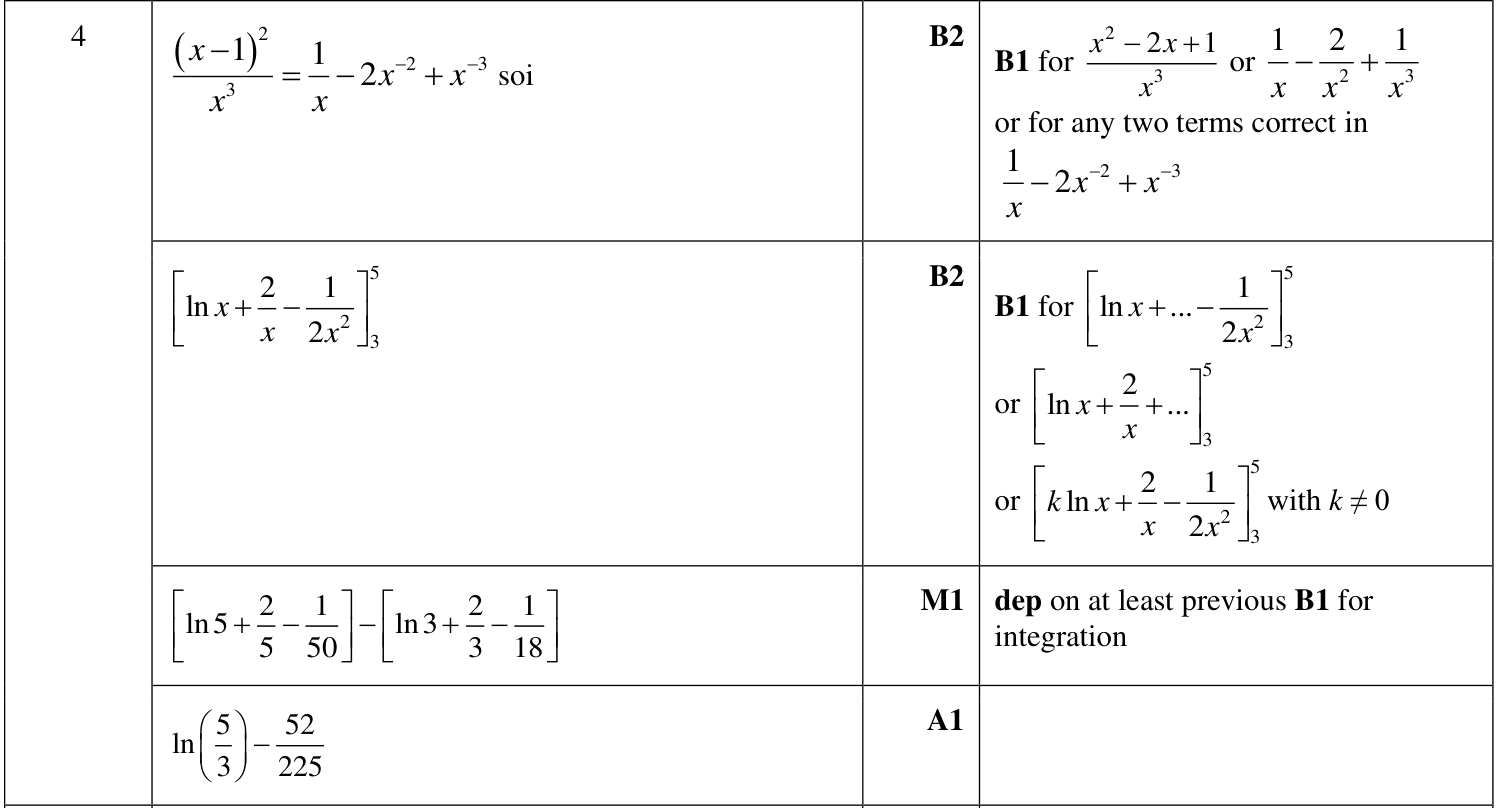
Find the exact value of
\(\displaystyle \int_3^5 \frac{(x-1)^2}{x^3}\,\mathrm dx.\)
0606 P22 - Nov 2023 - Q6 - 6 marks
Find the exact value of
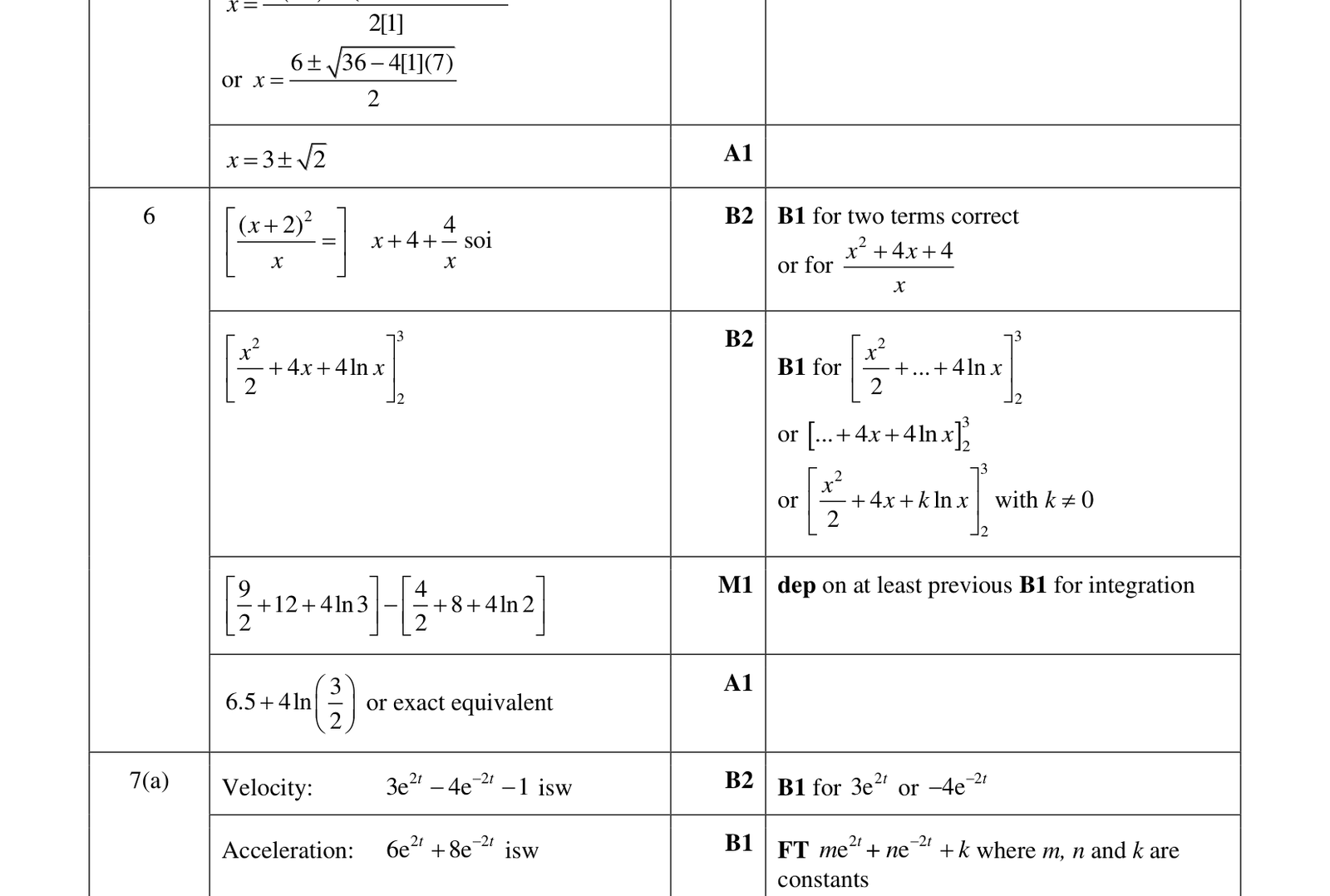
\(\displaystyle \int_2^3\frac{(x+2)^2}{x}\,\mathrm dx.\)