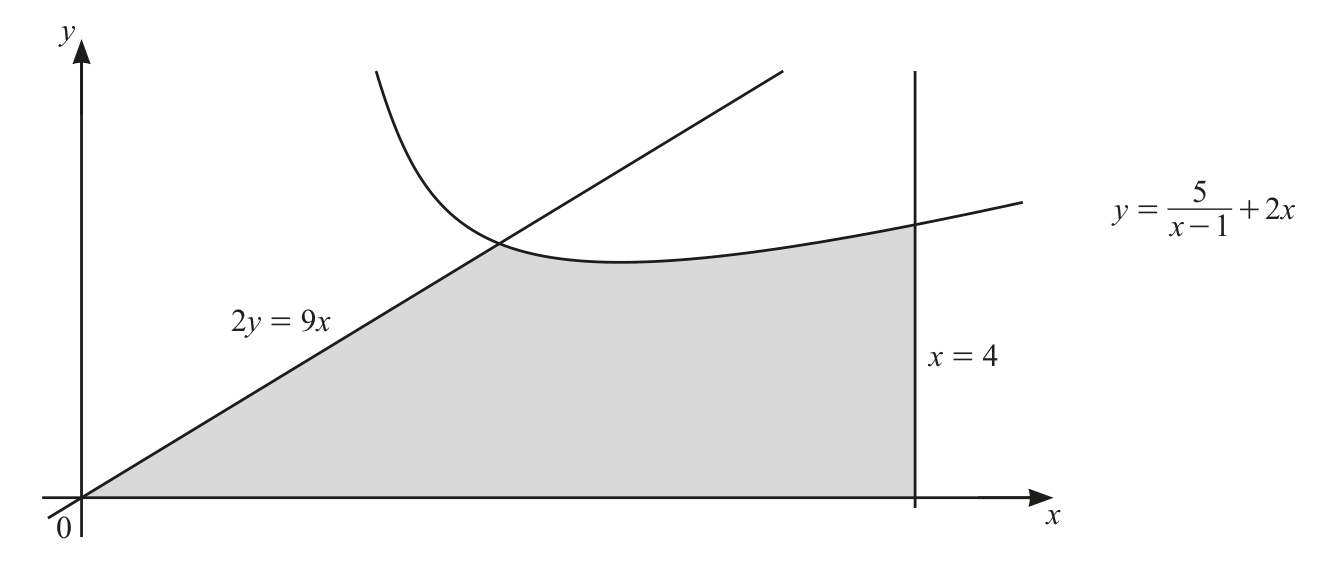
Answer: stationary point \(\left(1+\frac{\sqrt{10}}{2},\,2+2\sqrt{10}\right)\); area \(21+5\ln3\).
(a) Differentiate
\(y=\frac5{x-1}+2x.\)
This gives
\(\frac{dy}{dx}=-\frac5{(x-1)^2}+2.\)
At a stationary point, \(\frac{dy}{dx}=0\), so
\(-\frac5{(x-1)^2}+2=0.\)
Hence
\(2=\frac5{(x-1)^2}.\)
Therefore
\((x-1)^2=\frac52.\)
On the branch shown, \(x\gt 1\), so
\(x-1=\sqrt{\frac52}=\frac{\sqrt{10}}{2}.\)
Thus
\(x=1+\frac{\sqrt{10}}{2}.\)
Now substitute this into the curve:
\(y=\frac5{x-1}+2x.\)
Since \(x-1=\frac{\sqrt{10}}{2}\),
\(\frac5{x-1}=\frac5{\sqrt{10}/2}=\sqrt{10}.\)
Also
\(2x=2+\sqrt{10}.\)
Therefore
\(y=2+2\sqrt{10}.\)
So the stationary point is
\(\left(1+\frac{\sqrt{10}}{2},\,2+2\sqrt{10}\right).\)
(b) The shaded region can be split into two parts. From \(x=0\) to \(x=2\), it is the triangle under the line \(2y=9x\). Since the point of intersection is \((2,9)\), the area of this triangle is
\(\frac12(2)(9)=9.\)
From \(x=2\) to \(x=4\), the shaded region lies under the curve. So its area is
\(\int_2^4\left(\frac5{x-1}+2x\right)\,dx.\)
An antiderivative is
\(5\ln(x-1)+x^2.\)
Therefore
\(\int_2^4\left(\frac5{x-1}+2x\right)\,dx =\left[5\ln(x-1)+x^2\right]_2^4.\)
This is
\((5\ln3+16)-(5\ln1+4).\)
Since \(\ln1=0\), the area under the curve is
\(12+5\ln3.\)
Adding the triangular area gives
\(9+(12+5\ln3)=21+5\ln3.\)