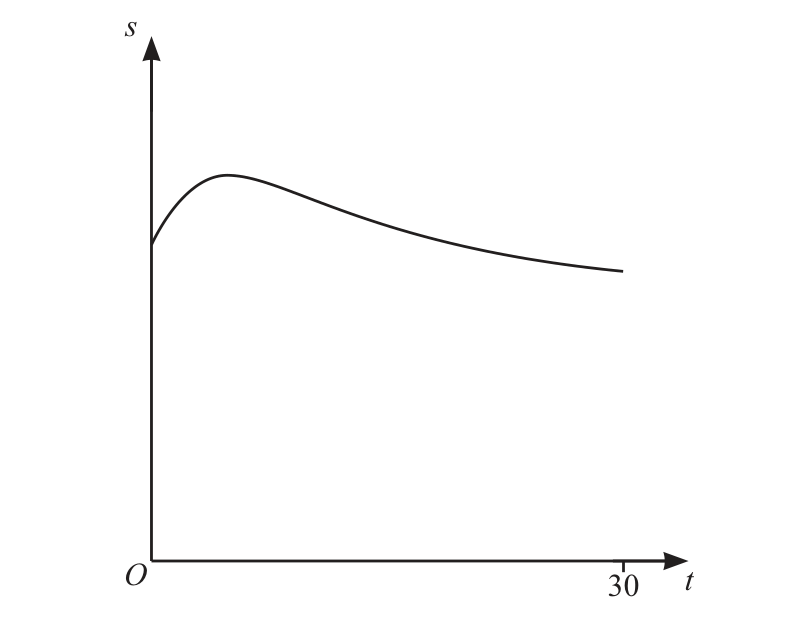
Answer: (a) \(t=5\). (b)(i) \(10\sqrt6-20\). (b)(ii) \(T=20\).
The displacement is
\(s=\dfrac{10t+100}{\sqrt{2t^2+100}}\).
Write this as
\(s=(10t+100)(2t^2+100)^{-1/2}\).
(a) Differentiate using the product rule:
\(\dfrac{\mathrm{d}s}{\mathrm{d}t}=10(2t^2+100)^{-1/2}+(10t+100)\left(-\frac12\right)(2t^2+100)^{-3/2}(4t)\).
So
\(\dfrac{\mathrm{d}s}{\mathrm{d}t}=10(2t^2+100)^{-1/2}-2t(10t+100)(2t^2+100)^{-3/2}\).
Put this over the common denominator \((2t^2+100)^{3/2}\):
\(\dfrac{\mathrm{d}s}{\mathrm{d}t}=\dfrac{10(2t^2+100)-2t(10t+100)}{(2t^2+100)^{3/2}}\).
The numerator is
\(20t^2+1000-20t^2-200t=1000-200t\).
Therefore
\(\dfrac{\mathrm{d}s}{\mathrm{d}t}=\dfrac{1000-200t}{(2t^2+100)^{3/2}}\).
At a maximum, \(\dfrac{\mathrm{d}s}{\mathrm{d}t}=0\), so
\(1000-200t=0\).
Hence
\(t=5\).
(b)(i) At \(t=0\),
\(s=\dfrac{100}{\sqrt{100}}=10\).
At the maximum, when \(t=5\),
\(s=\dfrac{10(5)+100}{\sqrt{2(5)^2+100}}=\dfrac{150}{\sqrt{150}}=\sqrt{150}=5\sqrt6\).
The particle starts at displacement \(10\), moves to the maximum displacement \(5\sqrt6\), and then returns to its starting point. So the total distance travelled is
\((5\sqrt6-10)+(5\sqrt6-10)=2(5\sqrt6-10)\).
Thus the total distance is
\(10\sqrt6-20\).
(b)(ii) The particle is back at its starting point when its displacement is again \(10\). Therefore set
\(\dfrac{10t+100}{\sqrt{2t^2+100}}=10\).
Divide by \(10\):
\(\dfrac{t+10}{\sqrt{2t^2+100}}=1\).
So
\(t+10=\sqrt{2t^2+100}\).
Squaring both sides gives
\((t+10)^2=2t^2+100\).
Expanding,
\(t^2+20t+100=2t^2+100\).
So
\(t^2-20t=0\).
Hence
\(t(t-20)=0\).
The solution \(t=0\) is the starting time, so the return time is
\(T=20\).