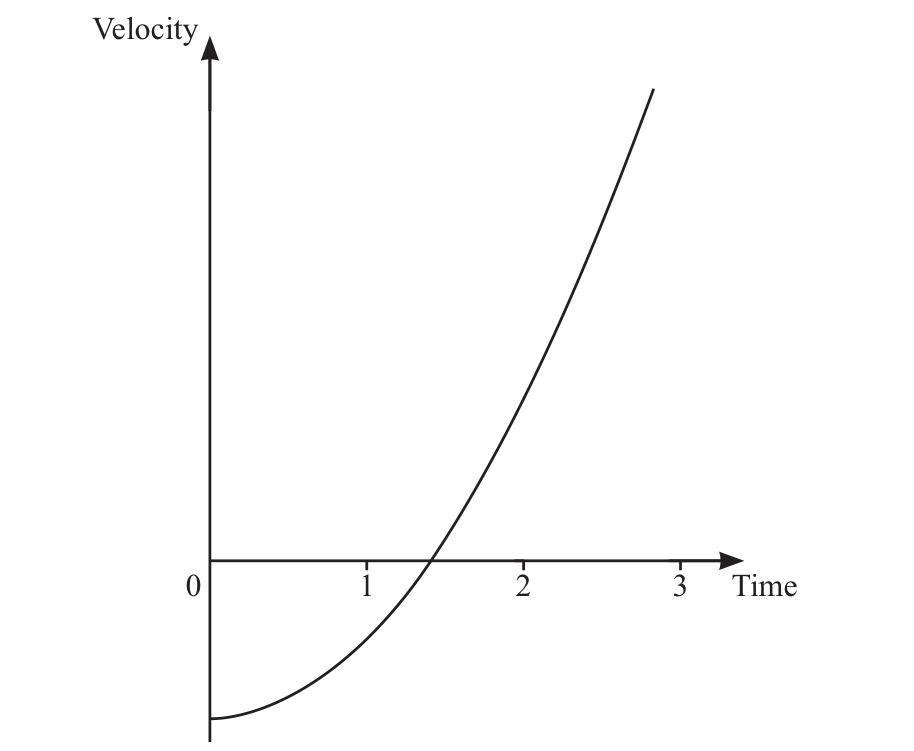
Answer: speed is the reflected velocity graph; acceleration is a straight line through the origin with positive gradient.
(a) Speed is the magnitude of velocity, so
\(\text{speed}=|v|.\)
This means that every part of the velocity-time graph above the \(t\)-axis stays unchanged. Any part below the \(t\)-axis is reflected in the \(t\)-axis, because negative velocity still gives positive speed.
So the speed-time graph should have the same shape as the velocity-time graph where \(v\geqslant0\), and the part where \(v\lt0\) should be drawn above the axis as its reflection.
(b) Acceleration is the gradient of the velocity-time graph:
\(a=\dfrac{\mathrm dv}{\mathrm dt}.\)
The velocity-time graph is part of a quadratic curve, so its gradient is a linear function of \(t\). Therefore the acceleration-time graph is a straight line.
The gradient of the velocity-time graph is zero when \(t=0\), so the acceleration-time graph passes through the origin. Since the quadratic curve opens upwards in the diagram, the gradient increases as \(t\) increases, so the acceleration-time graph is a straight line with positive gradient.