Past Exam Questions
← Back0606 P21 - Nov 2024 - Q8 - 10 marks
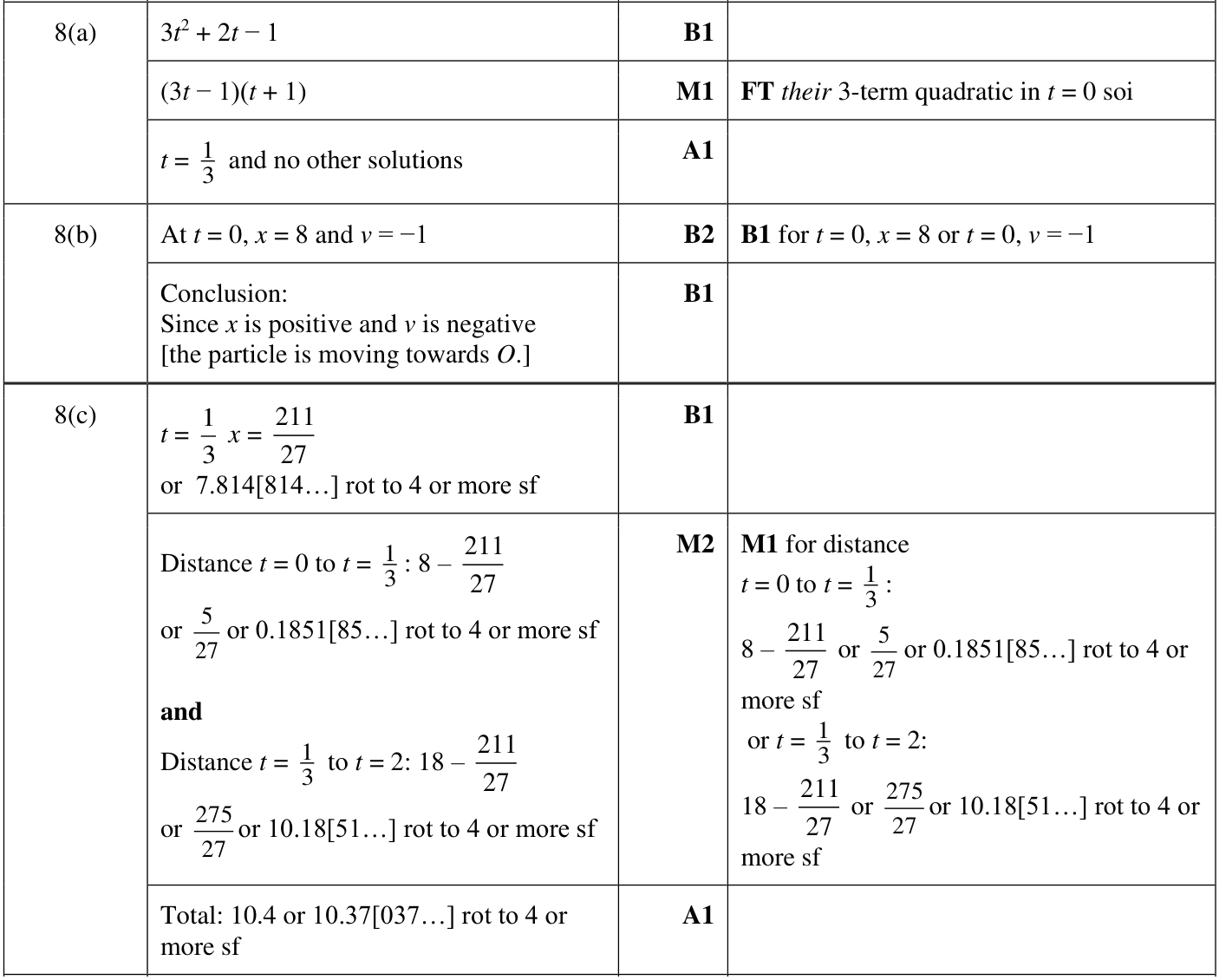
A particle moves in a straight line so that its displacement from a fixed point \(O\) at time \(t\) seconds is \(x\) metres, where \(x=t^{3}+t^{2}-t+8\) and \(t \geqslant 0\). (a) Find the time when the particle changes direction.
(b) Show that the particle is moving towards \(O\) when \(t=0\). (c) Find the total distance travelled by the particle during the first 2 seconds of its motion.
0606 P22 - Nov 2024 - Q9 - 6 marks
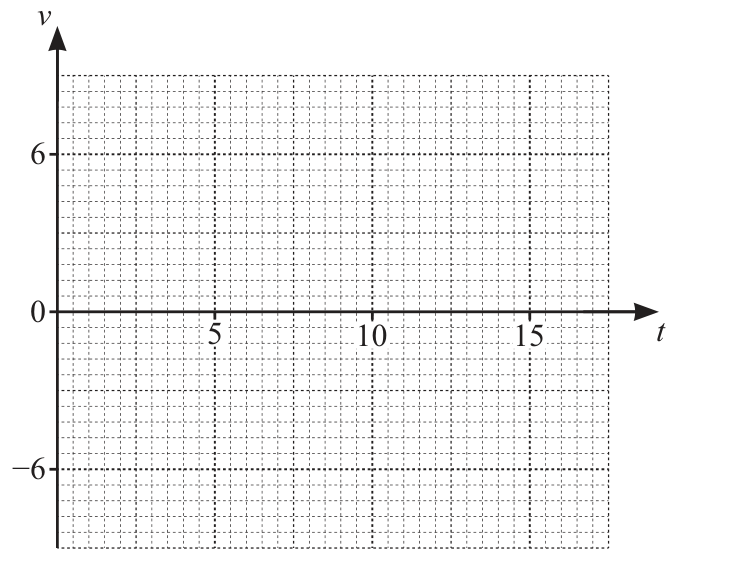
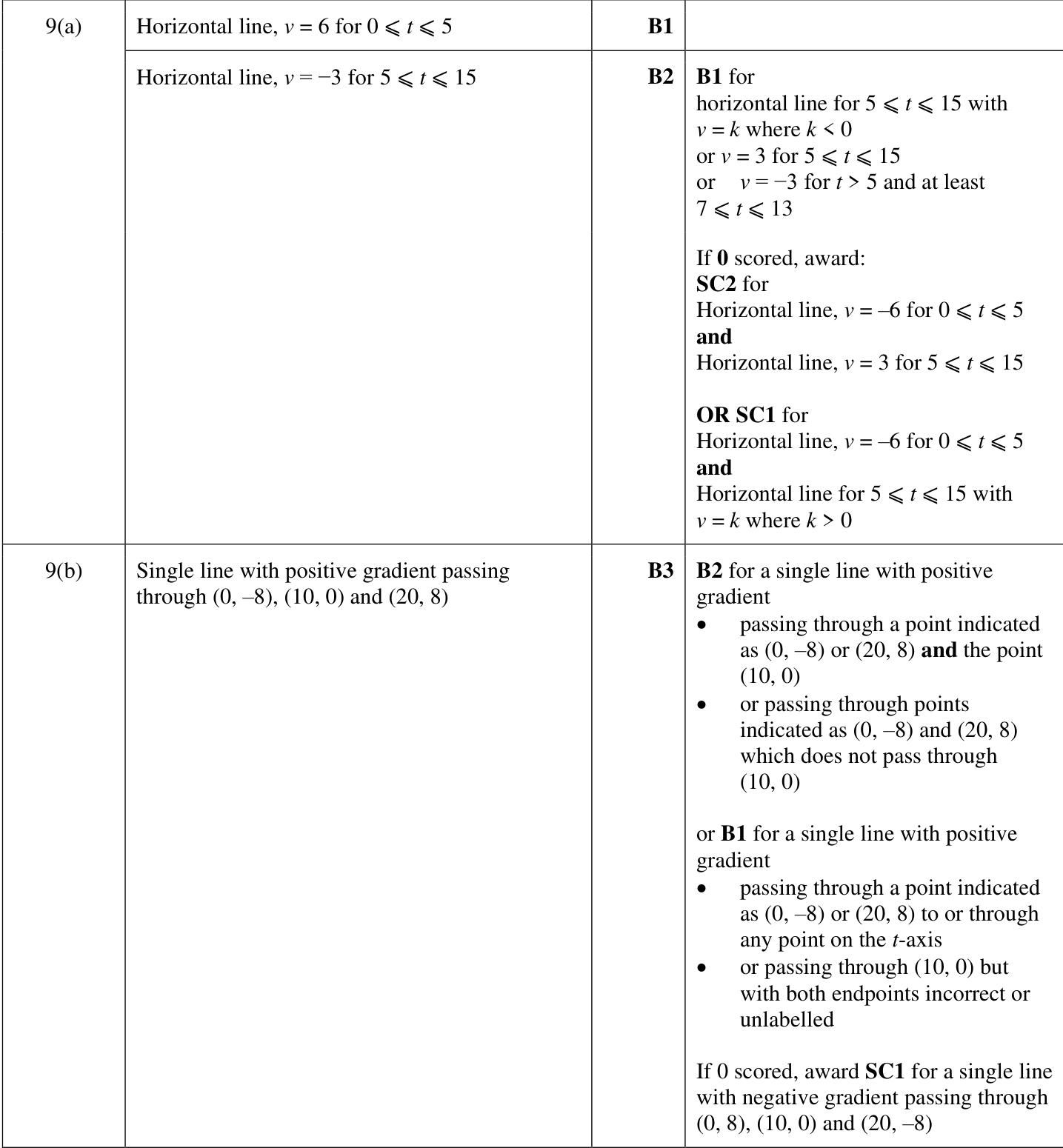
In this question time is measured in seconds. (a) A particle is moving in a straight line with constant velocity of \(6 \mathrm{~ms}^{-1}\). At time \(t=0\), it passes a fixed point \(A\). At time \(t=5\) it suddenly changes direction and moves with a different constant velocity along the same straight line. It passes the point \(A\) again at time \(t=15\). Sketch the velocity-time graph for the motion.
(b) Another particle is moving in a straight line with constant acceleration. At time \(t=0\) it passes a fixed point \(B\) with velocity \(-8 \mathrm{~ms}^{-1}\). It passes the point \(B\) again at time \(t=20\). Sketch the velocity-time graph for the motion.
0606 P12 - Mar 2024 - Q6 - 9 marks
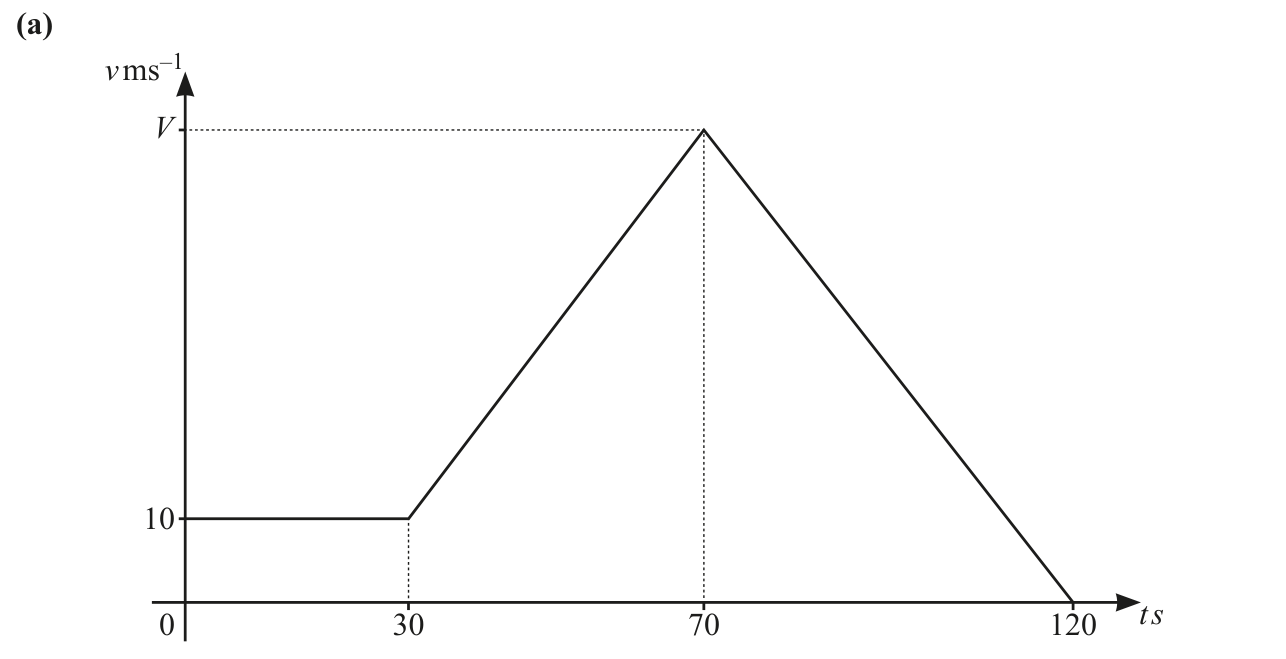
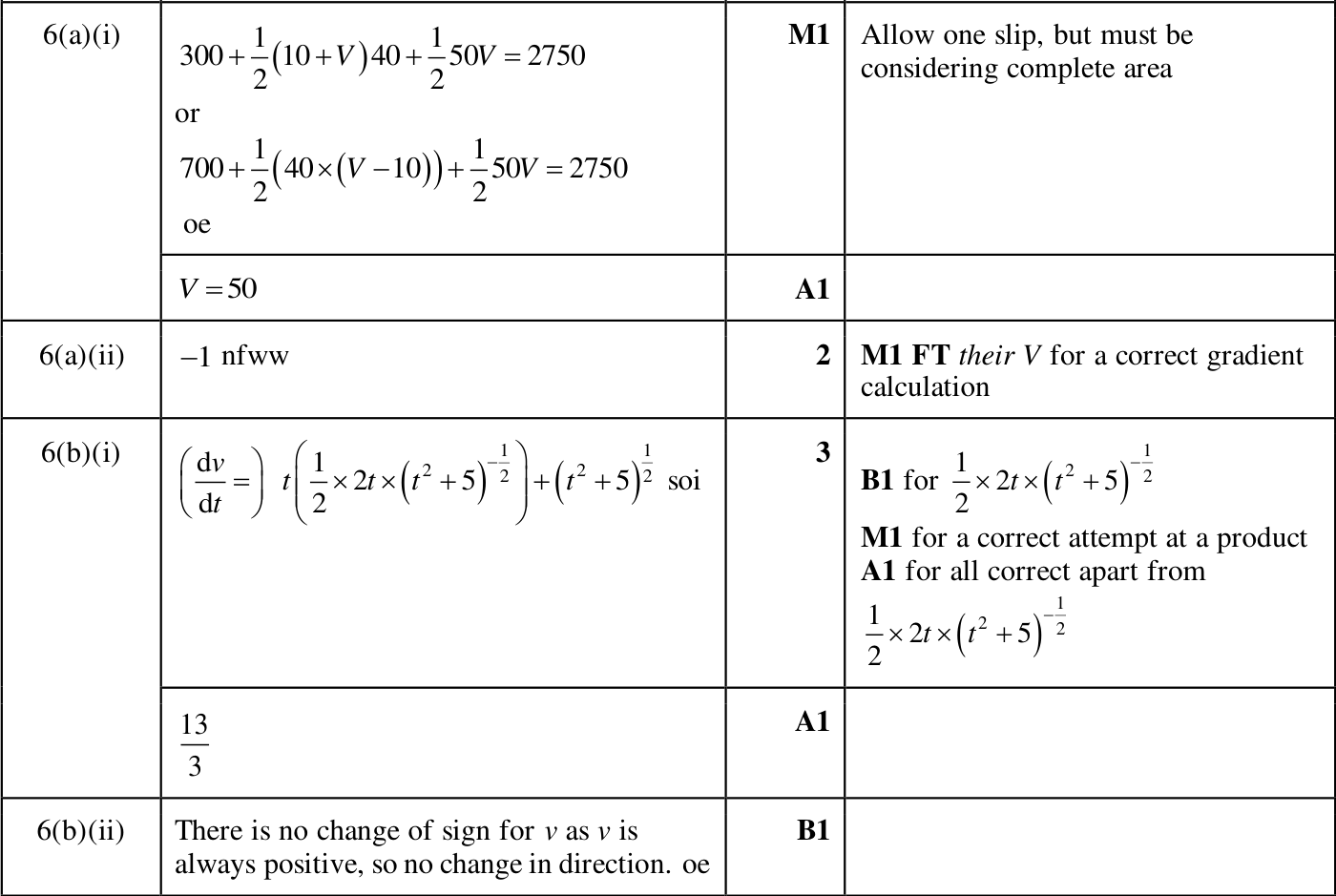
In this question all distances are in metres and all times are in seconds. (a) (i) The diagram shows the velocity-time ( \(v-t\) ) graph of a particle travelling in a straight line. The particle travels a distance of 2750 m in 120 s . Find the velocity, \(V\), of the particle when \(t=70\). (ii) Find the acceleration of the particle for \(70\lt t\lt 120\). (b) A different particle moves in a straight line such that its velocity, \(v \mathrm{~ms}^{-1}, t\) seconds after leaving a fixed point \(O\), is given by \(\quad v=t\left(t^{2}+5\right)^{\frac{1}{2}}\). (i) Find the exact acceleration of the particle when \(t=2\). (ii) Explain why the particle does not change direction for \(t\gt 0\).
0606 P13 - Jun 2024 - Q9 - 10 marks
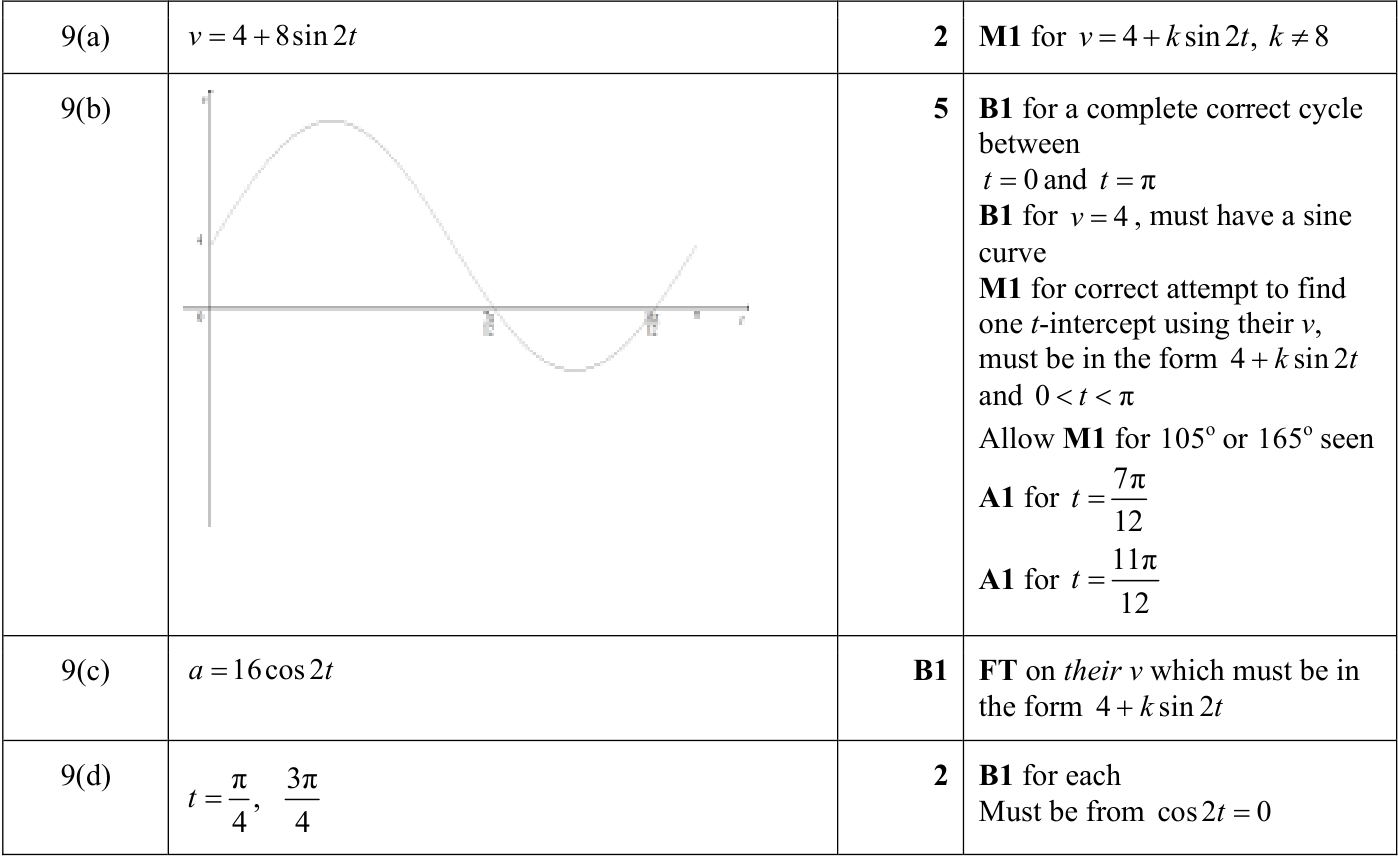
In this question, all lengths are in metres, and time, \(t\), is in seconds. A particle \(P\) moves in a straight line such that, \(t\) seconds after leaving a fixed point \(O\), its displacement, \(s\), is given by \(s=4 t-4 \cos 2 t+4\). (a) Find the velocity, \(v\), of \(P\) at time \(t\).
(b) On the axes, sketch the velocity-time graph for \(P\) for \(0 \leqslant t \leqslant \pi\), stating the intercepts with the axes in exact form.
(c) Find the acceleration of \(P\) at time \(t\).
(d) Find the times when the acceleration of \(P\) is zero for \(0 \leqslant t \leqslant \pi\). Give your answers in terms of \(\pi\).
0606 P23 - Nov 2023 - Q6 - 9 marks
A particle travels in a straight line. Its displacement, \(s\) metres, from the origin, at time \(t\) seconds, where \(t\gt2\), is given by
\(s=\ln(4t^2-5)-t.\)
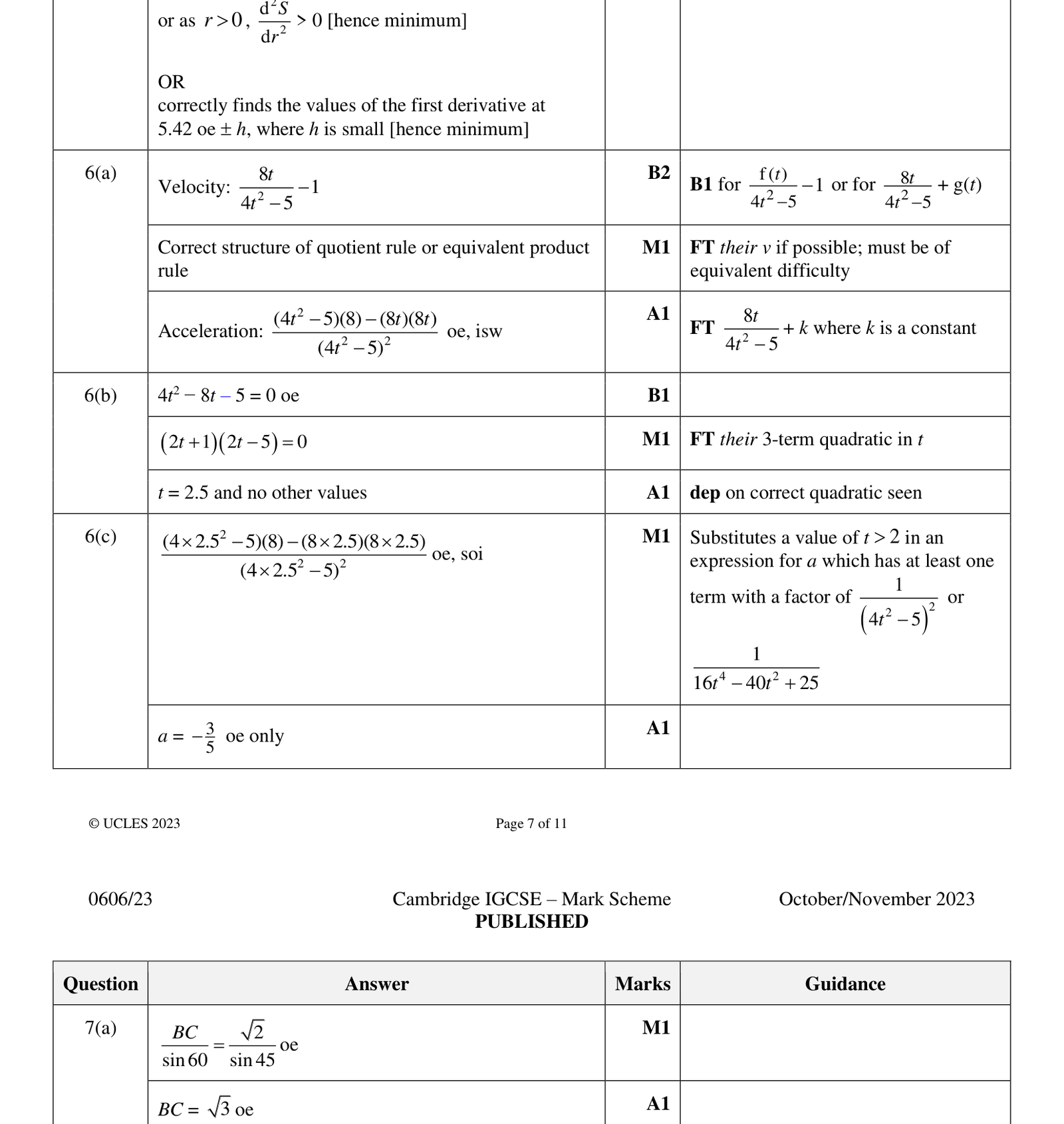
(a) Find an expression for the velocity, \(v\), and show that the acceleration, \(a\), is given by
\(a=-\frac{8(4t^2+5)}{(4t^2-5)^2}.\)
(b) Find the exact value of \(t\) when the particle is at rest.
(c) Find the exact value of the acceleration when the particle is at rest.
0606 P22 - Nov 2023 - Q7 - 9 marks
A particle is travelling in a straight line. Its displacement, \(s\) metres, from the origin at time \(t\) seconds is given by
\(s=1.5\mathrm e^{2t}+2\mathrm e^{-2t}-t.\)
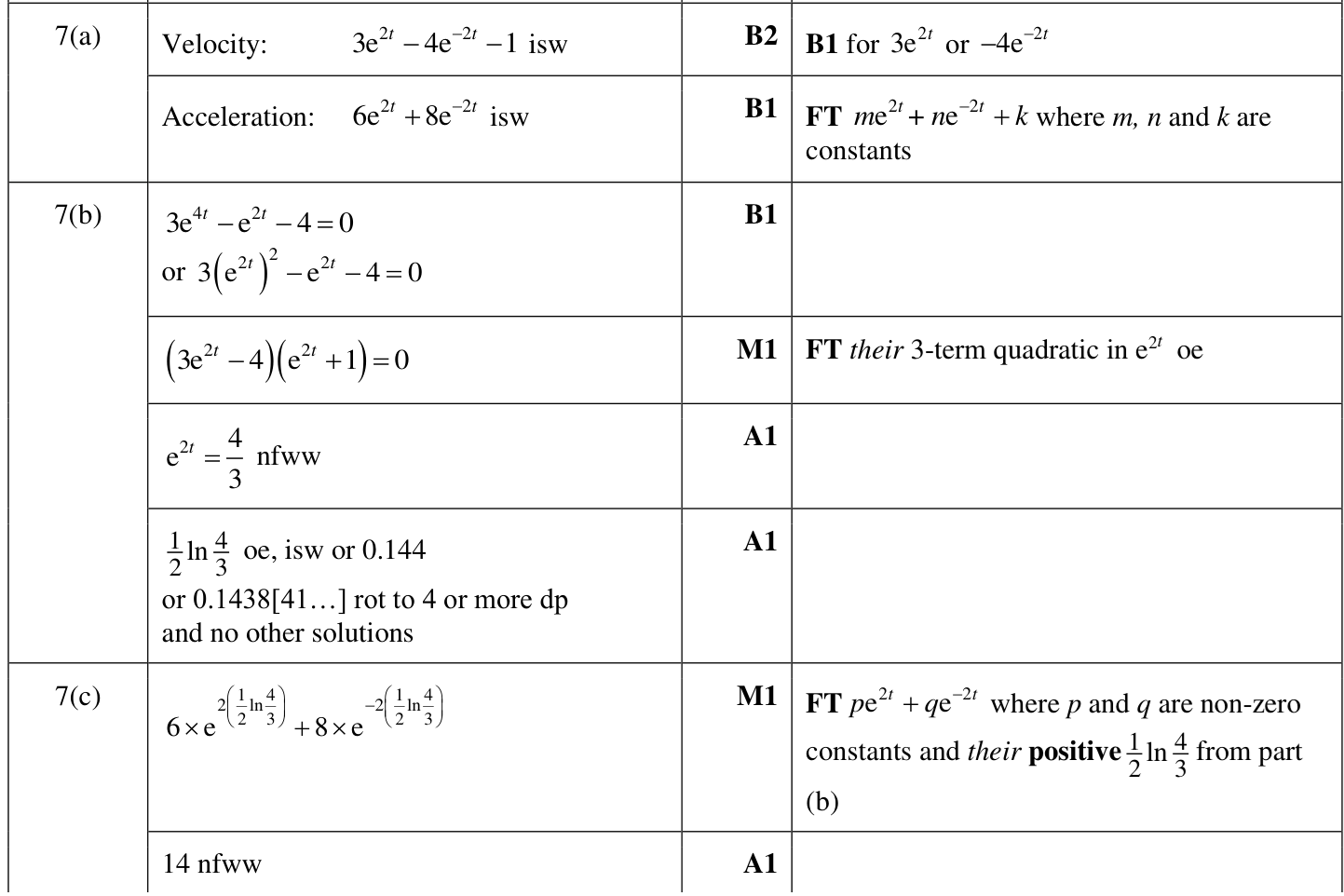
(a) Find expressions for the velocity, \(v\text{ m s}^{-1}\), and acceleration, \(a\text{ m s}^{-2}\), of the particle.
(b) Find the time, \(T\) seconds, when the particle is at rest.
(c) Find the acceleration of the particle at time \(T\) seconds.
0606 P13 - Jun 2023 - Q9 - 12 marks
In this question lengths are in centimetres and time is in seconds.
A particle \(P\) moves in a straight line such that its displacement \(s\), from a fixed point at a time \(t\), is given by
\(s=3(t+2)(t-4)^2\)
for \(0\leq t\leq5\).
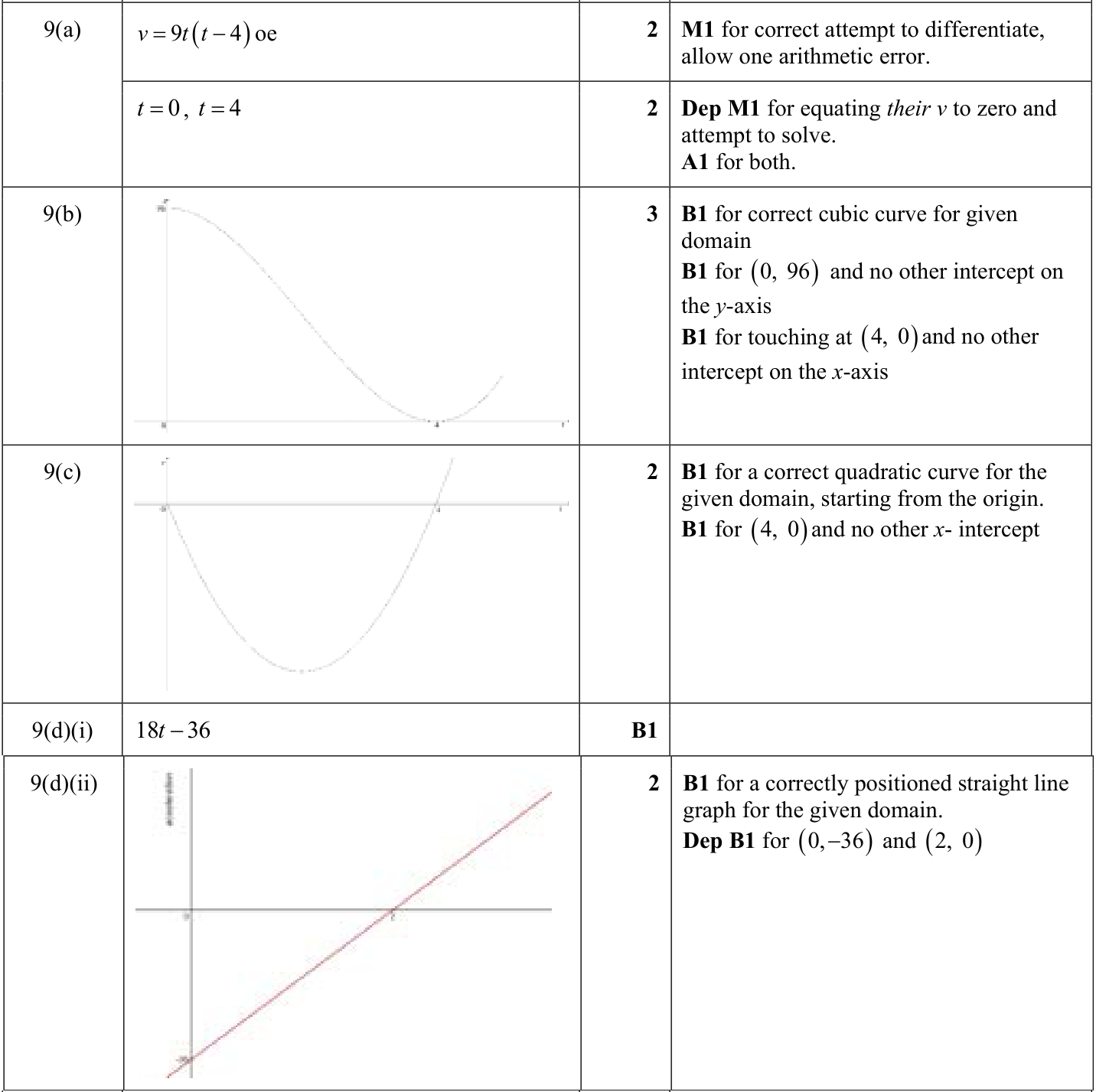
(a) Find the values of \(t\) for which the velocity, \(v\), of \(P\) is zero.
(b) Sketch the displacement-time graph of \(P\), stating the intercepts with the axes.
(c) Sketch the velocity-time graph of \(P\), stating the intercepts with the axes.
(d)(i) Find an expression for the acceleration of \(P\) at time \(t\).
(d)(ii) Hence sketch the acceleration-time graph of \(P\), stating the intercepts with the axes.
0606 P11 - Jun 2022 - Q2 - 5 marks
A particle moves in a straight line such that its displacement, \(s\) metres, from a fixed point, at time \(t\) seconds, \(t\ge0\), is given by \(s=(1+3t)^{-1/2}\).
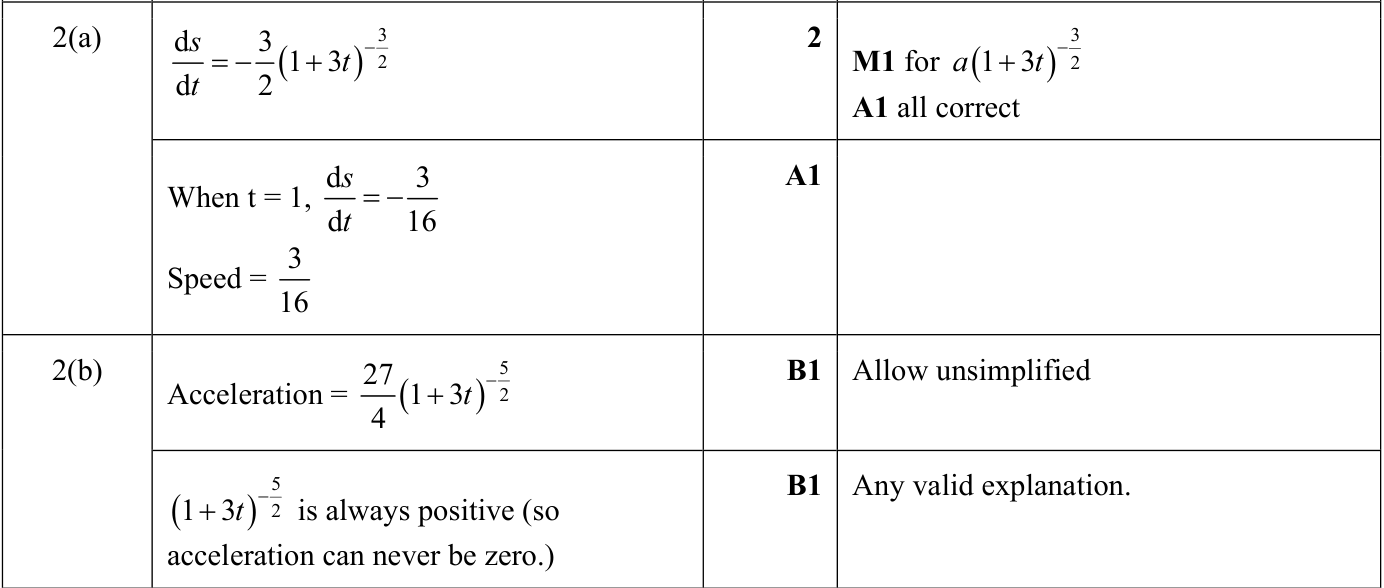
(a) Find the exact speed of the particle when \(t=1\).
(b) Show that the acceleration of the particle will never be zero.
0606 P12 - Jun 2022 - Q11 - 11 marks
In this question all lengths are in kilometres and time is in hours.
A particle \(P\) moves in a straight line such that its displacement, \(s\), from a fixed point at time \(t\) is given by
\(s=(t+2)(t-5)^2,\qquad t\ge0.\)
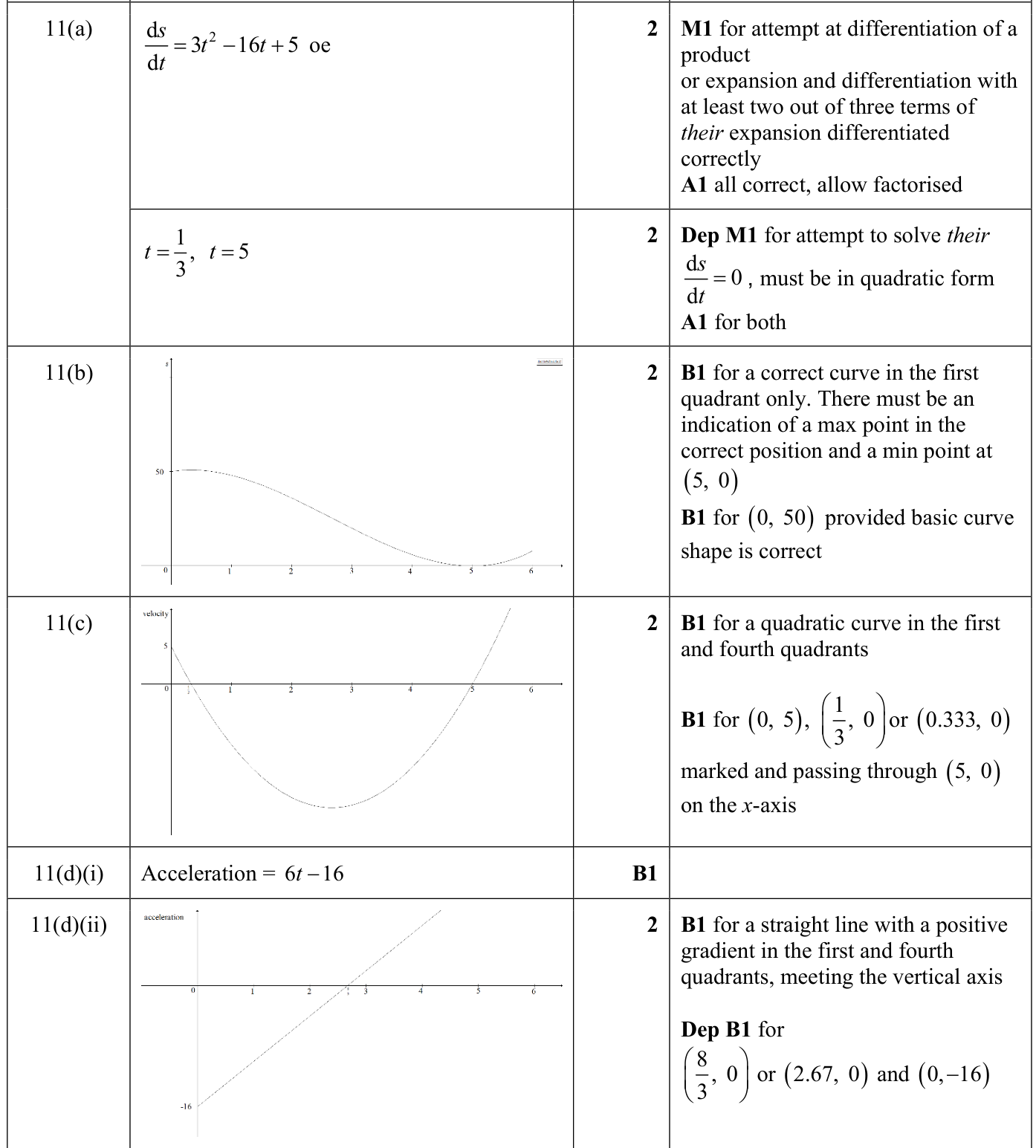
(a) Find the values of \(t\) for which the velocity of \(P\) is zero.
(b) On the axes, draw the displacement-time graph for \(P\) for \(0\le t\le6\), stating the coordinates of the points where the graph meets the coordinate axes.
(c) On the axes, draw the velocity-time graph for \(P\) for \(0\le t\le6\), stating the coordinates of the points where the graph meets the coordinate axes.
(d)(i) Write down an expression for the acceleration of \(P\) at time \(t\).
(ii) Hence draw the acceleration-time graph for \(P\) for \(0\le t\le6\), stating the coordinates of the points where the graph meets the coordinate axes.
0606 P12 - Nov 2022 - Q11 - 6 marks
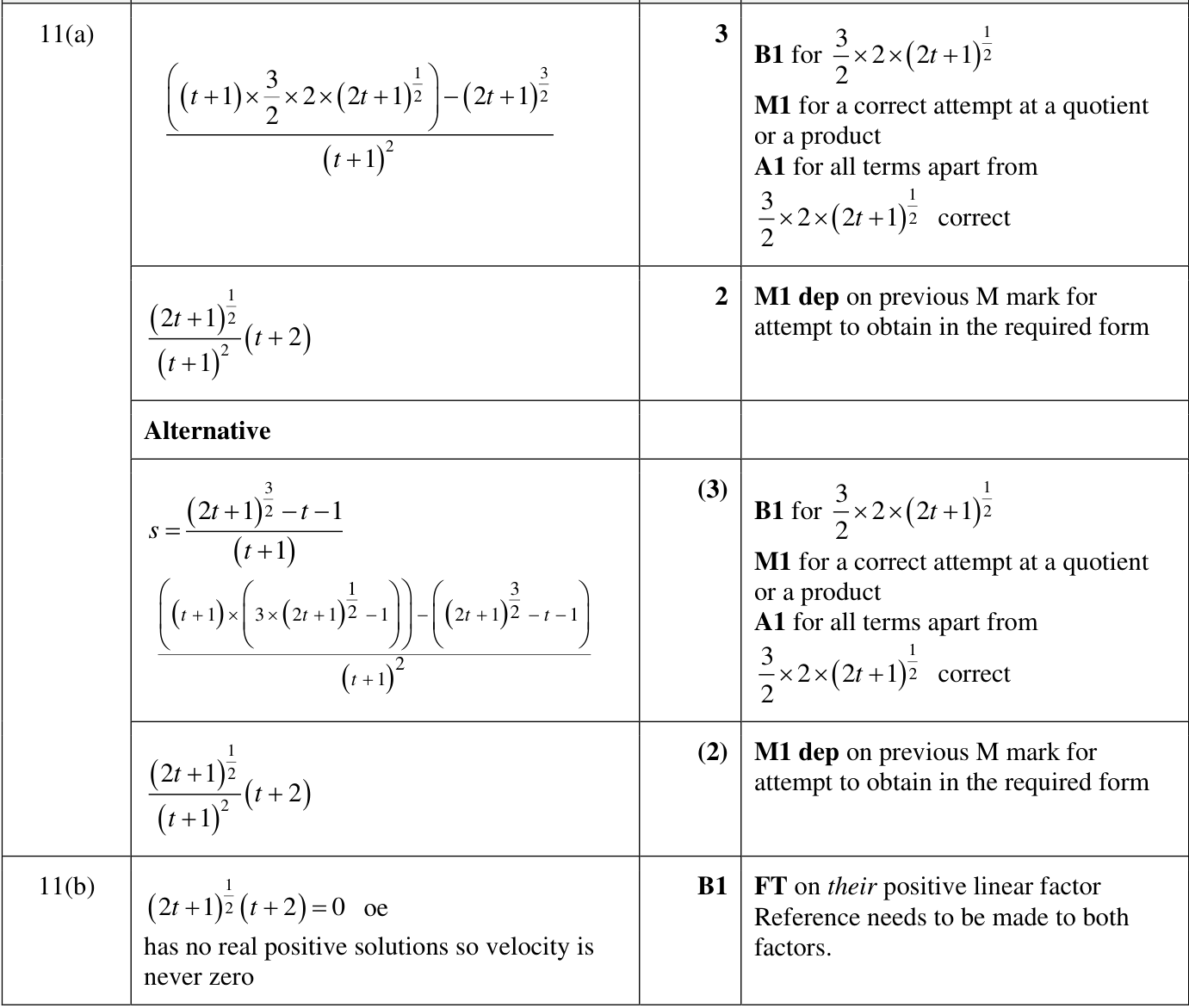
A particle \(P\) moves in a straight line such that, \(t\) seconds after passing through a fixed point \(O\), its displacement, \(s\) metres, is given by
\(s=\frac{(2t+1)^{3/2}}{t+1}-1.\)
(a) Show that the velocity of \(P\) at time \(t\) can be written in the form
\(\frac{(2t+1)^{1/2}}{(t+1)^2}(a+bt),\)
where \(a\) and \(b\) are integers to be found.
(b) Show that \(P\) is never at instantaneous rest after passing through \(O\).
0606 P13 - Nov 2021 - Q2 - 2 marks
A particle moves in a straight line such that its velocity, \(v\text{ ms}^{-1}\), at time \(t\) seconds after passing through a fixed point \(O\), is given by \(v=e^{3t}-25\). Find the speed of the particle when \(t=1\).

0606 P13 - Nov 2020 - Q4 - 7 marks
The diagram shows the \(x\)-\(t\) graph for a runner, where displacement \(x\) is measured in metres and time \(t\) is measured in seconds.
(a)(i) On the axes below, draw the \(v\)-\(t\) graph for the runner.
(a)(ii) Find the total distance covered by the runner in \(125\) s.
(b) The displacement \(x\) m of a particle from a fixed point at time \(t\) s is given by
\(x=6\cos\left(3t+\frac{\pi}{3}\right).\)
Find the acceleration of the particle when \(t=\dfrac{2\pi}{3}\).


0606 P21 - Nov 2020 - Q9 - 8 marks
A particle moves in a straight line. Its displacement, \(s\) metres, from a fixed point at time \(t\) seconds is given by
\(s=e^{2t}-10e^t-12t+9.\)
(a) Find expressions for the velocity and acceleration of the particle at time \(t\).
(b) Find the time at which the particle is instantaneously at rest.
(c) Find the acceleration of the particle at this time.

0606 P23 - Jun 2019 - Q11 - 8 marks
A particle travelling in a straight line passes through a fixed point \(O\). The displacement, \(x\) metres, of the particle, \(t\) seconds after it passes through \(O\), is given by \(x=5t+\sin t\).
(i) Show that the particle is never at rest.
(ii) Find the distance travelled by the particle between \(t=\dfrac{\pi}{3}\) and \(t=\dfrac{\pi}{2}\).
(iii) Find the acceleration of the particle when \(t=4\).
(iv) Find the value of \(t\) when the velocity of the particle is first at its minimum.

0606 P21 - Nov 2019 - Q5 - 8 marks
A particle is moving in a straight line such that \(t\) seconds after passing a fixed point \(O\) its displacement, \(s\) m, is given by
\(s=3\sin2t+4\cos2t-4.\)
(i) Find expressions for the velocity and acceleration of the particle at time \(t\).
(ii) Find the first time when the particle is instantaneously at rest.
(iii) Find the acceleration of the particle at the time found in part (ii).

0606 P12 - Jun 2018 - Q4 - 7 marks
A particle \(P\) moves so that its displacement, \(x\) metres from a fixed point \(O\), at time \(t\) seconds, is given by
\(x=\ln(5t+3).\)
(i) Find the value of \(t\) when the displacement of \(P\) is \(3\text{ m}\).
(ii) Find the velocity of \(P\) when \(t=0\).
(iii) Explain why, after passing through \(O\), the velocity of \(P\) is never negative.
(iv) Find the acceleration of \(P\) when \(t=0\).

0606 P21 - Jun 2018 - Q10 - 7 marks
A particle moves in a straight line such that its displacement, \(s\) metres, from a fixed point \(O\) at time \(t\) seconds, is given by
\(s=4+\cos3t,\qquad t\geq0.\)
The particle is initially at rest.
(i) Find the exact value of \(t\) when the particle is next at rest.
(ii) Find the distance travelled by the particle between \(t=\dfrac{\pi}{4}\) and \(t=\dfrac{\pi}{2}\) seconds.
(iii) Find the greatest acceleration of the particle.
0606 P23 - Jun 2018 - Q10 - 7 marks
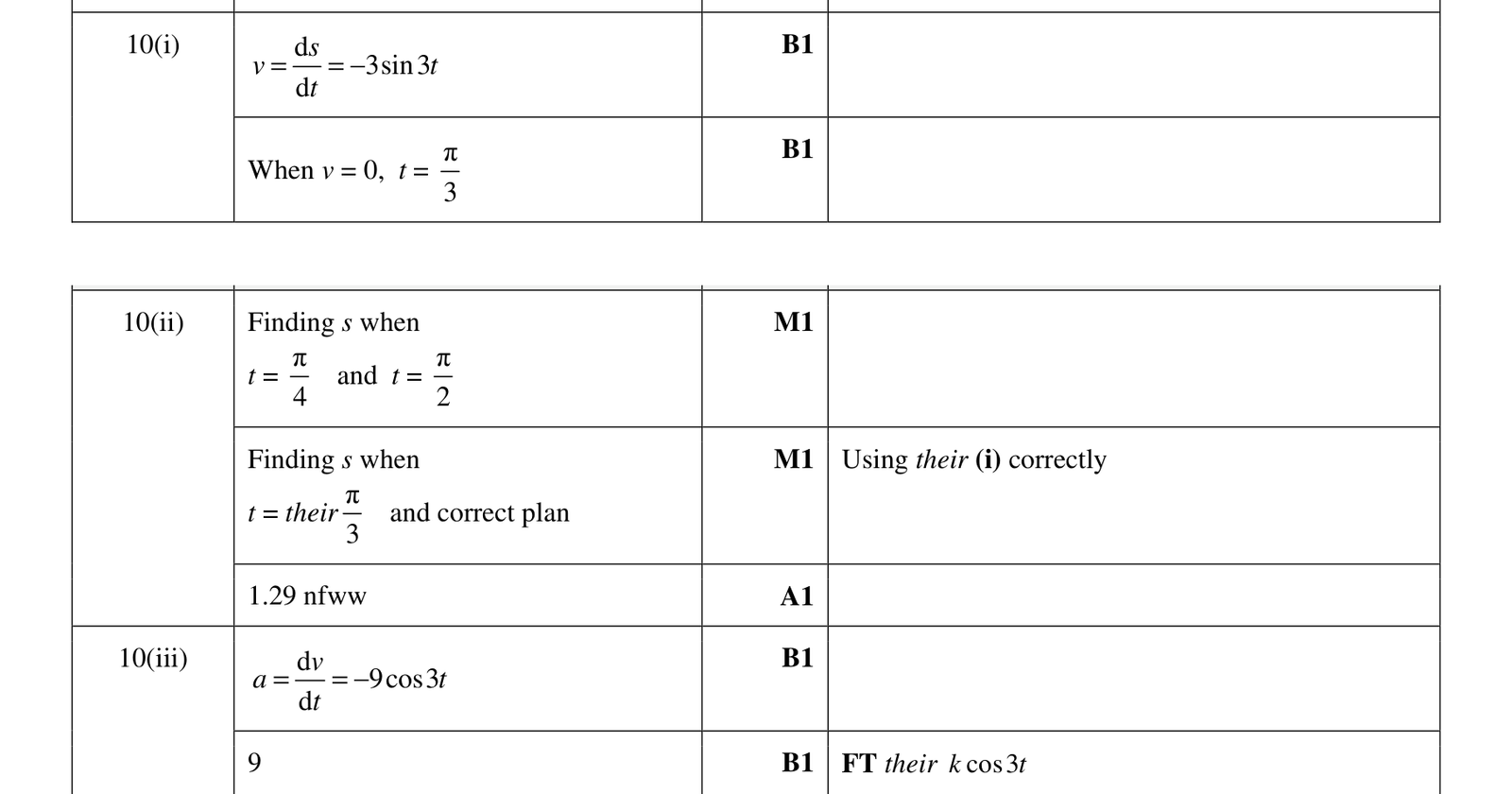
A particle moves in a straight line such that its displacement, \(s\) metres, from a fixed point \(O\) at time \(t\) seconds, is given by
\(s=4+\cos3t,\qquad t\geq0.\)
The particle is initially at rest.
(i) Find the exact value of \(t\) when the particle is next at rest.
(ii) Find the distance travelled by the particle between \(t=\dfrac{\pi}{4}\) and \(t=\dfrac{\pi}{2}\) seconds.
(iii) Find the greatest acceleration of the particle.

0606 P13 - Nov 2018 - Q6 - 9 marks
A particle \(P\) is moving in a straight line such that its displacement, \(s\text{ m}\), from a fixed point \(O\) at time \(t\text{ s}\), is given by \(s=12e^{-0.5t}+4t-12\).
(i) Find the value of \(t\) when \(P\) is instantaneously at rest.
(ii) Find an expression for the acceleration of \(P\) at time \(t\text{ s}\).
(iii) Find the value of \(s\) when the acceleration of \(P\) is \(0.3\text{ m s}^{-2}\).
(iv) Explain why the acceleration of the particle will always be positive.

0606 P12 - Jun 2017 - Q5 - 6 marks
A particle \(P\) moves in a straight line, such that its displacement, \(x\) m, from a fixed point \(O\), \(t\) s after passing \(O\), is given by
\(x=4\cos(3t)-4.\)
(i) Find the velocity of \(P\) at time \(t\).
(ii) Hence write down the maximum speed of \(P\).
(iii) Find the smallest value of \(t\) for which the acceleration of \(P\) is zero.
(iv) For the value of \(t\) found in part (iii), find the distance of \(P\) from \(O\).