0606 P12 - Nov 2018 - Q8 - 8 marks
8498
\(A=\begin{pmatrix}a&3\\4&a+4\end{pmatrix}.\)
(i) Find the values of the constant \(a\) for which \(A^{-1}\) does not exist.
(ii) Given that \(a=4\), find \(A^{-1}\).
(iii) Hence find the matrix \(B\) such that \(AB=\begin{pmatrix}2&3\\4&-5\end{pmatrix}\).
Solution
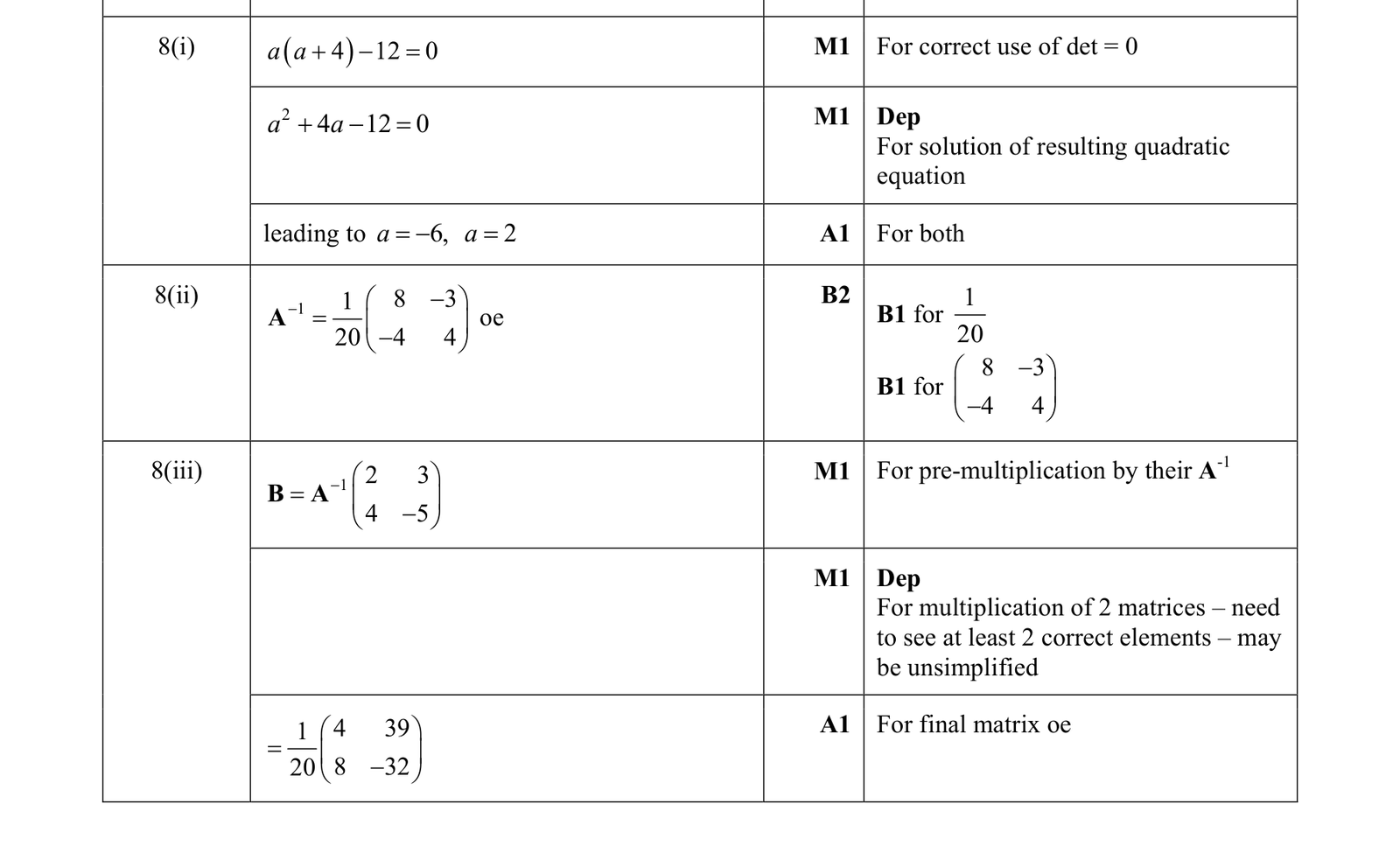
Answer: \(a=-6\) or \(a=2\); \(A^{-1}=\dfrac1{20}\begin{pmatrix}8&-3\\-4&4\end{pmatrix}\); \(B=\dfrac1{20}\begin{pmatrix}4&39\\8&-32\end{pmatrix}\).
The inverse does not exist when the determinant is zero:
\(\det A=a(a+4)-12.\)
So
\(a^2+4a-12=0.\)
Factorising,
\((a+6)(a-2)=0.\)
Hence \(A^{-1}\) does not exist when
\(a=-6\quad\text{or}\quad a=2.\)
When \(a=4\),
\(A=\begin{pmatrix}4&3\\4&8\end{pmatrix}.\)
The determinant is \(4(8)-3(4)=20\), so
\(A^{-1}=\frac1{20}\begin{pmatrix}8&-3\\-4&4\end{pmatrix}.\)
Since \(AB=\begin{pmatrix}2&3\\4&-5\end{pmatrix}\),
\(B=A^{-1}\begin{pmatrix}2&3\\4&-5\end{pmatrix}.\)
Therefore
\(B=\frac1{20} \begin{pmatrix}8&-3\\-4&4\end{pmatrix} \begin{pmatrix}2&3\\4&-5\end{pmatrix} =\frac1{20}\begin{pmatrix}4&39\\8&-32\end{pmatrix}.\)