0606 P23 - Nov 2018 - Q5 - 7 marks
8541
Given that
\(A=\begin{pmatrix}2&3\\1&4\end{pmatrix} \quad\text{and}\quad B=\begin{pmatrix}1&4\\-2&5\end{pmatrix},\)
find
(i) \(A^{-1}\),
(ii) the matrix \(C\) such that \(CA=B\),
(iii) the matrix \(D\) such that \(A^{-1}D+B=I\).
Solution
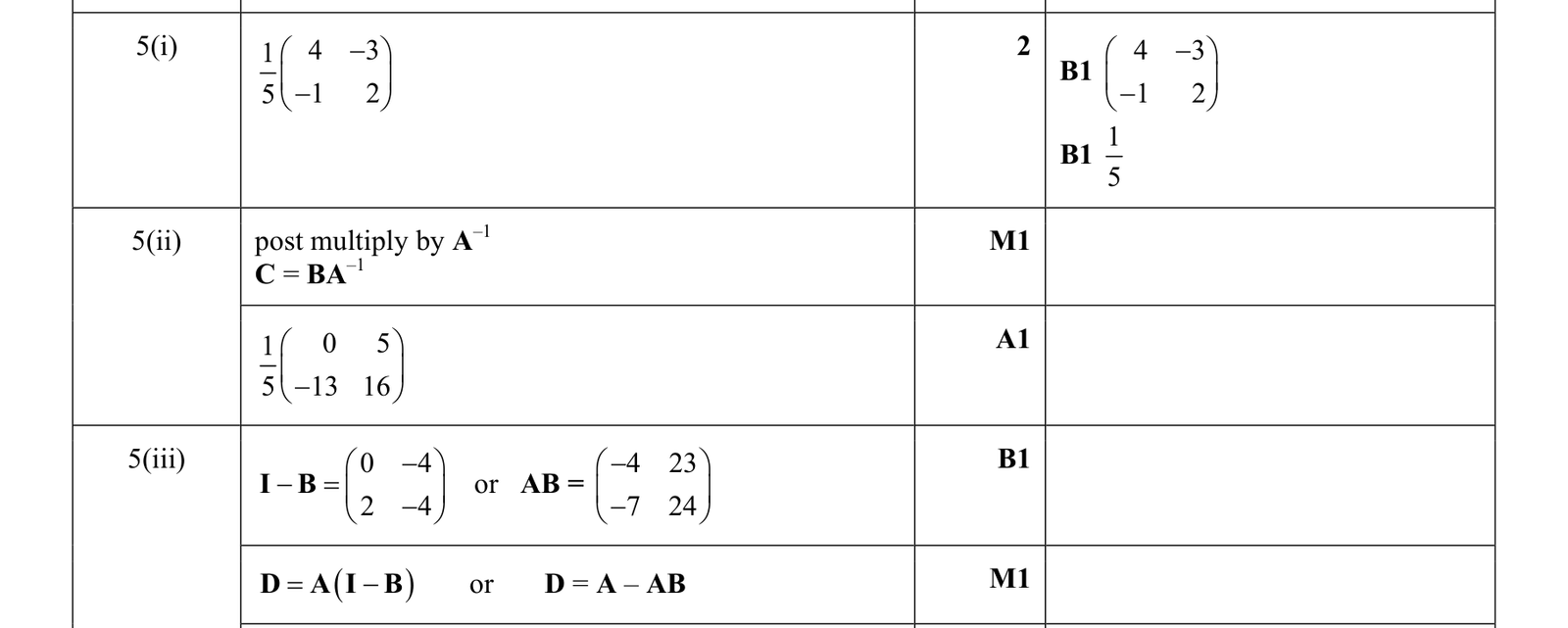
Answer: (i) \(A^{-1}=\dfrac15\begin{pmatrix}4&-3\\-1&2\end{pmatrix}\). (ii) \(C=\dfrac15\begin{pmatrix}0&5\\-13&16\end{pmatrix}\). (iii) \(D=\begin{pmatrix}6&-20\\8&-20\end{pmatrix}\).
(i) For
\(A=\begin{pmatrix}2&3\\1&4\end{pmatrix},\)
the determinant is
\(2\cdot4-3\cdot1=5.\)
Hence
\(A^{-1} = \frac15 \begin{pmatrix}4&-3\\-1&2\end{pmatrix}.\)
(ii) Since \(CA=B\), post-multiply by \(A^{-1}\):
\(C=BA^{-1}.\)
So
\(C= \begin{pmatrix}1&4\\-2&5\end{pmatrix} \frac15 \begin{pmatrix}4&-3\\-1&2\end{pmatrix}.\)
Multiplying gives
\(C=\frac15 \begin{pmatrix} 4-4&-3+8\\ -8-5&6+10 \end{pmatrix} = \frac15 \begin{pmatrix}0&5\\-13&16\end{pmatrix}.\)
(iii) From
\(A^{-1}D+B=I,\)
we have
\(A^{-1}D=I-B.\)
Multiplying by \(A\) gives
\(D=A(I-B).\)
Now
\(I-B= \begin{pmatrix}1&0\\0&1\end{pmatrix} - \begin{pmatrix}1&4\\-2&5\end{pmatrix} = \begin{pmatrix}0&-4\\2&-4\end{pmatrix}.\)
Therefore
\(D= \begin{pmatrix}2&3\\1&4\end{pmatrix} \begin{pmatrix}0&-4\\2&-4\end{pmatrix} = \begin{pmatrix}6&-20\\8&-20\end{pmatrix}.\)