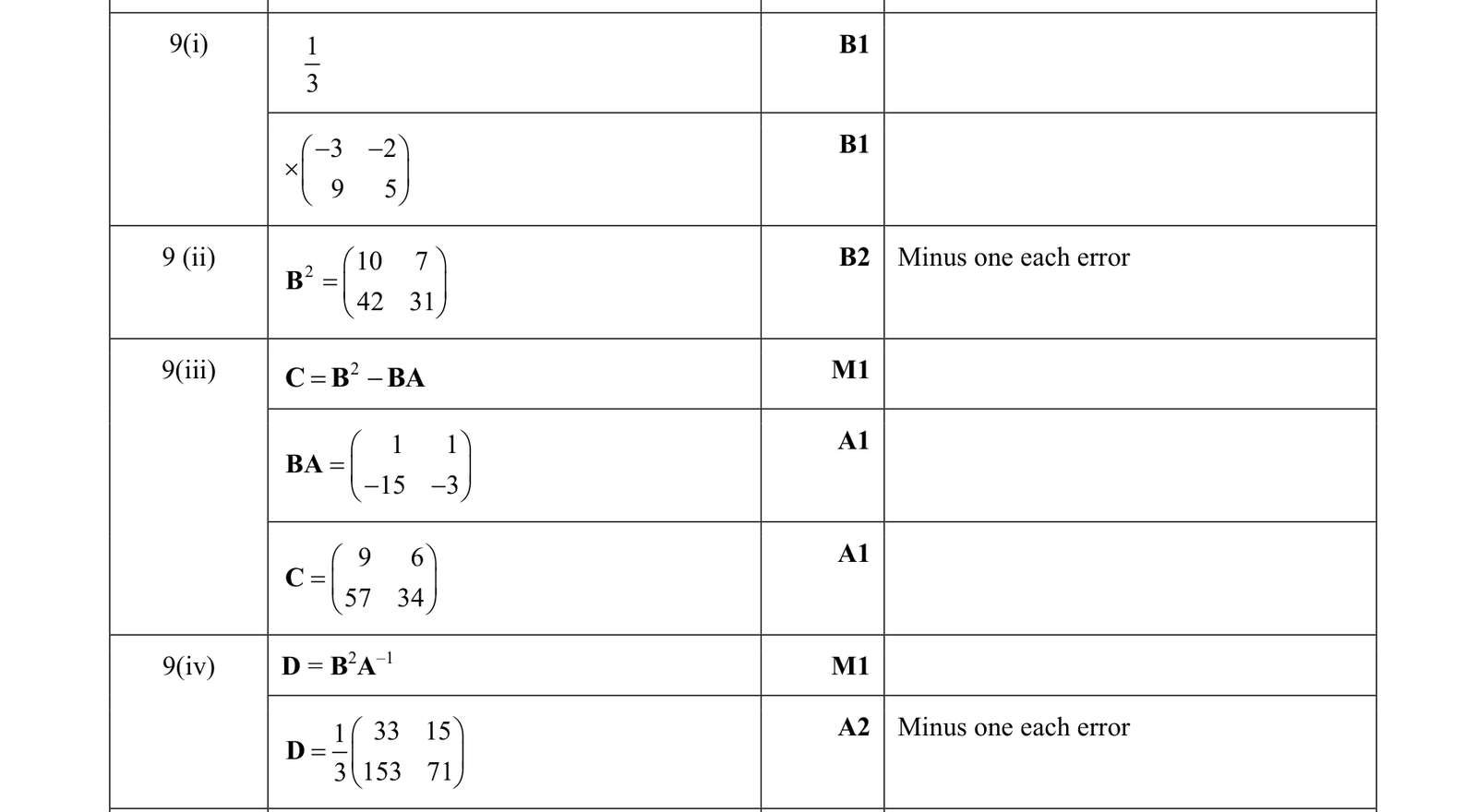
Answer: \(A^{-1}=\frac13\begin{pmatrix}-3&-2\\9&5\end{pmatrix}\), \(B^2=\begin{pmatrix}10&7\\42&31\end{pmatrix}\), \(C=\begin{pmatrix}9&6\\57&34\end{pmatrix}\), \(D=\frac13\begin{pmatrix}33&15\\153&71\end{pmatrix}\).
The determinant of \(A\) is
\(5(-3)-2(-9)=-15+18=3.\)
Therefore
\(A^{-1}=\frac13\begin{pmatrix}-3&-2\\9&5\end{pmatrix}.\)
Next,
\(B^2=\begin{pmatrix}2&1\\6&5\end{pmatrix}\begin{pmatrix}2&1\\6&5\end{pmatrix} =\begin{pmatrix}10&7\\42&31\end{pmatrix}.\)
For \(C\), start with
\(B^{-1}C+A=B.\)
Then
\(B^{-1}C=B-A.\)
Multiplying by \(B\) gives
\(C=B(B-A)=B^2-BA.\)
Now
\(BA=\begin{pmatrix}2&1\\6&5\end{pmatrix}\begin{pmatrix}5&2\\-9&-3\end{pmatrix} =\begin{pmatrix}1&1\\-15&-3\end{pmatrix}.\)
So
\(C=\begin{pmatrix}10&7\\42&31\end{pmatrix}-\begin{pmatrix}1&1\\-15&-3\end{pmatrix} =\begin{pmatrix}9&6\\57&34\end{pmatrix}.\)
For \(D\),
\(B^{-2}DA=I.\)
Multiplying by \(B^2\) gives
\(DA=B^2.\)
Then multiplying by \(A^{-1}\) gives
\(D=B^2A^{-1}.\)
Thus
\(D=\begin{pmatrix}10&7\\42&31\end{pmatrix}\cdot\frac13\begin{pmatrix}-3&-2\\9&5\end{pmatrix}.\)
Therefore
\(D=\frac13\begin{pmatrix}33&15\\153&71\end{pmatrix}.\)