Past Exam Questions
← Back0606 P22 - Jun 2018 - Q8 - 7 marks
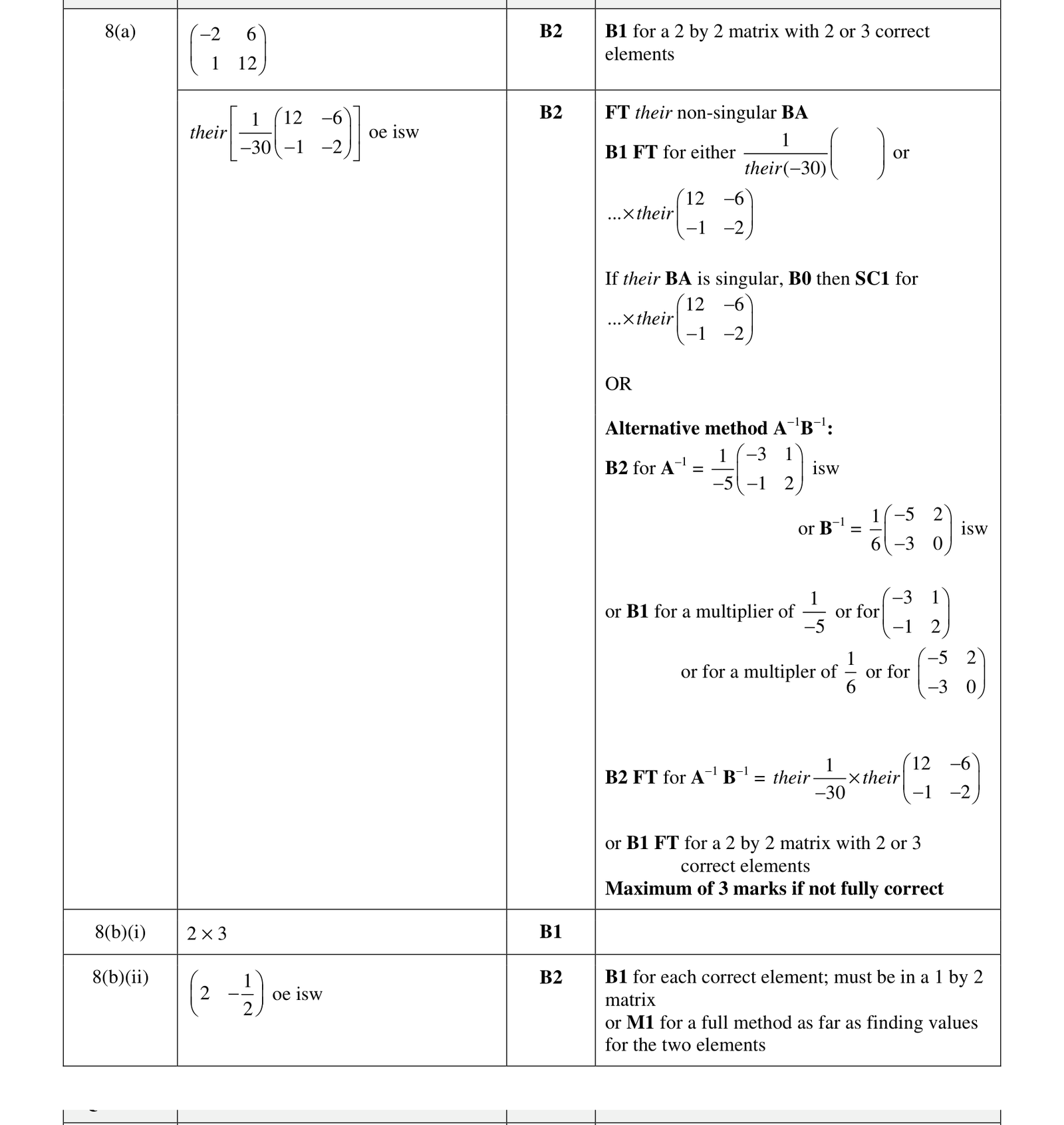
(a) Given
\(A=\begin{pmatrix}2&-1\\1&-3\end{pmatrix}, \qquad B=\begin{pmatrix}0&-2\\3&-5\end{pmatrix},\)
find \((BA)^{-1}\).
(b) The matrix \(X\) is such that \(XC=D\), where
\(C=\begin{pmatrix}-2&5&3\\0&10&4\end{pmatrix}, \qquad D=\begin{pmatrix}-4&5&4\end{pmatrix}.\)
(i) State the order of the matrix \(C\).
(ii) Find the matrix \(X\).
0606 P12 - Nov 2018 - Q8 - 8 marks
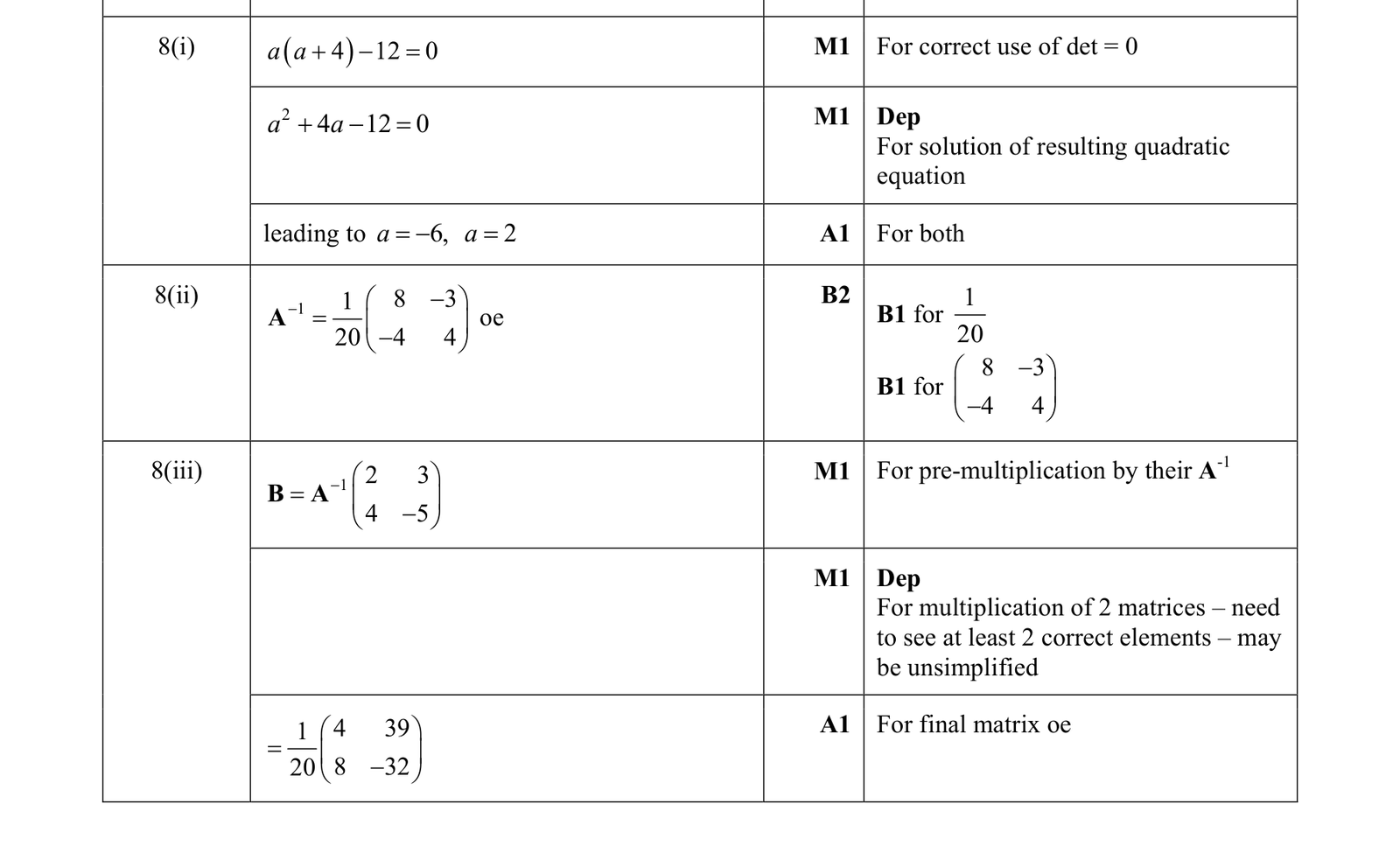
\(A=\begin{pmatrix}a&3\\4&a+4\end{pmatrix}.\)
(i) Find the values of the constant \(a\) for which \(A^{-1}\) does not exist.
(ii) Given that \(a=4\), find \(A^{-1}\).
(iii) Hence find the matrix \(B\) such that \(AB=\begin{pmatrix}2&3\\4&-5\end{pmatrix}\).
0606 P21 - Nov 2018 - Q5 - 6 marks
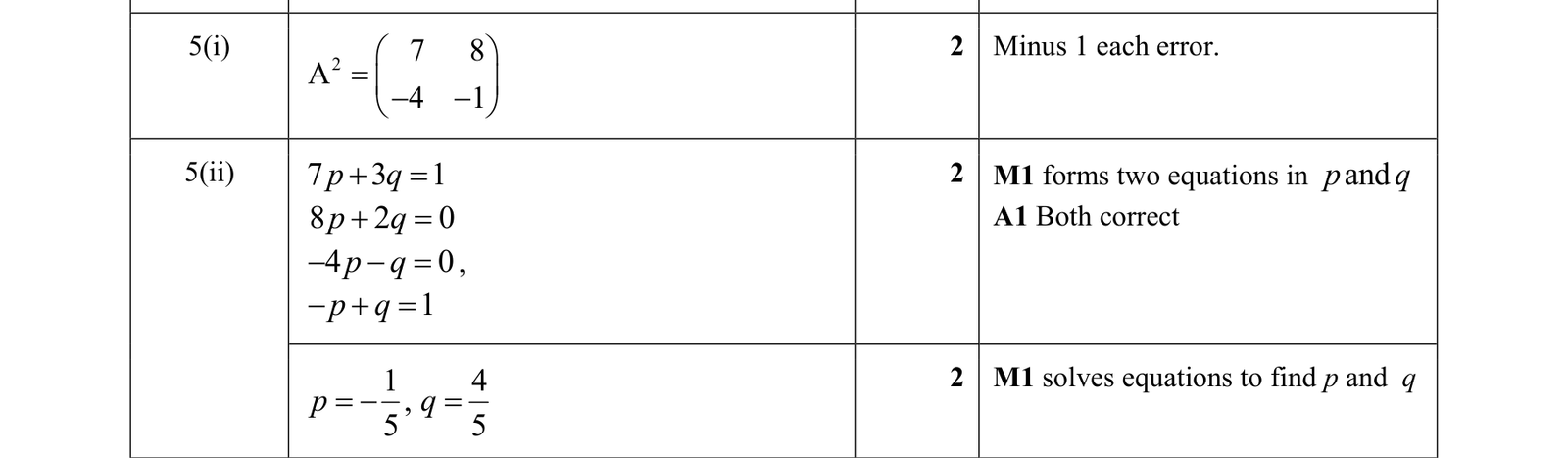
\(A=\begin{pmatrix}3&2\\-1&1\end{pmatrix}.\)
(i) Find \(A^2\).
(ii) Find constants \(p\) and \(q\) such that
\(pA^2+qA=I.\)
0606 P23 - Nov 2018 - Q5 - 7 marks
Given that
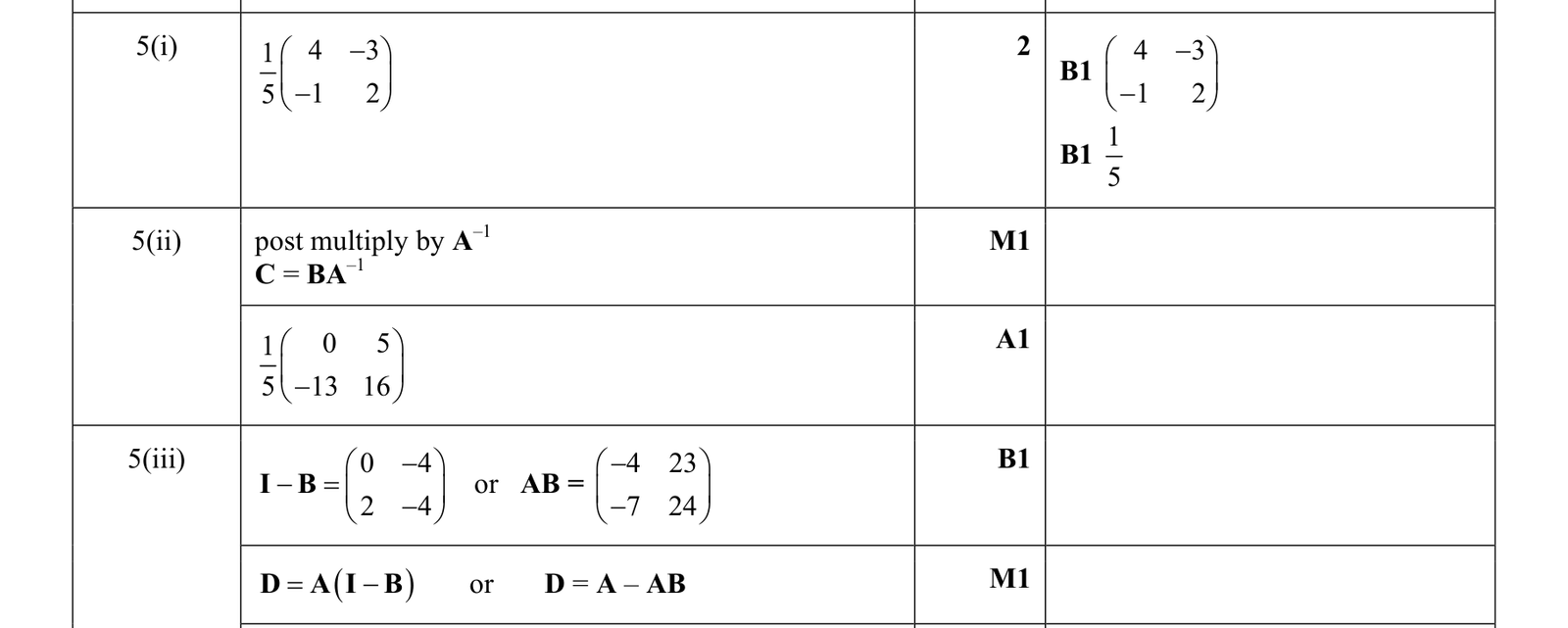
\(A=\begin{pmatrix}2&3\\1&4\end{pmatrix} \quad\text{and}\quad B=\begin{pmatrix}1&4\\-2&5\end{pmatrix},\)
find
(i) \(A^{-1}\),
(ii) the matrix \(C\) such that \(CA=B\),
(iii) the matrix \(D\) such that \(A^{-1}D+B=I\).
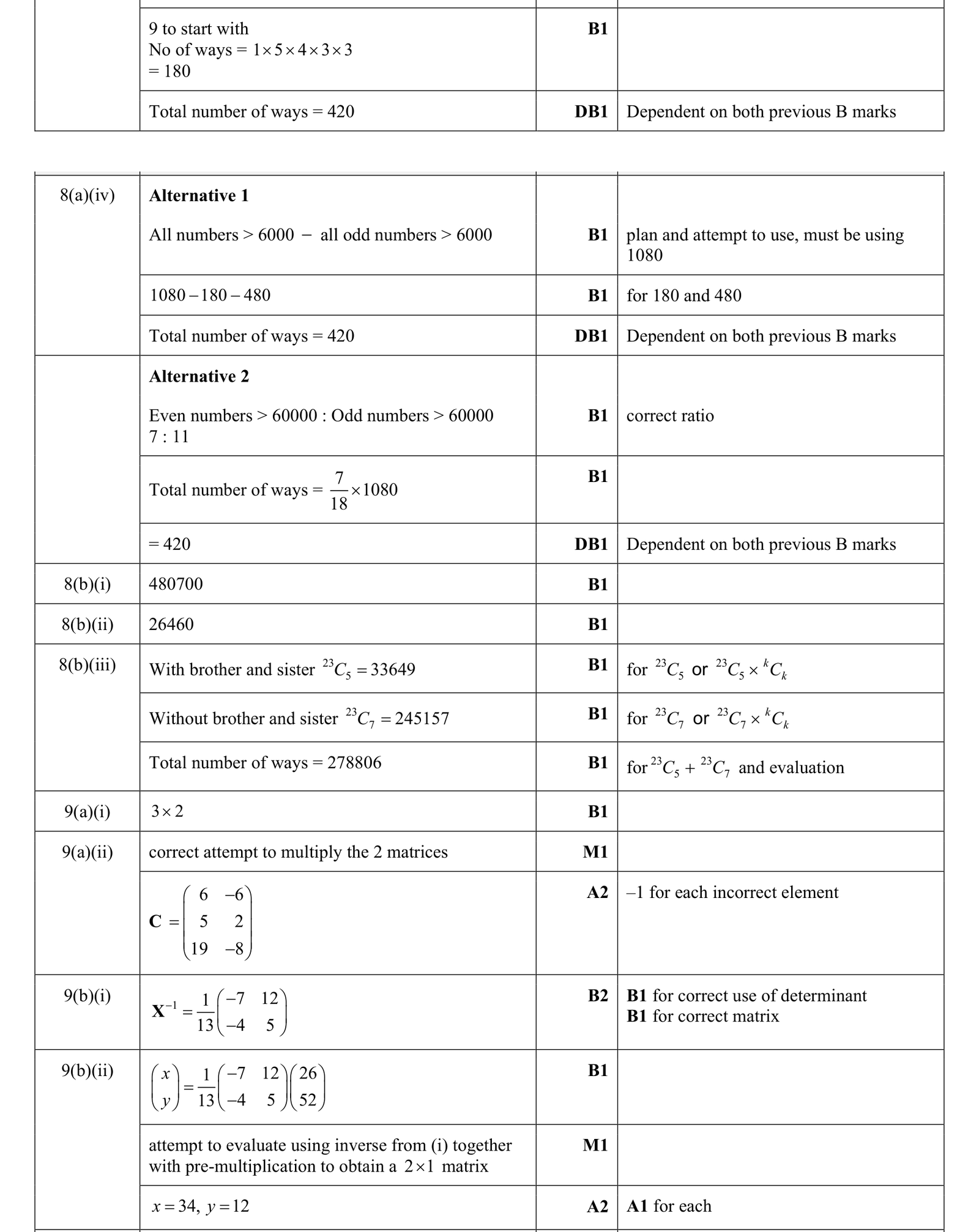
0606 P12 - Jun 2017 - Q9 - 10 marks
(a) Given
\(A=\begin{pmatrix}3&1\\-1&2\\4&5\end{pmatrix},\qquad B=\begin{pmatrix}1&-2\\3&0\end{pmatrix}, \qquad C=AB,\)
(i) state the order of \(A\), (ii) find \(C\).
(b) The matrix
\(X=\begin{pmatrix}5&-12\\4&-7\end{pmatrix}.\)
(i) Find \(X^{-1}\).
(ii) Using \(X^{-1}\), find the coordinates of the point of intersection of the lines \(12y=5x-26\) and \(7y=4x-52\).
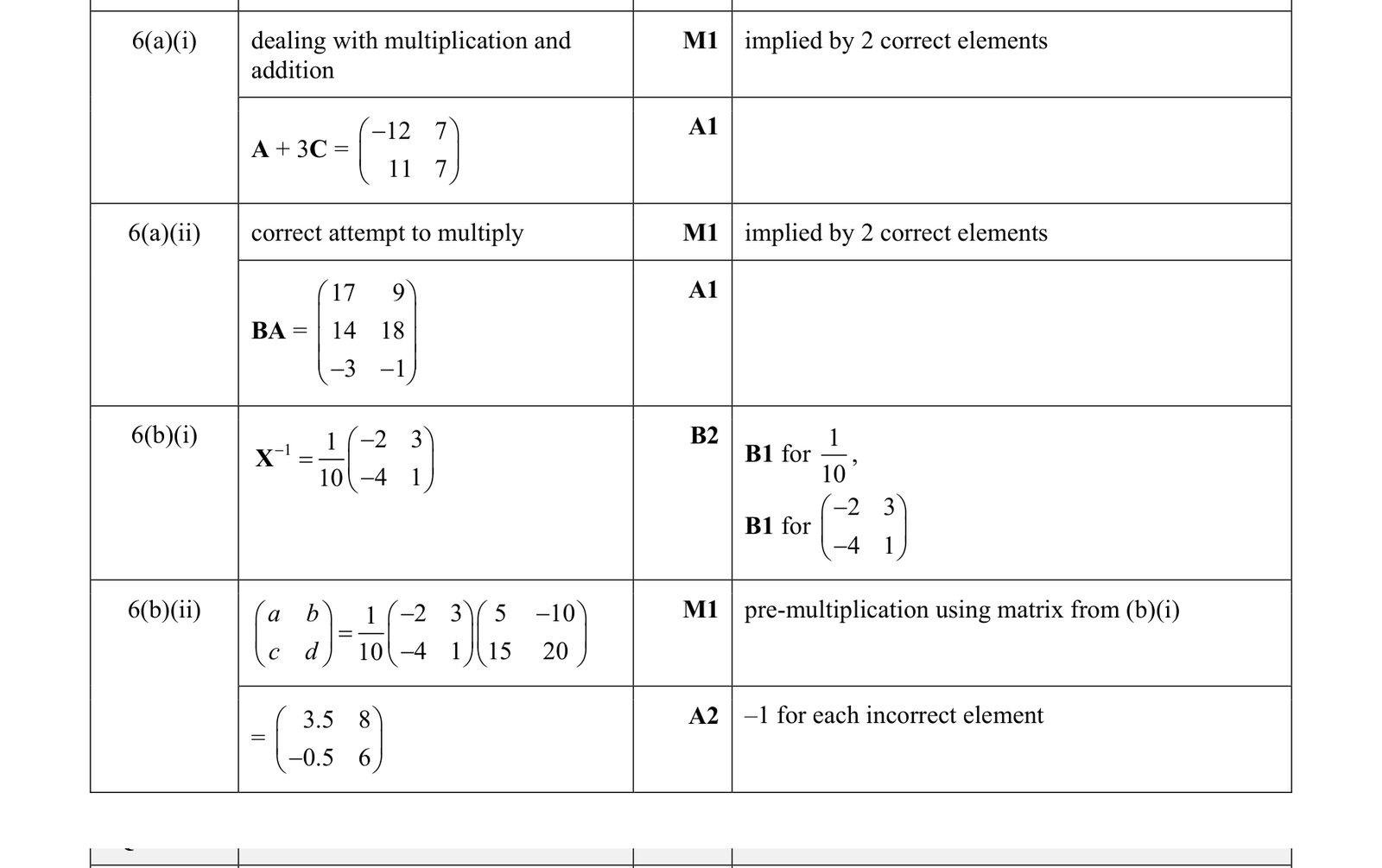
0606 P13 - Jun 2017 - Q6 - 9 marks
Given that
\(A=\begin{pmatrix}3&1\\2&4\end{pmatrix},\quad B=\begin{pmatrix}5&1\\2&4\\-1&0\end{pmatrix}, \quad\text{and}\quad C=\begin{pmatrix}-5&2\\3&1\end{pmatrix},\)
find
(a)(i) \(A+3C\),
(a)(ii) \(BA\).
(b)(i) Given that
\(X=\begin{pmatrix}1&-3\\4&-2\end{pmatrix},\)
find \(X^{-1}\).
(b)(ii) Hence find \(Y\), such that
\(XY=\begin{pmatrix}5&-10\\15&20\end{pmatrix}.\)
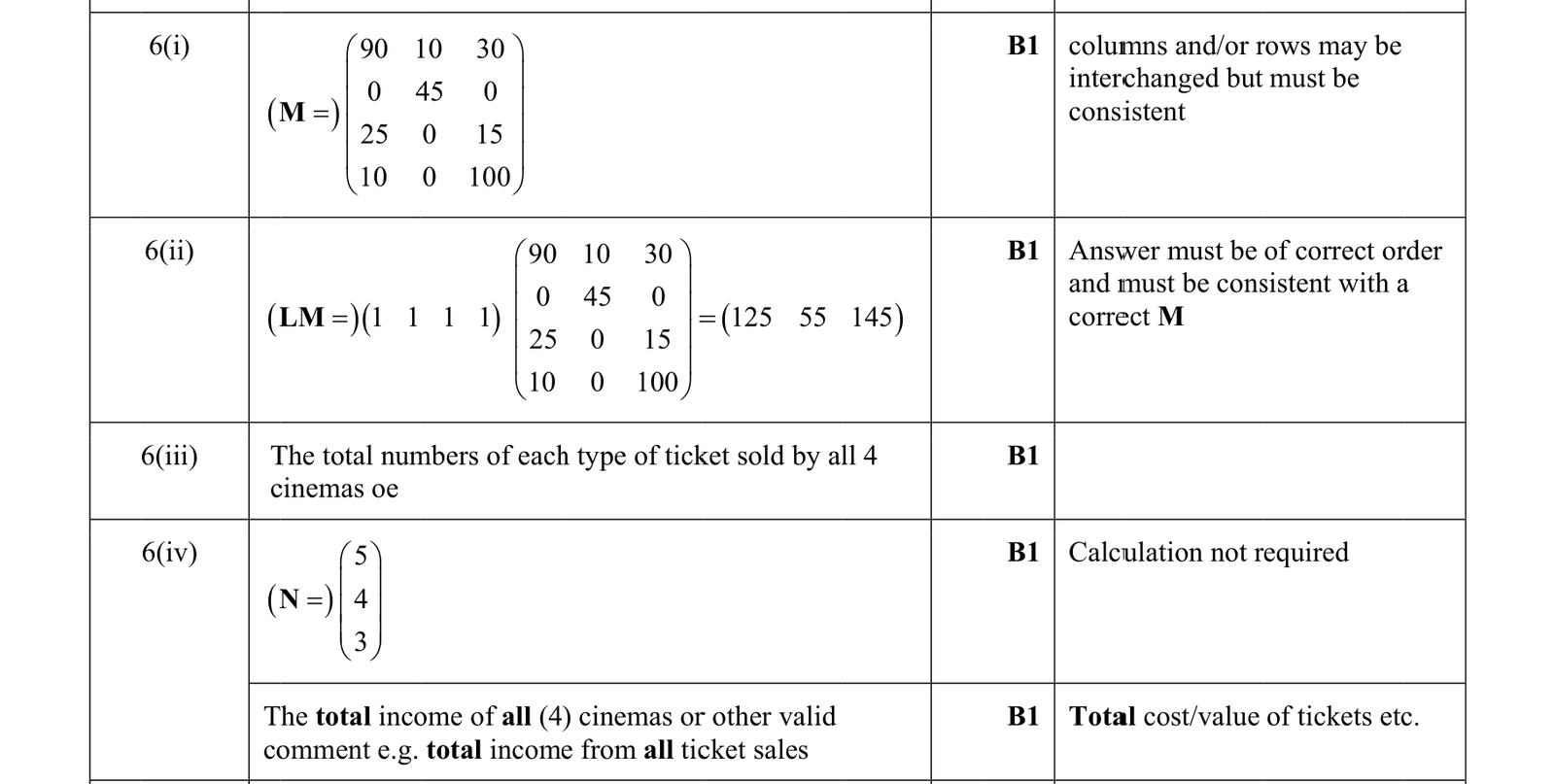
0606 P21 - Jun 2017 - Q6 - 5 marks
Four cinemas, \(P\), \(Q\), \(R\) and \(S\) each sell adult, student and child tickets. The number of tickets sold by each cinema on one weekday were
| Cinema | Adult | Student | Child |
|---|---|---|---|
| \(P\) | 90 | 10 | 30 |
| \(Q\) | 0 | 45 | 0 |
| \(R\) | 25 | 0 | 15 |
| \(S\) | 10 | 0 | 100 |
(i) Given that \(L=(1\ 1\ 1\ 1)\), construct a matrix \(M\), of the number of tickets sold, such that the matrix product \(LM\) can be found.
(ii) Find the matrix product \(LM\).
(iii) State what information is represented by the matrix product \(LM\).
An adult ticket costs \(\$5\), a student ticket costs \(\$4\) and a child ticket costs \(\$3\).
(iv) Construct a matrix \(N\), of the ticket costs, such that the matrix product \(LMN\) can be found and state what information is represented by the matrix product \(LMN\).
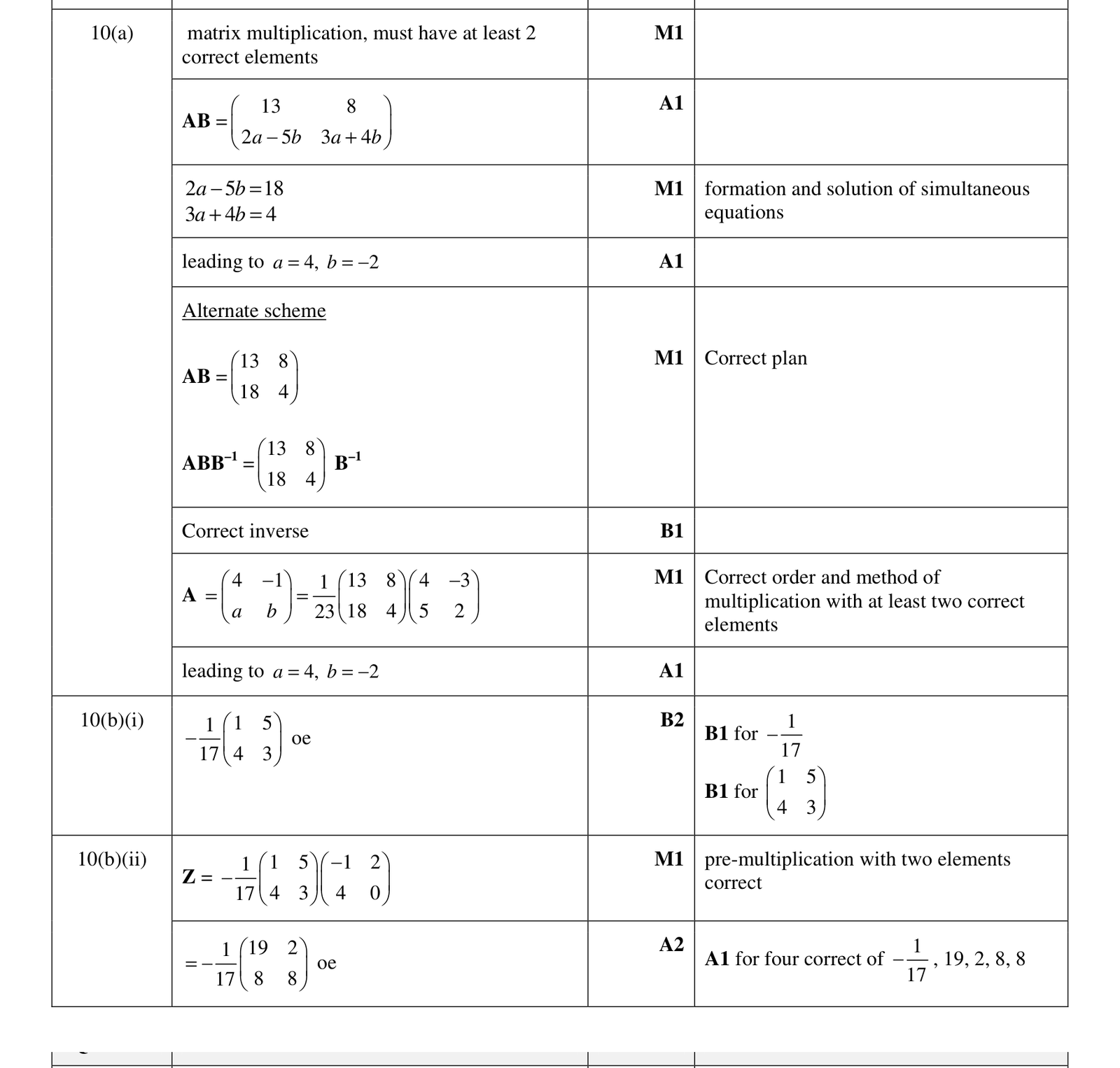
0606 P13 - Nov 2017 - Q10 - 9 marks
(a) It is given that \(A=\begin{pmatrix}4&-1\\a&b\end{pmatrix}\), \(B=\begin{pmatrix}2&3\\-5&4\end{pmatrix}\), and \(AB=\begin{pmatrix}13&8\\18&4\end{pmatrix}\). Find the value of \(a\) and of \(b\).
(b) It is given that \(X=\begin{pmatrix}3&-5\\-4&1\end{pmatrix}\), \(Y=\begin{pmatrix}-1&2\\4&0\end{pmatrix}\), and \(XZ=Y\).
(i) Find \(X^{-1}\).
(ii) Hence find \(Z\).
0606 P21 - Nov 2017 - Q6 - 7 marks
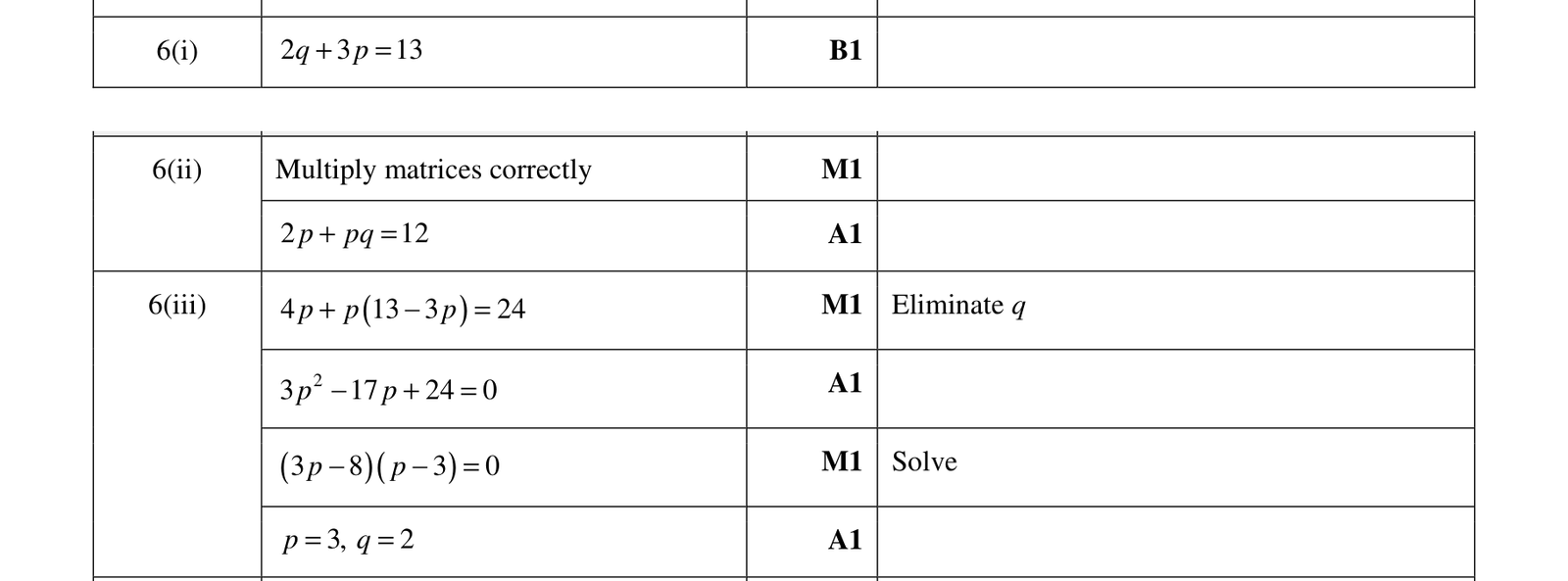
It is given that \(M=\begin{pmatrix}2&p\\-3&q\end{pmatrix}\), where \(p\) and \(q\) are integers.
(i) If \(\det M=13\), find an equation connecting \(p\) and \(q\).
(ii) Given also that \(M^2=\begin{pmatrix}4-3p&12\\-6-3q&-3p+q^2\end{pmatrix}\), find a second equation connecting \(p\) and \(q\).
(iii) Find the value of \(p\) and of \(q\).
0606 P22 - Nov 2017 - Q8 - 7 marks
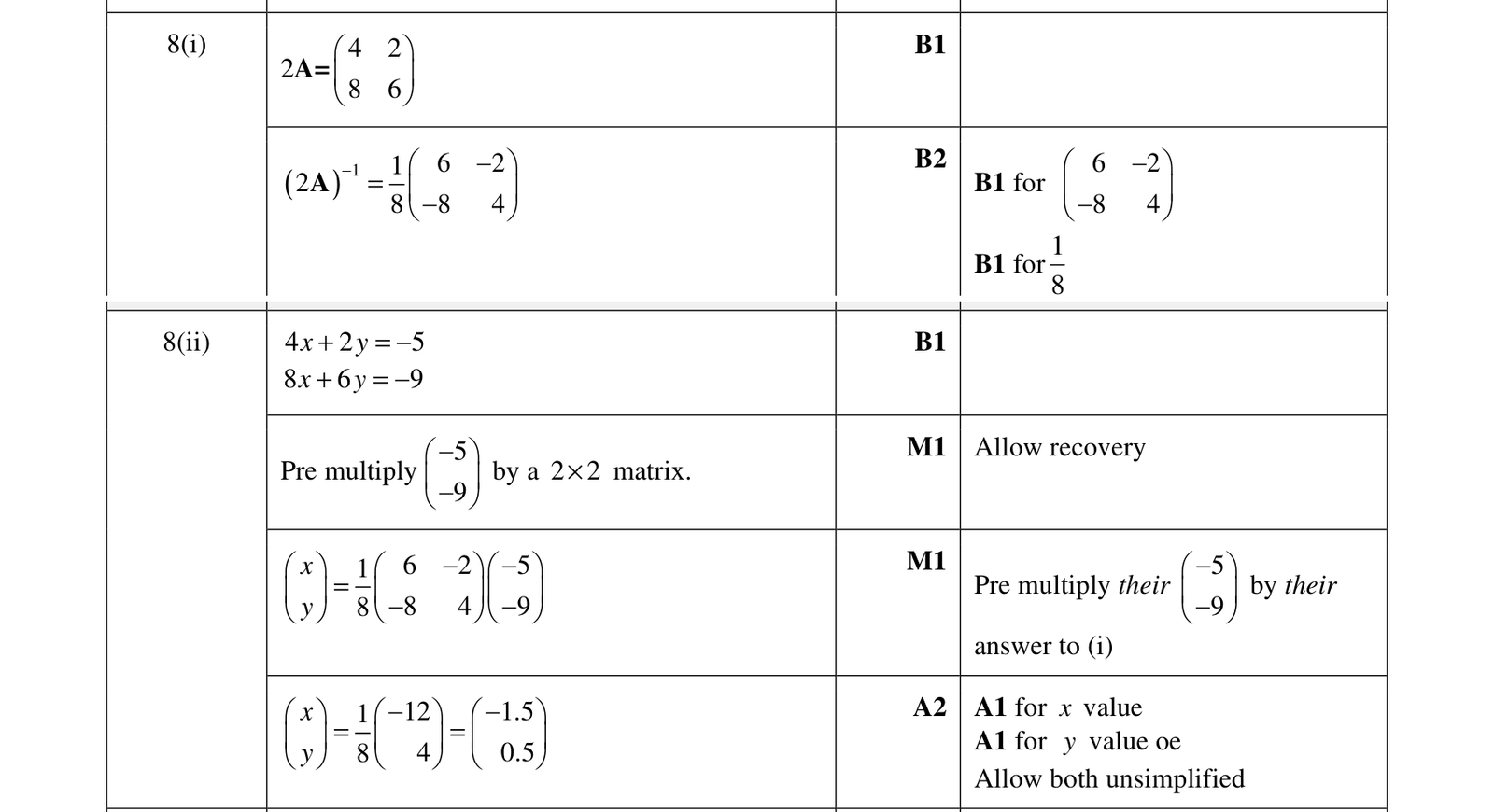
The matrix \(A\) is \(\begin{pmatrix}2&1\\4&3\end{pmatrix}\).
(i) Find \((2A)^{-1}\).
(ii) Hence solve the simultaneous equations
\(2y+4x+5=0,\)
\(6y+8x+9=0.\)
9231 P31 - Nov 2025 - Q3 - 7 marks
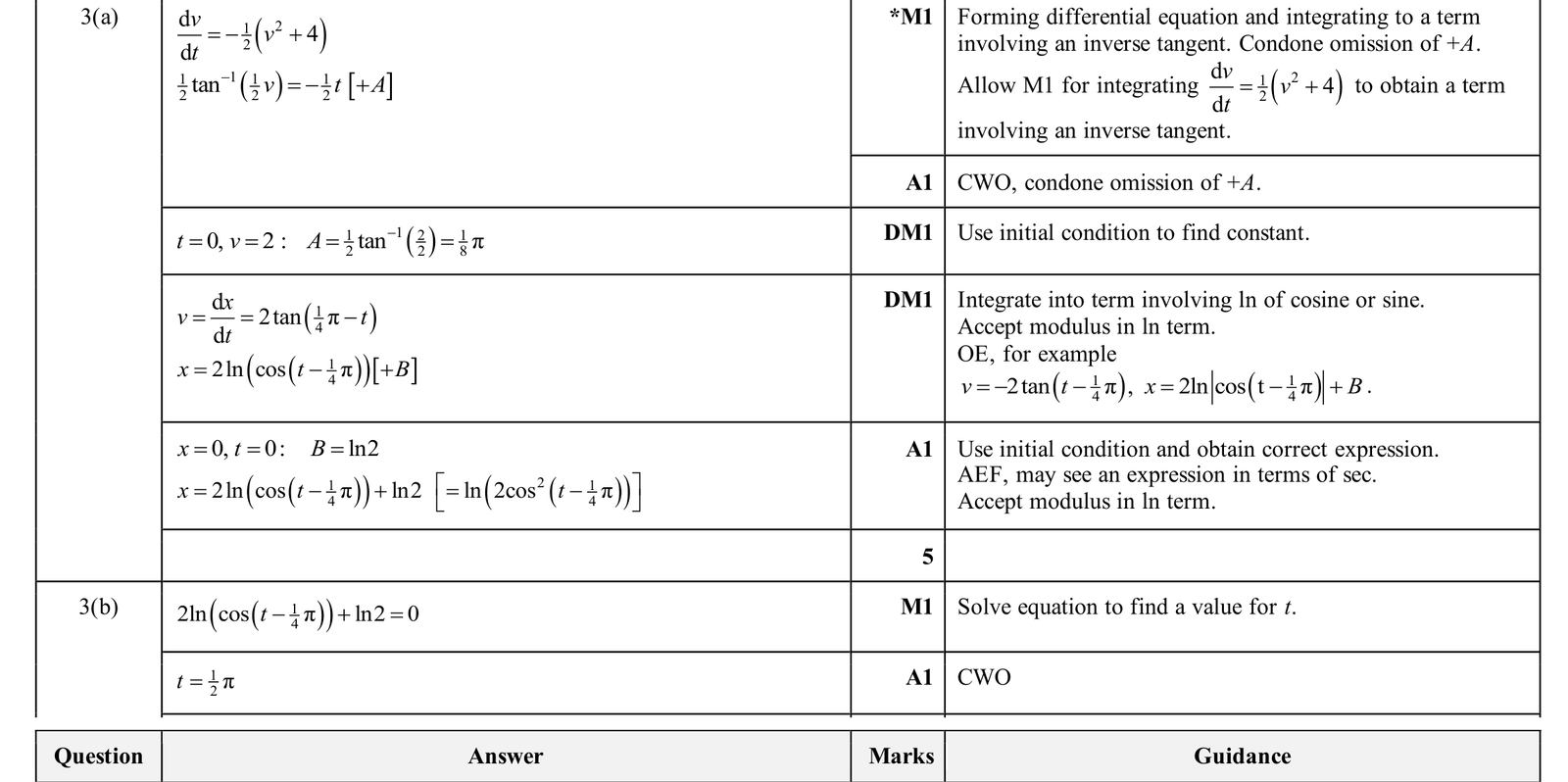
A particle \(P\) is moving in a straight horizontal line. At time \(t \mathrm{~s}\), the displacement of \(P\) from a fixed point \(O\) on the line is \(x \mathrm{~m}\) and the velocity of \(P\) is \(v \mathrm{~ms}^{-1}\). The acceleration of \(P\) is \(\frac{1}{2}\left(v^{2}+4\right) \mathrm{ms}^{-2}\) in the direction \(P O\). Initially \(P\) is at \(O\) and is moving with velocity \(2 \mathrm{~ms}^{-1}\). (a) Find an expression for \(x\) in terms of \(t\). (b) Find the time when \(P\) next goes through \(O\).
9231 P32 - Nov 2025 - Q7 - 10 marks
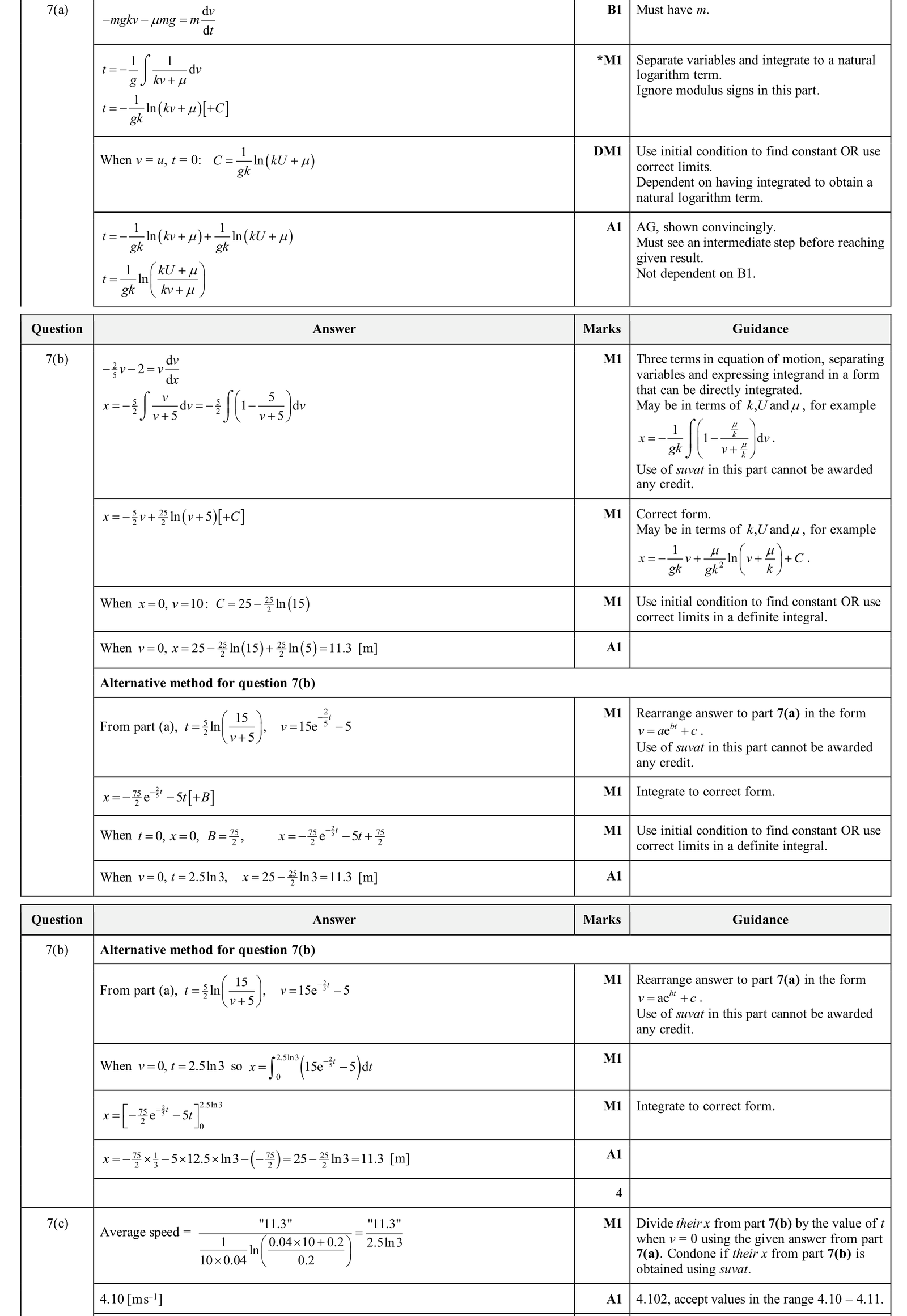
A particle \(P\) of mass \(m \mathrm{~kg}\) moving along a rough horizontal table has displacement \(x \mathrm{~m}\) from a fixed point \(O\) on the table and velocity \(v \mathrm{~ms}^{-1}\) at time \(t \mathrm{~s}\). The particle \(P\) is subject to a resistive force of magnitude \(m g k v \mathrm{~N}\), where \(k\) is a positive constant, and a frictional force of magnitude \(\mu m g\). The particle \(P\) is initially at \(O\) with speed \(U \mathrm{~ms}^{-1}\). (a) Show that \(t=\frac{1}{g k} \ln \left(\frac{k U+\mu}{k v+\mu}\right)\).
It is given that \(U=10, k=0.04\) and \(\mu=0.2\). (b) Find the distance \(P\) moves before coming to rest. (c) Find the average speed of \(P\) over the period it is moving.
9231 P34 - Jun 2025 - Q2 - 7 marks
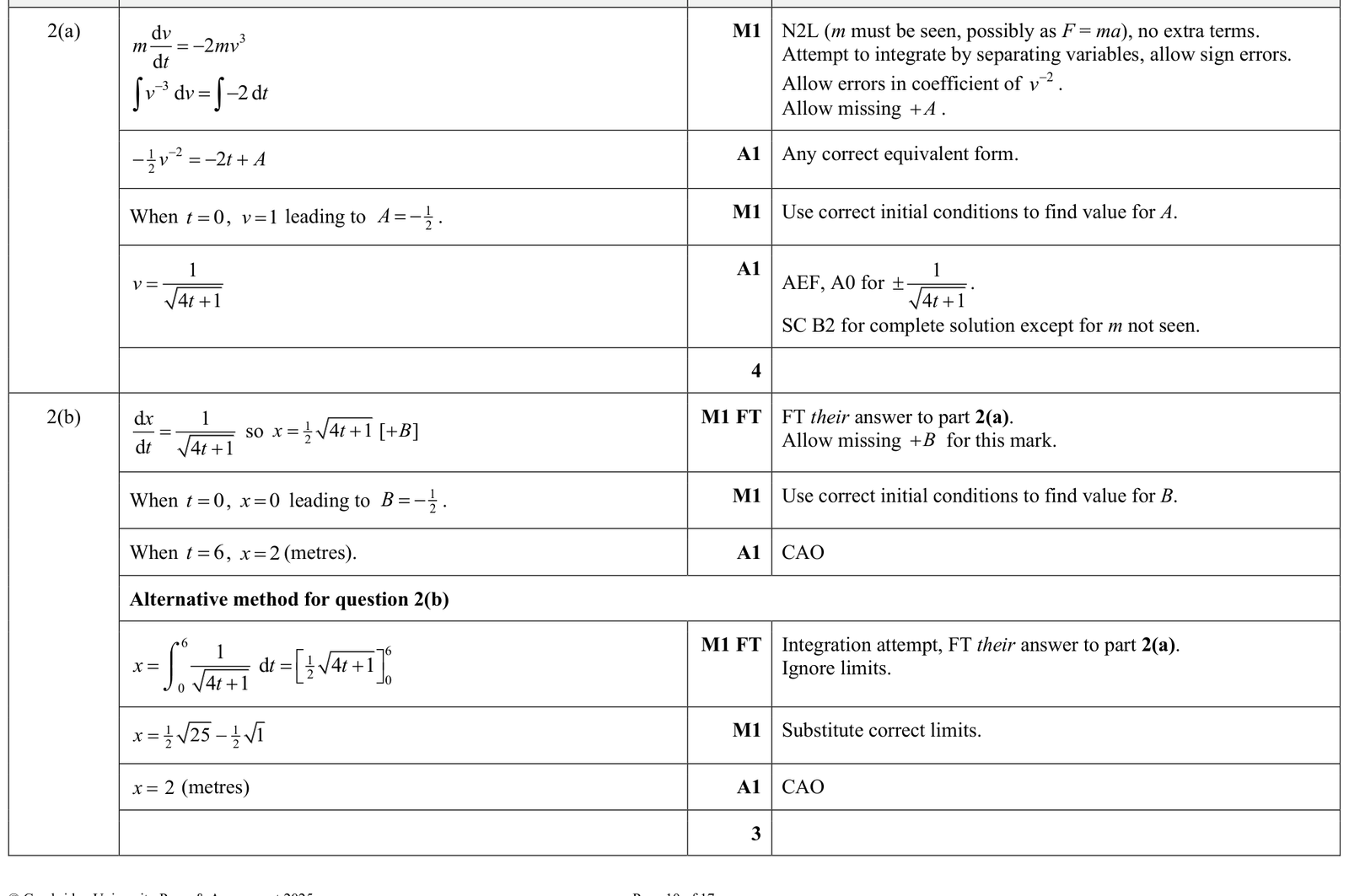
A particle \(P\) of mass \(m\,\text{kg}\) moves along a horizontal straight line against a resistive force of magnitude \(2mv^3\,\text{N}\), where \(v\,\text{m s}^{-1}\) is the velocity of \(P\) at time \(t\,\text{s}\). When \(t=0\), \(v=1\).
(a) Find an expression for \(v\) in terms of \(t\).
(b) Find the displacement of \(P\) from its initial position when \(t=6\).
9231 P31 - Nov 2024 - Q5 - 7 marks
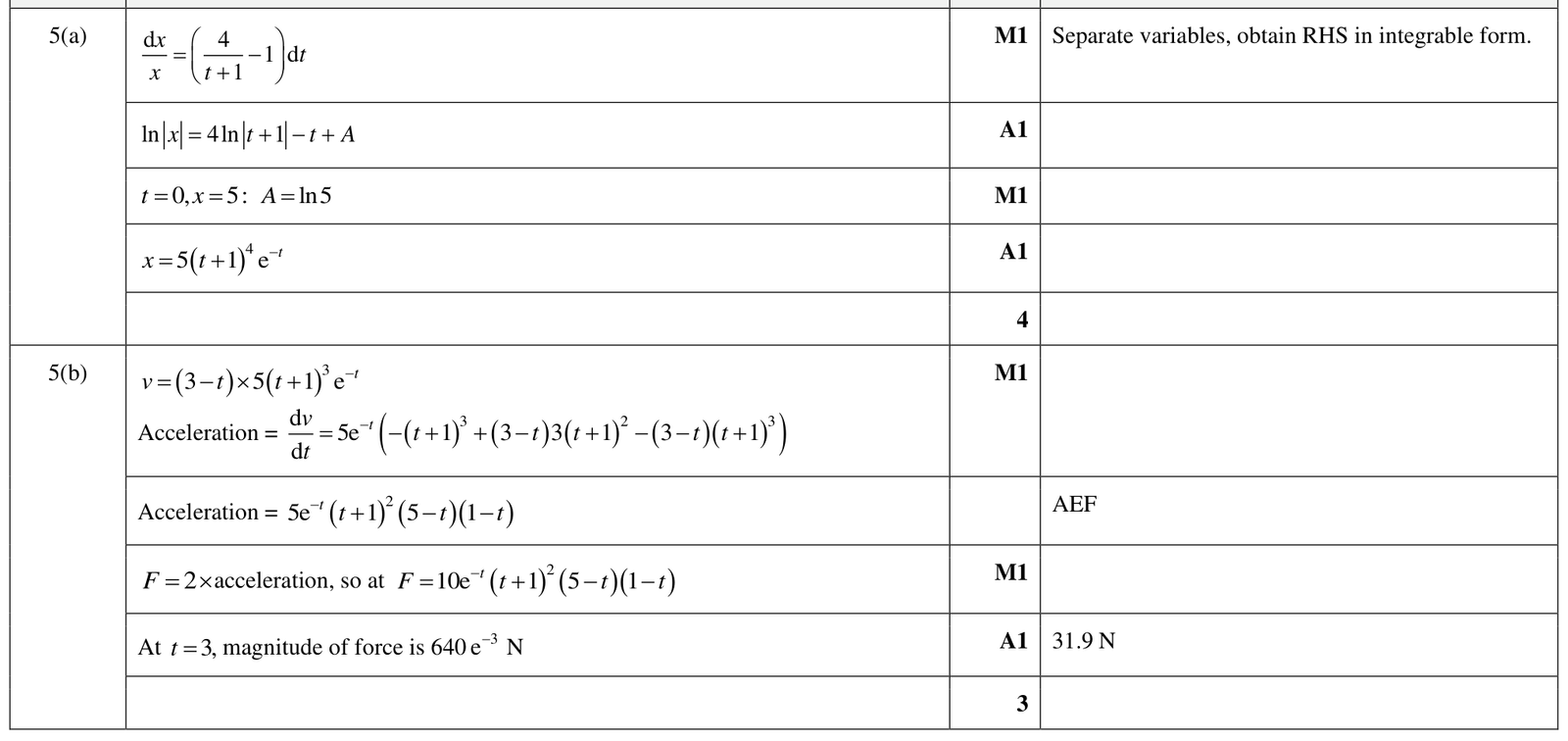
A particle \(P\) of mass \(2\,\text{kg}\) moves on a horizontal straight line. Its displacement from a fixed point \(O\) is \(x\) m and its velocity is \(v\,\text{m s}^{-1}\) at time \(t\) s.
The only horizontal force acting on \(P\) is a variable force \(F\) N which can be expressed as a function of \(t\). It is given that
and when \(t=0\), \(x=5\).
(a) Find an expression for \(x\) in terms of \(t\).
(b) Find the magnitude of \(F\) when \(t=3\).
9231 P31 - Jun 2024 - Q6 - 9 marks
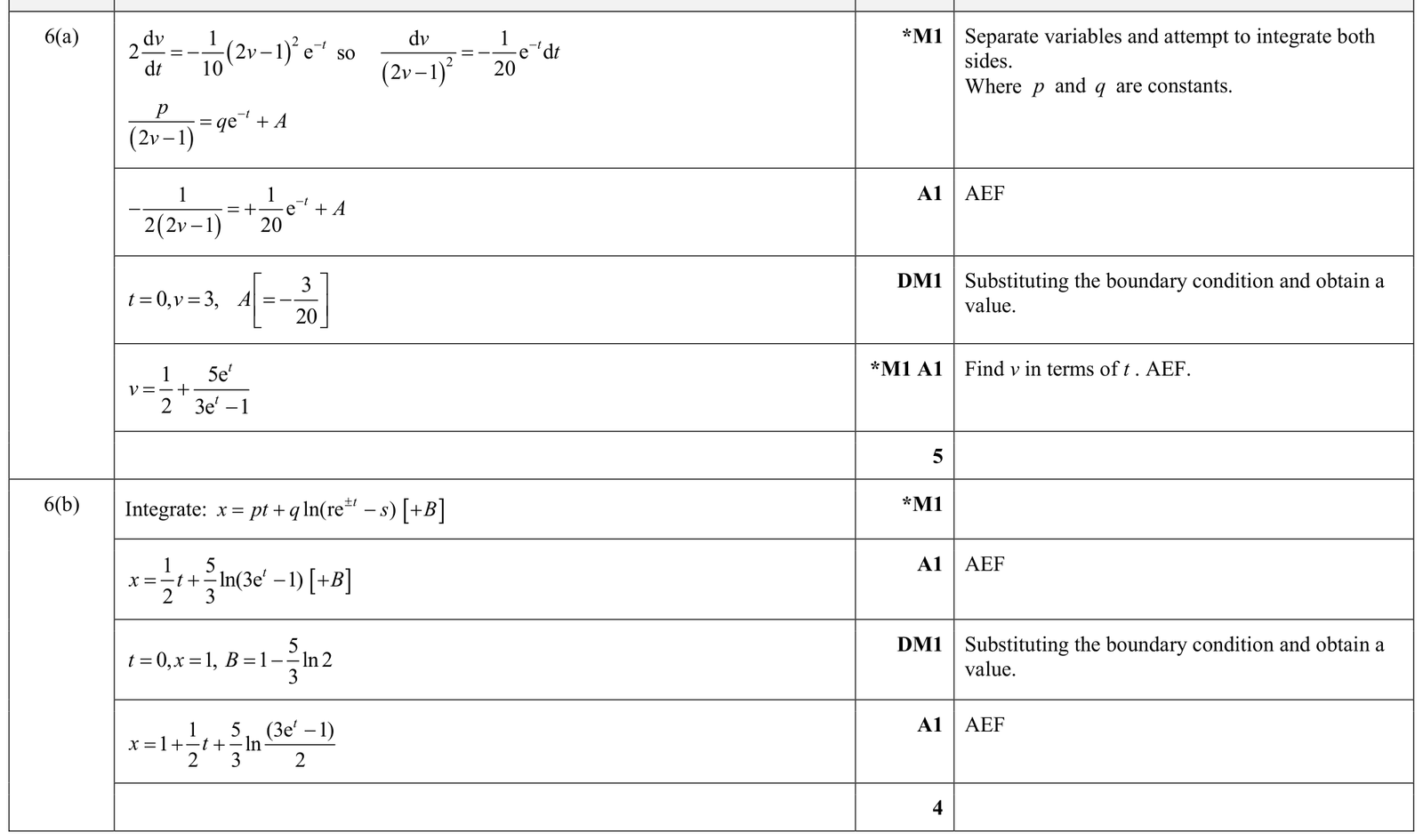
A particle \(P\) of mass \(2\,\text{kg}\) moving on a horizontal straight line has displacement \(x\) m from a fixed point \(O\) on the line and velocity \(v\,\text{m s}^{-1}\) at time \(t\) s.
The only horizontal force acting on \(P\) has magnitude \(\dfrac1{10}(2v-1)^2e^{-t}\) N and acts towards \(O\). When \(t=0\), \(x=1\) and \(v=3\).
(a) Find an expression for \(v\) in terms of \(t\).
(b) Find an expression for \(x\) in terms of \(t\).
9231 P33 - Jun 2024 - Q7 - 11 marks
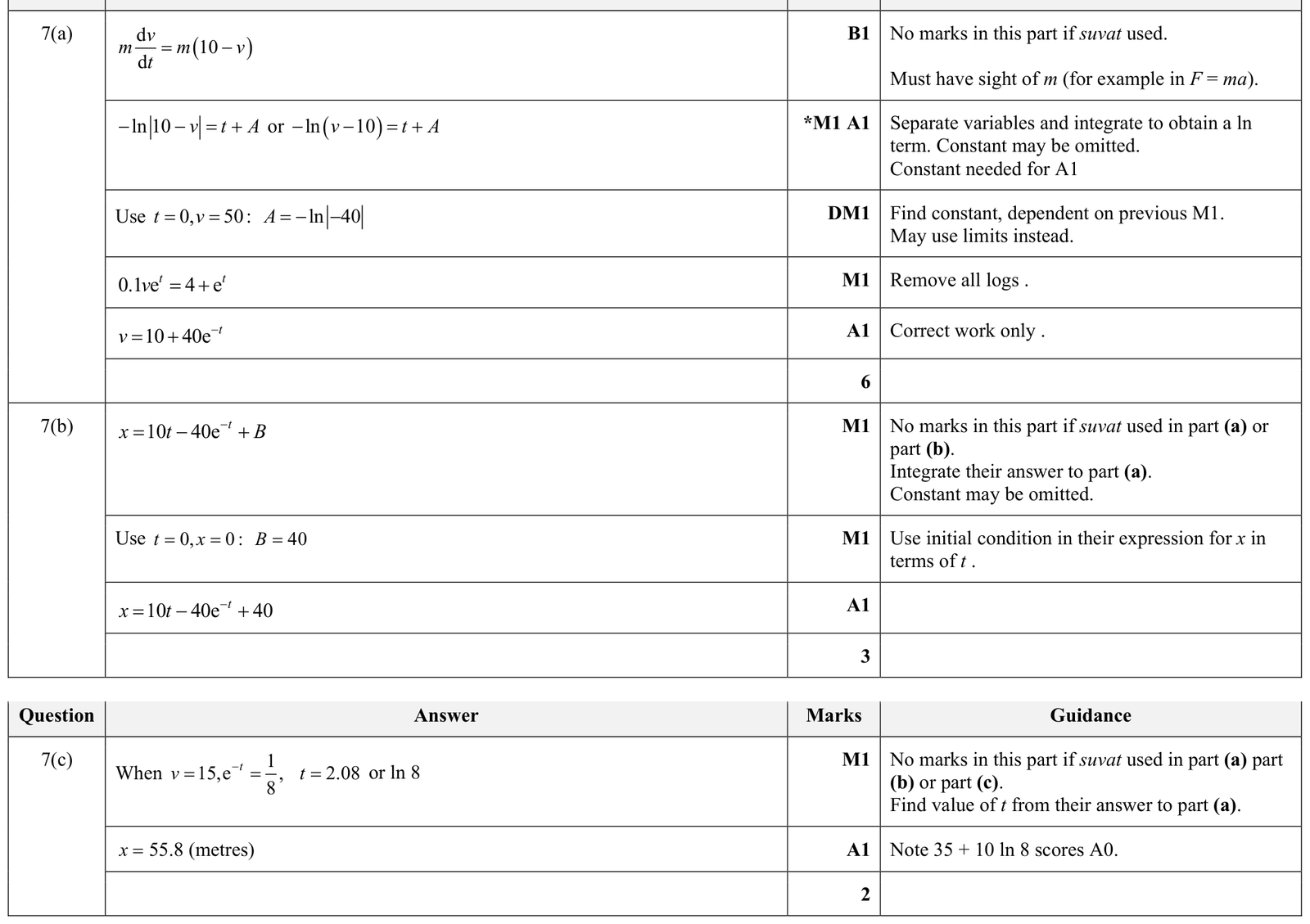
A parachutist of mass \(m\) kg opens his parachute when he is moving vertically downwards with speed \(50\,\text{m s}^{-1}\). At time \(t\) seconds after opening his parachute, he has fallen a distance \(x\) m from the point where he opened his parachute, and his speed is \(v\,\text{m s}^{-1}\).
The forces acting on him are his weight and a resistive force of magnitude \(mv\) N.
(a) Find an expression for \(v\) in terms of \(t\).
(b) Find an expression for \(x\) in terms of \(t\).
(c) Find the distance that the parachutist has fallen, since opening his parachute, when his speed is \(15\,\text{m s}^{-1}\).
9231 P31 - Nov 2023 - Q2 - 7 marks
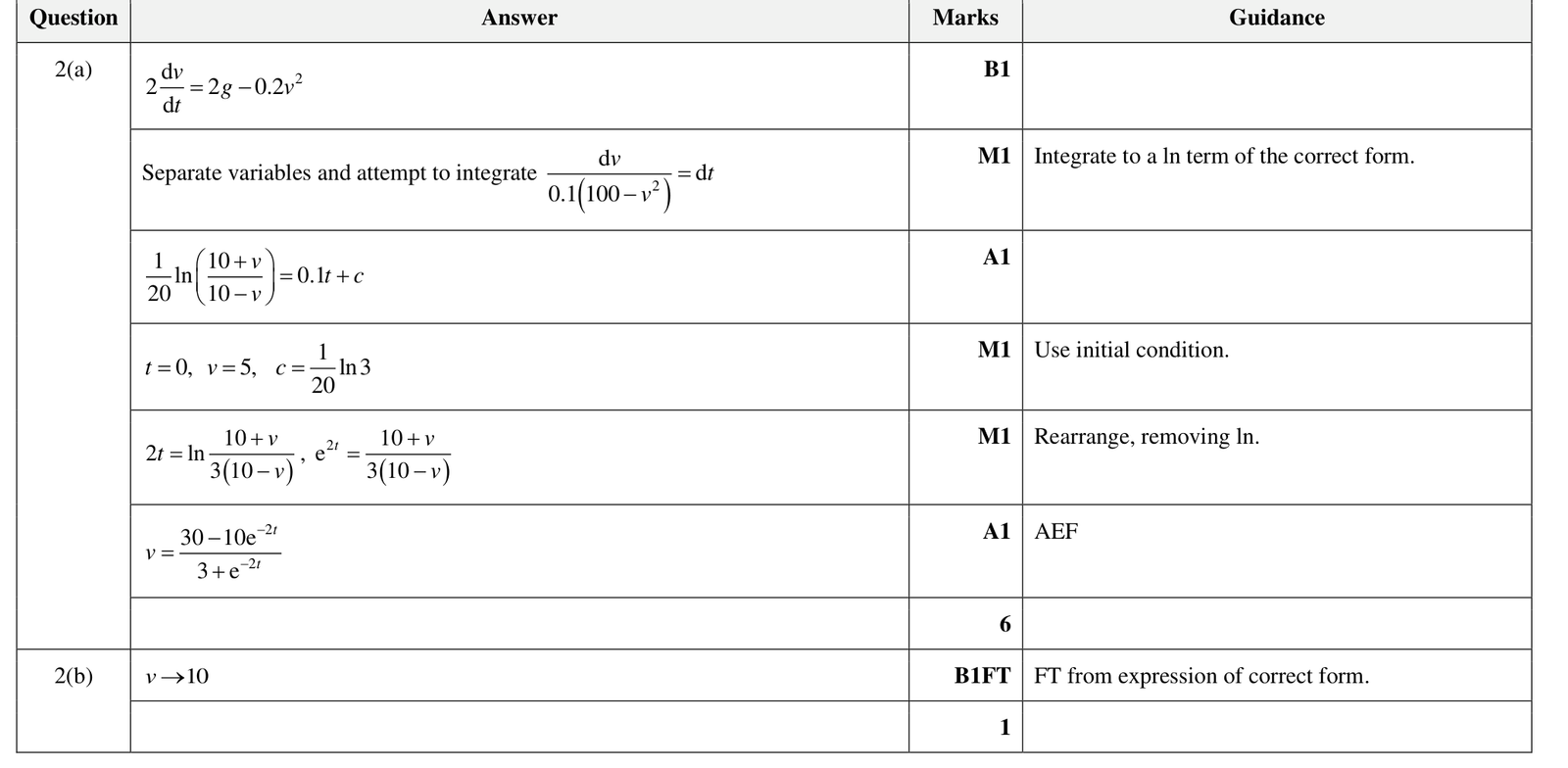
A ball of mass \(2\,\text{kg}\) is projected vertically downwards with speed \(5\,\text{m s}^{-1}\) through a liquid. At time \(t\) seconds after projection, the velocity of the ball is \(v\,\text{m s}^{-1}\), and its displacement from its starting point is \(x\) metres.
The forces acting on the ball are its weight and a resistive force of magnitude \(0.2v^2\,\text{N}\).
(a) Find an expression for \(v\) in terms of \(t\).
(b) Deduce what happens to \(v\) for large values of \(t\).
9231 P33 - Jun 2023 - Q6 - 10 marks
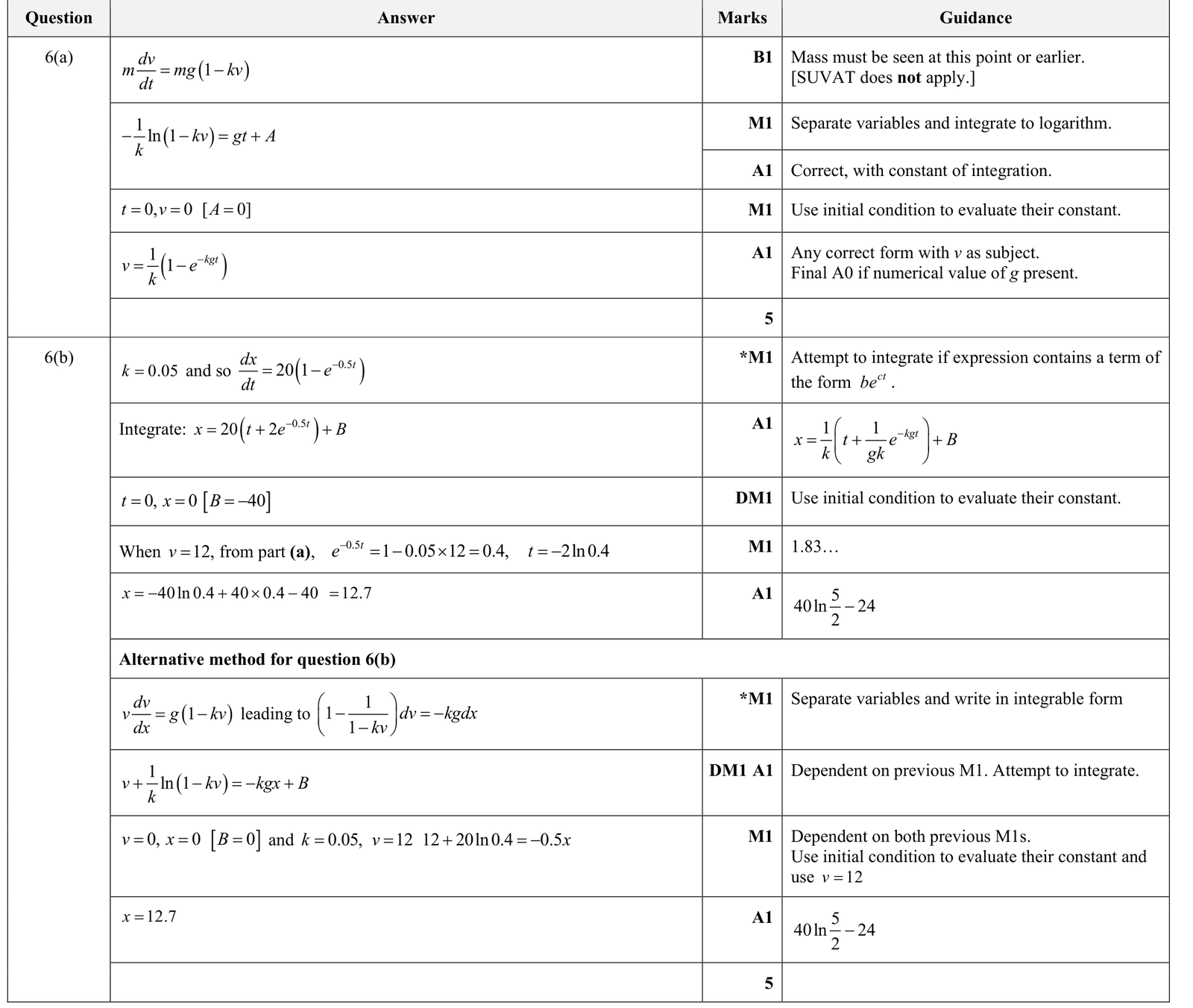
A particle of mass \(m \mathrm{~kg}\) falls vertically under gravity, from rest. At time \(t \mathrm{~s}, P\) has fallen \(x \mathrm{~m}\) and has velocity \(v \mathrm{~m} \mathrm{~s}^{-1}\). The only forces acting on \(P\) are its weight and a resistance of magnitude \(k m g v \mathrm{~N}\), where \(k\) is a constant.
(a) Find an expression for \(v\) in terms of \(t, g\) and \(k\).
(b) Given that \(k=0.05\), find, in metres, how far \(P\) has fallen when its speed is \(12 \mathrm{~m} \mathrm{~s}^{-1}\).
9231 P31 - Jun 2022 - Q3 - 5 marks
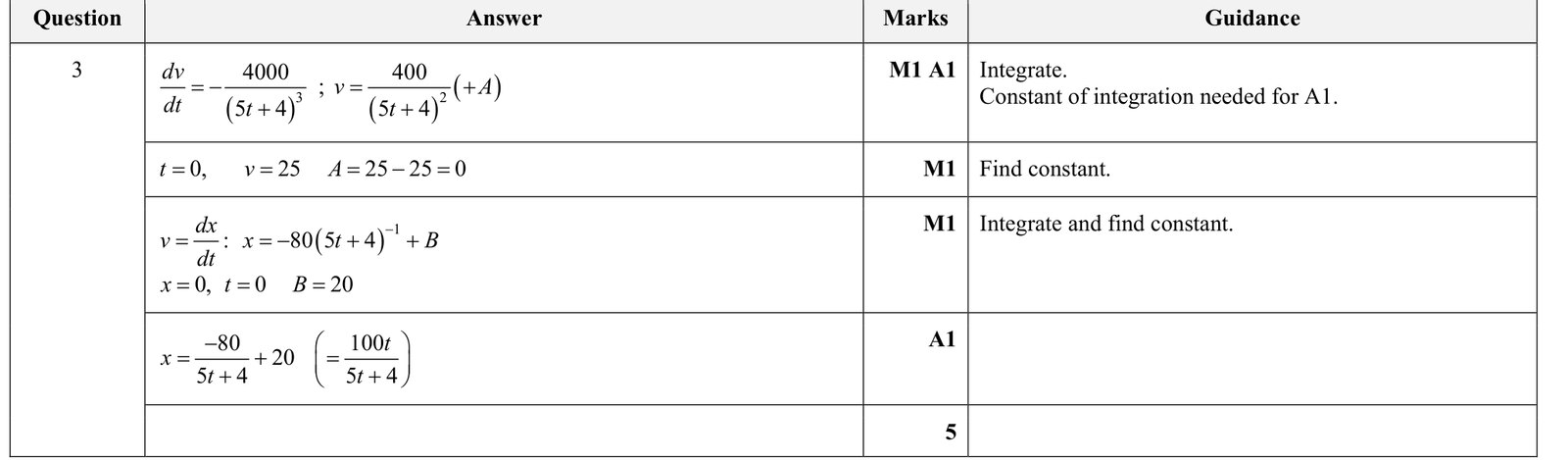
A particle \(P\) is moving in a horizontal straight line. Initially \(P\) is at the point \(O\) on the line and is moving with velocity \(25 \mathrm{~m} \mathrm{~s}^{-1}\). At time \(t \mathrm{~s}\) after passing through \(O\), the acceleration of \(P\) is \(\frac{4000}{(5 t+4)^{3}} \mathrm{~ms}^{-2}\) in the direction \(P O\). The displacement of \(P\) from \(O\) at time \(t\) is \(x \mathrm{~m}\).
Find an expression for \(x\) in terms of \(t\).
9231 P31 - Nov 2022 - Q4 - 8 marks
A particle of mass 0.5 kg moves along a horizontal straight line. Its velocity is \(v \mathrm{~m} \mathrm{~s}^{-1}\) at time \(t \mathrm{~s}\). The forces acting on the particle are a driving force of magnitude 50 N and a resistance of magnitude \(2 v^{2} \mathrm{~N}\). The initial velocity of the particle is \(3 \mathrm{~ms}^{-1}\).
(a) Find an expression for \(v\) in terms of \(t\).
(b) Deduce the limiting value of \(v\).
