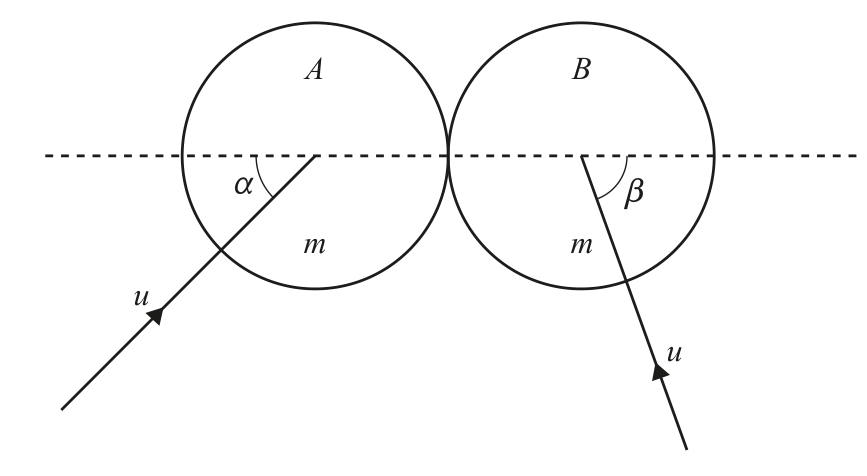
Answer:
(a) Sphere \(A\) moves perpendicular to the line of centres after the collision. (b) \(\alpha=45^\circ\).
(a) Resolve velocities along the line of centres. Let the components of the velocities of \(A\) and \(B\) after the collision along the line of centres be \(v_1\) and \(v_2\), respectively.
Before the collision, the components along the line of centres are \(u\cos\alpha\) for \(A\) and \(-u\cos\beta\) for \(B\), using a positive direction in \(A\)'s line-of-centres direction.
Conservation of momentum along the line of centres gives
\(mv_1+mv_2=mu\cos\alpha-mu\cos\beta.\)
Cancel \(m\):
\(v_1+v_2=u(\cos\alpha-\cos\beta).\)
Newton's law of restitution gives
\(v_2-v_1=\frac13u(\cos\alpha+\cos\beta).\)
It is given that
\(2\cos\beta=\cos\alpha,\)
so
\(\cos\beta=\frac12\cos\alpha.\)
Therefore the momentum equation becomes
\(v_1+v_2=\frac12u\cos\alpha,\)
and the restitution equation becomes
\(v_2-v_1=\frac13u\left(\cos\alpha+\frac12\cos\alpha\right)=\frac12u\cos\alpha.\)
Adding and subtracting these equations gives
\(v_2=\frac12u\cos\alpha,\qquad v_1=0.\)
Thus \(A\) has no velocity component along the line of centres after the collision. Its component perpendicular to the line of centres is unchanged by the impulse, so its direction of motion after the collision is perpendicular to the line of centres.
(b) Since \(v_1=0\), the final speed of \(A\) is just its unchanged perpendicular component:
\(u\sin\alpha.\)
For \(B\), the final component along the line of centres is
\(v_2=\frac12u\cos\alpha=u\cos\beta,\)
and its perpendicular component remains \(u\sin\beta\). Hence the final speed of \(B\) is
\(\sqrt{u^2\cos^2\beta+u^2\sin^2\beta}=u.\)
The total kinetic energy after the collision is given as \(\dfrac34mu^2\). Therefore
\(\frac12m(u\sin\alpha)^2+\frac12mu^2=\frac34mu^2.\)
Cancel \(\frac12mu^2\):
\(\sin^2\alpha+1=\frac32.\)
So
\(\sin^2\alpha=\frac12.\)
Since \(\alpha\) is an acute angle in the diagram,
\(\alpha=45^\circ.\)