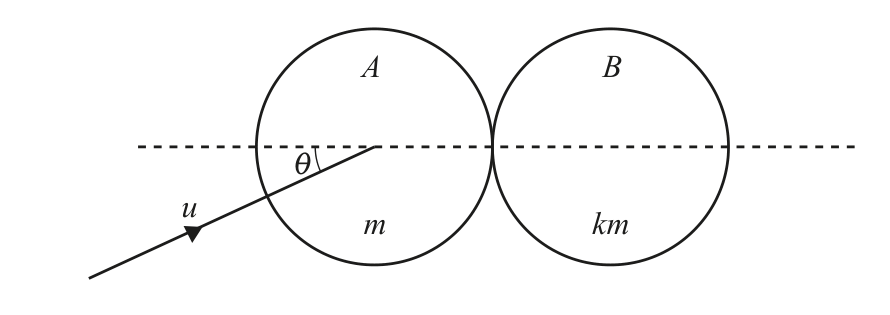
Answer:
(a) \(v_B=\dfrac{4u\cos\theta}{3(1+k)}\). (b) \(k=7\).
(a) Resolve velocities along the line of centres. Let the final components along the line of centres of \(A\) and \(B\) be \(v_1\) and \(v_2\), respectively.
Before the collision, sphere \(A\)'s component along the line of centres is \(u\cos\theta\), while sphere \(B\) is at rest.
Conservation of momentum along the line of centres gives
\(mv_1+kmv_2=mu\cos\theta.\)
Newton's law of restitution gives
\(v_2-v_1=\frac13u\cos\theta.\)
From the restitution equation,
\(v_1=v_2-\frac13u\cos\theta.\)
Substitute this into the momentum equation:
\(m\left(v_2-\frac13u\cos\theta\right)+kmv_2=mu\cos\theta.\)
Cancel \(m\):
\((1+k)v_2-\frac13u\cos\theta=u\cos\theta.\)
Therefore
\((1+k)v_2=\frac43u\cos\theta.\)
So
\(v_2=\frac{4u\cos\theta}{3(1+k)}.\)
Since \(B\) was initially at rest, this is the speed of \(B\) after the collision.
(b) From the result above and the restitution equation,
\(v_1=v_2-\frac13u\cos\theta =\frac{4u\cos\theta}{3(1+k)}-\frac13u\cos\theta.\)
Thus
\(v_1=\frac{(3-k)u\cos\theta}{3(1+k)}.\)
The component of \(A\)'s velocity perpendicular to the line of centres is unchanged, so it remains \(u\sin\theta\).
Given \(\tan\theta=\dfrac13\),
\(\cos^2\theta=\frac9{10},\qquad \sin^2\theta=\frac1{10}.\)
Since \(70\%\) of the kinetic energy is lost, the final kinetic energy is \(30\%\) of the initial kinetic energy:
\(\frac12kmv_2^2+\frac12m\left(v_1^2+u^2\sin^2\theta\right)=\frac{3}{10}\cdot\frac12mu^2.\)
Substitute \(v_2\), \(v_1\), \(\cos^2\theta=\dfrac9{10}\), and \(\sin^2\theta=\dfrac1{10}\). After cancelling \(\frac12mu^2\), this simplifies to
\(\frac{16k\cos^2\theta}{9(1+k)^2}+\frac{(3-k)^2\cos^2\theta}{9(1+k)^2}+\sin^2\theta=\frac{3}{10}.\)
Multiplying by \(10\) and substituting the trigonometric values gives
\(\frac{16k+(3-k)^2}{(1+k)^2}+1=3.\)
Therefore
\((3-k)^2+16k=2(1+k)^2.\)
Expanding,
\(k^2+10k+9=2k^2+4k+2.\)
So
\(k^2-6k-7=0.\)
Factorising,
\((k-7)(k+1)=0.\)
Since \(k\gt 0\),
\(k=7.\)