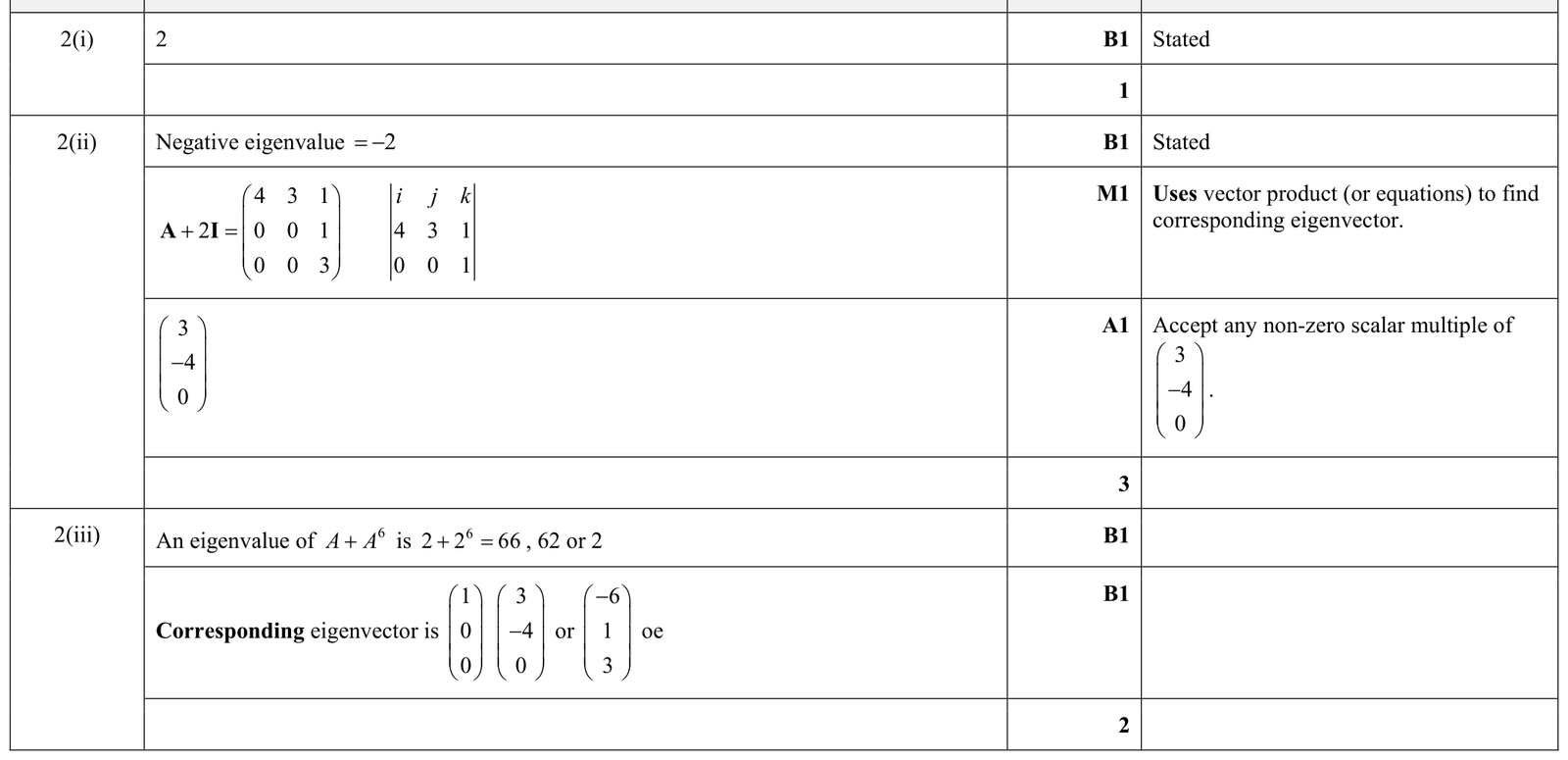
Answer: (i) The eigenvector \(\begin{pmatrix}1\\0\\0\end{pmatrix}\) corresponds to the eigenvalue \(2\).
(ii) The negative eigenvalue is \(-2\), and a corresponding eigenvector is \(\begin{pmatrix}3\\-4\\0\end{pmatrix}\).
(iii) An eigenvalue of \(A+A^6\) is \(66\), with corresponding eigenvector \(\begin{pmatrix}1\\0\\0\end{pmatrix}\).
Since \(A\) is upper triangular, its eigenvalues are the diagonal entries \(2\), \(-2\) and \(1\).
(i) For the eigenvector \(\begin{pmatrix}1\\0\\0\end{pmatrix}\), we have
\(A\begin{pmatrix}1\\0\\0\end{pmatrix}=\begin{pmatrix}2\\0\\0\end{pmatrix}=2\begin{pmatrix}1\\0\\0\end{pmatrix}.\)
So the corresponding eigenvalue is \(2\).
(ii) The negative eigenvalue is \(-2\). To find a corresponding eigenvector, solve \((A+2I)\mathbf{x}=\mathbf{0}\):
\(A+2I=\begin{pmatrix}4&3&1\\0&0&1\\0&0&3\end{pmatrix}.\)
Let \(\mathbf{x}=\begin{pmatrix}x\\y\\z\end{pmatrix}\). Then
\(\begin{cases}4x+3y+z=0,\\ z=0.\\\end{cases}\)
From \(z=0\), the first equation becomes \(4x+3y=0\), so we may take \(x=3\), \(y=-4\). Hence a corresponding eigenvector is
\(\begin{pmatrix}3\\-4\\0\end{pmatrix}.\)
(iii) If \(\mathbf{v}\) is an eigenvector of \(A\) with eigenvalue \(\lambda\), then
\(A\mathbf{v}=\lambda \mathbf{v}\)
and therefore
\(A^6\mathbf{v}=\lambda^6 \mathbf{v}.\)
So \(\mathbf{v}\) is also an eigenvector of \(A+A^6\), with eigenvalue \(\lambda+\lambda^6\).
Using the eigenvalue \(2\) from part (i) and eigenvector \(\begin{pmatrix}1\\0\\0\end{pmatrix}\), we get
\(\left(A+A^6\right)\begin{pmatrix}1\\0\\0\end{pmatrix}=(2+2^6)\begin{pmatrix}1\\0\\0\end{pmatrix}=66\begin{pmatrix}1\\0\\0\end{pmatrix}.\)
So an eigenvalue of \(A+A^6\) is \(66\), with corresponding eigenvector \(\begin{pmatrix}1\\0\\0\end{pmatrix}\).