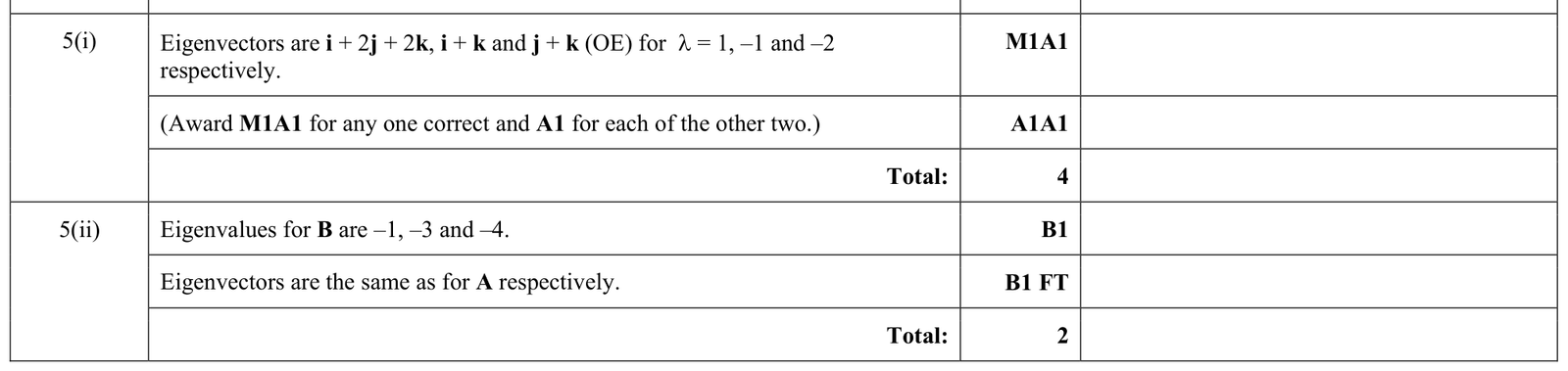
Answer: (a) A suitable set of eigenvectors is
- for eigenvalue \(1\): \(\mathbf{i}+2\mathbf{j}+2\mathbf{k}\)
- for eigenvalue \(-1\): \(\mathbf{i}+\mathbf{k}\)
- for eigenvalue \(-2\): \(\mathbf{j}+\mathbf{k}\)
(b) The eigenvalues of \(\mathbf{B}=\mathbf{A}-2\mathbf{I}\) are \(-1\), \(-3\) and \(-4\). A corresponding set of eigenvectors is the same as for \(\mathbf{A}\): \(\mathbf{i}+2\mathbf{j}+2\mathbf{k}\), \(\mathbf{i}+\mathbf{k}\) and \(\mathbf{j}+\mathbf{k}\).
(a) For each eigenvalue \(\lambda\), we find a non-zero vector \(\mathbf{x}\) such that \(\mathbf{A}\mathbf{x}=\lambda \mathbf{x}\). Solving the three systems gives the following eigenvectors.
For \(\lambda=1\), one eigenvector is \(\begin{pmatrix}1\\2\\2\end{pmatrix}\), i.e. \(\mathbf{i}+2\mathbf{j}+2\mathbf{k}\).
For \(\lambda=-1\), one eigenvector is \(\begin{pmatrix}1\\0\\1\end{pmatrix}\), i.e. \(\mathbf{i}+\mathbf{k}\).
For \(\lambda=-2\), one eigenvector is \(\begin{pmatrix}0\\1\\1\end{pmatrix}\), i.e. \(\mathbf{j}+\mathbf{k}\).
So a set of corresponding eigenvectors is \(\mathbf{i}+2\mathbf{j}+2\mathbf{k}\), \(\mathbf{i}+\mathbf{k}\), and \(\mathbf{j}+\mathbf{k}\).
(b) If \(\mathbf{A}\mathbf{x}=\lambda \mathbf{x}\), then
\(\mathbf{B}\mathbf{x}=(\mathbf{A}-2\mathbf{I})\mathbf{x}=\mathbf{A}\mathbf{x}-2\mathbf{x}=(\lambda-2)\mathbf{x}.\)
So each eigenvalue of \(\mathbf{B}\) is 2 less than the corresponding eigenvalue of \(\mathbf{A}\).
Hence the eigenvalues of \(\mathbf{B}\) are \(1-2=-1\), \(-1-2=-3\), and \(-2-2=-4\).
The eigenvectors are unchanged, so a corresponding set is
- for \(-1\): \(\mathbf{i}+2\mathbf{j}+2\mathbf{k}\)
- for \(-3\): \(\mathbf{i}+\mathbf{k}\)
- for \(-4\): \(\mathbf{j}+\mathbf{k}\)