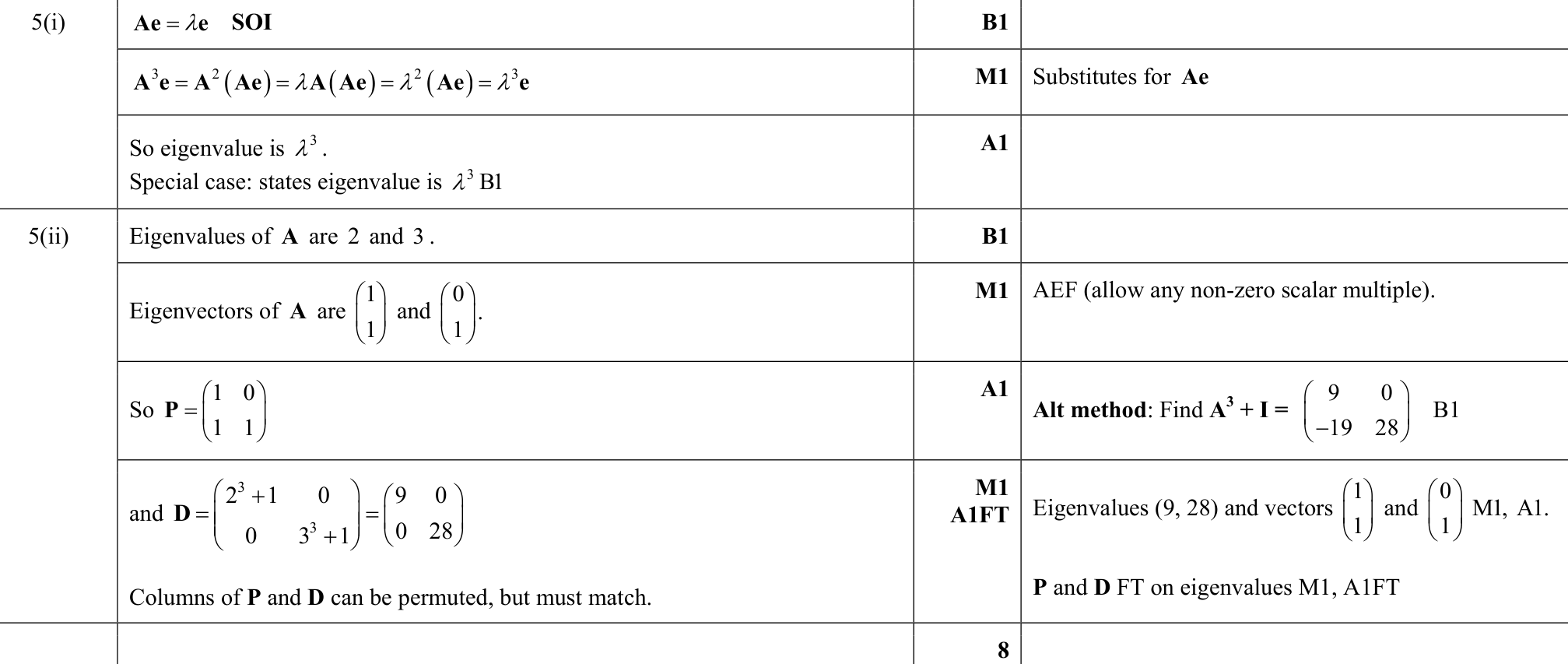
Answer: (i) Since \(\mathbf{A}\mathbf{e}=\lambda\mathbf{e}\), multiplying by \(\mathbf{A}\) again gives
\(\mathbf{A}^2\mathbf{e}=\mathbf{A}(\lambda\mathbf{e})=\lambda\mathbf{A}\mathbf{e}=\lambda^2\mathbf{e}\).
Multiplying once more by \(\mathbf{A}\),
\(\mathbf{A}^3\mathbf{e}=\mathbf{A}(\lambda^2\mathbf{e})=\lambda^2\mathbf{A}\mathbf{e}=\lambda^3\mathbf{e}\).
So \(\mathbf{e}\) is an eigenvector of \(\mathbf{A}^3\) with corresponding eigenvalue \(\lambda^3\).
(ii) First find \(\mathbf{A}^3\). Since \(\mathbf{A}\) is triangular, its eigenvalues are its diagonal entries \(2\) and \(3\), so \(\mathbf{A}^3+\mathbf{I}\) has eigenvalues \(2^3+1=9\) and \(3^3+1=28\).
Now compute \(\mathbf{A}^3\) directly:
\(\mathbf{A}^2=\begin{pmatrix}2&0\\-1&3\end{pmatrix}\begin{pmatrix}2&0\\-1&3\end{pmatrix}=\begin{pmatrix}4&0\\-5&9\end{pmatrix}\),
so
\(\mathbf{A}^3=\begin{pmatrix}4&0\\-5&9\end{pmatrix}\begin{pmatrix}2&0\\-1&3\end{pmatrix}=\begin{pmatrix}8&0\\-19&27\end{pmatrix}.\)
Hence
\(\mathbf{A}^3+\mathbf{I}=\begin{pmatrix}9&0\\-19&28\end{pmatrix}.\)
To diagonalise this matrix, find its eigenvectors.
For eigenvalue \(9\):
\(\begin{pmatrix}0&0\\-19&19\end{pmatrix}\begin{pmatrix}x\\y\end{pmatrix}=\begin{pmatrix}0\\0\end{pmatrix}\), so \(-19x+19y=0\), hence \(x=y\). Take \(\mathbf{v}_1=\begin{pmatrix}1\\1\end{pmatrix}.\)
For eigenvalue \(28\):
\(\begin{pmatrix}-19&0\\-19&0\end{pmatrix}\begin{pmatrix}x\\y\end{pmatrix}=\begin{pmatrix}0\\0\end{pmatrix}\), so \(x=0\). Take \(\mathbf{v}_2=\begin{pmatrix}0\\1\end{pmatrix}.\)
Using these eigenvectors as columns of \(\mathbf{P}\),
\(\mathbf{P}=\begin{pmatrix}1&0\\1&1\end{pmatrix}, \qquad \mathbf{D}=\begin{pmatrix}9&0\\0&28\end{pmatrix}.\)
Then \(\mathbf{A}^3+\mathbf{I}=\mathbf{PDP}^{-1}\).
(i) Let \(\mathbf{A}\mathbf{e}=\lambda\mathbf{e}\). Then
\(\mathbf{A}^2\mathbf{e}=\mathbf{A}(\mathbf{A}\mathbf{e})=\mathbf{A}(\lambda\mathbf{e})=\lambda\mathbf{A}\mathbf{e}=\lambda^2\mathbf{e}\).
Applying \(\mathbf{A}\) once more gives
\(\mathbf{A}^3\mathbf{e}=\mathbf{A}(\mathbf{A}^2\mathbf{e})=\mathbf{A}(\lambda^2\mathbf{e})=\lambda^2\mathbf{A}\mathbf{e}=\lambda^3\mathbf{e}\).
Therefore \(\mathbf{e}\) is an eigenvector of \(\mathbf{A}^3\), with corresponding eigenvalue \(\lambda^3\).
(ii) We consider \(\mathbf{B}=\mathbf{A}^3+\mathbf{I}\), where
\(\mathbf{A}=\begin{pmatrix}2&0\\-1&3\end{pmatrix}.\)
First calculate \(\mathbf{A}^3\):
\(\mathbf{A}^2=\begin{pmatrix}2&0\\-1&3\end{pmatrix}\begin{pmatrix}2&0\\-1&3\end{pmatrix}=\begin{pmatrix}4&0\\-5&9\end{pmatrix}\),
so
\(\mathbf{A}^3=\mathbf{A}^2\mathbf{A}=\begin{pmatrix}4&0\\-5&9\end{pmatrix}\begin{pmatrix}2&0\\-1&3\end{pmatrix}=\begin{pmatrix}8&0\\-19&27\end{pmatrix}.\)
Hence
\(\mathbf{B}=\mathbf{A}^3+\mathbf{I}=\begin{pmatrix}9&0\\-19&28\end{pmatrix}.\)
This is triangular, so its eigenvalues are the diagonal entries \(9\) and \(28\).
For \(\lambda=9\), solve \((\mathbf{B}-9\mathbf{I})\mathbf{x}=\mathbf{0}\):
\(\begin{pmatrix}0&0\\-19&19\end{pmatrix}\begin{pmatrix}x\\y\end{pmatrix}=\mathbf{0}\),
so \(-19x+19y=0\), hence \(x=y\). A suitable eigenvector is \(\begin{pmatrix}1\\1\end{pmatrix}\).
For \(\lambda=28\), solve \((\mathbf{B}-28\mathbf{I})\mathbf{x}=\mathbf{0}\):
\(\begin{pmatrix}-19&0\\-19&0\end{pmatrix}\begin{pmatrix}x\\y\end{pmatrix}=\mathbf{0}\),
so \(x=0\). A suitable eigenvector is \(\begin{pmatrix}0\\1\end{pmatrix}\).
Take these eigenvectors as the columns of \(\mathbf{P}\):
\(\mathbf{P}=\begin{pmatrix}1&0\\1&1\end{pmatrix}.\)
Then the corresponding diagonal matrix is
\(\mathbf{D}=\begin{pmatrix}9&0\\0&28\end{pmatrix}.\)
Therefore \(\mathbf{A}^3+\mathbf{I}=\mathbf{PDP}^{-1}\), with
\(\mathbf{P}=\begin{pmatrix}1&0\\1&1\end{pmatrix},\quad \mathbf{D}=\begin{pmatrix}9&0\\0&28\end{pmatrix}.\)