Past Exam Questions
← Back9231 P31 - Nov 2020 - Q6 - 10 marks
Two smooth spheres \(A\) and \(B\) have equal radii and masses \(m\) and \(2 m\) respectively. Sphere \(B\) is at rest on a smooth horizontal floor. Sphere \(A\) is moving on the floor with velocity \(u\) and collides directly with \(B\). The coefficient of restitution between the spheres is \(e\).
(a) Find, in terms of \(u\) and \(e\), the velocities of \(A\) and \(B\) after the collision.
Subsequently, \(B\) collides with a fixed vertical wall which makes an angle \(\theta\) with the direction of motion of \(B\), where \(\tan \theta=\frac{3}{4}\).
The coefficient of restitution between \(B\) and the wall is \(\frac{2}{3}\). Immediately after \(B\) collides with the wall, the kinetic energy of \(A\) is \(\frac{5}{32}\) of the kinetic energy of \(B\).
(b) Find the possible values of \(e\).

9231 P32 - Nov 2020 - Q2 - 5 marks
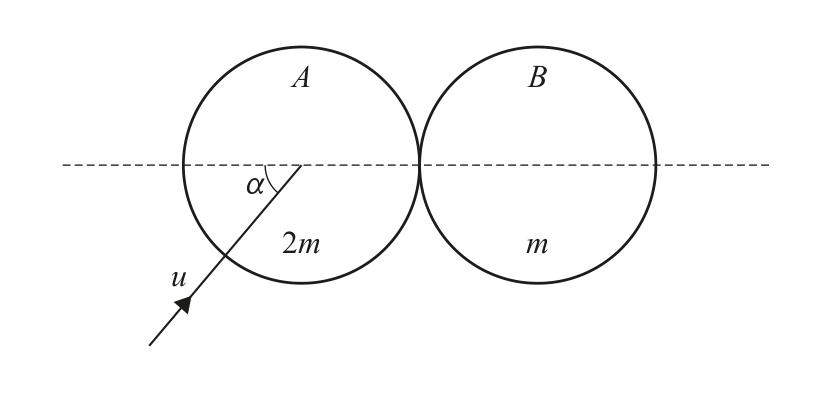
Two uniform smooth spheres \(A\) and \(B\) of equal radii have masses \(2 m\) and \(m\) respectively. Sphere \(B\) is at rest on a smooth horizontal surface. Sphere \(A\) is moving on the surface with speed \(u\) and collides with \(B\). Immediately before the collision, the direction of motion of \(A\) makes an angle \(\alpha\) with the line of centres of the spheres, where \(\tan \alpha=\frac{4}{3}\) (see diagram). The coefficient of restitution between the spheres is \(\frac{1}{3}\).
Find the speed of \(A\) after the collision.

9231 P23 - Jun 2024 - Q7 - 12 marks
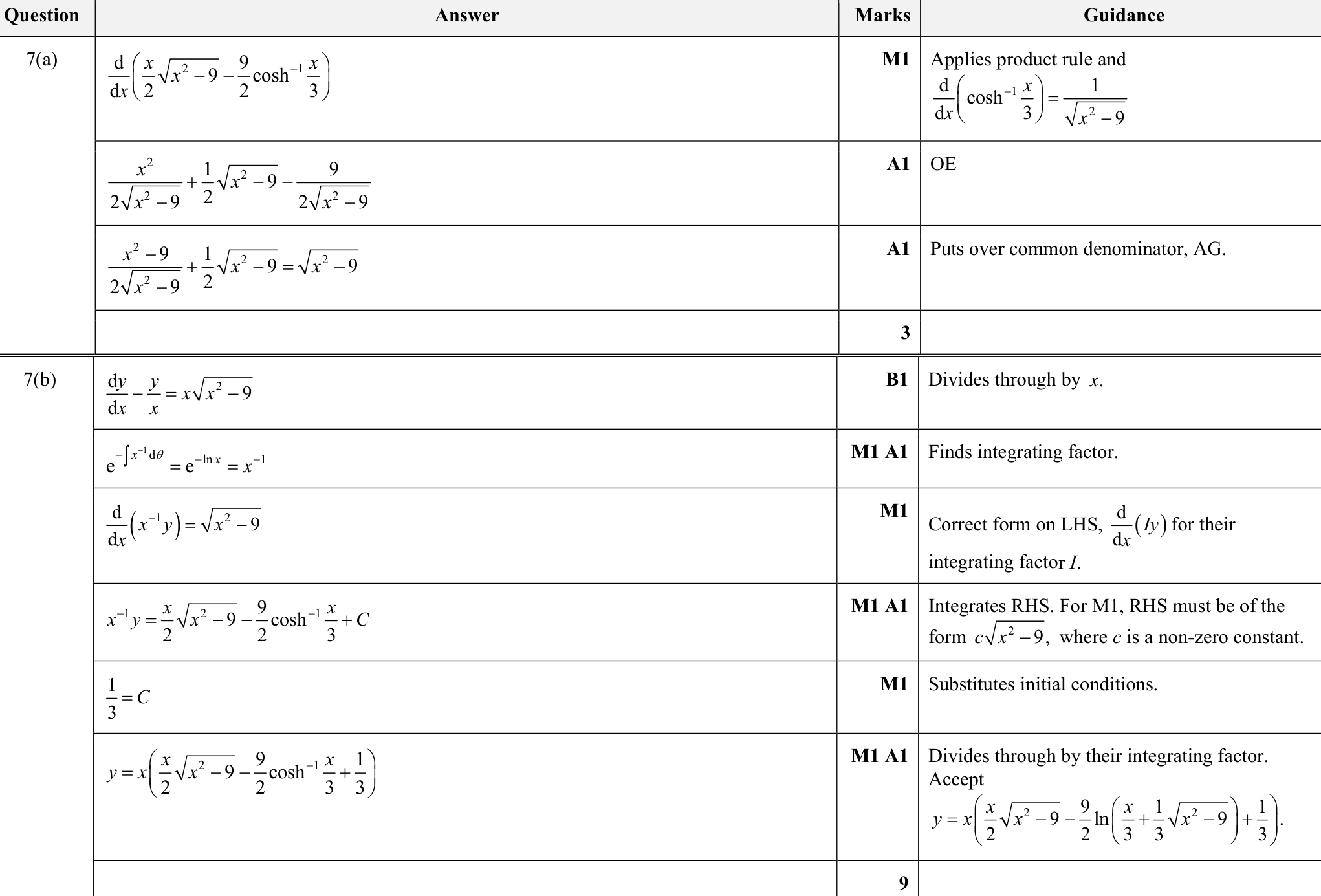
(a) Show that
\(\frac{\mathrm{d}}{\mathrm{~d} x}\left(\frac{x}{2} \sqrt{x^{2}-9}-\frac{9}{2} \cosh ^{-1} \frac{x}{3}\right)=\sqrt{x^{2}-9} .\)
(b) Find the solution of the differential equation
\(x \frac{\mathrm{~d} y}{\mathrm{~d} x}-y=x^{2} \sqrt{x^{2}-9}\)
given that \(y=1\) when \(x=3\). Give your answer in the form \(y=\mathrm{f}(x)\).
9231 P21 - Jun 2024 - Q7 - 12 marks
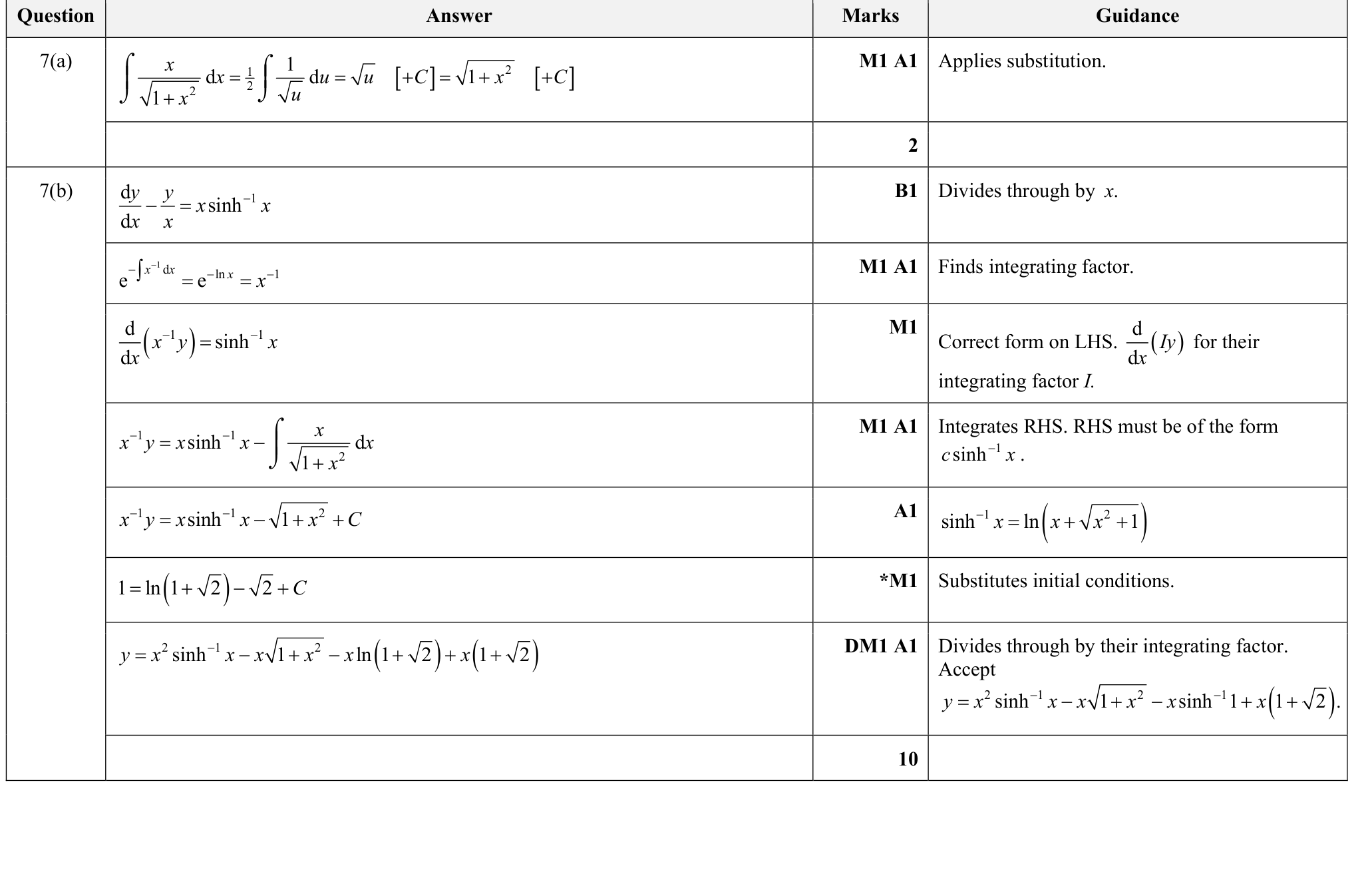
(a) Use the substitution \(u=1+x^{2}\) to find
\(\int \frac{x}{\sqrt{1+x^{2}}} \mathrm{~d} x\)
(b) Find the solution of the differential equation
\(x \frac{\mathrm{~d} y}{\mathrm{~d} x}-y=x^{2} \sinh ^{-1} x\)
given that \(y=1\) when \(x=1\). Give your answer in the form \(y=\mathrm{f}(x)\).
9231 P22 - Nov 2024 - Q7 - 7 marks
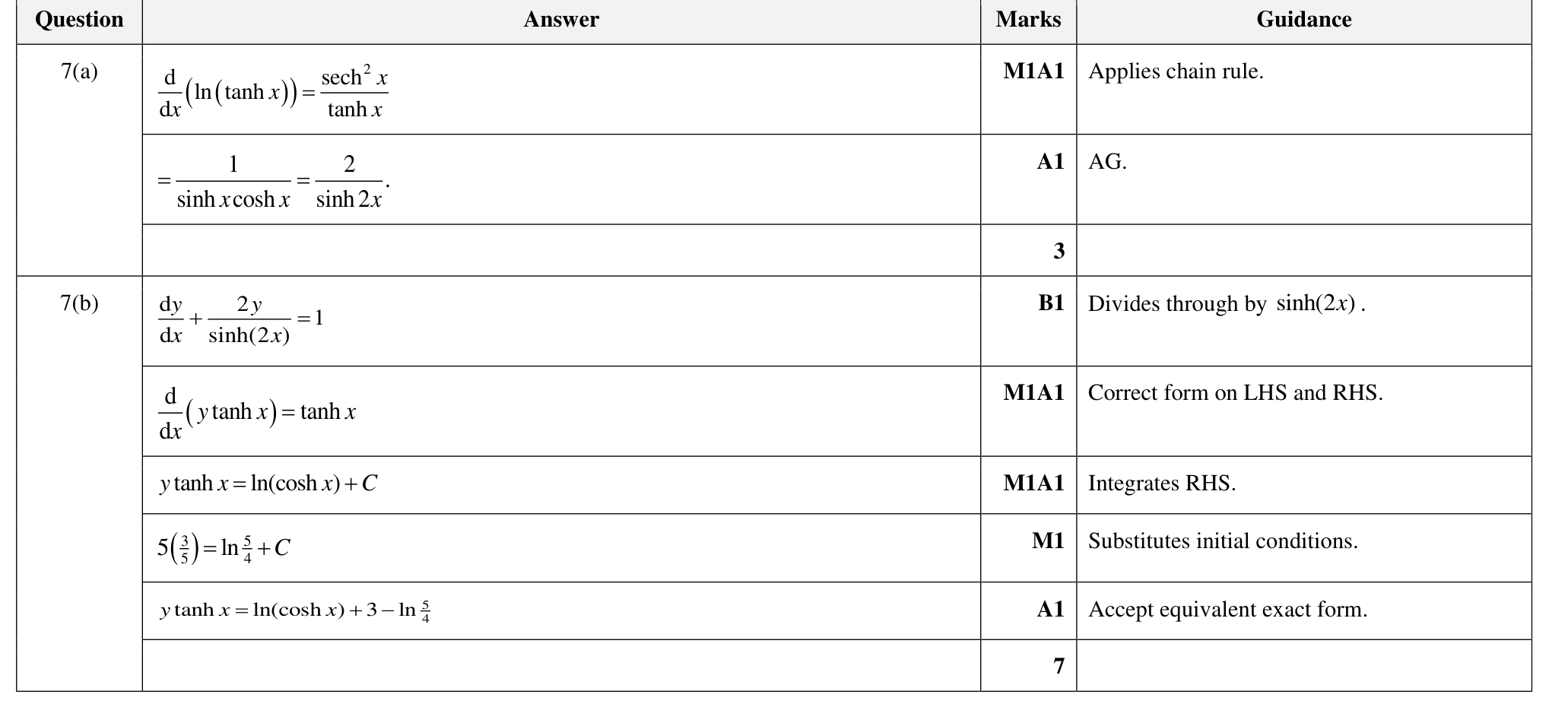
(a) Show that \(\frac{\mathrm{d}}{\mathrm{d} x}(\ln (\tanh x))=2 \operatorname{cosech} 2 x\).
(b) Find the solution of the differential equation
\(\sinh 2 x \frac{\mathrm{~d} y}{\mathrm{~d} x}+2 y=\sinh 2 x\)
for which \(y=5\) when \(x=\ln 2\). Give your answer in an exact form.
9231 P23 - Jun 2023 - Q5 - 11 marks
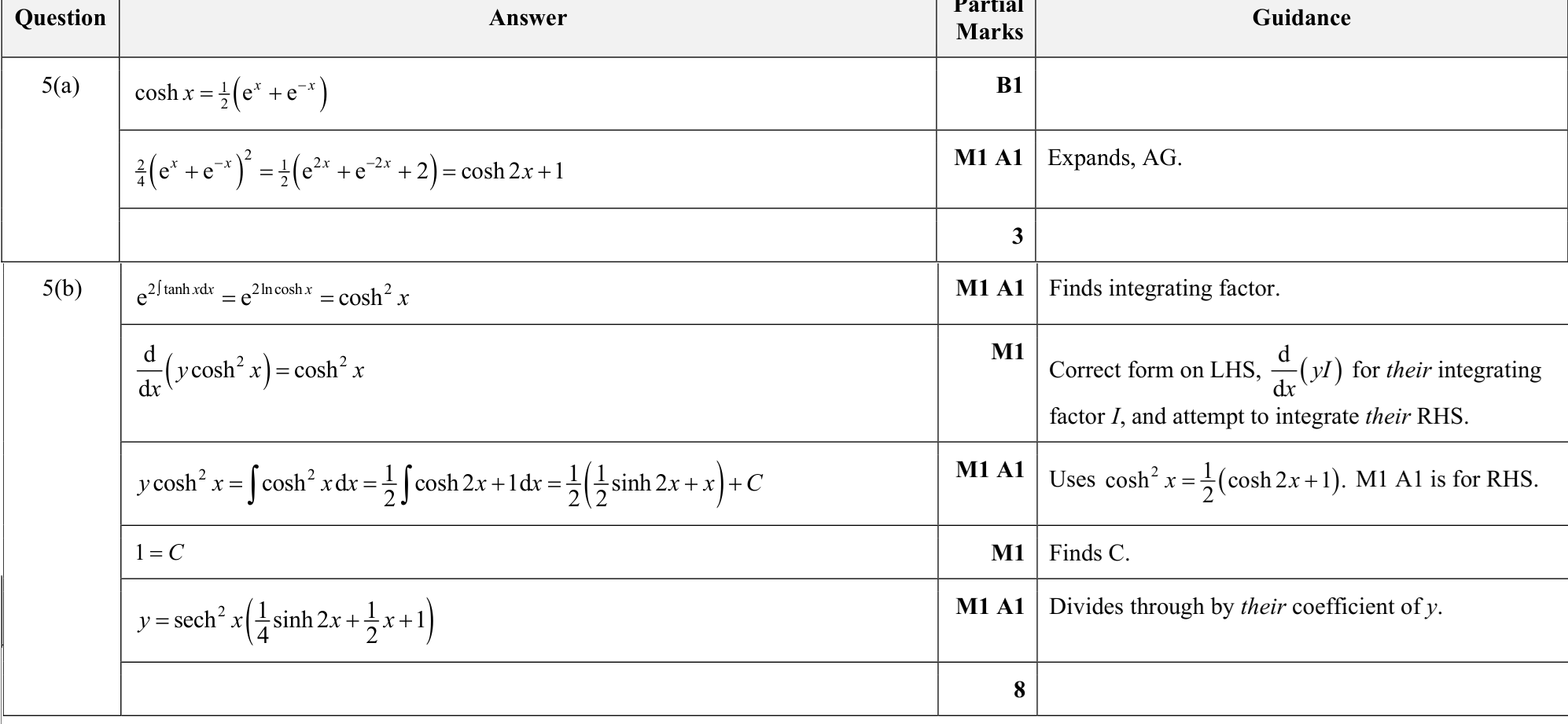
(a) Starting from the definitions of cosh and sinh in terms of exponentials, prove that
\(2 \cosh ^{2} x=\cosh 2 x+1\)
(b) Find the solution of the differential equation
\(\frac{\mathrm{d} y}{\mathrm{~d} x}+2 y \tanh x=1\)
for which \(y=1\) when \(x=0\). Give your answer in the form \(y=\mathrm{f}(x)\).
9231 P21 - Nov 2023 - Q6 - 14 marks
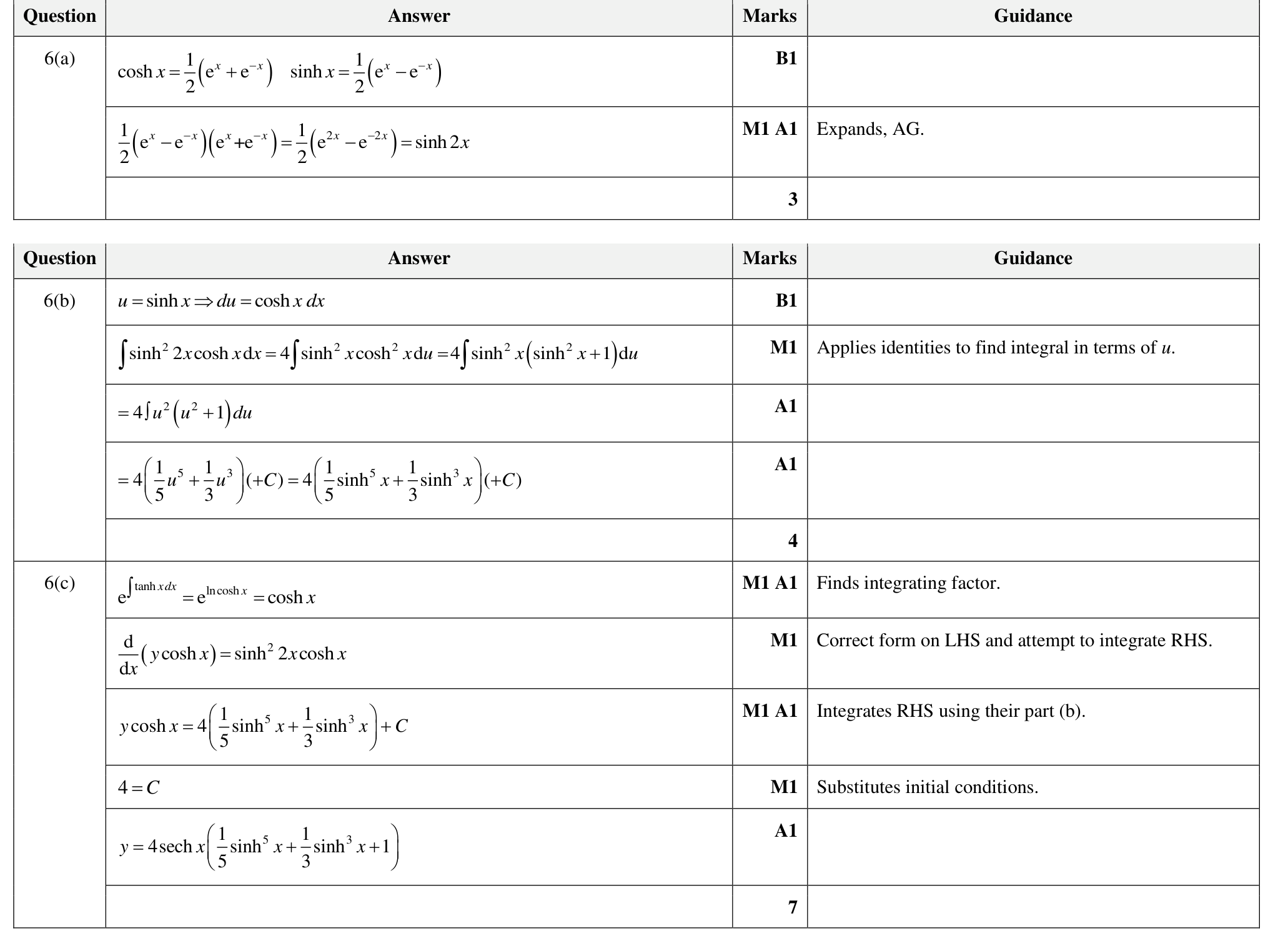
(a) Starting from the definitions of cosh and sinh in terms of exponentials, prove that
\(\sinh 2 x=2 \sinh x \cosh x .\)
(b) Using the substitution \(u=\sinh x\), find \(\int \sinh ^{2} 2 x \cosh x \mathrm{~d} x\).
(c) Find the particular solution of the differential equation
\(\frac{\mathrm{d} y}{\mathrm{~d} x}+y \tanh x=\sinh ^{2} 2 x,\)
given that \(y=4\) when \(x=0\). Give your answer in the form \(y=\mathrm{f}(x)\).
9231 P21 - Jun 2022 - Q2 - 8 marks
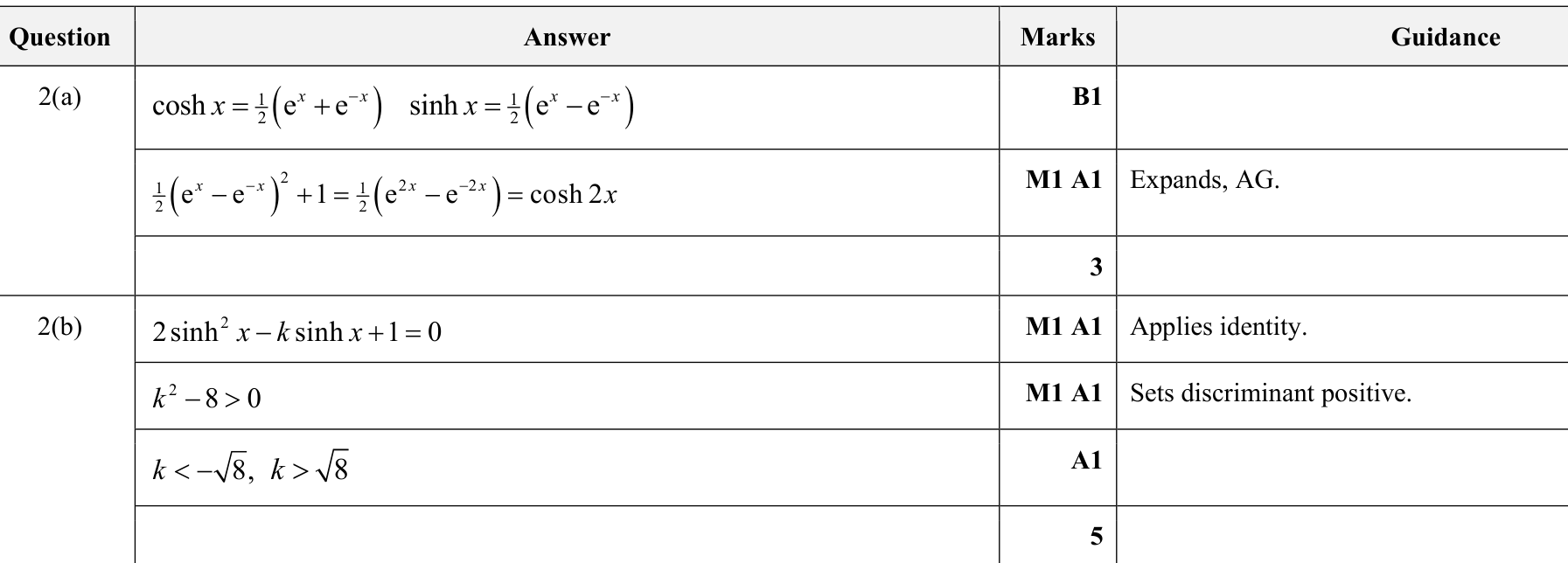
(a) Starting from the definitions of cosh and sinh in terms of exponentials, prove that
\(\cosh 2 x=2 \sinh ^{2} x+1 .\)
(b) Find the set of values of \(k\) for which \(\cosh 2 x=k \sinh x\) has two distinct real roots.
9231 P11 - Jun 2019 - Q9 - 10 marks
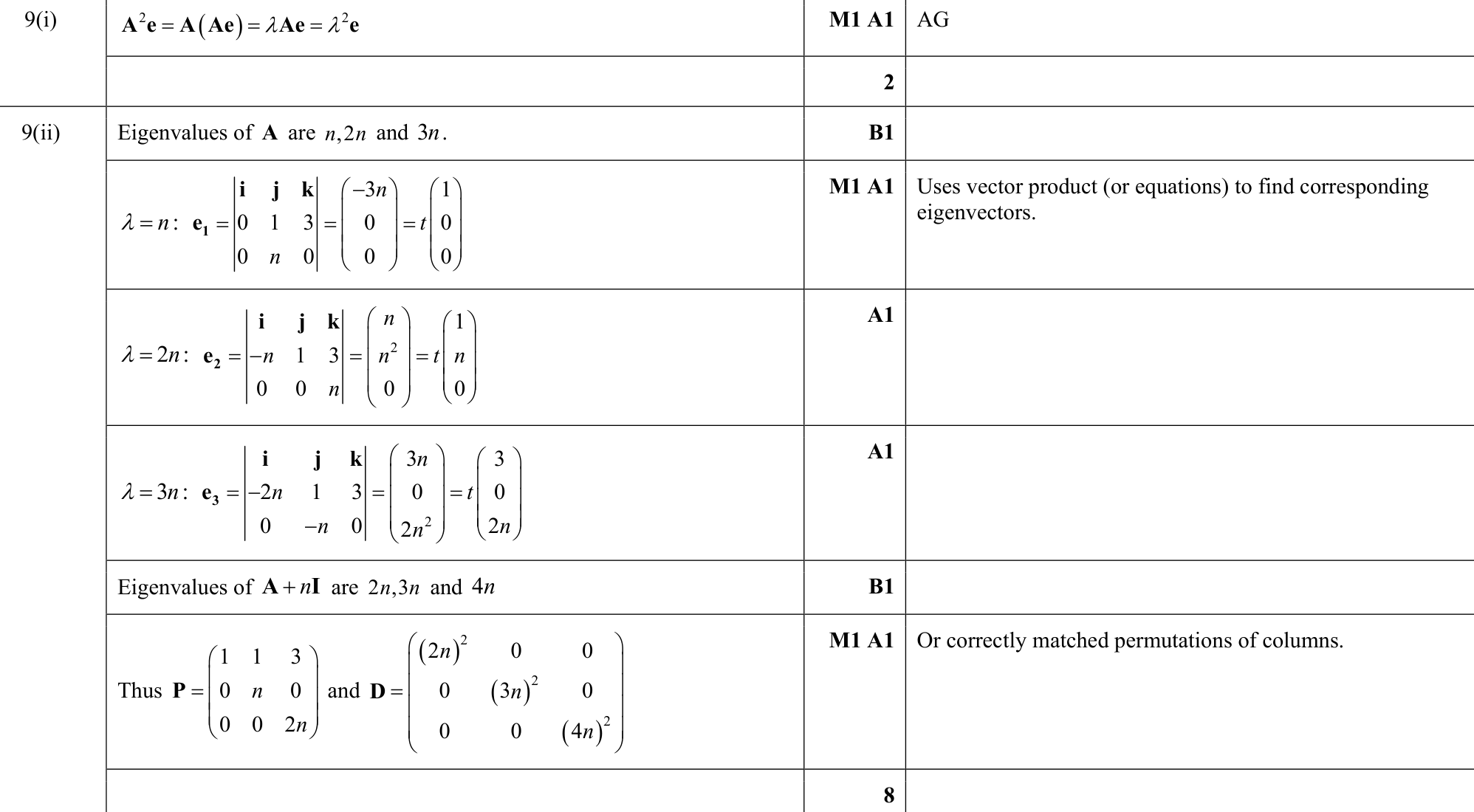
9 It is given that \(\mathbf{e}\) is an eigenvector of the matrix \(\mathbf{A}\), with corresponding eigenvalue \(\lambda\).
(i) Show that \(\mathbf{e}\) is an eigenvector of \(\mathbf{A}^{2}\), with corresponding eigenvalue \(\lambda^{2}\).
The matrices \(\mathbf{A}\) and \(\mathbf{B}\) are given by
\(\mathbf{A}=\left(\begin{array}{ccc}
n & 1 & 3 \\
0 & 2 n & 0 \\
0 & 0 & 3 n
\end{array}\right) \quad \text { and } \quad \mathbf{B}=(\mathbf{A}+n \mathbf{I})^{2}\)
where \(\mathbf{I}\) is the \(3 \times 3\) identity matrix and \(n\) is a non-zero integer.
(ii) Find, in terms of \(n\), a non-singular matrix \(\mathbf{P}\) and a diagonal matrix \(\mathbf{D}\) such that \(\mathbf{B}=\mathbf{P D P}^{-1}\).
9231 P13 - Jun 2019 - Q11 - 28 marks
11 Answer only one of the following two alternatives.
EITHER
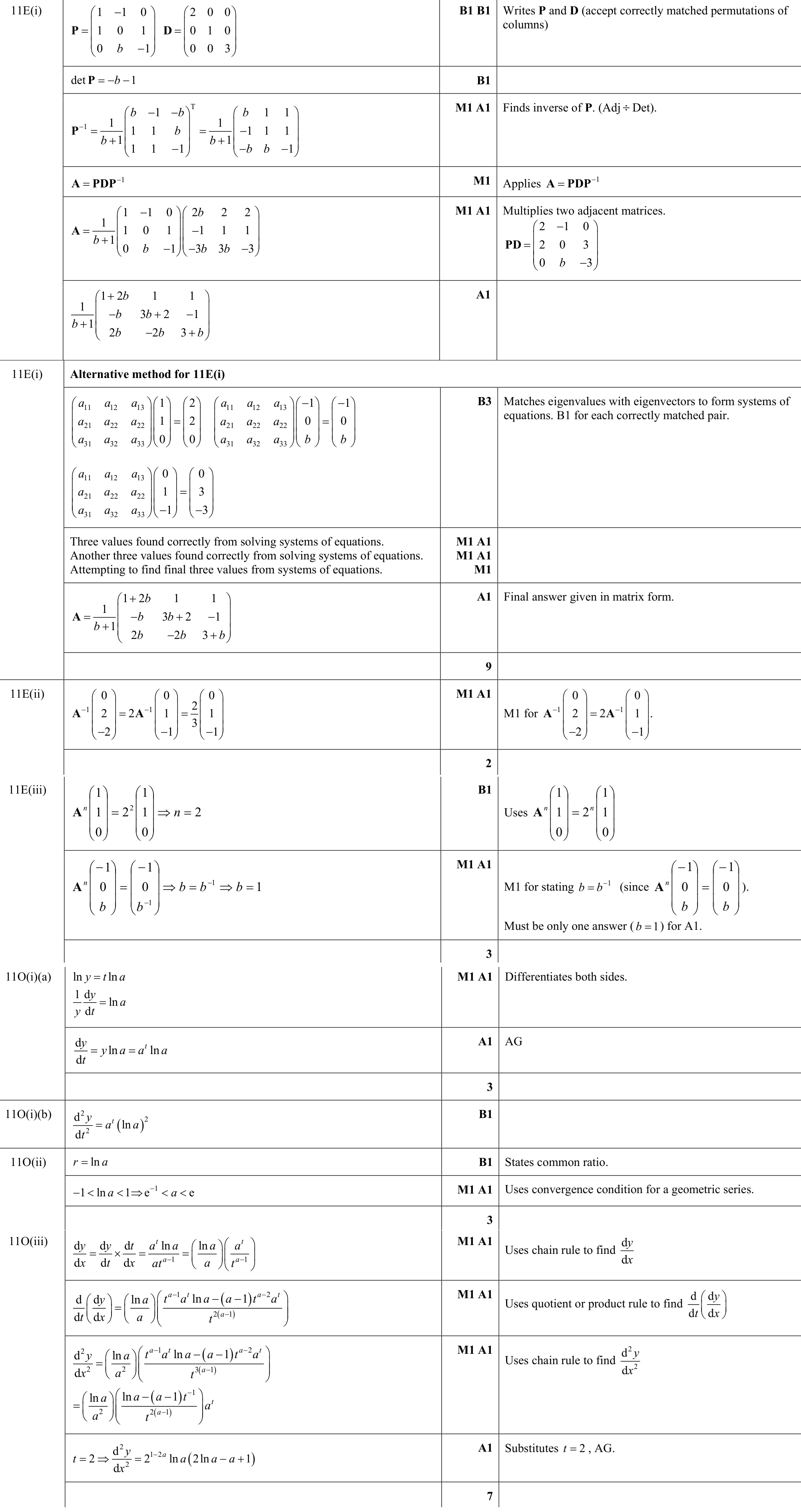
A \(3\times3\) matrix \(A\) has distinct eigenvalues \(2\), \(1\), \(3\), with corresponding eigenvectors \(\begin{pmatrix}1\\1\\0\end{pmatrix}\), \(\begin{pmatrix}-1\\0\\b\end{pmatrix}\), \(\begin{pmatrix}0\\1\\-1\end{pmatrix}\), respectively, where \(b\) is a positive constant.
(i) Find \(A\) in terms of \(b\).
(ii) Find \(A^{-1}\begin{pmatrix}0\\2\\-2\end{pmatrix}\).
(iii) It is given that \(A^n\begin{pmatrix}1\\1\\0\end{pmatrix}=\begin{pmatrix}4\\4\\0\end{pmatrix}\) and \(A^n\begin{pmatrix}-1\\0\\b\end{pmatrix}=\begin{pmatrix}-1\\0\\b^{-1}\end{pmatrix}\). Find the values of \(n\) and \(b\).
9231 P13 - Jun 2018 - Q5 - 8 marks
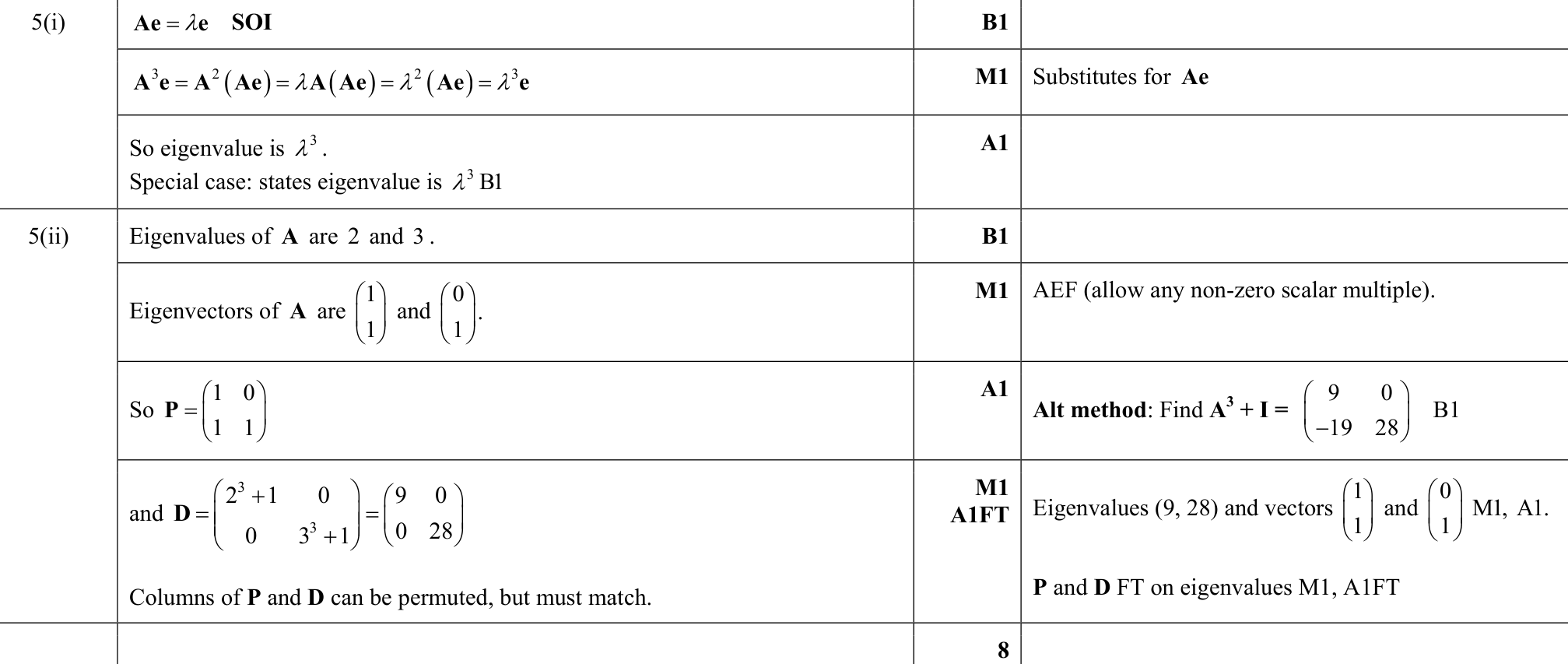
It is given that \(\mathbf{e}\) is an eigenvector of the matrix \(\mathbf{A}\) with corresponding eigenvalue \(\lambda\).
(i) Show that \(\mathbf{e}\) is an eigenvector of \(\mathbf{A}^{3}\) and state the corresponding eigenvalue.
It is given that
\(\mathbf{A}=\left(\begin{array}{rr}
2 & 0 \\
-1 & 3
\end{array}\right) .\)
(ii) Find a matrix \(\mathbf{P}\) and a diagonal matrix \(\mathbf{D}\) such that
\(\mathbf{A}^{3}+\mathbf{I}=\mathbf{P D P} \mathbf{P}^{-1}\)
where \(\mathbf{I}\) is the \(2 \times 2\) identity matrix.
9231 P11 - Nov 2018 - Q5 - 9 marks
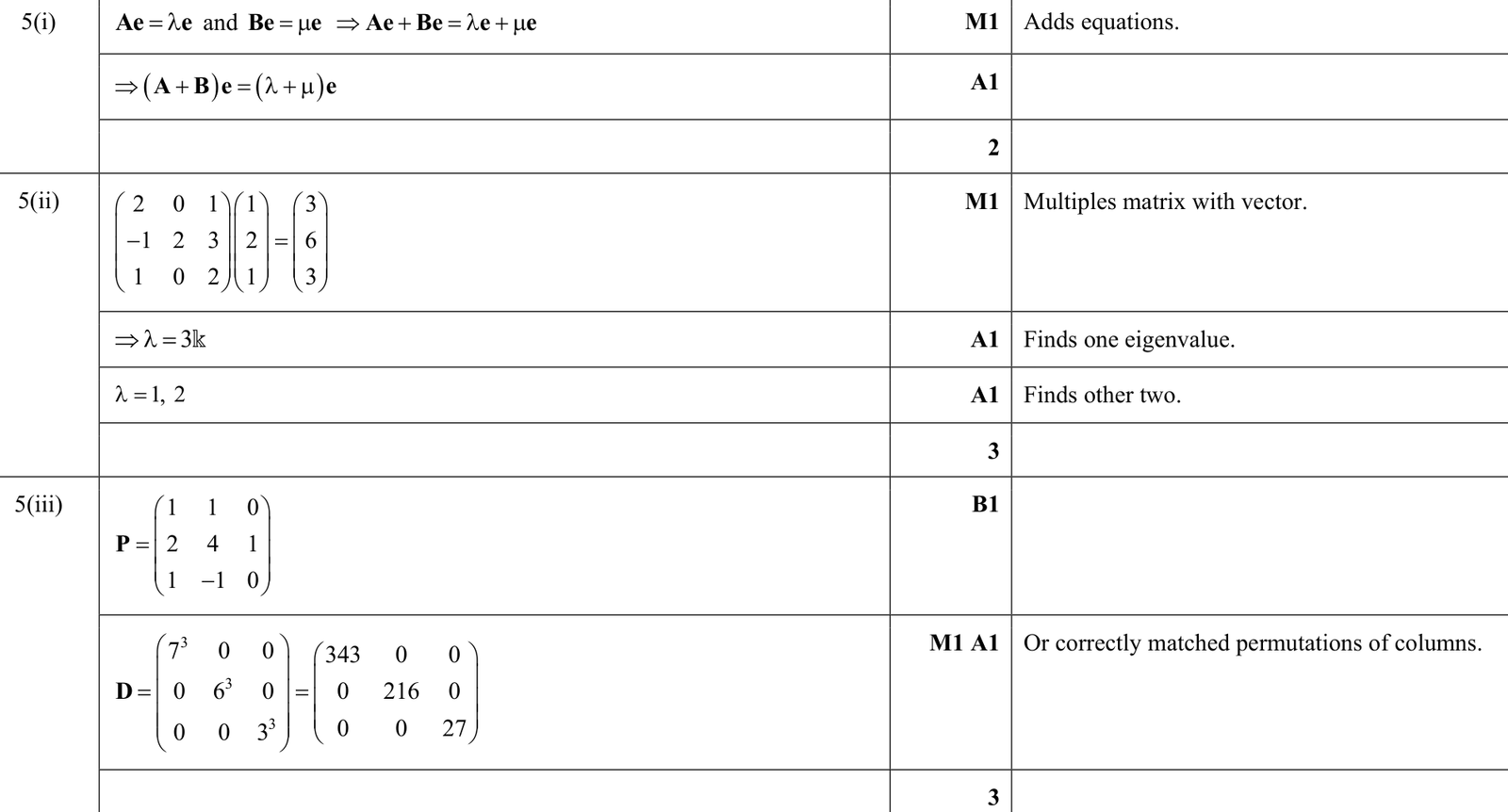
It is given that \(\lambda\) is an eigenvalue of the matrix \(\mathbf{A}\) with \(\mathbf{e}\) as a corresponding eigenvector, and \(\mu\) is an eigenvalue of the matrix \(\mathbf{B}\) for which \(\mathbf{e}\) is also a corresponding eigenvector.
(i) Show that \(\lambda+\mu\) is an eigenvalue of the matrix \(\mathbf{A}+\mathbf{B}\) with \(\mathbf{e}\) as a corresponding eigenvector.
The matrix \(\mathbf{A}\), given by
\(\mathbf{A}=\left(\begin{array}{rrr}
2 & 0 & 1 \\
-1 & 2 & 3 \\
1 & 0 & 2
\end{array}\right)\)
has \(\left(\begin{array}{l}1 \\ 2 \\ 1\end{array}\right),\left(\begin{array}{r}1 \\ 4 \\ -1\end{array}\right)\) and \(\left(\begin{array}{l}0 \\ 1 \\ 0\end{array}\right)\) as eigenvectors.
(ii) Find the corresponding eigenvalues.
The matrix \(\mathbf{B}\) has eigenvalues 4, 5 and 1 with corresponding eigenvectors \(\left(\begin{array}{l}1 \\ 2 \\ 1\end{array}\right),\left(\begin{array}{r}1 \\ 4 \\ -1\end{array}\right)\) and \(\left(\begin{array}{l}0 \\ 1 \\ 0\end{array}\right)\) respectively.
(iii) Find a matrix \(\mathbf{P}\) and a diagonal matrix \(\mathbf{D}\) such that \((\mathbf{A}+\mathbf{B})^{3}=\mathbf{P D P}^{-1}\).
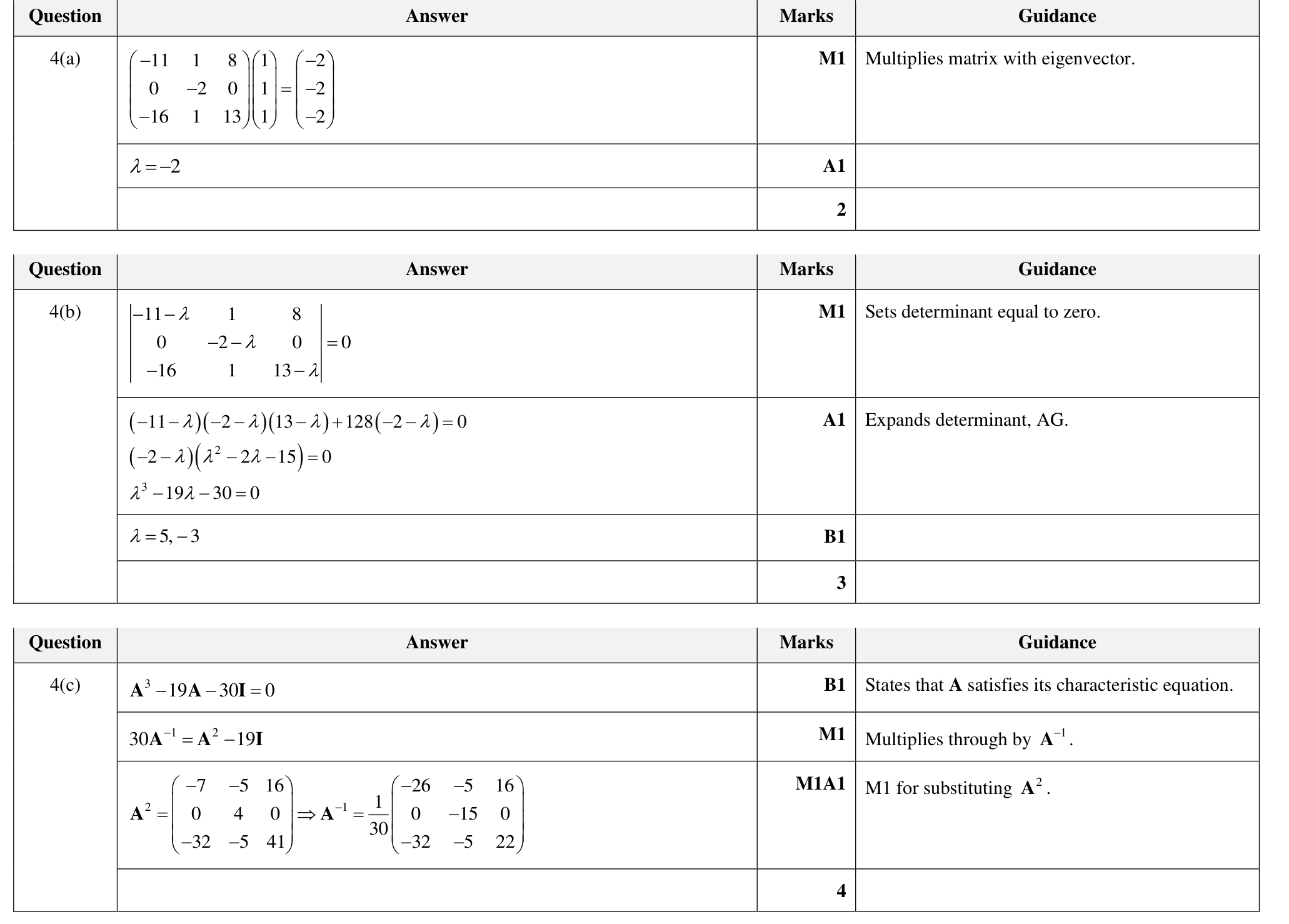
9231 P21 - Nov 2024 - Q4 - 9 marks
The matrix \(\mathbf{A}\) is given by
\(\mathbf{A}=\left(\begin{array}{rrr} -11 & 1 & 8 \\ 0 & -2 & 0 \\ -16 & 1 & 13 \end{array}\right)\)
(a) Show that \(\left(\begin{array}{l}1 \\ 1 \\ 1\end{array}\right)\) is an eigenvector of \(\mathbf{A}\) and state the corresponding eigenvalue.
(b) Show that the characteristic equation of \(\mathbf{A}\) is \(\lambda^{3}-19 \lambda-30=0\) and hence find the other eigenvalues of \(\mathbf{A}\).
(c) Use the characteristic equation of \(\mathbf{A}\) to find \(\mathbf{A}^{-1}\).
9231 P22 - Nov 2023 - Q6 - 10 marks
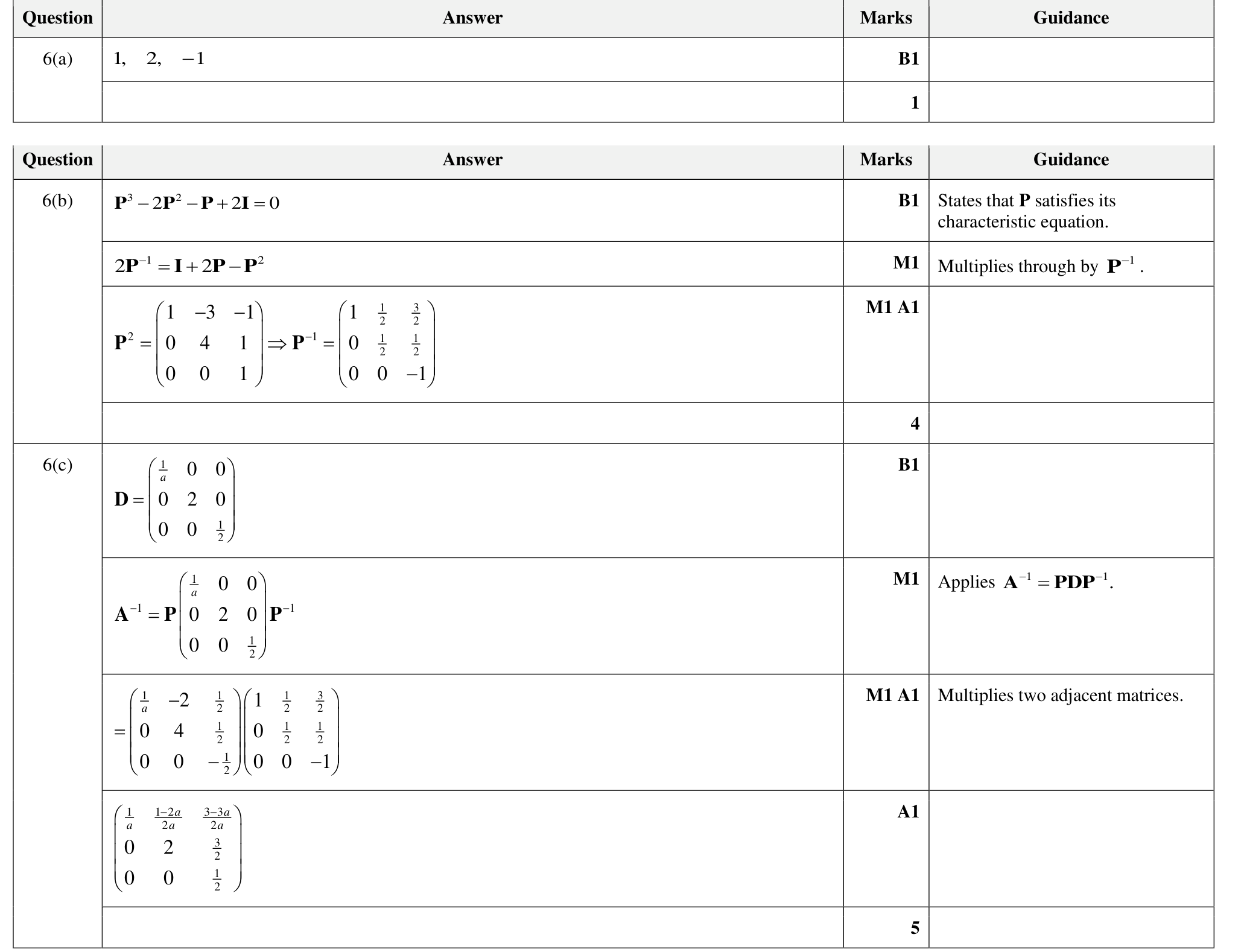
The matrix \(\mathbf{P}\) is given by
\(\mathbf{P}=\left(\begin{array}{rrr} 1 & -1 & 1 \\ 0 & 2 & 1 \\ 0 & 0 & -1 \end{array}\right) .\)
(a) State the eigenvalues of \(\mathbf{P}\).
(b) Use the characteristic equation of \(\mathbf{P}\) to find \(\mathbf{P}^{-1}\).
The \(3 \times 3\) matrix \(\mathbf{A}\) has distinct non-zero eigenvalues \(a, \frac{1}{2}, 2\) with corresponding eigenvectors
\(\left(\begin{array}{l} 1 \\ 0 \\ \end{array}\right), \quad\left(\begin{array}{r} -1 \\ 2 \\ \end{array}\right), \quad\left(\begin{array}{r} 1 \\ 1 \\ -1 \end{array}\right),\)
respectively.
(c) Find \(\mathbf{A}^{-1}\) in terms of \(a\).
9231 P23 - Jun 2022 - Q3 - 7 marks
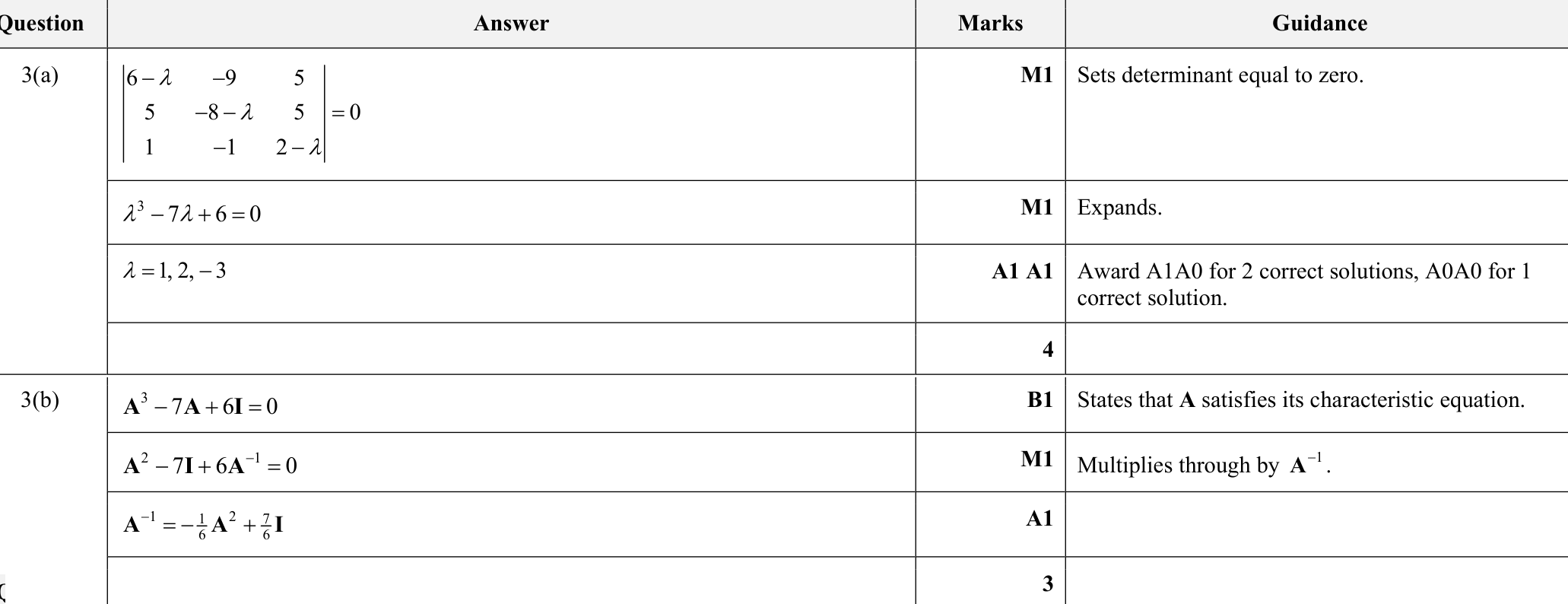
The matrix \(\mathbf{A}\) is given by
\(\mathbf{A}=\left(\begin{array}{lll} 6 & -9 & 5 \\ 5 & -8 & 5 \\ 1 & -1 & 2 \end{array}\right) .\)
(a) Find the eigenvalues of \(\mathbf{A}\).
(b) Use the characteristic equation of \(\mathbf{A}\) to show that \(\mathbf{A}^{-1}=p \mathbf{A}^{2}+q \mathbf{I}\), where \(p\) and \(q\) are constants to be determined.
9231 P12 - Nov 2018 - Q2 - 6 marks
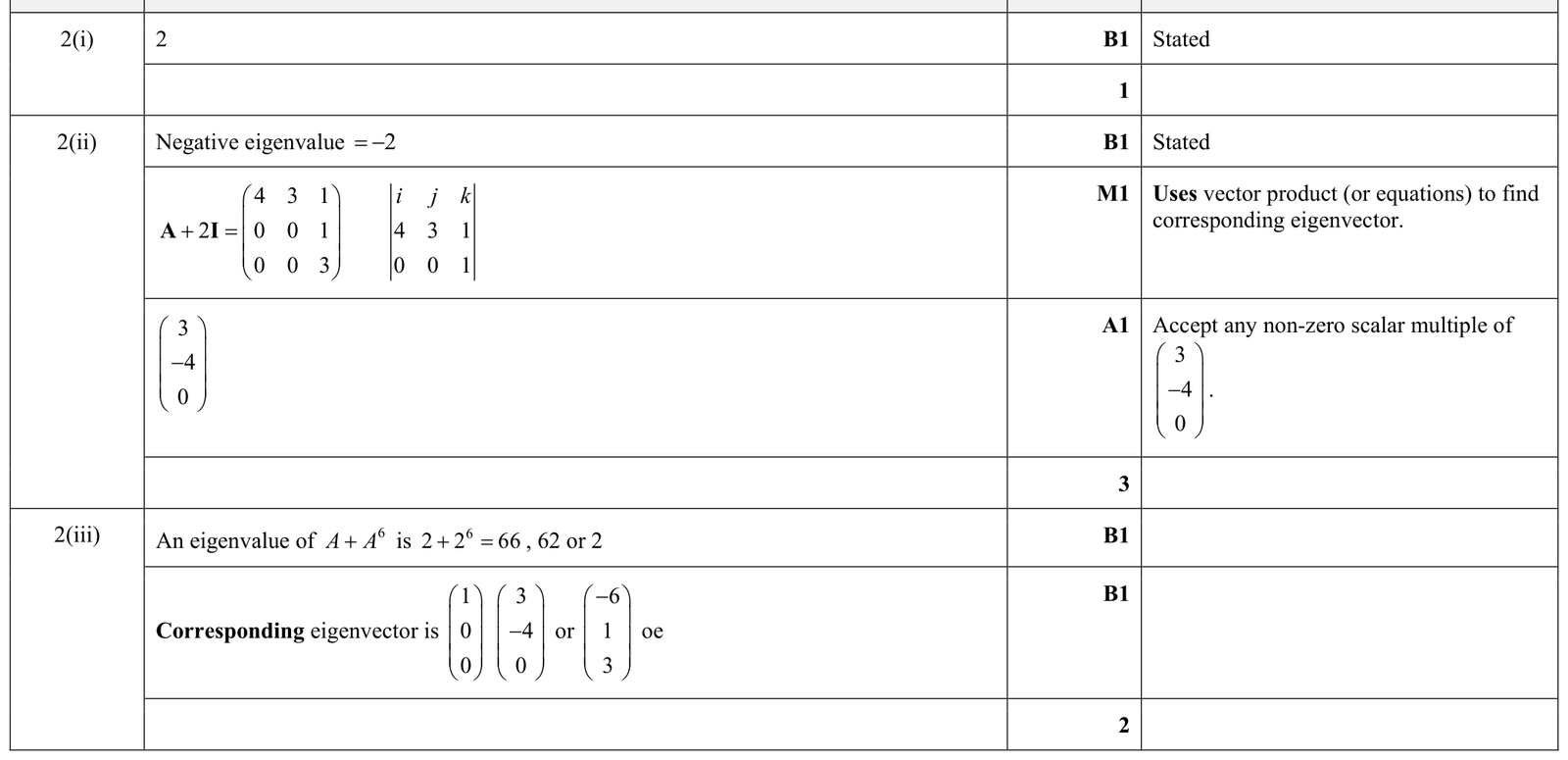
It is given that
\(\mathbf{A}=\left(\begin{array}{rrr} 2 & 3 & 1 \\ 0 & -2 & 1 \\ 0 & 0 & 1 \end{array}\right) .\)
(i) Find the eigenvalue of \(\mathbf{A}\) corresponding to the eigenvector \(\left(\begin{array}{l}1 \\ 0 \\ 0\end{array}\right)\).
(ii) Write down the negative eigenvalue of \(\mathbf{A}\) and find a corresponding eigenvector.
(iii) Find an eigenvalue and a corresponding eigenvector of the matrix \(\mathbf{A}+\mathbf{A}^{6}\).
9231 P11 - Jun 2017 - Q5 - 6 marks
The matrix \(\mathbf{A}\), given by
\(\mathbf{A}=\left(\begin{array}{lll} 1 & 2 & -2 \\ 6 & 4 & -6 \\ 6 & 5 & -7 \end{array}\right),\)
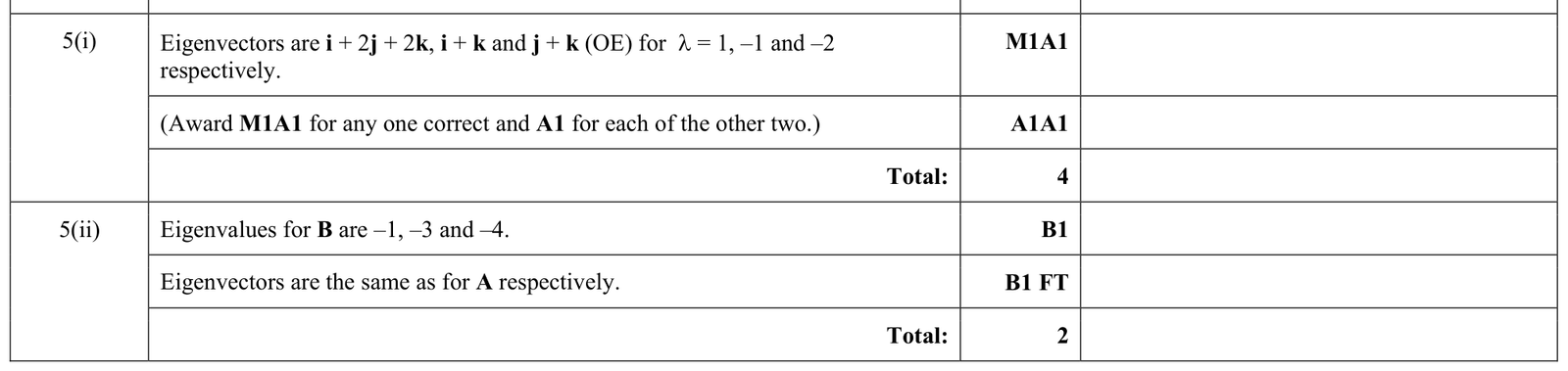
has eigenvalues \(1,-1\) and -2 .
(i) Find a set of corresponding eigenvectors.
(ii) The matrix \(\mathbf{B}\) is given by \(\mathbf{B}=\mathbf{A}-2 \mathbf{I}\), where \(\mathbf{I}\) is the \(3 \times 3\) identity matrix. Write down the eigenvalues of \(\mathbf{B}\), and state a set of corresponding eigenvectors.
9231 P13 - Jun 2017 - Q10 - 13 marks
The matrix \(\mathbf{A}\) is given by
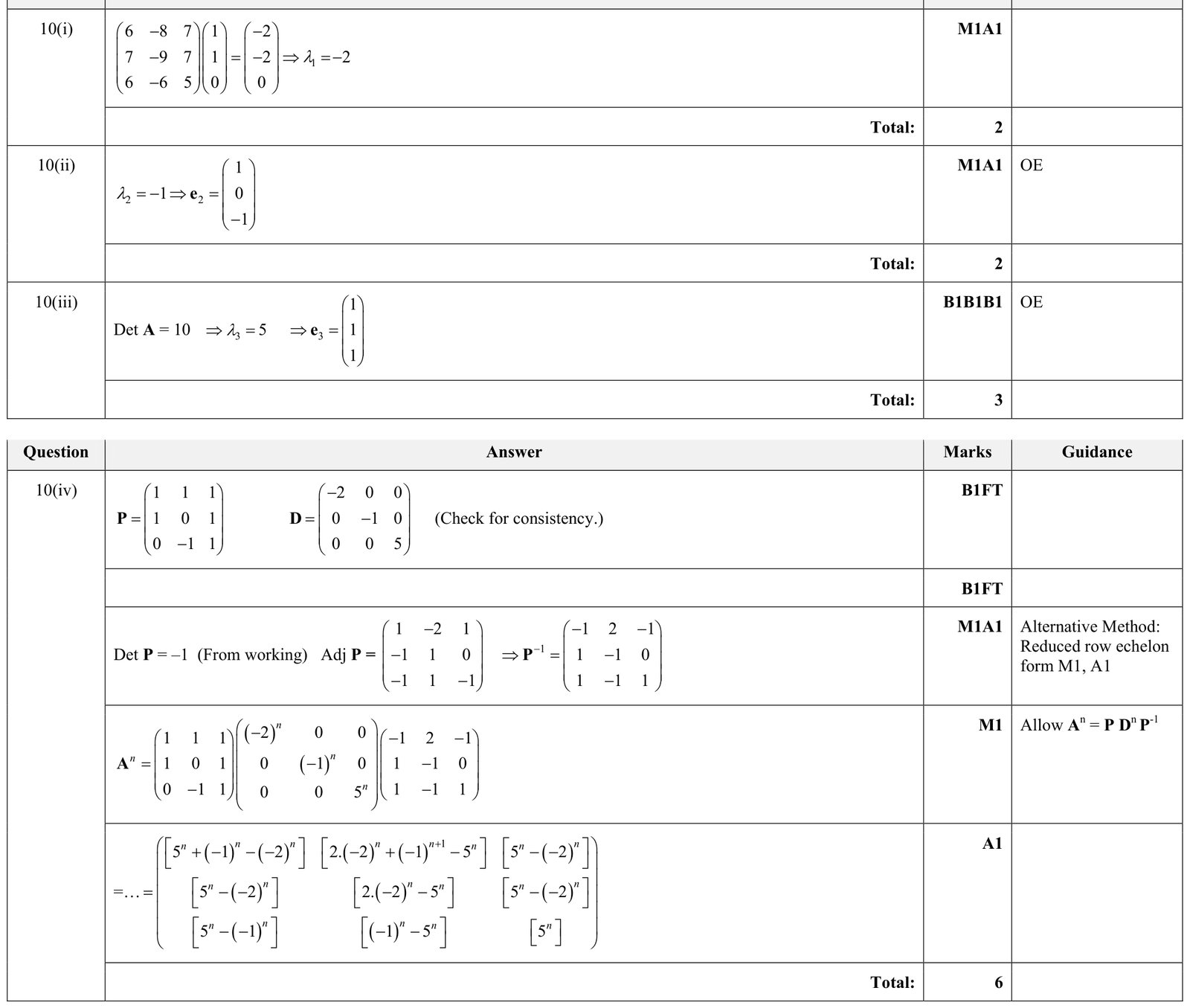
\(\mathbf{A}=\left(\begin{array}{lll} 6 & -8 & 7 \\ 7 & -9 & 7 \\ 6 & -6 & 5 \end{array}\right)\)
(i) Given that \(\left(\begin{array}{l}1 \\ 1 \\ 0\end{array}\right)\) is an eigenvector of \(\mathbf{A}\), find the corresponding eigenvalue.
(ii) Given also that -1 is an eigenvalue of \(\mathbf{A}\), find a corresponding eigenvector.
(iii) It is given that the determinant of \(\mathbf{A}\) is equal to the product of the eigenvalues of \(\mathbf{A}\). Use this result to find the third eigenvalue of \(\mathbf{A}\), and find also a corresponding eigenvector.
(iv) Write down matrices \(\mathbf{P}\) and \(\mathbf{D}\) such that \(\mathbf{P}^{-1} \mathbf{A P}=\mathbf{D}\), where \(\mathbf{D}\) is a diagonal matrix, and hence find the matrix \(\mathbf{A}^{n}\) in terms of \(n\), where \(n\) is a positive integer.
9231 P13 - Jun 2014 - Q8 - 11 marks
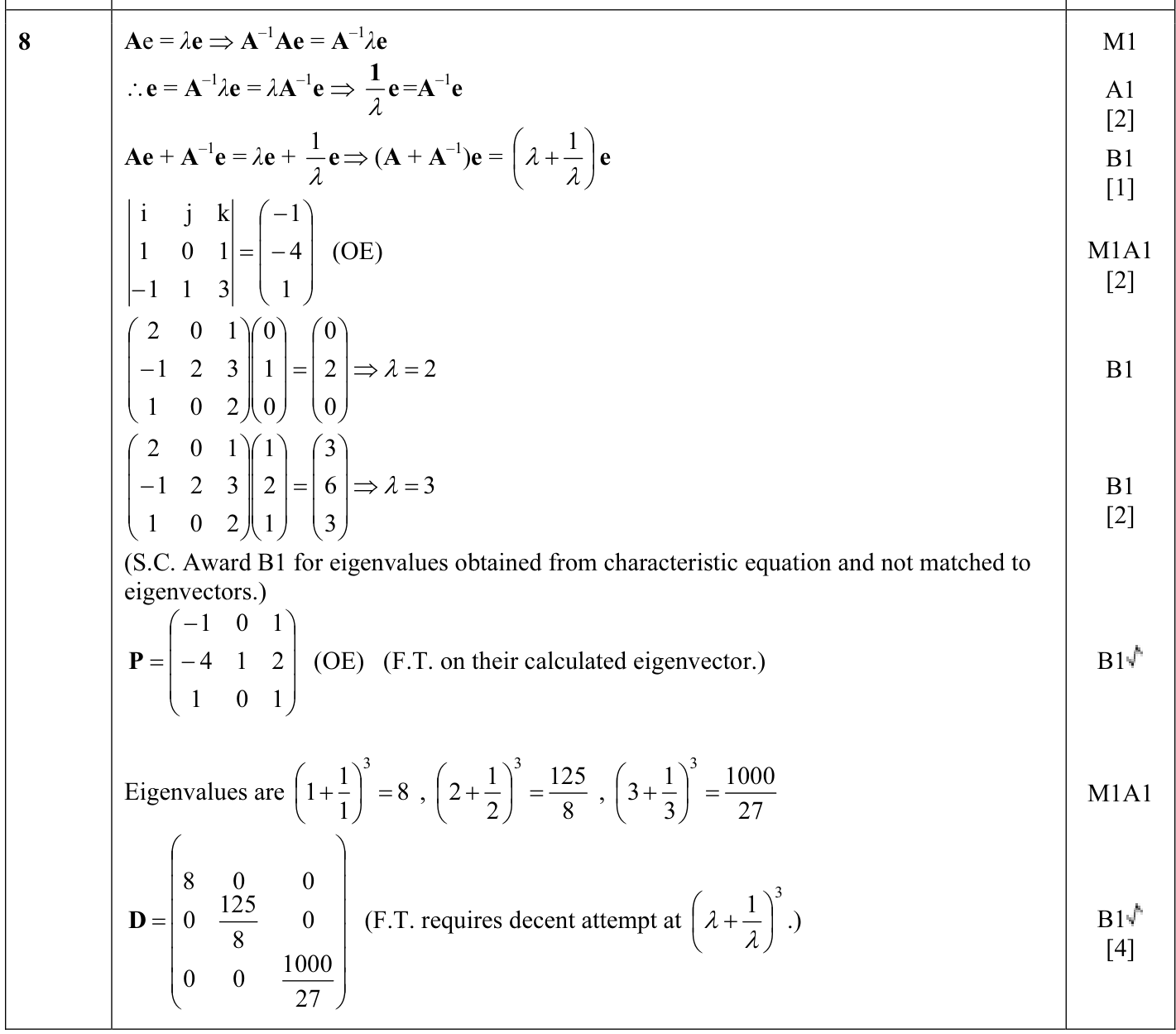
It is given that \(\lambda\) is an eigenvalue of the non-singular square matrix \(\mathbf{A}\), with corresponding eigenvector \(\mathbf{e}\). Show that \(\lambda^{-1}\) is an eigenvalue of \(\mathbf{A}^{-1}\) for which \(\mathbf{e}\) is a corresponding eigenvector.
Deduce that \(\lambda+\lambda^{-1}\) is an eigenvalue of \(\mathbf{A}+\mathbf{A}^{-1}\).
It is given that \(1\) is an eigenvalue of the matrix \(\mathbf{A}\), where
\(\mathbf{A}=\begin{pmatrix}2&0&1\\-1&2&3\\1&0&2\end{pmatrix}.\)
Find a corresponding eigenvector.
It is also given that \(\begin{pmatrix}0\\1\\0\end{pmatrix}\) and \(\begin{pmatrix}1\\2\\1\end{pmatrix}\) are eigenvectors of \(\mathbf{A}\). Find the corresponding eigenvalues.
Hence find a matrix \(\mathbf{P}\) and a diagonal matrix \(\mathbf{D}\) such that \(\left(\mathbf{A}+\mathbf{A}^{-1}\right)^3=\mathbf{PDP}^{-1}\).
9231 P11 - Jun 2014 - Q9 - 10 marks
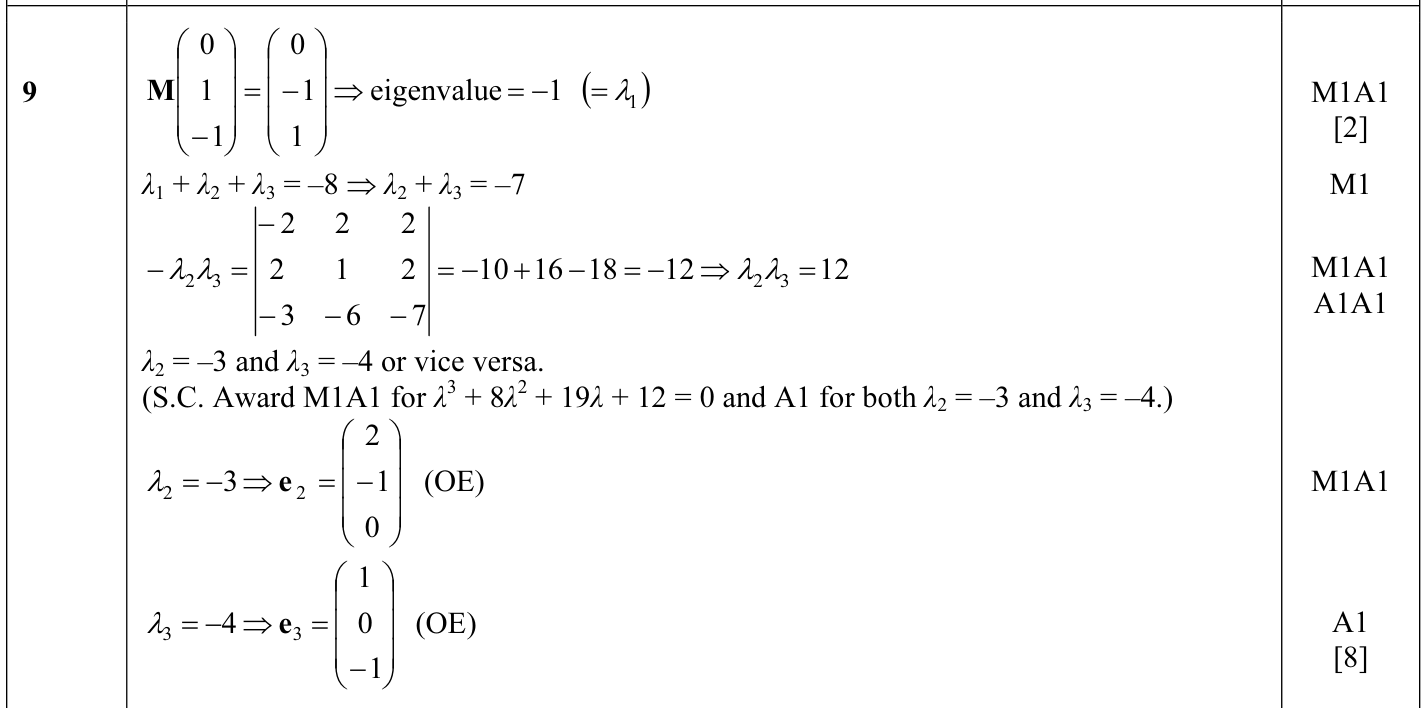
The matrix \(\mathbf{M}\), where
\(\mathbf{M}=\left(\begin{array}{rrr} -2 & 2 & 2 \\ 2 & 1 & 2 \\ -3 & -6 & -7 \end{array}\right),\)
has an eigenvector \(\left(\begin{array}{r}0 \\ 1 \\ -1\end{array}\right)\). Find the corresponding eigenvalue.
It is given that if the eigenvalues of a general \(3 \times 3\) matrix \(\mathbf{A}\), where
\(\mathbf{A}=\left(\begin{array}{lll} a & b & c \\ d & e & f \\ g & h & i \end{array}\right),\)
are \(\lambda_{1}, \lambda_{2}\) and \(\lambda_{3}\) then
\(\lambda_{1}+\lambda_{2}+\lambda_{3}=a+e+i\)
and
the determinant of \(\mathbf{A}\) has the value \(\lambda_{1} \lambda_{2} \lambda_{3}\).
Use these results to find the other two eigenvalues of the matrix \(\mathbf{M}\), and find corresponding eigenvectors.