Past Exam Questions
← Back9231 P11 - Nov 2015 - Q6 - 10 marks
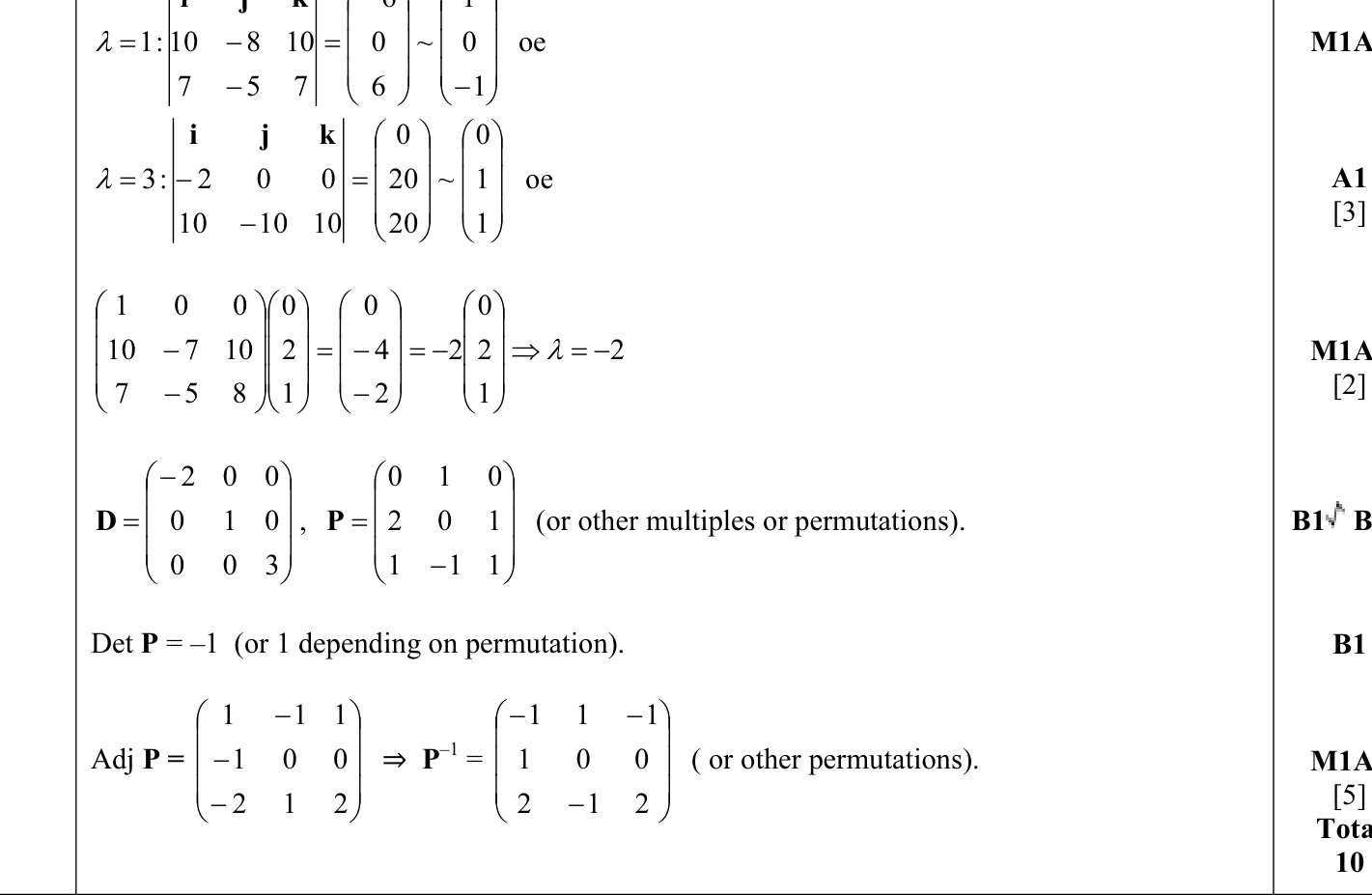
The matrix A, where
\(\mathbf{A}=\left(\begin{array}{rrr} 1 & 0 & 0 \\ 10 & -7 & 10 \\ 7 & -5 & 8 \end{array}\right),\)
has eigenvalues 1 and 3 . Find corresponding eigenvectors.
It is given that \(\left(\begin{array}{l}0 \\ 2 \\ 1\end{array}\right)\) is an eigenvector of \(\mathbf{A}\). Find the corresponding eigenvalue.
Find a diagonal matrix \(\mathbf{D}\) and matrices \(\mathbf{P}\) and \(\mathbf{P}^{-1}\) such that \(\mathbf{P}^{-1} \mathbf{A P}=\mathbf{D}\).
9231 P13 - Jun 2015 - Q11O - 14 marks
OR
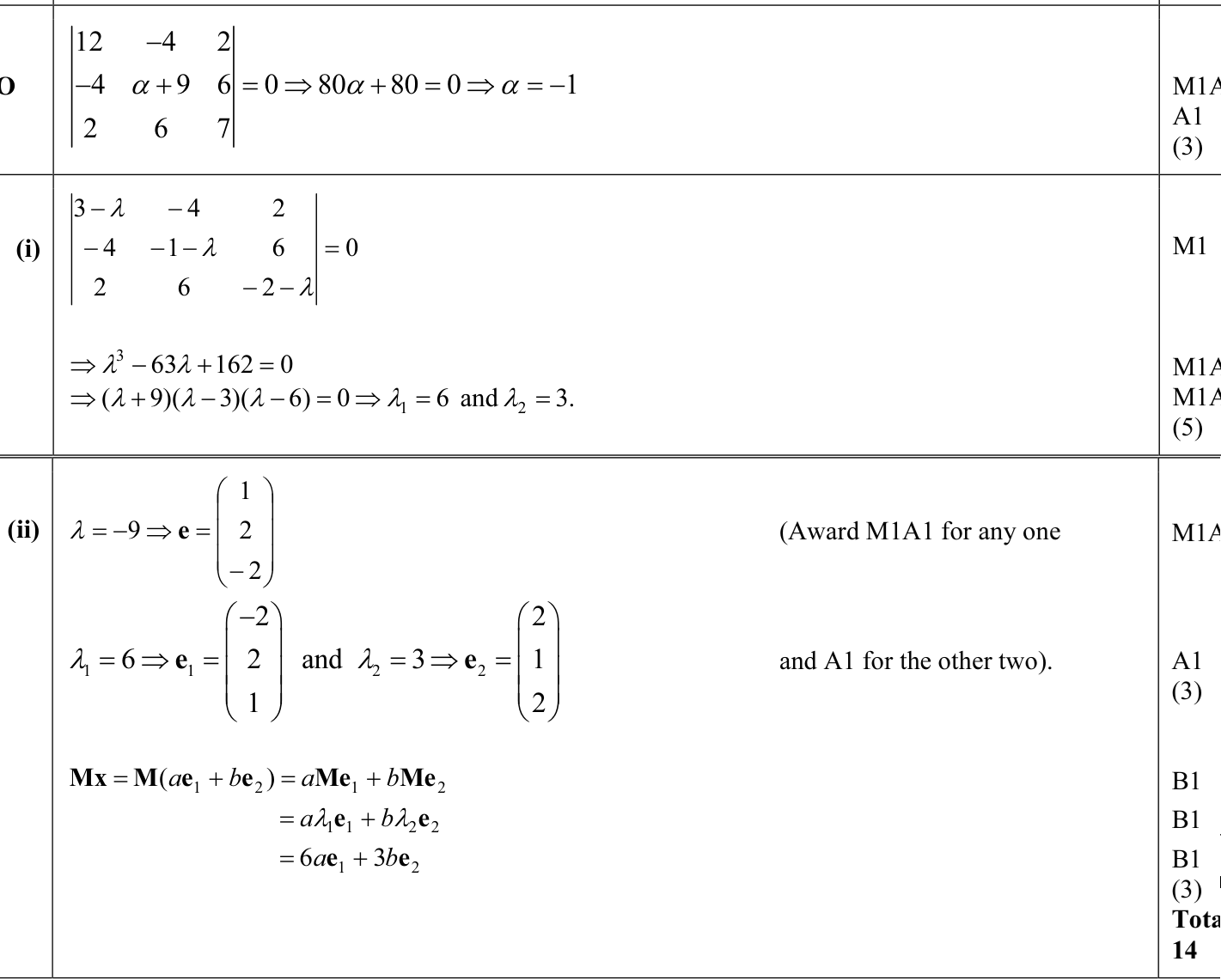
One of the eigenvalues of the matrix \(\mathbf M\), where
\(\mathbf M=\begin{pmatrix}3&-4&2\\-4&\alpha&6\\2&6&-2\end{pmatrix}\),
is \(-9\). Find the value of \(\alpha\).
Find
(i) the other two eigenvalues, \(\lambda_1\) and \(\lambda_2\), of \(\mathbf M\), where \(\lambda_1\gt\lambda_2\),
(ii) corresponding eigenvectors for all three eigenvalues of \(\mathbf M\).
It is given that \(\mathbf x=a\mathbf e_1+b\mathbf e_2\), where \(\mathbf e_1\) and \(\mathbf e_2\) are eigenvectors of \(\mathbf M\) corresponding to \(\lambda_1\) and \(\lambda_2\), respectively. Show that \(\mathbf M\mathbf x=p\mathbf e_1+q\mathbf e_2\), expressing \(p\) and \(q\) in terms of \(a\) and \(b\).
9231 P11 - Nov 2016 - Q3 - 7 marks
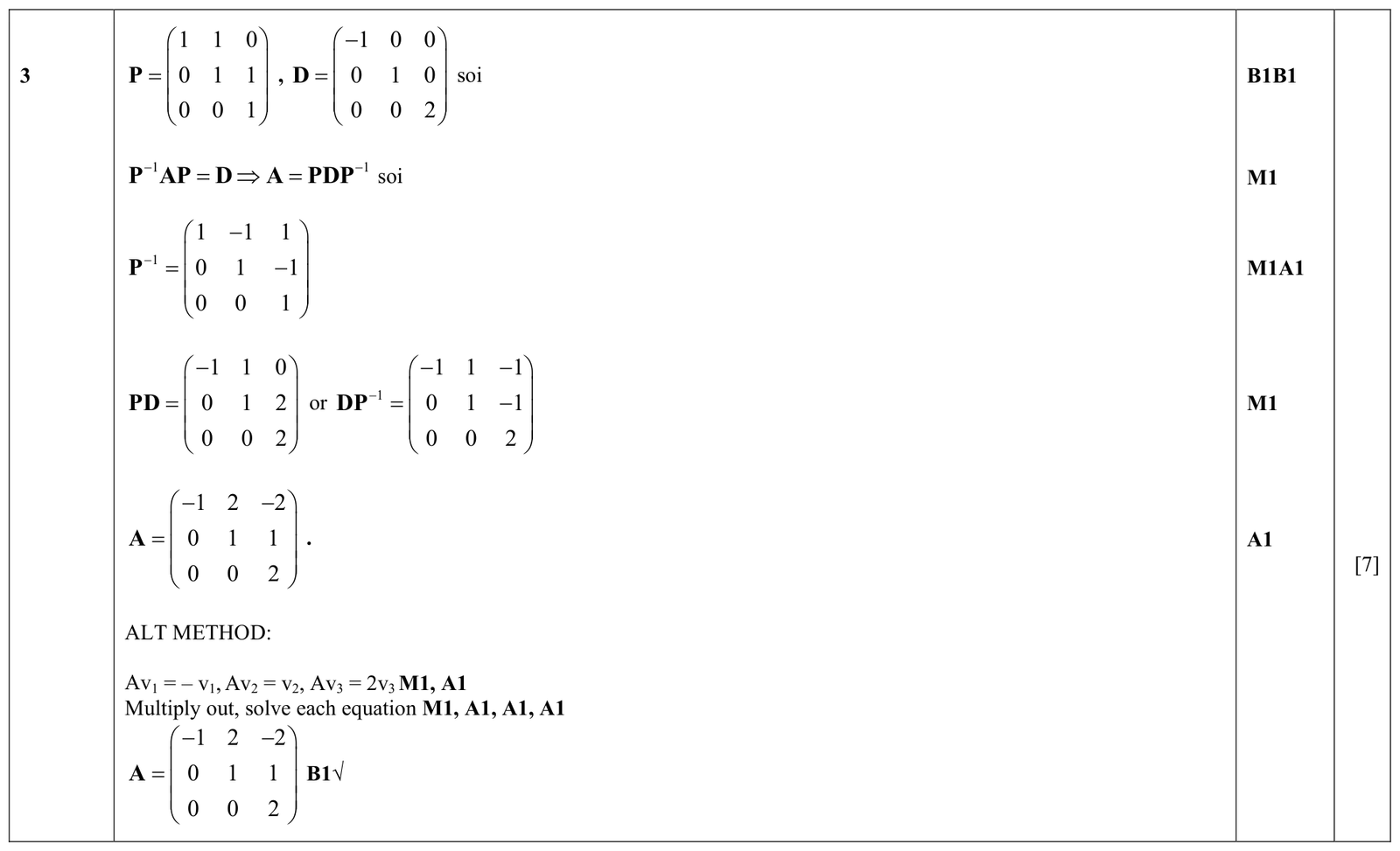
Find a matrix \(\mathbf{A}\) whose eigenvalues are \(-1,1,2\) and for which corresponding eigenvectors are
\(\left(\begin{array}{l} 1 \\ 0 \\ \end{array}\right), \quad\left(\begin{array}{l} 1 \\ 1 \\ \end{array}\right), \quad\left(\begin{array}{l} 0 \\ 1 \\ \end{array}\right),\)
respectively.
9231 P11 - Nov 2017 - Q11E - 13 marks
EITHER
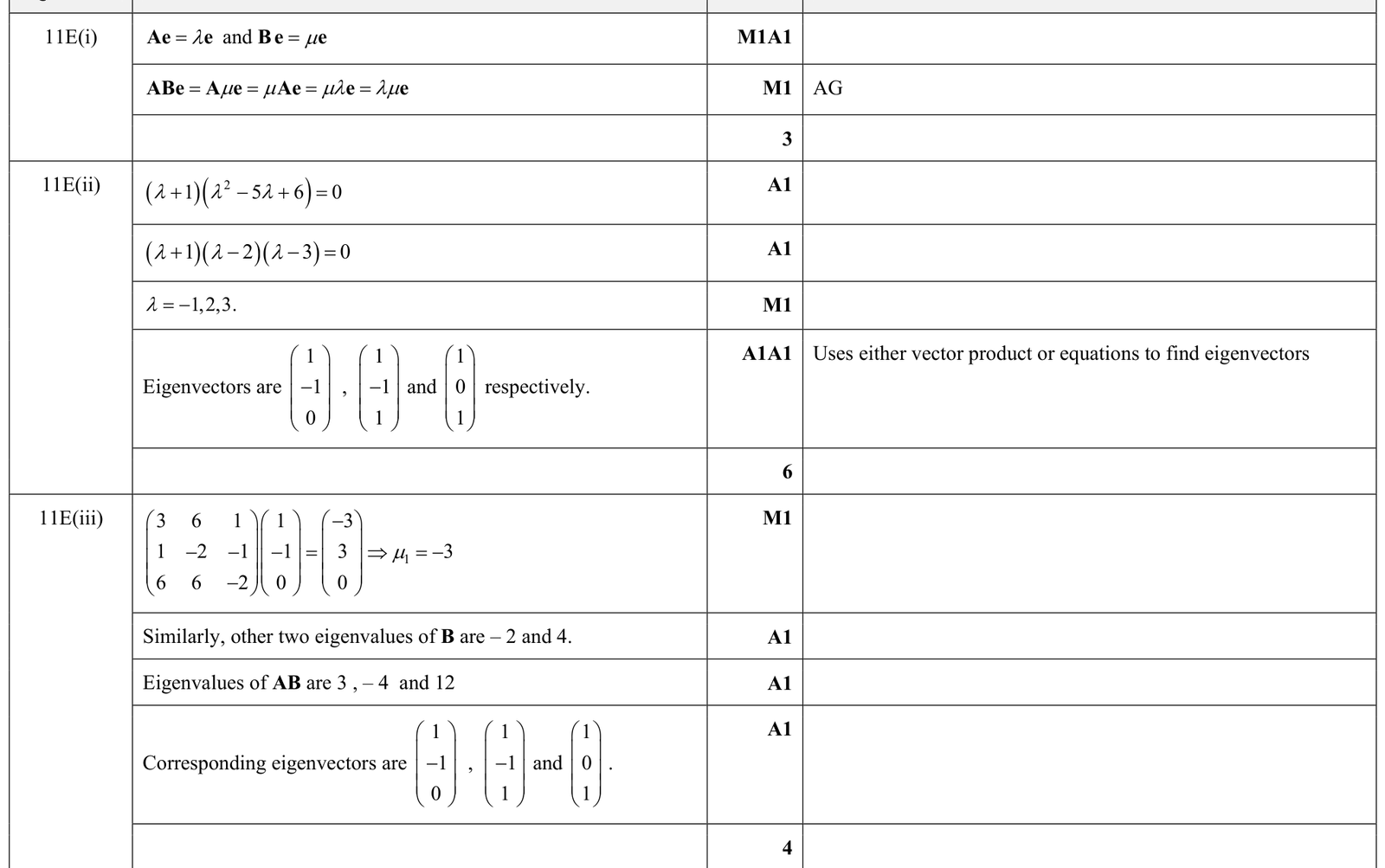
The vector \(\mathbf e\) is an eigenvector of the matrix \(\mathbf A\), with corresponding eigenvalue \(\lambda\), and is also an eigenvector of the matrix \(\mathbf B\), with corresponding eigenvalue \(\mu\).
(i) Show that \(\mathbf e\) is an eigenvector of the matrix \(\mathbf{AB}\) with corresponding eigenvalue \(\lambda\mu\).
(ii) Find the eigenvalues and corresponding eigenvectors of
\(\mathbf A=\begin{pmatrix}0&1&-3\\4&-3&-2\\1&1&2\end{pmatrix}.\)
(iii) The matrix
\(\mathbf B=\begin{pmatrix}3&6&1\\1&-2&-1\\6&6&-2\end{pmatrix}\)
has eigenvectors \(\begin{pmatrix}1\\-1\\0\end{pmatrix}\), \(\begin{pmatrix}1\\-1\\1\end{pmatrix}\) and \(\begin{pmatrix}1\\0\\1\end{pmatrix}\). Find the eigenvalues of \(\mathbf{AB}\), and state the corresponding eigenvectors.
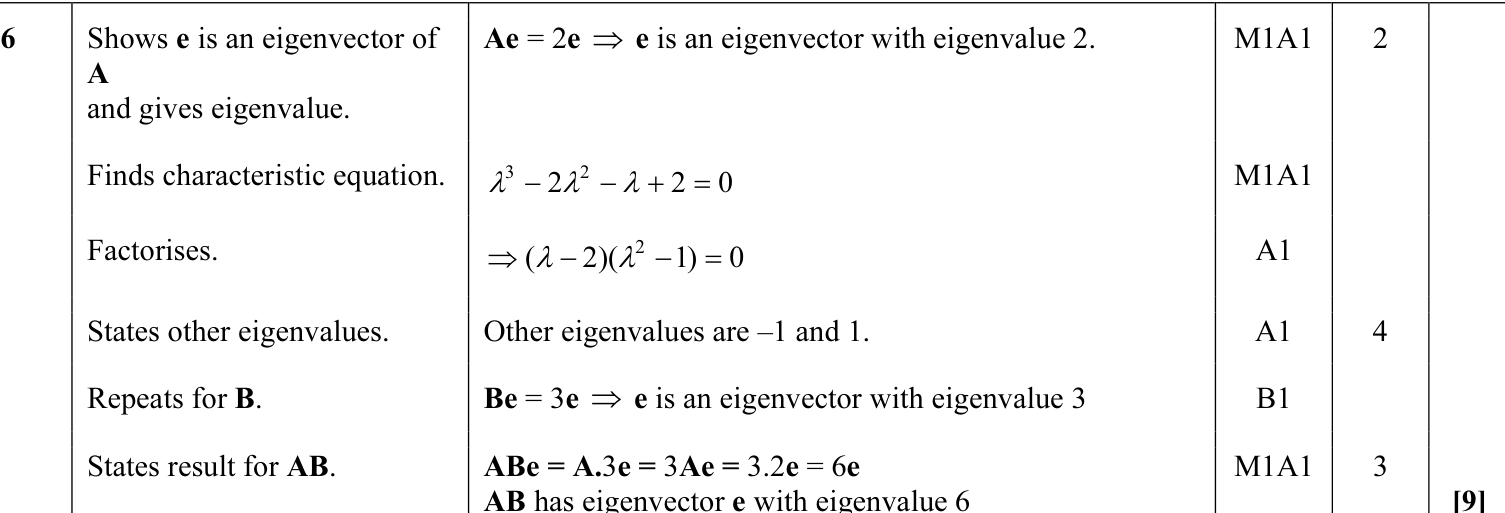
9231 P11 - Jun 2013 - Q6 - 9 marks
The matrix \(\mathbf{A}\) is given by
\(\mathbf{A}=\left(\begin{array}{lll} 4 & -5 & 3 \\ 3 & -4 & 3 \\ 1 & -1 & 2 \end{array}\right)\)
Show that \(\mathbf{e}=\left(\begin{array}{l}1 \\ 1 \\ 1\end{array}\right)\) is an eigenvector of \(\mathbf{A}\) and state the corresponding eigenvalue.
Find the other two eigenvalues of \(\mathbf{A}\).
The matrix \(\mathbf{B}\) is given by
\(\mathbf{B}=\left(\begin{array}{rrr} -1 & 4 & 0 \\ -1 & 3 & 1 \\ 1 & -1 & 3 \end{array}\right)\)
Show that \(\mathbf{e}\) is an eigenvector of \(\mathbf{B}\) and deduce an eigenvector of the matrix \(\mathbf{A B}\), stating the corresponding eigenvalue.
9231 P13 - Jun 2013 - Q9 - 11 marks
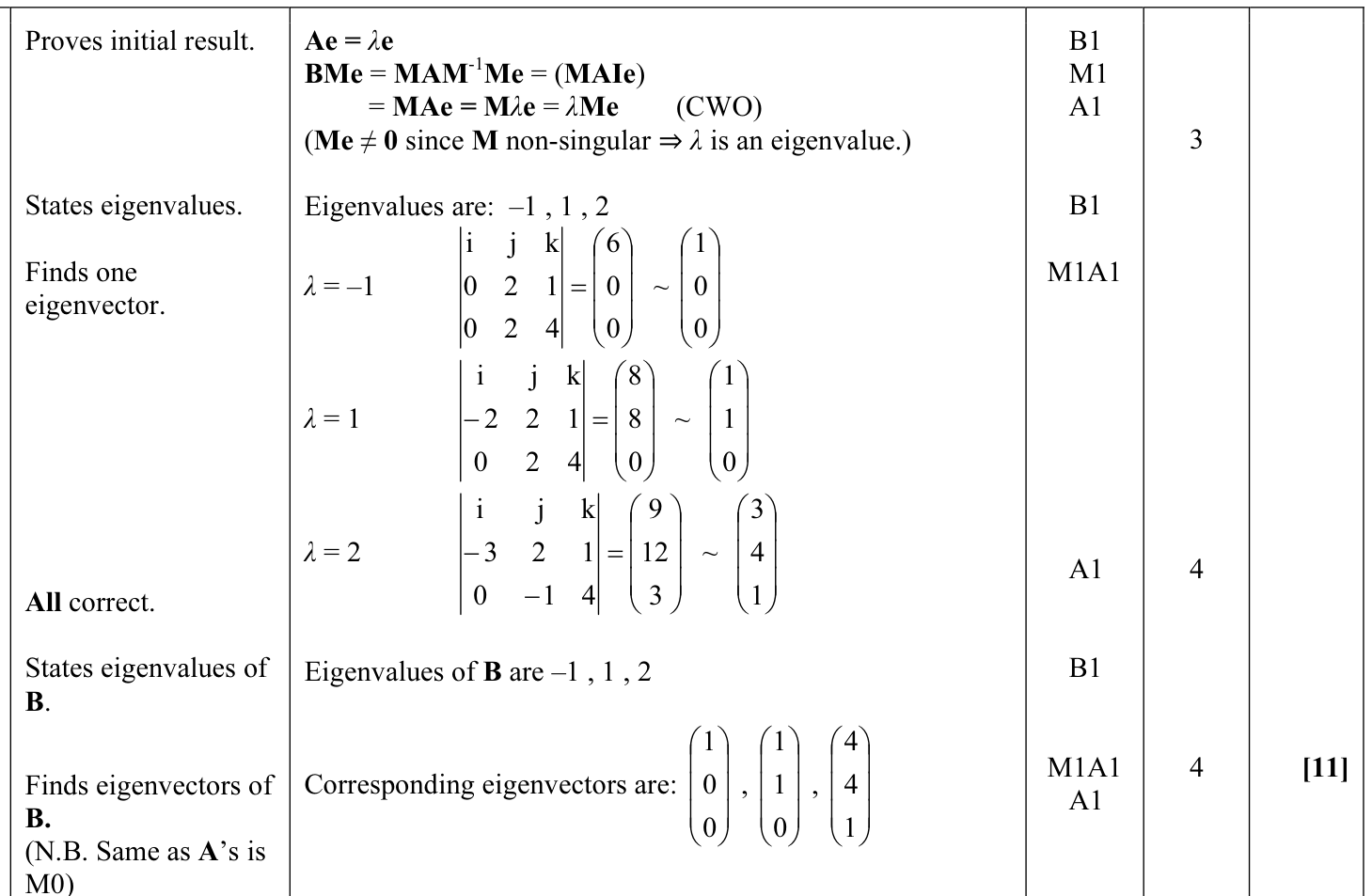
The square matrix \(\mathbf{A}\) has an eigenvalue \(\lambda\) with corresponding eigenvector \(\mathbf{e}\). The non-singular matrix \(\mathbf{M}\) is of the same order as \(\mathbf{A}\). Show that \(\mathbf{M e}\) is an eigenvector of the matrix \(\mathbf{B}\), where \(\mathbf{B}=\mathbf{M} \mathbf{A} \mathbf{M}^{-1}\), and that \(\lambda\) is the corresponding eigenvalue.
Let
\(\mathbf{A}=\left(\begin{array}{rrr} -1 & 2 & 1 \\ 0 & 1 & 4 \\ 0 & 0 & 2 \end{array}\right)\)
Write down the eigenvalues of \(\mathbf{A}\) and obtain corresponding eigenvectors.
Given that
\(\mathbf{M}=\left(\begin{array}{lll} 1 & 0 & 1 \\ 0 & 1 & 0 \\ 0 & 0 & 1 \end{array}\right)\)
find the eigenvalues and corresponding eigenvectors of \(\mathbf{B}\).
9231 P11 - Nov 2013 - Q7 - 10 marks
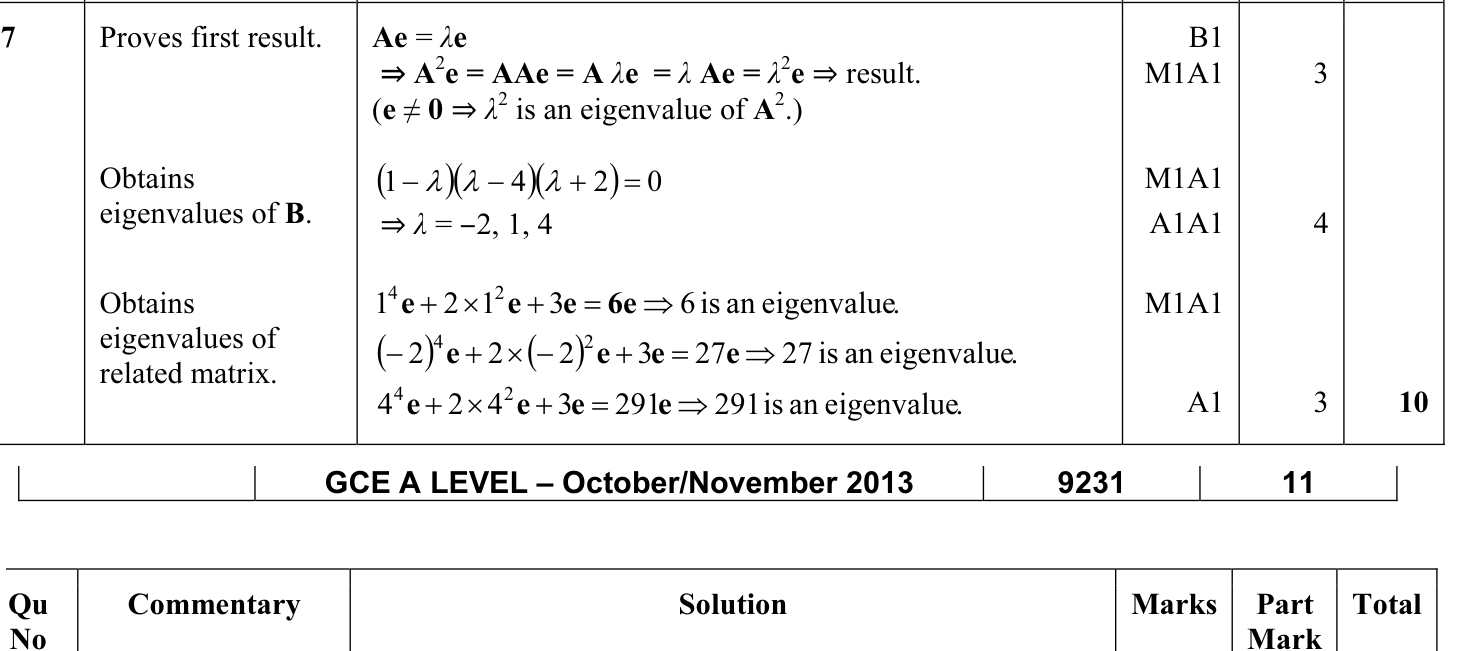
The square matrix \(\mathbf{A}\) has \(\lambda\) as an eigenvalue with \(\mathbf{e}\) as a corresponding eigenvector. Show that \(\mathbf{e}\) is an eigenvector of \(\mathbf{A}^{2}\) and state the corresponding eigenvalue.
Find the eigenvalues of the matrix \(\mathbf{B}\), where
\(\mathbf{B}=\left(\begin{array}{lll} 1 & 3 & 0 \\ 2 & 0 & 2 \\ 1 & 1 & 2 \end{array}\right) .\)
Find the eigenvalues of \(\mathbf{B}^{4}+2 \mathbf{B}^{2}+3 \mathbf{I}\), where \(\mathbf{I}\) is the \(3 \times 3\) identity matrix.
9231 P12 - Nov 2013 - Q7 - 10 marks
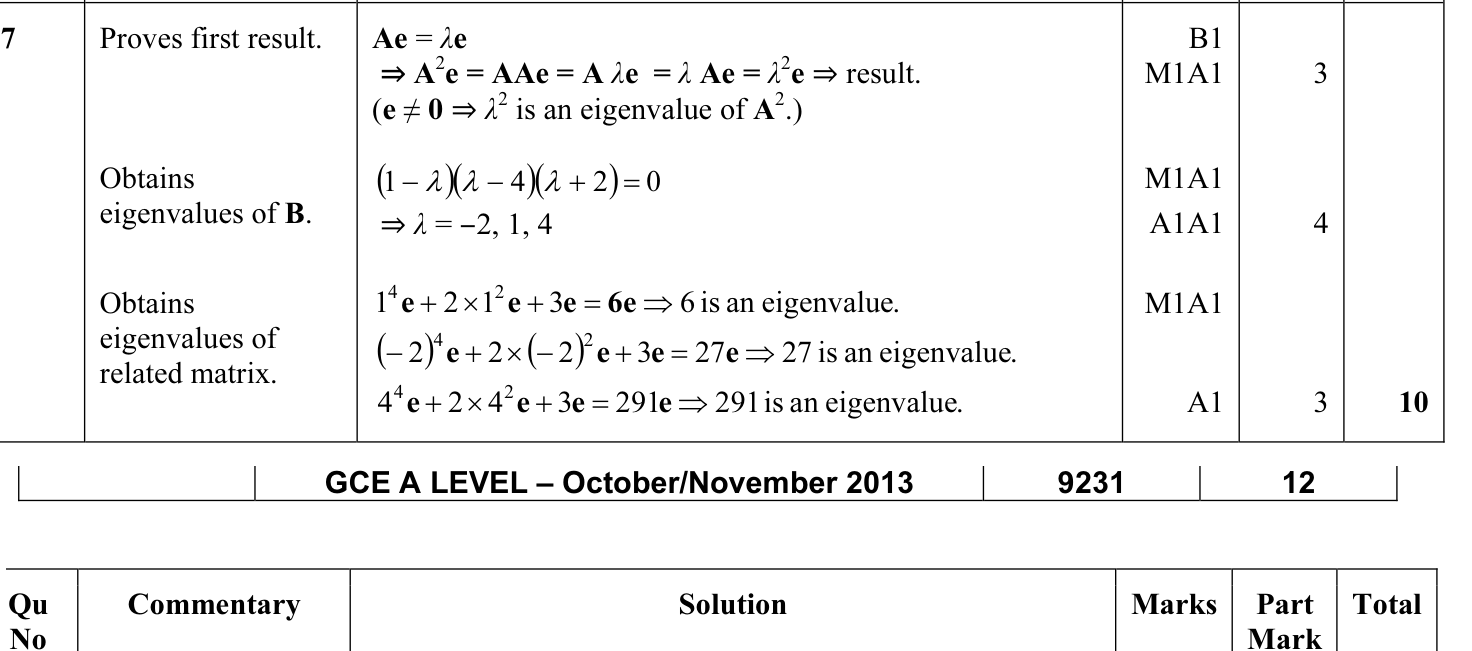
The square matrix \(\mathbf{A}\) has \(\lambda\) as an eigenvalue with \(\mathbf{e}\) as a corresponding eigenvector. Show that \(\mathbf{e}\) is an eigenvector of \(\mathbf{A}^{2}\) and state the corresponding eigenvalue.
Find the eigenvalues of the matrix \(\mathbf{B}\), where
\(\mathbf{B}=\left(\begin{array}{lll} 1 & 3 & 0 \\ 2 & 0 & 2 \\ 1 & 1 & 2 \end{array}\right) .\)
Find the eigenvalues of \(\mathbf{B}^{4}+2 \mathbf{B}^{2}+3 \mathbf{I}\), where \(\mathbf{I}\) is the \(3 \times 3\) identity matrix.
9231 P13 - Nov 2013 - Q11 - 28 marks
Answer only one of the following two alternatives.
EITHER
Let \(I_{n}=\int_{0}^{1}\left(1+x^{2}\right)^{n} \mathrm{~d} x\). Show that, for all integers \(n\),
\((2 n+1) I_{n}=2 n I_{n-1}+2^{n} .\)
Evaluate \(I_{0}\) and hence find \(I_{3}\).
Given that \(I_{-1}=\frac{1}{4} \pi\), find \(I_{-3}\).
OR
The vector \(\mathbf{e}\) is an eigenvector of each of the \(3 \times 3\) matrices \(\mathbf{A}\) and \(\mathbf{B}\), with corresponding eigenvalues \(\lambda\) and \(\mu\) respectively. Justifying your answer, state an eigenvalue of \(\mathbf{A}+\mathbf{B}\).
The matrix \(\mathbf{A}\), where
\(\mathbf{A}=\left(\begin{array}{rrr} 6 & -1 & -6 \\ 1 & 0 & -2 \\ 3 & -1 & -3 \end{array}\right),\)
has eigenvectors \(\left(\begin{array}{l}1 \\ 1 \\ 1\end{array}\right),\left(\begin{array}{r}1 \\ -1 \\ 1\end{array}\right),\left(\begin{array}{l}2 \\ 0 \\ 1\end{array}\right)\). Find the corresponding eigenvalues.
The matrix \(\mathbf{B}\), where
\(\mathbf{B}=\left(\begin{array}{rrr} 8 & -2 & -8 \\ 2 & 0 & -4 \\ 4 & -2 & -4 \end{array}\right),\)
also has eigenvectors \(\left(\begin{array}{l}1 \\ 1 \\ 1\end{array}\right),\left(\begin{array}{r}1 \\ -1 \\ 1\end{array}\right),\left(\begin{array}{l}2 \\ 0 \\ 1\end{array}\right)\), for which \(-2,2,4\), respectively, are corresponding eigenvalues. The matrix \(\mathbf{M}\) is given by \(\mathbf{M}=\mathbf{A}+\mathbf{B}-5 \mathbf{I}\), where \(\mathbf{I}\) is the \(3 \times 3\) identity matrix. State the eigenvalues of \(\mathbf{M}\).
Find matrices \(\mathbf{R}\) and \(\mathbf{S}\) and a diagonal matrix \(\mathbf{D}\) such that \(\mathbf{M}^{5}=\mathbf{R D S}\).
[You should show clearly all the elements of the matrices \(\mathbf{R}, \mathbf{S}\) and \(\mathbf{D}\).]