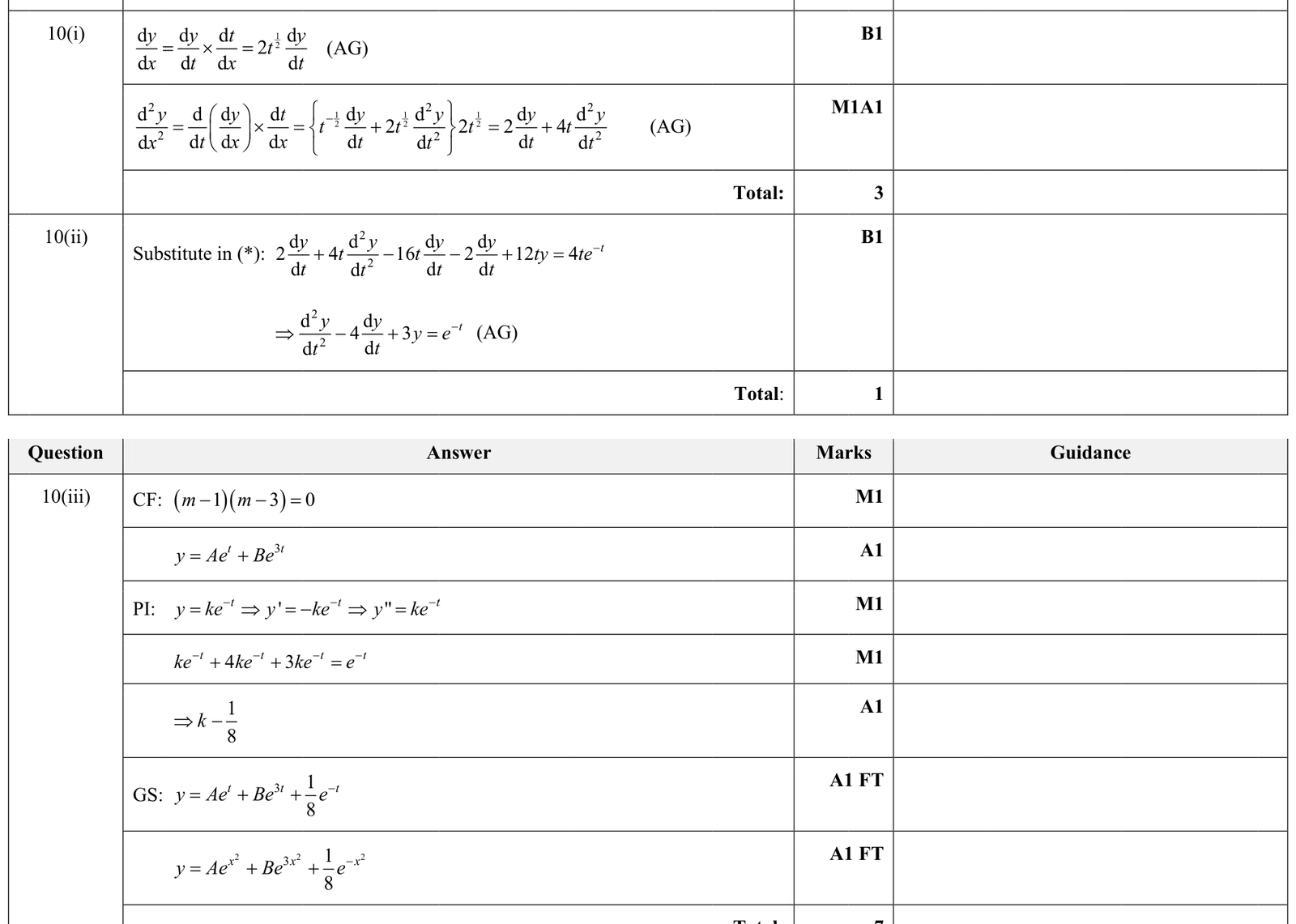
Answer: (i) Since \(x=t^{1/2}\), we have \(t=x^2\). Hence \(\dfrac{\mathrm d t}{\mathrm d x}=2x=2t^{1/2}\).
Therefore
\(\dfrac{\mathrm d y}{\mathrm d x}=\dfrac{\mathrm d y}{\mathrm d t}\dfrac{\mathrm d t}{\mathrm d x}=2t^{1/2}\dfrac{\mathrm d y}{\mathrm d t}.\)
For the second derivative, differentiate with respect to \(t\) and then multiply by \(\dfrac{\mathrm d t}{\mathrm d x}\):
\(\dfrac{\mathrm d}{\mathrm d t}\left(2t^{1/2}\dfrac{\mathrm d y}{\mathrm d t}\right)=t^{-1/2}\dfrac{\mathrm d y}{\mathrm d t}+2t^{1/2}\dfrac{\mathrm d^2 y}{\mathrm d t^2}.\)
So
\(\dfrac{\mathrm d^2 y}{\mathrm d x^2}=\left(t^{-1/2}\dfrac{\mathrm d y}{\mathrm d t}+2t^{1/2}\dfrac{\mathrm d^2 y}{\mathrm d t^2}\right)2t^{1/2}=2\dfrac{\mathrm d y}{\mathrm d t}+4t\dfrac{\mathrm d^2 y}{\mathrm d t^2}.\)
(ii) Substitute \(x=t^{1/2}\), so \(x^2=t\), into the differential equation:
\(\dfrac{\mathrm d^2 y}{\mathrm d x^2}-\left(8x+\dfrac1x\right)\dfrac{\mathrm d y}{\mathrm d x}+12x^2y=4x^2e^{-x^2}.\)
Using \(\dfrac{\mathrm d y}{\mathrm d x}=2t^{1/2}\dfrac{\mathrm d y}{\mathrm d t}\) and \(\dfrac{\mathrm d^2 y}{\mathrm d x^2}=2\dfrac{\mathrm d y}{\mathrm d t}+4t\dfrac{\mathrm d^2 y}{\mathrm d t^2}\), this becomes
\(2\dfrac{\mathrm d y}{\mathrm d t}+4t\dfrac{\mathrm d^2 y}{\mathrm d t^2}-\left(8t^{1/2}+t^{-1/2}\right)\left(2t^{1/2}\dfrac{\mathrm d y}{\mathrm d t}\right)+12ty=4te^{-t}.\)
Since \(\left(8t^{1/2}+t^{-1/2}\right)2t^{1/2}=16t+2\), we get
\(2\dfrac{\mathrm d y}{\mathrm d t}+4t\dfrac{\mathrm d^2 y}{\mathrm d t^2}-(16t+2)\dfrac{\mathrm d y}{\mathrm d t}+12ty=4te^{-t}.\)
So
\(4t\dfrac{\mathrm d^2 y}{\mathrm d t^2}-16t\dfrac{\mathrm d y}{\mathrm d t}+12ty=4te^{-t}.\)
Dividing by \(4t\) gives
\(\dfrac{\mathrm d^2 y}{\mathrm d t^2}-4\dfrac{\mathrm d y}{\mathrm d t}+3y=e^{-t}.\)
(iii) First solve the homogeneous equation
\(\dfrac{\mathrm d^2 y}{\mathrm d t^2}-4\dfrac{\mathrm d y}{\mathrm d t}+3y=0.\)
Try \(y=e^{mt}\). Then
\(m^2-4m+3=0\), so \((m-1)(m-3)=0\).
Hence the complementary function is
\(y_c=Ae^t+Be^{3t}.\)
For a particular solution, try \(y=ke^{-t}\). Then \(y'=-ke^{-t}\) and \(y''=ke^{-t}\). Substituting into the differential equation gives
\(ke^{-t}-4(-ke^{-t})+3ke^{-t}=e^{-t}.\)
Thus \(8ke^{-t}=e^{-t}\), so \(k=\dfrac18\).
Therefore
\(y=Ae^t+Be^{3t}+\dfrac18 e^{-t}.\)
Finally, since \(t=x^2\), the general solution in terms of \(x\) is
\(\boxed{y=Ae^{x^2}+Be^{3x^2}+\dfrac18 e^{-x^2}}.\)
(i) From \(x=t^{1/2}\), we have \(t=x^2\), so \(\dfrac{\mathrm d t}{\mathrm d x}=2x=2t^{1/2}\).
By the chain rule,
\(\dfrac{\mathrm d y}{\mathrm d x}=\dfrac{\mathrm d y}{\mathrm d t}\dfrac{\mathrm d t}{\mathrm d x}=2t^{1/2}\dfrac{\mathrm d y}{\mathrm d t}.\)
Differentiate this with respect to \(t\):
\(\dfrac{\mathrm d}{\mathrm d t}\left(2t^{1/2}\dfrac{\mathrm d y}{\mathrm d t}\right)=t^{-1/2}\dfrac{\mathrm d y}{\mathrm d t}+2t^{1/2}\dfrac{\mathrm d^2 y}{\mathrm d t^2}.\)
Then multiply by \(\dfrac{\mathrm d t}{\mathrm d x}=2t^{1/2}\):
\(\dfrac{\mathrm d^2 y}{\mathrm d x^2}=\left(t^{-1/2}\dfrac{\mathrm d y}{\mathrm d t}+2t^{1/2}\dfrac{\mathrm d^2 y}{\mathrm d t^2}\right)2t^{1/2}=2\dfrac{\mathrm d y}{\mathrm d t}+4t\dfrac{\mathrm d^2 y}{\mathrm d t^2}.\)
So the required identities are proved.
(ii) In the differential equation
\(\dfrac{\mathrm d^2 y}{\mathrm d x^2}-\left(8x+\dfrac1x\right)\dfrac{\mathrm d y}{\mathrm d x}+12x^2y=4x^2e^{-x^2},\)
substitute \(x=t^{1/2}\), so \(x^2=t\) and \(\dfrac1x=t^{-1/2}\). Also use the results from part (i):
\(\dfrac{\mathrm d y}{\mathrm d x}=2t^{1/2}\dfrac{\mathrm d y}{\mathrm d t}, \qquad \dfrac{\mathrm d^2 y}{\mathrm d x^2}=2\dfrac{\mathrm d y}{\mathrm d t}+4t\dfrac{\mathrm d^2 y}{\mathrm d t^2}.\)
Hence
\(2\dfrac{\mathrm d y}{\mathrm d t}+4t\dfrac{\mathrm d^2 y}{\mathrm d t^2}-\left(8t^{1/2}+t^{-1/2}\right)\left(2t^{1/2}\dfrac{\mathrm d y}{\mathrm d t}\right)+12ty=4te^{-t}.\)
Now \(\left(8t^{1/2}+t^{-1/2}\right)2t^{1/2}=16t+2\), so this simplifies to
\(4t\dfrac{\mathrm d^2 y}{\mathrm d t^2}-16t\dfrac{\mathrm d y}{\mathrm d t}+12ty=4te^{-t}.\)
Dividing through by \(4t\) gives
\(\dfrac{\mathrm d^2 y}{\mathrm d t^2}-4\dfrac{\mathrm d y}{\mathrm d t}+3y=e^{-t}.\)
(iii) Solve the transformed equation
\(\dfrac{\mathrm d^2 y}{\mathrm d t^2}-4\dfrac{\mathrm d y}{\mathrm d t}+3y=e^{-t}.\)
For the complementary function, let \(y=e^{mt}\). Then
\(m^2-4m+3=0\), so \((m-1)(m-3)=0\).
Thus
\(y_c=Ae^t+Be^{3t}.\)
For a particular solution, try \(y=ke^{-t}\). Then \(y'=-ke^{-t}\) and \(y''=ke^{-t}\). Substitution gives
\(ke^{-t}-4(-ke^{-t})+3ke^{-t}=e^{-t},\)
so \(8ke^{-t}=e^{-t}\) and therefore \(k=\dfrac18\).
Hence
\(y=Ae^t+Be^{3t}+\dfrac18 e^{-t}.\)
Since \(t=x^2\), the general solution in terms of \(x\) is
\(\boxed{y=Ae^{x^2}+Be^{3x^2}+\dfrac18 e^{-x^2}}.\)