Past Exam Questions
← Back9231 P11 - Jun 2015 - Q10 - 12 marks
The matrix \(\mathbf A\) is given by
\(\mathbf A=\begin{pmatrix}2&2&-3\\2&2&3\\-3&3&3\end{pmatrix}\).
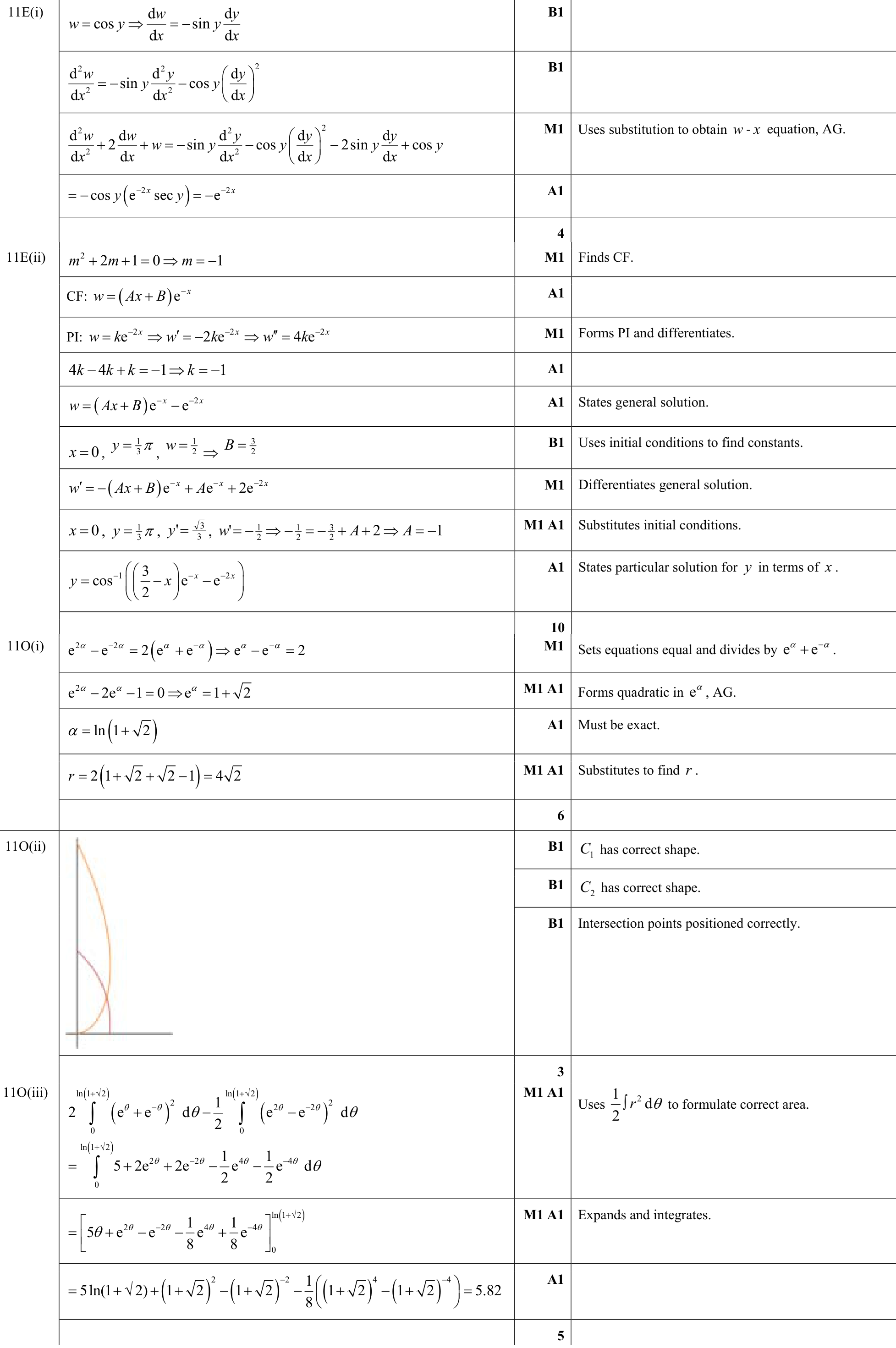
The matrix \(\mathbf A\) has an eigenvector \(\begin{pmatrix}1\\-1\\1\end{pmatrix}\). Find the corresponding eigenvalue.
The matrix \(\mathbf A\) also has eigenvalues \(4\) and \(6\). Find corresponding eigenvectors.
Hence find a matrix \(\mathbf P\) and a diagonal matrix \(\mathbf D\) such that \(\mathbf A=\mathbf P\mathbf D\mathbf P^{-1}\).
The matrix \(\mathbf B\) is such that \(\mathbf B=\mathbf Q\mathbf A\mathbf Q^{-1}\), where \(\mathbf Q=\begin{pmatrix}4&11&5\\1&4&2\\1&2&1\end{pmatrix}\).
By using the expression \(\mathbf P\mathbf D\mathbf P^{-1}\) for \(\mathbf A\), find the set of eigenvalues and a corresponding set of eigenvectors for \(\mathbf B\).
9231 P13 - Jun 2016 - Q11E - 14 marks
EITHER
It is given that \(1\) and \(4\) are eigenvalues of the matrix \(\mathbf A\), where
\(\mathbf A=\begin{pmatrix}1&-3&-3\\-8&6&-3\\8&-2&7\end{pmatrix}.\)
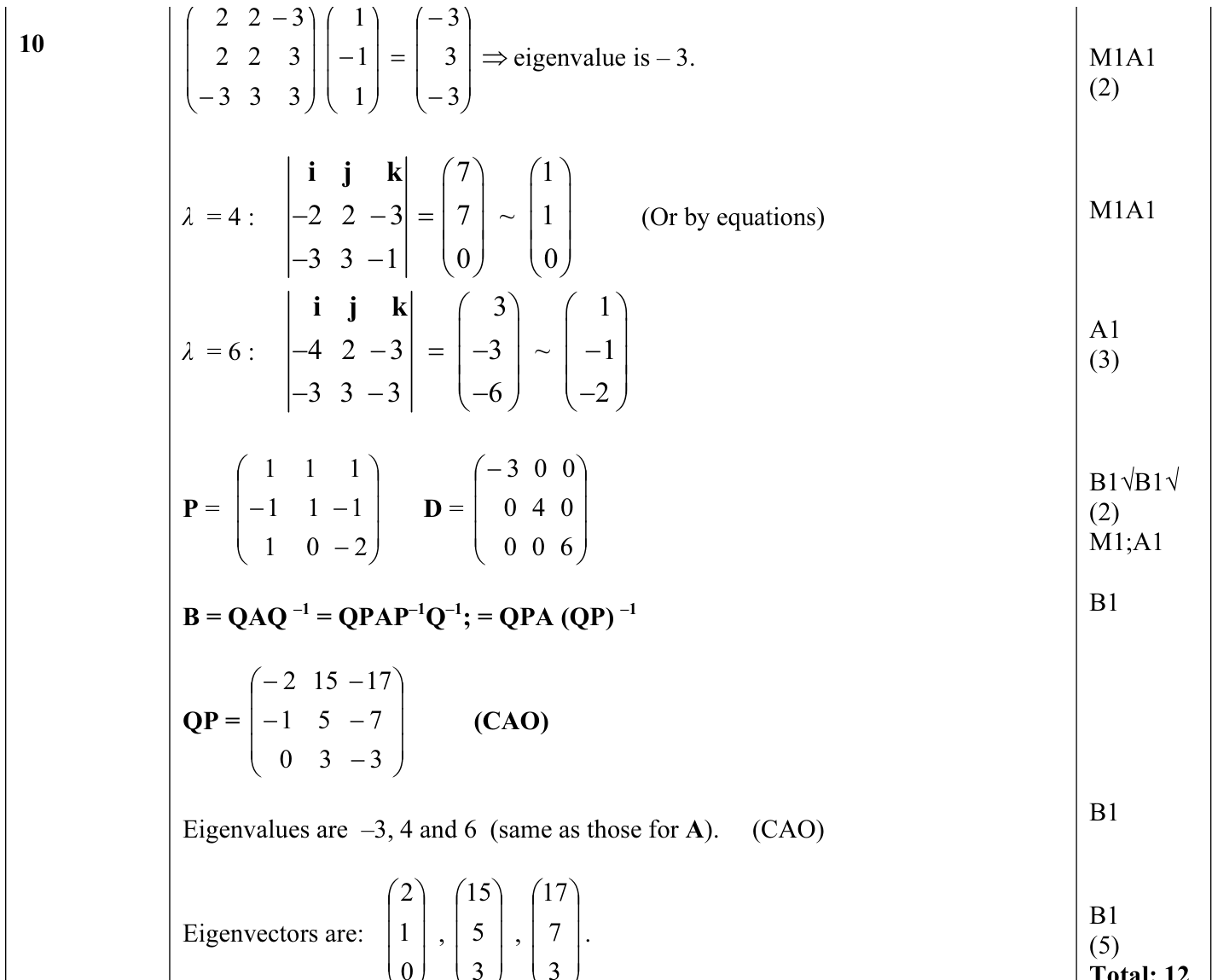
Find eigenvectors corresponding to each of these eigenvalues.
Given further that \(\begin{pmatrix}0\\1\\-1\end{pmatrix}\) is an eigenvector of \(\mathbf A\), find the corresponding eigenvalue.
Write down matrices \(\mathbf P\) and \(\mathbf D\) such that \(\mathbf P^{-1}\mathbf A\mathbf P=\mathbf D\), where \(\mathbf D\) is a diagonal matrix, and find \(\mathbf P^{-1}\).
Write down a matrix \(\mathbf C\) such that \(\mathbf C^2=\mathbf D\), and deduce a matrix \(\mathbf B\) such that \(\mathbf B^2=\mathbf A\).
9231 P11 - Jun 2016 - Q10 - 12 marks
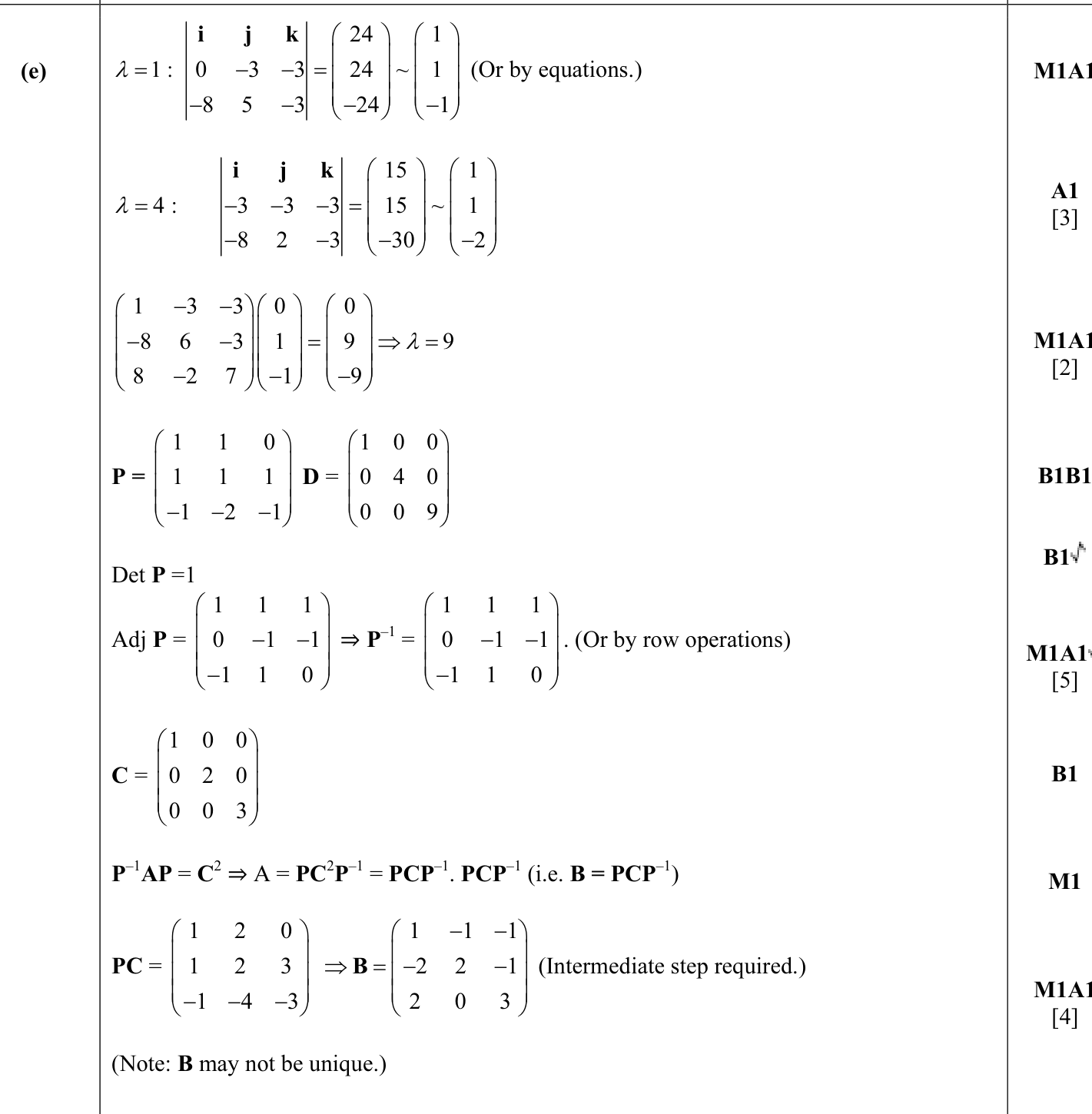
Write down the eigenvalues of the matrix \(\mathbf{A}\), where
\(\mathbf{A}=\left(\begin{array}{rrr} -2 & 1 & -1 \\ 0 & -1 & 2 \\ 0 & 0 & 1 \end{array}\right),\)
and find corresponding eigenvectors.
Find a matrix \(\mathbf{P}\) and a diagonal matrix \(\mathbf{D}\) such that \(\mathbf{P}^{-1} \mathbf{A P}=\mathbf{D}\), and hence find the matrix \(\mathbf{A}^{n}\), where \(n\) is a positive integer.
[Question 11 is printed on the next page.]
9231 P11 - Nov 2019 - Q10 - 12 marks
The matrix \(\mathbf{A}\) is defined by
\(\mathbf{A}=\left(\begin{array}{rrr}
1 & 5 & 1 \\
1 & -2 & -2 \\
2 & 3 & \theta
\end{array}\right) .\)
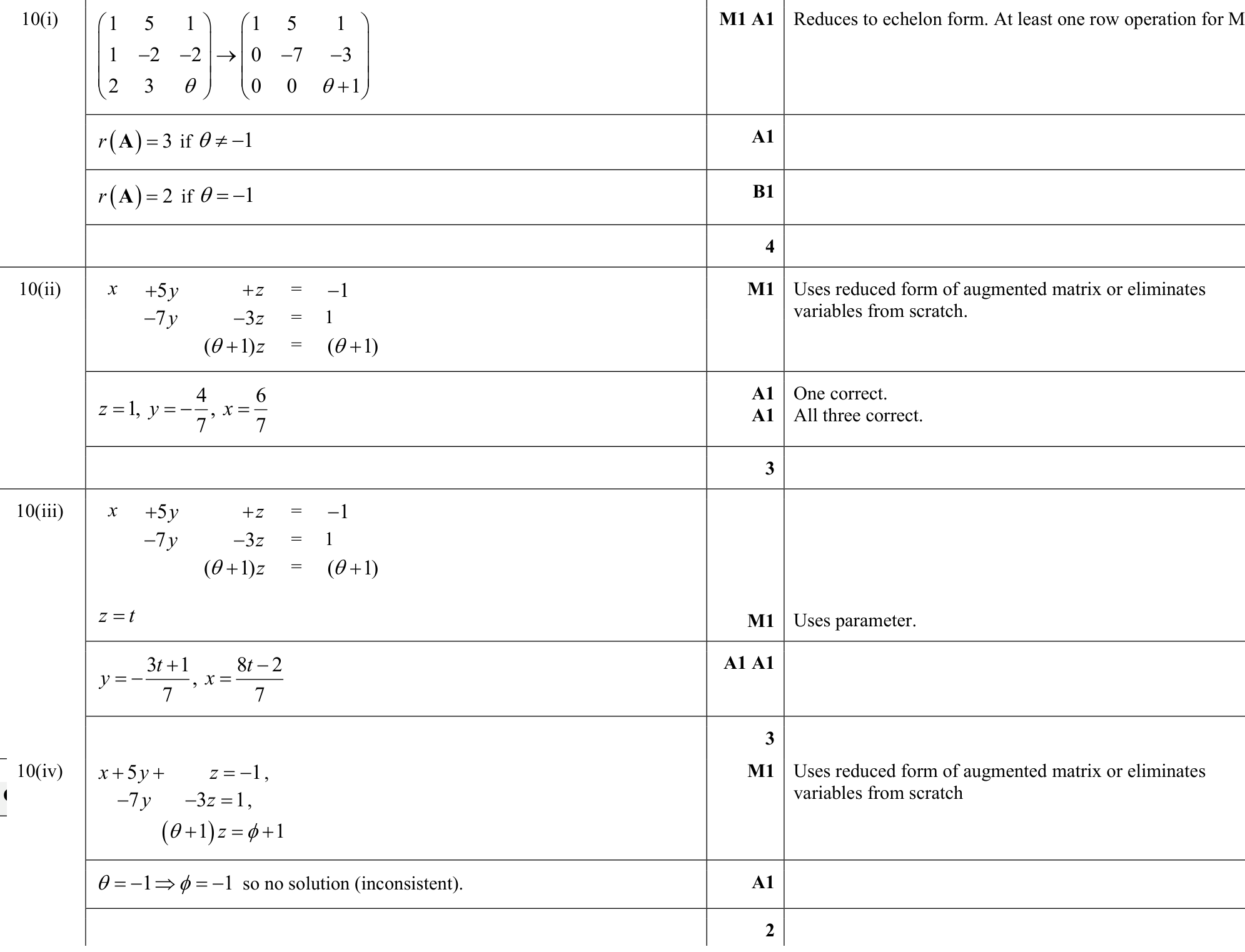
(i) (a) Find the rank of \(\mathbf{A}\) when \(\theta \neq-1\).
(b) Find the rank of \(\mathbf{A}\) when \(\theta=-1\).
Consider the system of equations
\(\begin{aligned}
x+5 y+z & =-1 \\
x-2 y-2 z & =0 \\
2 x+3 y+\theta z & =\theta
\end{aligned}\)
(ii) Solve the system of equations when \(\theta \neq-1\).
(iii) Find the general solution when \(\theta=-1\).
(iv) Show that if \(\theta=-1\) and \(\phi \neq-1\) then \(\mathbf{A x}=\left(\begin{array}{r}-1 \\ 0 \\ \phi\end{array}\right)\) has no solution.
9231 P23 - Jun 2023 - Q8 - 14 marks
The matrix \(\mathbf{A}\) is given by
\(\mathbf{A}=\left(\begin{array}{ccc} a & -6 a & 2 a+2 \\ 0 & 1-a & 0 \\ 0 & 2-a & -1 \end{array}\right)\)
where \(a\) is a constant with \(a \neq 0\) and \(a \neq 1\).
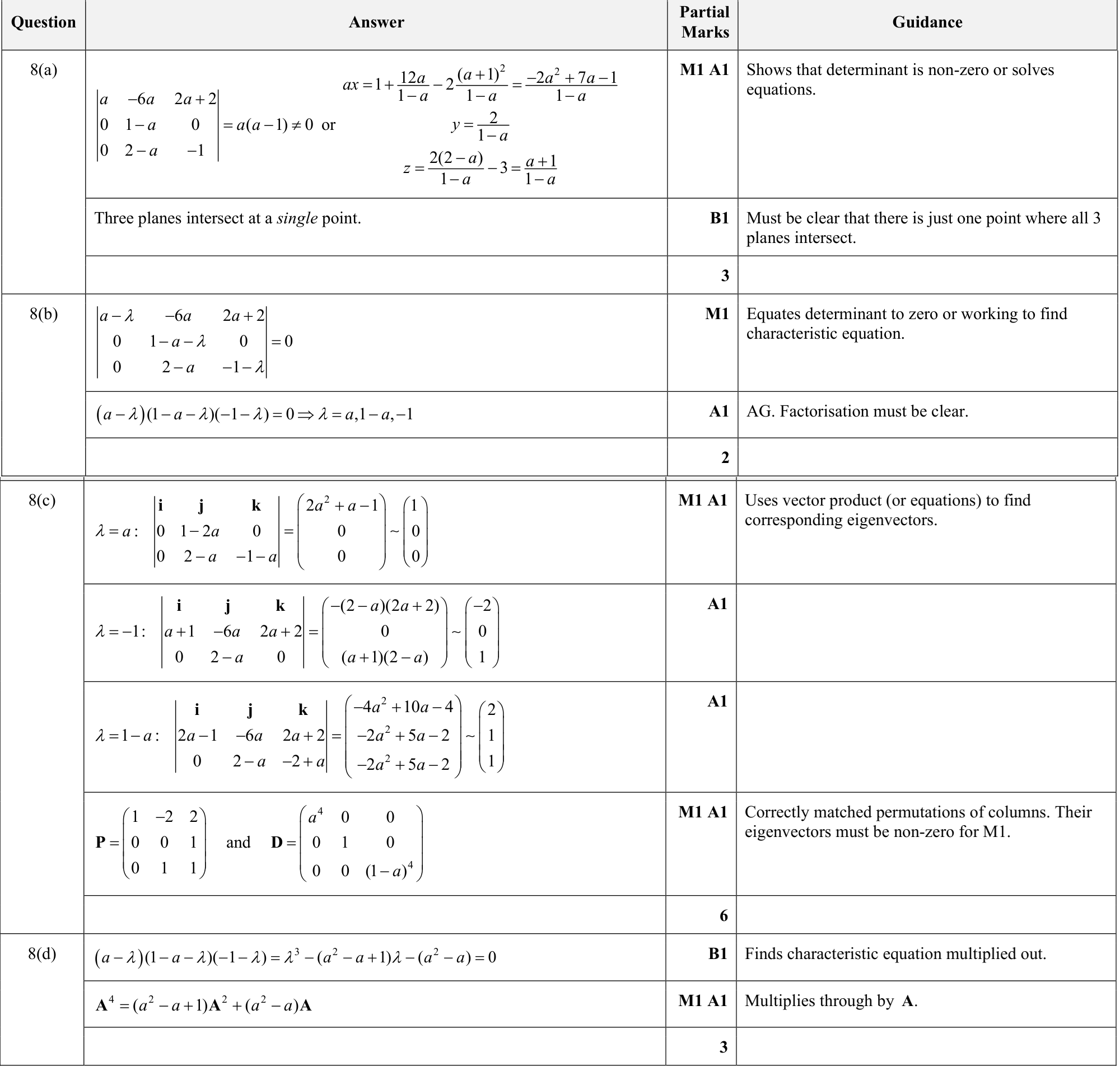
(a) Show that the equation \(\mathbf{A}\left(\begin{array}{c}x \\ y \\ z\end{array}\right)=\left(\begin{array}{l}1 \\ 2 \\ 3\end{array}\right)\) has a unique solution and interpret this situation geometrically.
(b) Show that the eigenvalues of \(\mathbf{A}\) are \(a, 1-a\) and -1 .
(c) Find a matrix \(\mathbf{P}\) and a diagonal matrix \(\mathbf{D}\) such that \(\mathbf{A}^{4}=\mathbf{P D P}^{-1}\).
(d) Use the characteristic equation of \(\mathbf{A}\) to find \(\mathbf{A}^{4}\) in terms of \(\mathbf{A}\) and \(a\).
9231 P21 - Jun 2023 - Q1 - 5 marks
(a) Show that the system of equations
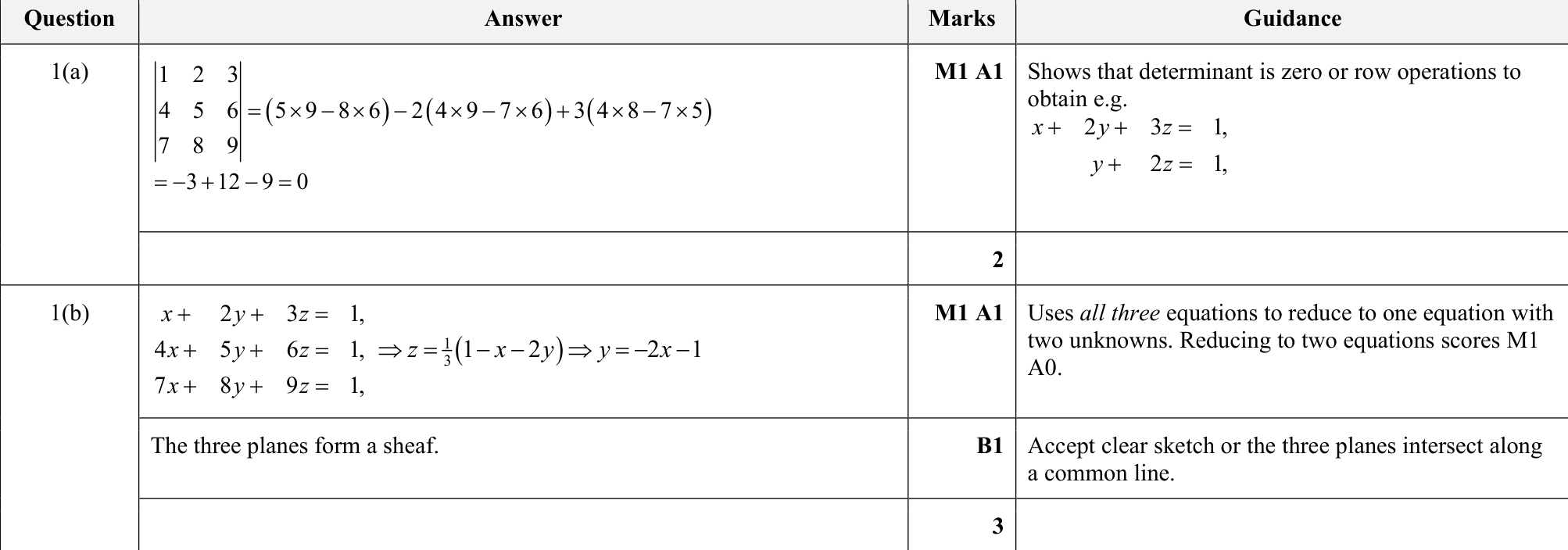
\(\begin{array}{r} x+2 y+3 z=1 \\ 4 x+5 y+6 z=1 \\ 7 x+8 y+9 z=1 \end{array}\)
does not have a unique solution.
(b) Show that the system of equations in part (a) is consistent. Interpret this situation geometrically.
9231 P21 - Nov 2024 - Q1 - 4 marks
Find the set of values of \(k\) for which the system of equations
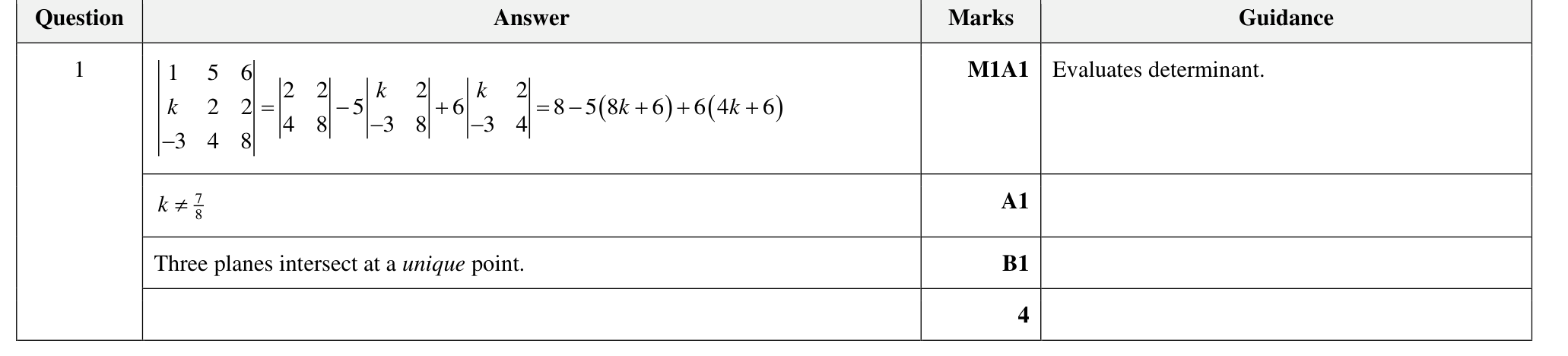
\(\begin{array}{r} x+5 y+6 z=1 \\ k x+2 y+2 z=2 \\ -3 x+4 y+8 z=3 \end{array}\)
has a unique solution and interpret this situation geometrically.
9231 P21 - Nov 2023 - Q1 - 4 marks
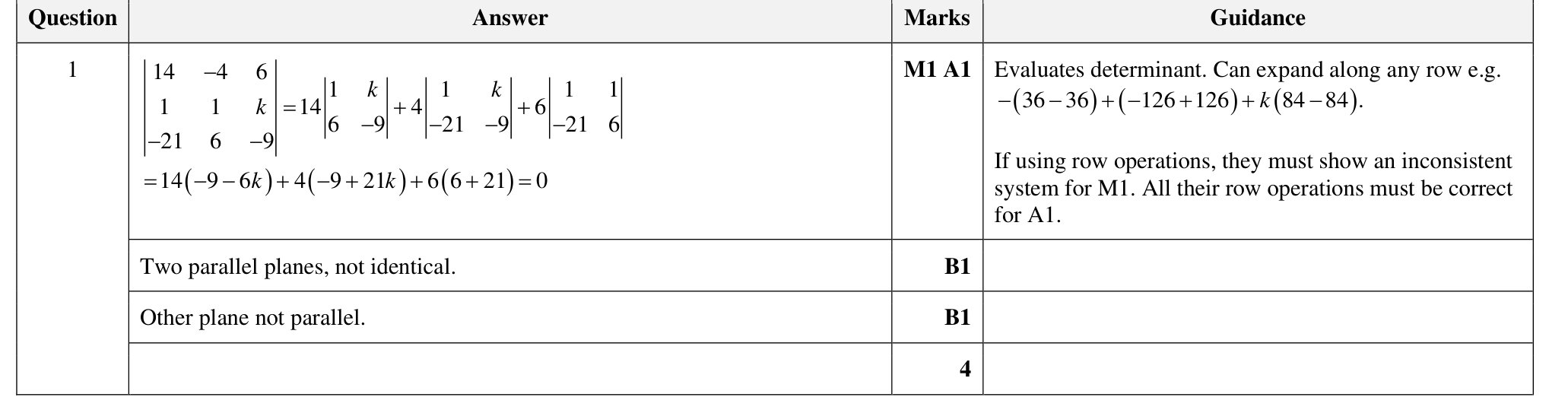
Show that the system of equations
\(\begin{aligned} 14 x-4 y+6 z & =5 \\ x+y+k z & =3 \\ -21 x+6 y-9 z & =14 \end{aligned}\)
where \(k\) is a constant, does not have a unique solution and interpret this situation geometrically.
9231 P21 - Jun 2022 - Q8 - 13 marks
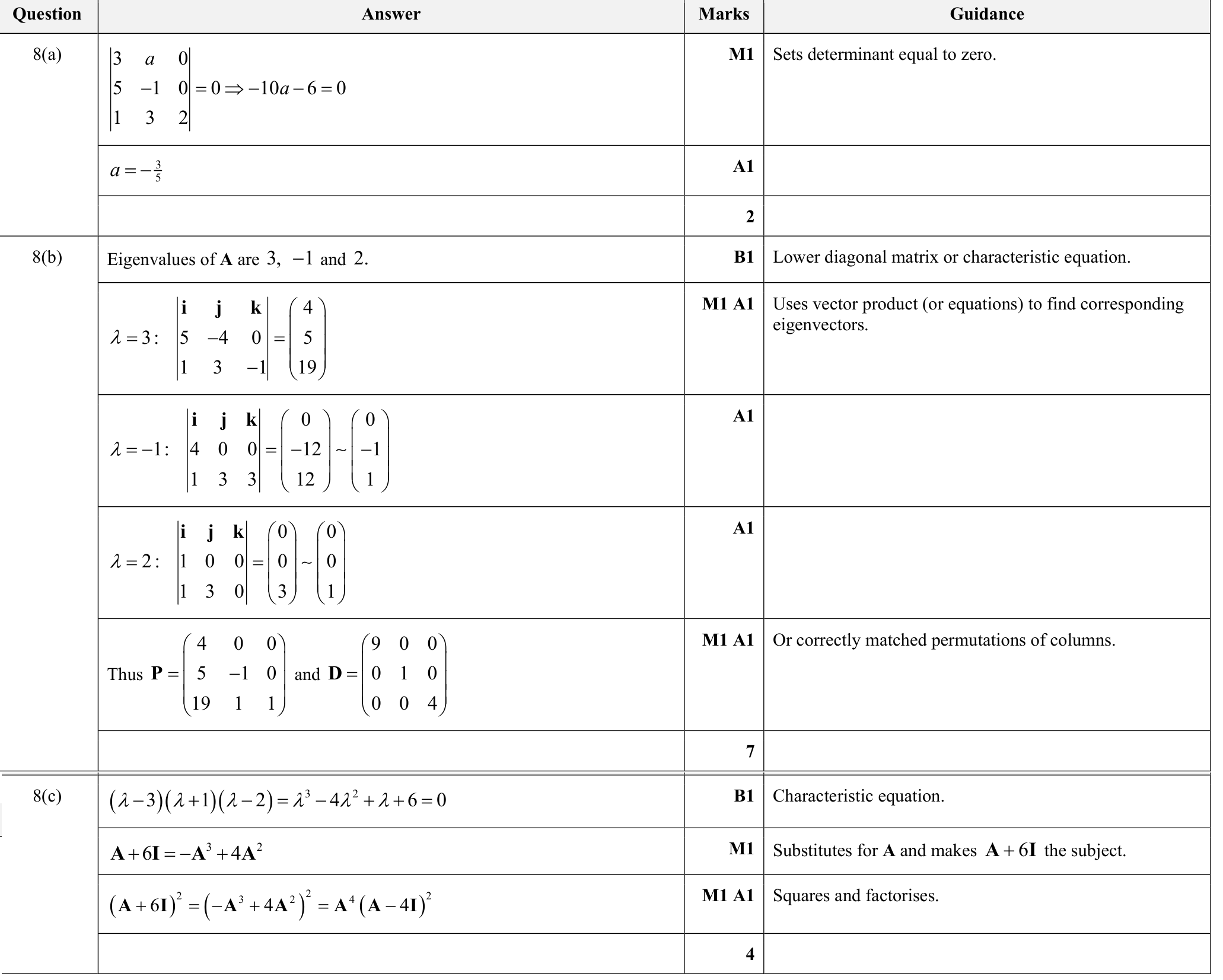
(a) Find the value of \(a\) for which the system of equations
\(\begin{array}{c} 3 x+a y=0 \\ 5 x-y=0 \\ x+3 y+2 z=0 \end{array}\)
does not have a unique solution.
The matrix \(\mathbf{A}\) is given by
\(\mathbf{A}=\left(\begin{array}{rrr} 3 & 0 & 0 \\ 5 & -1 & 0 \\ 1 & 3 & 2 \end{array}\right)\)
(b) Find a matrix \(\mathbf{P}\) and a diagonal matrix \(\mathbf{D}\) such that \(\mathbf{A}^{2}=\mathbf{P D P}^{-1}\).
(c) Use the characteristic equation of \(\mathbf{A}\) to show that
\((\mathbf{A}+6 \mathbf{I})^{2}=\mathbf{A}^{4}(\mathbf{A}+b \mathbf{I})^{2}\)
where \(b\) is an integer to be determined.
9231 P21 - Nov 2022 - Q2 - 7 marks
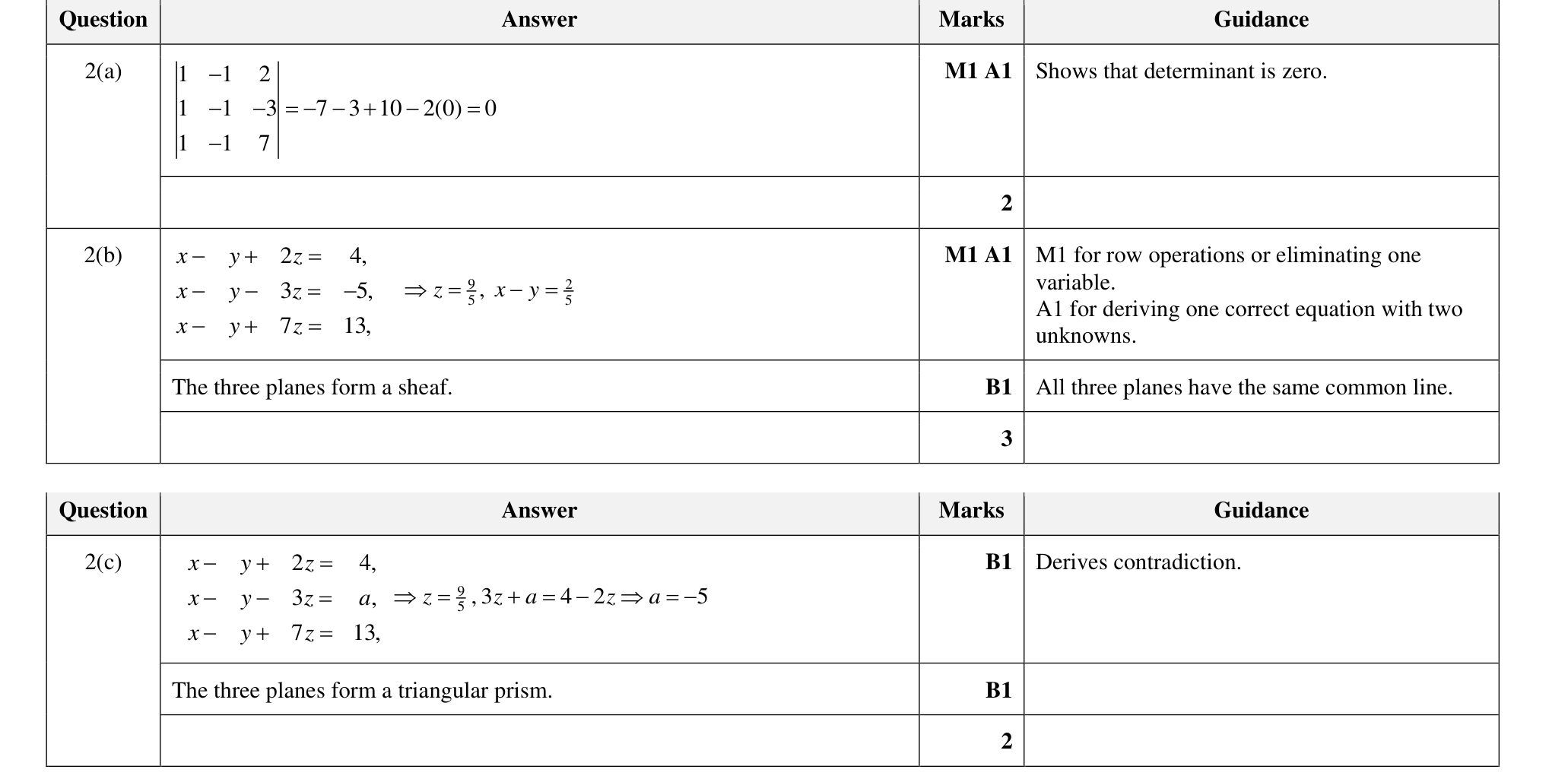
(a) Show that the system of equations
\(\begin{array}{l} x-y+2 z=4 \\ x-y-3 z=a \\ x-y+7 z=13 \end{array}\)
where \(a\) is a constant, does not have a unique solution.
(b) Given that \(a=-5\), show that the system of equations in part (a) is consistent. Interpret this situation geometrically.
(c) Given instead that \(a \neq-5\), show that the system of equations in part (a) is inconsistent. Interpret this situation geometrically.
9231 P22 - Nov 2022 - Q1 - 5 marks
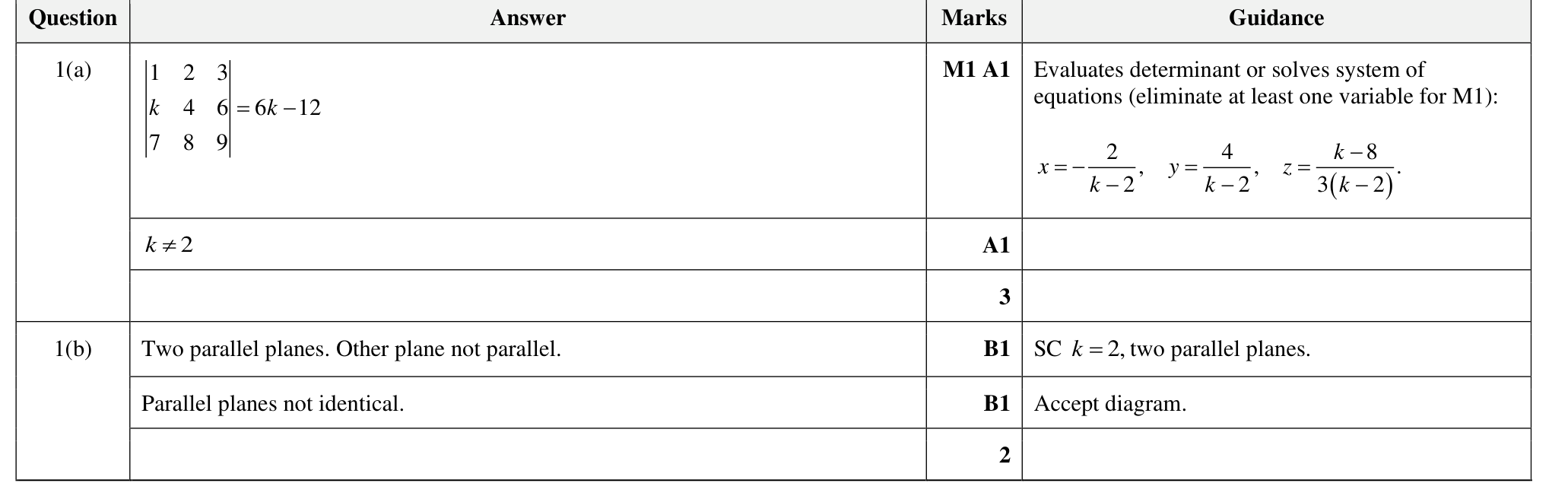
(a) Find the set of values of \(k\) for which the system of equations
\(\begin{aligned} x+2 y+3 z & =1 \\ k x+4 y+6 z & =0 \\ 7 x+8 y+9 z & =3 \end{aligned}\)
has a unique solution.
9231 P21 - Jun 2021 - Q1 - 5 marks
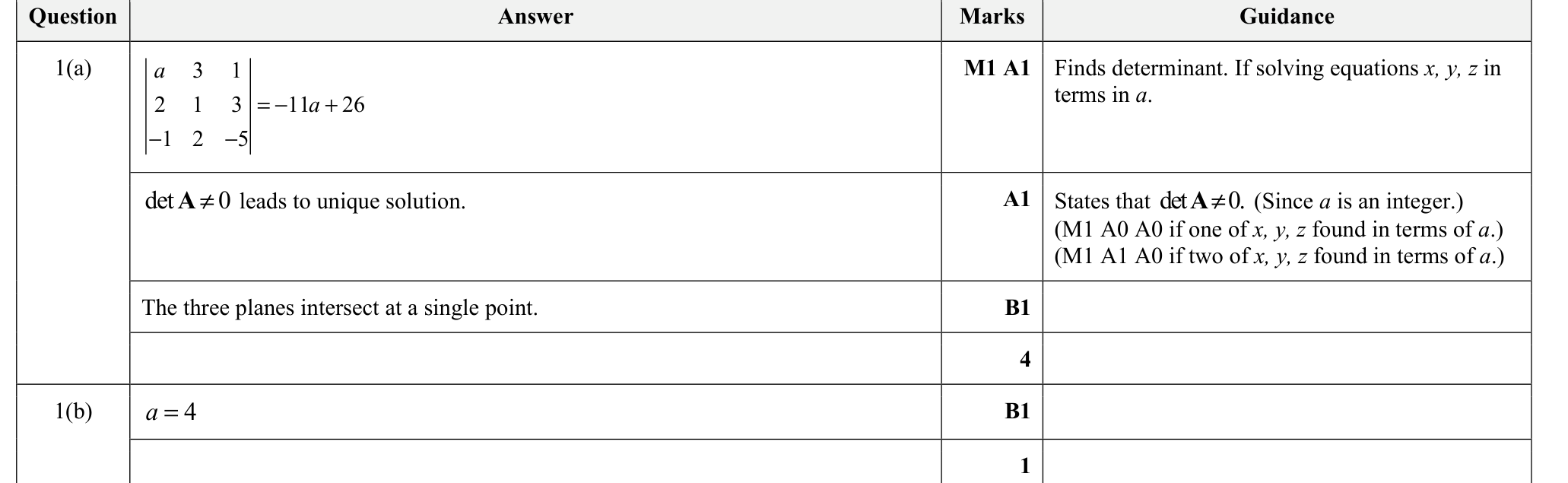
(a) Given that \(a\) is an integer, show that the system of equations
\(\begin{aligned} a x+3 y+z & =14 \\ 2 x+y+3 z & =0 \\ -x+2 y-5 z & =17 \end{aligned}\)
has a unique solution and interpret this situation geometrically.
(b) Find the value of \(a\) for which \(x=1, y=4, z=-2\) is the solution to the system of equations in part (a).
9231 P13 - Jun 2017 - Q11O - 14 marks
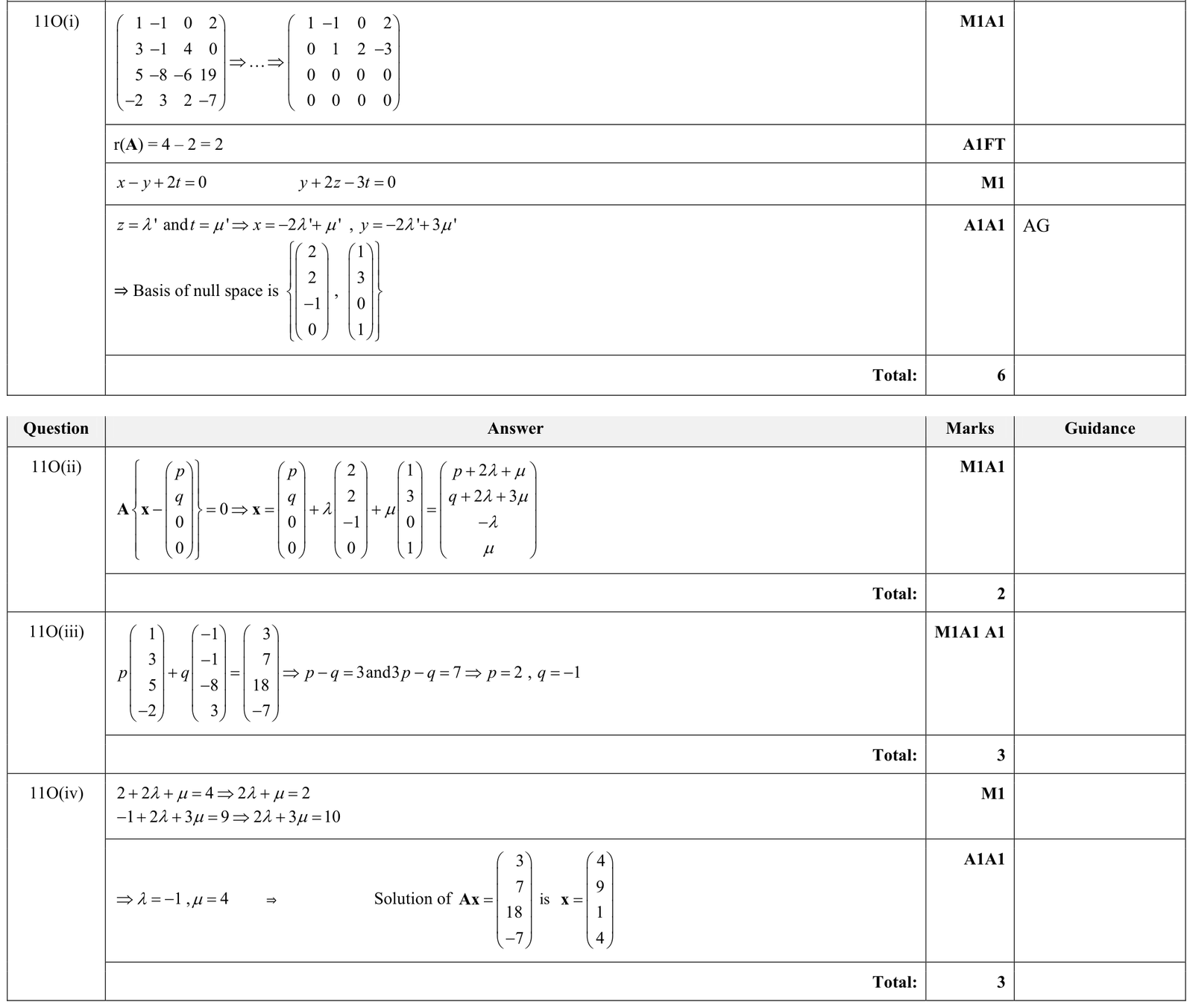
The matrix \(A\), given by \(A=\begin{pmatrix}1&-1&0&2\\3&-1&4&0\\5&-8&-6&19\\-2&3&2&-7\end{pmatrix}\), represents a transformation from \(\mathbb{R}^4\) to \(\mathbb{R}^4\).
(i) Find the rank of \(A\) and show that \(\left\{\begin{pmatrix}2\\2\\-1\\0\end{pmatrix},\begin{pmatrix}1\\3\\0\\1\end{pmatrix}\right\}\) is a basis for the null space of the transformation.
(ii) Show that if \(A\mathbf{x}=p\begin{pmatrix}1\\3\\5\\-2\end{pmatrix}+q\begin{pmatrix}-1\\-1\\-8\\3\end{pmatrix}\), where \(p\) and \(q\) are given real numbers, then \(\mathbf{x}=\begin{pmatrix}p+2\lambda+\mu\\q+2\lambda+3\mu\\-\lambda\\\mu\end{pmatrix}\), where \(\lambda\) and \(\mu\) are real numbers.
(iii) Find the values of \(p\) and \(q\) such that \(p\begin{pmatrix}1\\3\\5\\-2\end{pmatrix}+q\begin{pmatrix}-1\\-1\\-8\\3\end{pmatrix}=\begin{pmatrix}3\\7\\18\\-7\end{pmatrix}\).
(iv) Find the solution of \(A\mathbf{x}=\begin{pmatrix}3\\7\\18\\-7\end{pmatrix}\) of the form \(\mathbf{x}=\begin{pmatrix}4\\9\\m\\n\end{pmatrix}\), where \(m\) and \(n\) are positive integers to be found.
9231 P11 - Jun 2015 - Q2 - 6 marks
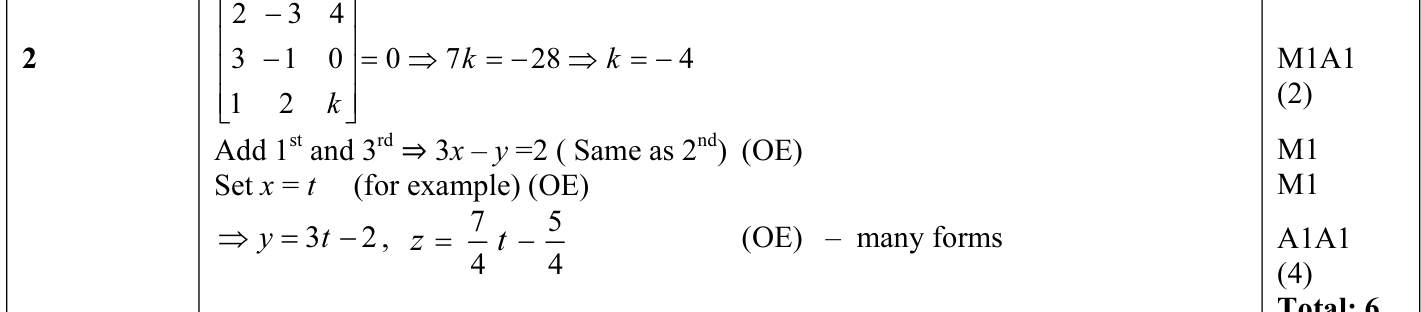
Find the value of the constant \(k\) for which the system of equations
\(\begin{aligned} 2 x-3 y+4 z & =1 \\ 3 x-y & =2 \\ x+2 y+k z & =1 \end{aligned}\)
does not have a unique solution.
For this value of \(k\), solve the system of equations.
9231 P13 - Jun 2016 - Q3 - 7 marks
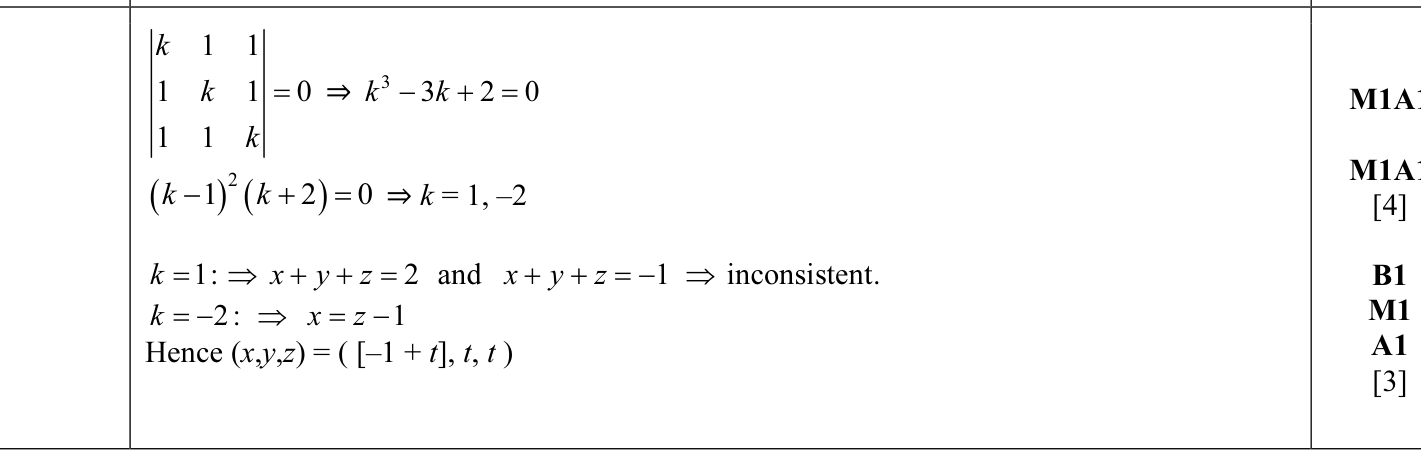
Find the two values of the constant \(k\) for which the equations
\(\begin{aligned}kx+y+z&=2\\x+ky+z&=-1\\x+y+kz&=-1\end{aligned}\)
have no unique solution.
Show that, for one of these values of \(k\), the equations have no solution, and solve the equations for the other value of \(k\).
9231 P11 - Jun 2016 - Q11O - 14 marks
OR
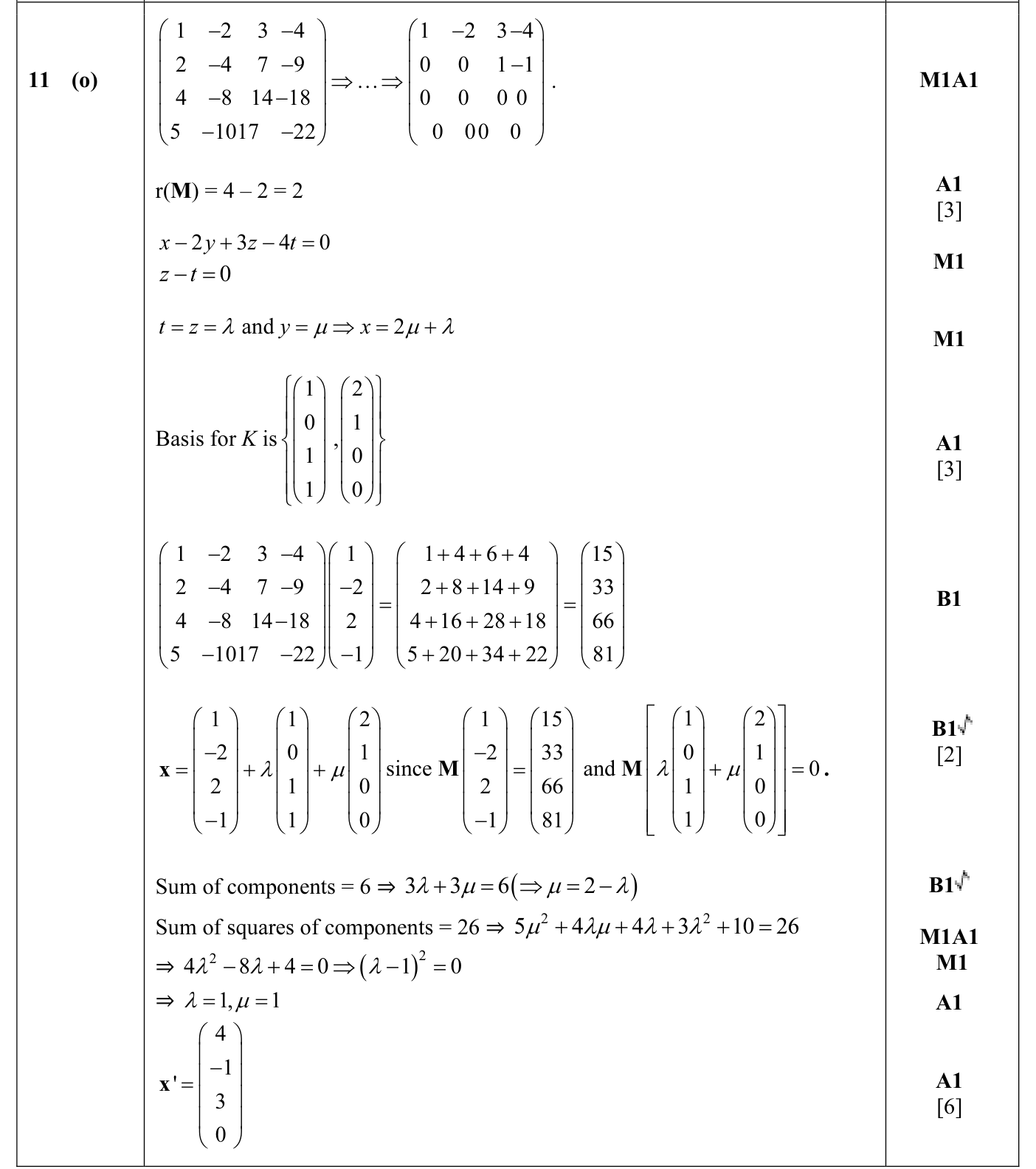
The linear transformation \(T:\mathbb R^4\to\mathbb R^4\) is represented by the matrix
\(\mathbf M=\begin{pmatrix}1&-2&3&-4\\2&-4&7&-9\\4&-8&14&-18\\5&-10&17&-22\end{pmatrix}.\)
Find the rank of \(\mathbf M\).
Obtain a basis for the null space \(K\) of \(T\).
Evaluate
\(\mathbf M\begin{pmatrix}1\\-2\\2\\-1\end{pmatrix},\)
and hence show that any solution of
\(\mathbf M\mathbf x=\begin{pmatrix}15\\33\\66\\81\end{pmatrix}\)
has the form
\(\begin{pmatrix}1\\-2\\2\\-1\end{pmatrix}+\lambda\mathbf e_1+\mu\mathbf e_2,\)
where \(\lambda\) and \(\mu\) are scalars and \(\{\mathbf e_1,\mathbf e_2\}\) is a basis for \(K\). Hence obtain a solution \(\mathbf x'\) for which the sum of the components is \(6\) and the sum of the squares of the components is \(26\).
9231 P11 - Nov 2017 - Q7 - 13 marks
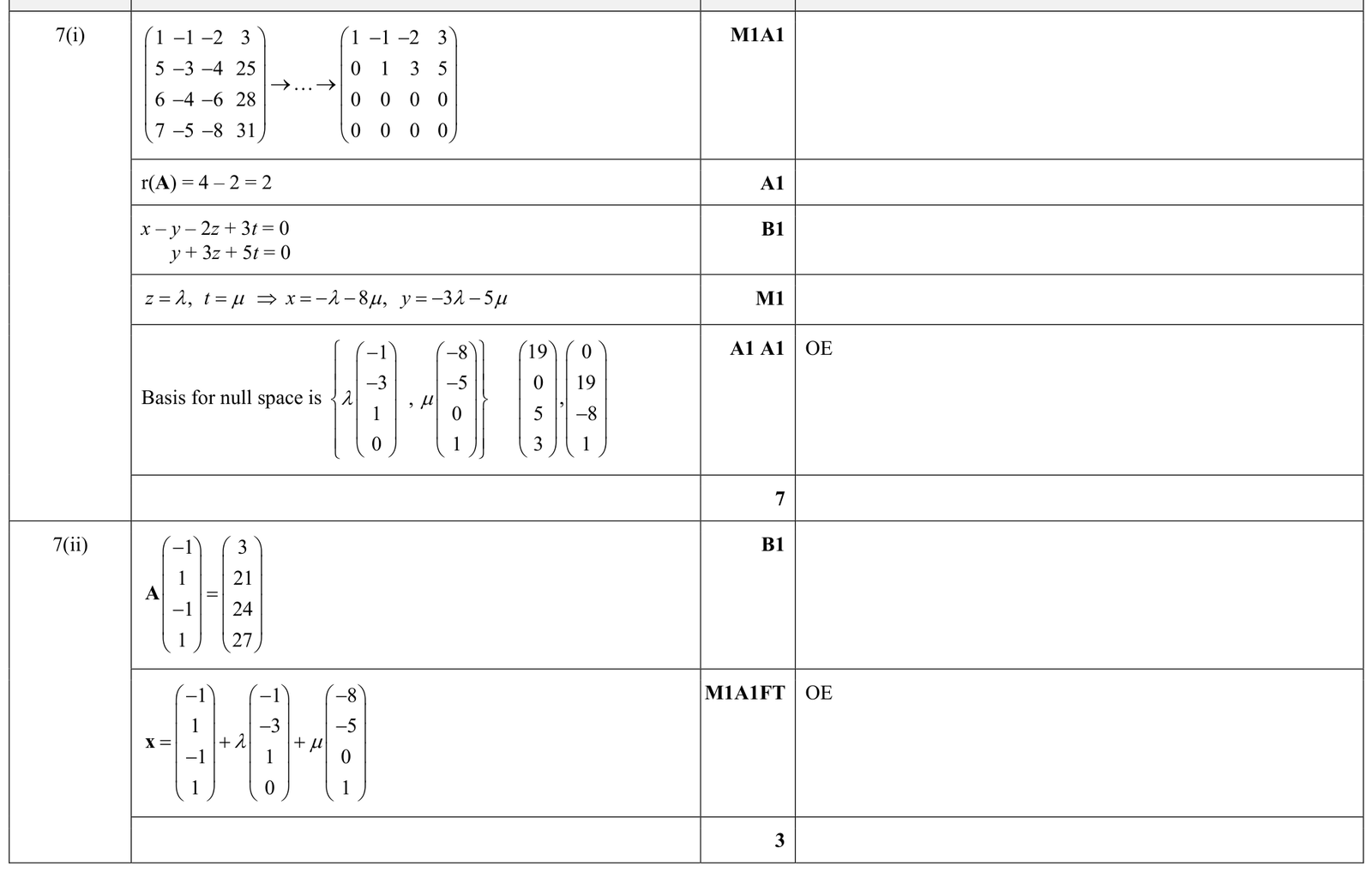
The linear transformation \(\mathrm{T}: \mathbb{R}^{4} \rightarrow \mathbb{R}^{4}\) is represented by the matrix \(\mathbf{A}\), where
\(\mathbf{A}=\left(\begin{array}{rrrr} 1 & -1 & -2 & 3 \\ 5 & -3 & -4 & 25 \\ 6 & -4 & -6 & 28 \\ 7 & -5 & -8 & 31 \end{array}\right) .\)
(i) Find the rank of \(\mathbf{A}\) and a basis for the null space of T .
(ii) Find the matrix product \(\mathbf{A}\left(\begin{array}{r}-1 \\ 1 \\ -1 \\ 1\end{array}\right)\) and hence find the general solution of the equation \(\mathbf{A} \mathbf{x}=\left(\begin{array}{r}3 \\ 21 \\ 24 \\ 27\end{array}\right)\).
9231 P13 - Nov 2013 - Q2 - 6 marks
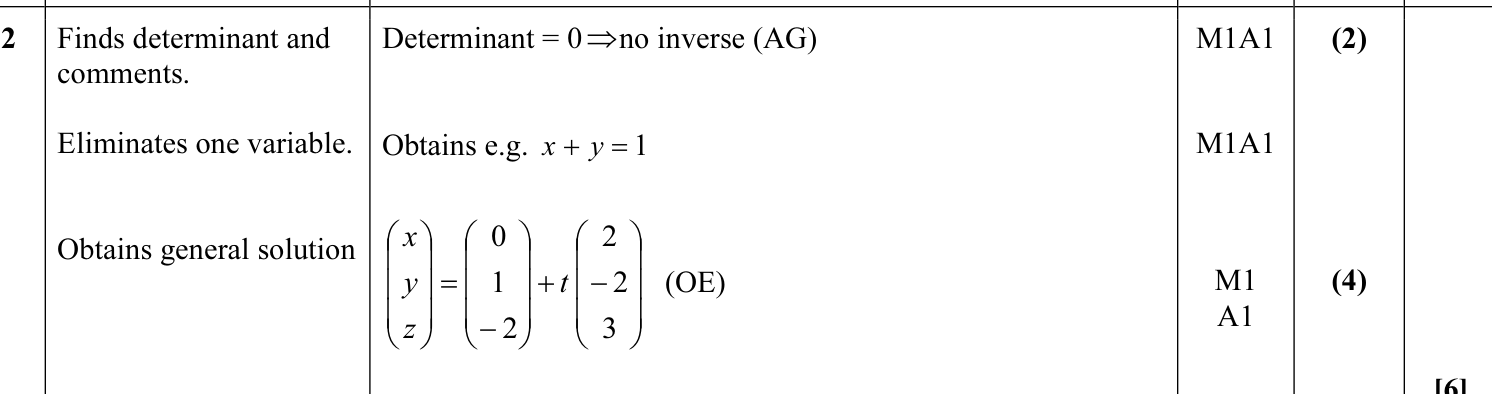
Show that the matrix \(\left(\begin{array}{rrr}1 & 0 & -2 \\ 3 & -3 & -4\end{array}\right)\) has no inverse.
Solve the system of equations
\(\begin{array}{r} x+4 y+2 z=0 \\ 3 x-2 z=4 \\ 3 x-3 y-4 z=5 \end{array}\)
9231 P11 - Jun 2019 - Q1 - 6 marks
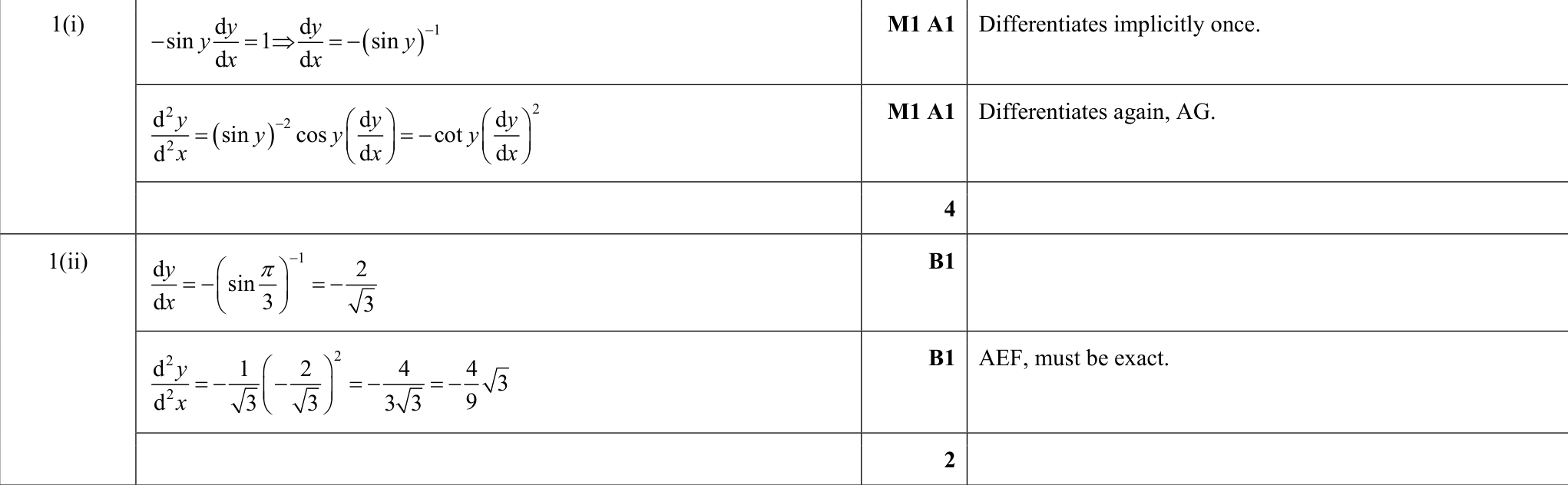
1 A curve \(C\) has equation \(\cos y=x\), for \(-\pi<x<\pi\).
(i) Use implicit differentiation to show that \(\dfrac{\mathrm d^2y}{\mathrm dx^2}=-\cot y\left(\dfrac{\mathrm dy}{\mathrm dx}\right)^2\).
(ii) Hence find the exact value of \(\dfrac{\mathrm d^2y}{\mathrm dx^2}\) at the point \(\left(\dfrac12,\dfrac{\pi}{3}\right)\) on \(C\).
9231 P11 - Nov 2019 - Q11 - 28 marks
Answer only one of the following two alternatives.
EITHER
It is given that \(w=\cos y\) and
\(\tan y\,\dfrac{\mathrm d^2y}{\mathrm dx^2}+\left(\dfrac{\mathrm dy}{\mathrm dx}\right)^2+2\tan y\,\dfrac{\mathrm dy}{\mathrm dx}=1+\mathrm e^{-2x}\sec y\).
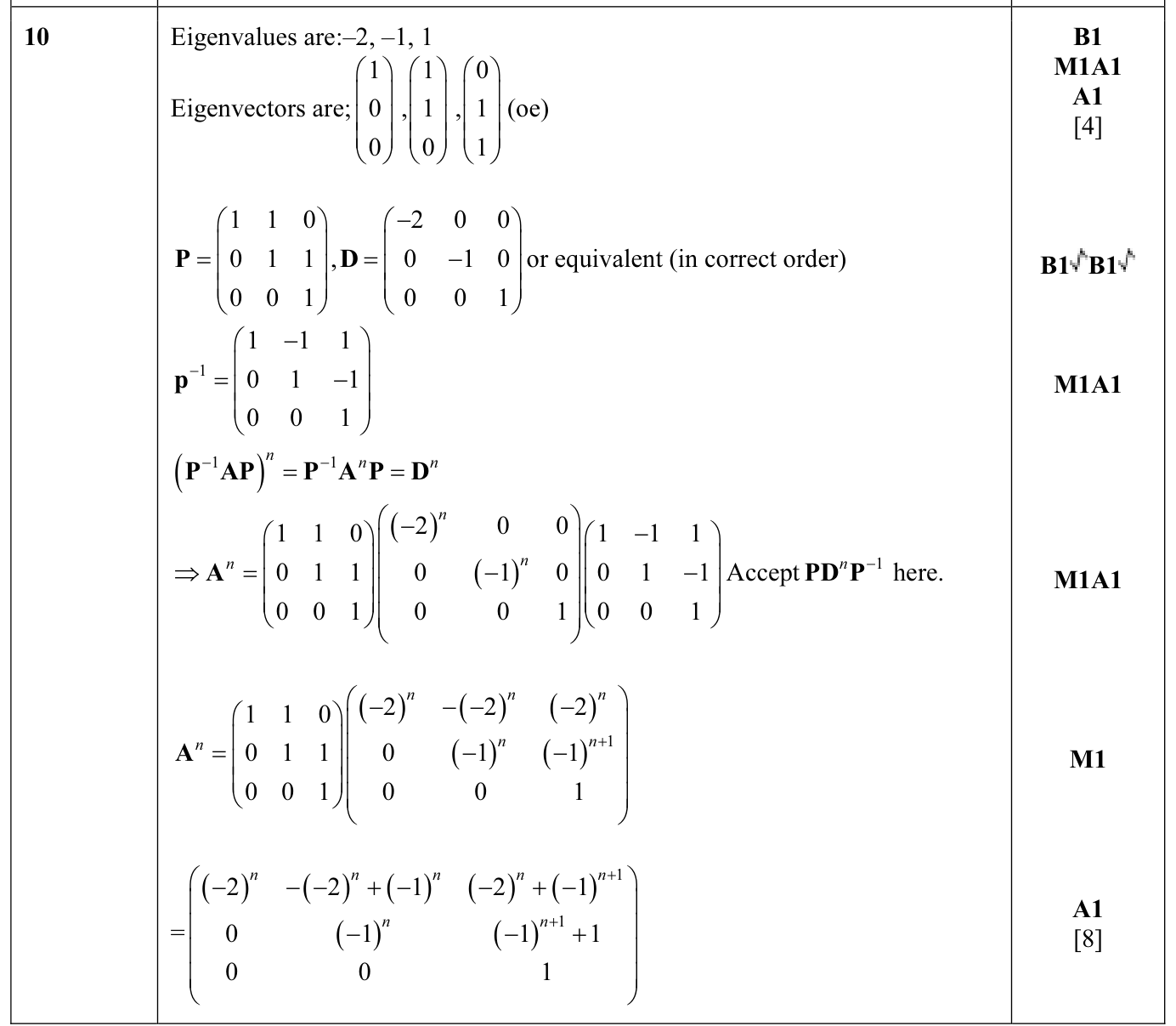
(i) Show that \(\dfrac{\mathrm d^2w}{\mathrm dx^2}+2\dfrac{\mathrm dw}{\mathrm dx}+w=-\mathrm e^{-2x}\).
(ii) Find the particular solution for \(y\) in terms of \(x\), given that when \(x=0\), \(y=\dfrac{\pi}{3}\) and \(\dfrac{\mathrm dy}{\mathrm dx}=\dfrac{1}{\sqrt3}\).
OR
The curves \(C_1\) and \(C_2\) have polar equations, for \(0\leq\theta\leq\dfrac{\pi}{2}\), as follows:
\(C_1: r=2\left(\mathrm e^{\theta}+\mathrm e^{-\theta}\right)\),
\(C_2: r=\mathrm e^{2\theta}-\mathrm e^{-2\theta}\).
The curves intersect at the point \(P\) where \(\theta=\alpha\).
(i) Show that \(\mathrm e^{2\alpha}-2\mathrm e^\alpha-1=0\). Hence find the exact value of \(\alpha\) and show that the value of \(r\) at \(P\) is \(4\sqrt2\).
(ii) Sketch \(C_1\) and \(C_2\) on the same diagram.
(iii) Find the area of the region enclosed by \(C_1\), \(C_2\) and the initial line, giving your answer correct to 3 significant figures.