Answer: 9P1: \(6x+y+4z=13\)
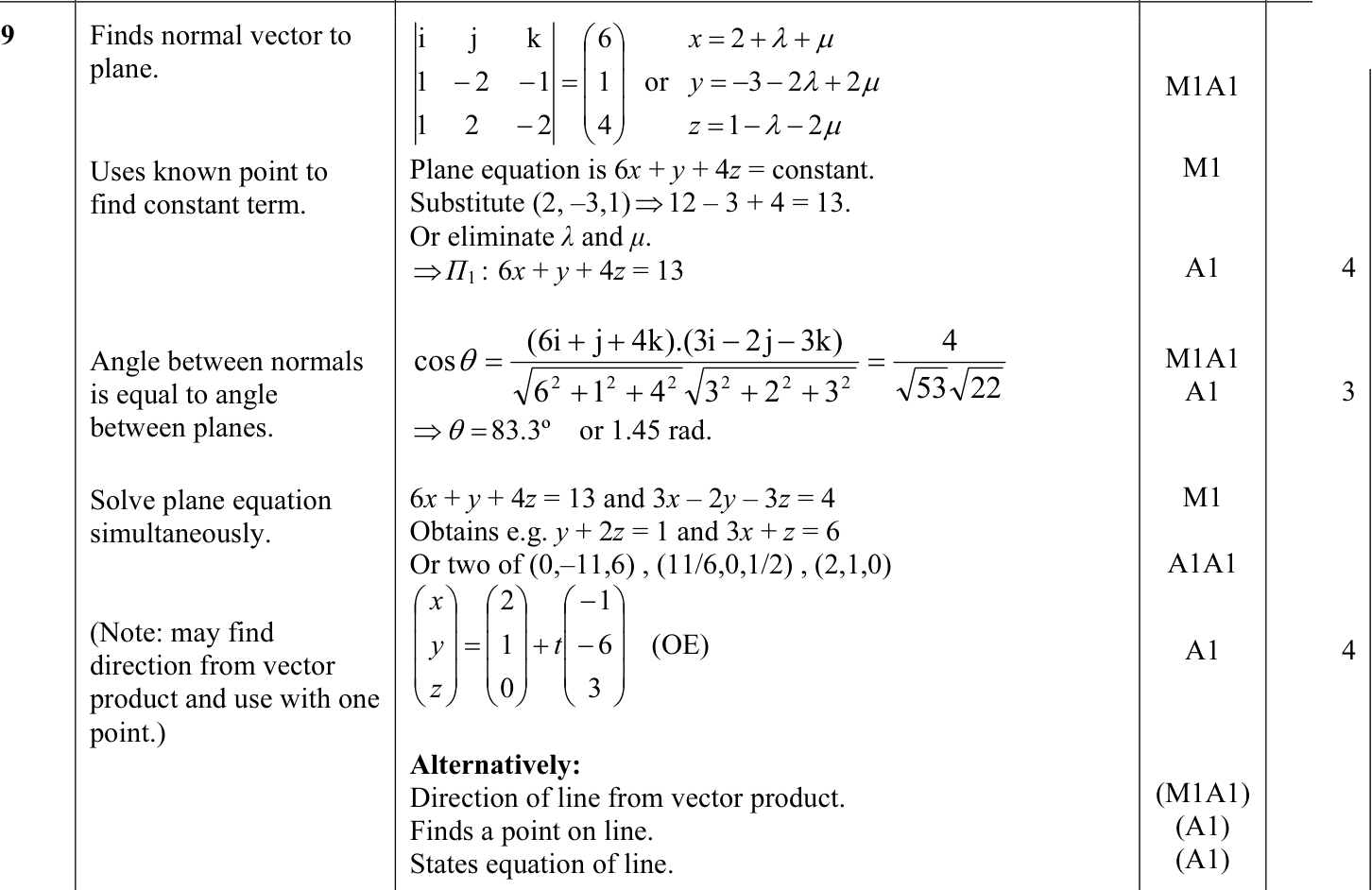
The acute angle between \(\Pi_1\) and \(\Pi_2\) is \(83.3^\circ\) (approximately).
A vector equation of the line of intersection is \(\left(\begin{array}{c}x\\y\\z\end{array}\right)=\left(\begin{array}{c}2\\1\\0\end{array}\right)+t\left(\begin{array}{c}-1\\-6\\3\end{array}\right)\), where \(t\\in\mathbb{R}\).
The plane \(\Pi_1\) is given by \(\mathbf r=(2,-3,1)+\lambda(1,-2,-1)+\mu(1,2,-2)\).
So two direction vectors in the plane are \(\mathbf a=(1,-2,-1)\) and \(\mathbf b=(1,2,-2)\). A normal vector is their cross product:
\(\mathbf n_1=\mathbf a\times\mathbf b=\begin{vmatrix}\mathbf i&\mathbf j&\mathbf k\\\\1&-2&-1\\\\1&2&-2\end{vmatrix}=(6,1,4)\).
Since \(\mathbf n_1\) is normal to \(\Pi_1\), the cartesian equation has the form \(6x+y+4z=c\). Using the point \((2,-3,1)\) on the plane:
\(6(2)+(-3)+4(1)=12-3+4=13\).
Hence \(\Pi_1: 6x+y+4z=13\).
For the acute angle between the planes, we use the angle between their normal vectors. A normal to \(\Pi_2: 3x-2y-3z=4\) is \(\mathbf n_2=(3,-2,-3)\).
So
\(\cos\theta=\frac{|\mathbf n_1\cdot\mathbf n_2|}{|\mathbf n_1||\mathbf n_2|}=\frac{|6\cdot3+1\cdot(-2)+4\cdot(-3)|}{\sqrt{6^2+1^2+4^2}\,\sqrt{3^2+(-2)^2+(-3)^2}}=\frac{4}{\sqrt{53}\sqrt{22}}\).
Therefore \(\theta\approx 83.3^\circ\).
To find the line of intersection, solve the two plane equations simultaneously:
\(6x+y+4z=13\)
\(3x-2y-3z=4\).
Eliminating \(x\) gives \(y+2z=1\), and eliminating \(y\) gives \(3x+z=6\).
Let \(z=3t\). Then \(y=1-2z=1-6t\) and \(3x+3t=6\), so \(x=2-t\).
Hence a vector equation of the line is
\(\left(\begin{array}{c}x\\y\\z\end{array}\right)=\left(\begin{array}{c}2\\1\\0\end{array}\right)+t\left(\begin{array}{c}-1\\-6\\3\end{array}\right),\quad t\in\mathbb R.\)