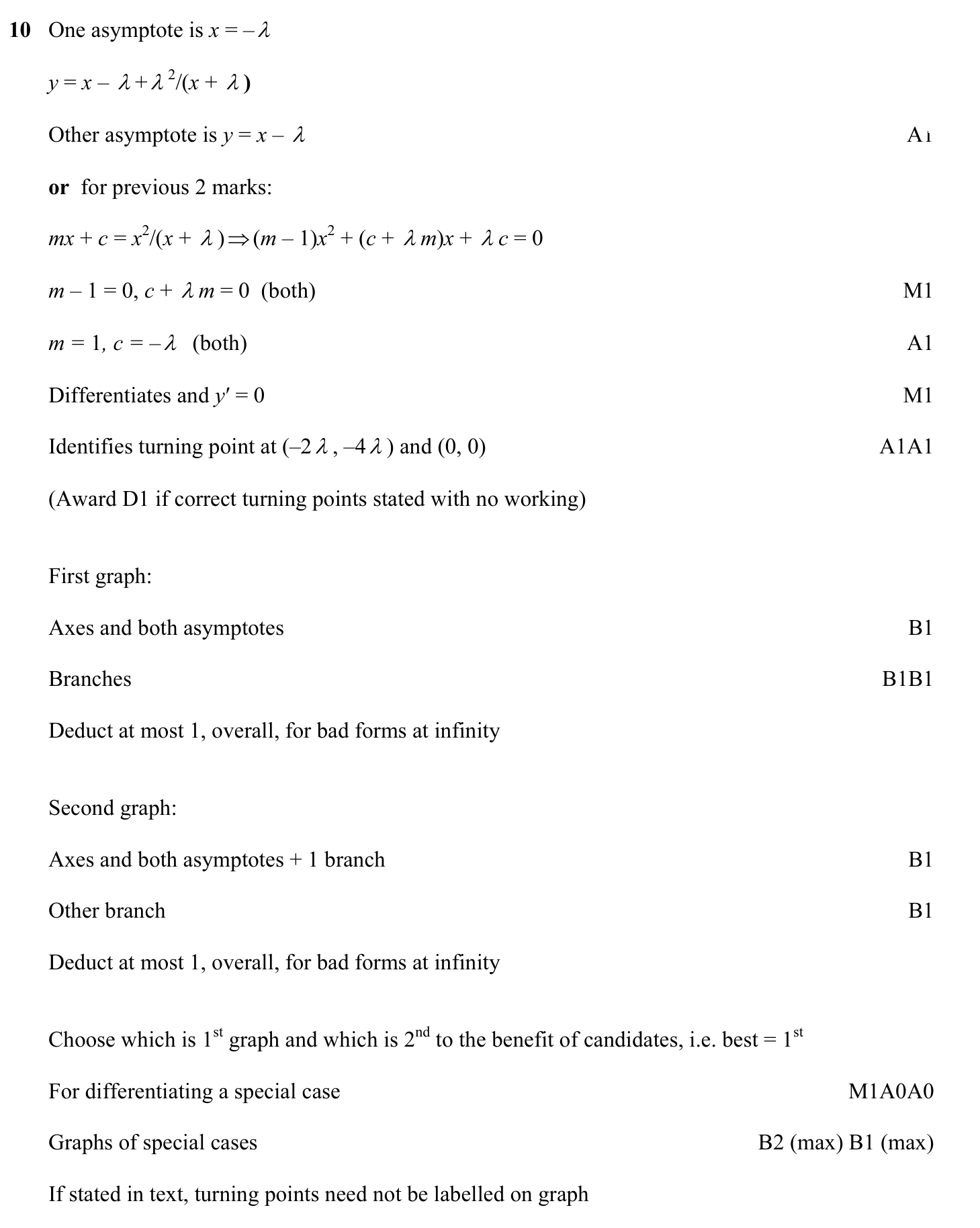
Answer: The asymptotes are the vertical line \(x=-\lambda\) and the oblique line \(y=x-\lambda\).
For \(\lambda\gt 0\), the curve has turning points at \((0,0)\) and \((-2\lambda,-4\lambda)\).
For \(\lambda\lt 0\), the same turning points occur; the sketch is drawn with the vertical asymptote on the opposite side of the \(y\)-axis from the \(\lambda\gt 0\) case.
We first rewrite the curve by division:
\(y=\frac{x^{2}}{x+\lambda}=x-\lambda+\frac{\lambda^{2}}{x+\lambda}.\)
This shows immediately that as \(x\to\pm\infty\), the term \(\frac{\lambda^{2}}{x+\lambda}\to 0\), so the oblique asymptote is
\(y=x-\lambda.\)
The denominator is zero when \(x+\lambda=0\), so there is also a vertical asymptote
\(x=-\lambda.\)
To find the turning points, differentiate:
\(y=x-\lambda+\lambda^{2}(x+\lambda)^{-1}.\)
Hence
\(\frac{dy}{dx}=1-\frac{\lambda^{2}}{(x+\lambda)^{2}}.\)
Set \(\frac{dy}{dx}=0\):
\(1=\frac{\lambda^{2}}{(x+\lambda)^{2}}\), so \(x+\lambda=\pm\lambda\).
This gives \(x=0\) or \(x=-2\lambda\).
Now find the corresponding \(y\)-values:
- if \(x=0\), then \(y=\frac{0^{2}}{\lambda}=0\), so one turning point is \((0,0)\);
- if \(x=-2\lambda\), then \(y=\frac{(-2\lambda)^2}{-2\lambda+\lambda}=\frac{4\lambda^2}{-\lambda}=-4\lambda\), so the other turning point is \((-2\lambda,-4\lambda)\).
So the asymptotes are \(x=-\lambda\) and \(y=x-\lambda\), and the turning points are \((0,0)\) and \((-2\lambda,-4\lambda)\).
For the sketch:
- when \(\lambda\gt 0\), the vertical asymptote is to the left of the \(y\)-axis;
- when \(\lambda\lt 0\), the vertical asymptote is to the right of the \(y\)-axis.
In each case, draw the curve approaching both asymptotes and passing through the turning points \((0,0)\) and \((-2\lambda,-4\lambda)\).