Past Exam Questions
← Back9231 P11 - Jun 2018 - Q7 - 10 marks
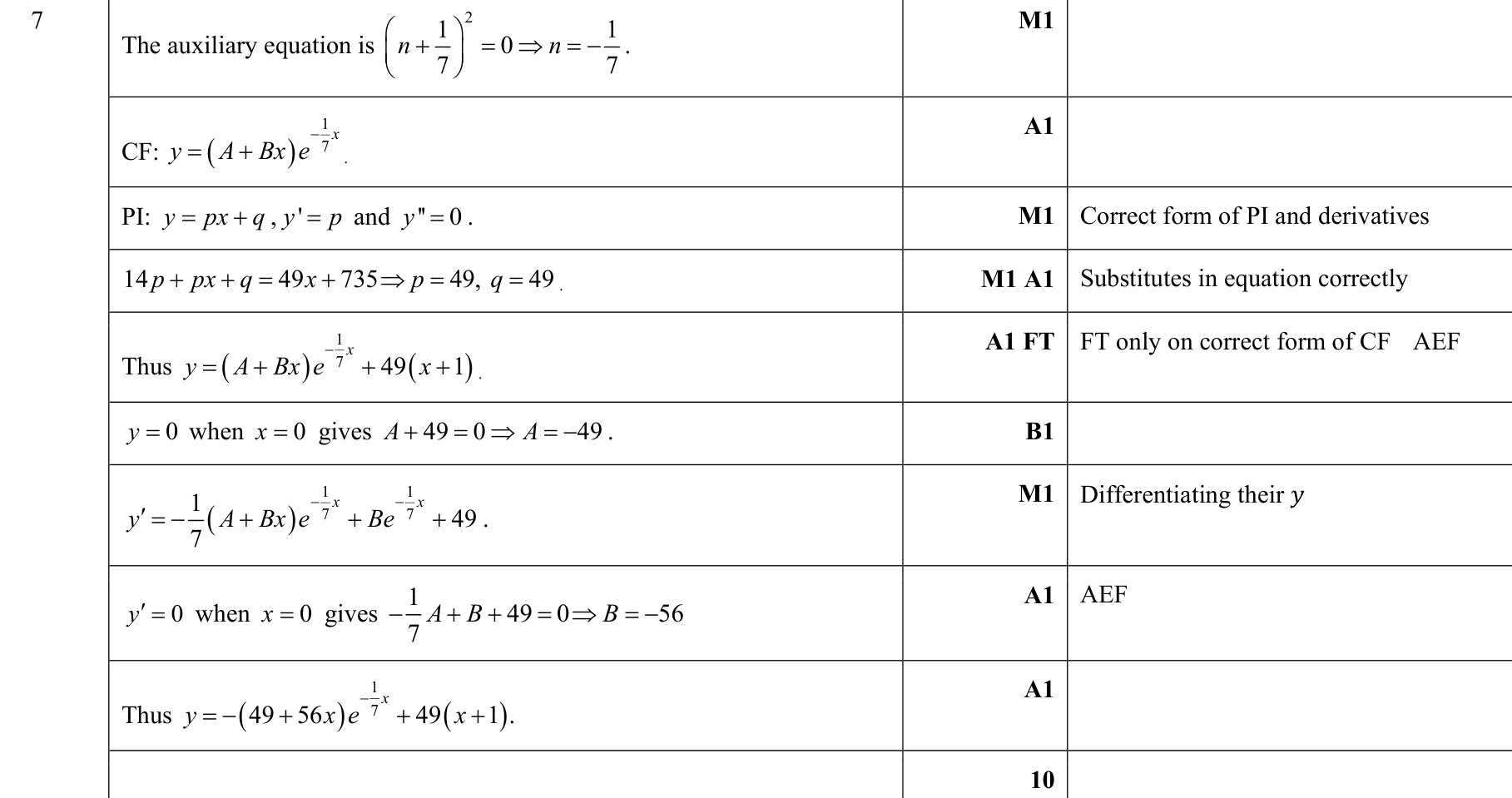
Find the particular solution of the differential equation
\(49 \frac{\mathrm{~d}^{2} y}{\mathrm{~d} x^{2}}+14 \frac{\mathrm{~d} y}{\mathrm{~d} x}+y=49 x+735,\)
given that when \(x=0, y=0\) and \(\frac{\mathrm{d} y}{\mathrm{~d} x}=0\).
9231 P13 - Jun 2018 - Q1 - 5 marks
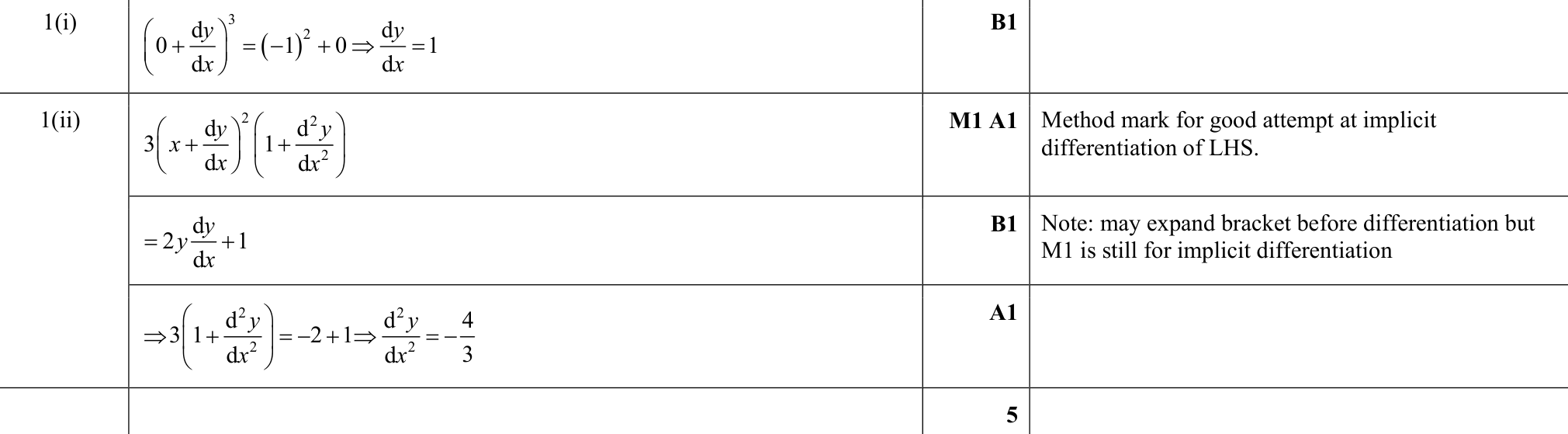
The variables \(x\) and \(y\) are such that \(y=-1\) when \(x=0\) and
\(\left(x+\frac{\mathrm{d} y}{\mathrm{~d} x}\right)^{3}=y^{2}+x\)
(i) Find the value of \(\frac{\mathrm{d} y}{\mathrm{~d} x}\) when \(x=0\).
(ii) Find also the value of \(\frac{\mathrm{d}^{2} y}{\mathrm{~d} x^{2}}\) when \(x=0\).
9231 P23 - Jun 2024 - Q3 - 8 marks
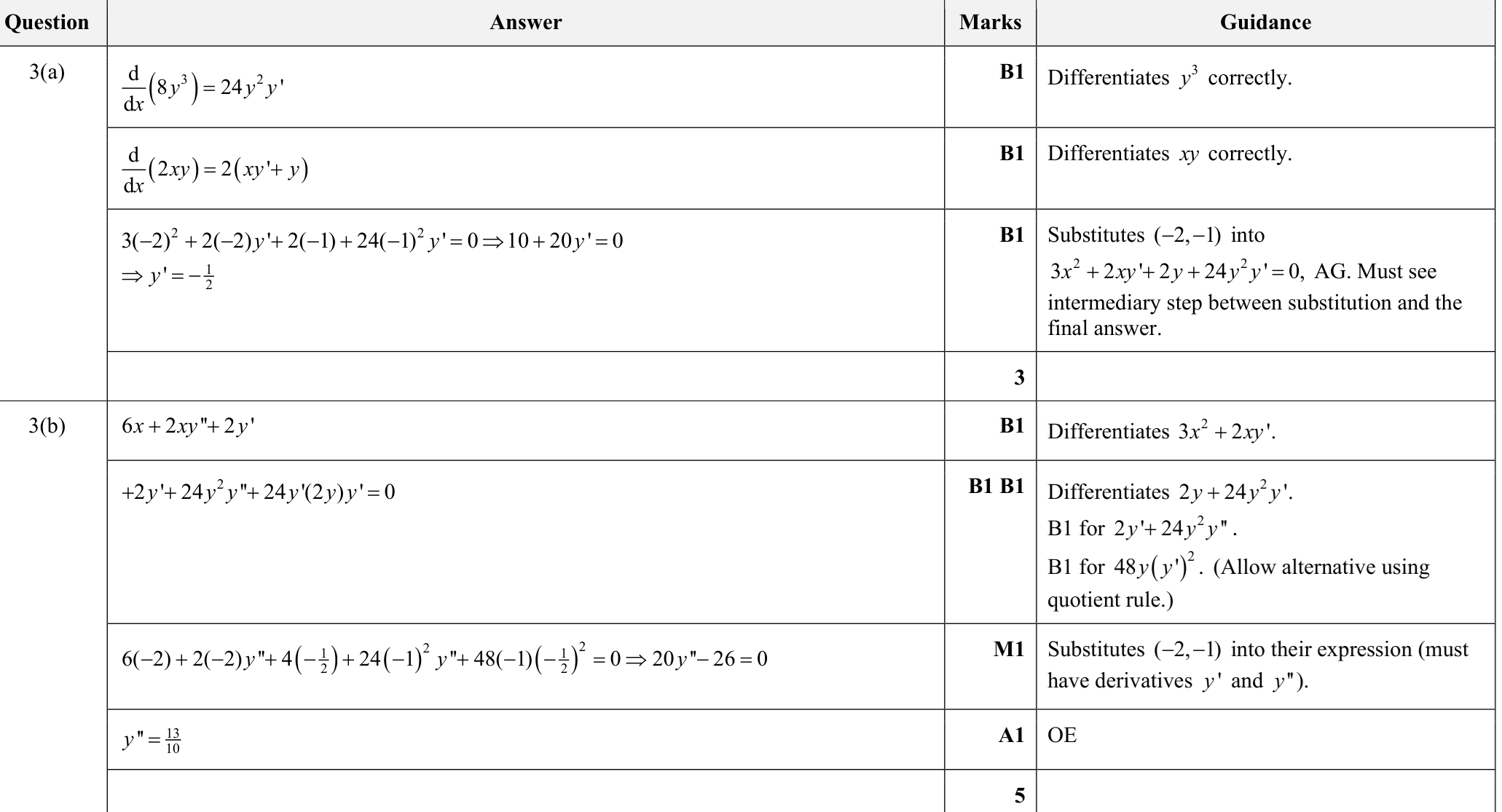
The curve \(C\) has equation
\(x^{3}+2 x y+8 y^{3}=-12\)
(a) Show that, at the point \((-2,-1)\) on \(C, \frac{\mathrm{~d} y}{\mathrm{~d} x}=-\frac{1}{2}\).
(b) Find the value of \(\frac{\mathrm{d}^{2} y}{\mathrm{~d} x^{2}}\) at the point \((-2,-1)\).
9231 P23 - Jun 2023 - Q4 - 8 marks
The curve \(C\) has equation
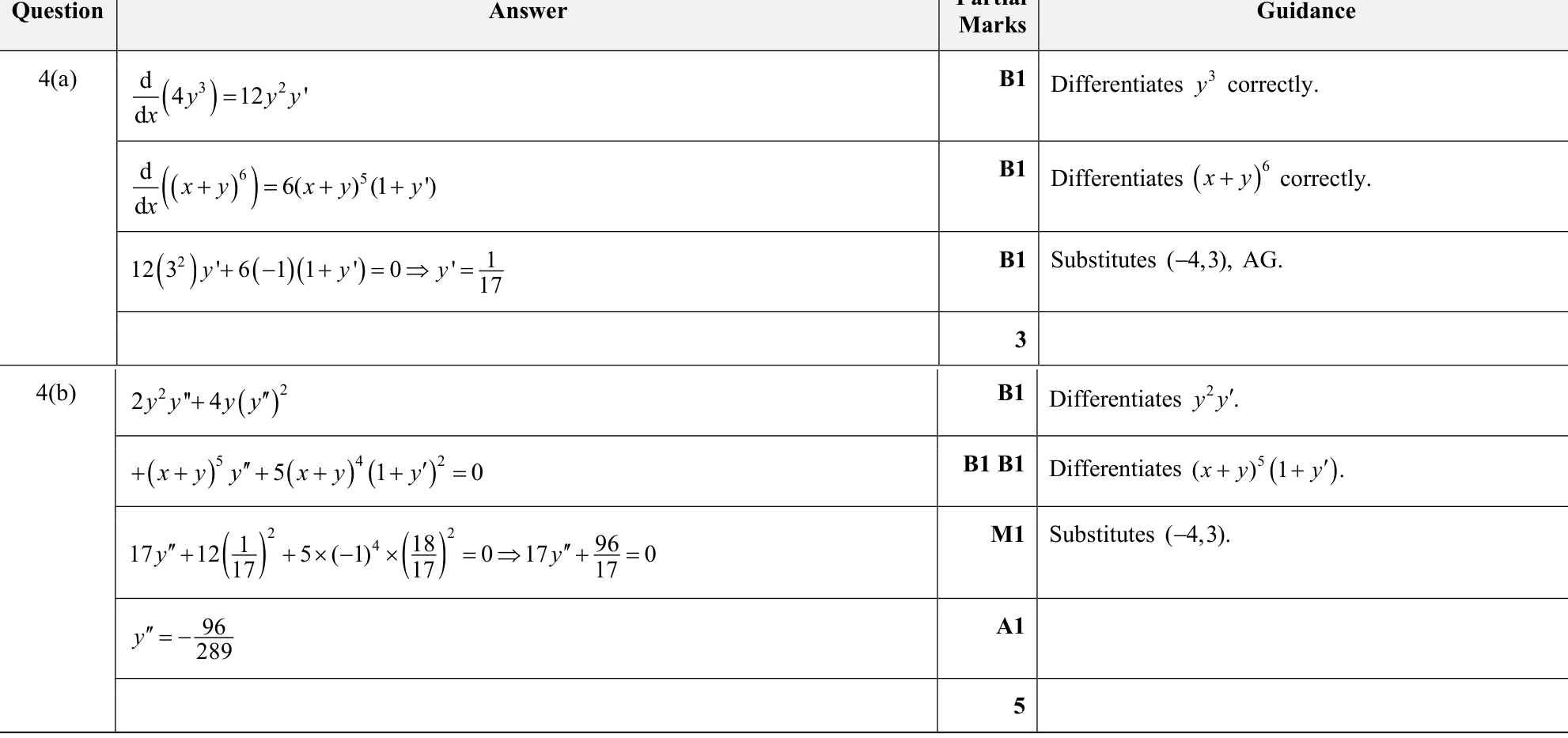
\(4 y^{3}+(x+y)^{6}=109 .\)
(a) Show that, at the point \((-4,3)\) on \(C, \frac{\mathrm{~d} y}{\mathrm{~d} x}=\frac{1}{17}\).
(b) Find the value of \(\frac{\mathrm{d}^{2} y}{\mathrm{~d} x^{2}}\) at the point \((-4,3)\).
9231 P22 - Nov 2024 - Q2 - 7 marks
The curve \(C\) has equation
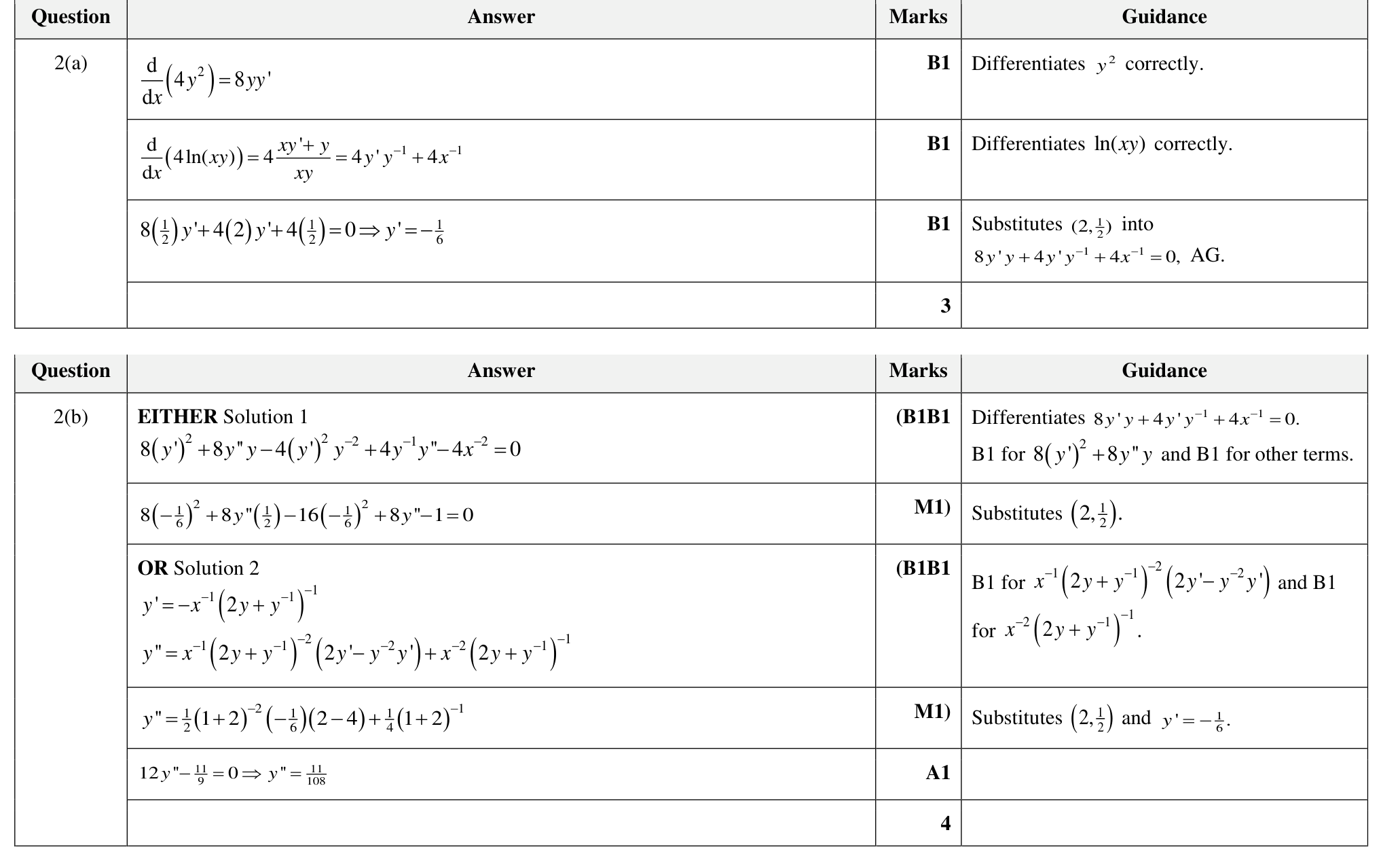
\(4 y^{2}+4 \ln (x y)=1 .\)
(a) Show that, at the point \(\left(2, \frac{1}{2}\right)\) on \(C, \frac{\mathrm{~d} y}{\mathrm{~d} x}=-\frac{1}{6}\).
(b) Find the value of \(\frac{\mathrm{d}^{2} y}{\mathrm{~d} x^{2}}\) at the point \(\left(2, \frac{1}{2}\right)\).
9231 P22 - Nov 2022 - Q2 - 7 marks
A curve has equation
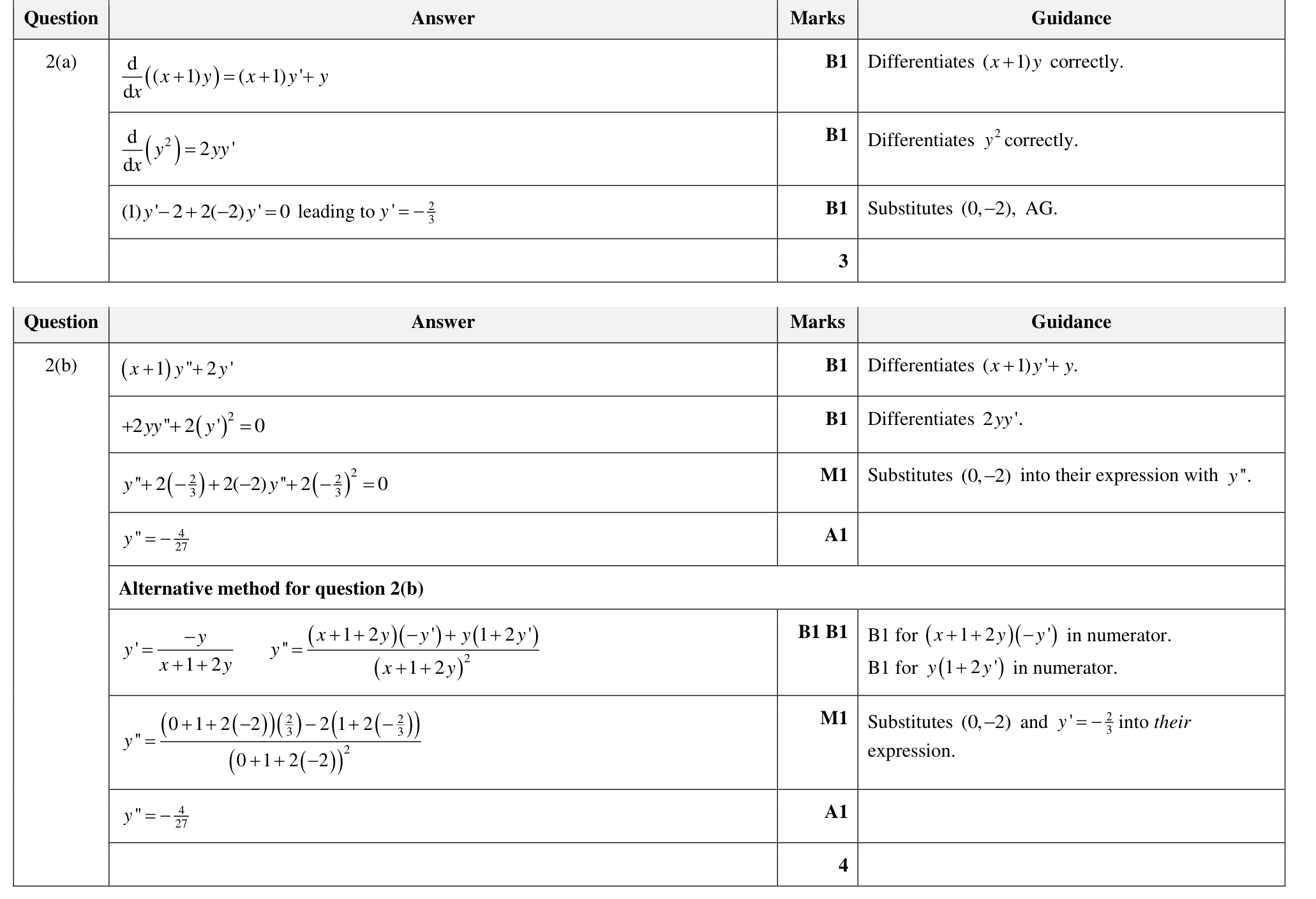
\((x+1) y+y^{2}=2\)
(a) Show that \(\frac{\mathrm{d} y}{\mathrm{~d} x}=-\frac{2}{3}\) at the point \((0,-2)\).
(b) Find the value of \(\frac{\mathrm{d}^{2} y}{\mathrm{~d} x^{2}}\) at the point \((0,-2)\).
9231 P21 - Nov 2021 - Q3 - 8 marks
The curve \(C\) has equation
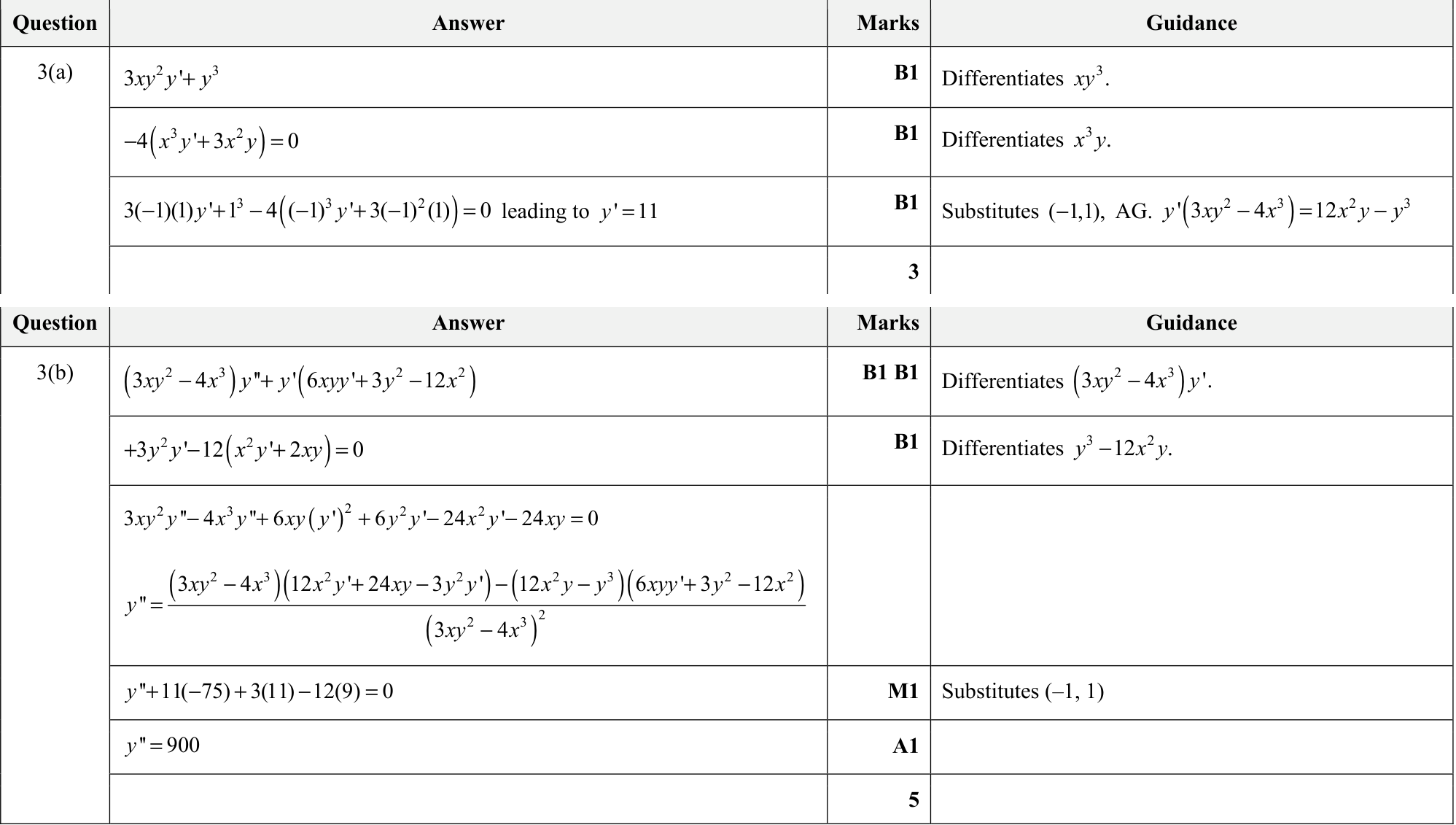
\(x y^{3}-4 x^{3} y=3 .\)
(a) Show that, at the point \((-1,1)\) on \(C, \frac{\mathrm{~d} y}{\mathrm{~d} x}=11\).
(b) Find the value of \(\frac{\mathrm{d}^{2} y}{\mathrm{~d} x^{2}}\) at the point \((-1,1)\).
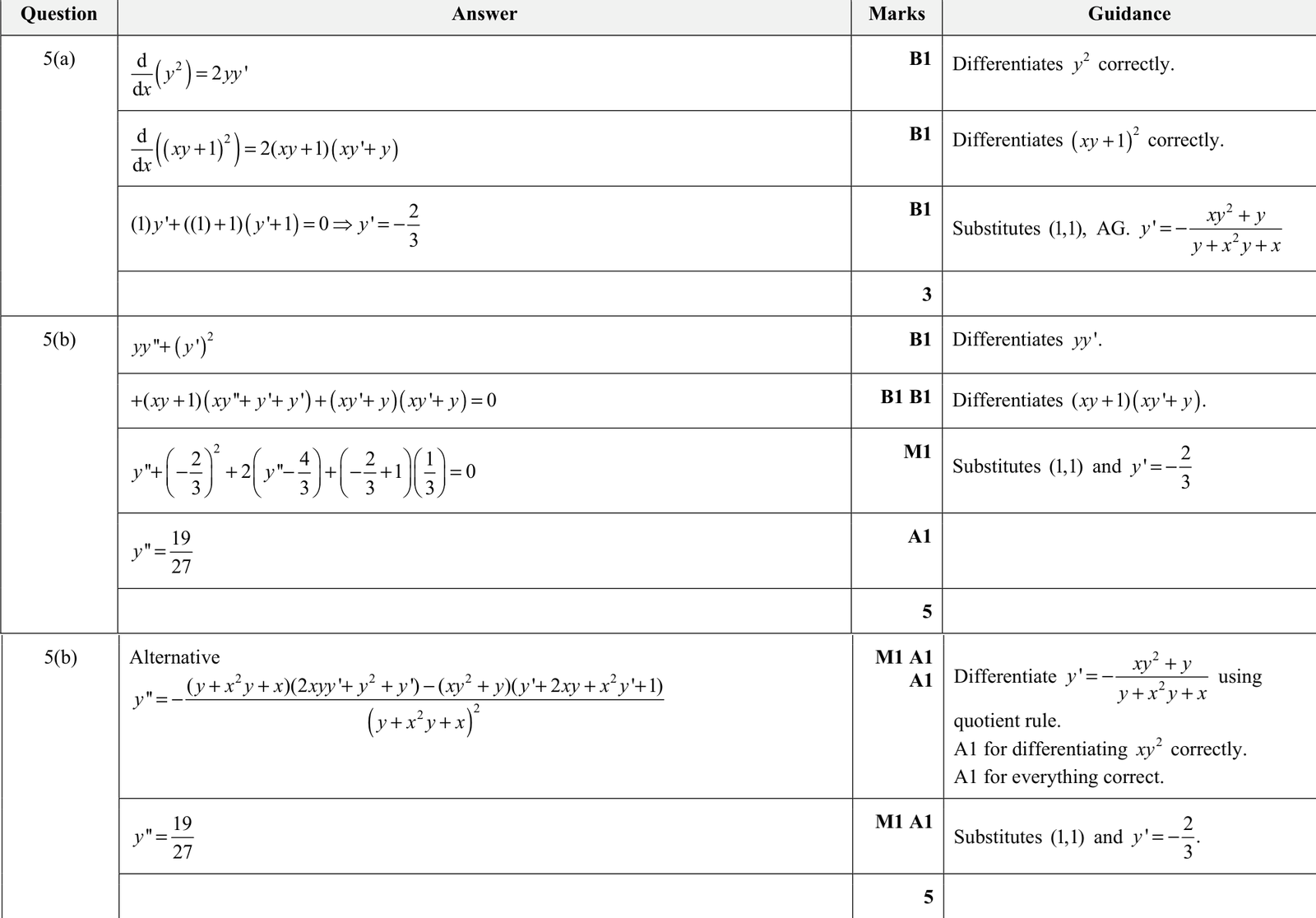
9231 P22 - Nov 2020 - Q5 - 8 marks
The curve \(C\) has equation
\[y^{2}+(x y+1)^{2}=5 .\]
(a) Show that, at the point \((1,1)\) on \(C, \frac{\mathrm{~d} y}{\mathrm{~d} x}=-\frac{2}{3}\).
(b) Find the value of \(\frac{\mathrm{d}^{2} y}{\mathrm{~d} x^{2}}\) at the point \((1,1)\).
9231 P11 - Jun 2017 - Q3 - 5 marks
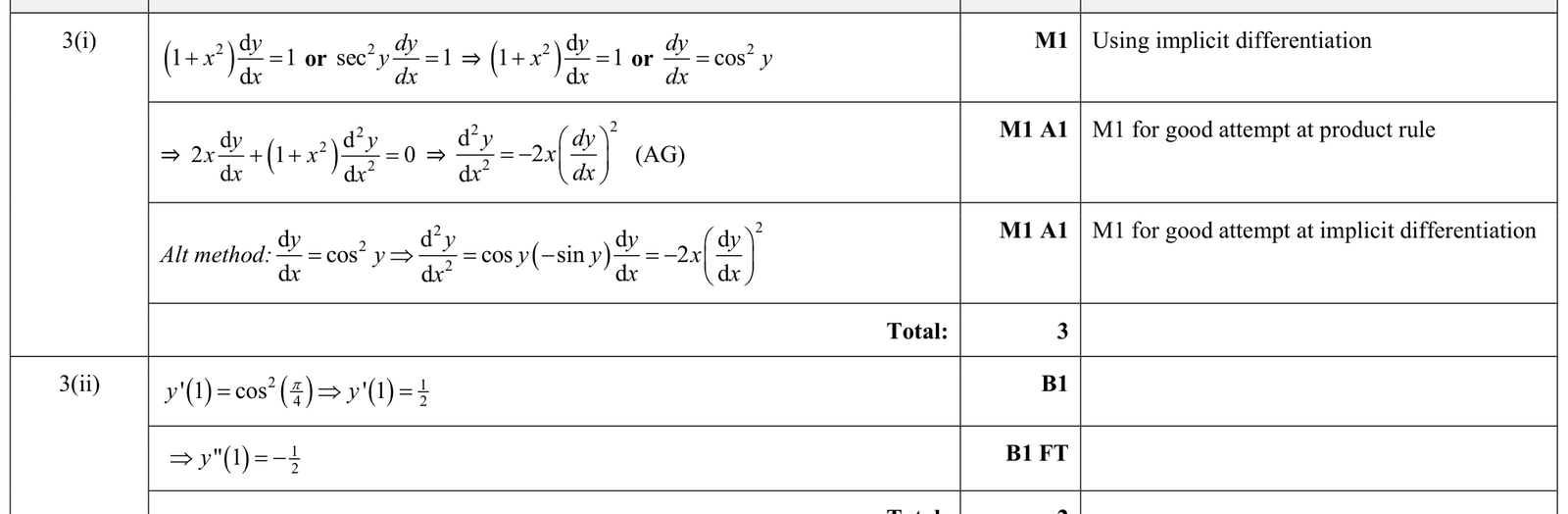
A curve \(C\) has equation \(\tan y=x\), for \(x\gt 0\).
(i) Use implicit differentiation to show that
\(\frac{\mathrm{d}^{2} y}{\mathrm{~d} x^{2}}=-2 x\left(\frac{\mathrm{~d} y}{\mathrm{~d} x}\right)^{2} .\)
(ii) Hence find the value of \(\frac{\mathrm{d}^{2} y}{\mathrm{~d} x^{2}}\) at the point \(\left(1, \frac{1}{4} \pi\right)\) on \(C\).
9231 P11 - Jun 2017 - Q9 - 11 marks
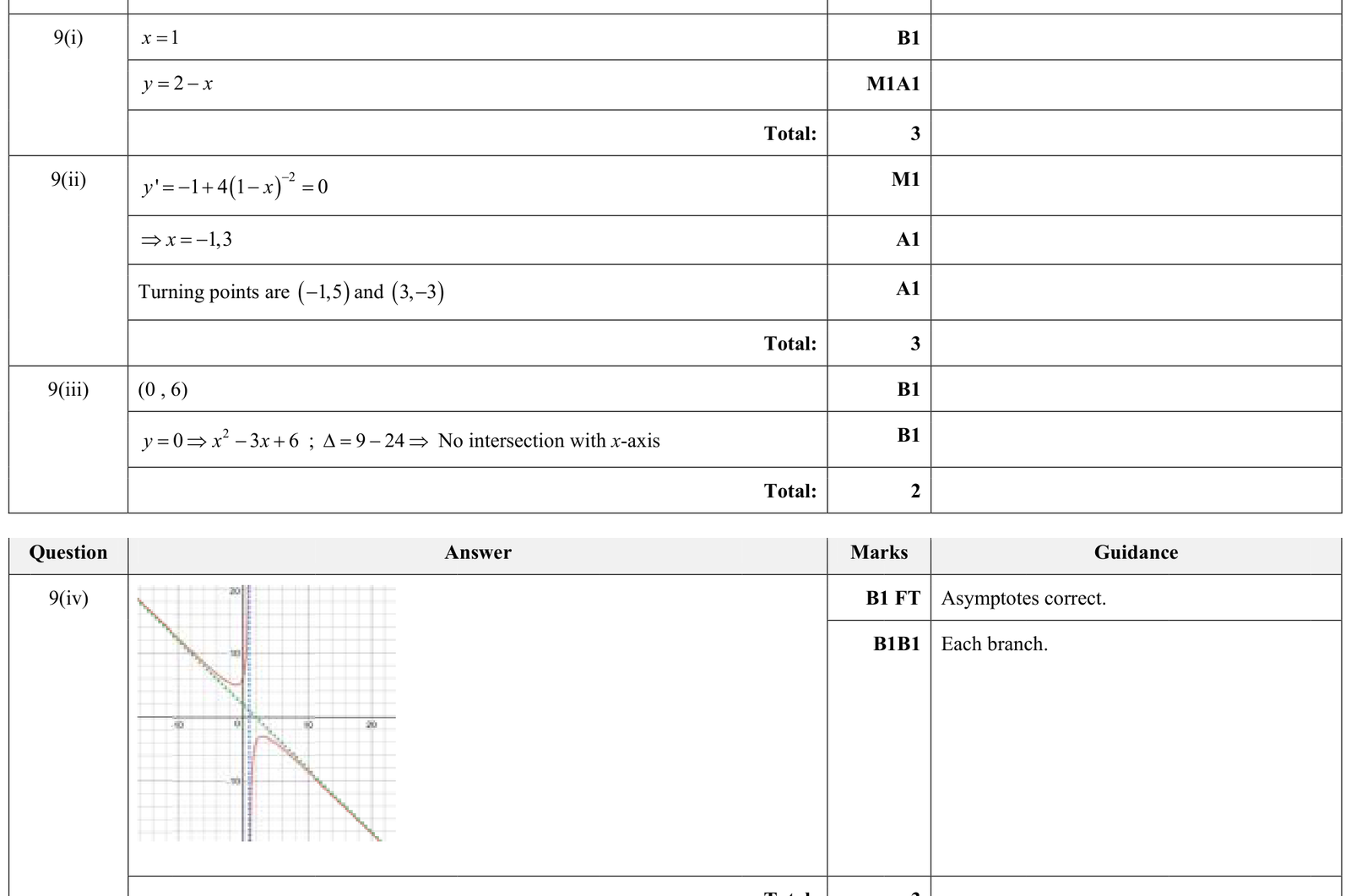
The curve \(C\) has equation \(y=\frac{x^{2}-3 x+6}{1-x}\).
(i) Find the equations of the asymptotes of \(C\).
(ii) Find the coordinates of the turning points of \(C\).
(iii) Find the coordinates of any intersections with the coordinate axes.
(iv) Sketch \(C\).
9231 P11 - Jun 2017 - Q10 - 11 marks
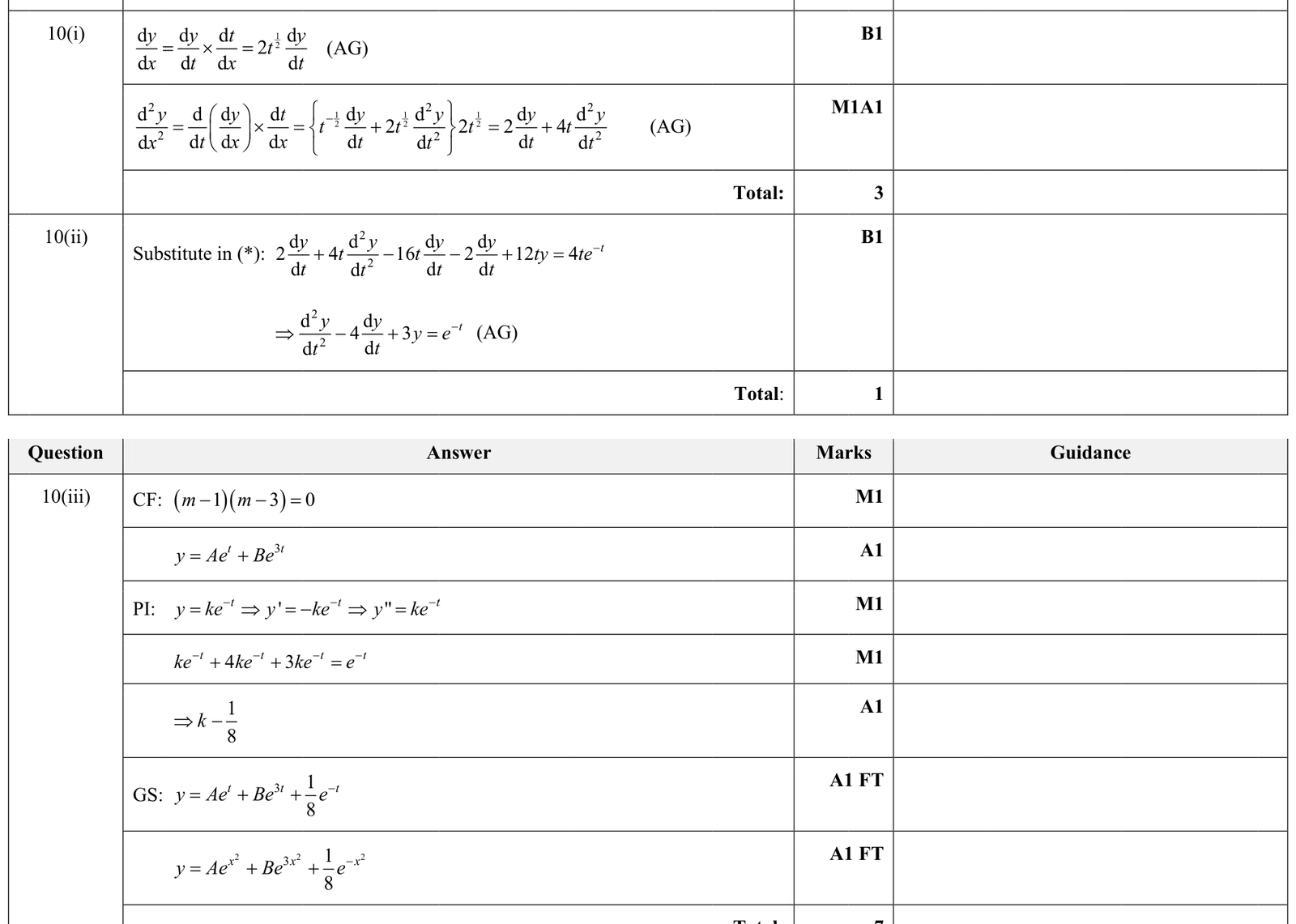
It is given that \(x=t^{\frac{1}{2}}\), where \(x\gt 0\) and \(t\gt 0\), and \(y\) is a function of \(x\).
(i) Show that \(\frac{\mathrm{d} y}{\mathrm{~d} x}=2 t^{\frac{1}{2}} \frac{\mathrm{~d} y}{\mathrm{~d} t}\) and \(\frac{\mathrm{d}^{2} y}{\mathrm{~d} x^{2}}=2 \frac{\mathrm{~d} y}{\mathrm{~d} t}+4 t \frac{\mathrm{~d}^{2} y}{\mathrm{~d} t^{2}}\).
(ii) Hence show that the differential equation
\(\frac{\mathrm{d}^{2} y}{\mathrm{~d} x^{2}}-\left(8 x+\frac{1}{x}\right) \frac{\mathrm{d} y}{\mathrm{~d} x}+12 x^{2} y=4 x^{2} \mathrm{e}^{-x^{2}}\)
reduces to the differential equation
\(\frac{\mathrm{d}^{2} y}{\mathrm{~d} t^{2}}-4 \frac{\mathrm{~d} y}{\mathrm{~d} t}+3 y=\mathrm{e}^{-t} .\)
(iii) Find the general solution of \((*)\), giving \(y\) in terms of \(x\).
9231 P13 - Jun 2017 - Q4 - 7 marks
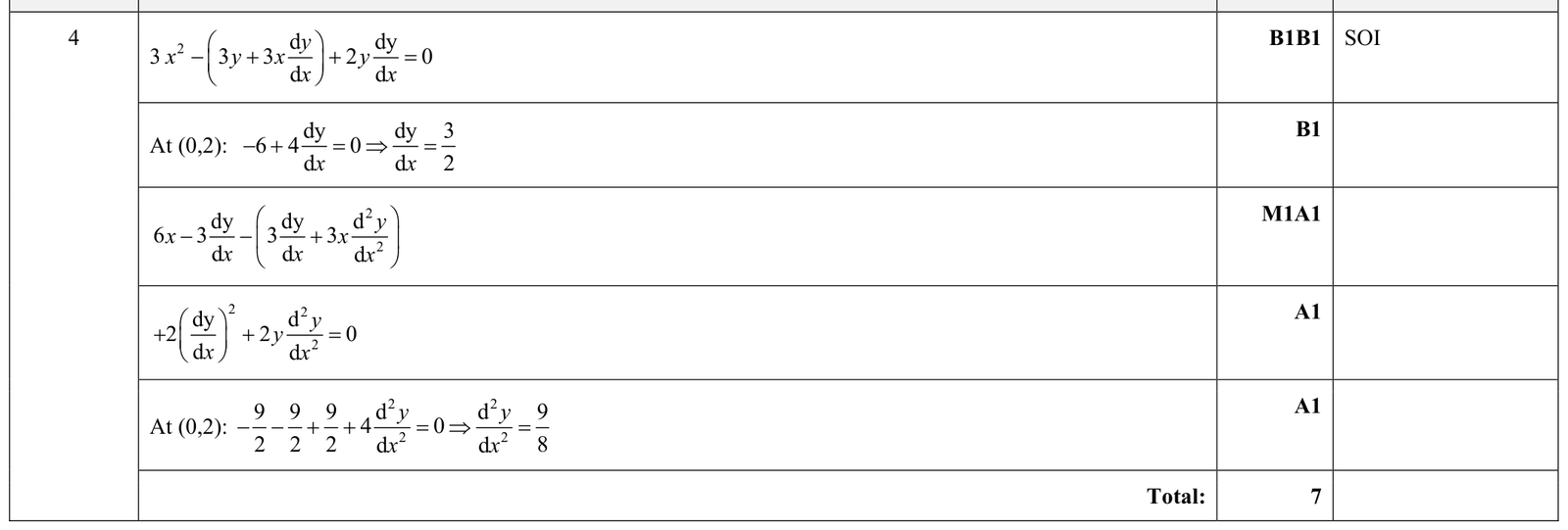
A curve \(C\) has equation \(x^{3}-3 x y+y^{2}=4\). Find the value of \(\frac{\mathrm{d}^{2} y}{\mathrm{~d} x^{2}}\) at the point \((0,2)\) of \(C\).
9231 P11 - Nov 2015 - Q1 - 4 marks
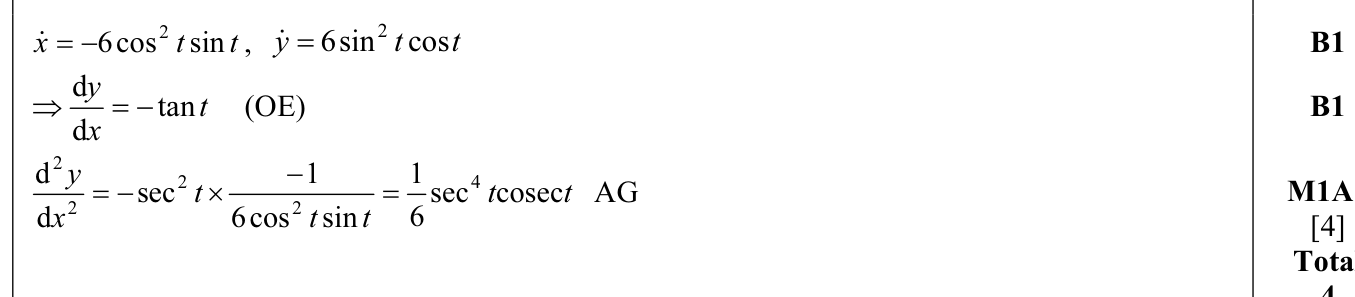
The curve \(C\) is defined parametrically by
\(x=2 \cos ^{3} t \quad \text { and } \quad y=2 \sin ^{3} t, \quad \text { for } 0\lt t\lt \frac{1}{2} \pi .\)
Show that, at the point with parameter \(t\),
\(\frac{\mathrm{d}^{2} y}{\mathrm{~d} x^{2}}=\frac{1}{6} \sec ^{4} t \operatorname{cosec} t\)
9231 P13 - Jun 2015 - Q7 - 10 marks
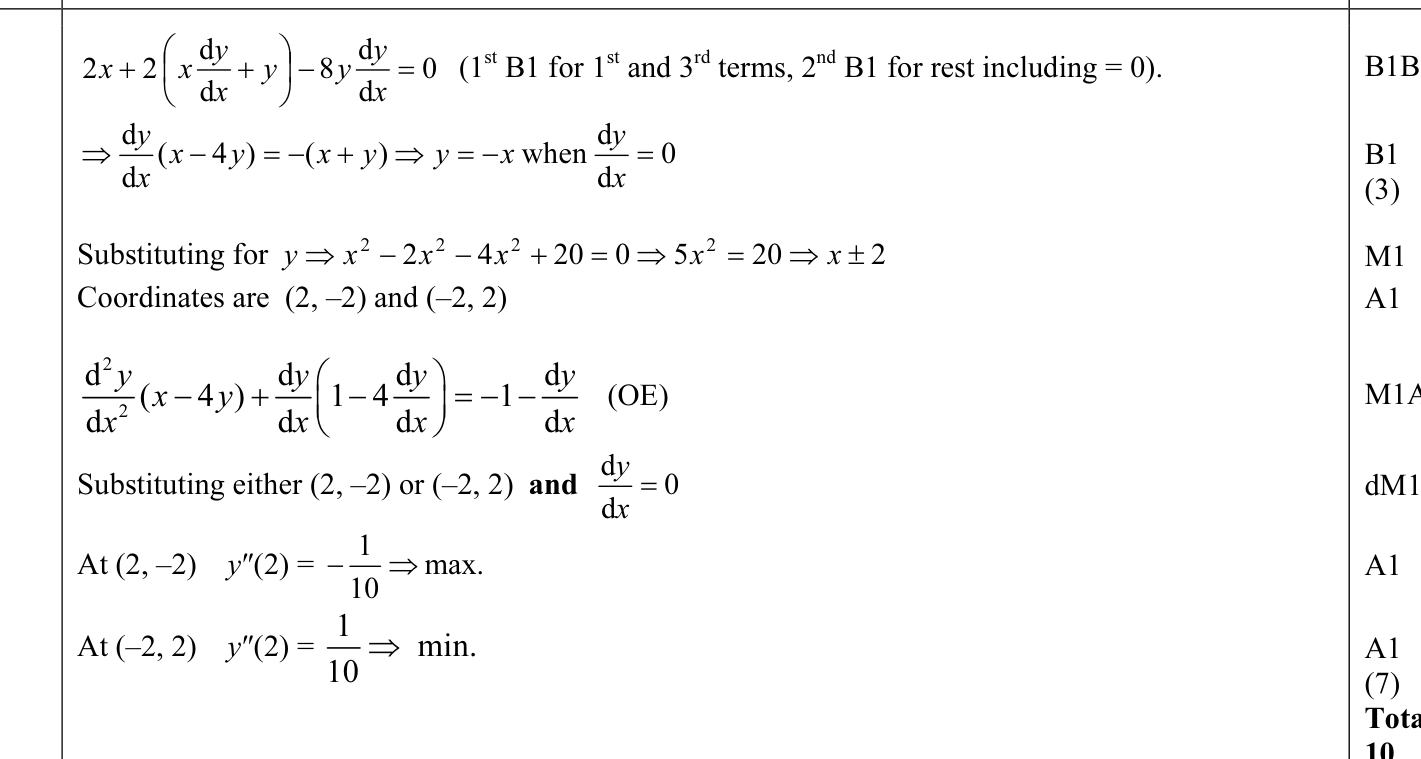
The curve \(C\) has equation \(x^{2}+2 x y-4 y^{2}+20=0\). Show that if the tangent to \(C\) at the point \((x, y)\) is parallel to the \(x\)-axis then \(x+y=0\).
Hence find the coordinates of the stationary points on \(C\), and determine their nature.
9231 P11 - Jun 2015 - Q6 - 9 marks
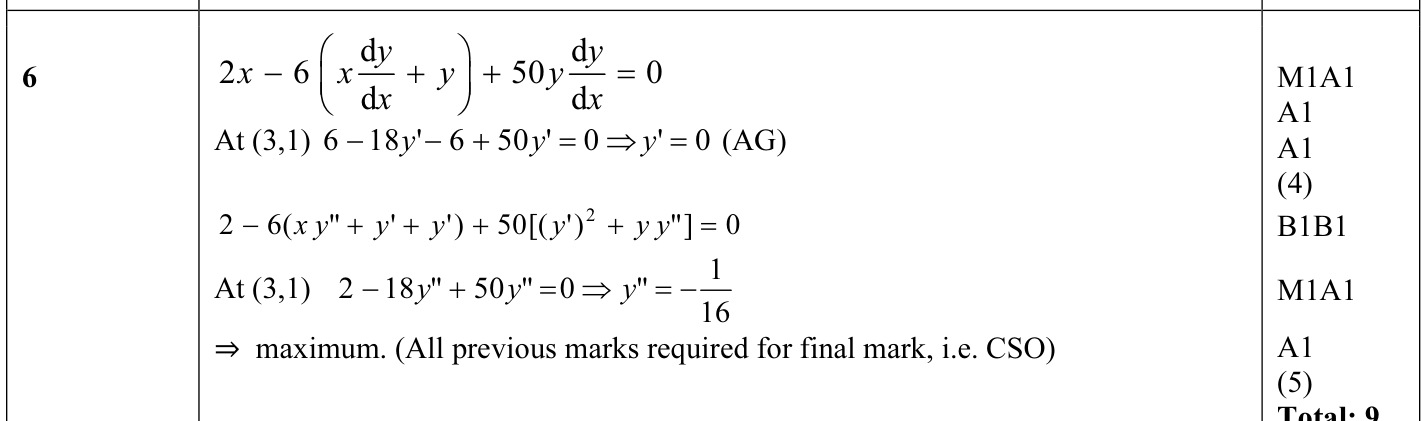
A curve has equation \(x^{2}-6 x y+25 y^{2}=16\). Show that \(\frac{\mathrm{d} y}{\mathrm{~d} x}=0\) at the point \((3,1)\).
By finding the value of \(\frac{\mathrm{d}^{2} y}{\mathrm{~d} x^{2}}\) at the point \((3,1)\), determine the nature of this turning point.
9231 P11 - Nov 2016 - Q8 - 11 marks
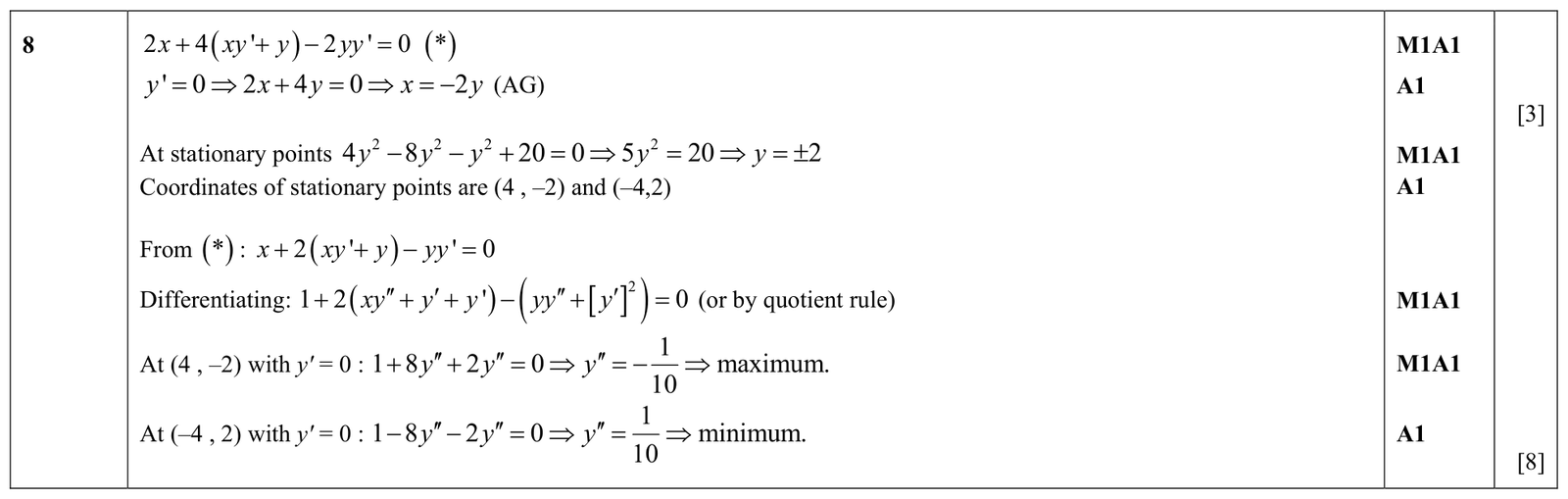
A curve \(C\) has equation \(x^{2}+4 x y-y^{2}+20=0\). Show that, at stationary points on \(C, x=-2 y\).
Find the coordinates of the stationary points on \(C\), and determine their nature by considering the value of \(\frac{\mathrm{d}^{2} y}{\mathrm{~d} x^{2}}\) at the stationary points.
9231 P11 - Nov 2017 - Q5 - 8 marks
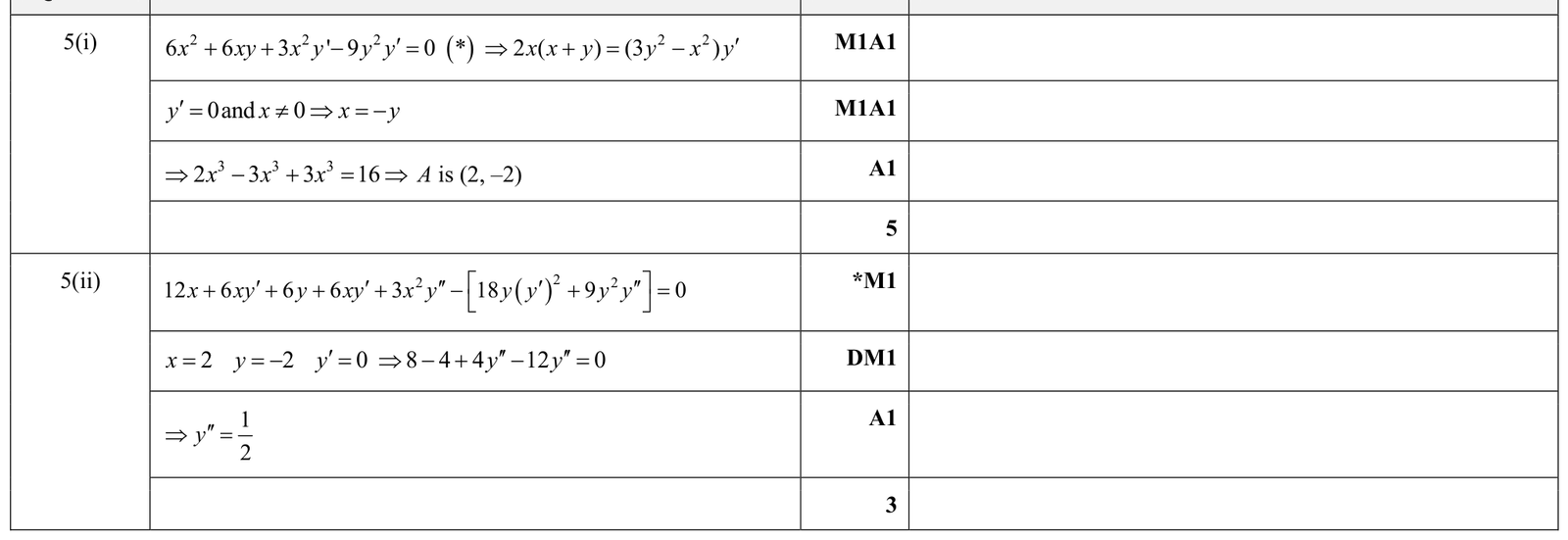
The curve \(C\) has equation \(2 x^{3}+3 x^{2} y-3 y^{3}-16=0\).
(i) Find the coordinates of the point \(A\) on \(C\) at which \(\frac{\mathrm{d} y}{\mathrm{~d} x}=0\) and \(x \neq 0\).
(ii) Find the value of \(\frac{\mathrm{d}^{2} y}{\mathrm{~d} x^{2}}\) at \(A\).
9231 P13 - Jun 2013 - Q4 - 8 marks
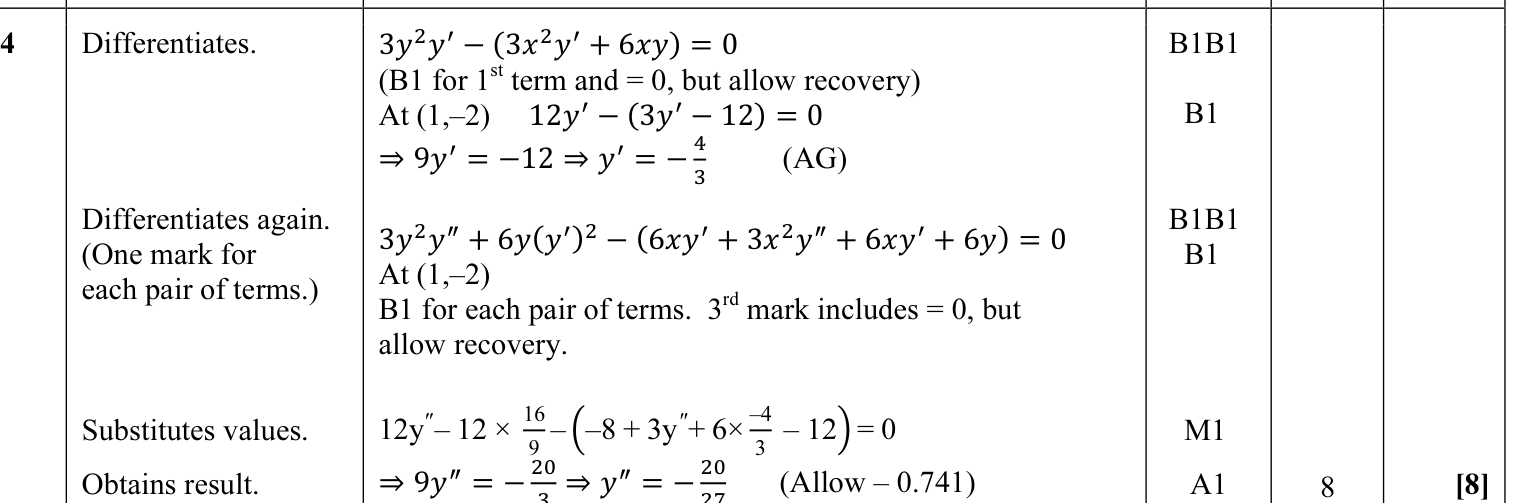
Show that \(\frac{\mathrm{d} y}{\mathrm{~d} x}=-\frac{4}{3}\) at the point \(A(1,-2)\) on the curve with equation
\(y^{3}-3 x^{2} y+2=0,\)
and find the value of \(\frac{\mathrm{d}^{2} y}{\mathrm{~d} x^{2}}\) at \(A\).
9231 P13 - Jun 2013 - Q7 - 10 marks
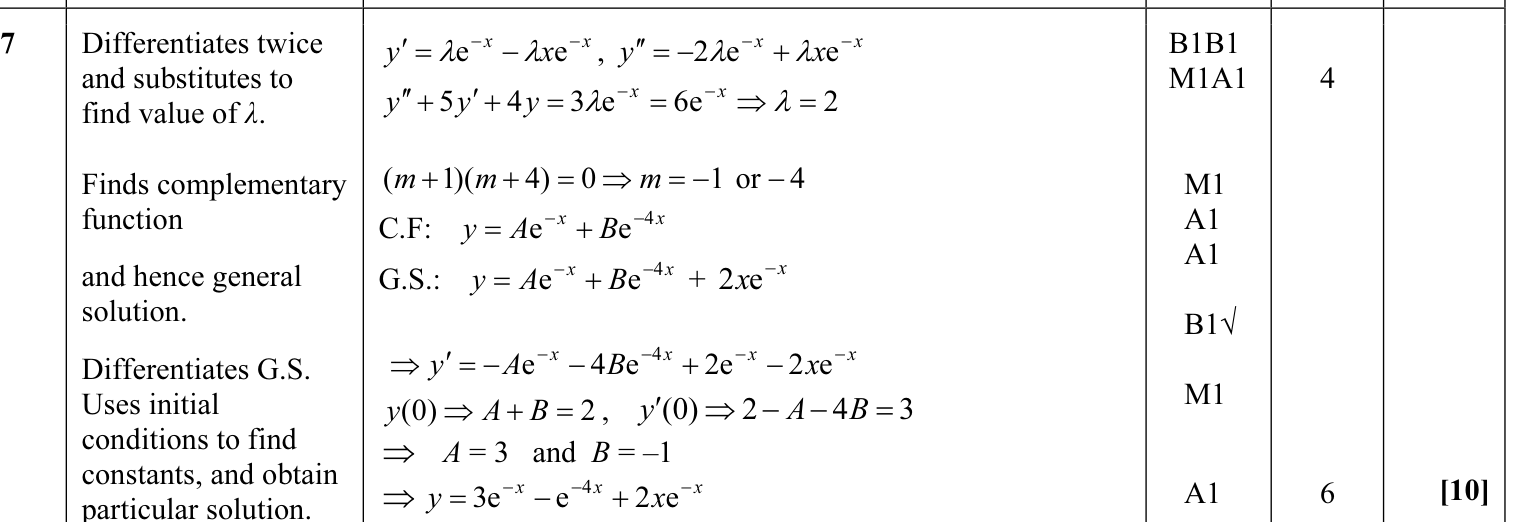
Find the value of the constant \(\lambda\) such that \(\lambda x \mathrm{e}^{-x}\) is a particular integral of the differential equation
\(\frac{\mathrm{d}^{2} y}{\mathrm{~d} x^{2}}+5 \frac{\mathrm{~d} y}{\mathrm{~d} x}+4 y=6 \mathrm{e}^{-x}\)
Find the solution of the differential equation for which \(y=2\) and \(\frac{\mathrm{d} y}{\mathrm{~d} x}=3\) when \(x=0\).
9231 P11 - Nov 2013 - Q10 - 12 marks
The curve \(C\) has equation
\(y=\frac{p x^{2}+4 x+1}{x+1},\)
where \(p\) is a positive constant and \(p \neq 3\).
(i) Obtain the equations of the asymptotes of \(C\).
(ii) Find the value of \(p\) for which the \(x\)-axis is a tangent to \(C\), and sketch \(C\) in this case.
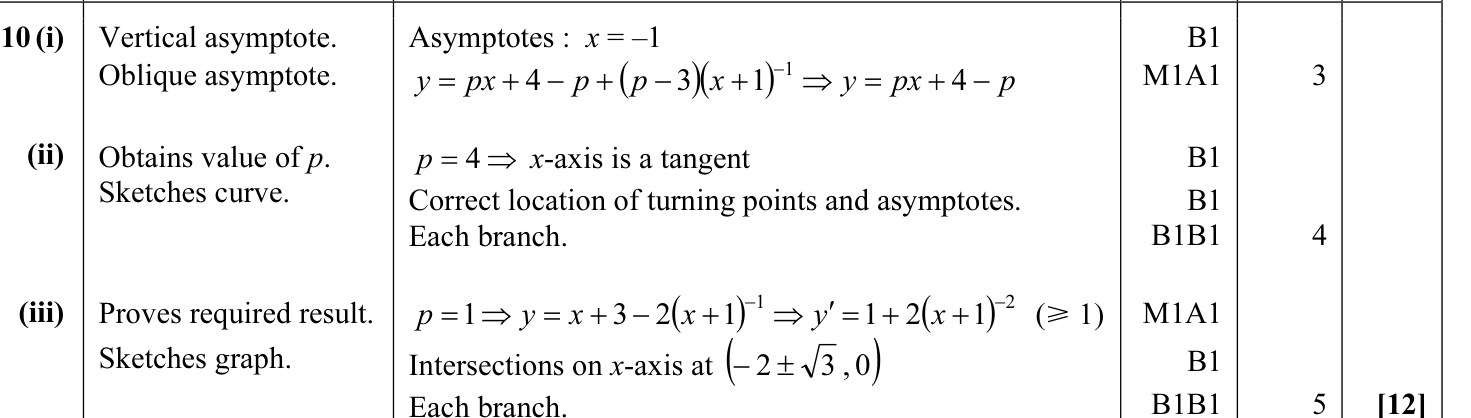
(iii) For the case \(p=1\), show that \(C\) has no turning points, and sketch \(C\), giving the exact coordinates of the points of intersection of \(C\) with the \(x\)-axis.