Past Exam Questions
← Back9231 P1 - Jun 2009 - Q10 - 11 marks
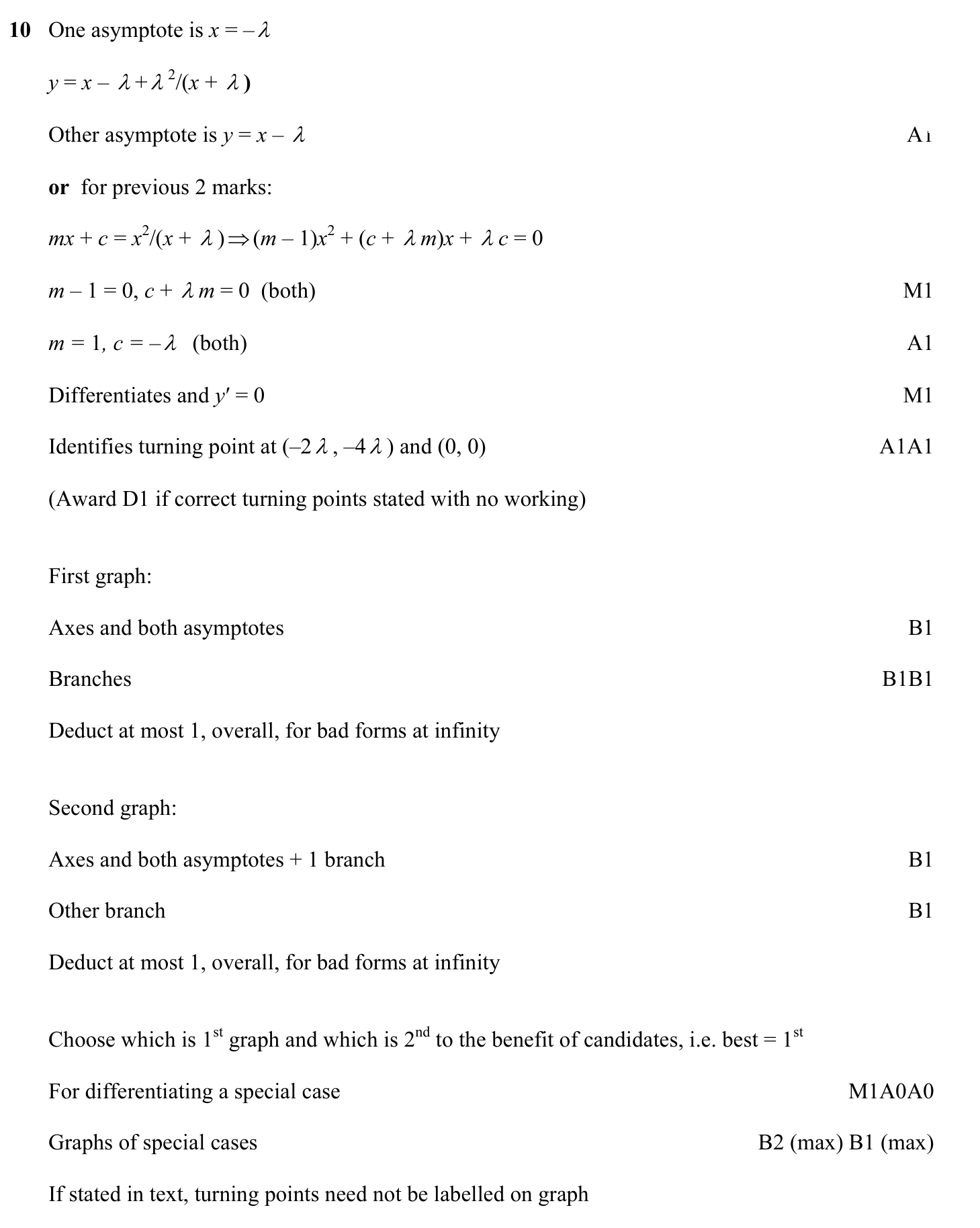
The curve \(C\) has equation
\(y=\frac{x^{2}}{x+\lambda}\)
where \(\lambda\) is a non-zero constant. Obtain the equation of each of the asymptotes of \(C\).
In separate diagrams, sketch \(C\) for the cases \(\lambda\gt 0\) and \(\lambda\lt 0\). In both cases the coordinates of the turning points must be indicated.
9231 P1 - Nov 2009 - Q9 - 11 marks
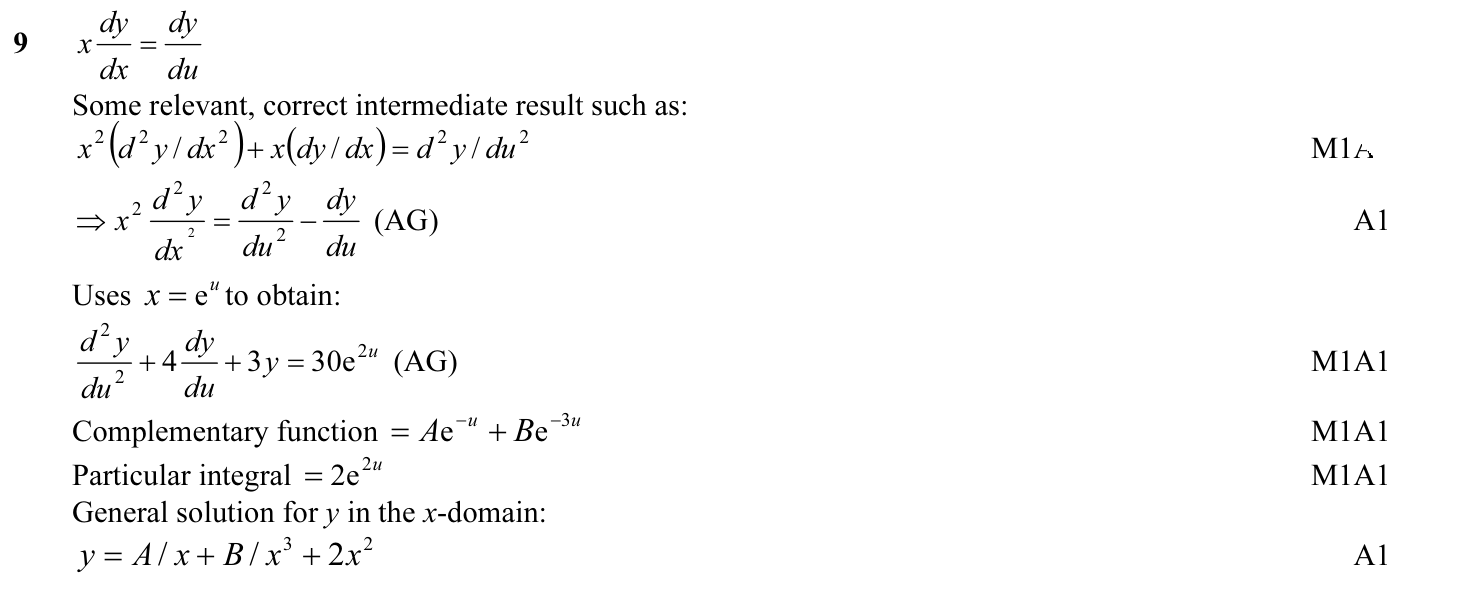
Show that if \(y\) depends on \(x\) and \(x=\mathrm{e}^{u}\) then
\(x^{2} \frac{\mathrm{~d}^{2} y}{\mathrm{~d} x^{2}}=\frac{\mathrm{d}^{2} y}{\mathrm{~d} u^{2}}-\frac{\mathrm{d} y}{\mathrm{~d} u} .\)
Given that \(y\) satisfies the differential equation
\(x^{2} \frac{\mathrm{~d}^{2} y}{\mathrm{~d} x^{2}}+5 x \frac{\mathrm{~d} y}{\mathrm{~d} x}+3 y=30 x^{2}\)
use the substitution \(x=\mathrm{e}^{u}\) to show that
\(\frac{\mathrm{d}^{2} y}{\mathrm{~d} u^{2}}+4 \frac{\mathrm{~d} y}{\mathrm{~d} u}+3 y=30 \mathrm{e}^{2 u}\)
Hence find the general solution for \(y\) in terms of \(x\).
9231 P21 - Jun 2023 - Q8 - 14 marks
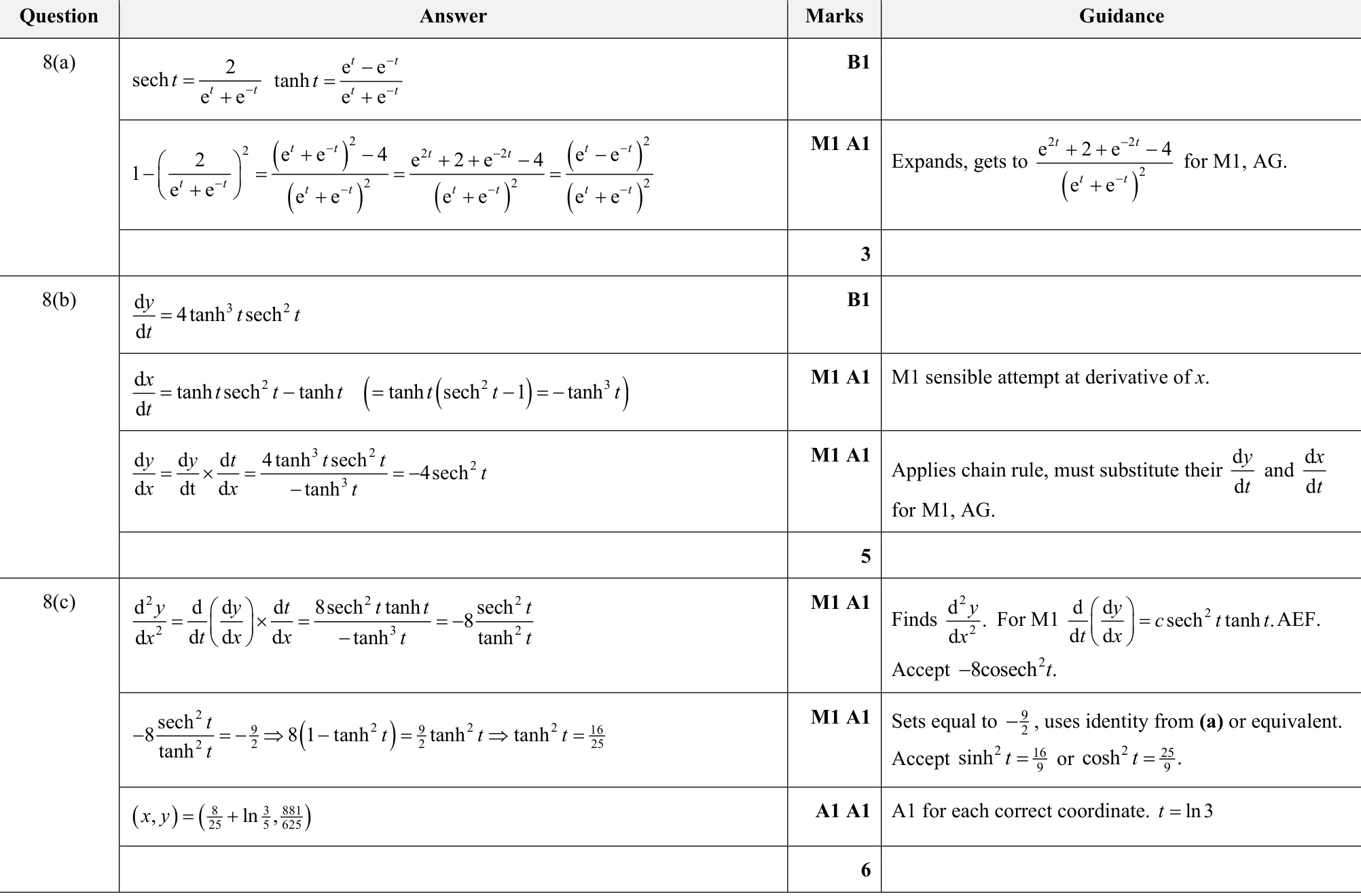
(a) Starting from the definitions of sech and tanh in terms of exponentials, prove that
\(1-\operatorname{sech}^{2} t=\tanh ^{2} t\)
The curve \(C\) has parametric equations
\(x=\frac{1}{2} \tanh ^{2} t+\ln \operatorname{sech} t, \quad y=1+\tanh ^{4} t, \quad \text { for } t\gt 0 .\)
(b) Show that \(\frac{\mathrm{d} y}{\mathrm{~d} x}=-4 \operatorname{sech}^{2} t\).
(c) Find the coordinates of the point on \(C\) with \(\frac{\mathrm{d}^{2} y}{\mathrm{~d} x^{2}}=-\frac{9}{2}\), giving your answer in the form \((a+\ln b, c)\) where \(a, b\) and \(c\) are rational numbers.
9231 P22 - Nov 2024 - Q3 - 7 marks
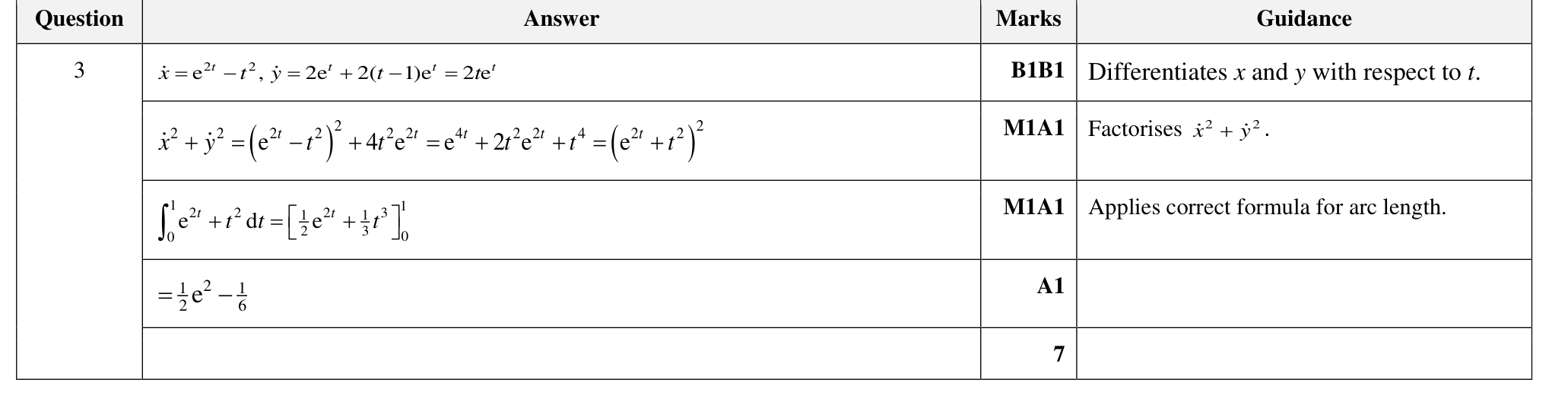
The curve \(C\) has parametric equations
\(x=\frac{1}{2} \mathrm{e}^{2 t}-\frac{1}{3} t^{3}-\frac{1}{2}, \quad y=2 \mathrm{e}^{t}(t-1), \quad \text { for } 0 \leqslant t \leqslant 1 .\)
Find the exact length of \(C\).
9231 P21 - Nov 2024 - Q2 - 6 marks
It is given that
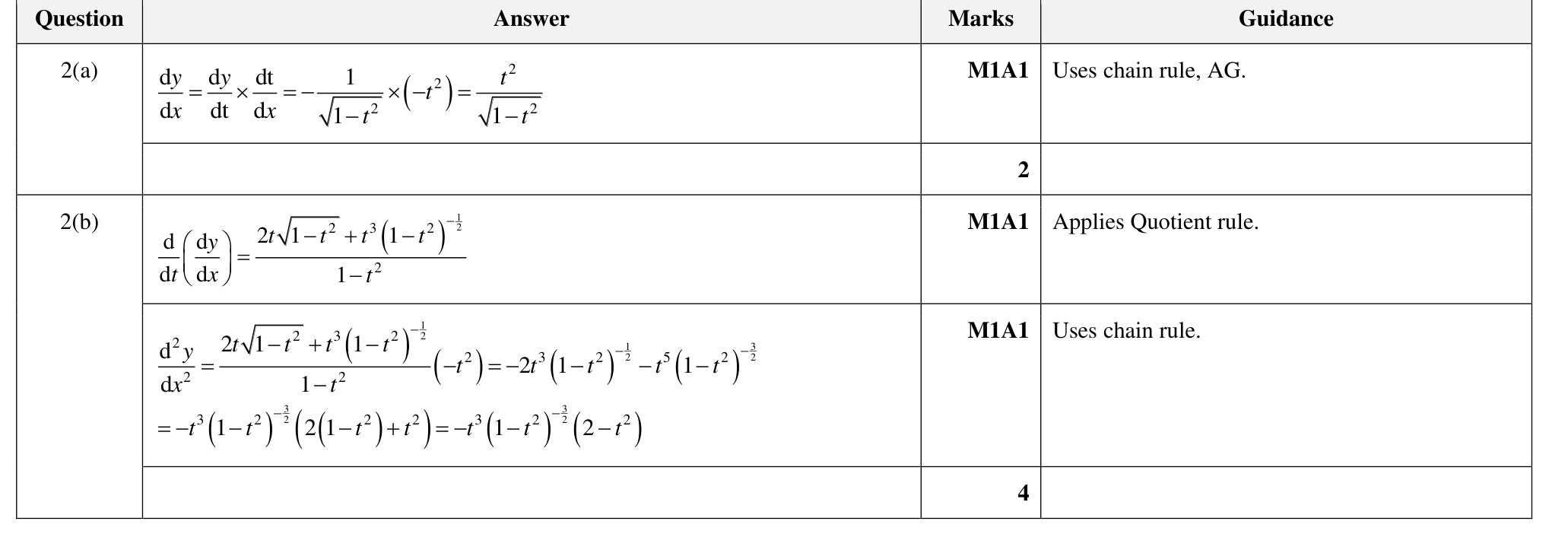
\(x=1+\frac{1}{t} \quad \text { and } \quad y=\cos ^{-1} t \quad \text { for } 0\lt t\lt 1 .\)
(a) Show that \(\frac{\mathrm{d} y}{\mathrm{~d} x}=\frac{t^{2}}{\sqrt{1-t^{2}}}\).
(b) Show that \(\frac{\mathrm{d}^{2} y}{\mathrm{~d} x^{2}}=-t^{a}\left(1-t^{2}\right)^{b}\left(2-t^{2}\right)\), where \(a\) and \(b\) are constants to be determined.
9231 P22 - Nov 2023 - Q2 - 7 marks
It is given that
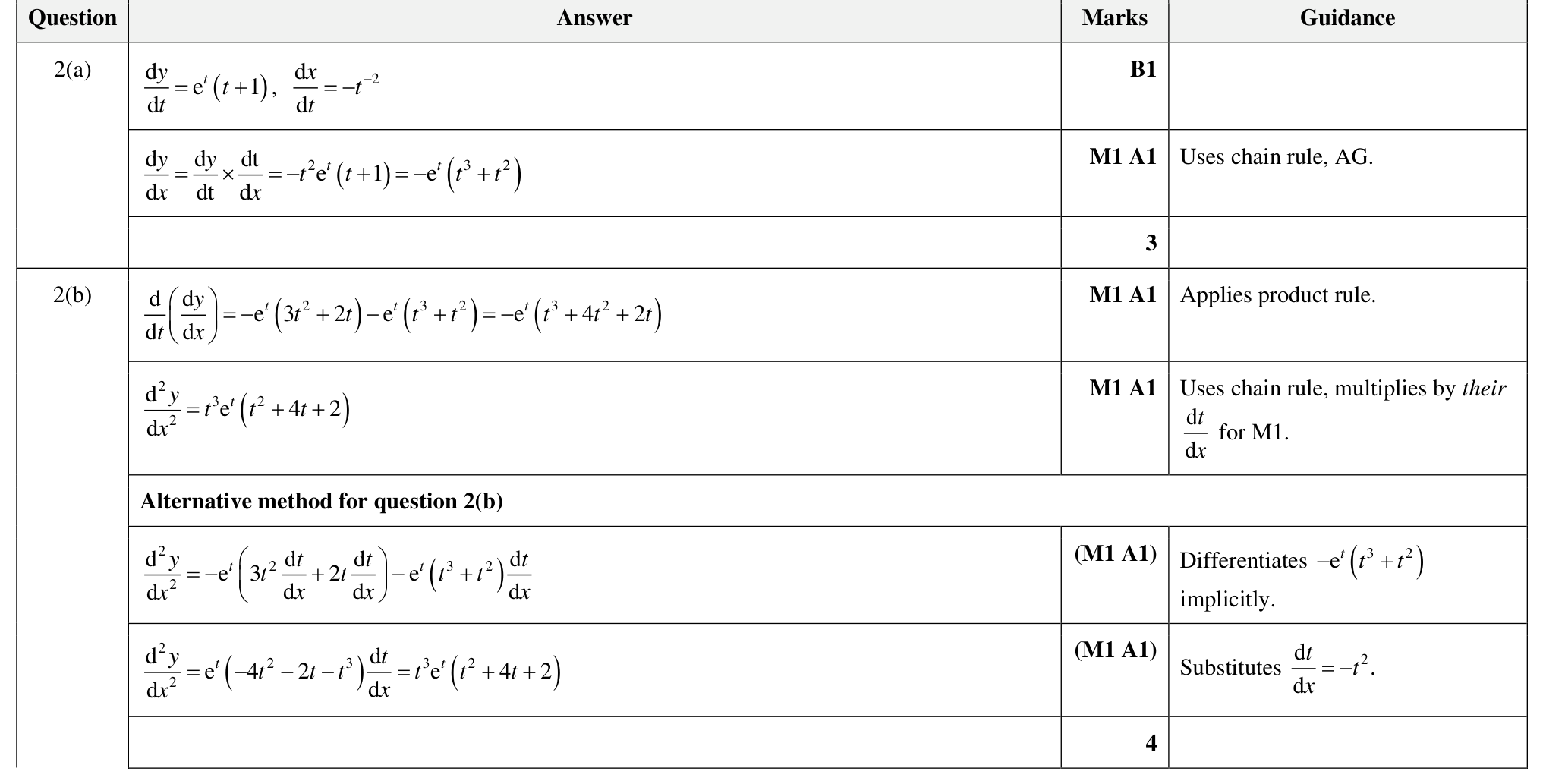
\(x=1+\frac{1}{t} \quad \text { and } \quad y=t \mathrm{e}^{t} .\)
(a) Show that \(\frac{\mathrm{d} y}{\mathrm{~d} x}=-\mathrm{e}^{t}\left(t^{3}+t^{2}\right)\).
(b) Find \(\frac{\mathrm{d}^{2} y}{\mathrm{~d} x^{2}}\) in terms of \(t\).
9231 P21 - Nov 2023 - Q5 - 10 marks
The curve \(C\) has parametric equations
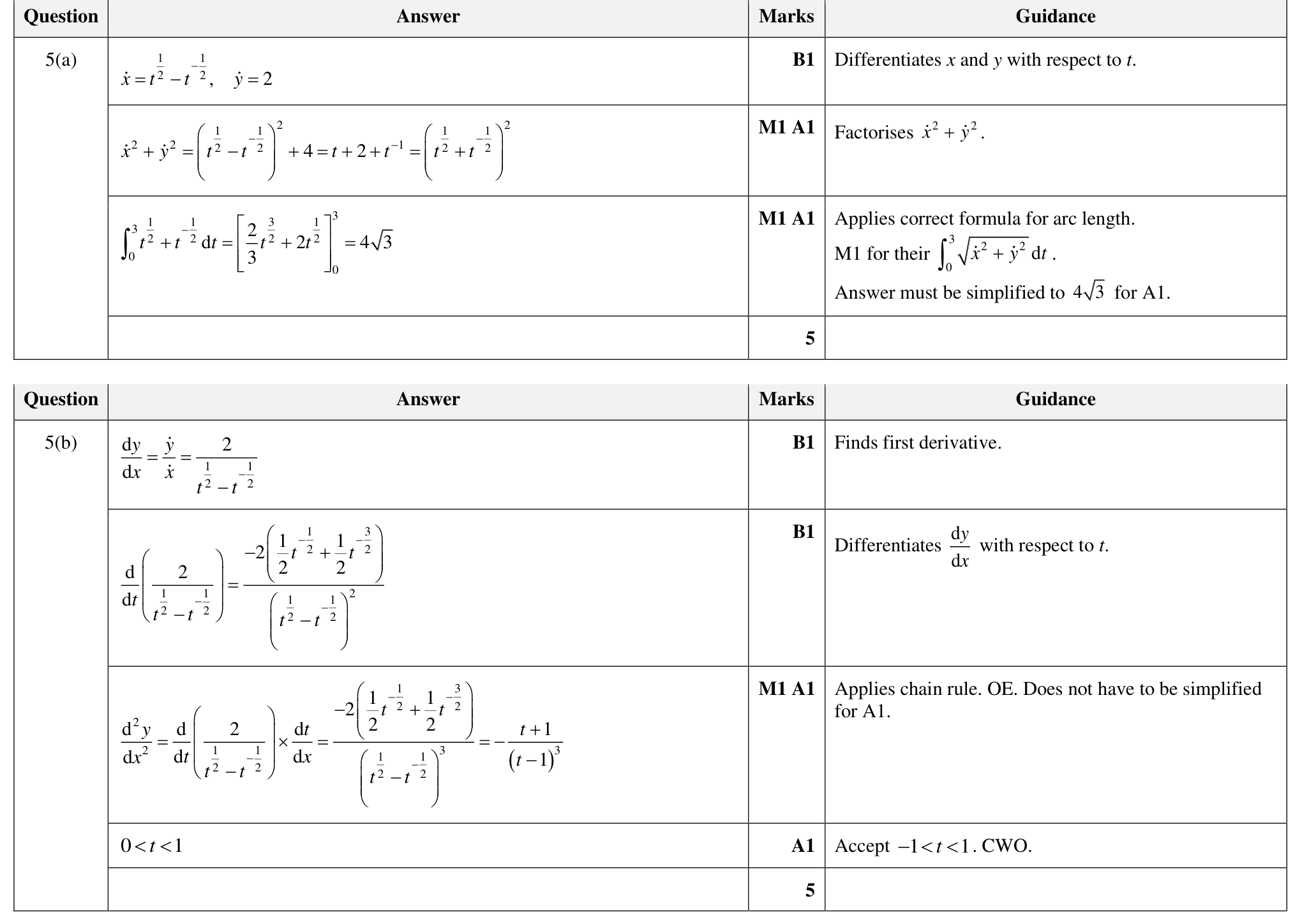
\(x=\frac{2}{3} t^{\frac{3}{2}}-2 t^{\frac{1}{2}}, \quad y=2 t+5, \quad \text { for } 0\lt t \leqslant 3 .\)
(a) Find the exact length of \(C\).
(b) Find the set of values of \(t\) for which \(\frac{\mathrm{d}^{2} y}{\mathrm{~d} x^{2}}\gt 0\).
9231 P23 - Jun 2022 - Q4 - 9 marks
It is given that
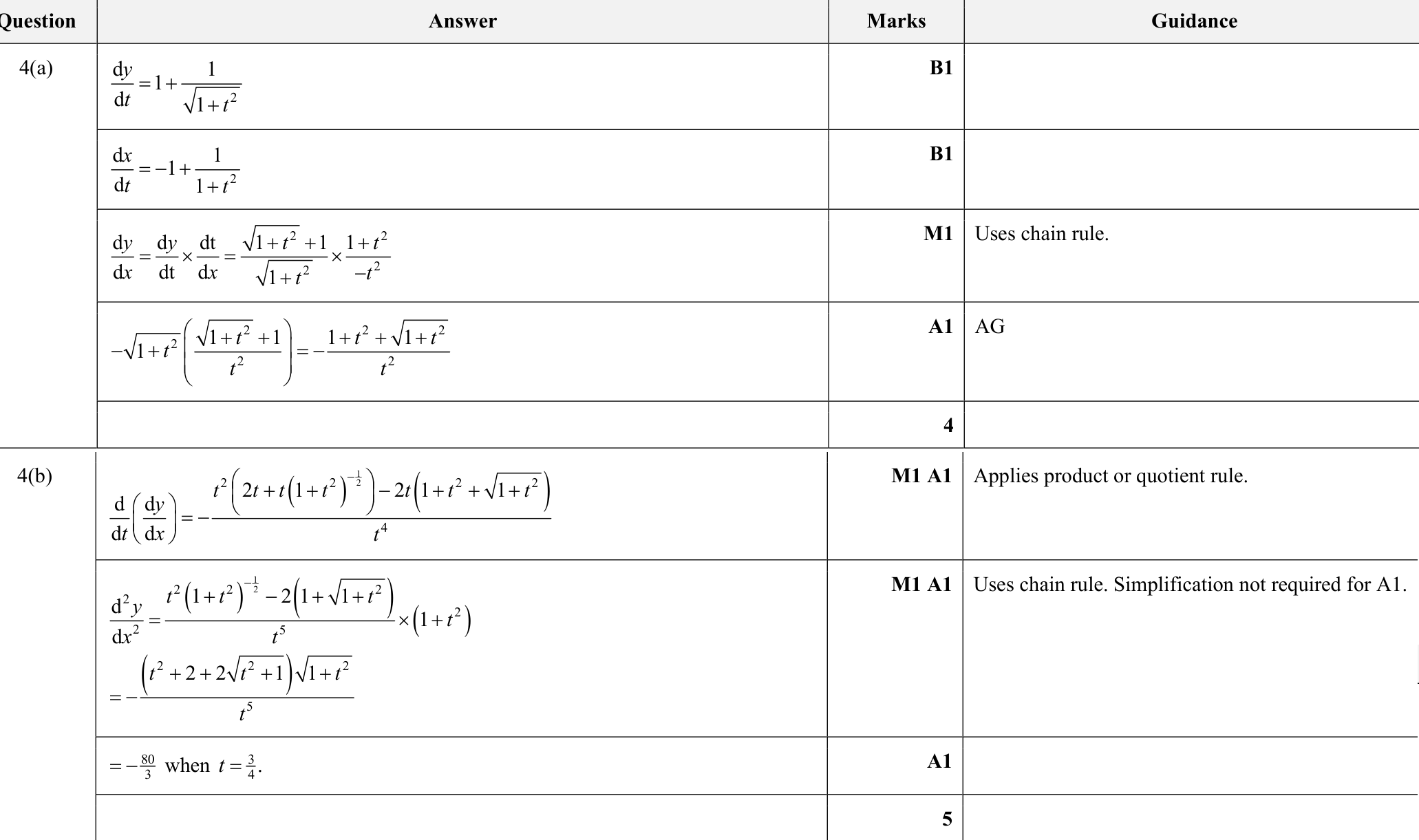
\(x=-t+\tan ^{-1} t \quad \text { and } \quad y=t+\sinh ^{-1} t\)
(a) Show that \(\frac{\mathrm{d} y}{\mathrm{~d} x}=-\frac{t^{2}+1+\sqrt{t^{2}+1}}{t^{2}}\).
(b) Find the value of \(\frac{\mathrm{d}^{2} y}{\mathrm{~d} x^{2}}\) when \(t=\frac{3}{4}\).
9231 P21 - Nov 2022 - Q3 - 6 marks
The curve \(C\) has parametric equations
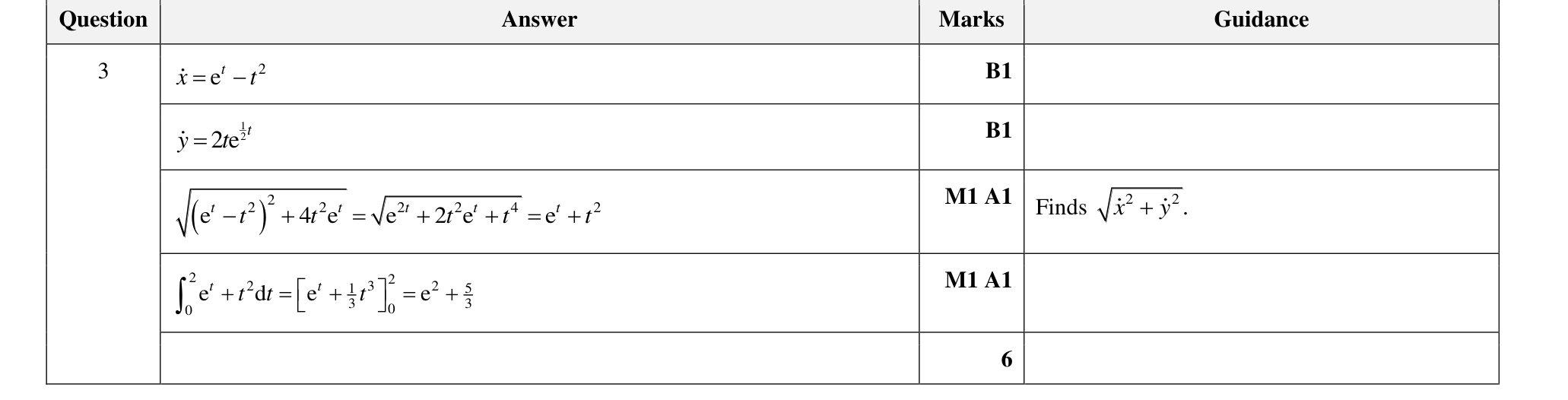
\(x=\mathrm{e}^{t}-\frac{1}{3} t^{3}, \quad y=4 \mathrm{e}^{\frac{1}{2} t}(t-2), \quad \text { for } 0 \leqslant t \leqslant 2\)
Find, in terms of e , the length of \(C\).
9231 P23 - Jun 2020 - Q5 - 9 marks
The curve \(C\) has parametric equations
\[x=\frac{1}{2} t^{2}-\ln t, \quad y=2 t+1, \quad \text { for } \frac{1}{2} \leqslant t \leqslant 2 .\]
(a) Find the exact length of \(C\).
(b) Find \(\frac{\mathrm{d}^{2} y}{\mathrm{~d} x^{2}}\) in terms of \(t\), simplifying your answer.

9231 P22 - Nov 2021 - Q5 - 10 marks
The curve \(C\) has parametric equations
\[x=3 t+2 t^{-1}+a t^{3}, \quad y=4 t-\frac{3}{2} t^{-1}+b t^{3}, \quad \text { for } 1 \leqslant t \leqslant 2\]
where \(a\) and \(b\) are constants.
(a) It is given that \(a=\frac{2}{3}\) and \(b=-\frac{1}{2}\).
Show that \(\left(\frac{\mathrm{d} x}{\mathrm{~d} t}\right)^{2}+\left(\frac{\mathrm{d} y}{\mathrm{~d} t}\right)^{2}=\frac{25}{4}\left(t^{2}+t^{-2}\right)^{2}\) and find the exact length of \(C\).
(b) It is given instead that \(a=b=0\).
Find the value of \(\frac{\mathrm{d}^{2} y}{\mathrm{~d} x^{2}}\) when \(t=1\).

9231 P13 - Jun 2014 - Q7 - 10 marks
The curve \(C\) has parametric equations
\(x=\sin t, \quad y=\sin 2 t, \quad \text { for } 0 \leqslant t \leqslant \pi .\)
Find \(\frac{\mathrm{d}^{2} y}{\mathrm{~d} x^{2}}\) in terms of \(t\).
Hence, or otherwise, find the coordinates of the stationary points on \(C\) and determine their nature.