Past Exam Questions
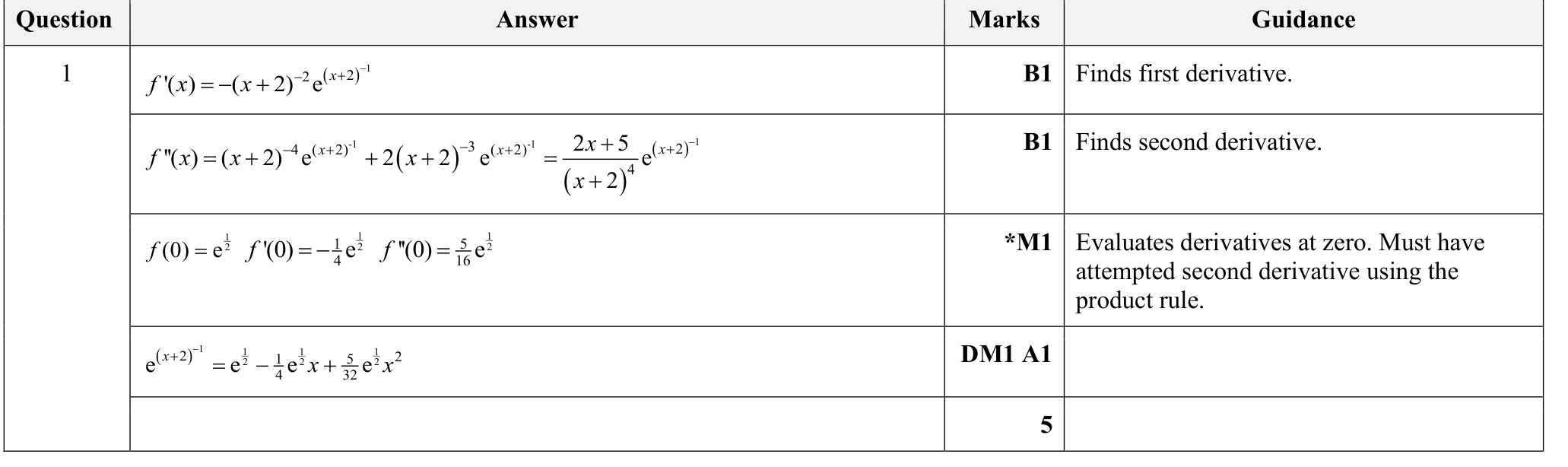
← Back9231 P23 - Jun 2025 - Q1 - 5 marks
Find the Maclaurin's series for \(\mathrm{e}^{\left(\frac{1}{x+2}\right)}\) up to and including the term in \(x^{2}\).
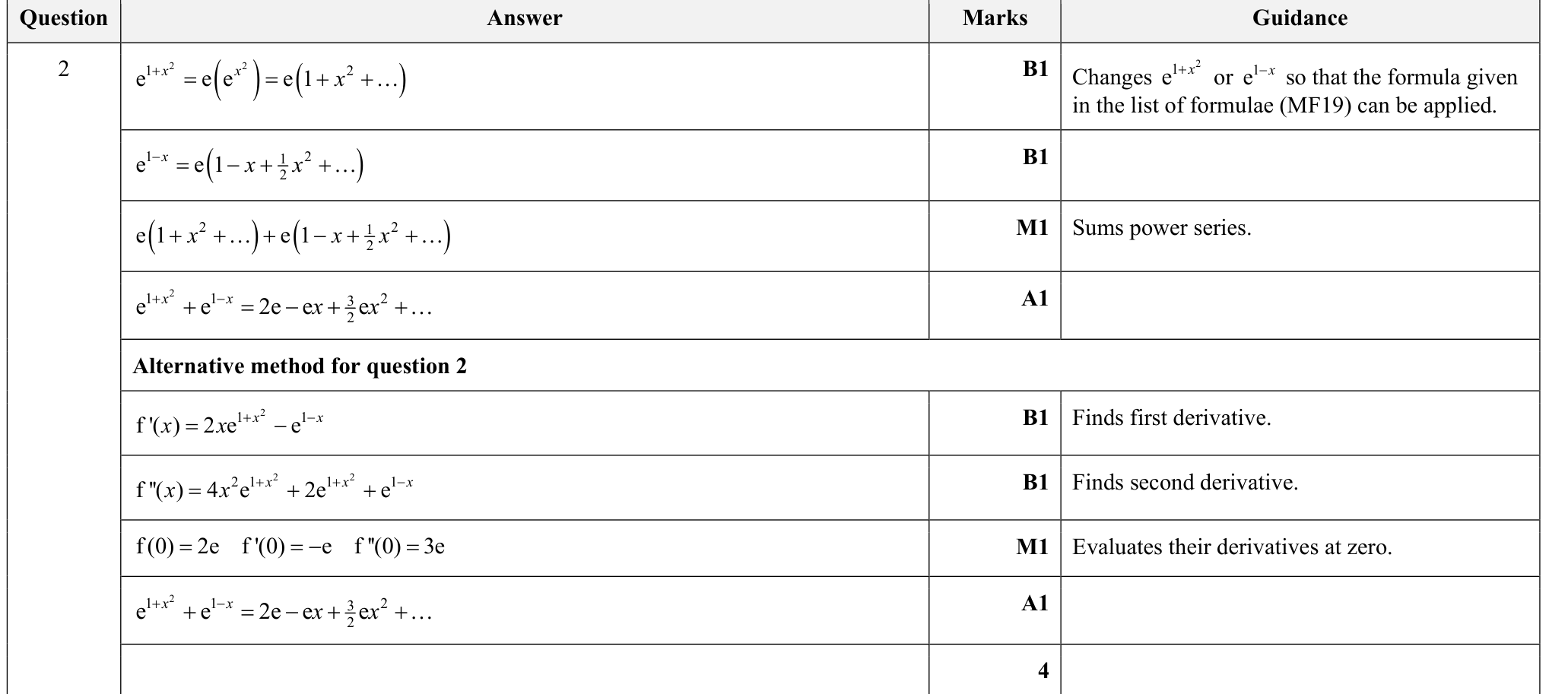
9231 P21 - Jun 2024 - Q2 - 4 marks
Find the Maclaurin's series for \(\mathrm{e}^{1+x^{2}}+\mathrm{e}^{1-x}\) up to and including the term in \(x^{2}\).
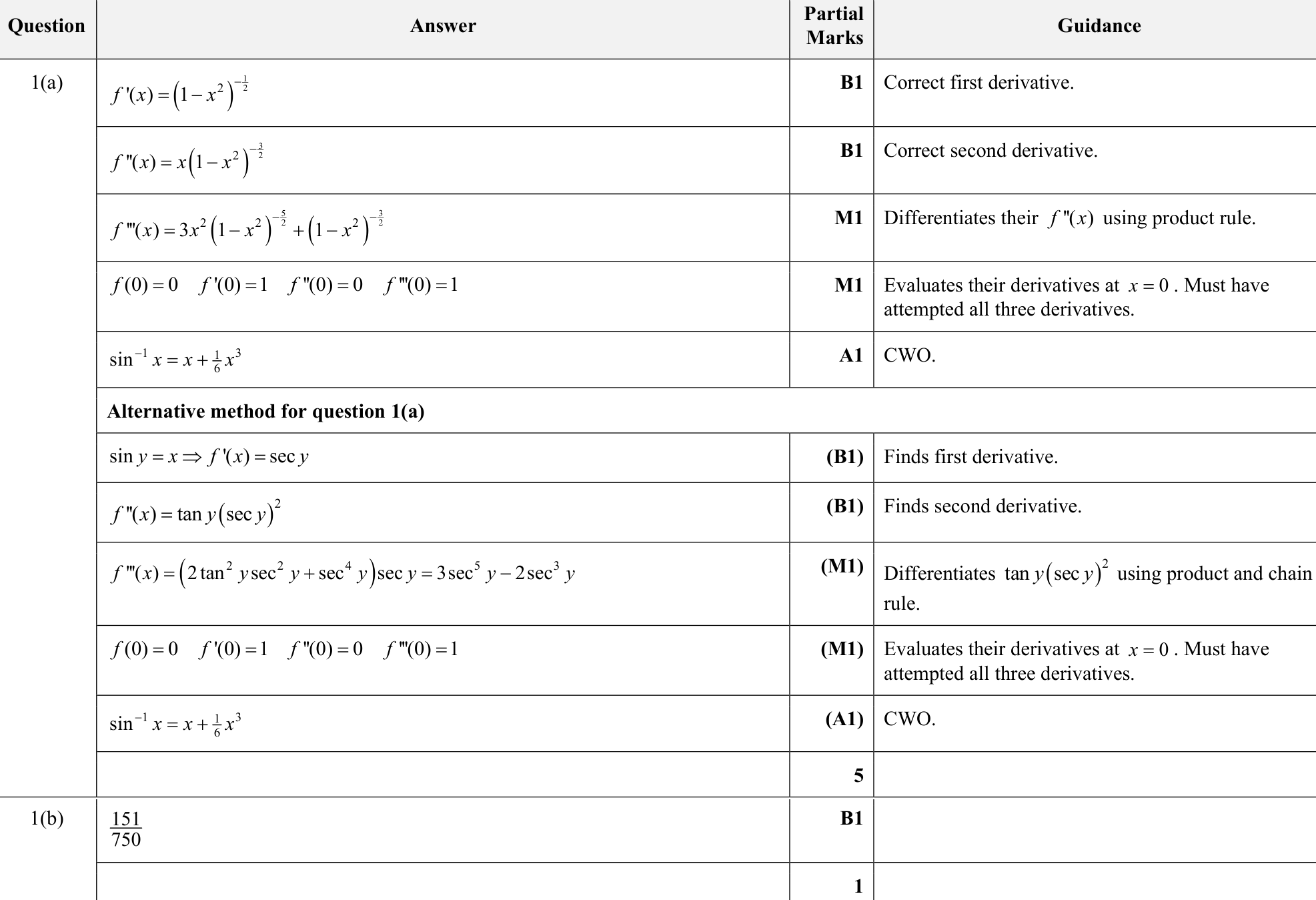
9231 P23 - Jun 2023 - Q1 - 6 marks
(a) Find the Maclaurin series for \(\sin ^{-1} x\) up to and including the term in \(x^{3}\).
(b) Deduce an approximation to \(\int_{0}^{\frac{1}{5}} \frac{1}{\sqrt{1-u^{2}}} \mathrm{~d} u\), giving your answer as a fraction.
9231 P22 - Nov 2023 - Q1 - 5 marks
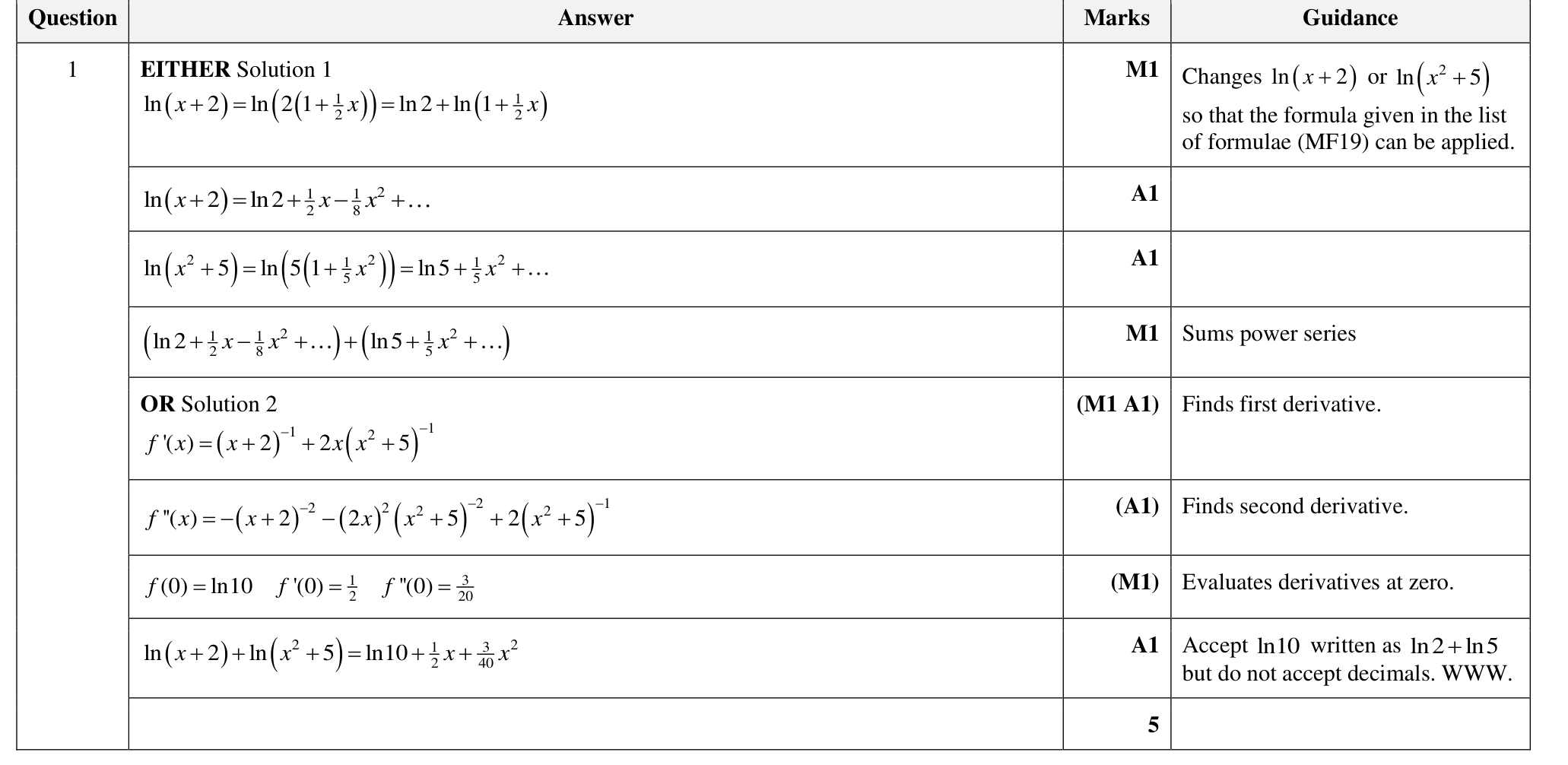
Find the Maclaurin's series for \(\ln (x+2)+\ln \left(x^{2}+5\right)\) up to and including the term in \(x^{2}\).
9231 P21 - Nov 2023 - Q3 - 6 marks
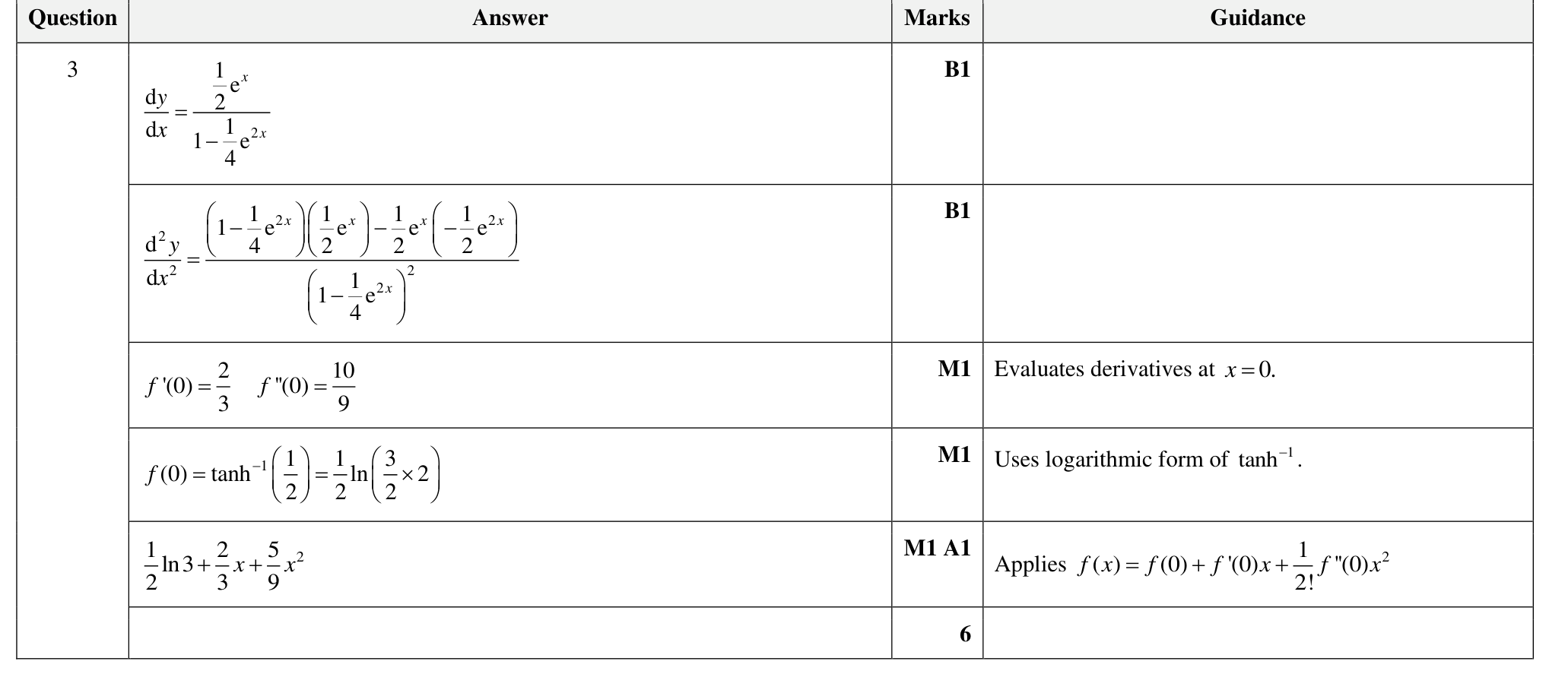
Find the first three terms in the Maclaurin's series for \(\tanh ^{-1}\left(\frac{1}{2} \mathrm{e}^{x}\right)\) in the form \(\frac{1}{2} \ln a+b x+c x^{2}\), giving the exact values of the constants \(a, b\) and \(c\).
9231 P21 - Jun 2022 - Q5 - 10 marks
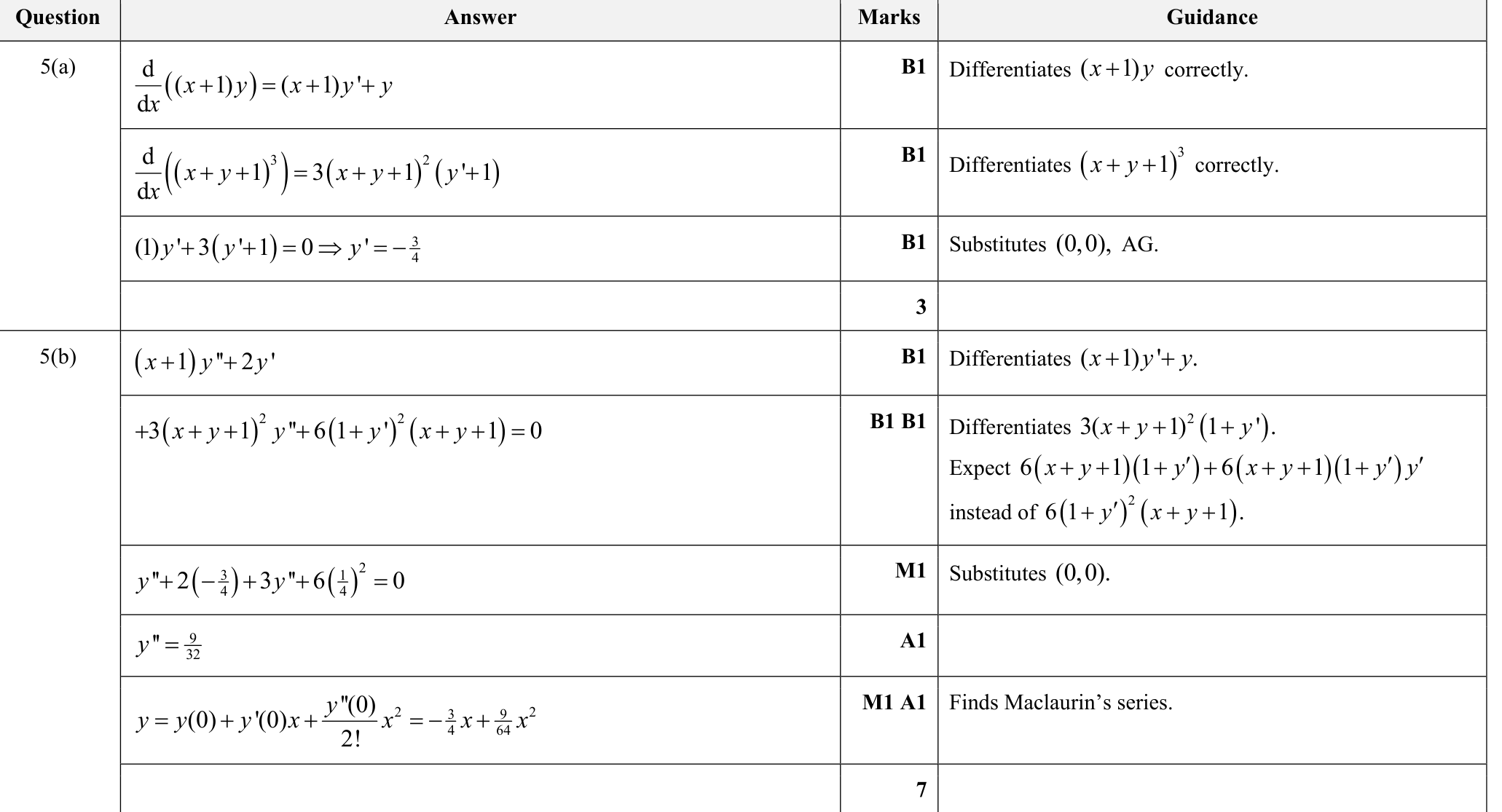
The variables \(x\) and \(y\) are such that \(y=0\) when \(x=0\) and
\((x+1) y+(x+y+1)^{3}=1 .\)
(a) Show that \(\frac{\mathrm{d} y}{\mathrm{~d} x}=-\frac{3}{4}\) when \(x=0\).
9231 P23 - Jun 2022 - Q2 - 8 marks
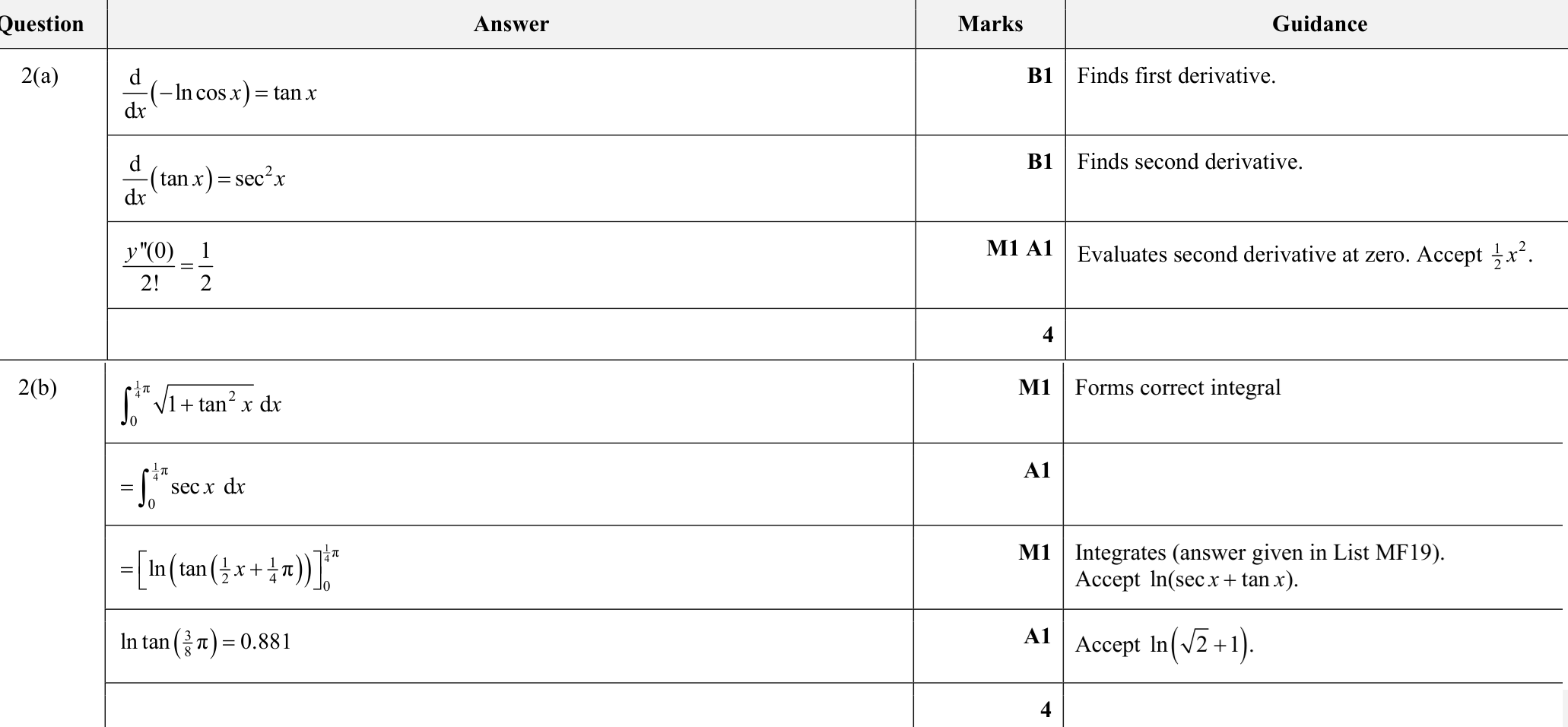
(a) Find the coefficient of \(x^{2}\) in the Maclaurin's series for \(-\ln \cos x\).
(b) Find the length of the arc of the curve with equation \(y=-\ln \cos x\) from the point where \(x=0\) to the point where \(x=\frac{1}{4} \pi\).
9231 P21 - Nov 2022 - Q1 - 5 marks
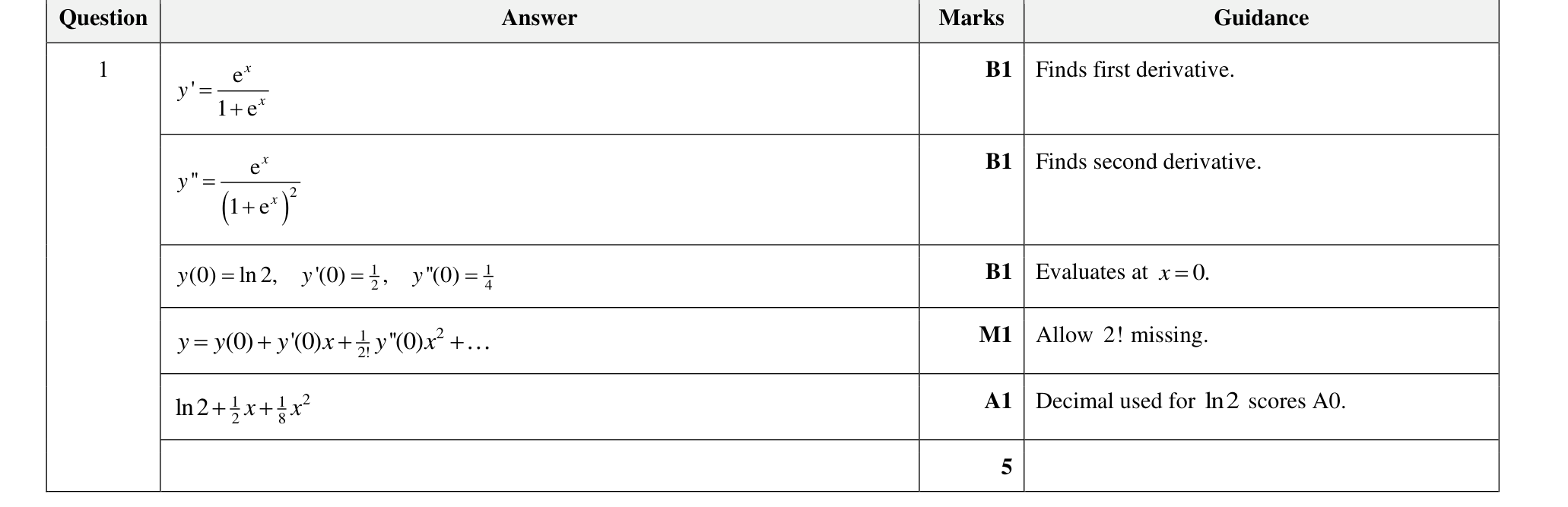
Find the Maclaurin's series for \(\ln \left(1+\mathrm{e}^{x}\right)\) up to and including the term in \(x^{2}\).
9231 P21 - Jun 2021 - Q7 - 10 marks
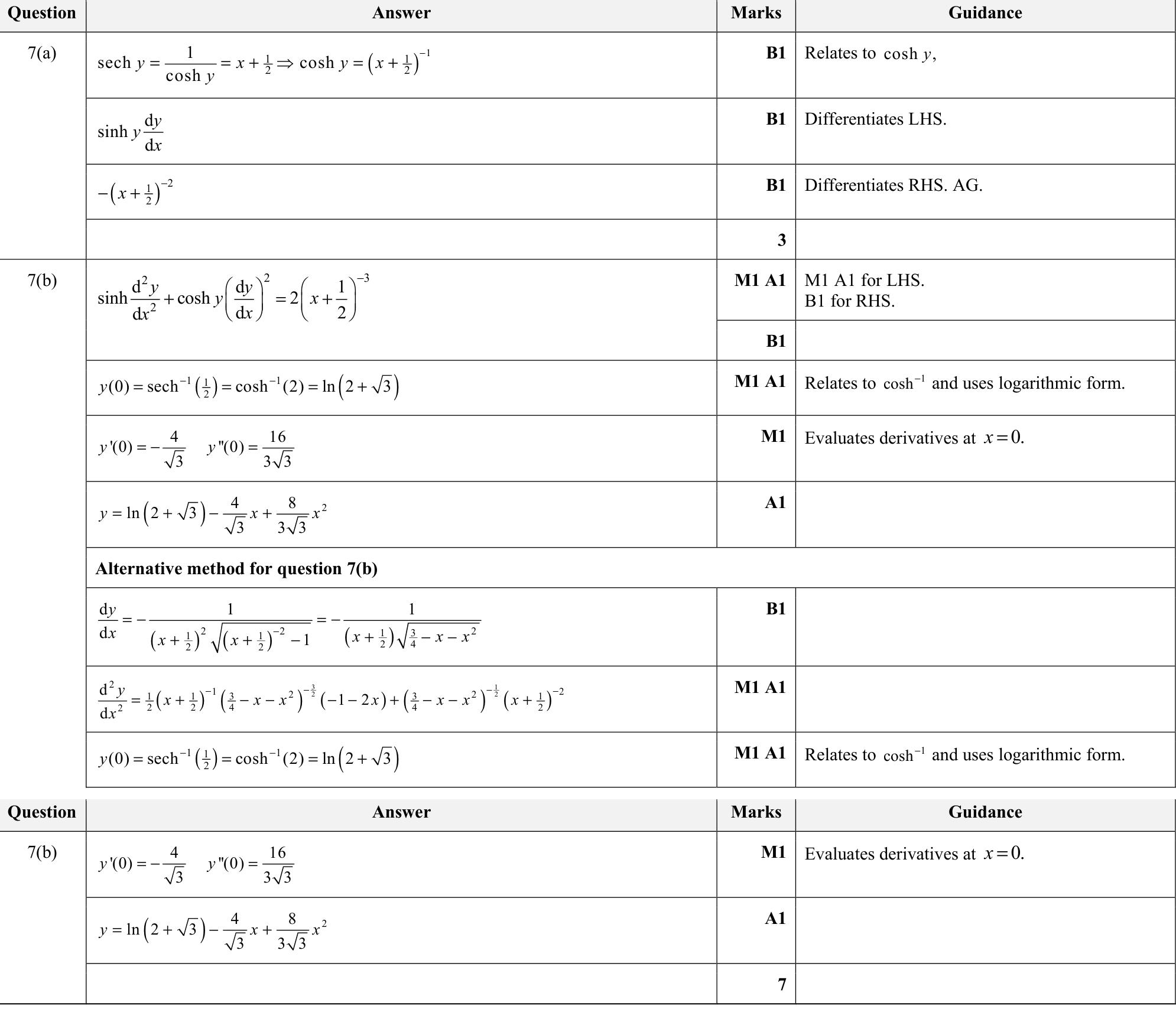
(a) It is given that \(y=\operatorname{sech}^{-1}\left(x+\frac{1}{2}\right)\).
Express cosh \(y\) in terms of \(x\) and hence show that \(\sinh y \frac{\mathrm{~d} y}{\mathrm{~d} x}=-\frac{1}{\left(x+\frac{1}{2}\right)^{2}}\).
(b) Find the first three terms in the Maclaurin's series for \(\operatorname{sech}^{-1}\left(x+\frac{1}{2}\right)\) in the form
\(\ln a+b x+c x^{2}\)
where \(a\), \(b\) and \(c\) are constants to be determined.
9231 P21 - Nov 2021 - Q1 - 5 marks
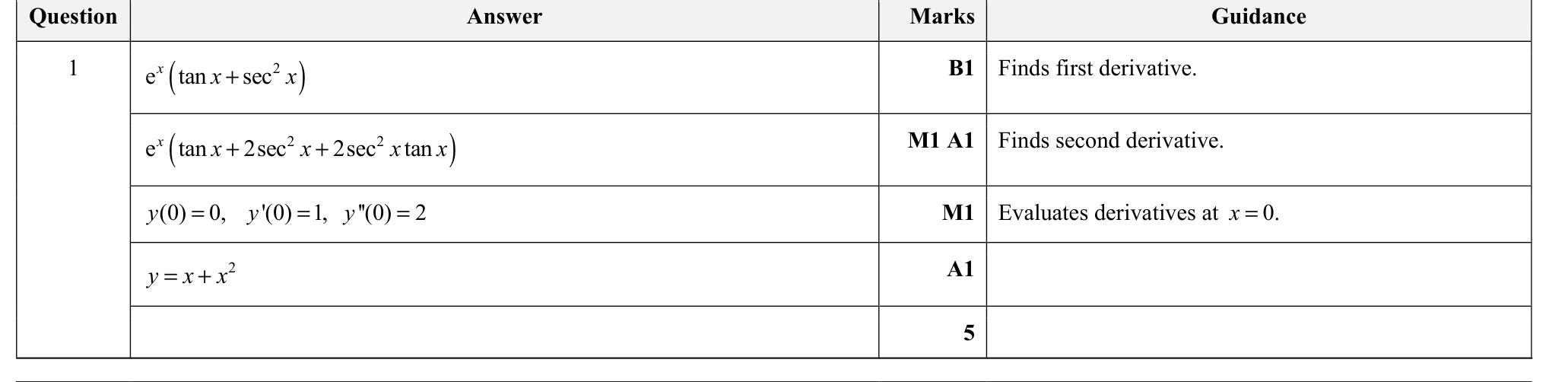
Find the Maclaurin's series for \(\mathrm{e}^{x} \tan x\) from first principles up to and including the term in \(x^{2}\).
9231 P21 - Jun 2020 - Q2 - 7 marks
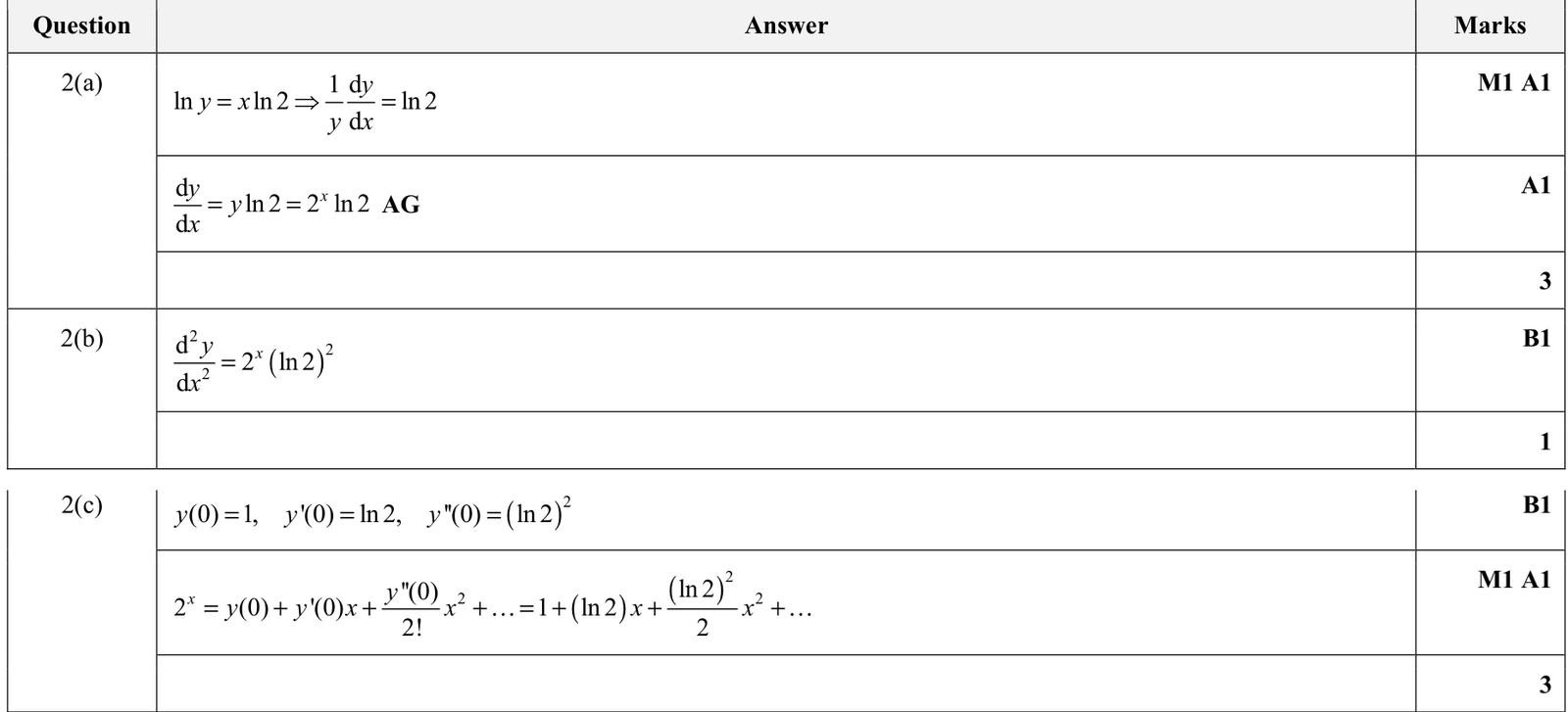
It is given that \(y=2^{x}\).
(a) By differentiating \(\ln y\) with respect to \(x\), show that \(\frac{\mathrm{d} y}{\mathrm{~d} x}=2^{x} \ln 2\).
(b) Write down \(\frac{\mathrm{d}^{2} y}{\mathrm{~d} x^{2}}\).
(c) Hence find the first three terms in the Maclaurin's series for \(2^{x}\).
9231 P23 - Jun 2020 - Q6 - 12 marks
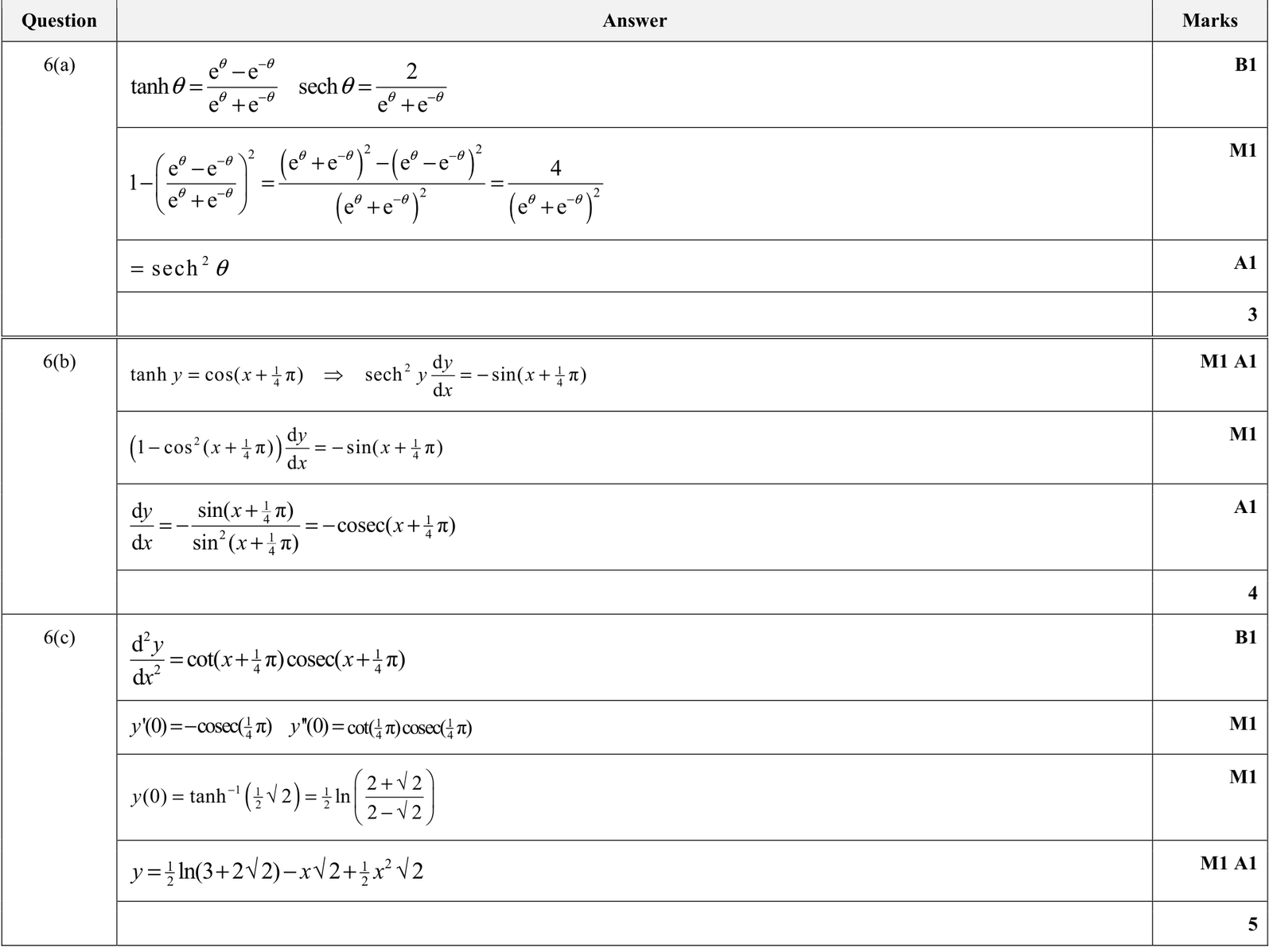
(a) Starting from the definitions of tanh and sech in terms of exponentials, prove that
\[1-\tanh ^{2} \theta=\operatorname{sech}^{2} \theta\]
The variables \(x\) and \(y\) are such that \(\tanh y=\cos \left(x+\frac{1}{4} \pi\right)\), for \(-\frac{1}{4} \pi<x<\frac{3}{4} \pi\).
(b) By differentiating the equation \(\tanh y=\cos \left(x+\frac{1}{4} \pi\right)\) with respect to \(x\), show that
\[\frac{\mathrm{d} y}{\mathrm{~d} x}=-\operatorname{cosec}\left(x+\frac{1}{4} \pi\right) .\]
(c) Hence find the first three terms in the Maclaurin's series for \(\tanh ^{-1}\left(\cos \left(x+\frac{1}{4} \pi\right)\right)\) in the form \(\frac{1}{2} \ln a+b x+c x^{2}\), giving the exact values of the constants \(a, b\) and \(c\).
9231 P23 - Jun 2021 - Q2 - 7 marks
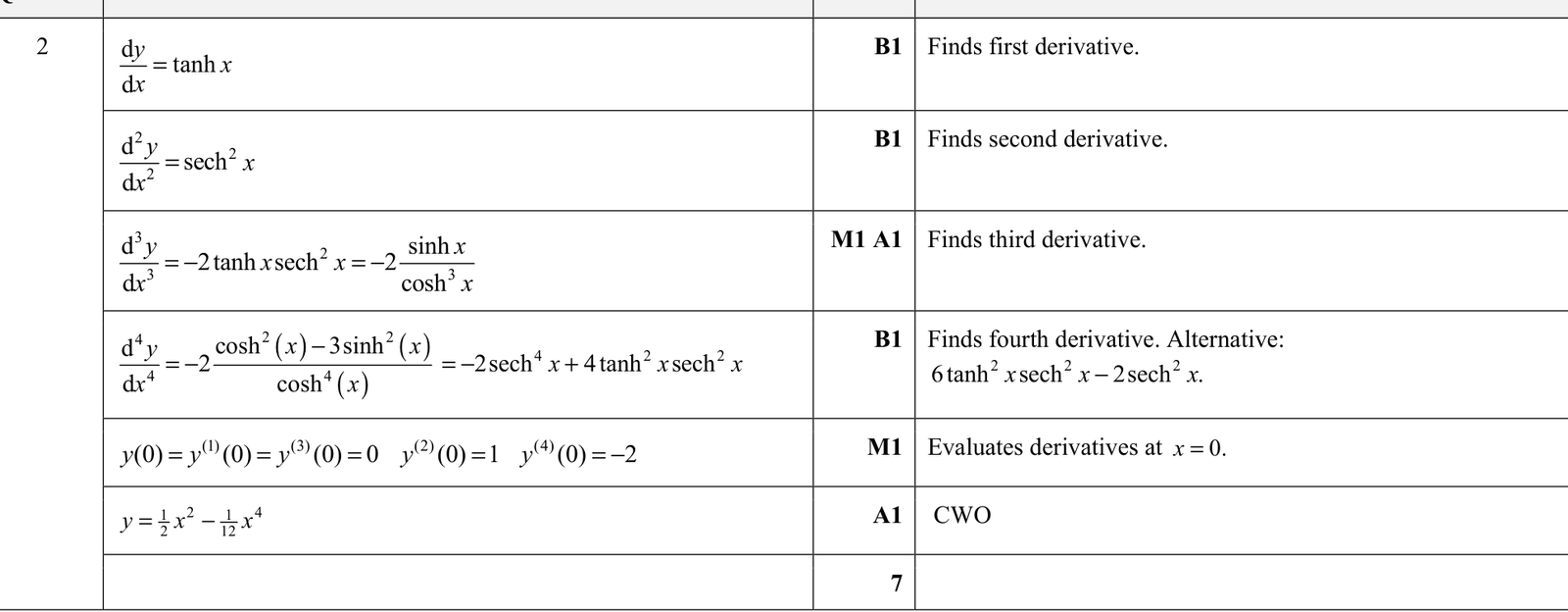
Find the Maclaurin's series for \(\ln \cosh x\) up to and including the term in \(x^{4}\).
9231 P22 - Nov 2020 - Q1 - 5 marks
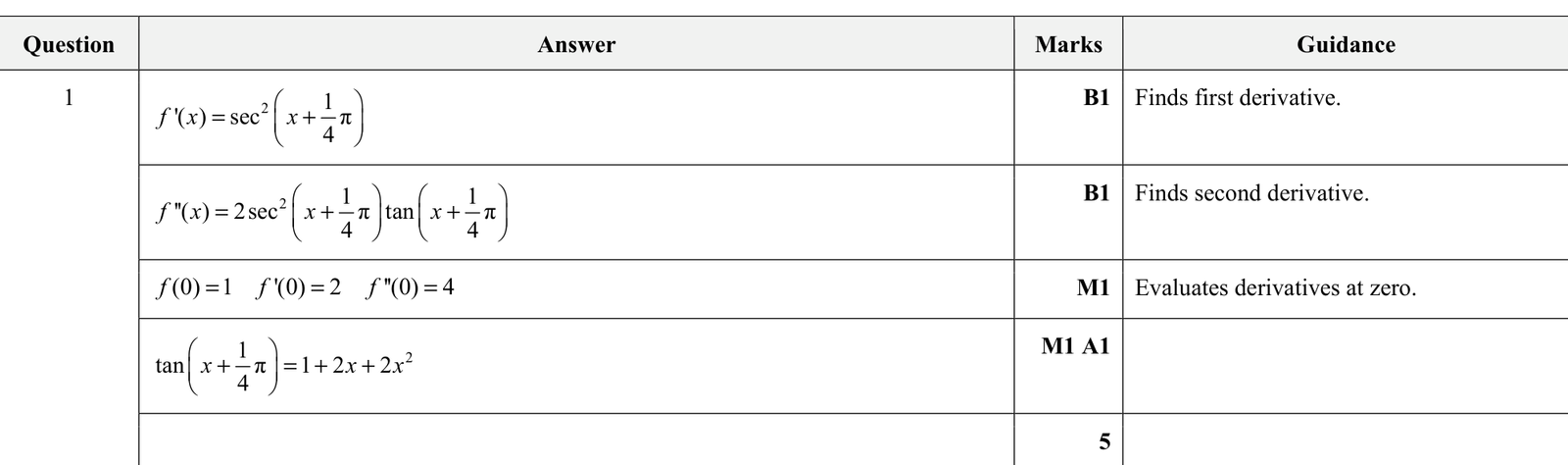
Find the Maclaurin's series for \(\tan \left(x+\frac{1}{4} \pi\right)\) up to and including the term in \(x^{2}\).
9231 P22 - Nov 2021 - Q1 - 5 marks
It is given that \(y=\sinh \left(x^{2}\right)+\cosh \left(x^{2}\right)\).
(a) Use standard results from the list of formulae (MF19) to find the Maclaurin's series for \(y\) in terms of \(x\) up to and including the term in \(x^{4}\).
(b) Deduce the value of \(\frac{\mathrm{d}^{4} y}{\mathrm{~d} x^{4}}\) when \(x=0\).
(c) Use your answer to part (a) to find an approximation to \(\int_{0}^{\frac{1}{2}} y \mathrm{~d} x\), giving your answer as a rational fraction in its lowest terms.

9231 P13 - Jun 2019 - Q10 - 11 marks
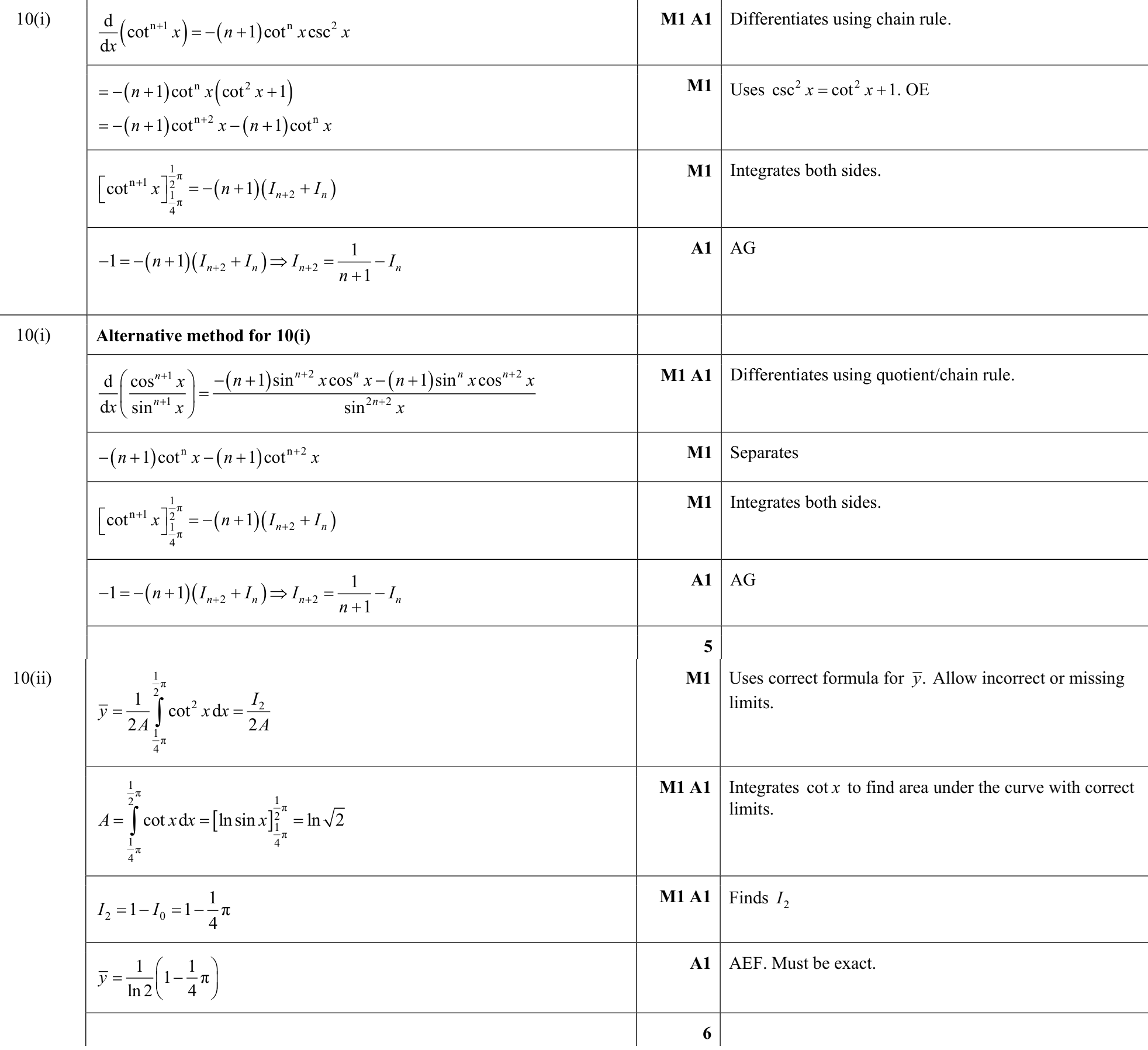
10 Let \(I_{n}=\int_{\frac{1}{4} \pi}^{\frac{1}{2} \pi} \cot ^{n} x \mathrm{~d} x\), where \(n \geqslant 0\).
(i) By considering \(\frac{\mathrm{d}}{\mathrm{d} x}\left(\cot ^{n+1} x\right)\), or otherwise, show that
\(I_{n+2}=\frac{1}{n+1}-I_{n} .\)
The curve \(C\) has equation \(y=\cot x\), for \(\frac{1}{4} \pi \leqslant x \leqslant \frac{1}{2} \pi\).
(ii) Find, in an exact form, the \(y\)-coordinate of the centroid of the region enclosed by \(C\), the line \(x=\frac{1}{4} \pi\) and the \(x\)-axis.
9231 P11 - Nov 2019 - Q1 - 6 marks
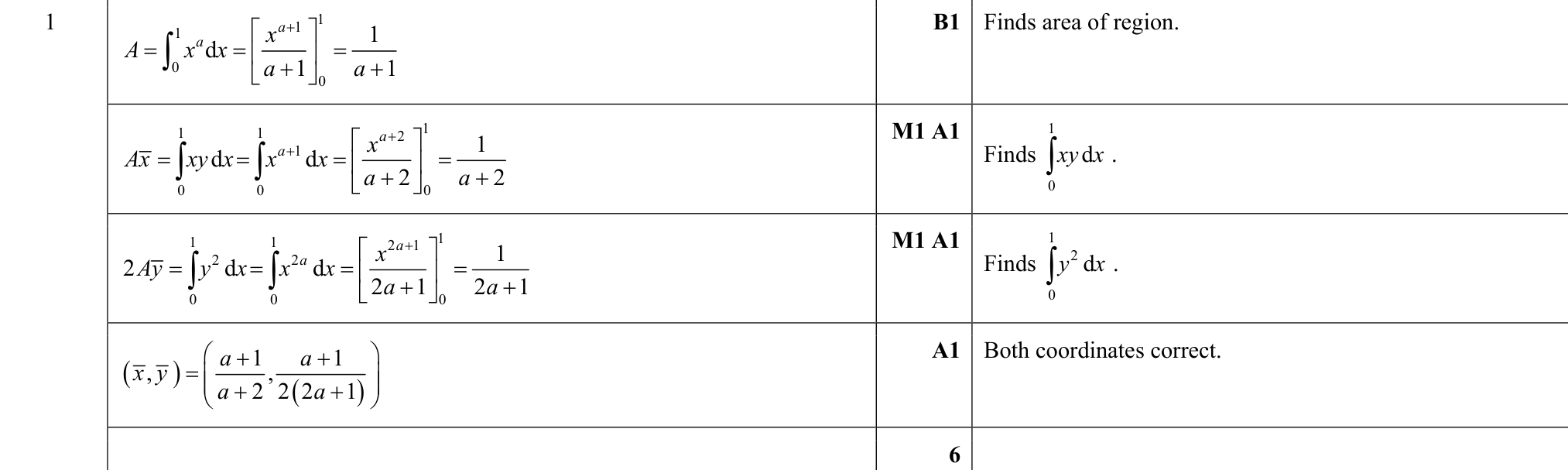
The curve \(C\) has equation \(y=x^{a}\) for \(0 \leqslant x \leqslant 1\), where \(a\) is a positive constant. Find, in terms of \(a\), the coordinates of the centroid of the region enclosed by \(C\), the line \(x=1\) and the \(x\)-axis.
9231 P11 - Jun 2018 - Q9 - 10 marks
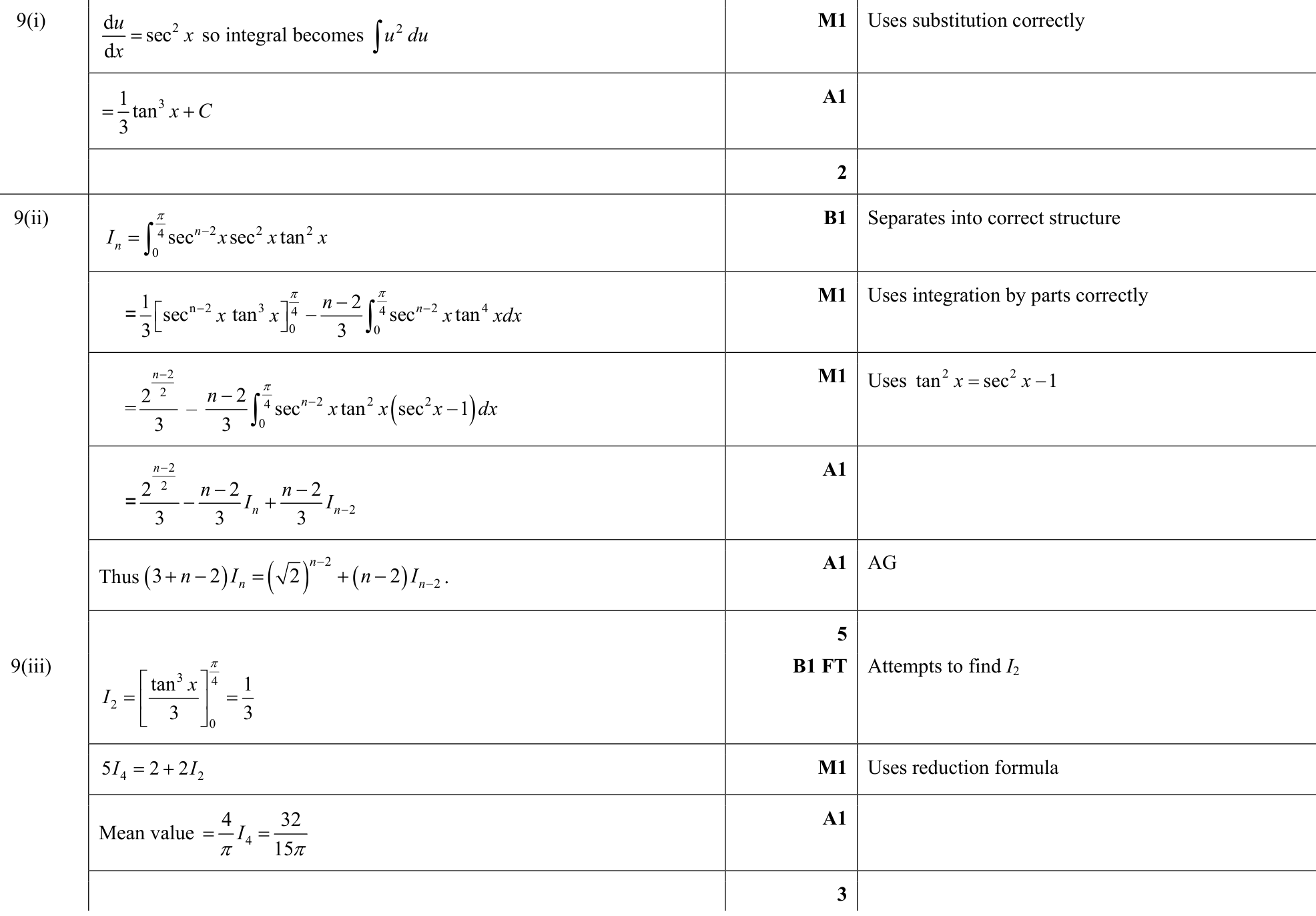
(i) Using the substitution \(u=\tan x\), or otherwise, find \(\int \sec ^{2} x \tan ^{2} x \mathrm{~d} x\).
It is given that, for \(n \geqslant 0\),
\(I_{n}=\int_{0}^{\frac{1}{4} \pi} \sec ^{n} x \tan ^{2} x \mathrm{~d} x\)
(ii) Using the result that \(\frac{\mathrm{d}}{\mathrm{d} x}(\sec x)=\tan x \sec x\), show that, for \(n \geqslant 2\),
\((n+1) I_{n}=(\sqrt{ } 2)^{n-2}+(n-2) I_{n-2} .\)
(iii) Hence find the mean value of \(\sec ^{4} x \tan ^{2} x\) with respect to \(x\) over the interval \(0 \leqslant x \leqslant \frac{1}{4} \pi\), giving your answer in exact form.
9231 P23 - Jun 2024 - Q1 - 5 marks
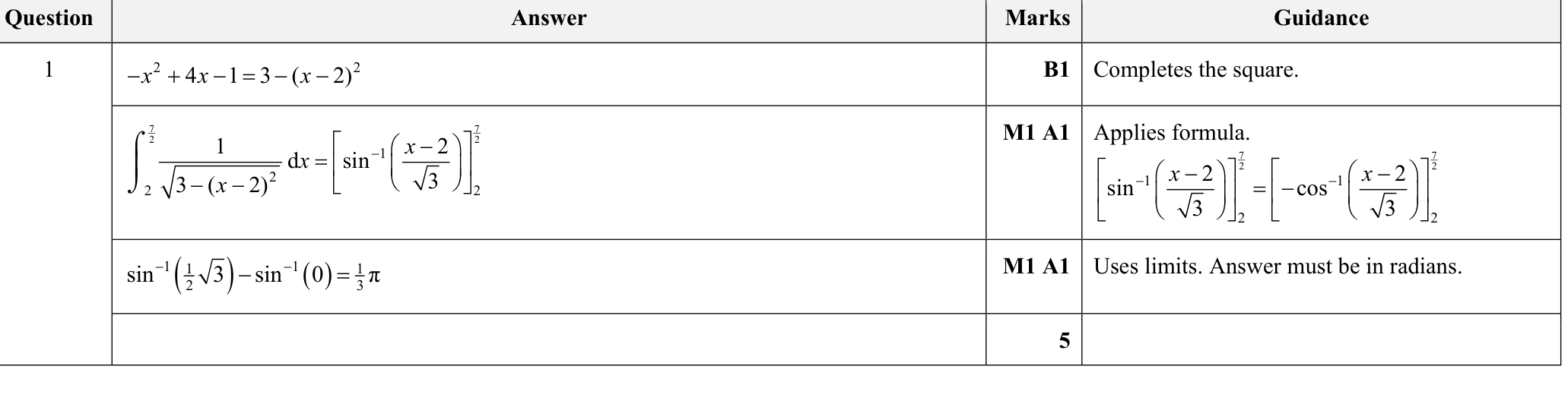
Find the exact value of \(\int_{2}^{\frac{7}{2}} \frac{1}{\sqrt{4 x-x^{2}-1}} \mathrm{~d} x\).
9231 P22 - Nov 2024 - Q1 - 4 marks
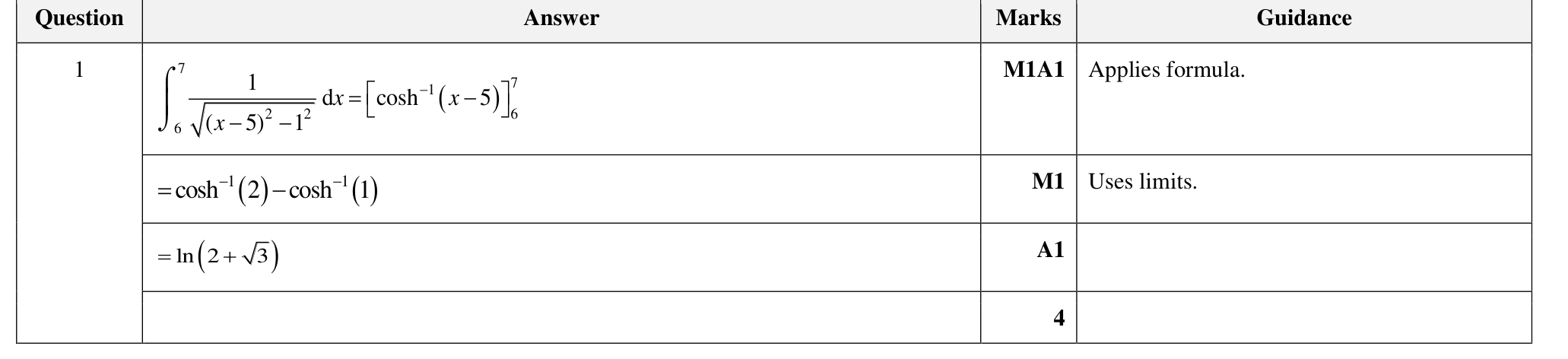
Find the value of \(\int_{6}^{7} \frac{1}{\sqrt{(x-5)^{2}-1}} \mathrm{~d} x\), giving your answer in the form \(\ln (a+\sqrt{b})\), where \(a\) and \(b\) are integers to be determined.