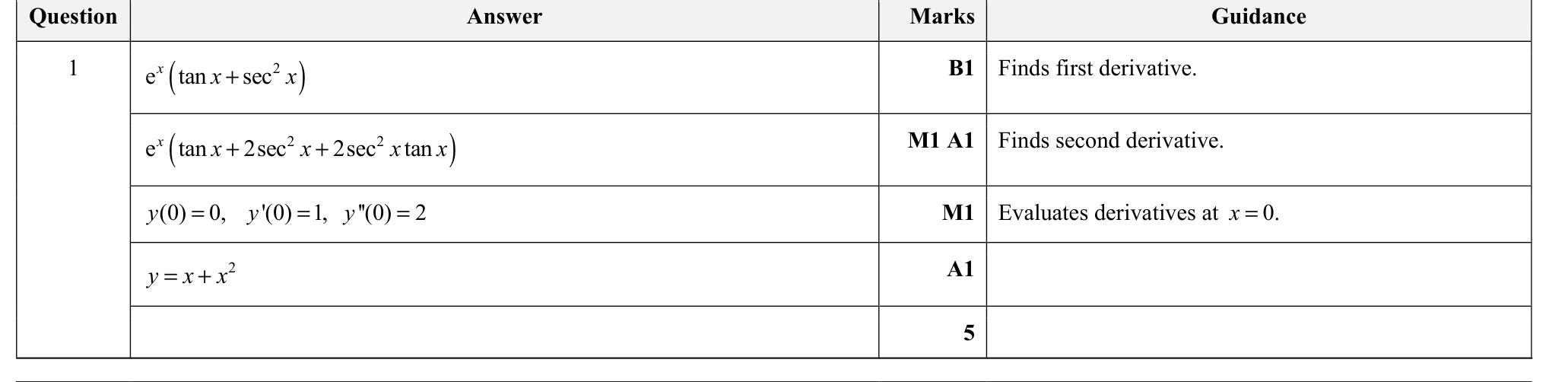
Answer: The Maclaurin series of \(\mathrm{e}^x\tan x\) up to and including the term in \(x^2\) is
\(\boxed{x+x^2}\).
Let \(y=\mathrm{e}^x\tan x\).
Using the Maclaurin expansion from first principles,
\(y=y(0)+xy'(0)+\dfrac{x^2}{2!}y''(0)+\cdots\)
So we need \(y(0)\), \(y'(0)\) and \(y''(0)\).
First,
\(y(0)=\mathrm{e}^0\tan 0=0\).
Differentiate:
\(y'=\mathrm{e}^x\tan x+\mathrm{e}^x\sec^2x=\mathrm{e}^x(\tan x+\sec^2x)\).
Hence
\(y'(0)=\mathrm{e}^0(\tan 0+\sec^2 0)=1\).
Differentiate again:
\(y''=\mathrm{e}^x(\tan x+\sec^2x)+\mathrm{e}^x(\sec^2x+2\sec^2x\tan x)\)
so
\(y''=\mathrm{e}^x(\tan x+2\sec^2x+2\sec^2x\tan x)\).
Therefore
\(y''(0)=\mathrm{e}^0(0+2\cdot 1+0)=2\).
Substitute into the Maclaurin series:
\(y=0+x(1)+\dfrac{x^2}{2}(2)+\cdots=x+x^2+\cdots\)
So, up to and including the term in \(x^2\),
\(\boxed{\mathrm{e}^x\tan x=x+x^2}.\)