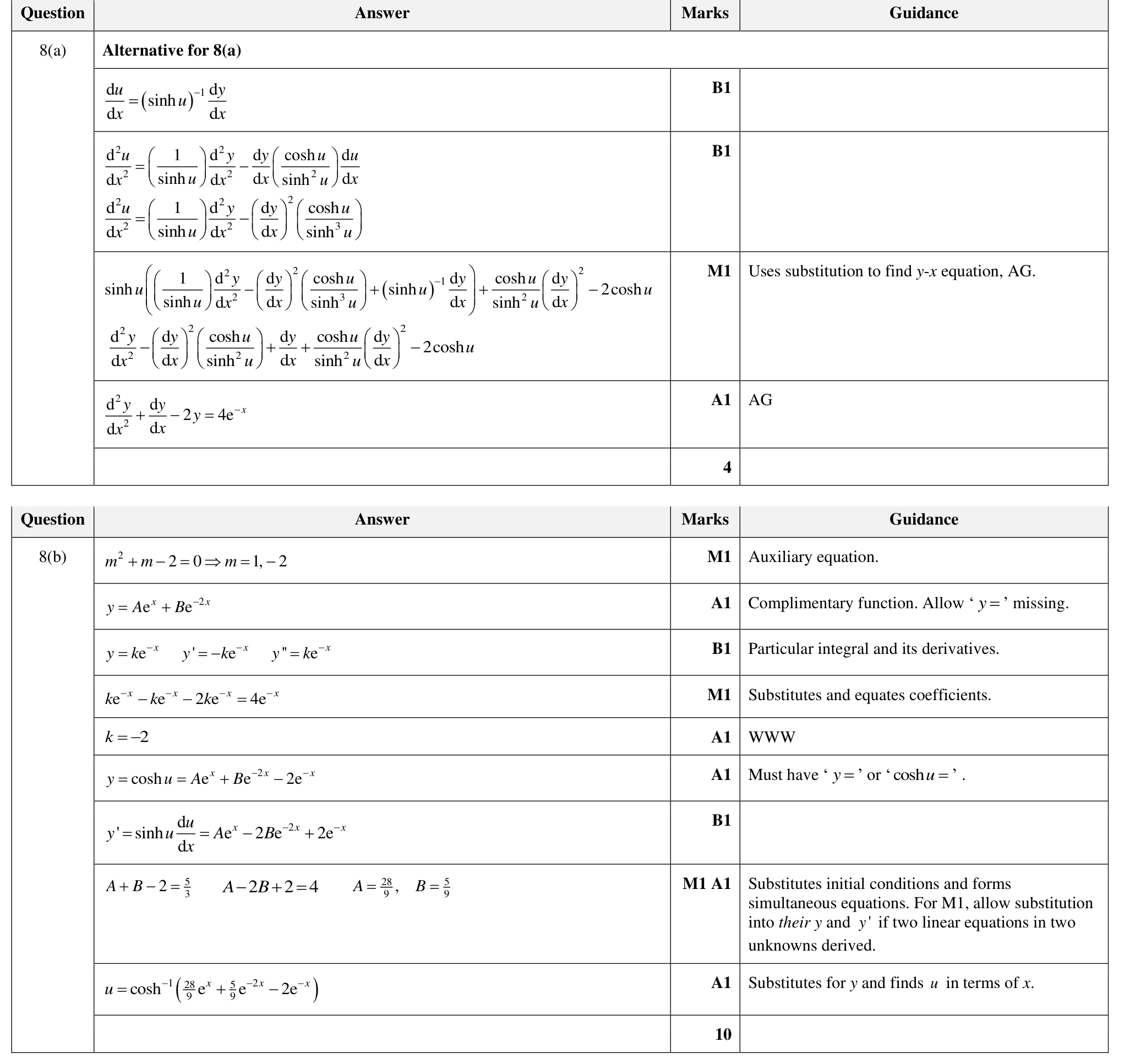
Answer: (a) \(\displaystyle \frac{\mathrm{d}^2y}{\mathrm{d}x^2}+\frac{\mathrm{d}y}{\mathrm{d}x}-2y=4\mathrm{e}^{-x}\).
(b) \(\displaystyle u=\cosh^{-1}\!\left(\frac{28}{9}\mathrm{e}^x+\frac{5}{9}\mathrm{e}^{-2x}-2\mathrm{e}^{-x}\right)\).
(a)
Since \(y=\cosh u\),
\(\displaystyle \frac{\mathrm{d}y}{\mathrm{d}x}=\sinh u\,\frac{\mathrm{d}u}{\mathrm{d}x}.\)
Also, because \(u\gt 0\), we have \(\sinh u\gt 0\), so
\(\displaystyle \sqrt{\cosh^2u-1}=\sqrt{\sinh^2u}=\sinh u.\)
Differentiate \(\frac{\mathrm{d}y}{\mathrm{d}x}=\sinh u\,\frac{\mathrm{d}u}{\mathrm{d}x}\):
\(\displaystyle \frac{\mathrm{d}^2y}{\mathrm{d}x^2}=\cosh u\left(\frac{\mathrm{d}u}{\mathrm{d}x}\right)^2+\sinh u\,\frac{\mathrm{d}^2u}{\mathrm{d}x^2}.\)
Hence
\(\displaystyle \frac{\mathrm{d}^2y}{\mathrm{d}x^2}+\frac{\mathrm{d}y}{\mathrm{d}x}-2y\)
\(\displaystyle =\cosh u\left(\frac{\mathrm{d}u}{\mathrm{d}x}\right)^2+\sinh u\,\frac{\mathrm{d}^2u}{\mathrm{d}x^2}+\sinh u\,\frac{\mathrm{d}u}{\mathrm{d}x}-2\cosh u\)
\(\displaystyle =\sqrt{\cosh^2u-1}\left(\frac{\mathrm{d}^2u}{\mathrm{d}x^2}+\frac{\mathrm{d}u}{\mathrm{d}x}\right)+\cosh u\left(\frac{\mathrm{d}u}{\mathrm{d}x}\right)^2-2\cosh u.\)
This is the given left-hand side, so
\(\displaystyle \frac{\mathrm{d}^2y}{\mathrm{d}x^2}+\frac{\mathrm{d}y}{\mathrm{d}x}-2y=4\mathrm{e}^{-x}.\)
(b)
Solve
\(\displaystyle y''+y'-2y=4\mathrm{e}^{-x}.\)
The auxiliary equation is
\(\displaystyle m^2+m-2=0,\)
so
\(\displaystyle (m-1)(m+2)=0\)
and therefore \(m=1,-2\).
Hence the complementary function is
\(\displaystyle y_c=A\mathrm{e}^x+B\mathrm{e}^{-2x}.\)
For a particular integral, try \(\displaystyle y_p=k\mathrm{e}^{-x}\).
Then
\(\displaystyle y_p'=-k\mathrm{e}^{-x},\qquad y_p''=k\mathrm{e}^{-x}.\)
Substituting gives
\(\displaystyle k\mathrm{e}^{-x}-k\mathrm{e}^{-x}-2k\mathrm{e}^{-x}=4\mathrm{e}^{-x},\)
so \(\displaystyle -2k=4\), hence \(\displaystyle k=-2\).
Therefore
\(\displaystyle y=A\mathrm{e}^x+B\mathrm{e}^{-2x}-2\mathrm{e}^{-x}.\)
Since \(y=\cosh u\),
\(\displaystyle \cosh u=A\mathrm{e}^x+B\mathrm{e}^{-2x}-2\mathrm{e}^{-x}.\)
Also
\(\displaystyle y'=A\mathrm{e}^x-2B\mathrm{e}^{-2x}+2\mathrm{e}^{-x},\)
and from \(y=\cosh u\),
\(\displaystyle y'=\sinh u\,\frac{\mathrm{d}u}{\mathrm{d}x}.\)
When \(x=0\), \(u=\ln 3\), so
\(\displaystyle y(0)=\cosh(\ln 3)=\frac{3+\frac13}{2}=\frac53.\)
Thus
\(\displaystyle A+B-2=\frac53.\)
Also, when \(x=0\), \(\frac{\mathrm{d}u}{\mathrm{d}x}=3\), and
\(\displaystyle \sinh(\ln 3)=\frac{3-\frac13}{2}=\frac43,\)
so
\(\displaystyle y'(0)=\sinh(\ln 3)\cdot 3=\frac43\cdot 3=4.\)
Hence
\(\displaystyle A-2B+2=4.\)
So the simultaneous equations are
\(\displaystyle A+B=\frac{11}{3},\qquad A-2B=2.\)
Solving,
\(\displaystyle B=\frac59,\qquad A=\frac{28}{9}.\)
Therefore
\(\displaystyle \cosh u=\frac{28}{9}\mathrm{e}^x+\frac{5}{9}\mathrm{e}^{-2x}-2\mathrm{e}^{-x}.\)
Since \(u\gt 0\),
\(\displaystyle u=\cosh^{-1}\!\left(\frac{28}{9}\mathrm{e}^x+\frac{5}{9}\mathrm{e}^{-2x}-2\mathrm{e}^{-x}\right).\)