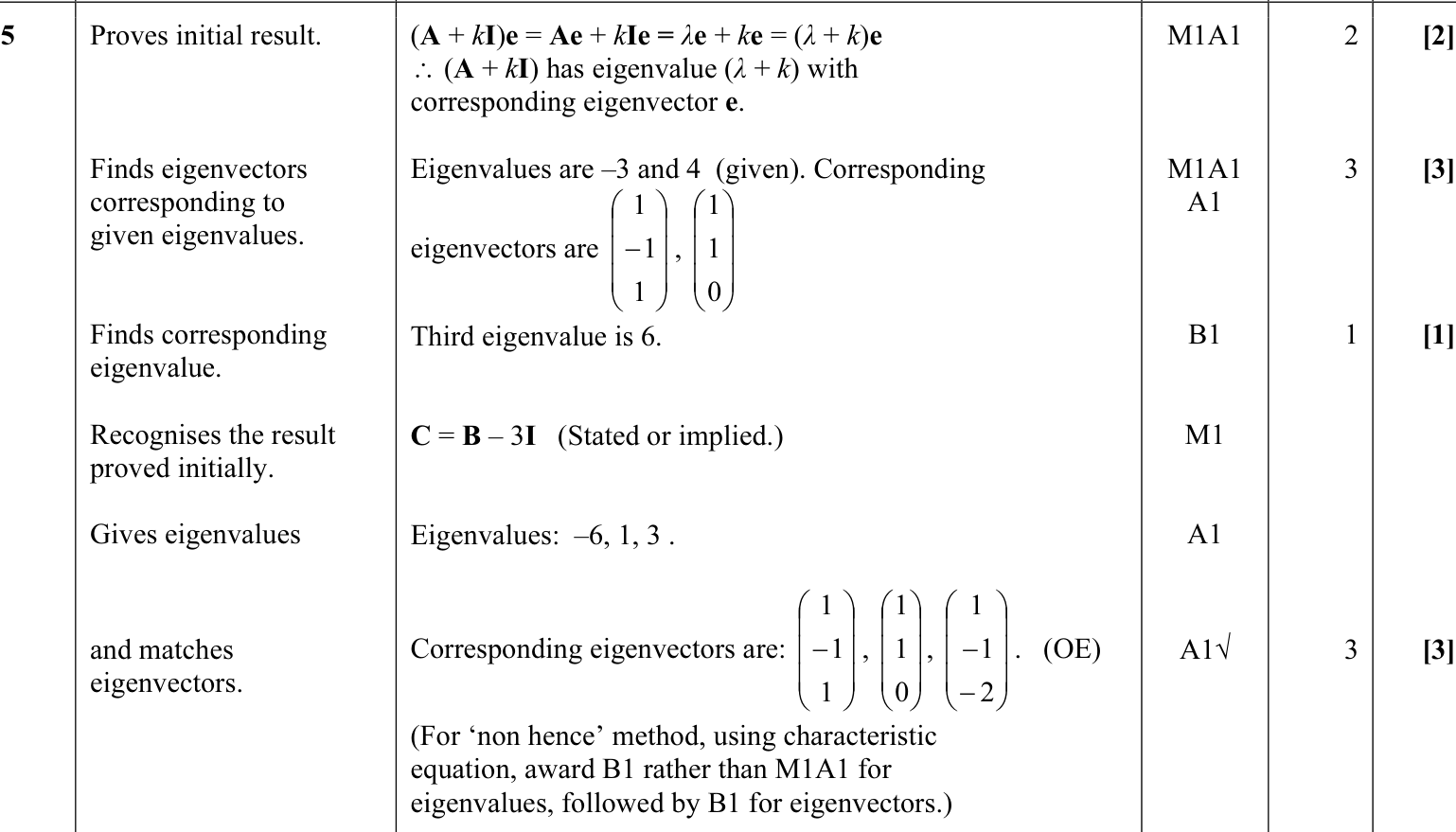
Answer: (a) Let \(\mathbf{e}\) be an eigenvector of \(\mathbf{A}\) with eigenvalue \(\lambda\). Then \(\mathbf{Ae}=\lambda \mathbf{e}\). So
\((\mathbf{A}+k\mathbf{I})\mathbf{e}=\mathbf{Ae}+k\mathbf{Ie}=\lambda\mathbf{e}+k\mathbf{e}=(\lambda+k)\mathbf{e}.\)
Hence \((\mathbf{A}+k\mathbf{I})\) has eigenvalue \(\lambda+k\) with corresponding eigenvector \(\mathbf{e}\).
(b) For \(\mathbf{B}=\begin{pmatrix}2&2&-3\\2&2&3\\-3&3&3\end{pmatrix}\), the given eigenvalues are \(-3\) and \(4\).
Corresponding eigenvectors are
for \(\lambda=-3\): \(\begin{pmatrix}1\\-1\\1\end{pmatrix}\),
for \(\lambda=4\): \(\begin{pmatrix}1\\1\\0\end{pmatrix}\).
Given that \(\begin{pmatrix}1\\-1\\-2\end{pmatrix}\) is an eigenvector of \(\mathbf{B}\), the corresponding eigenvalue is \(6\).
(c) Since \(\mathbf{C}=\begin{pmatrix}-1&2&-3\\2&-1&3\\-3&3&0\end{pmatrix}=\mathbf{B}-3\mathbf{I},\) each eigenvalue of \(\mathbf{B}\) is reduced by \(3\) for \(\mathbf{C}\), while the eigenvectors stay the same.
Therefore the eigenvalues of \(\mathbf{C}\) are \(-6\), \(1\) and \(3\).
The corresponding eigenvectors are
\(\lambda=-6:\ \begin{pmatrix}1\\-1\\1\end{pmatrix},\quad \lambda=1:\ \begin{pmatrix}1\\1\\0\end{pmatrix},\quad \lambda=3:\ \begin{pmatrix}1\\-1\\-2\end{pmatrix}.\)
(a) If \(\mathbf{e}\) is an eigenvector of \(\mathbf{A}\) with eigenvalue \(\lambda\), then \(\mathbf{Ae}=\lambda\mathbf{e}\).
Now
\((\mathbf{A}+k\mathbf{I})\mathbf{e}=\mathbf{Ae}+k\mathbf{Ie}.\)
Since \(\mathbf{Ie}=\mathbf{e}\), this becomes
\((\mathbf{A}+k\mathbf{I})\mathbf{e}=\lambda\mathbf{e}+k\mathbf{e}=(\lambda+k)\mathbf{e}.\)
So \(\mathbf{e}\) is still an eigenvector, and the new eigenvalue is \(\lambda+k\).
(b) To find an eigenvector for an eigenvalue, solve \((\mathbf{B}-\mu\mathbf{I})\mathbf{x}=\mathbf{0}\).
For \(\mu=-3\), we solve \((\mathbf{B}+3\mathbf{I})\mathbf{x}=\mathbf{0}\):
\(\mathbf{B}+3\mathbf{I}=\begin{pmatrix}5&2&-3\\2&5&3\\-3&3&6\end{pmatrix}.\)
A suitable non-zero solution is \(\mathbf{x}=\begin{pmatrix}1\\-1\\1\end{pmatrix}\), so an eigenvector for \(-3\) is \(\begin{pmatrix}1\\-1\\1\end{pmatrix}\).
For \(\mu=4\), we solve \((\mathbf{B}-4\mathbf{I})\mathbf{x}=\mathbf{0}\):
\(\mathbf{B}-4\mathbf{I}=\begin{pmatrix}-2&2&-3\\2&-2&3\\-3&3&-1\end{pmatrix}.\)
A suitable non-zero solution is \(\mathbf{x}=\begin{pmatrix}1\\1\\0\end{pmatrix}\), so an eigenvector for \(4\) is \(\begin{pmatrix}1\\1\\0\end{pmatrix}\).
For the given eigenvector \(\begin{pmatrix}1\\-1\\-2\end{pmatrix}\), let the eigenvalue be \(\mu\). Then \(\mathbf{B}\mathbf{x}=\mu\mathbf{x}\).
Calculate
\(\mathbf{B}\begin{pmatrix}1\\-1\\-2\end{pmatrix}=\begin{pmatrix}2(1)+2(-1)-3(-2)\\2(1)+2(-1)+3(-2)\\-3(1)+3(-1)+3(-2)\end{pmatrix}=\begin{pmatrix}6\\-12\\-18\end{pmatrix}.\)
This is equal to \(6\begin{pmatrix}1\\-1\\-2\end{pmatrix}\), so the eigenvalue is \(6\).
(c) We notice that
\(\mathbf{C}=\begin{pmatrix}-1&2&-3\\2&-1&3\\-3&3&0\end{pmatrix}=\mathbf{B}-3\mathbf{I}.\)
So if \(\mu\) is an eigenvalue of \(\mathbf{B}\), then \(\mu-3\) is the corresponding eigenvalue of \(\mathbf{C}\), with the same eigenvector.
The eigenvalues of \(\mathbf{B}\) are \(-3\), \(4\), \(6\), so the eigenvalues of \(\mathbf{C}\) are
\(-6,\ 1,\ 3\).
Matching eigenvectors are unchanged:
\(\lambda=-6\) has eigenvector \(\begin{pmatrix}1\\-1\\1\end{pmatrix}\),
\(\lambda=1\) has eigenvector \(\begin{pmatrix}1\\1\\0\end{pmatrix}\),
\(\lambda=3\) has eigenvector \(\begin{pmatrix}1\\-1\\-2\end{pmatrix}\).