Answer:
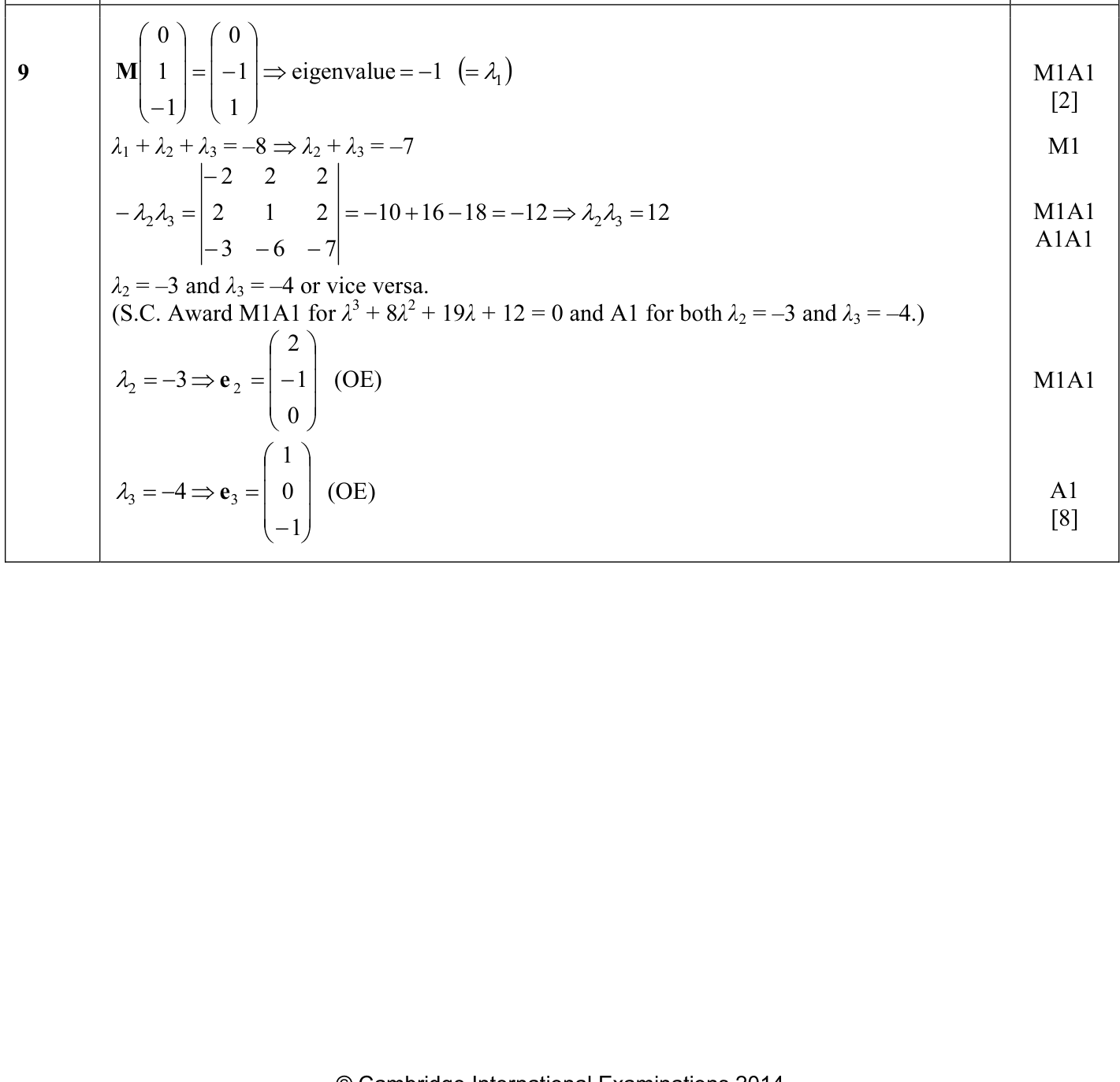
The corresponding eigenvalue is \(-1\).
The other eigenvalues are \(-3\) and \(-4\).
Corresponding eigenvectors are:
- for \(\lambda=-3\), \(\begin{pmatrix}2\\-1\\0\end{pmatrix}\)
- for \(\lambda=-4\), \(\begin{pmatrix}1\\0\\-1\end{pmatrix}\)
First check the given eigenvector \(\begin{pmatrix}0\\1\\-1\end{pmatrix}\):
\(\mathbf{M}\begin{pmatrix}0\\1\\-1\end{pmatrix}=\begin{pmatrix}-2\cdot 0+2\cdot 1+2\cdot(-1)\\2\cdot 0+1\cdot 1+2\cdot(-1)\\-3\cdot 0-6\cdot 1-7\cdot(-1)\end{pmatrix}=\begin{pmatrix}0\\-1\\1\end{pmatrix}.\)
This is \(-1\) times the original vector, so the corresponding eigenvalue is \(-1\).
Now let the other two eigenvalues be \(\lambda_2\) and \(\lambda_3\).
The trace of \(\mathbf{M}\) is
\(-2+1-7=-8,\)
so the sum of the eigenvalues is
\(-1+\lambda_2+\lambda_3=-8 \Rightarrow \lambda_2+\lambda_3=-7.\)
The determinant of \(\mathbf{M}\) is
\(\begin{vmatrix}-2&2&2\\2&1&2\\-3&-6&-7\end{vmatrix}=-2\begin{vmatrix}1&2\\-6&-7\end{vmatrix}-2\begin{vmatrix}2&2\\-3&-7\end{vmatrix}+2\begin{vmatrix}2&1\\-3&-6\end{vmatrix}.\)
So
\(=-2((-7)-(-12)) -2((-14)-(-6)) +2((-12)-(-3))\)
\(=-2(5)-2(-8)+2(-9)=-10+16-18=-12.\)
Hence the product of the eigenvalues is \(-12\):
\((-1)\lambda_2\lambda_3=-12 \Rightarrow \lambda_2\lambda_3=12.\)
Therefore \(\lambda_2\) and \(\lambda_3\) satisfy
\(t^2-(\lambda_2+\lambda_3)t+\lambda_2\lambda_3=0,\)
so
\(t^2+7t+12=0=(t+3)(t+4).\)
Thus the other two eigenvalues are \(-3\) and \(-4\).
For \(\lambda=-3\), solve \((\mathbf{M}+3\mathbf{I})\mathbf{x}=\mathbf{0}\):
\(\mathbf{M}+3\mathbf{I}=\begin{pmatrix}1&2&2\\2&4&2\\-3&-6&-4\end{pmatrix}.\)
Let \(\mathbf{x}=(x,y,z)^T\). Then from the first two equations:
\(x+2y+2z=0,\qquad 2x+4y+2z=0.\)
Subtracting twice the first from the second gives \(-2z=0\), so \(z=0\). Then \(x+2y=0\), so taking \(y=-1\) gives \(x=2\). Hence one eigenvector is
\(\begin{pmatrix}2\\-1\\0\end{pmatrix}.\)
For \(\lambda=-4\), solve \((\mathbf{M}+4\mathbf{I})\mathbf{x}=\mathbf{0}\):
\(\mathbf{M}+4\mathbf{I}=\begin{pmatrix}2&2&2\\2&5&2\\-3&-6&-3\end{pmatrix}.\)
The equations include \(2x+2y+2z=0\), so \(x+y+z=0\). Taking \(y=0\) and \(x=1\) gives \(z=-1\), and this satisfies the other equations too. So an eigenvector is
\(\begin{pmatrix}1\\0\\-1\end{pmatrix}.\)