Answer: For the eigenvalue \(5\), solve \((\mathbf{A}-5\mathbf{I})\mathbf{x}=\mathbf{0}\).
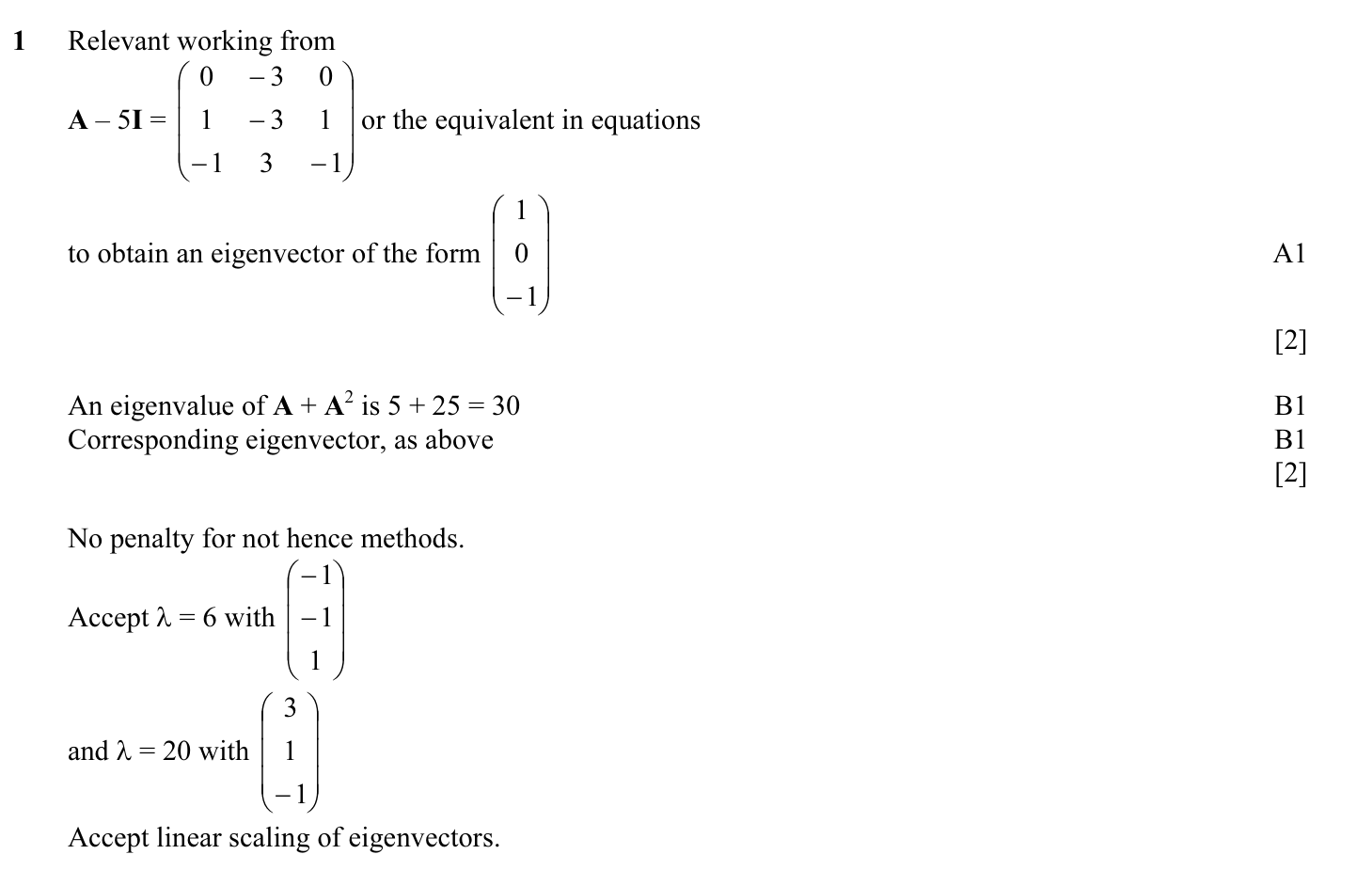
Now \(\mathbf{A}-5\mathbf{I}=\begin{pmatrix}0 & -3 & 0\\ 1 & -3 & 1\\ -1 & 3 & -1\end{pmatrix}\), so the equations are
\(-3y=0\), \(x-3y+z=0\), \(-x+3y-z=0\).
From the first equation, \(y=0\). Then \(x+z=0\), so \(z=-x\). Taking \(x=1\) gives an eigenvector \(\begin{pmatrix}1\\0\\-1\end{pmatrix}\).
Since \(\mathbf{A}\mathbf{v}=5\mathbf{v}\) for this eigenvector \(\mathbf{v}\), we also have \(\mathbf{A}^2\mathbf{v}=25\mathbf{v}\). Hence
\((\mathbf{A}+\mathbf{A}^2)\mathbf{v}=\mathbf{A}\mathbf{v}+\mathbf{A}^2\mathbf{v}=5\mathbf{v}+25\mathbf{v}=30\mathbf{v}.\)
So an eigenvalue of \(\mathbf{A}+\mathbf{A}^2\) is \(30\), with corresponding eigenvector \(\begin{pmatrix}1\\0\\-1\end{pmatrix}\).
Let \(\mathbf{v}\) be an eigenvector of \(\mathbf{A}\) for the eigenvalue \(5\). Then \((\mathbf{A}-5\mathbf{I})\mathbf{v}=\mathbf{0}\).
So we solve
\(\begin{pmatrix}0 & -3 & 0\\ 1 & -3 & 1\\ -1 & 3 & -1\end{pmatrix}\begin{pmatrix}x\\y\\z\end{pmatrix}=\begin{pmatrix}0\\0\\0\end{pmatrix}.\)
This gives the equations
- \(-3y=0\),
- \(x-3y+z=0\),
- \(-x+3y-z=0\).
From \(-3y=0\), we get \(y=0\). Substituting into the second equation gives \(x+z=0\), so \(z=-x\). Taking \(x=1\), one convenient eigenvector is
\(\mathbf{v}=\begin{pmatrix}1\\0\\-1\end{pmatrix}.\)
Now use the fact that if \(\mathbf{A}\mathbf{v}=\lambda\mathbf{v}\), then \(\mathbf{A}^2\mathbf{v}=\lambda^2\mathbf{v}\). Here \(\lambda=5\), so
\(\mathbf{A}^2\mathbf{v}=25\mathbf{v}.\)
Therefore
\((\mathbf{A}+\mathbf{A}^2)\mathbf{v}=\mathbf{A}\mathbf{v}+\mathbf{A}^2\mathbf{v}=5\mathbf{v}+25\mathbf{v}=30\mathbf{v}.\)
Hence an eigenvalue of \(\mathbf{A}+\mathbf{A}^2\) is \(30\), with corresponding eigenvector \(\begin{pmatrix}1\\0\\-1\end{pmatrix}\).