Past Exam Questions
← Back0606 P22 - Jun 2019 - Q10 - 8 marks
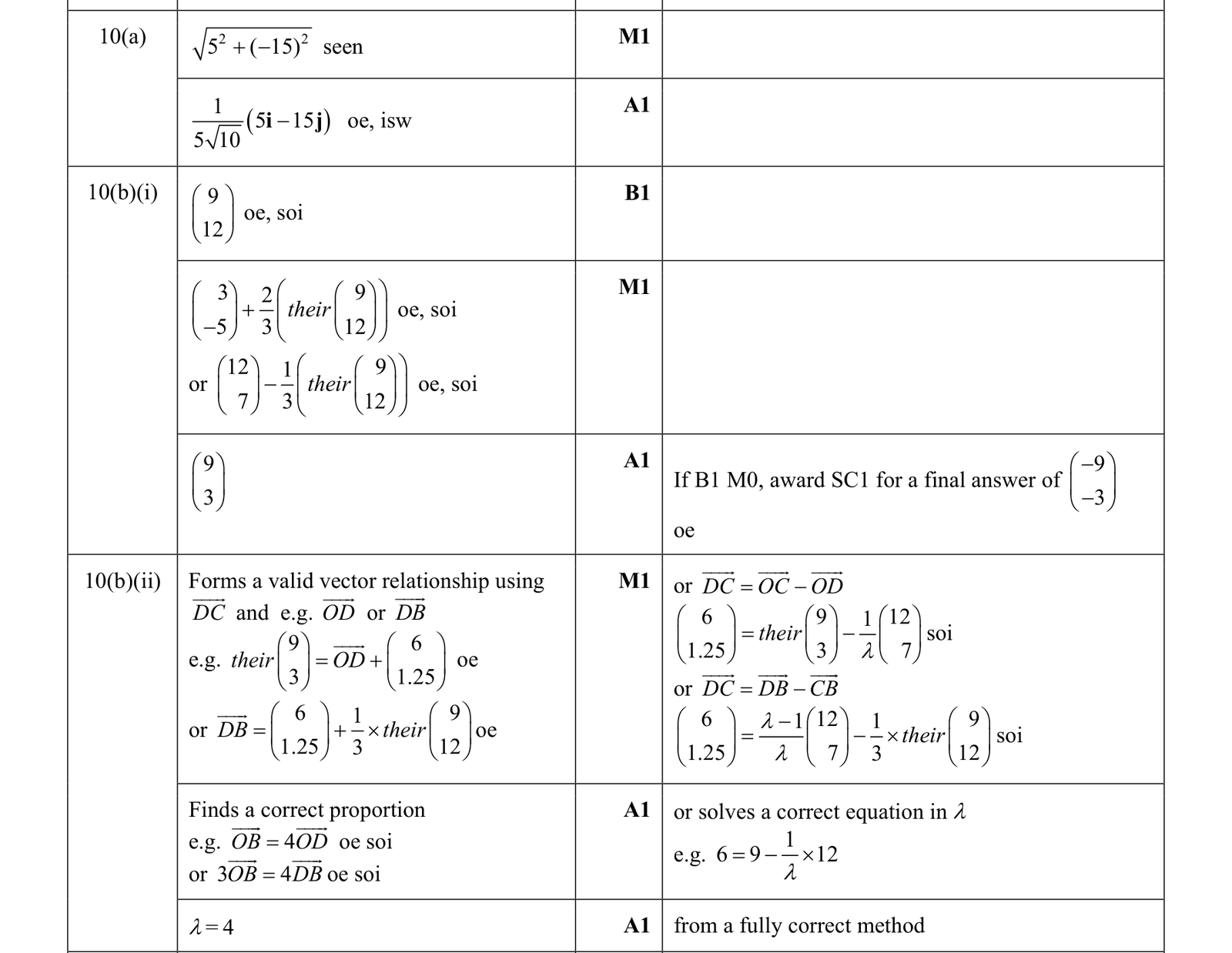
(a) Find the unit vector in the direction of \(5\mathbf{i}-15\mathbf{j}\).
(b) The position vectors of points \(A\) and \(B\) relative to an origin \(O\) are \(\begin{pmatrix}3\\-5\end{pmatrix}\) and \(\begin{pmatrix}12\\7\end{pmatrix}\) respectively. The point \(C\) lies on \(AB\) such that \(AC:CB=2:1\).
(i) Find the position vector of \(C\) relative to \(O\).
The point \(D\) lies on \(OB\) such that \(OD:OB=1:\lambda\) and \(\overrightarrow{DC}=\begin{pmatrix}6\\1.25\end{pmatrix}\).
(ii) Find the value of \(\lambda\).
0606 P23 - Jun 2019 - Q10 - 9 marks
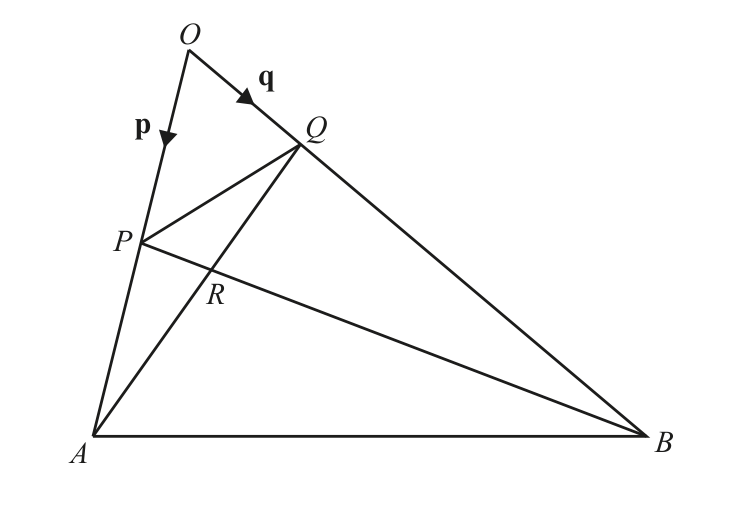
The diagram shows a triangle \(OAB\). The point \(P\) is the midpoint of \(OA\) and the point \(Q\) lies on \(OB\) such that \(\overrightarrow{OQ}=\dfrac14\overrightarrow{OB}\). The position vectors of \(P\) and \(Q\) relative to \(O\) are \(\mathbf{p}\) and \(\mathbf{q}\) respectively.
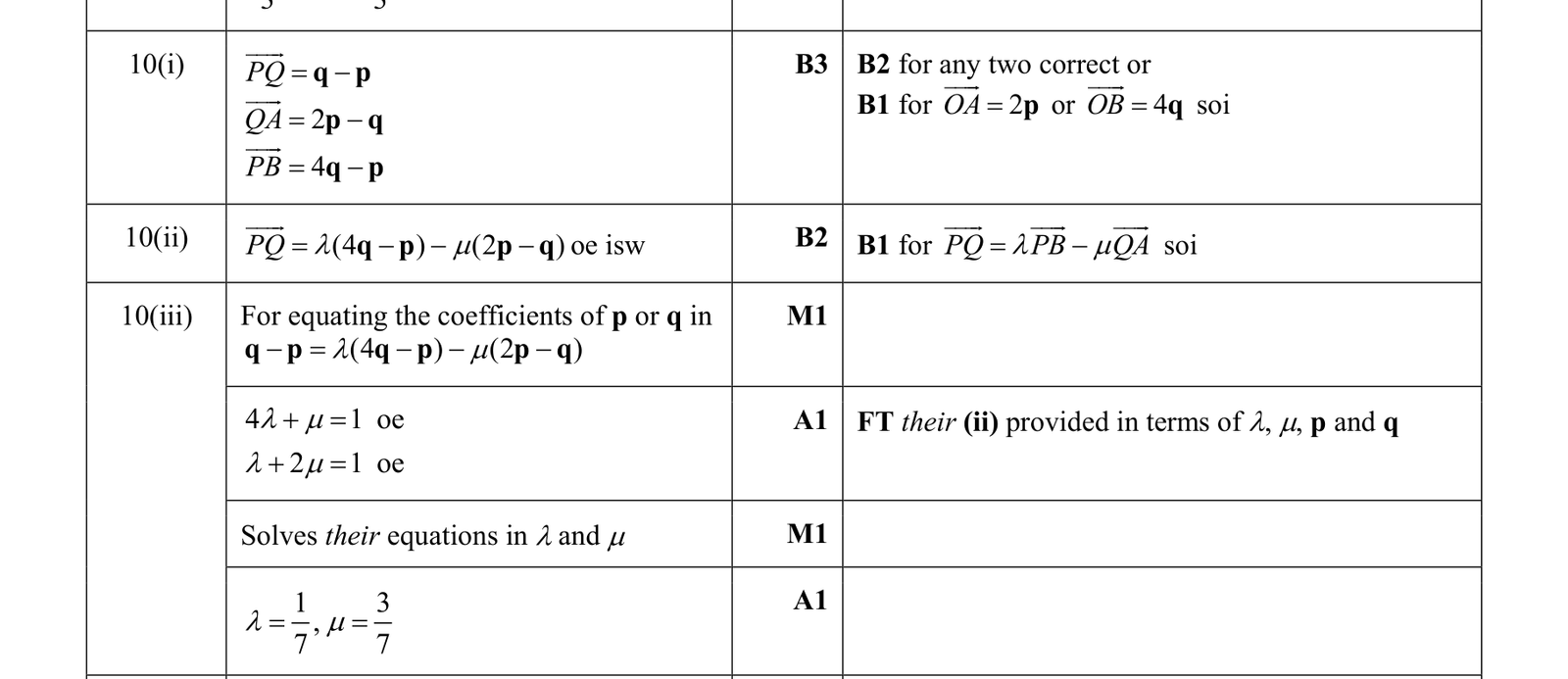
(i) Find, in terms of \(\mathbf{p}\) and \(\mathbf{q}\), an expression for each of the vectors \(\overrightarrow{PQ}\), \(\overrightarrow{QA}\) and \(\overrightarrow{PB}\).
(ii) Given that \(\overrightarrow{PR}=\lambda\overrightarrow{PB}\) and that \(\overrightarrow{QR}=\mu\overrightarrow{QA}\), find an expression for \(\overrightarrow{PQ}\) in terms of \(\lambda\), \(\mu\), \(\mathbf{p}\) and \(\mathbf{q}\).
(iii) Using your expressions for \(\overrightarrow{PQ}\), find the value of \(\lambda\) and of \(\mu\).
0606 P23 - Nov 2019 - Q9 - 9 marks
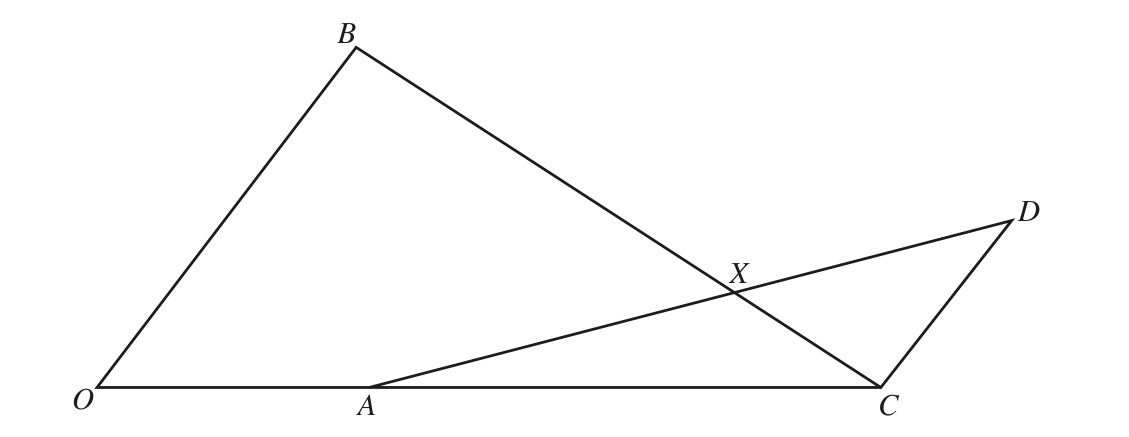
The diagram shows the points \(O\), \(A\), \(B\), \(C\), \(D\) and \(X\). The position vectors of \(A\), \(B\) and \(C\) relative to \(O\) are \(\overrightarrow{OA}=\mathbf{a}\), \(\overrightarrow{OB}=2\mathbf{b}\) and \(\overrightarrow{OC}=3\mathbf{a}\). The vector \(\overrightarrow{CD}=\mathbf{b}\).
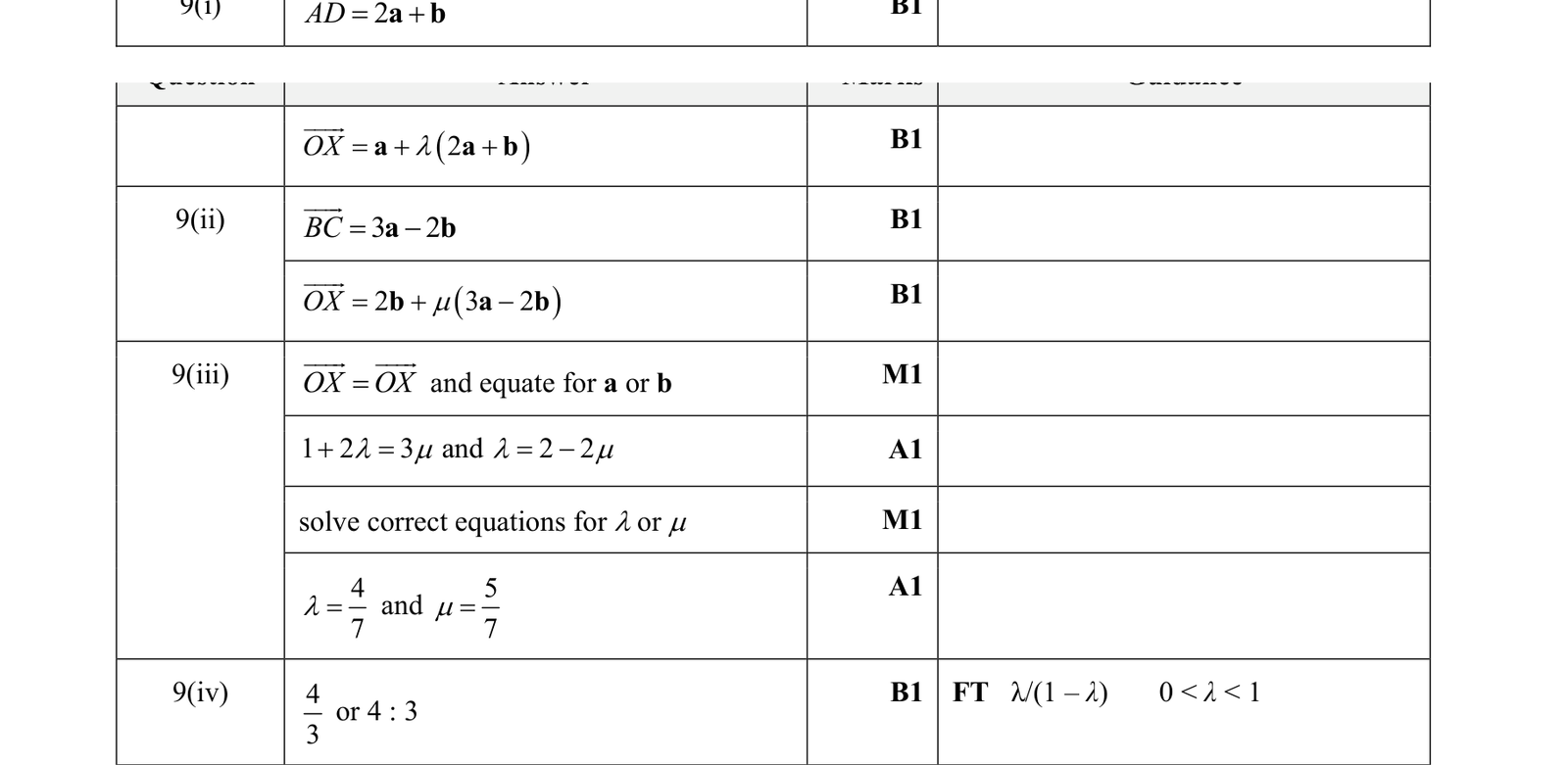
(i) Given that \(\overrightarrow{AX}=\lambda\overrightarrow{AD}\), find \(\overrightarrow{OX}\) in terms of \(\lambda\), \(\mathbf{a}\) and \(\mathbf{b}\).
(ii) Given that \(\overrightarrow{BX}=\mu\overrightarrow{BC}\), find \(\overrightarrow{OX}\) in terms of \(\mu\), \(\mathbf{a}\) and \(\mathbf{b}\).
(iii) Hence find the value of \(\lambda\) and of \(\mu\).
(iv) Find the ratio \(\displaystyle \frac{AX}{XD}\).
0606 P12 - Mar 2018 - Q6 - 8 marks
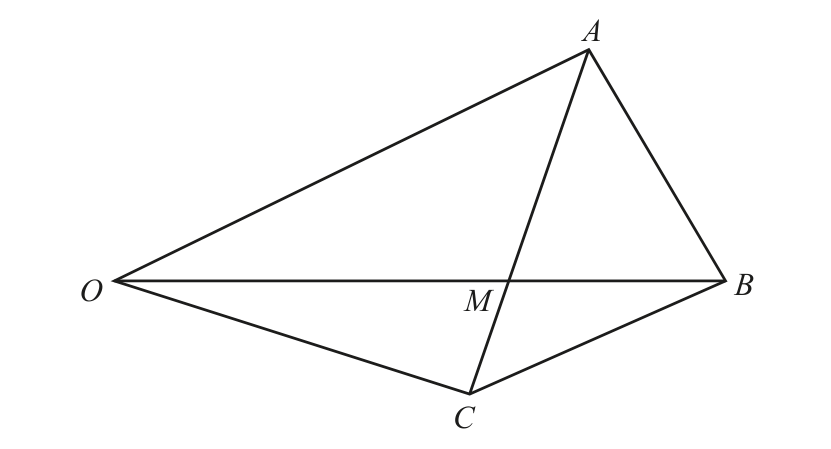
In the quadrilateral \(OABC\), \(\overrightarrow{OA}=\mathbf a\), \(\overrightarrow{OB}=\mathbf b\), and \(\overrightarrow{OC}=\mathbf c\). The point \(M\) lies on \(AC\) such that \(AM:MC=2:1\). The point \(M\) also lies on \(OB\) such that \(OM:MB=3:2\).
(i) Find \(\overrightarrow{AC}\) in terms of \(\mathbf a\) and \(\mathbf c\).
(ii) Find \(\overrightarrow{OM}\) in terms of \(\mathbf a\) and \(\mathbf c\).
(iii) Find \(\overrightarrow{OM}\) in terms of \(\mathbf b\).
(iv) Find \(5\mathbf a+10\mathbf c\) in terms of \(\mathbf b\).
(v) Find \(\overrightarrow{AB}\) in terms of \(\mathbf a\) and \(\mathbf c\), simplifying your answer.

0606 P13 - Nov 2018 - Q7 - 6 marks
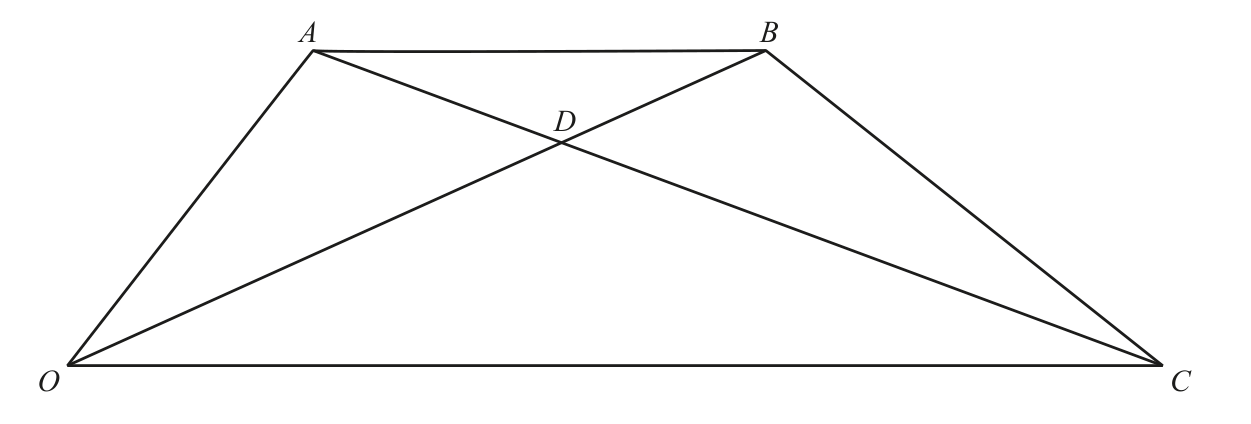
The diagram shows a quadrilateral \(OABC\). The point \(D\) lies on \(OB\) such that \(\overrightarrow{OD}=2\overrightarrow{DB}\) and \(\overrightarrow{AD}=m\overrightarrow{AC}\), where \(m\) is a scalar quantity.
\(\overrightarrow{OA}=\mathbf a,\qquad \overrightarrow{OB}=\mathbf b,\qquad \overrightarrow{OC}=\mathbf c.\)
(i) Find \(\overrightarrow{AD}\) in terms of \(m\), \(\mathbf a\) and \(\mathbf c\).
(ii) Find \(\overrightarrow{AD}\) in terms of \(\mathbf a\) and \(\mathbf b\).
(iii) Given that \(15\mathbf a=16\mathbf b-9\mathbf c\), find the value of \(m\).

0606 P11 - Jun 2017 - Q5 - 11 marks
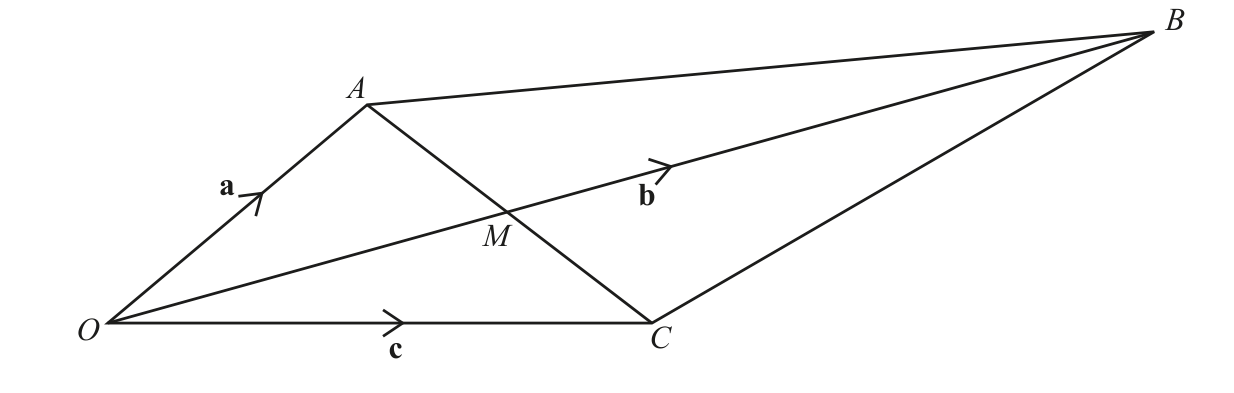
(a) The diagram shows a figure \(OABC\), where \(\overrightarrow{OA}=\mathbf a\), \(\overrightarrow{OB}=\mathbf b\), and \(\overrightarrow{OC}=\mathbf c\). The lines \(AC\) and \(OB\) intersect at \(M\), where \(M\) is the midpoint of \(AC\).
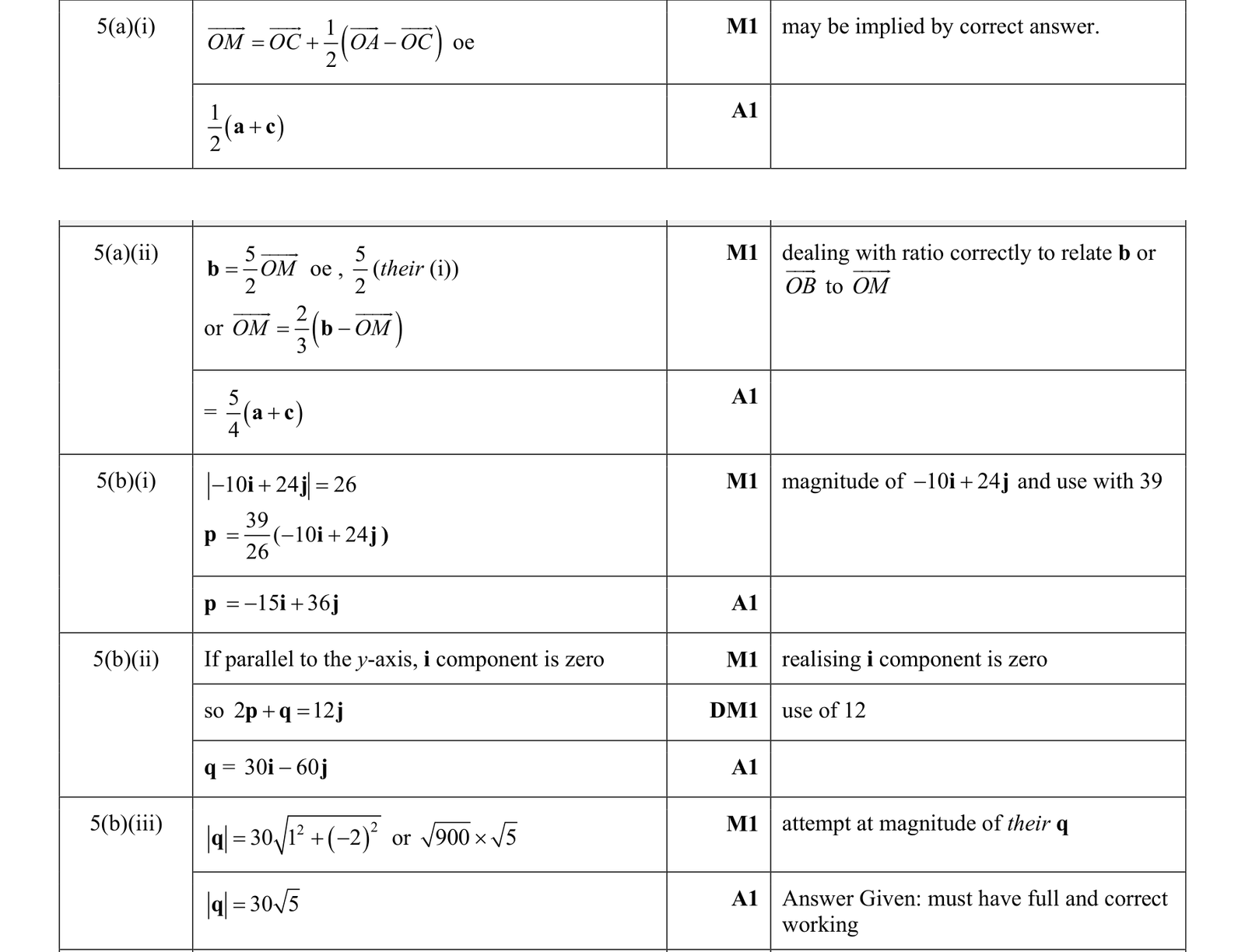
(i) Find \(\overrightarrow{OM}\) in terms of \(\mathbf a\) and \(\mathbf c\).
(ii) Given that \(OM:MB=2:3\), find \(\mathbf b\) in terms of \(\mathbf a\) and \(\mathbf c\).
(b) Vectors \(\mathbf i\) and \(\mathbf j\) are unit vectors parallel to the \(x\)-axis and \(y\)-axis respectively. The vector \(\mathbf p\) has magnitude \(39\) units and has the same direction as \(-10\mathbf i+24\mathbf j\).
(i) Find \(\mathbf p\) in terms of \(\mathbf i\) and \(\mathbf j\).
(ii) Find \(\mathbf q\) such that \(2\mathbf p+\mathbf q\) is parallel to the positive \(y\)-axis and has magnitude \(12\) units.
(iii) Hence show that \(|\mathbf q|=k\sqrt5\), where \(k\) is an integer to be found.
0606 P23 - Nov 2017 - Q5 - 8 marks
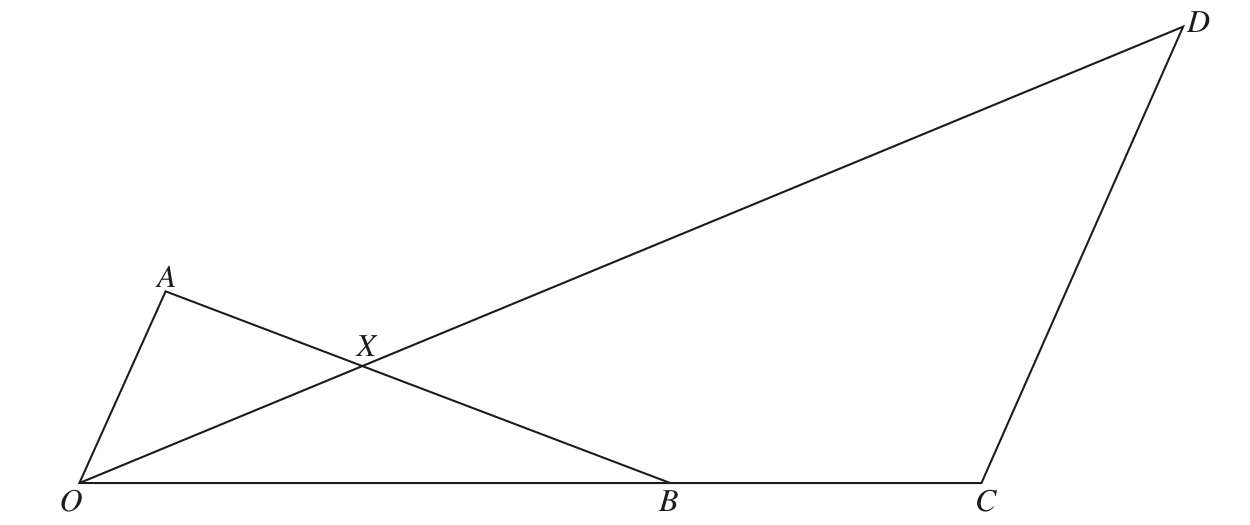
The diagram shows points \(O,A,B,C,D\) and \(X\). The position vectors of \(A\), \(B\), and \(C\) relative to \(O\) are
\(\overrightarrow{OA}=\mathbf a\), \(\overrightarrow{OB}=\mathbf b\), and \(\overrightarrow{OC}=\dfrac32\mathbf b\). The vector \(\overrightarrow{CD}=3\mathbf a\).
(i) If \(\overrightarrow{OX}=\lambda\overrightarrow{OD}\), express \(\overrightarrow{OX}\) in terms of \(\lambda\), \(\mathbf a\), and \(\mathbf b\).
(ii) If \(\overrightarrow{AX}=\mu\overrightarrow{AB}\), express \(\overrightarrow{OX}\) in terms of \(\mu\), \(\mathbf a\), and \(\mathbf b\).
(iii) Use your two expressions for \(\overrightarrow{OX}\) to find \(\lambda\) and \(\mu\).
(iv) Find \(\dfrac{AX}{XB}\).
(v) Find \(\dfrac{OX}{XD}\).

0606 P22 - Nov 2025 - Q6 - 8 marks
A particle \(P\) is moving in a straight line with speed \(26\) in the direction of the vector \(\begin{pmatrix}5\\-12\end{pmatrix}\).
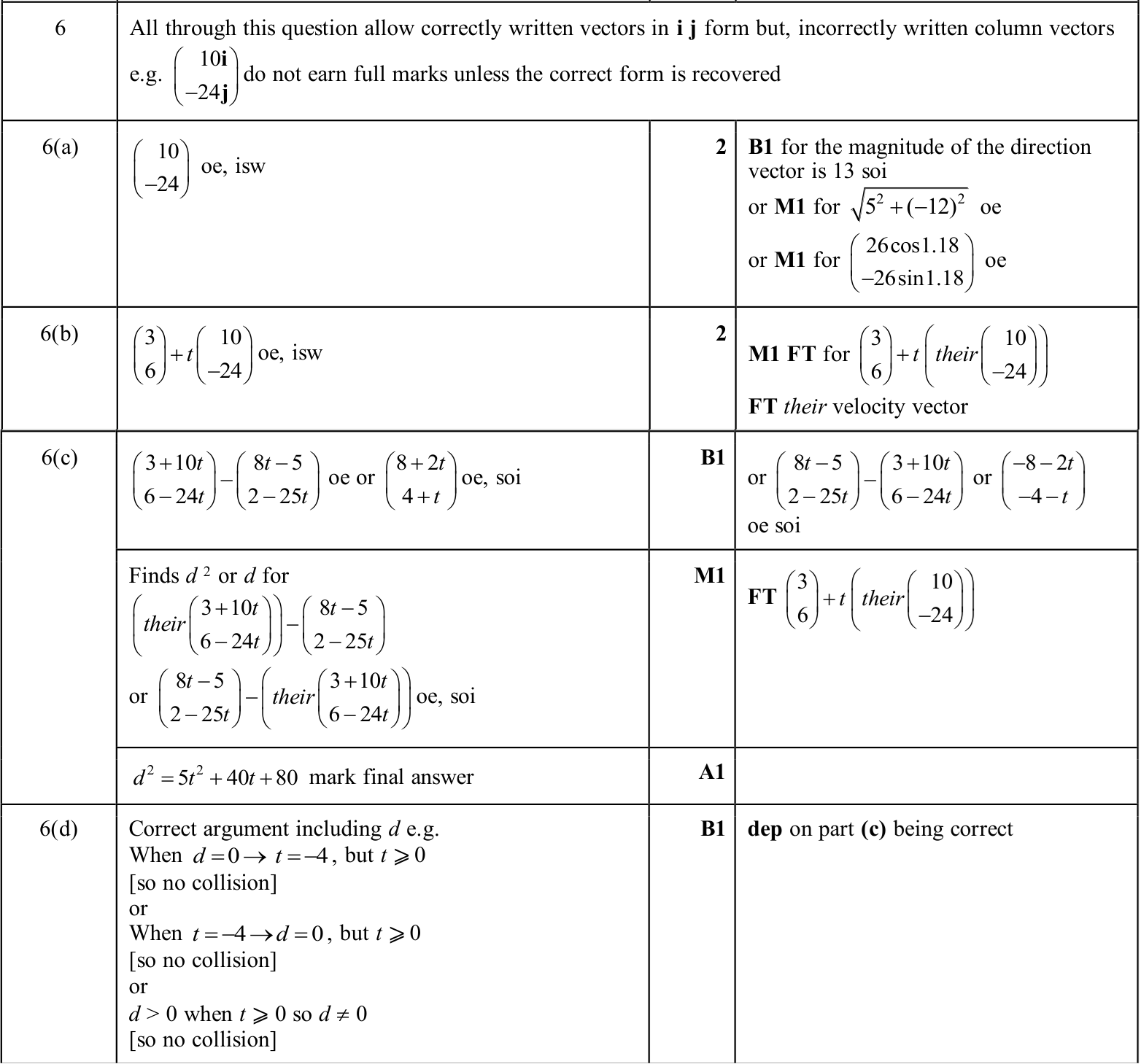
(a) Find the velocity vector of \(P\).
When \(t=0\), \(P\) passes through a point \(A\) with position vector \(\begin{pmatrix}3\\6\end{pmatrix}\).
(b) Write down the position vector of \(P\) at time \(t\).
At the same time, a particle \(Q\) passes through a point \(B\). The position vector of \(Q\) at time \(t\) is \(\begin{pmatrix}8t-5\\2-25t\end{pmatrix}\). The distance between \(P\) and \(Q\) at time \(t\) is \(d\).
(c) Show that \(d^2=mt^2+nt+r\), where \(m,n,r\) are integers to be found.
(d) Hence show that \(P\) and \(Q\) do not collide.
0606 P21 - Nov 2025 - Q12 - 7 marks
In this question, the \(x\)- and \(y\)-directions are east and north respectively. The units are metres and seconds.
Boat \(A\) starts from the origin \(O\) and moves with constant speed \(5\sqrt3\text{ m s}^{-1}\) on a bearing of \(030^\circ\).
After \(100\) seconds boat \(B\) starts from point \(P\), which has position vector \(\binom{0}{1000}\). Boat \(B\) moves with constant speed \(10\text{ m s}^{-1}\) on a bearing of \(060^\circ\).
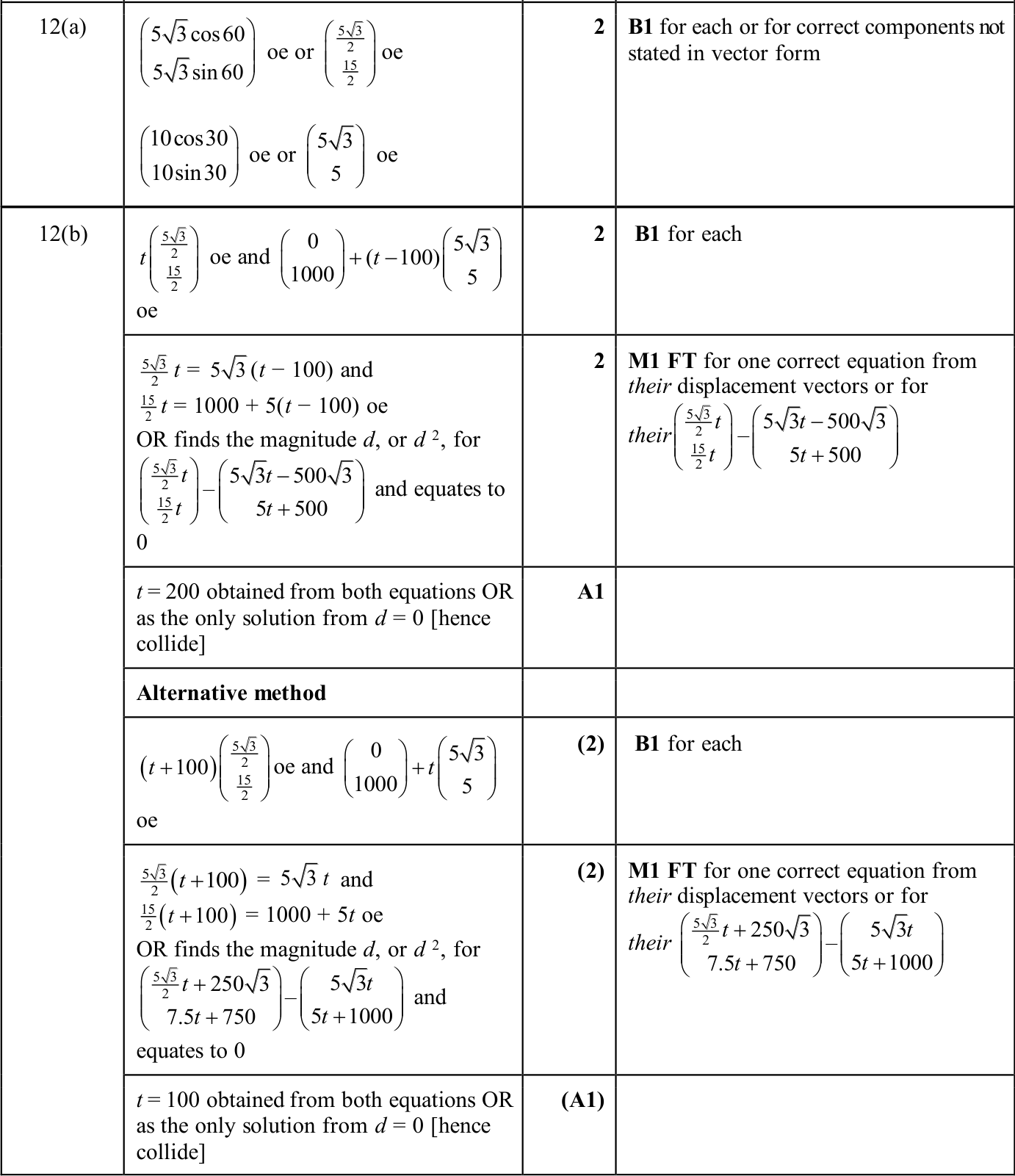
(a) Find the velocity of each boat in vector form.
(b) Show that the two boats will collide.
0606 P23 - Jun 2025 - Q10 - 9 marks
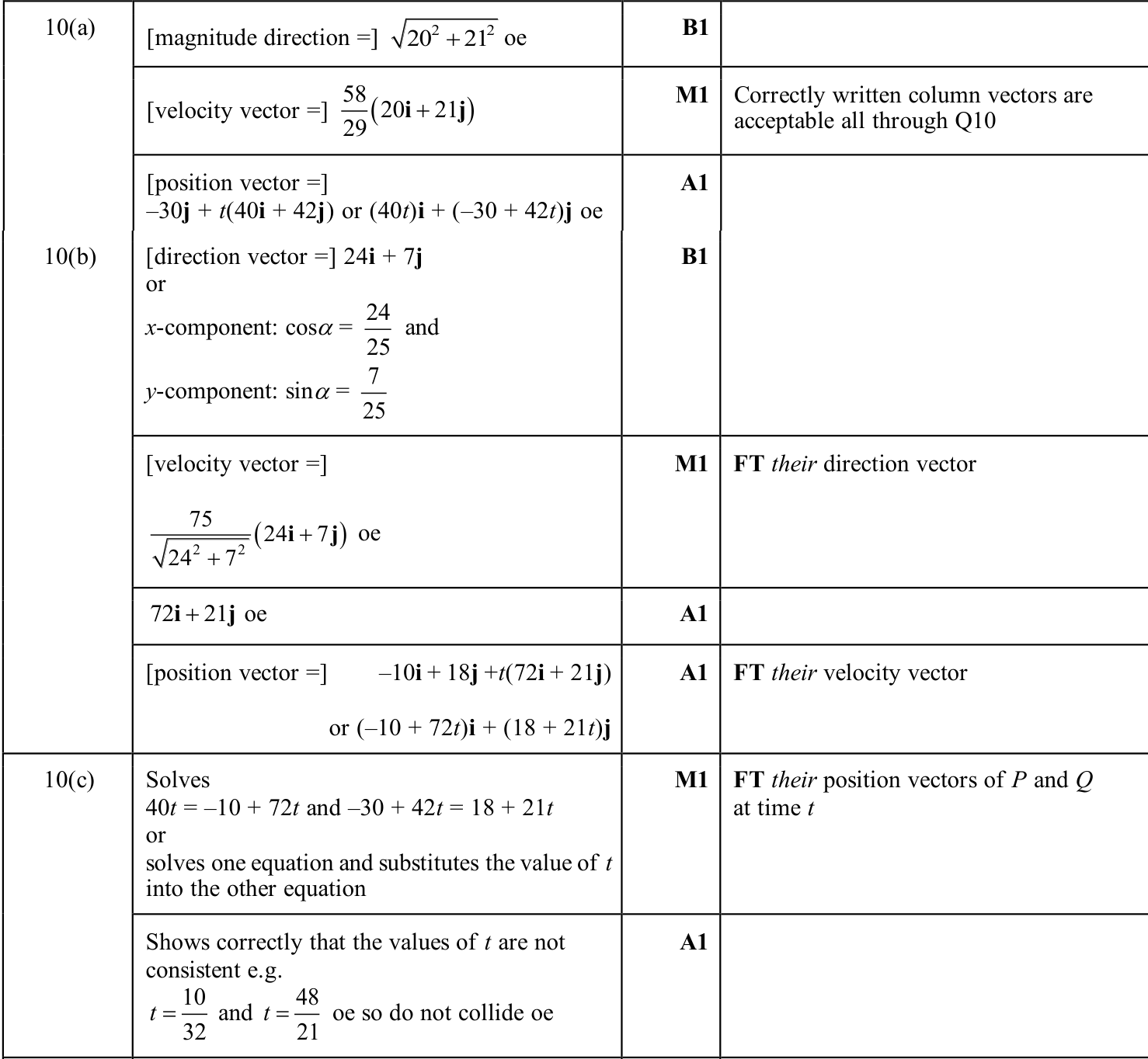
In this question, time is in seconds. (a) At time \(t=0\), particle \(P\) starts from the point with position vector \(-30 \mathbf{j}\). \(P\) travels with speed \(58 \mathrm{~ms}^{-1}\) in the direction \(20 \mathbf{i}+21 \mathbf{j}\). Find the position vector of \(P\) at time \(t\).
(b) Also at time \(t=0\), particle \(Q\) starts from the point with position vector \(-10 \mathbf{i}+18 \mathbf{j}\). \(Q\) travels with speed \(75 \mathrm{~ms}^{-1}\) at an angle \(\alpha\) above the positive \(x\)-axis, where \(\tan \alpha=\frac{7}{24}\). Find the position vector of \(Q\) at time \(t\).
(c) Determine whether \(P\) and \(Q\) collide.
0606 P22 - Nov 2024 - Q11 - 9 marks
In this question \(\mathbf{i}\) is a unit vector in the positive \(x\)-direction and \(\mathbf{j}\) is a unit vector in the positive \(y\)-direction. Time is in seconds and distances are in metres.
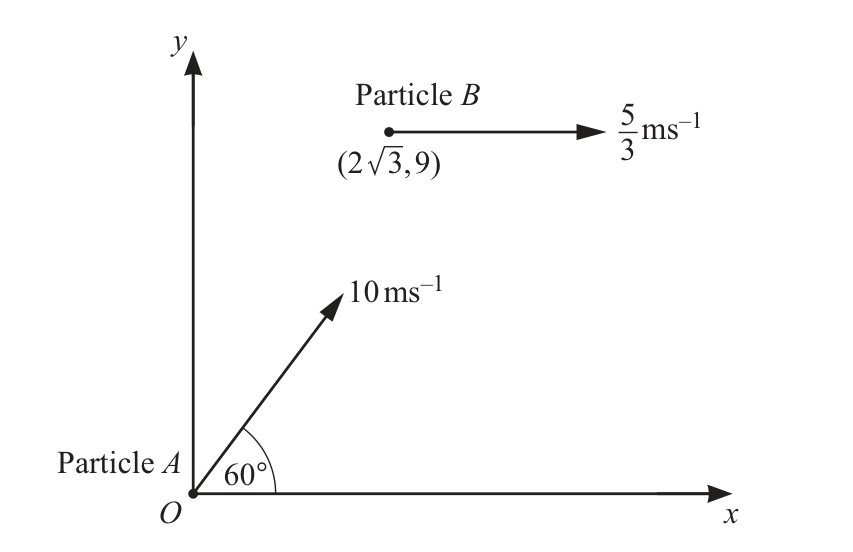
The diagram shows the initial positions and velocities of two particles, \(A\) and \(B\), that move in the \(x-y\) plane.
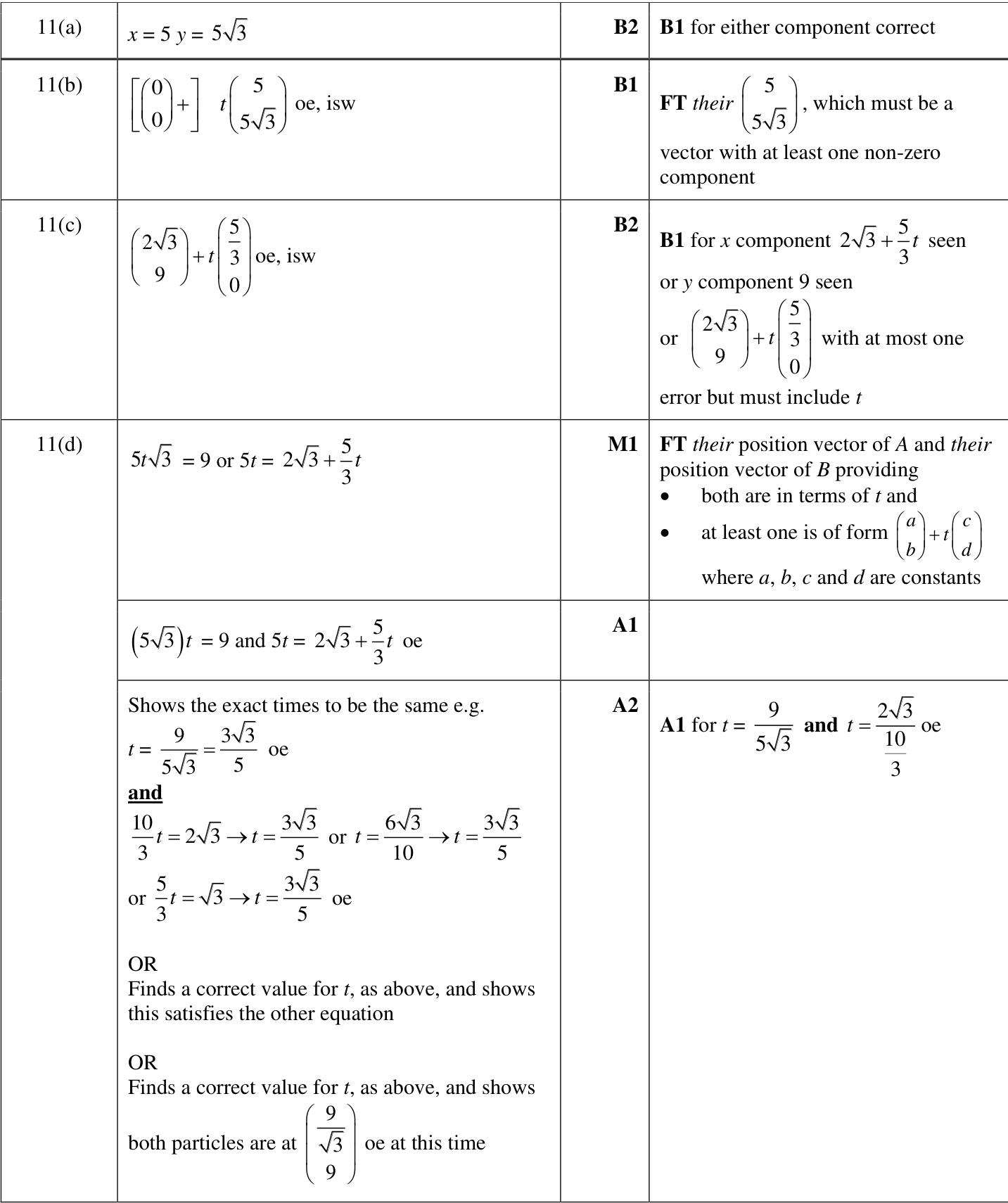
Particle \(A\) starts from the origin \(O\) at time \(t=0\). It moves with constant speed \(10 \mathrm{~ms}^{-1}\) in the direction \(60^{\circ}\) above the \(x\)-axis. (a) Find the exact values of the components of the velocity of particle \(A\) in the \(x\)-direction and the \(y\)-direction.
(b) Find, in terms of \(t\), the position vector of particle \(A\) at time \(t\).
Particle \(B\) starts from the point \((2 \sqrt{3}, 9)\) at time \(t=0\). It moves with constant speed \(\frac{5}{3} \mathrm{~ms}^{-1}\) parallel to the positive \(x\)-axis. (c) Find, in terms of \(t\), the position vector of particle \(B\) at time \(t\).
(d) Hence show that the particles collide.
0606 P12 - Jun 2024 - Q9 - 10 marks
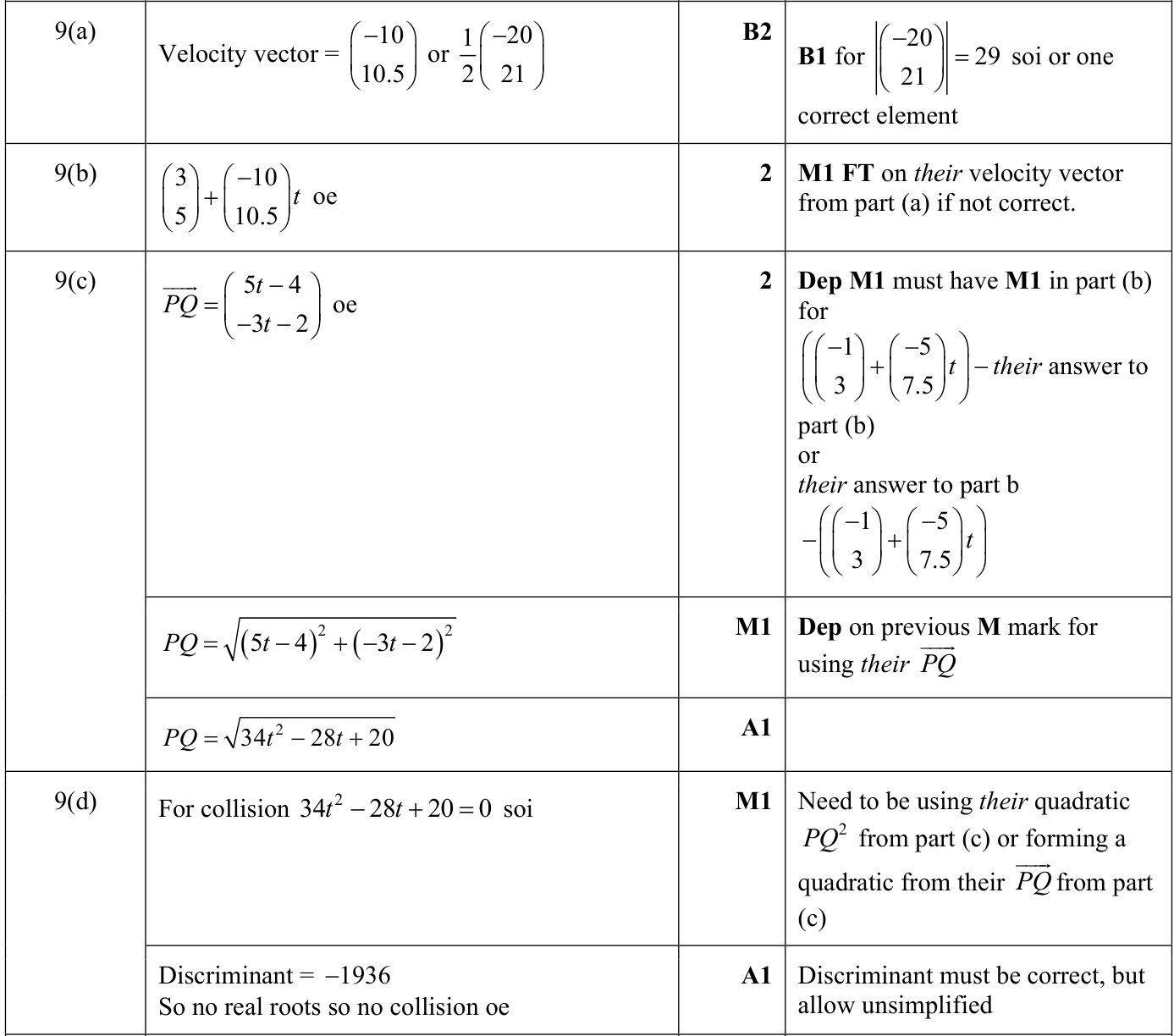
In this question, all distances are in metres and time, \(t\), is in seconds. A particle \(P\) moves with a speed of 14.5 parallel to the vector \(\binom{-20}{21}\). (a) Find the velocity vector of \(P\).
Initially, \(P\) has position vector \(\binom{3}{5}\). (b) Write down the position vector of \(P\) at time \(t\).
A second particle \(Q\) has position vector \(\binom{-1}{3}+\binom{-5}{7.5} t\) at time \(t\). (c) Find, in terms of \(t\), the distance between \(P\) and \(Q\) at time \(t\). Simplify your answer.
(d) Hence show that \(P\) and \(Q\) never collide.
0606 P12 - Mar 2023 - Q9 - 8 marks
In this question, all lengths are in metres.
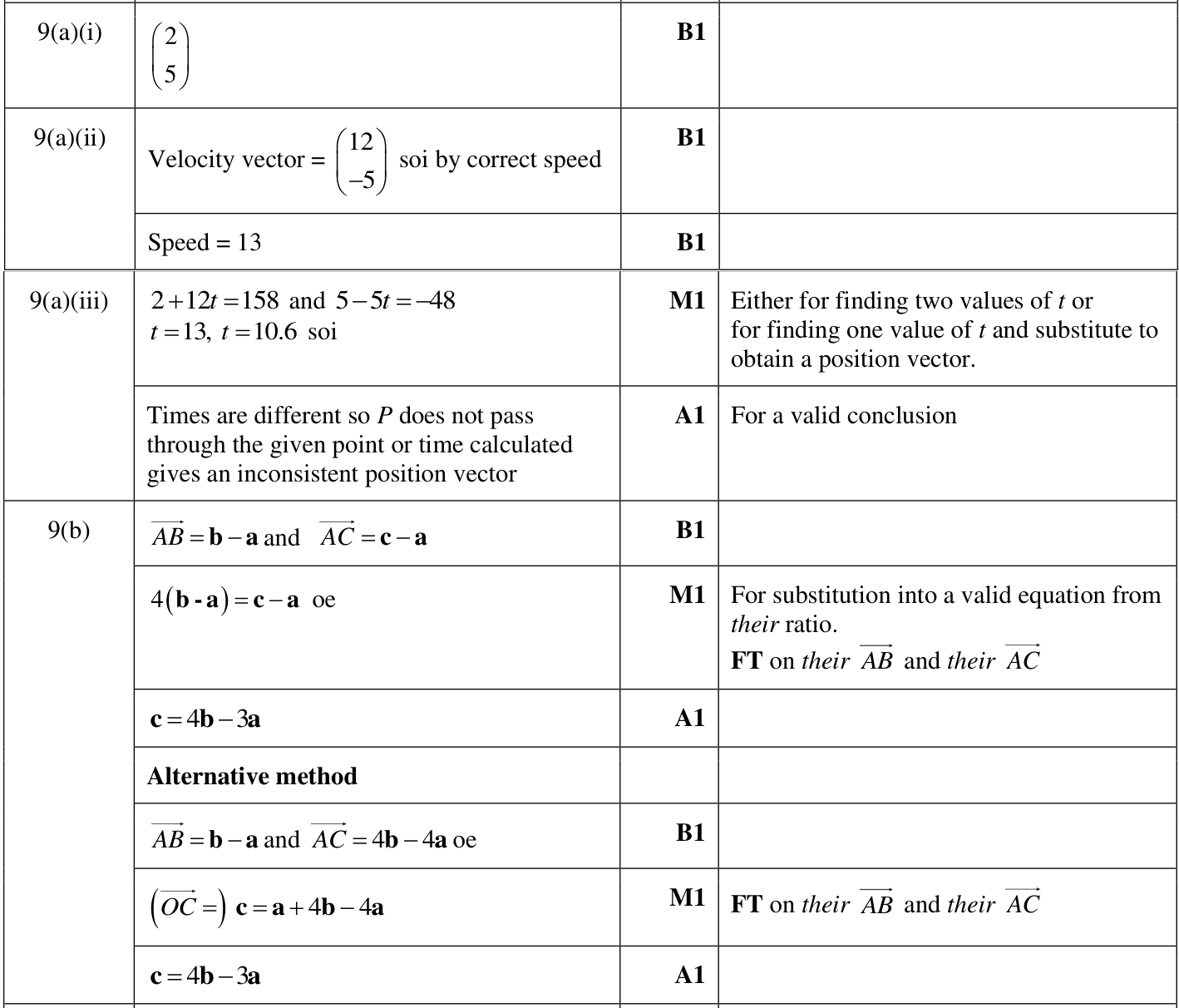
(a) A particle \(P\) has position vector
\(\begin{pmatrix}2+12t\\5-5t\end{pmatrix}\)
at a time \(t\) seconds, \(t\geq0\).
(i) Write down the initial position vector of \(P\).
(ii) Find the speed of \(P\).
(iii) Determine whether \(P\) passes through the point with position vector
\(\begin{pmatrix}158\\-48\end{pmatrix}.\)
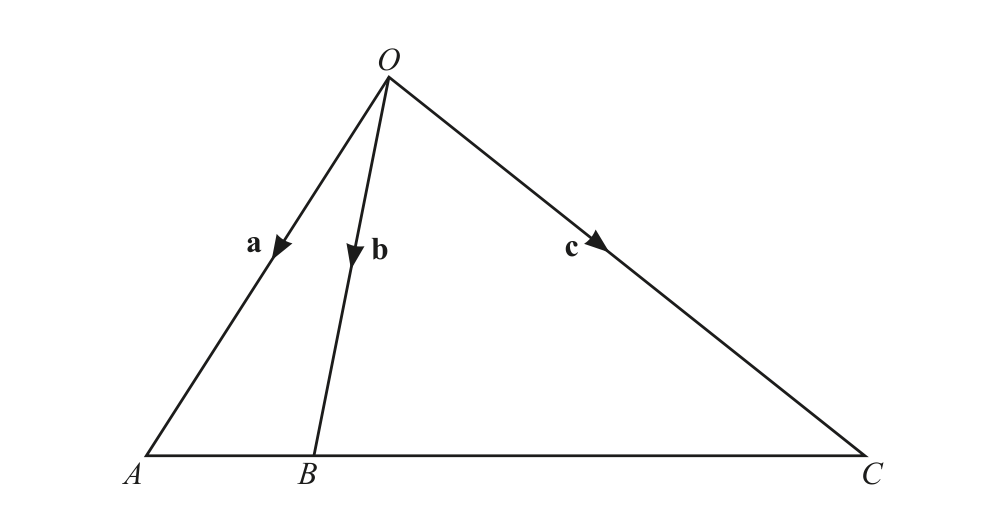
(b) The diagram shows the triangle \(OAC\). The point \(B\) lies on \(AC\) such that \(AB:AC=1:4\). Given that
\(\overrightarrow{OA}=\mathbf a,\qquad \overrightarrow{OB}=\mathbf b,\qquad \overrightarrow{OC}=\mathbf c,\)
find \(\mathbf c\) in terms of \(\mathbf a\) and \(\mathbf b\).
0606 P12 - Mar 2022 - Q8 - 8 marks
In this question, all lengths are in metres and all times are in seconds.
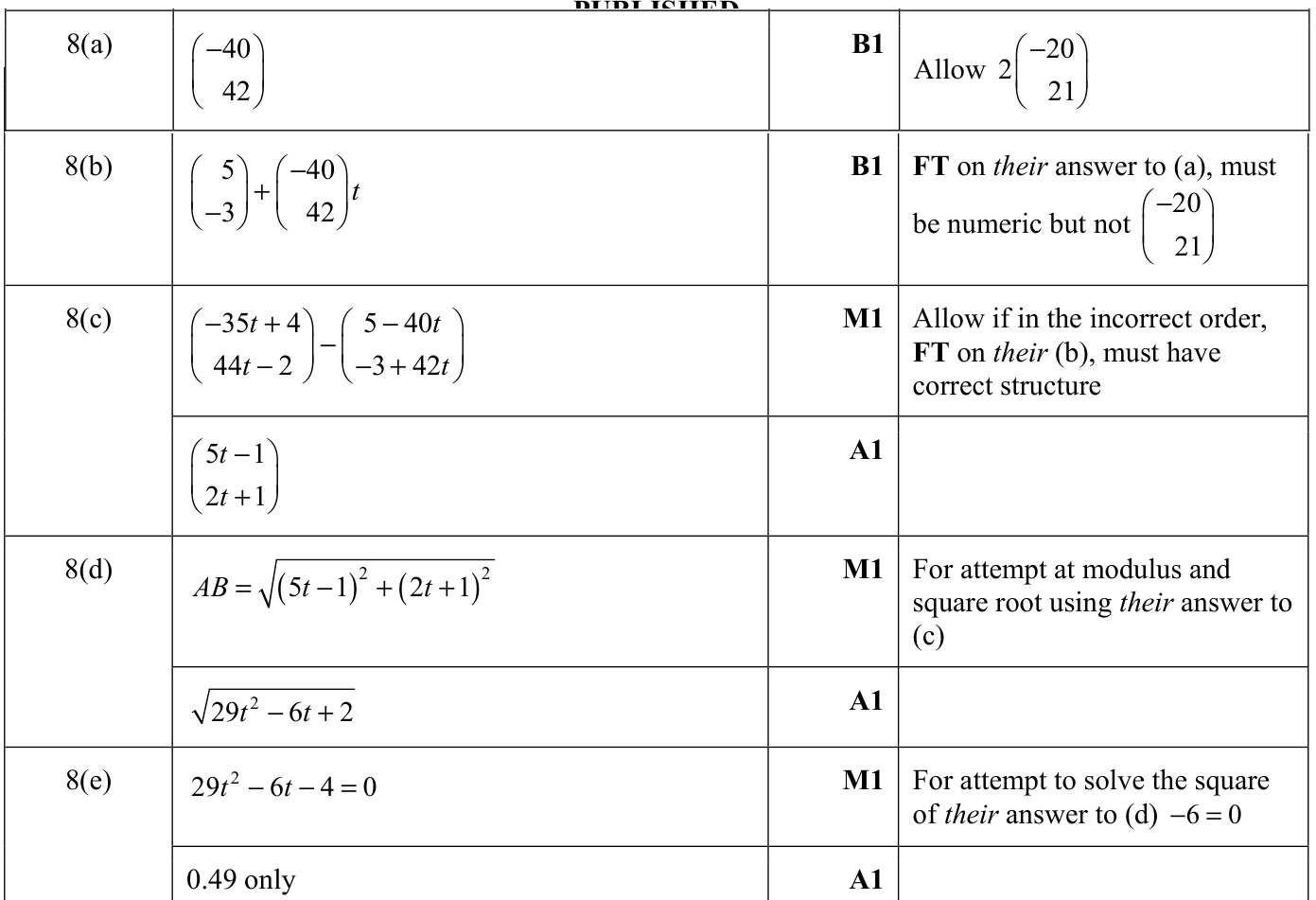
A particle \(A\) is moving in the direction \(\begin{pmatrix}-20\\21\end{pmatrix}\) with a speed of 58.
(a) Find the velocity vector of \(A\).
(b) Given that \(A\) is initially at the point with position vector \(\begin{pmatrix}5\\-3\end{pmatrix}\), write down the position vector of \(A\) at time \(t\).
A particle \(B\) starts to move such that its position vector at time \(t\) is \(\begin{pmatrix}-35t+4\\44t-2\end{pmatrix}\).
(c) Find the displacement vector \(\overrightarrow{AB}\) at time \(t\).
(d) Hence find the distance \(AB\), at time \(t\), in the form \(\sqrt{pt^2+qt+r}\), where \(p\), \(q\) and \(r\) are constants.
(e) Find the value of \(t\) when the distance \(AB\) is \(\sqrt6\), giving your answer correct to 2 decimal places.
0606 P21 - Jun 2022 - Q8 - 7 marks
Unit vectors \(\mathbf{i}\) and \(\mathbf{j}\) point east and north respectively.
At 09:00, ship A leaves the point \(P\), whose position vector is \(5\mathbf{i}+16\mathbf{j}\). Ship A travels with speed \(6\sqrt3\) km h\(^{-1}\) on a bearing of \(120^{\circ}\).
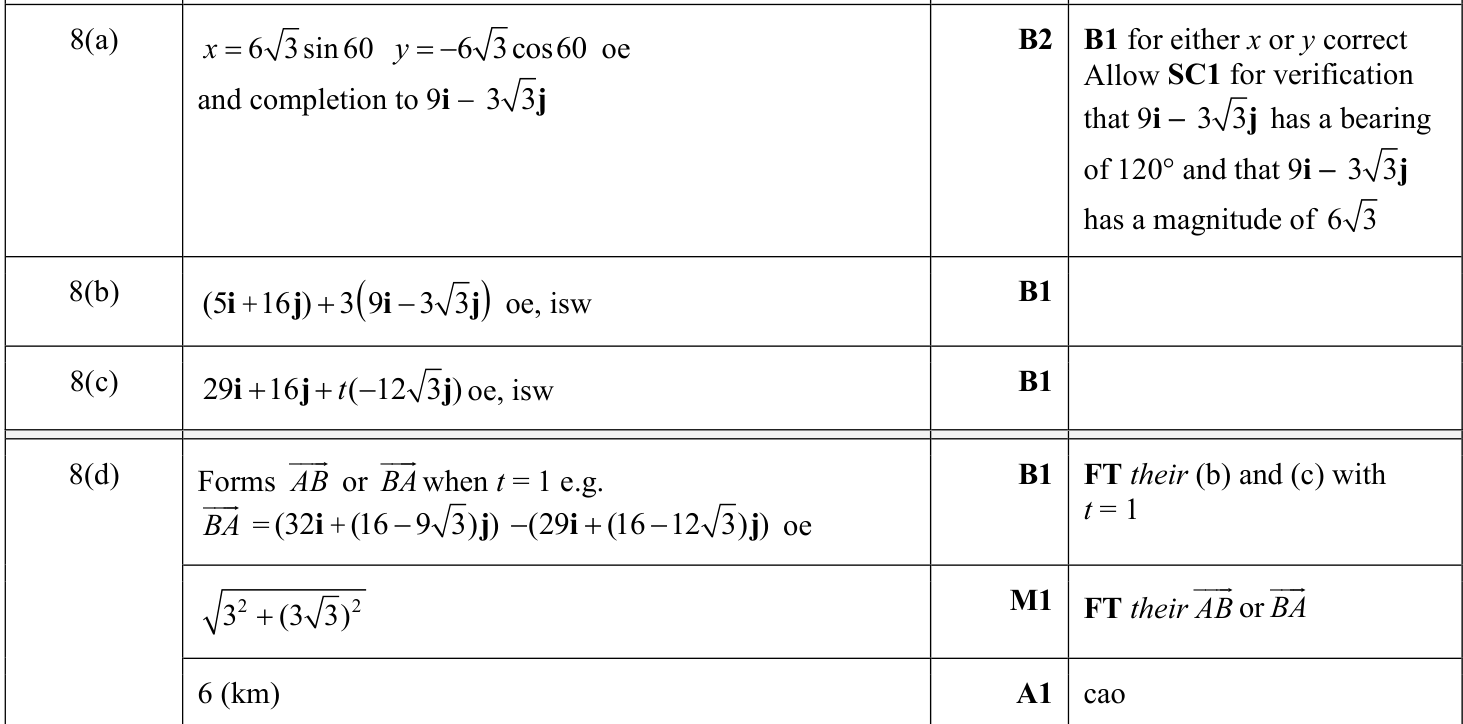
(a) Show that the velocity vector of ship A is \(9\mathbf{i}-3\sqrt3\mathbf{j}\).
(b) Find the position vector of ship A at 12:00.
At 11:00, ship B leaves the point \(Q\), whose position vector is \(29\mathbf{i}+16\mathbf{j}\). Ship B travels with velocity vector \(-12\sqrt3\mathbf{j}\) km h\(^{-1}\).
(c) Write down the position vector of ship B at time \(t\) hours after 11:00.
(d) Find the distance between ships A and B at 12:00.
0606 P23 - Nov 2022 - Q8 - 10 marks
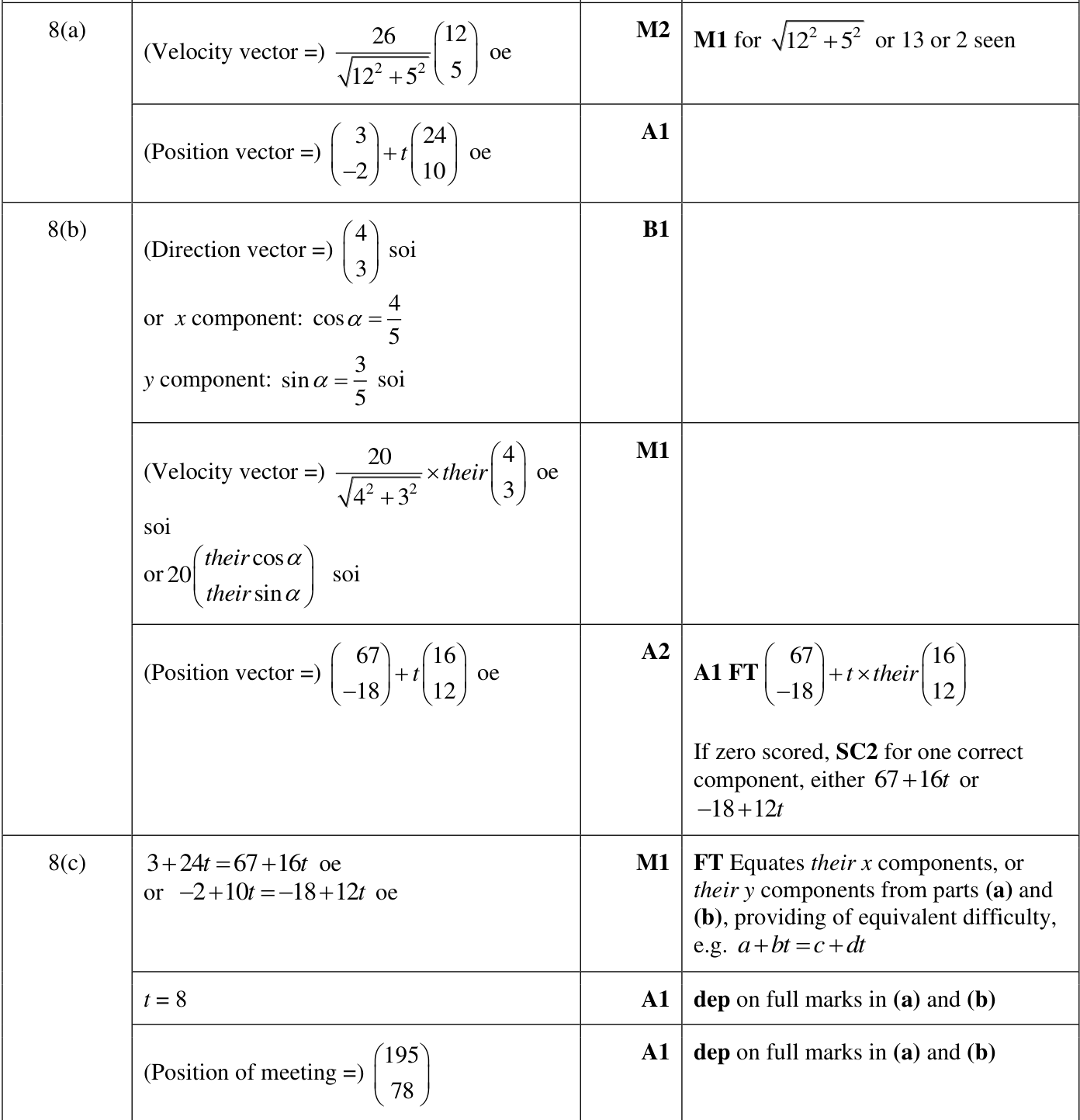
Particle \(A\) starts from the point with position vector \(3\mathbf{i}-2\mathbf{j}\). It moves with speed \(26\,\text{m s}^{-1}\) in the direction of the vector \(12\mathbf{i}+5\mathbf{j}\).
Particle \(B\) starts from the point with position vector \(67\mathbf{i}-18\mathbf{j}\). It moves with speed \(20\,\text{m s}^{-1}\) at an angle \(\alpha\) above the positive \(x\)-axis, where \(\tan\alpha=\frac34\).
The particles meet after \(t\) seconds. Find the value of \(t\) and the position vector of the point where they meet.
0606 P12 - Mar 2021 - Q5 - 7 marks
In this question all lengths are in kilometres and time is in hours.
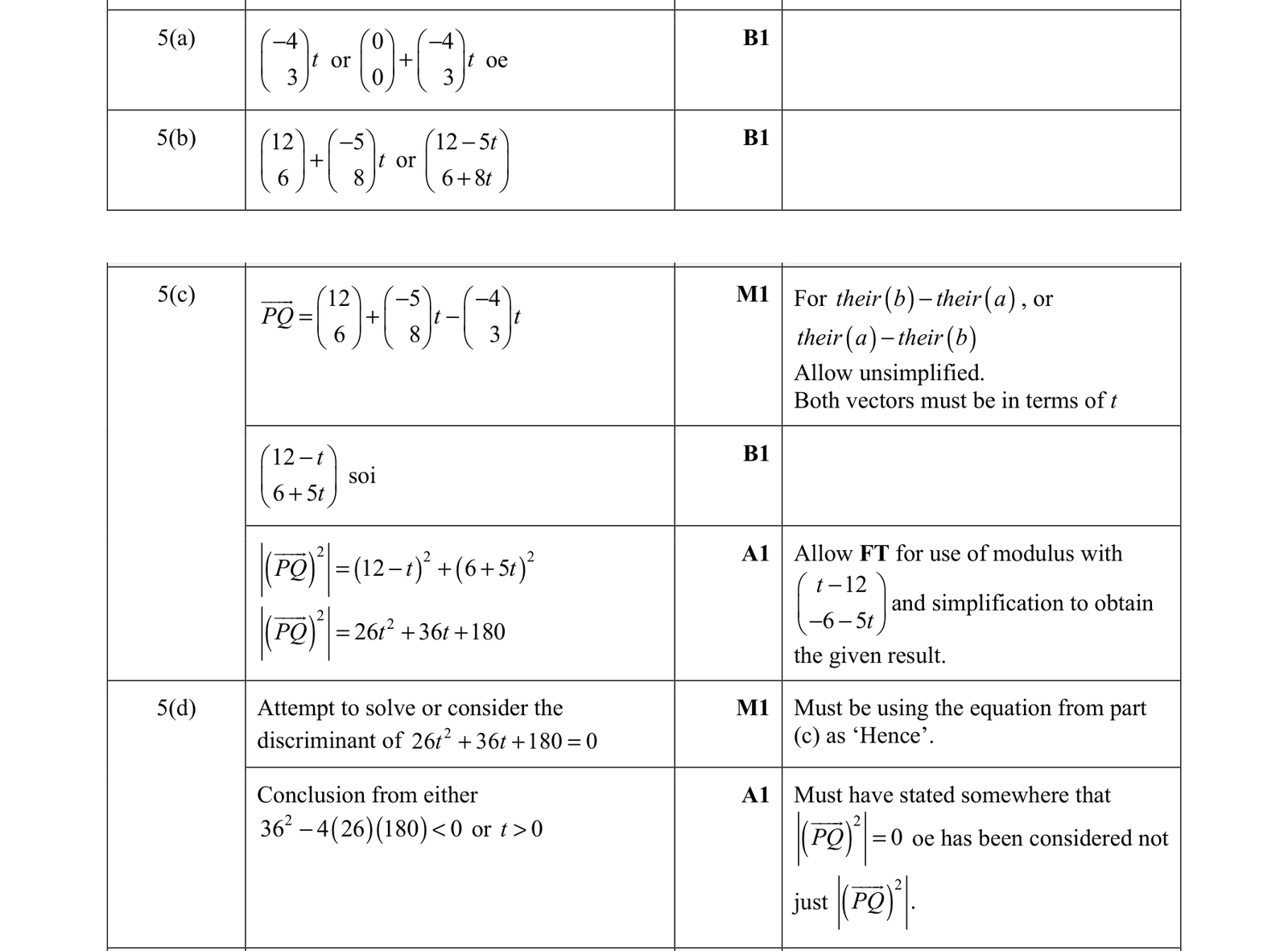
Boat \(A\) sails, with constant velocity, from a point \(O\) with position vector \(\begin{pmatrix}0\\0\end{pmatrix}\). After 3 hours \(A\) is at the point with position vector \(\begin{pmatrix}-12\\9\end{pmatrix}\).
(a) Find the position vector, \(\overrightarrow{OP}\), of \(A\) at time \(t\).
At the same time as \(A\) sails from \(O\), boat \(B\) sails from a point with position vector \(\begin{pmatrix}12\\6\end{pmatrix}\), with constant velocity \(\begin{pmatrix}-5\\8\end{pmatrix}\).
(b) Find the position vector, \(\overrightarrow{OQ}\), of \(B\) at time \(t\).
(c) Show that at time \(t\), \(|\overrightarrow{PQ}|^2=26t^2+36t+180\).
(d) Hence show that \(A\) and \(B\) do not collide.
0606 P12 - Mar 2020 - Q8 - 8 marks
In this question all distances are in km.
A ship \(P\) sails from a point \(A\), which has position vector
\(\begin{pmatrix}0\\0\end{pmatrix},\)
with a speed of \(52\text{ km h}^{-1}\) in the direction of
\(\begin{pmatrix}-5\\12\end{pmatrix}.\)
(a) Find the velocity vector of the ship.
(b) Write down the position vector of \(P\) at a time \(t\) hours after leaving \(A\).
At the same time that ship \(P\) sails from \(A\), a ship \(Q\) sails from a point \(B\), which has position vector
\(\begin{pmatrix}12\\8\end{pmatrix},\)
with velocity vector
\(\begin{pmatrix}-25\\45\end{pmatrix}\text{ km h}^{-1}.\)
(c) Write down the position vector of \(Q\) at a time \(t\) hours after leaving \(B\).
(d) Using your answers to parts (b) and (c), find the displacement vector \(\overrightarrow{PQ}\) at time \(t\) hours.
(e) Hence show that
\(PQ=\sqrt{34t^2-168t+208}.\)
(f) Find the value of \(t\) when \(P\) and \(Q\) are first \(2\) km apart.

0606 P11 - Nov 2020 - Q6 - 7 marks
A particle \(P\) is initially at the point with position vector \(\begin{pmatrix}30\\10\end{pmatrix}\) and moves with a constant speed of \(10\text{ m s}^{-1}\) in the same direction as \(\begin{pmatrix}-4\\3\end{pmatrix}\).
(a) Find the position vector of \(P\) after \(t\) s.
As \(P\) starts moving, a particle \(Q\) starts to move such that its position vector after \(t\) s is given by
\(\begin{pmatrix}-80\\90\end{pmatrix} +t\begin{pmatrix}5\\12\end{pmatrix}.\)
(b) Write down the speed of \(Q\).
(c) Find the exact distance between \(P\) and \(Q\) when \(t=10\), giving your answer in its simplest surd form.

0606 P11 - Jun 2019 - Q5 - 7 marks
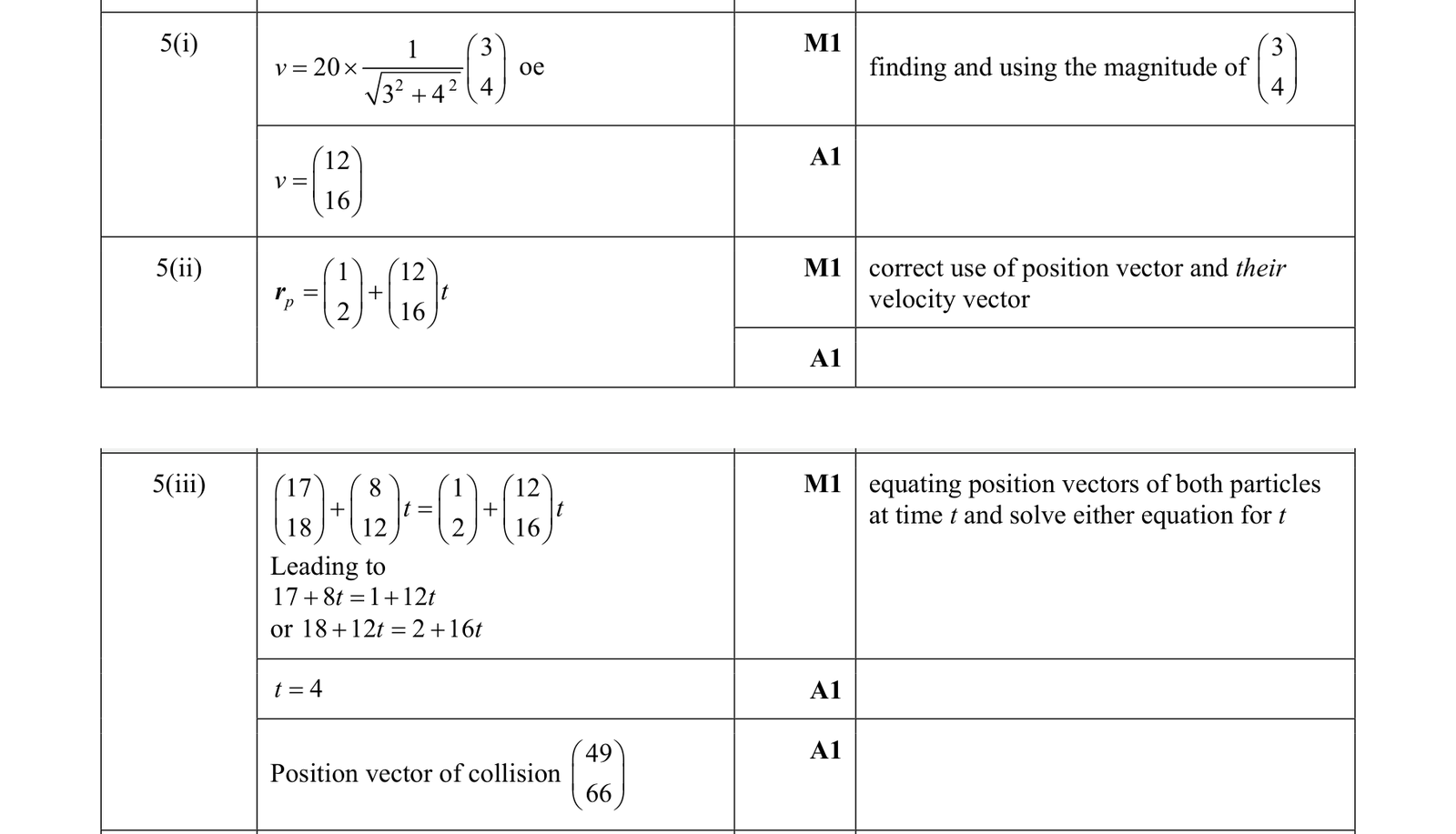
A particle \(P\) is moving with a velocity of \(20\text{ m s}^{-1}\) in the same direction as \(\binom34\).
(i) Find the velocity vector of \(P\).
At time \(t=0\), \(P\) has position vector \(\binom12\) relative to a fixed point \(O\).
(ii) Write down the position vector of \(P\) after \(t\) seconds.
A particle \(Q\) has position vector \(\binom{17}{18}\) relative to \(O\) at time \(t=0\), and has velocity vector \(\binom8{12}\text{ m s}^{-1}\).
(iii) Given that \(P\) and \(Q\) collide, find the value of \(t\) and the position vector of the point of collision.