Past Exam Questions
← Back0606 P11 - Jun 2022 - Q5 - 5 marks
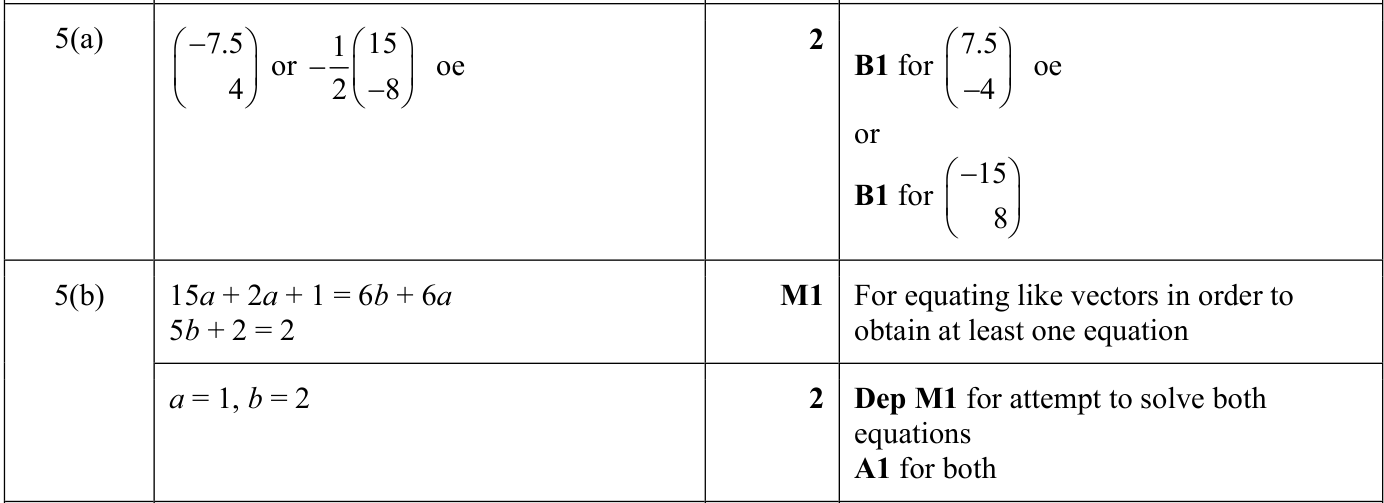
(a) Find the vector which is in the opposite direction to \(\begin{pmatrix}15\\-8\end{pmatrix}\) and has magnitude \(8.5\).
(b) Find \(a\) and \(b\) such that
\(5\begin{pmatrix}3a\\b\end{pmatrix}+\begin{pmatrix}2a+1\\2\end{pmatrix}=6\begin{pmatrix}b+a\\2\end{pmatrix}.\)
0606 P12 - Jun 2022 - Q4 - 5 marks
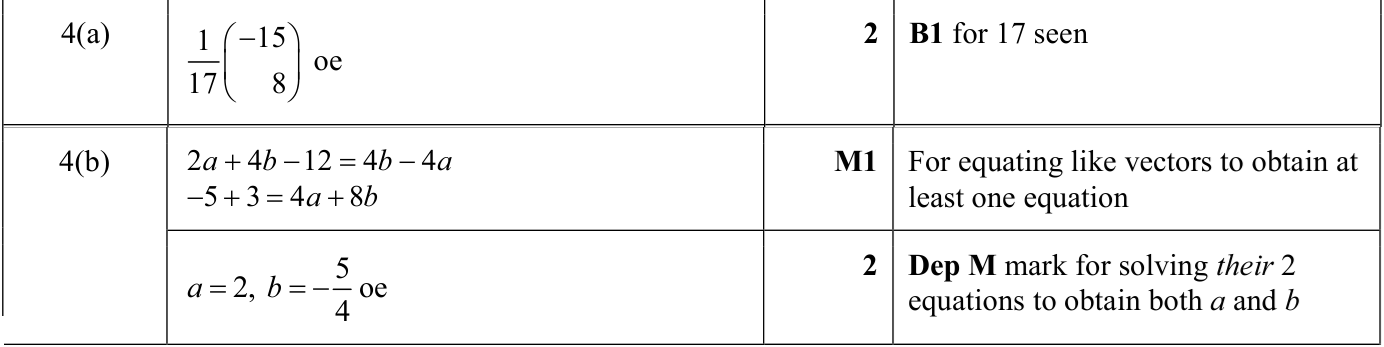
(a) Find the unit vector in the same direction as \(\begin{pmatrix}-15\\8\end{pmatrix}\).
(b) Given that
\(\begin{pmatrix}2a\\-5\end{pmatrix}+\begin{pmatrix}4b-12\\3\end{pmatrix}=4\begin{pmatrix}b-a\\a+2b\end{pmatrix},\)
find the values of \(a\) and \(b\).
0606 P22 - Jun 2022 - Q6 - 7 marks
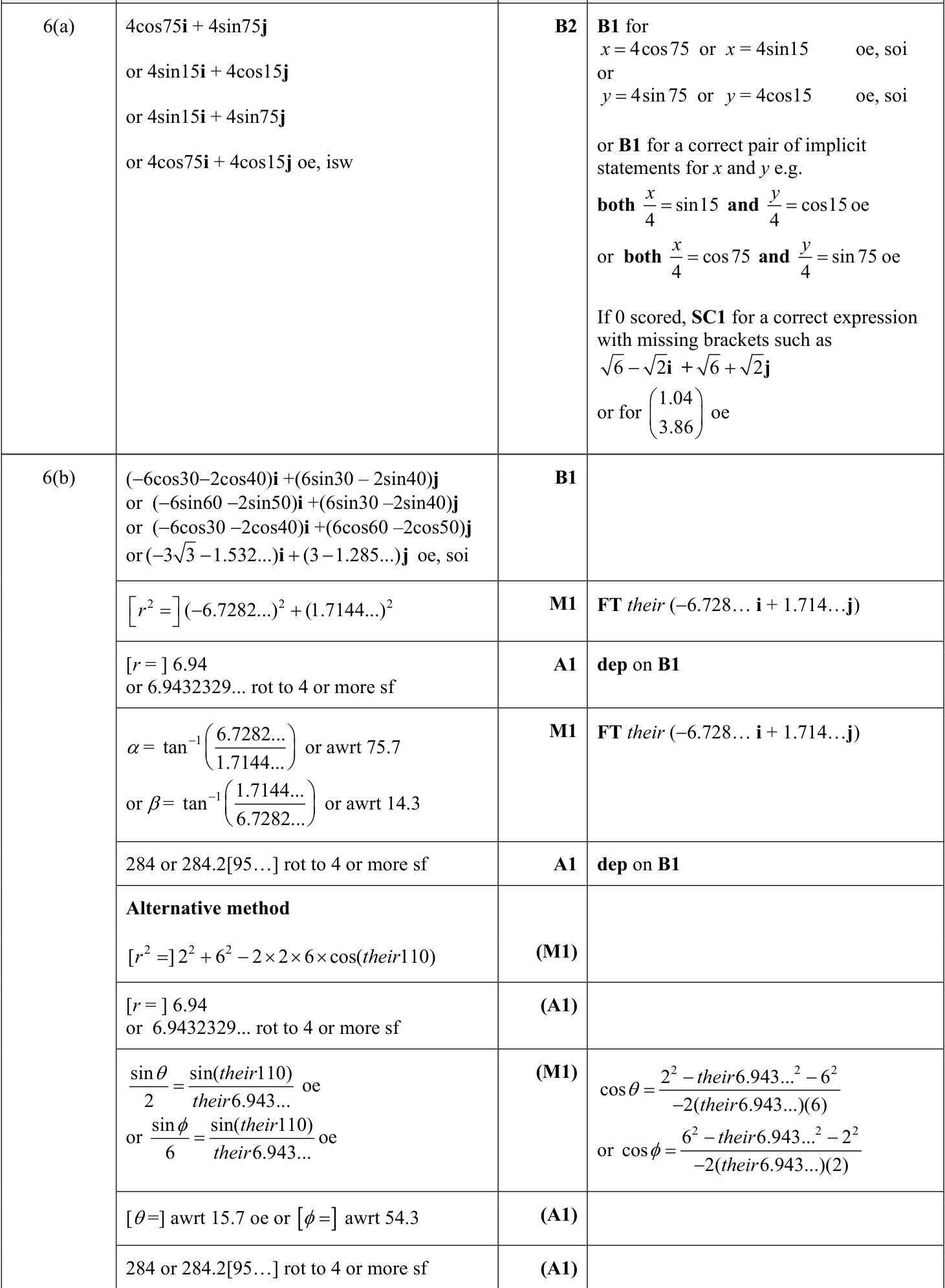
(a) In this question, \(\mathbf{i}\) is a unit vector due east and \(\mathbf{j}\) is a unit vector due north. A cyclist rides at a speed of 4 m s\(^{-1}\) on a bearing of \(015^{\circ}\). Write the velocity vector of the cyclist in the form \(x\mathbf{i}+y\mathbf{j}\), where \(x\) and \(y\) are constants.
(b) A vector of magnitude 6 on a bearing of \(300^{\circ}\) is added to a vector of magnitude 2 on a bearing of \(230^{\circ}\) to give a vector \(\mathbf{v}\). Find the magnitude and bearing of \(\mathbf{v}\).
0606 P21 - Jun 2021 - Q10 - 8 marks
Relative to an origin \(O\), the position vectors of the points \(A\), \(B\), \(C\) and \(D\) are
\(\overrightarrow{OA}=\binom{6}{-5},\quad \overrightarrow{OB}=\binom{10}{3},\quad \overrightarrow{OC}=\binom{x}{y},\quad \overrightarrow{OD}=\binom{12}{7}.\)
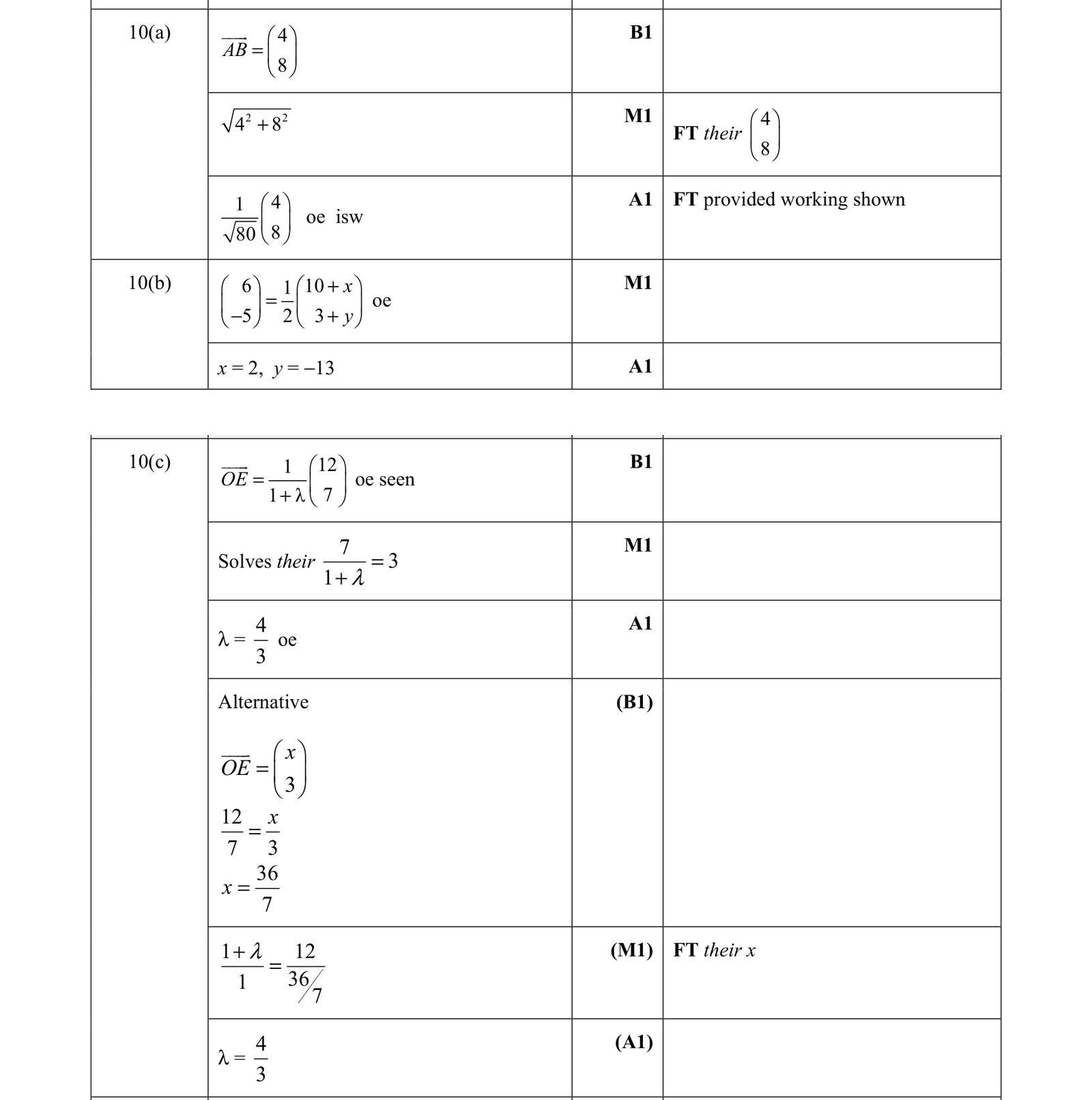
(a) Find the unit vector in the direction of \(\overrightarrow{AB}\).
(b) The point \(A\) is the mid-point of \(BC\). Find the value of \(x\) and of \(y\).
(c) The point \(E\) lies on \(OD\) such that \(OE:OD=1:1+\lambda\). Find the value of \(\lambda\) such that \(\overrightarrow{BE}\) is parallel to the \(x\)-axis.
0606 P11 - Nov 2021 - Q3 - 6 marks
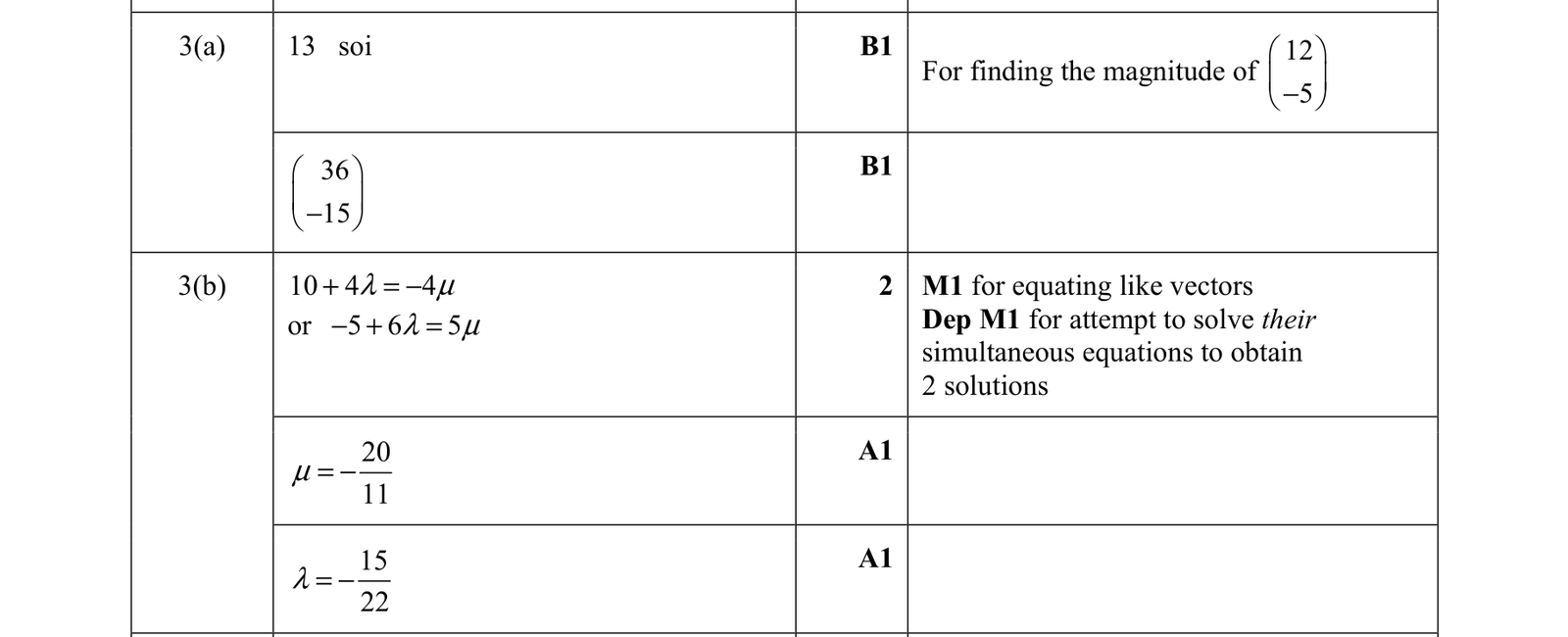
(a) Find the vector which has magnitude \(39\) and is in the same direction as \(\begin{pmatrix}12\\-5\end{pmatrix}\).
(b) Given that \(\mathbf a=\begin{pmatrix}2\\-1\end{pmatrix}\) and \(\mathbf b=\begin{pmatrix}-4\\5\end{pmatrix}\), find the constants \(\lambda\) and \(\mu\) such that \(5\mathbf a+\lambda\begin{pmatrix}4\\6\end{pmatrix}=\mu\mathbf b\).
0606 P23 - Nov 2021 - Q7 - 8 marks
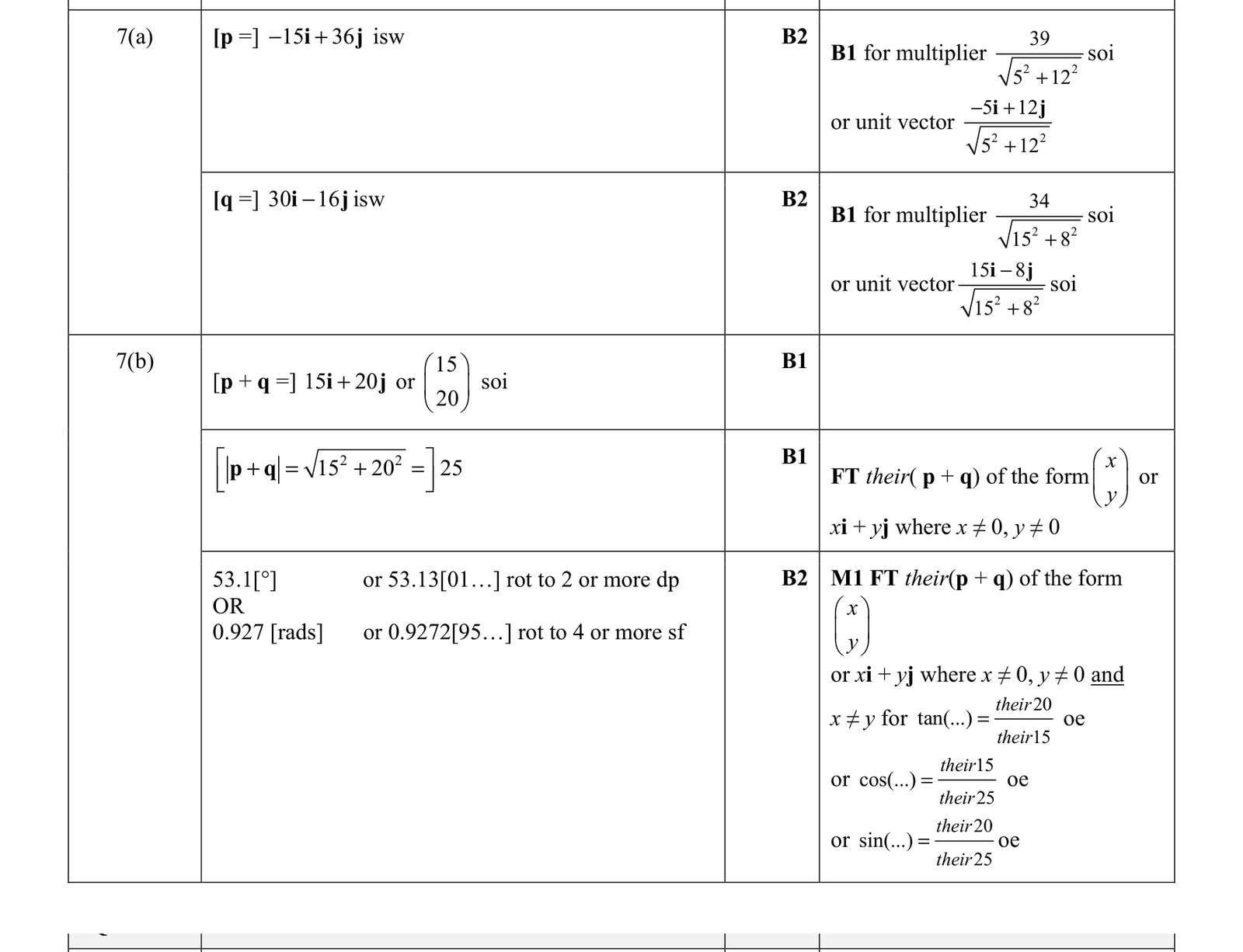
The vector \(\mathbf p\) has magnitude \(39\) and is in the direction \(-5\mathbf i+12\mathbf j\). The vector \(\mathbf q\) has magnitude \(34\) and is in the direction \(15\mathbf i-8\mathbf j\).
(a) Write both \(\mathbf p\) and \(\mathbf q\) in terms of \(\mathbf i\) and \(\mathbf j\).
(b) Find the magnitude of \(\mathbf p+\mathbf q\) and the angle this vector makes with the positive \(x\)-axis.
0606 P21 - Jun 2020 - Q5 - 5 marks
The vectors \(\mathbf a\) and \(\mathbf b\) are such that
\(\mathbf a=\alpha\mathbf i+\mathbf j \qquad\text{and}\qquad \mathbf b=12\mathbf i+\beta\mathbf j.\)
(a) Find the value of each of the constants \(\alpha\) and \(\beta\) such that
\(4\mathbf a-\mathbf b=(\alpha+3)\mathbf i-2\mathbf j.\)
(b) Hence find the unit vector in the direction of \(\mathbf b-4\mathbf a\).

0606 P22 - Jun 2018 - Q7 - 6 marks
Vectors \(\mathbf{i}\) and \(\mathbf{j}\) are vectors parallel to the \(x\)-axis and \(y\)-axis respectively.
Given that
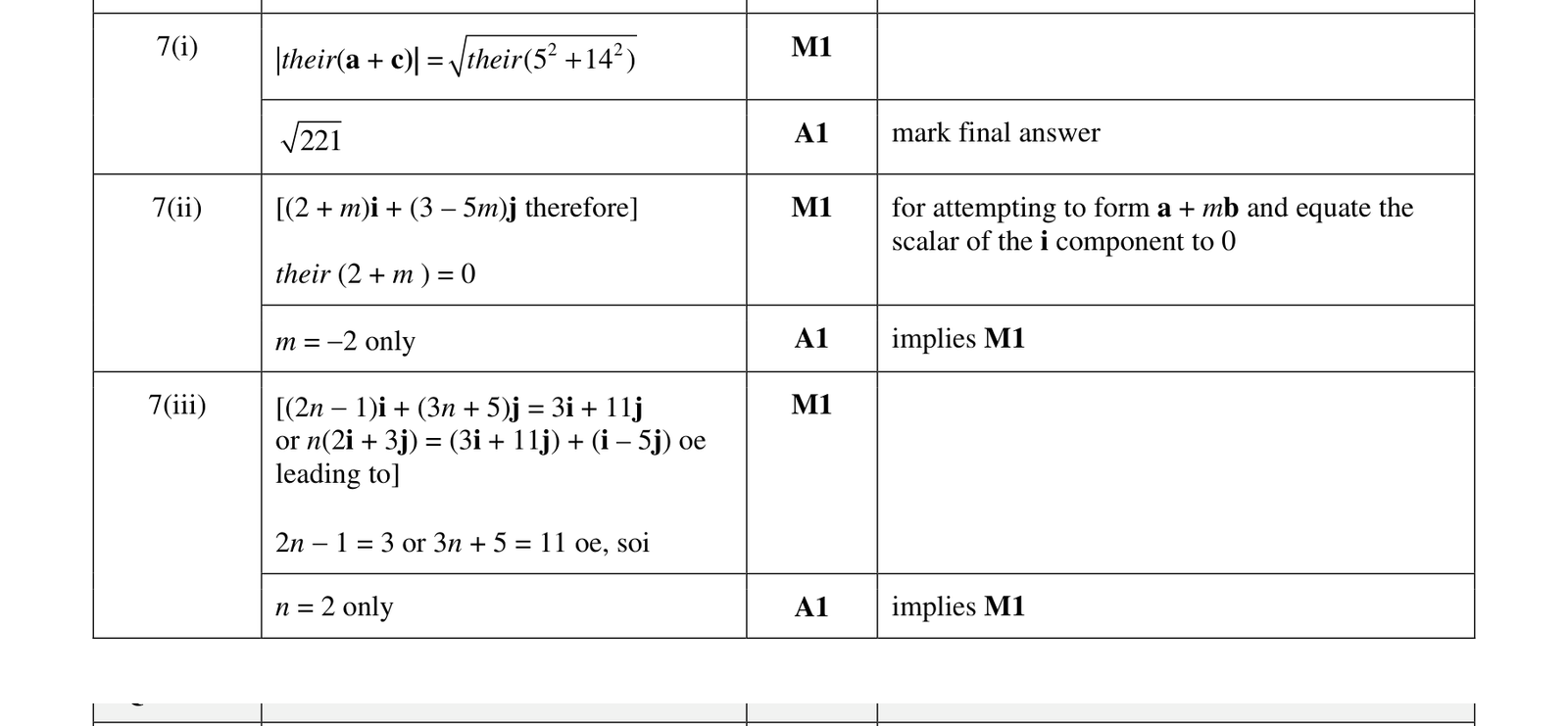
\(\mathbf{a}=2\mathbf{i}+3\mathbf{j},\qquad \mathbf{b}=\mathbf{i}-5\mathbf{j},\qquad \mathbf{c}=3\mathbf{i}+11\mathbf{j},\)
find
(i) the exact value of \(|\mathbf{a}+\mathbf{c}|\),
(ii) the value of \(m\) such that \(\mathbf{a}+m\mathbf{b}\) is parallel to \(\mathbf{j}\),
(iii) the value of \(n\) such that \(n\mathbf{a}-\mathbf{b}=\mathbf{c}\).
0606 P12 - Nov 2018 - Q7 - 6 marks
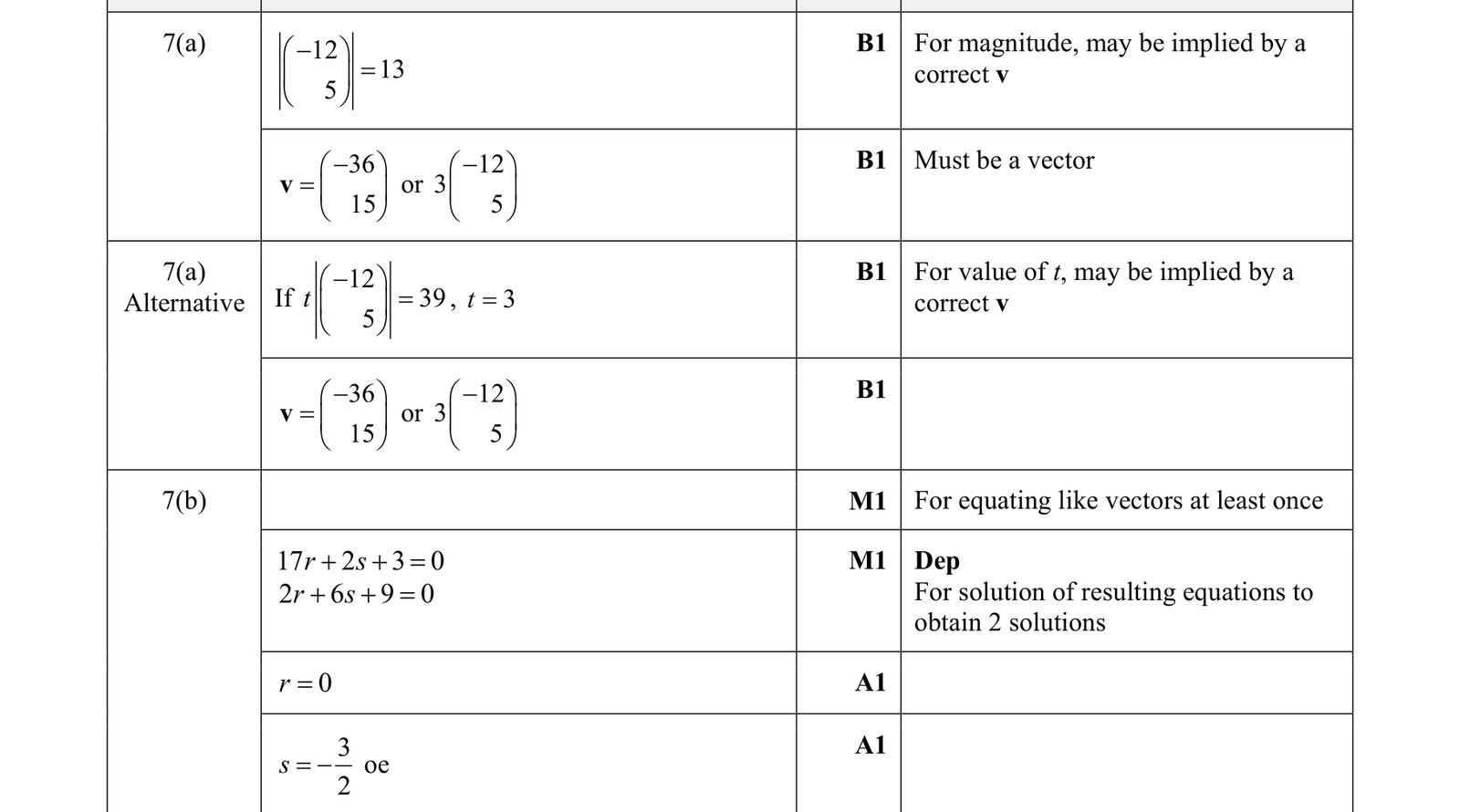
(a) The vector \(\mathbf v\) has a magnitude of 39 units and is in the same direction as \(\begin{pmatrix}-12\\5\end{pmatrix}\). Write \(\mathbf v\) in the form \(\begin{pmatrix}a\\b\end{pmatrix}\), where \(a\) and \(b\) are constants.
(b) Vectors \(\mathbf p\) and \(\mathbf q\) are such that \(\mathbf p=\begin{pmatrix}r+s\\r+6\end{pmatrix}\) and \(\mathbf q=\begin{pmatrix}5r+1\\2s-1\end{pmatrix}\), where \(r\) and \(s\) are constants. Given that \(2\mathbf p+3\mathbf q=\begin{pmatrix}0\\0\end{pmatrix}\), find the value of \(r\) and of \(s\).
0606 P12 - Jun 2017 - Q3 - 4 marks
Vectors \(\mathbf i\) and \(\mathbf j\) are unit vectors parallel to the \(x\)-axis and \(y\)-axis respectively.
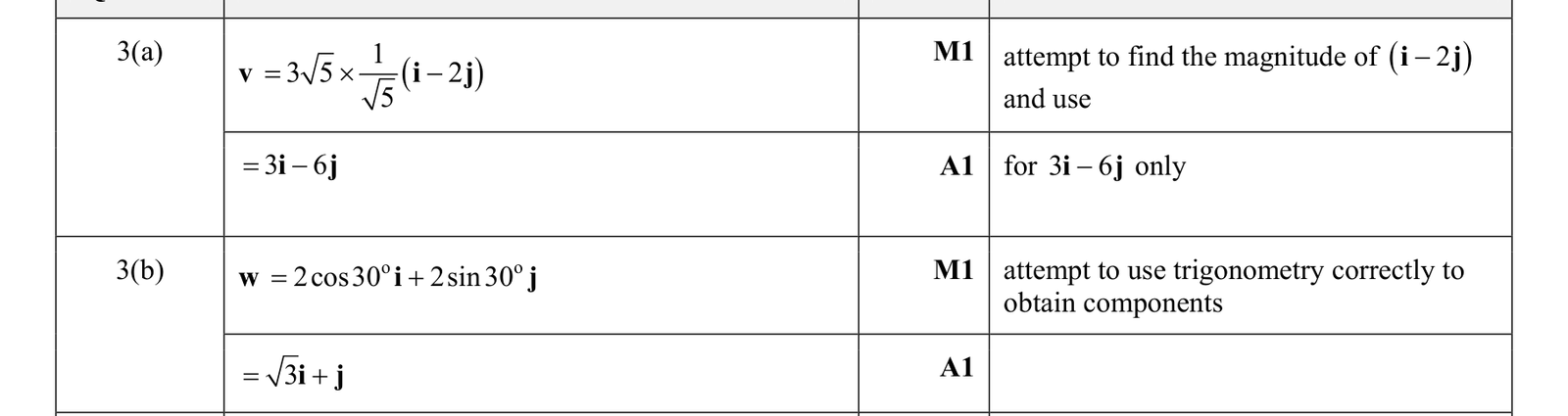
(a) The vector \(\mathbf v\) has magnitude \(3\sqrt5\) and has the same direction as \(\mathbf i-2\mathbf j\). Find \(\mathbf v\) in the form \(a\mathbf i+b\mathbf j\), where \(a\) and \(b\) are integers.
(b) The velocity vector \(\mathbf w\) makes an angle of \(30^\circ\) with the positive \(x\)-axis and \(|\mathbf w|=2\). Find \(\mathbf w\) in the form \(\sqrt c\,\mathbf i+d\mathbf j\), where \(c\) and \(d\) are integers.
0606 P11 - Nov 2023 - Q3 - 5 marks
The position vectors of the points \(A\) and \(B\), relative to the origin, are
\(\begin{pmatrix}2\\-6\end{pmatrix}\) and \(\begin{pmatrix}-3\\6\end{pmatrix}\), respectively.
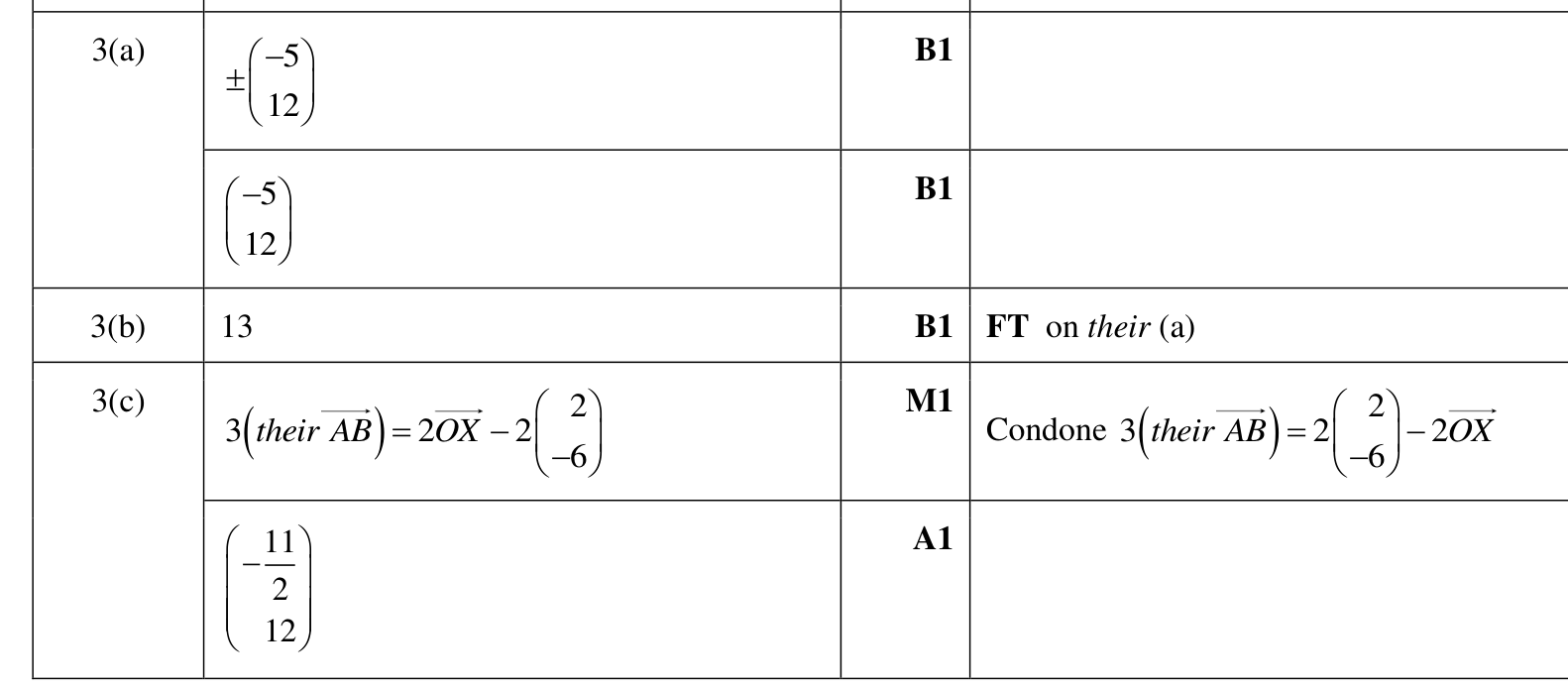
(a) Find the displacement vector of \(B\) from \(A\).
(b) Find the distance \(AB\).
(c) The point \(X\) is such that \(3\overrightarrow{AB}=2\overrightarrow{AX}\). Find the position vector of \(X\).
0606 P22 - Mar 2022 - Q10 - 8 marks
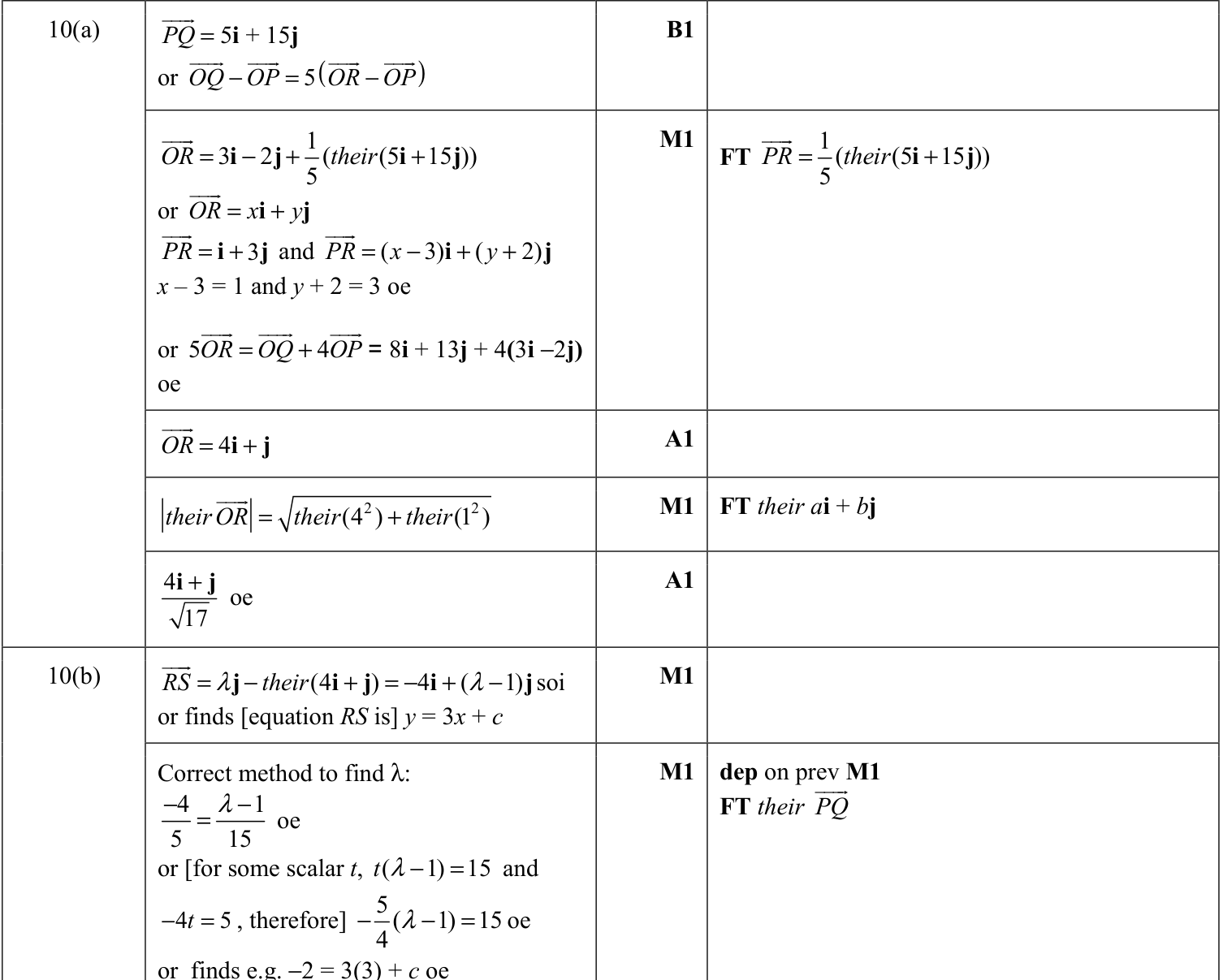
Relative to an origin \(O\), the position vector of point \(P\) is \(3\mathbf{i}-2\mathbf{j}\) and the position vector of point \(Q\) is \(8\mathbf{i}+13\mathbf{j}\).
(a) The point \(R\) is such that \(\overrightarrow{PQ}=5\overrightarrow{PR}\). Find the unit vector in the direction \(\overrightarrow{OR}\).
(b) The position vector of \(S\) relative to \(O\) is \(\lambda\mathbf{j}\). Given that \(RS\) is parallel to \(PQ\), find the value of \(\lambda\).
0606 P23 - Jun 2022 - Q9 - 6 marks
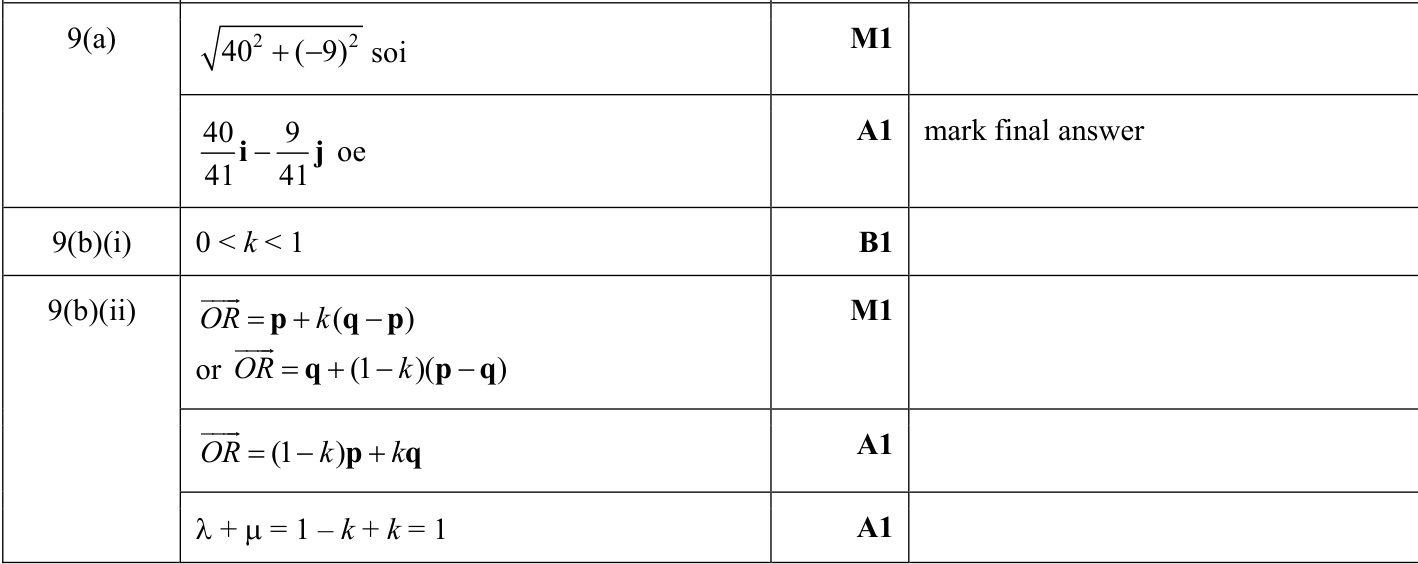
(a) Find a unit vector in the direction of the vector \(40\mathbf{i}-9\mathbf{j}\).
(b) The position vectors of the points \(P\) and \(Q\) are \(\mathbf{p}\) and \(\mathbf{q}\), respectively. The point \(R\) lies on \(PQ\), between \(P\) and \(Q\), such that \(\dfrac{PR}{PQ}=k\).
(i) Write down the set of possible values of \(k\).
(ii) Given that the position vector of \(R\) is \(\lambda\mathbf{p}+\mu\mathbf{q}\), show that \(\lambda+\mu=1\).
0606 P22 - Mar 2020 - Q4 - 5 marks
Relative to an origin \(O\), the position vectors of points \(A\), \(B\) and \(C\) are
\(\begin{pmatrix}-5\\-7\end{pmatrix},\qquad \begin{pmatrix}10\\-4\end{pmatrix},\qquad \begin{pmatrix}x\\y\end{pmatrix}\)
respectively.
Given that \(\overrightarrow{AC}=4\overrightarrow{BC}\), find a unit vector in the direction of \(\overrightarrow{OC}\).

0606 P12 - Jun 2020 - Q8 - 10 marks
The diagram shows triangle \(OAB\), where \(\overrightarrow{OA}=\mathbf a\) and \(\overrightarrow{OB}=\mathbf b\). The point \(P\) lies on \(OA\), where \(OP=\frac34 OA\). The point \(Q\) is the midpoint of \(AB\). The lines \(OB\) and \(PQ\), when extended, meet at \(R\).
(a) Find \(\overrightarrow{AB}\) in terms of \(\mathbf a\) and \(\mathbf b\).
(b) Find \(\overrightarrow{PQ}\) in terms of \(\mathbf a\) and \(\mathbf b\), giving your answer in its simplest form.
It is given that \(n\overrightarrow{PQ}=\overrightarrow{QR}\) and \(\overrightarrow{BR}=k\mathbf b\), where \(n\) and \(k\) are positive constants.
(c) Find \(\overrightarrow{QR}\) in terms of \(n\), \(\mathbf a\) and \(\mathbf b\).
(d) Find \(\overrightarrow{QR}\) in terms of \(k\), \(\mathbf a\) and \(\mathbf b\).
(e) Hence find the values of \(n\) and \(k\).


0606 P13 - Jun 2020 - Q6 - 8 marks
(a) Find the unit vector in the direction of
\(\begin{pmatrix}5\\-12\end{pmatrix}.\)
(b) Given that
\(\begin{pmatrix}4\\1\end{pmatrix} +k\begin{pmatrix}-2\\3\end{pmatrix} =r\begin{pmatrix}-10\\5\end{pmatrix},\)
find the value of each of the constants \(k\) and \(r\).
(c) Relative to an origin \(O\), the points \(A\), \(B\) and \(C\) have position vectors \(\mathbf p\), \(3\mathbf q-\mathbf p\) and \(9\mathbf q-5\mathbf p\) respectively.
(i) Find \(\overrightarrow{AB}\) in terms of \(\mathbf p\) and \(\mathbf q\).
(ii) Find \(\overrightarrow{AC}\) in terms of \(\mathbf p\) and \(\mathbf q\).
(iii) Explain why \(A\), \(B\) and \(C\) all lie in a straight line.
(iv) Find the ratio \(AB:BC\).

0606 P22 - Mar 2019 - Q8 - 8 marks
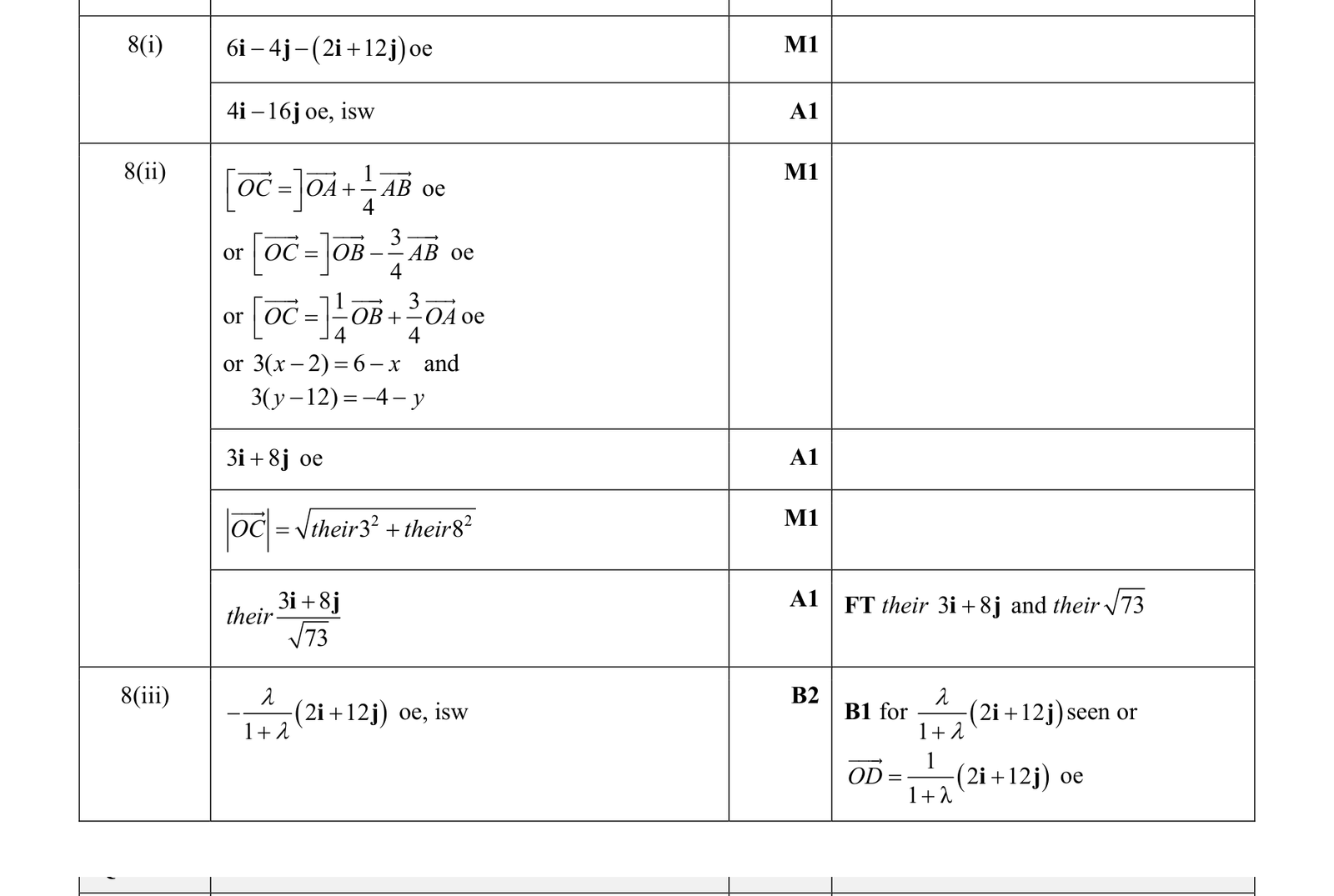
Relative to an origin \(O\), the position vectors of the points \(A\) and \(B\) are \(2\mathbf i+12\mathbf j\) and \(6\mathbf i-4\mathbf j\) respectively.
(i) Write down and simplify an expression for \(\overrightarrow{AB}\).
The point \(C\) lies on \(\overrightarrow{AB}\) such that \(AC:CB\) is \(1:3\).
(ii) Find the unit vector in the direction of \(\overrightarrow{OC}\).
The point \(D\) lies on \(\overrightarrow{OA}\) such that \(OD:DA\) is \(1:3\).
(iii) Find an expression for \(\overrightarrow{AD}\) in terms of \(\mathbf i\) and \(\mathbf j\).
0606 P23 - Jun 2017 - Q4 - 6 marks
(a) Vectors \(\mathbf a\), \(\mathbf b\) and \(\mathbf c\) are such that
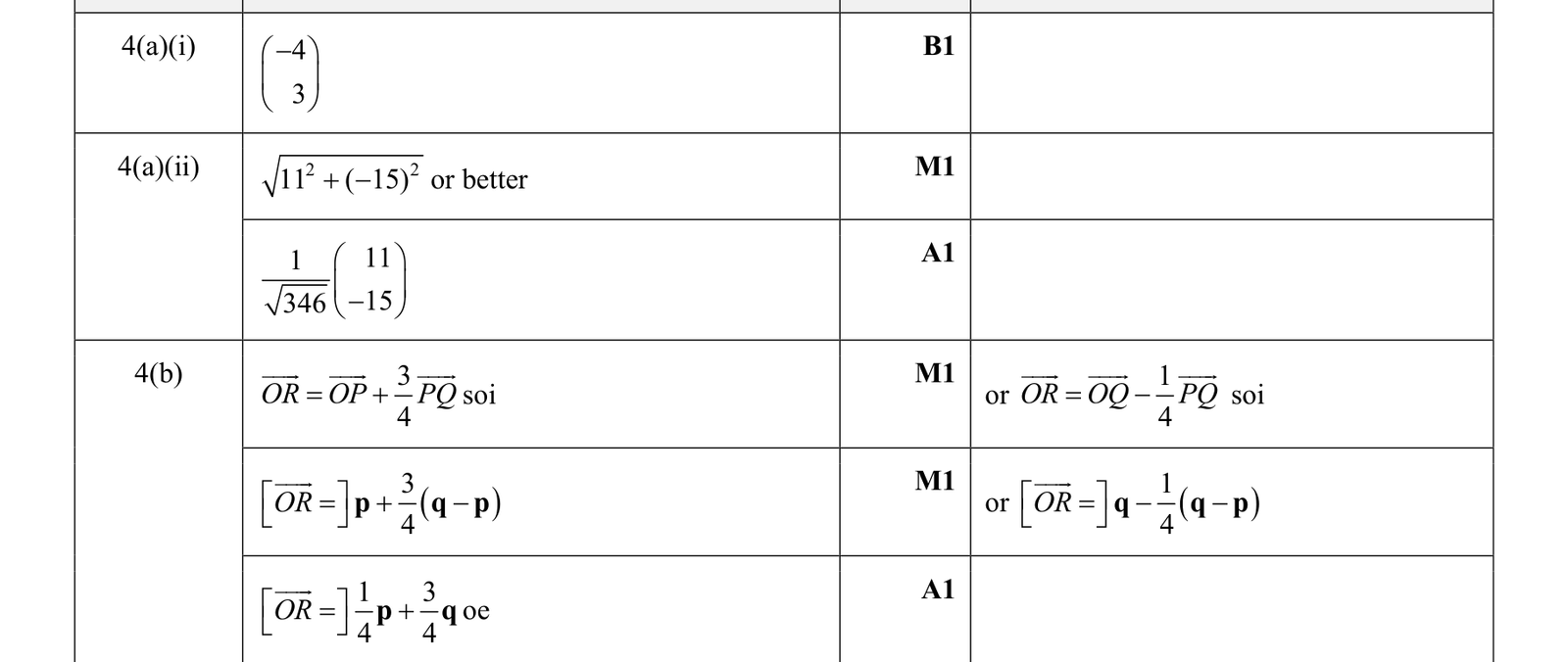
\(\mathbf a=\binom{5}{-6},\qquad \mathbf b=\binom{11}{-15},\qquad 3\mathbf a+\mathbf c=\mathbf b.\)
(i) Find \(\mathbf c\).
(ii) Find the unit vector in the direction of \(\mathbf b\).
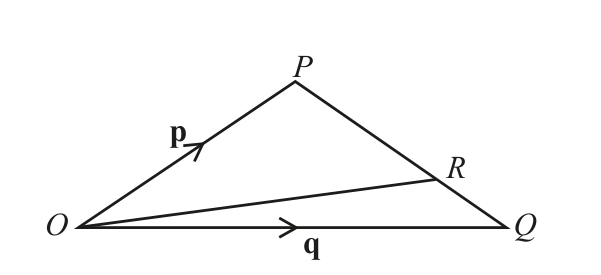
(b) In the diagram, \(\overrightarrow{OP}=\mathbf p\) and \(\overrightarrow{OQ}=\mathbf q\). The point \(R\) lies on \(PQ\) such that \(PR=3RQ\).
Find \(\overrightarrow{OR}\) in terms of \(\mathbf p\) and \(\mathbf q\), simplifying your answer.
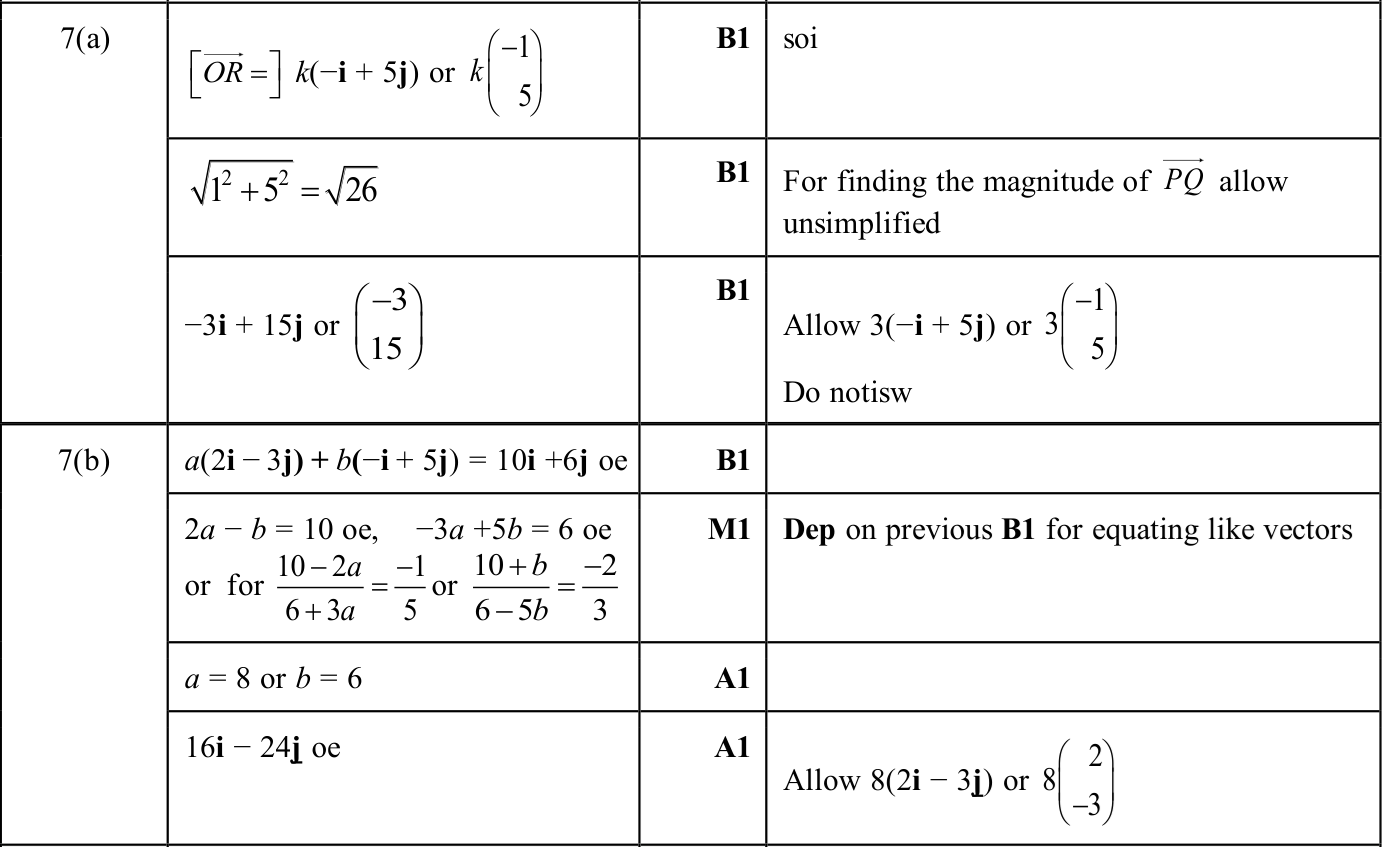
0606 P13 - Nov 2025 - Q7 - 7 marks
The point \(O\) is the origin. Two points \(P\) and \(Q\) are such that \(\overrightarrow{PQ}\) is in the same direction as \(-\mathbf{i}+5\mathbf{j}\).
(a) The point \(R\) is such that \(\overrightarrow{OR}\) is in the same direction as \(\overrightarrow{PQ}\) and the magnitude of \(\overrightarrow{OR}\) is \(3\sqrt{26}\). Find \(\overrightarrow{OR}\).
(b) \(\overrightarrow{OP}\) is in the same direction as \(2\mathbf{i}-3\mathbf{j}\), and \(\overrightarrow{OQ}=10\mathbf{i}+6\mathbf{j}\). Find \(\overrightarrow{OP}\).
0606 P11 - Nov 2025 - Q12 - 6 marks
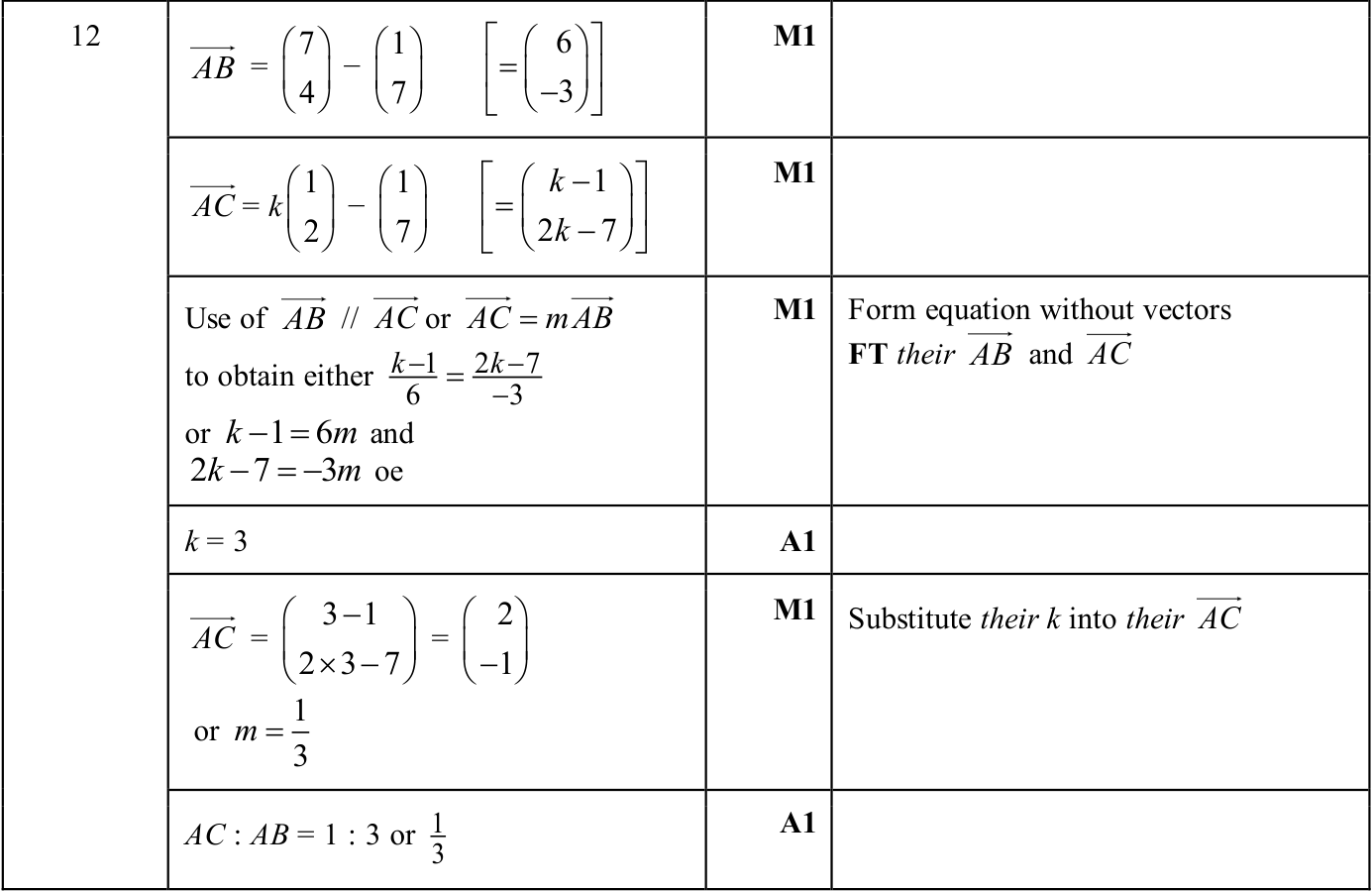
The points \(A\), \(B\) and \(C\) have position vectors \(\overrightarrow{OA}=\binom{1}{7}\), \(\overrightarrow{OB}=\binom{7}{4}\), and \(\overrightarrow{OC}=k\binom{1}{2}\). Given that \(C\) lies on the line segment \(AB\), find \(AC:AB\).