Answer: The moment of inertia is \(180Ma^2\), and the period of the small oscillations is \(\boxed{2\pi\sqrt{\dfrac{6a}{g}}}\).
(i) For a thin ring, the moment of inertia about an axis through its centre and perpendicular to its plane is \(mr^2\). Therefore, by the perpendicular axis theorem, the moment of inertia about a diameter is
\[\frac12mr^2.\]
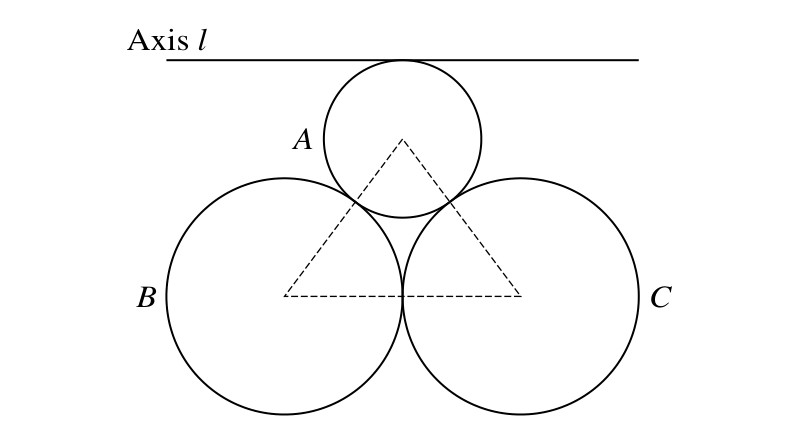
For ring \(A\), \(m=3M\) and \(r=2a\). So the moment of inertia about a diameter parallel to the given axis is
\[I_A=\frac12(3M)(2a)^2=6Ma^2.\]
The axis \(l\) is tangent to ring \(A\), so the distance from the centre of \(A\) to \(l\) is \(2a\). By the parallel axis theorem,
\[I_A'=6Ma^2+3M(2a)^2=6Ma^2+12Ma^2=18Ma^2.\]
For each of rings \(B\) and \(C\), \(m=2M\) and \(r=3a\). The moment of inertia about a diameter through its centre, parallel to \(l\), is
\[I_B=\frac12(2M)(3a)^2=9Ma^2.\]
From the geometry of the three tangent rings, the centre of each of \(B\) and \(C\) is \(6a\) from the axis \(l\). Hence
\[I_B'=9Ma^2+2M(6a)^2=9Ma^2+72Ma^2=81Ma^2.\]
There are two such rings, so the total moment of inertia is
\[I=18Ma^2+2(81Ma^2)=180Ma^2.\]
This proves the required result.
(ii) Let \(\theta\) be the small angle through which the object is displaced from its equilibrium position.
The weights produce a restoring moment about \(l\). The centre of ring \(A\) is \(2a\) from \(l\), and the centres of \(B\) and \(C\) are each \(6a\) from \(l\). Therefore the restoring moment has magnitude
\[3Mg(2a)\sin\theta+2\{2Mg(6a)\sin\theta\}=30Mga\sin\theta.\]
Since this moment is restoring,
\[I\frac{\mathrm d^2\theta}{\mathrm dt^2}=-30Mga\sin\theta.\]
Using \(I=180Ma^2\),
\[180Ma^2\frac{\mathrm d^2\theta}{\mathrm dt^2}=-30Mga\sin\theta.\]
So
\[\frac{\mathrm d^2\theta}{\mathrm dt^2}=-\frac{g}{6a}\sin\theta.\]
For small oscillations, \(\sin\theta\approx\theta\). Hence
\[\frac{\mathrm d^2\theta}{\mathrm dt^2}\approx-\frac{g}{6a}\theta.\]
This is the standard SHM form, so the angular frequency satisfies
\[\omega^2=\frac{g}{6a}.\]
Therefore the period is
\[T=\frac{2\pi}{\omega}=\boxed{2\pi\sqrt{\frac{6a}{g}}}.\]