Past Exam Questions
← Back0606 P22 - Jun 2021 - Q11 - 8 marks
In this question all lengths are in centimetres.
The volume and surface area of a sphere of radius \(r\) are \(\frac43\pi r^3\) and \(4\pi r^2\) respectively.
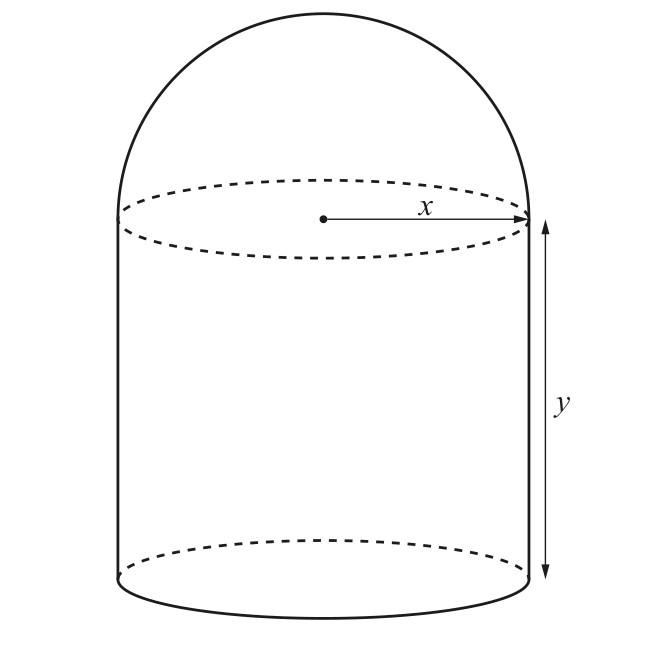
The diagram shows a solid object made from a hemisphere of radius \(x\) and a cylinder of radius \(x\) and height \(y\). The volume of the object is \(500\text{ cm}^3\).
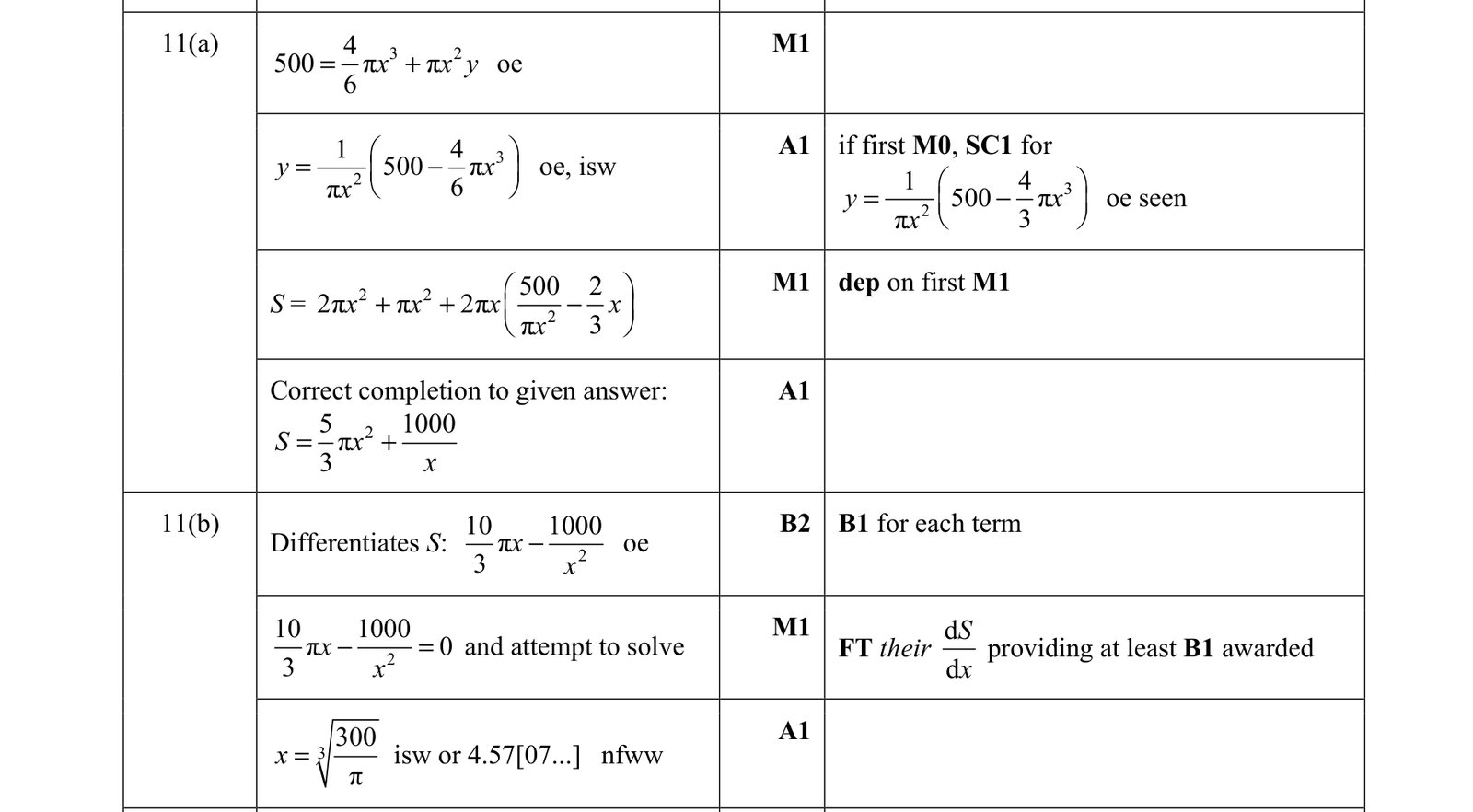
(a) Find an expression for \(y\) in terms of \(x\) and show that the surface area, \(S\), of the object is given by
\(S=\frac53\pi x^2+\frac{1000}{x}.\)
(b) Given that \(x\) can vary and that \(S\) has a minimum value, find the value of \(x\) for which \(S\) is a minimum.
0606 P23 - Jun 2021 - Q10 - 8 marks
In this question all lengths are in centimetres.
The volume and curved surface area of a cone of base radius \(r\), height \(h\) and sloping edge \(l\) are \(\frac13\pi r^2h\) and \(\pi rl\) respectively.
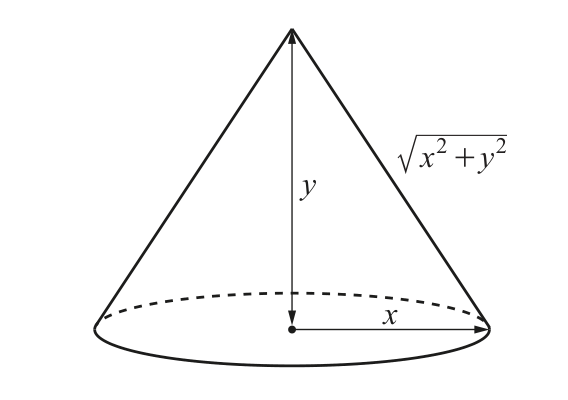
The diagram shows a cone of base radius \(x\), height \(y\) and sloping edge \(\sqrt{x^2+y^2}\). The volume of the cone is \(10\pi\).
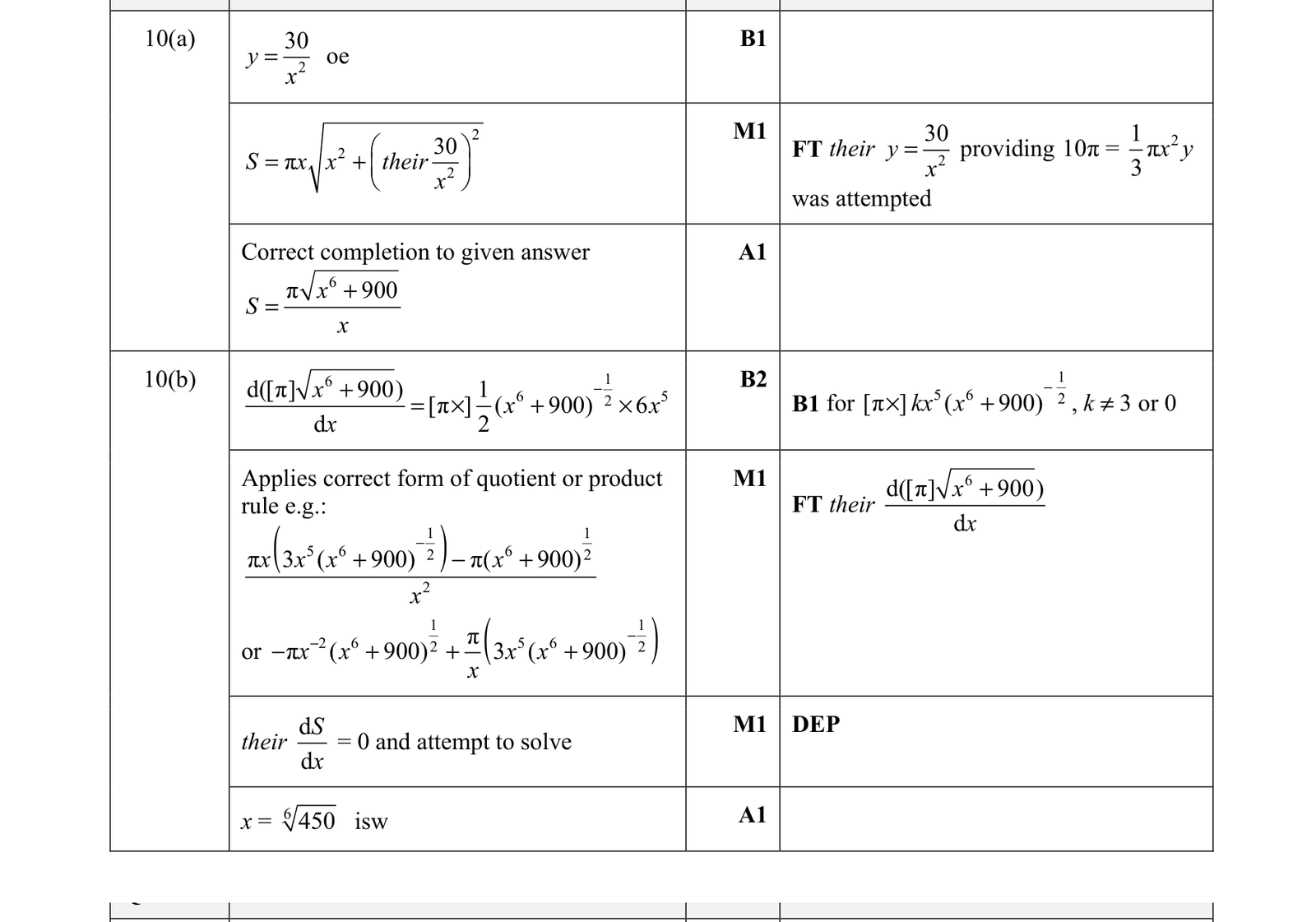
(a) Find an expression for \(y\) in terms of \(x\) and show that the curved surface area, \(S\), of the cone is given by
\(S=\frac{\pi\sqrt{x^6+900}}{x}.\)
(b) Given that \(x\) can vary and that \(S\) has a minimum value, find the exact value of \(x\) for which \(S\) is a minimum.
0606 P21 - Nov 2021 - Q11 - 11 marks
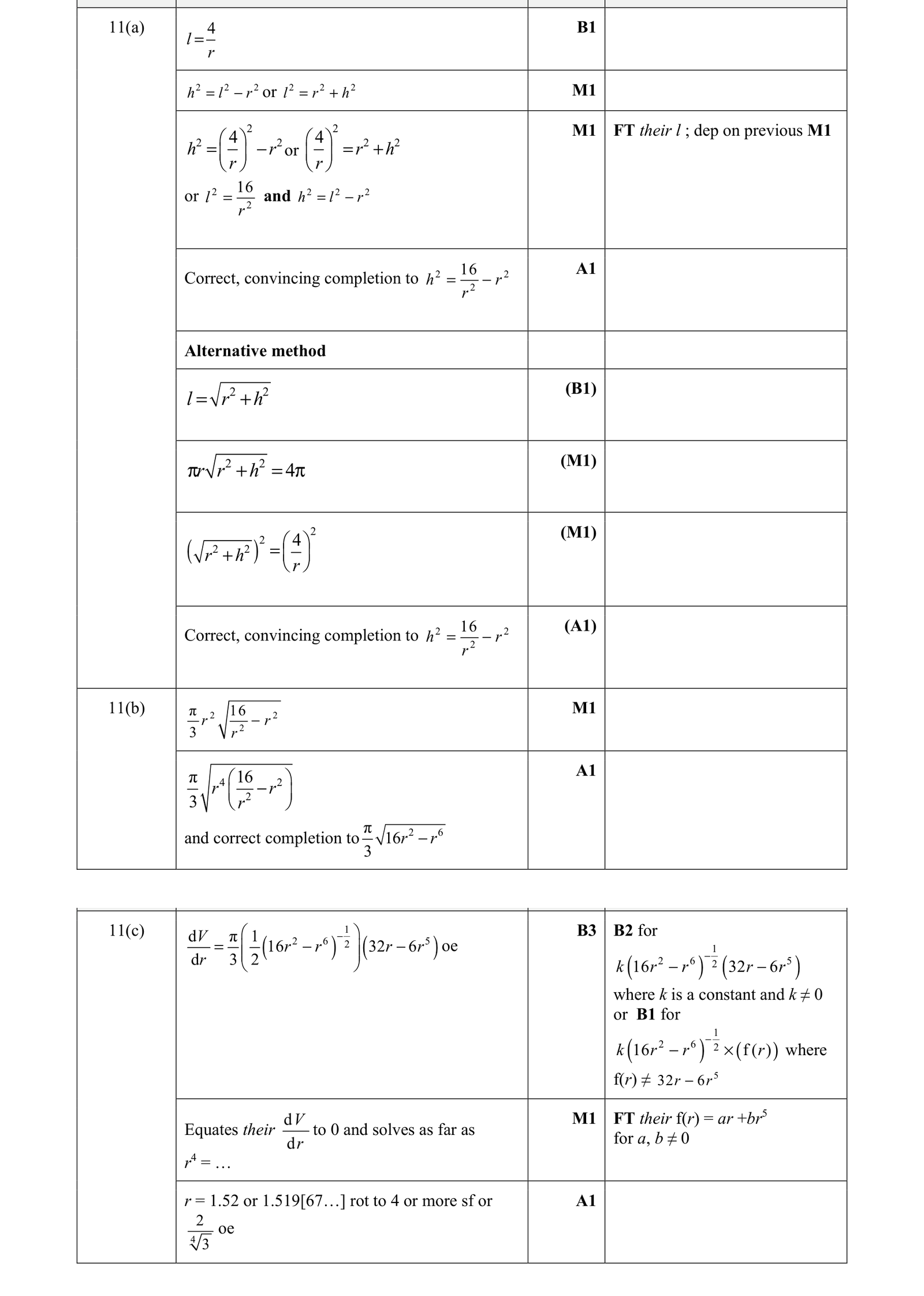
The volume \(V\) of a cone with base radius \(r\) and vertical height \(h\) is given by
\(V=\frac13\pi r^2h.\)
The curved surface area of a cone with base radius \(r\) and slant height \(l\) is given by \(\pi rl\).
A cone has base radius \(r\text{ cm}\), vertical height \(h\text{ cm}\) and volume \(V\text{ cm}^3\). The curved surface area of the cone is \(4\pi\text{ cm}^2\).
(a) Show that
\(h^2=\frac{16}{r^2}-r^2.\)
(b) Show that
\(V=\frac{\pi}{3}\sqrt{16r^2-r^6}.\)
(c) Given that \(r\) can vary and that \(V\) has a maximum value, find the value of \(r\) that gives the maximum volume.
0606 P22 - Mar 2020 - Q11 - 8 marks
An open cylinder has radius \(r\) cm and height \(h\) cm. Its volume is \(1000\text{ cm}^3\).
Find the minimum possible value of the total outer surface area of the cylinder.


0606 P23 - Nov 2020 - Q9 - 9 marks
The diagram shows a rectangular field \(ABDE\), where \(AB=300\) m and \(AE=400\) m. Joseph walks from \(A\) to \(C\) across the field at \(0.9\text{ m s}^{-1}\), then from \(C\) to \(D\) along the edge of the field at \(1.5\text{ m s}^{-1}\). It is given that \(BC=x\) metres.
(a) Show that the total time, \(T\) seconds, for Joseph's walk is
\(T=\frac{\sqrt{300^2+x^2}}{0.9}+\frac{400-x}{1.5}.\)
(b) Find the minimum possible value of \(T\).


0606 P12 - Mar 2019 - Q9 - 7 marks
A sector of a circle has radius \(r\) cm and area \(36\text{ cm}^2\). The perimeter of the sector is \(P\) cm.
(i) Show that \(P=2r+\dfrac{72}{r}\).
(ii) Find the stationary value of \(P\), and determine whether it is a maximum or a minimum.

0606 P11 - Jun 2019 - Q9 - 8 marks
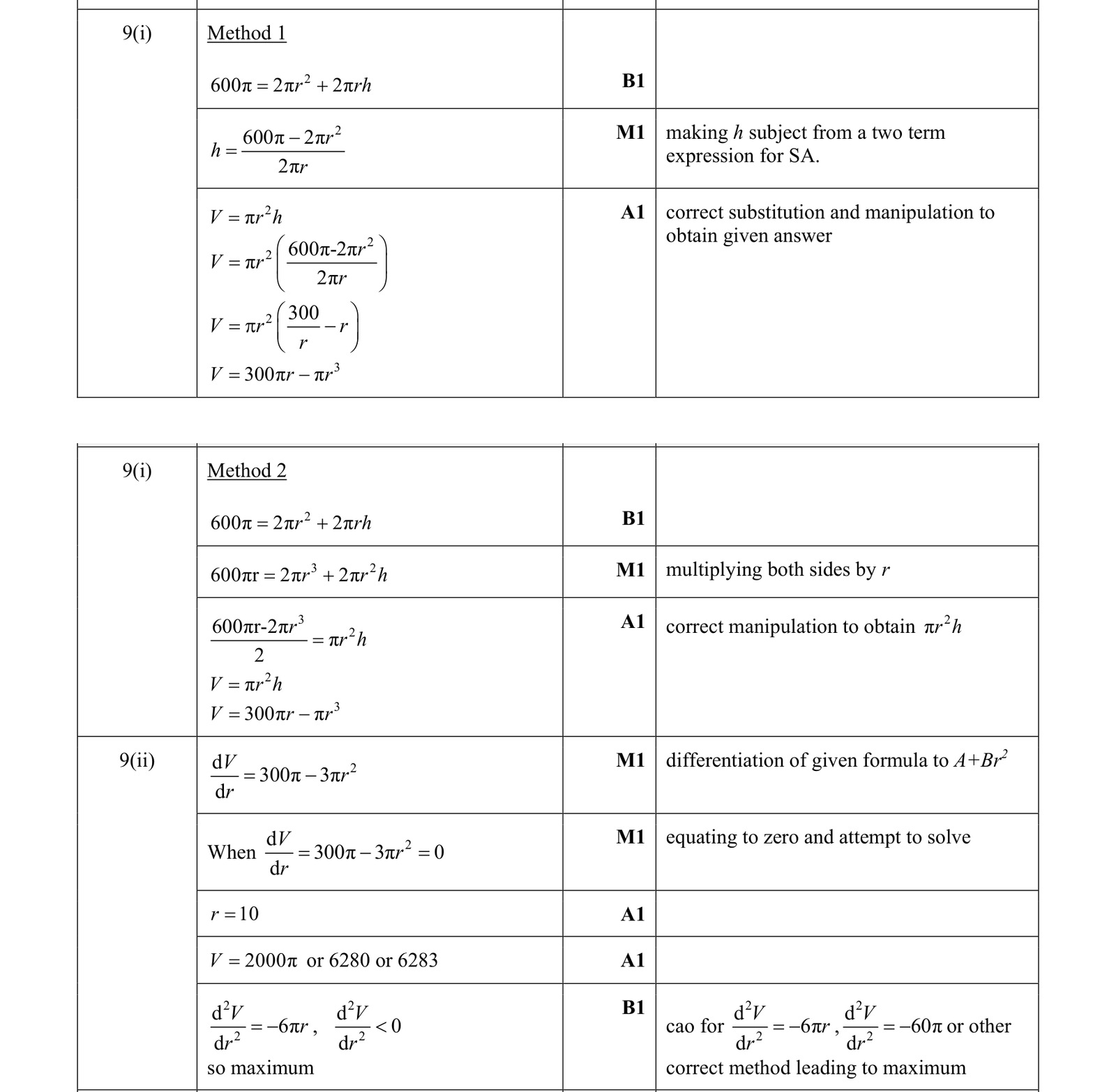
A closed cylinder has base radius \(r\), height \(h\), and volume \(V\). The total surface area of the cylinder is \(600\pi\), and \(V\), \(r\) and \(h\) can vary.
(i) Show that \(V=300\pi r-\pi r^3\).
(ii) Find the stationary value of \(V\) and determine its nature.
0606 P12 - Jun 2019 - Q10 - 9 marks
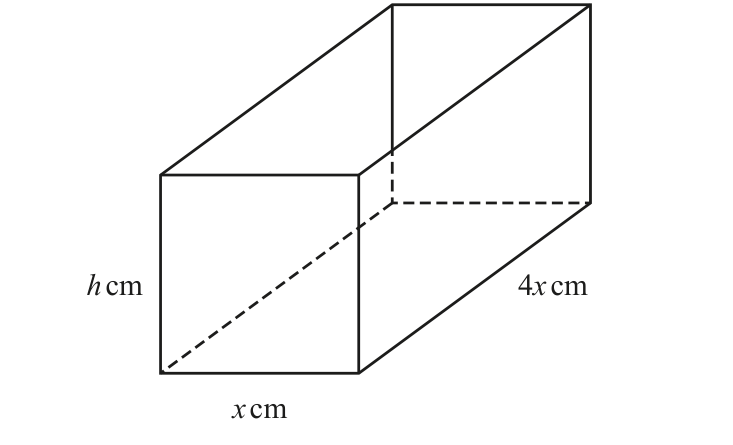
The diagram shows an open container in the shape of a cuboid of width \(x\) cm, length \(4x\) cm and height \(h\) cm. The volume of the container is \(800\text{ cm}^3\).
(i) Show that the external surface area, \(S\text{ cm}^2\), of the open container is such that \(S=4x^2+\frac{2000}{x}\).
(ii) Given that \(x\) can vary, find the stationary value of \(S\) and determine its nature.

0606 P12 - Nov 2019 - Q9 - 8 marks
A solid circular cylinder has a base radius of \(r\) cm and a height of \(h\) cm. The cylinder has a volume of \(1200\pi\text{ cm}^3\) and a total surface area of \(S\text{ cm}^2\).
(i) Show that
\(S=2\pi r^2+\frac{2400\pi}{r}.\)
(ii) Given that \(h\) and \(r\) can vary, find the stationary value of \(S\) and determine its nature.

0606 P21 - Nov 2018 - Q9 - 9 marks
In this question, all lengths are in metres.
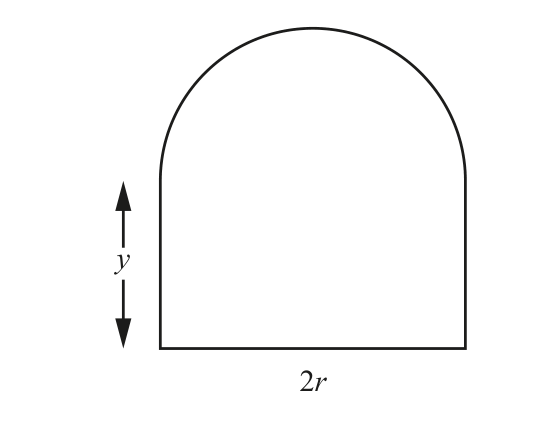
The diagram shows a window formed by a semi-circle of radius \(r\) on top of a rectangle with dimensions \(2r\) by \(y\). The total perimeter of the window is \(5\).
(i) Find \(y\) in terms of \(r\).
(ii) Show that the total area of the window is
\(A=5r-\frac{\pi r^2}{2}-2r^2.\)
(iii) Given that \(r\) can vary, find the value of \(r\) which gives a maximum area of the window and find this area. You are not required to show that this area is a maximum.

0606 P22 - Nov 2017 - Q6 - 8 marks
The volume of a closed cylinder of base radius \(x\text{ cm}\) and height \(h\text{ cm}\) is \(500\text{ cm}^3\).
(i) Express \(h\) in terms of \(x\).
(ii) Show that the total surface area of the cylinder is given by \(A=2\pi x^2+\dfrac{1000}{x}\text{ cm}^2\).
(iii) Given that \(x\) can vary, find the stationary value of \(A\) and show that this value is a minimum.

9231 P32 - Nov 2025 - Q4 - 7 marks
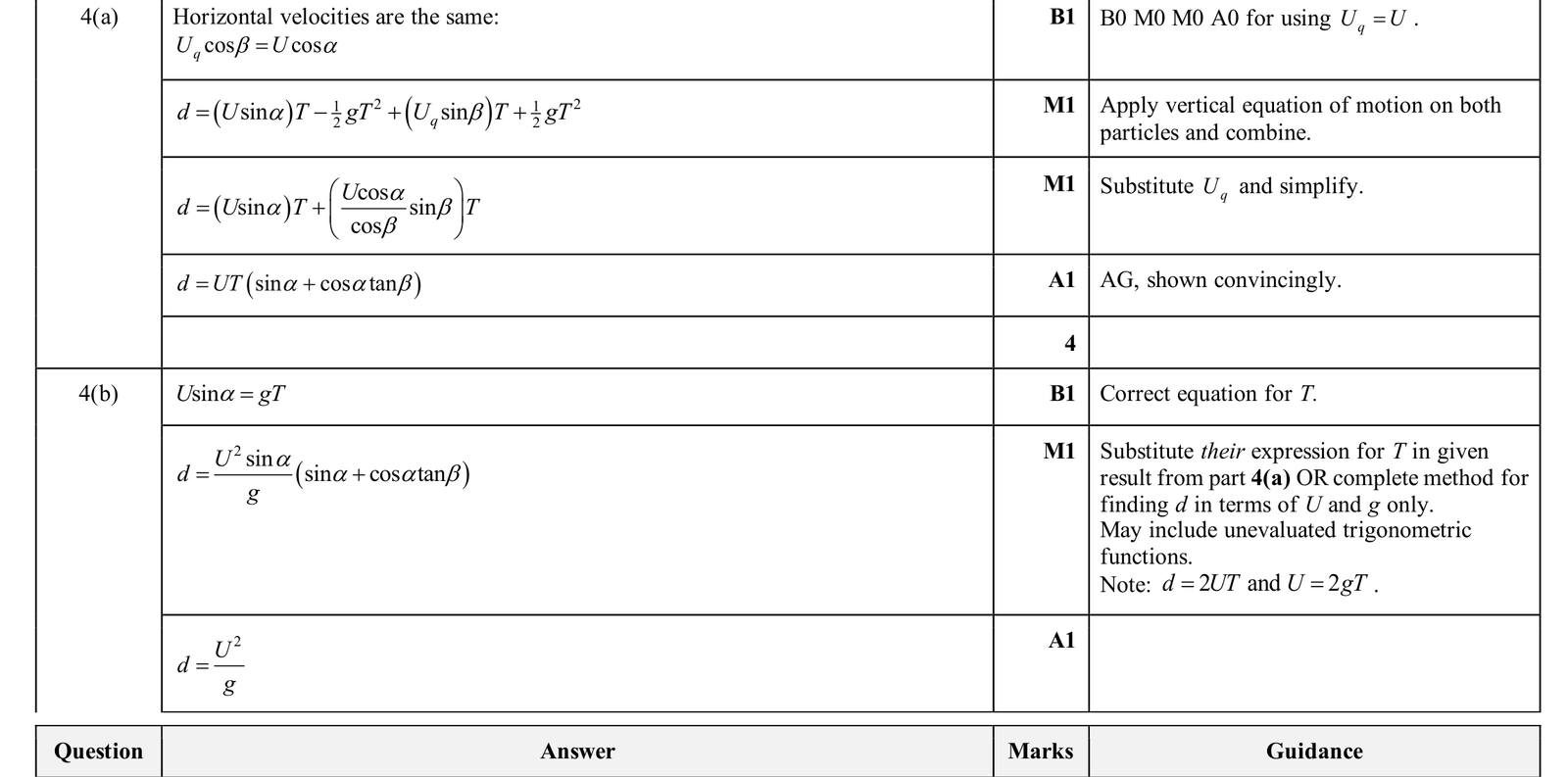
A particle \(Q\) is initially positioned at a distance \(d\) vertically above a particle \(P\). Particle \(P\) is projected with speed \(U\) at an angle \(\alpha\) above the horizontal. At the same time, \(Q\) is projected at an angle \(\beta\) below the horizontal. Both particles move freely under gravity. The particles collide at time \(T\) after the projections. (a) Show that \(d=U T(\sin \alpha+\cos \alpha \tan \beta)\).
The particles collide when \(P\) is at its maximum height. (b) Given that \(\alpha=30^{\circ}\) and \(\beta=60^{\circ}\), find \(d\) in terms of \(U\) and \(g\).
9231 P33 - Jun 2025 - Q7 - 11 marks
A particle \(P\) is projected from \(O\) with speed \(U\) at angle \(45^\circ\) above the horizontal and moves freely under gravity.
(a) State the vertical and horizontal components of velocity at time \(t\).
At time \(T\), \(P\) is moving at angle \(60^\circ\) below the horizontal.
(b) Show that \(T=\dfrac{U}{2g}(\sqrt2+\sqrt6)\).
At time \(T\), the particle strikes a smooth horizontal plane at a point a horizontal distance \(D\) from \(O\) and a vertical distance \(H\) below \(O\).
(c) Find \(H:D\).
After striking the plane, \(P\) rebounds with speed \(w\). The coefficient of restitution is \(\frac23\).
(d) Find \(w\) in terms of \(U\).

9231 P31 - Jun 2024 - Q3 - 5 marks
At time \(t=0\), a particle \(P\) is projected with speed \(u\,\text{m s}^{-1}\) at an angle \(60^\circ\) above the horizontal from a point \(O\). It then moves freely under gravity.
The direction of motion of \(P\) when \(t=5\) is perpendicular to its direction of motion when \(t=15\).
Find \(u\).

9231 P33 - Jun 2024 - Q6 - 8 marks
A particle \(P\) is projected with speed \(u\,\text{m s}^{-1}\) at an angle \(\theta\) above the horizontal from a point \(O\), and moves freely under gravity.
After \(5\) seconds the speed of \(P\) is \(\dfrac34u\).
(a) Show that
(b) It is given that the velocity of \(P\) after \(5\) seconds is perpendicular to the initial velocity. Find, in either order, \(u\) and \(\sin\theta\).

9231 P31 - Jun 2023 - Q7 - 9 marks
At time \(t \mathrm{~s}\), a particle \(P\) is projected with speed \(40 \mathrm{~ms}^{-1}\) at an angle \(\theta\) above the horizontal from a point \(O\) on a horizontal plane and moves freely under gravity. The greatest height achieved by \(P\) during its flight is \(H \mathrm{~m}\) and the corresponding time is \(T \mathrm{~s}\).
(a) Obtain expressions for \(H\) and \(T\) in terms of \(\theta\).
During the time between \(t=T\) and \(t=3, P\) descends a distance \(\frac{1}{4} H\).
(b) Find the value of \(\theta\).
(c) Find the speed of \(P\) when \(t=3\).

9231 P33 - Jun 2023 - Q7 - 9 marks
The points \(O\) and \(P\) are on a horizontal plane, a distance 8 m apart. A ball is thrown from \(O\) with speed \(u \mathrm{~ms}^{-1}\) at an angle \(\theta\) above the horizontal, where \(\tan \theta=\frac{4}{3}\). At the same instant, a model aircraft is launched with speed \(5 \mathrm{~ms}^{-1}\) parallel to the horizontal plane from a point 4 m vertically above \(P\). The model aircraft moves in the same vertical plane as the ball and in the same horizontal direction as the ball. The model aircraft moves horizontally with a constant speed of \(5 \mathrm{~m} \mathrm{~s}^{-1}\). After \(T \mathrm{~s}\), the ball and the model aircraft collide.
(a) Find the value of \(T\).
(b) Find the direction in which the ball is moving immediately before the collision.

9231 P31 - Jun 2022 - Q7 - 11 marks
Particles \(P\) and \(Q\) are projected in the same vertical plane from a point \(O\) at the top of a cliff. The height of the cliff exceeds 50 m . Both particles move freely under gravity. Particle \(P\) is projected with speed \(\frac{35}{2} \mathrm{~ms}^{-1}\) at an angle \(\alpha\) above the horizontal, where \(\tan \alpha=\frac{4}{3}\). Particle \(Q\) is projected with speed \(u \mathrm{~ms}^{-1}\) at an angle \(\beta\) above the horizontal, where \(\tan \beta=\frac{1}{2}\). Particle \(Q\) is projected one second after the projection of particle \(P\). The particles collide \(T \mathrm{~s}\) after the projection of particle \(Q\).
(a) Write down expressions, in terms of \(T\), for the horizontal displacements of \(P\) and \(Q\) from \(O\) when they collide and hence show that \(4 u T=21 \sqrt{5}(T+1)\).
(b) Find the value of \(T\).
(c) Find the horizontal and vertical displacements of the particles from \(O\) when they collide.

9231 P33 - Jun 2022 - Q3 - 8 marks
A particle \(P\) is projected with speed \(25 \mathrm{~ms}^{-1}\) at an angle \(\theta\) above the horizontal from a point \(O\) on a horizontal plane and moves freely under gravity. After 2 s the speed of \(P\) is \(15 \mathrm{~ms}^{-1}\).
(a) Find the value of \(\sin \theta\).
(b) Find the range of the flight.

9231 P31 - Nov 2022 - Q7 - 10 marks
A particle \(P\) is projected with speed \(V\,\mathrm{m\,s}^{-1}\) at an angle \(75^{\circ}\) above the horizontal from a point \(O\) on a horizontal plane. It then moves freely under gravity.
(a) Show that the total time of flight, in seconds, is \(\frac{2 V}{g} \sin 75^{\circ}\).
A smooth vertical barrier is now inserted with its lower end on the plane at a distance 15 m from \(O\). The particle is projected as before but now strikes the barrier, rebounds and returns to \(O\). The coefficient of restitution between the barrier and the particle is \(\frac{3}{5}\).
(b) Explain why the total time of flight is unchanged.
(c) Find an expression for \(V\) in terms of \(g\).
