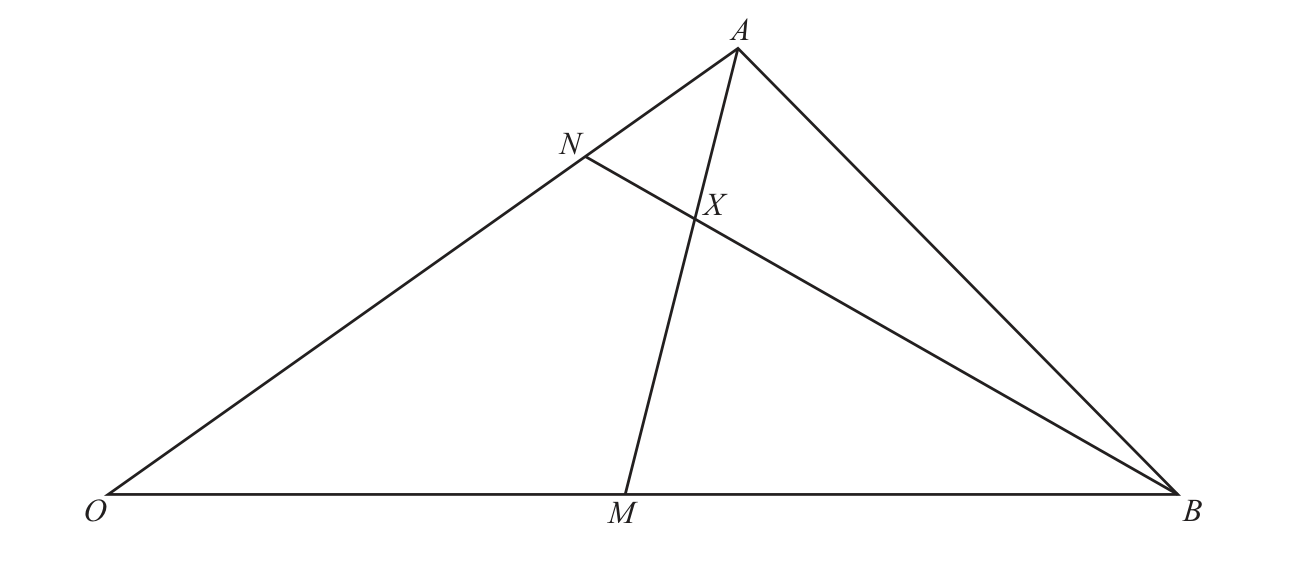
Answer: \(\overrightarrow{OX}=\lambda\frac34\mathbf a+(1-\lambda)\mathbf b\), \(\overrightarrow{OX}=\mu\mathbf a+\frac{1-\mu}{2}\mathbf b\), \(\lambda=\frac45\), \(\mu=\frac35\).
Start by taking the key information from the graph or diagram, such as intercepts, turning points, amplitudes, periods, or intersection points. Then use the relevant algebra to justify the result.
Since \(\overrightarrow{ON}=3\overrightarrow{NA}\), the point \(N\) divides \(OA\) in the ratio \(3:1\). Hence
\(\overrightarrow{ON}=\frac34\mathbf a.\)
Also
\(\overrightarrow{BN}=\overrightarrow{ON}-\overrightarrow{OB}=\frac34\mathbf a-\mathbf b.\)
Using \(\overrightarrow{BX}=\lambda\overrightarrow{BN}\),
\(\overrightarrow{OX}=\overrightarrow{OB}+\overrightarrow{BX}=\mathbf b+\lambda\left(\frac34\mathbf a-\mathbf b\right).\)
So
\(\overrightarrow{OX}=\frac34\lambda\mathbf a+(1-\lambda)\mathbf b.\)
Since \(M\) is the midpoint of \(OB\),
\(\overrightarrow{OM}=\frac12\mathbf b.\)
Also
\(\overrightarrow{MA}=\mathbf a-\frac12\mathbf b.\)
Using \(\overrightarrow{MX}=\mu\overrightarrow{MA}\),
\(\overrightarrow{OX}=\overrightarrow{OM}+\overrightarrow{MX}=\frac12\mathbf b+\mu\left(\mathbf a-\frac12\mathbf b\right).\)
So
\(\overrightarrow{OX}=\mu\mathbf a+\frac{1-\mu}{2}\mathbf b.\)
Equate coefficients of \(\mathbf a\) and \(\mathbf b\):
\(\frac34\lambda=\mu,\)
and
\(1-\lambda=\frac{1-\mu}{2}.\)
From \(\mu=\frac34\lambda\), substitute into the second equation:
\(1-\lambda=\frac{1-\frac34\lambda}{2}.\)
Hence
\(2-2\lambda=1-\frac34\lambda.\)
So
\(1=\frac54\lambda,\)
and therefore
\(\lambda=\frac45.\)
Then
\(\mu=\frac34\cdot\frac45=\frac35.\)
This gives the required answer: \(\overrightarrow{OX}=\lambda\frac34\mathbf a+(1-\lambda)\mathbf b\), \(\overrightarrow{OX}=\mu\mathbf a+\frac{1-\mu}{2}\mathbf b\), \(\lambda=\frac45\), \(\mu=\frac35\).