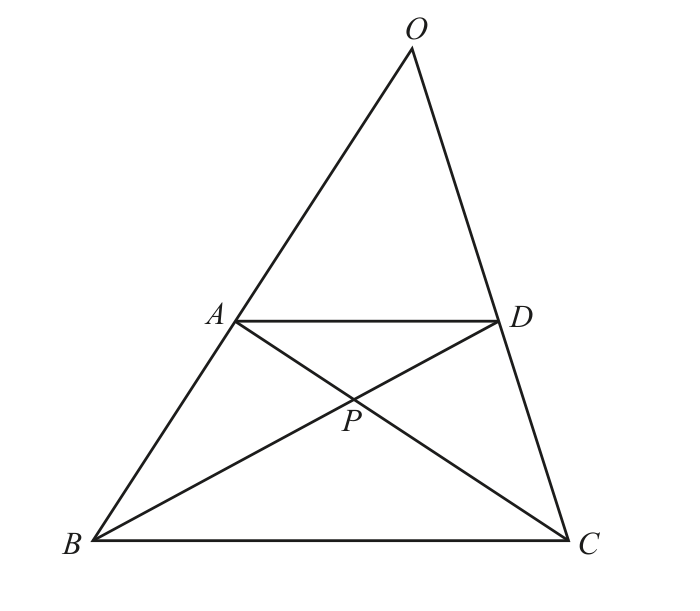
Answer: \(\lambda=\dfrac4{11}\), \(\mu=\dfrac7{11}\), so \(AP:PC=4:7\) and \(DP:PB=4:7\); \(O,Q,P\) are collinear.
We start with the main method. Use the measurements and relationships shown in the diagram, then translate them into algebraic or trigonometric equations. Use position vectors and ratios along a line, then compare coefficients of independent vectors.
Since \(OA:OB=4:7\),
\(\overrightarrow{OA}=\frac47\mathbf b.\)
Since \(OD:OC=4:7\),
\(\overrightarrow{OD}=\frac47\mathbf c.\)
Using the path from \(O\) to \(A\), then from \(A\) to \(P\),
\(\overrightarrow{OP}=\overrightarrow{OA}+\overrightarrow{AP}.\)
But \(\overrightarrow{AP}=\lambda\overrightarrow{AC}\), and
\(\overrightarrow{AC}=\mathbf c-\frac47\mathbf b.\)
Therefore
\(\overrightarrow{OP}=\frac47\mathbf b+\lambda\left(\mathbf c-\frac47\mathbf b\right).\)
Using the path from \(O\) to \(B\), then from \(B\) to \(P\),
\(\overrightarrow{OP}=\overrightarrow{OB}+\overrightarrow{BP}.\)
But \(\overrightarrow{BP}=\mu\overrightarrow{BD}\), and
\(\overrightarrow{BD}=\frac47\mathbf c-\mathbf b.\)
So
\(\overrightarrow{OP}=\mathbf b+\mu\left(\frac47\mathbf c-\mathbf b\right).\)
Now compare the coefficients of \(\mathbf b\) and \(\mathbf c\) in the two expressions.
From the coefficient of \(\mathbf c\),
\(\lambda=\frac47\mu.\)
From the coefficient of \(\mathbf b\),
\(\frac47(1-\lambda)=1-\mu.\)
Substitute \(\lambda=\frac47\mu\) into the second equation:
\(\frac47\left(1-\frac47\mu\right)=1-\mu.\)
Multiply by \(49\):
\(28-16\mu=49-49\mu.\)
Thus
\(33\mu=21\), so \(\mu=\frac7{11}\).
Then
\(\lambda=\frac47\cdot\frac7{11}=\frac4{11}.\)
Since \(\lambda=\frac4{11}\),
\(AP=\frac4{11}AC\) and \(PC=\frac7{11}AC\).
Therefore
\(AP:PC=4:7.\)
Since \(\mu=\frac7{11}\),
\(BP=\frac7{11}BD\) and \(DP=\frac4{11}BD\).
Therefore
\(DP:PB=4:7.\)
For part (b), substitute \(\lambda=\frac4{11}\) into the expression for \(\overrightarrow{OP}\):
\(\overrightarrow{OP}=\frac47\mathbf b+\frac4{11}\left(\mathbf c-\frac47\mathbf b\right).\)
Simplifying gives
\(\overrightarrow{OP}=\frac4{11}\mathbf b+\frac4{11}\mathbf c =\frac4{11}(\mathbf b+\mathbf c).\)
Also
\(\overrightarrow{OQ}=\frac27\mathbf b+\frac27\mathbf c =\frac27(\mathbf b+\mathbf c).\)
Therefore \(\overrightarrow{OP}\) and \(\overrightarrow{OQ}\) are scalar multiples of the same vector \(\mathbf b+\mathbf c\):
\(\overrightarrow{OP}=\frac{14}{11}\overrightarrow{OQ}.\)
Since both vectors start at \(O\), the points \(O\), \(Q\), and \(P\) are collinear.
This completes the solution and gives the required result.