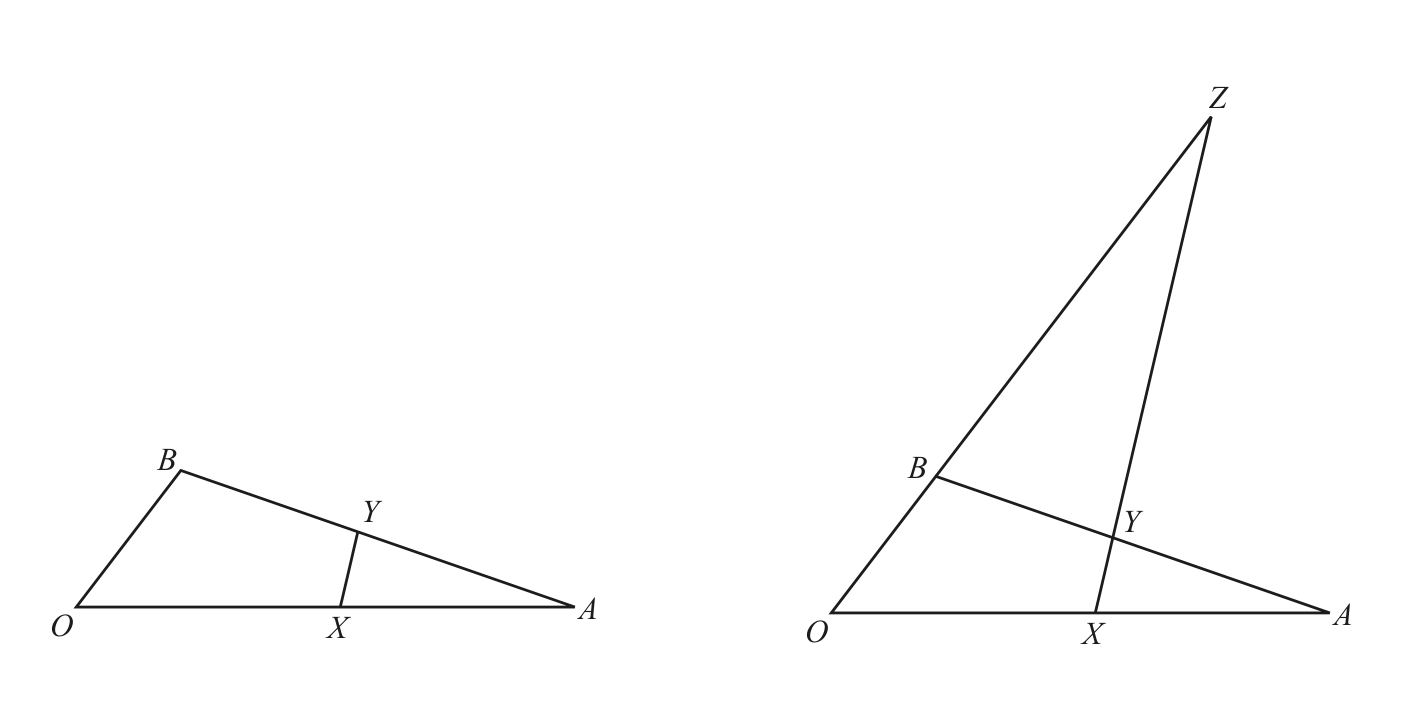
Answer: (a) \(\mathbf b-\mathbf a\); (b) \(\frac12\mathbf b-\frac1{10}\mathbf a\); (e) \(\lambda=5\), \(\mu=2\).
Write each position or direction vector in terms of the given basis vectors, then compare coefficients to find the required constants or ratio.
(a) Since \(\overrightarrow{OA}=\mathbf a\) and \(\overrightarrow{OB}=\mathbf b\),
\(\overrightarrow{AB}=\mathbf b-\mathbf a.\)
(b) The point \(Y\) is the midpoint of \(AB\), so
\(\overrightarrow{OY}=\frac12(\mathbf a+\mathbf b).\)
Also,
\(\overrightarrow{OX}=\frac35\mathbf a.\)
Therefore
\(\overrightarrow{XY} =\overrightarrow{OY}-\overrightarrow{OX} =\frac12(\mathbf a+\mathbf b)-\frac35\mathbf a.\)
So
\(\overrightarrow{XY}=\frac12\mathbf b-\frac1{10}\mathbf a.\)
(c) Since \(\overrightarrow{YZ}=\lambda\overrightarrow{XY}\),
\(\overrightarrow{XZ} =\overrightarrow{XY}+\overrightarrow{YZ} =(\lambda+1)\overrightarrow{XY}.\)
Hence
\(\overrightarrow{XZ} =(\lambda+1)\left(\frac12\mathbf b-\frac1{10}\mathbf a\right).\)
(d) Since \(\overrightarrow{BZ}=\mu\mathbf b\),
\(\overrightarrow{OZ}=\overrightarrow{OB}+\overrightarrow{BZ} =\mathbf b+\mu\mathbf b=(\mu+1)\mathbf b.\)
Therefore
\(\overrightarrow{XZ} =\overrightarrow{OZ}-\overrightarrow{OX} =(\mu+1)\mathbf b-\frac35\mathbf a.\)
(e) Equate the two expressions for \(\overrightarrow{XZ}\):
\((\lambda+1)\left(\frac12\mathbf b-\frac1{10}\mathbf a\right) =-\frac35\mathbf a+(\mu+1)\mathbf b.\)
Compare the coefficients of \(\mathbf a\):
\(-\frac{\lambda+1}{10}=-\frac35.\)
So
\(\lambda+1=6,\)
and
\(\lambda=5.\)
Compare the coefficients of \(\mathbf b\):
\(\frac{\lambda+1}{2}=\mu+1.\)
Using \(\lambda=5\),
\(\frac6{2}=\mu+1.\)
Therefore
\(\mu=2.\)