Past Exam Questions
← Back0606 P23 - Jun 2024 - Q6 - 11 marks
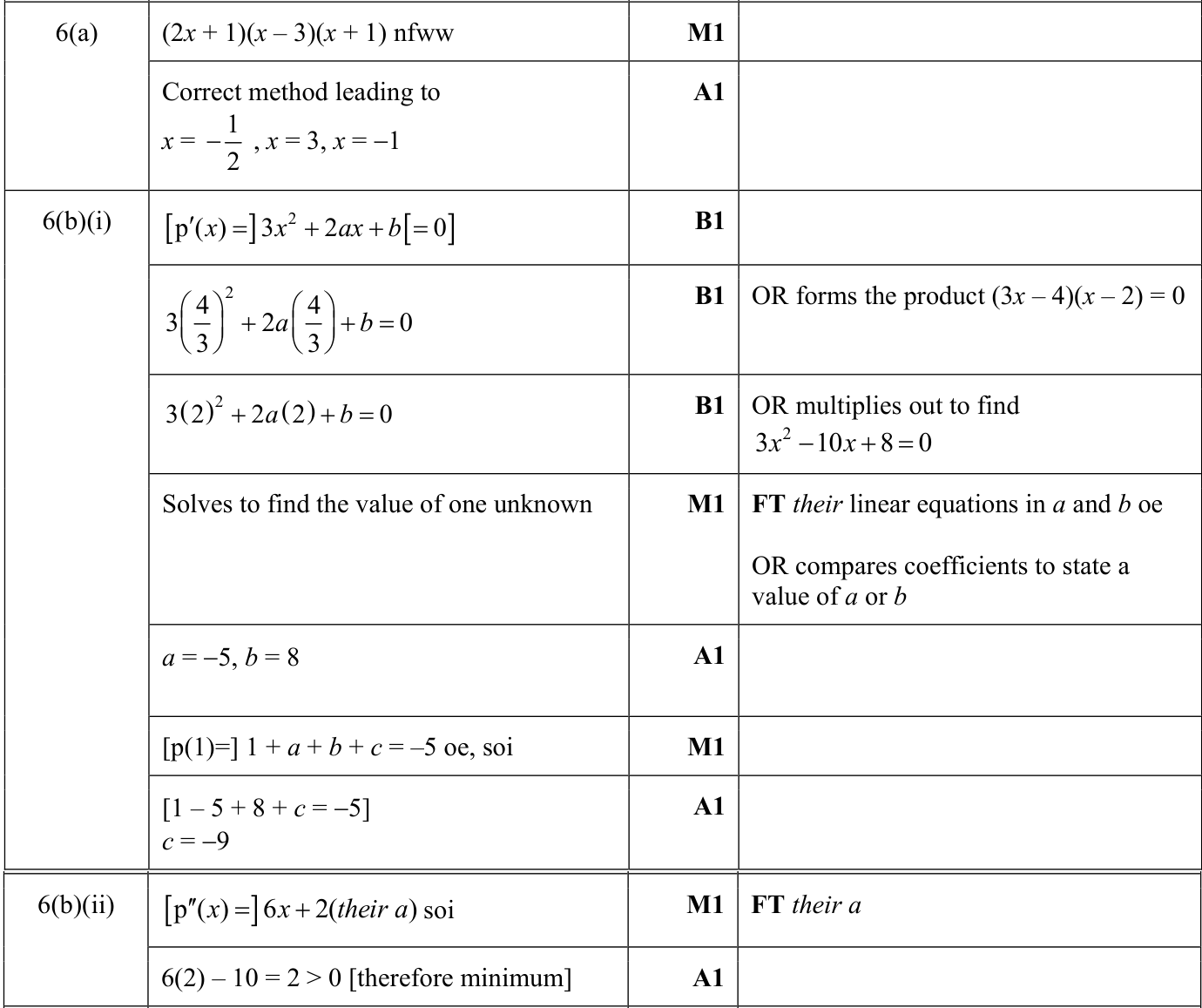
DO NOT USE A CALCULATOR IN THIS QUESTION. (a) Given that \(x-3\) and \(x+1\) are both factors of \(2 x^{3}-3 x^{2}-8 x-3\), solve the equation \(2 x^{3}-3 x^{2}-8 x-3=0\). (b) The polynomial \(\mathrm{p}(x)=x^{3}+a x^{2}+b x+c\), where \(a, b\) and \(c\) are constants, has remainder -5 when divided by \(x-1\). The curve \(y=\mathrm{p}(x)\) has stationary points at \(x=\frac{4}{3}\) and \(x=2\). (i) Find the values of \(a, b\) and \(c\). (ii) Hence use the second derivative test to show that the stationary point at \(x=2\) is a minimum.
0606 P22 - Jun 2023 - Q2 - 8 marks
A curve has equation
\(y=32x^2+\frac{1}{8x^2},\qquad x\ne0.\)
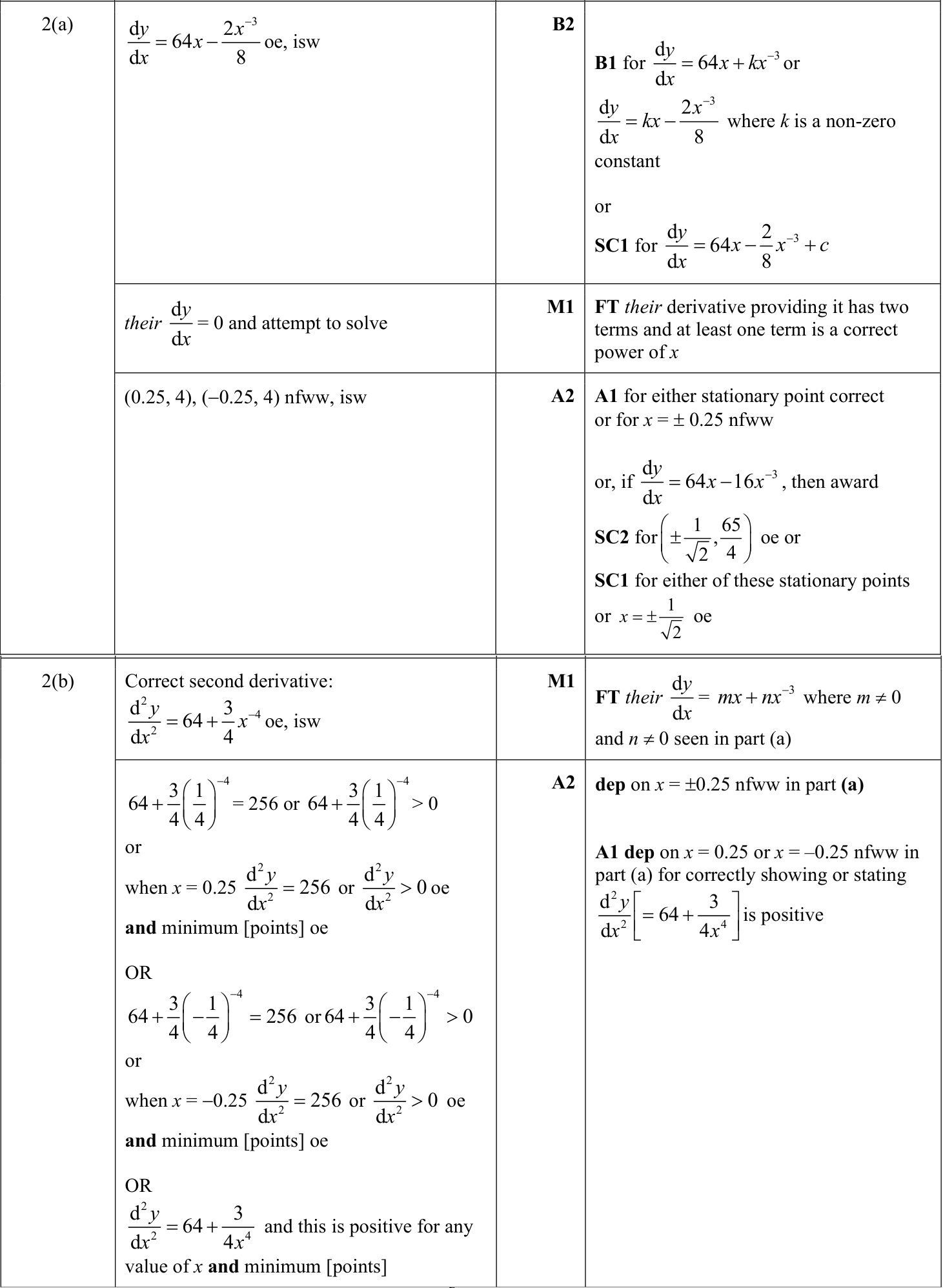
(a) Find the coordinates of the stationary points of the curve.
(b) These stationary points have the same nature. Use the second derivative test to determine whether they are maximum points or minimum points.
0606 P11 - Nov 2023 - Q7 - 10 marks
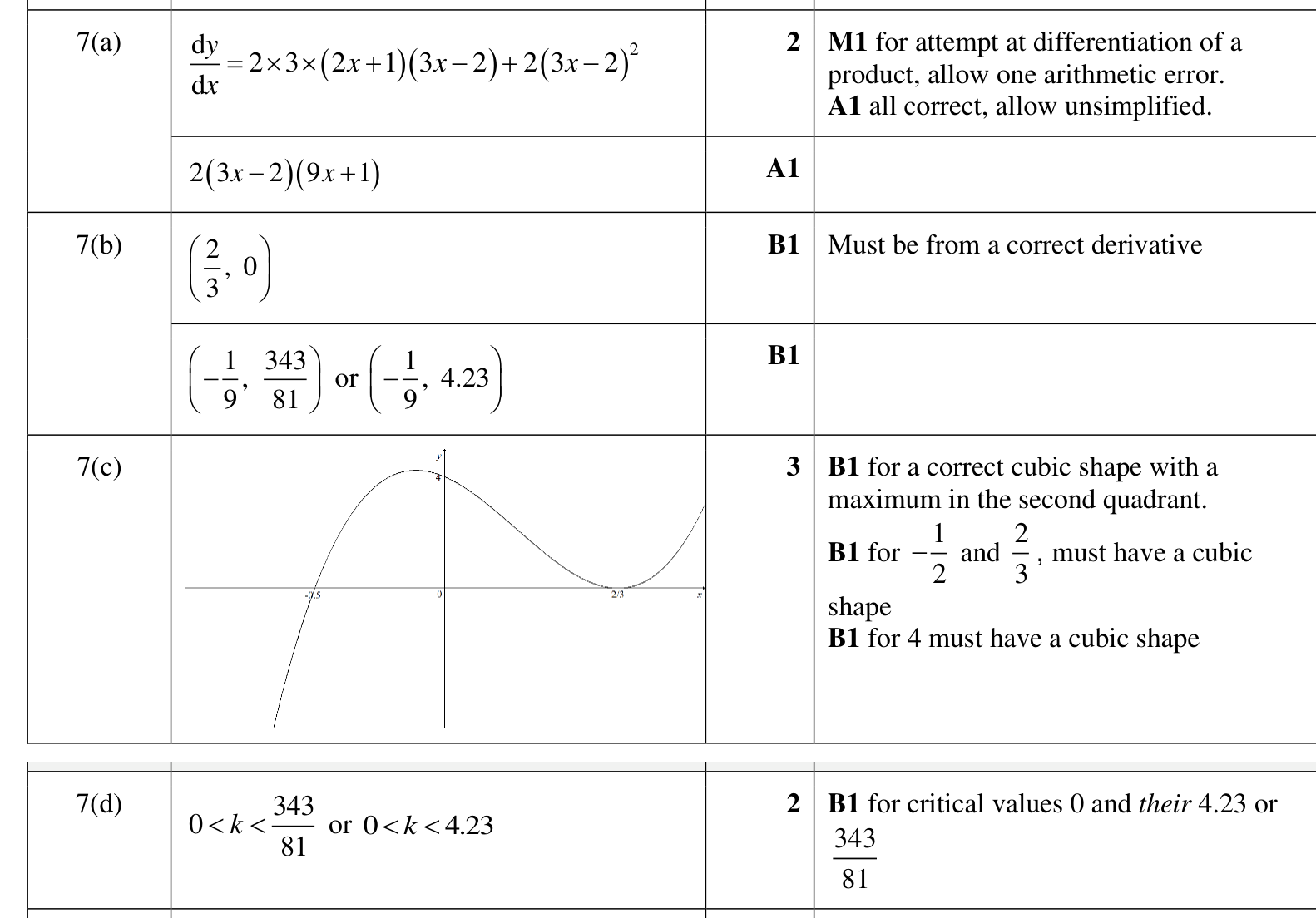
The function \(f\) is defined by
\(f(x)=(2x+1)(3x-2)^2\).
(a) Show that \(f'(x)\) can be written in the form \(2(3x-2)(px+q)\), where \(p\) and \(q\) are integers to be found.
(b) Find the coordinates of the stationary points of the graph of \(y=f(x)\).
(c) Sketch the graph of \(y=f(x)\), showing clearly the intercepts with the axes and the stationary points.
(d) Find the set of values of the constant \(k\) for which the equation \(f(x)=k\) has 3 distinct real roots.
0606 P13 - Nov 2023 - Q6 - 10 marks
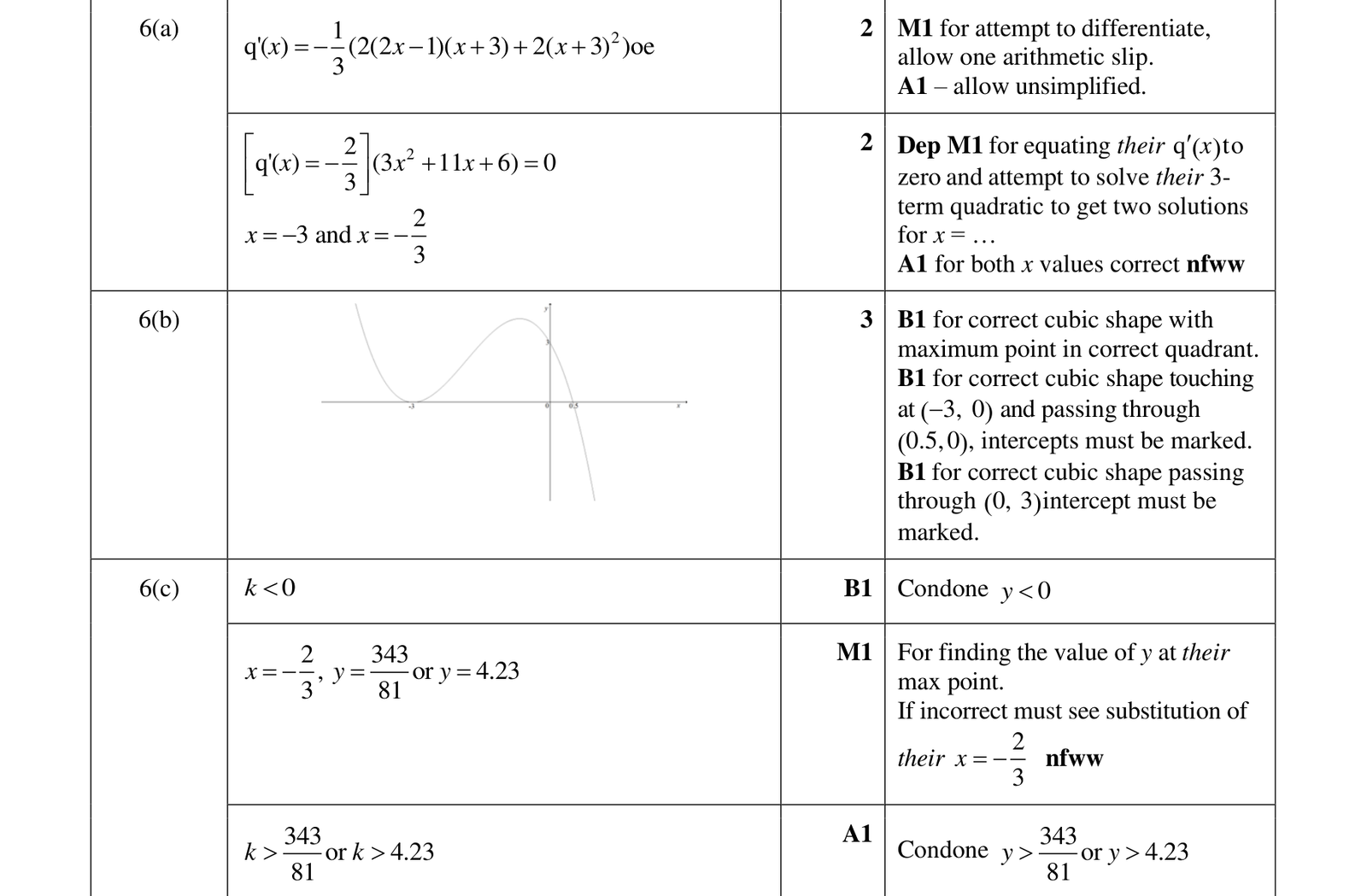
The polynomial \(\mathrm q(x)\) is given by
\(\mathrm q(x)=-\frac13(2x-1)(x+3)^2.\)
(a) Find the \(x\)-coordinates of the stationary points on the curve \(y=\mathrm q(x)\).
(b) On the axes, sketch the graph of \(y=\mathrm q(x)\), stating the intercepts with the coordinate axes.
(c) Find the values of \(k\) such that \(\mathrm q(x)=k\) has exactly one solution.
0606 P11 - Jun 2021 - Q8 - 8 marks
Do not use a calculator in this question.
A curve has equation
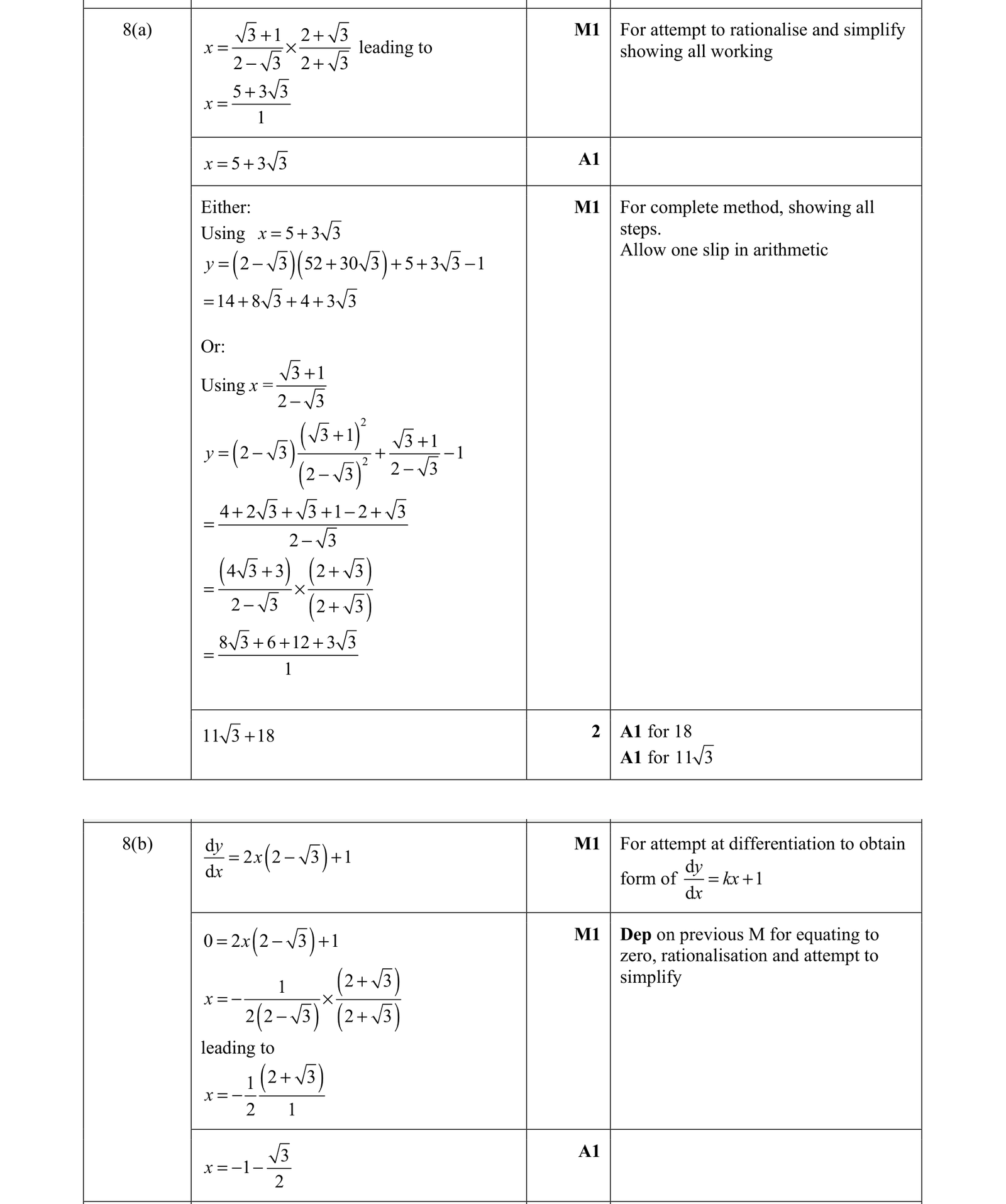
\(y=(2-\sqrt3)x^2+x-1.\)
The \(x\)-coordinate of a point \(A\) on the curve is
\(\frac{\sqrt3+1}{2-\sqrt3}.\)
(a) Show that the coordinates of \(A\) can be written in the form \((p+q\sqrt3,r+s\sqrt3)\), where \(p,q,r\) and \(s\) are integers.
(b) Find the \(x\)-coordinate of the stationary point on the curve, giving your answer in the form \(a+b\sqrt3\), where \(a\) and \(b\) are rational numbers.
0606 P12 - Jun 2021 - Q6 - 7 marks
A curve has equation
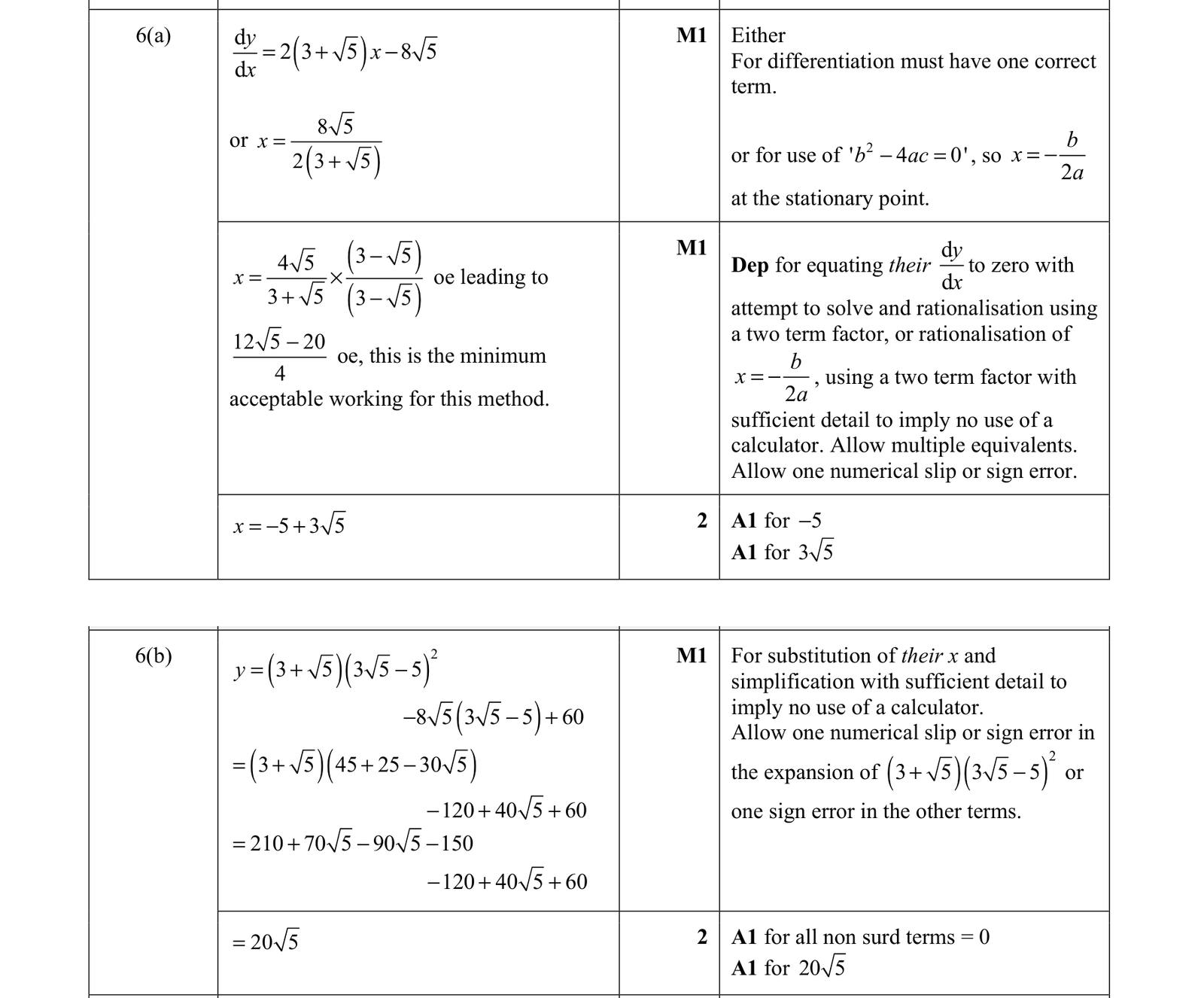
\(y=(3+\sqrt5)x^2-8\sqrt5\,x+60.\)
(a) Find the \(x\)-coordinate of the stationary point of the curve in the form \(a+b\sqrt5\), where \(a\) and \(b\) are integers.
(b) Find the \(y\)-coordinate of this stationary point in the form \(c\sqrt5\), where \(c\) is an integer.
0606 P22 - Nov 2021 - Q4 - 8 marks
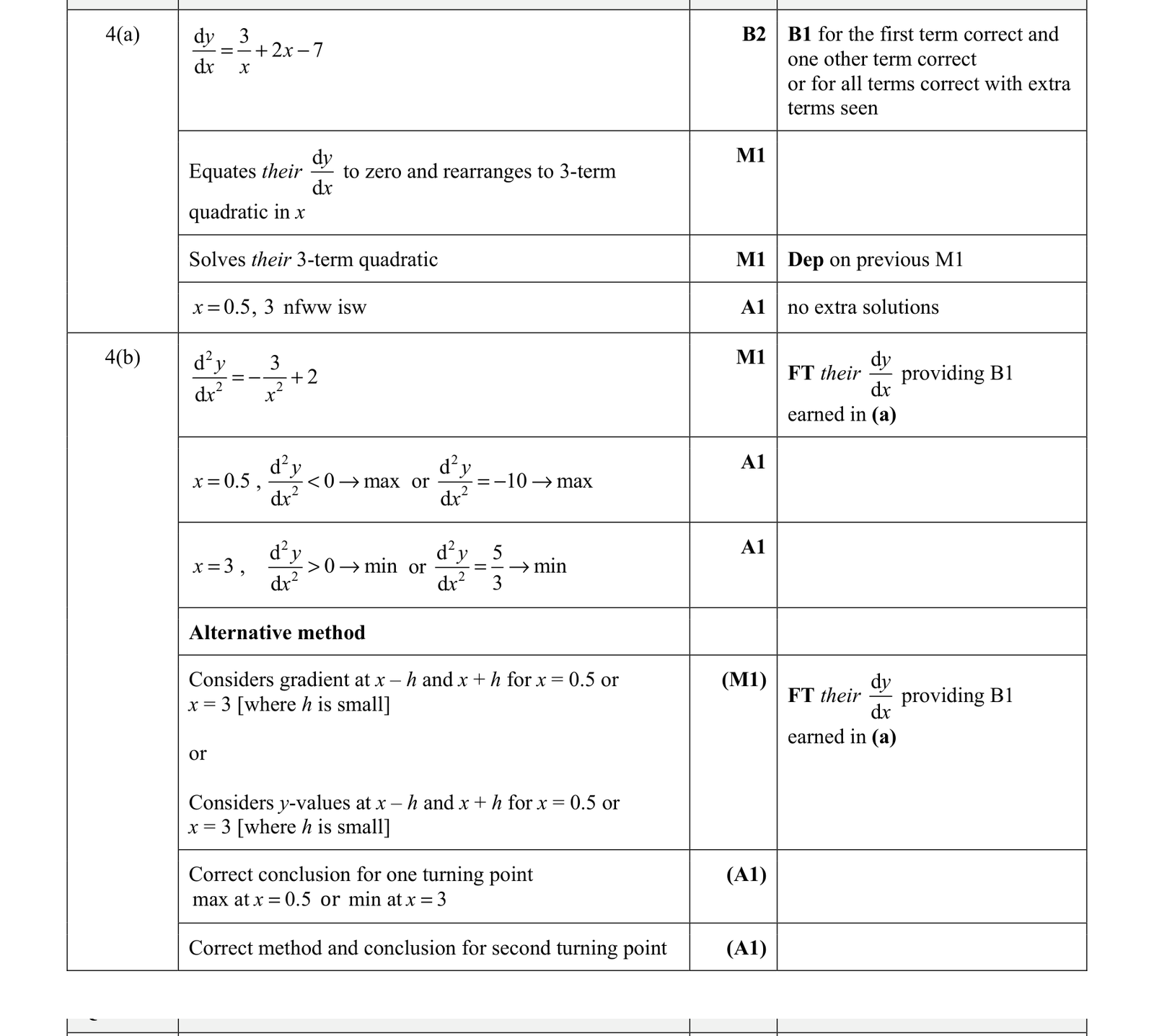
(a) Find the \(x\)-coordinates of the stationary points on the curve
\(y=3\ln x+x^2-7x,\)
where \(x\gt 0\).
(b) Determine the nature of each of these stationary points.
0606 P12 - Jun 2020 - Q7 - 10 marks
\(y=(x^2-1)\sqrt{5x+2}.\)
(a) Show that
\(\frac{dy}{dx}=\frac{Ax^2+Bx+C}{2\sqrt{5x+2}},\)
where \(A\), \(B\) and \(C\) are integers to be found.
(b) Find the coordinates of the stationary point of the curve for \(x\gt0\). Give your answer correct to 2 significant figures.
(c) Determine the nature of this stationary point.

0606 P13 - Jun 2020 - Q10 - 10 marks
(a) Given that
\(y=x\sqrt{x+2},\)
show that
\(\frac{dy}{dx}=\frac{Ax+B}{2\sqrt{x+2}},\)
where \(A\) and \(B\) are constants.
(b) Find the exact coordinates of the stationary point of the curve \(y=x\sqrt{x+2}\).
(c) Determine the nature of this stationary point.

0606 P12 - Nov 2020 - Q9 - 8 marks
It is given that
\(y=(2x-1)\sqrt{4x+3}.\)
(a) Show that
\(\frac{dy}{dx}=\frac{4(Ax+B)}{\sqrt{4x+3}},\)
where \(A\) and \(B\) are constants to be found.
(b) Find the \(x\)-coordinate of the stationary point and determine its nature.

0606 P12 - Jun 2018 - Q6 - 6 marks
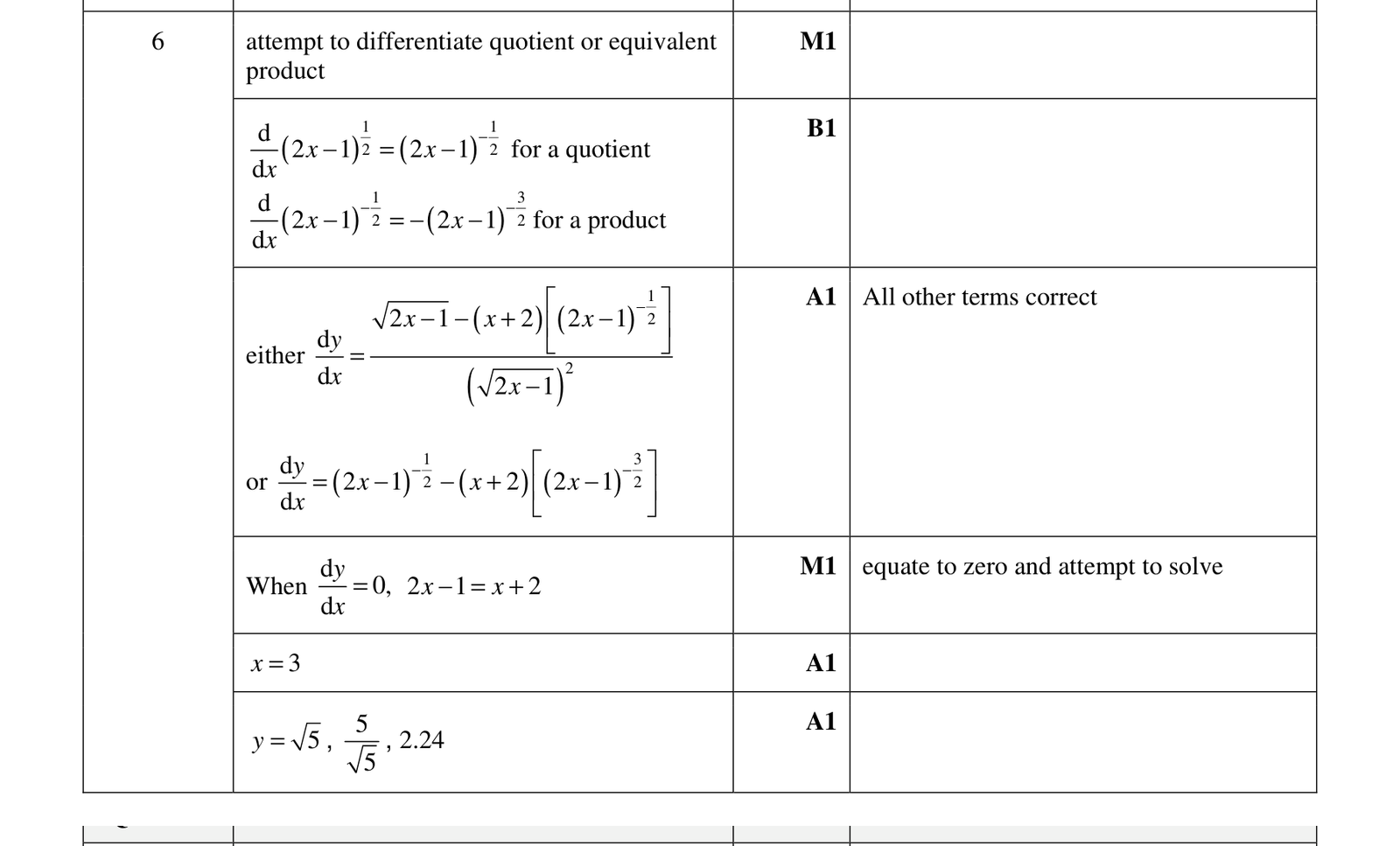
Find the coordinates of the stationary point of the curve
\(y=\frac{x+2}{\sqrt{2x-1}}.\)
0606 P23 - Nov 2018 - Q10 - 10 marks
The equation of a curve is
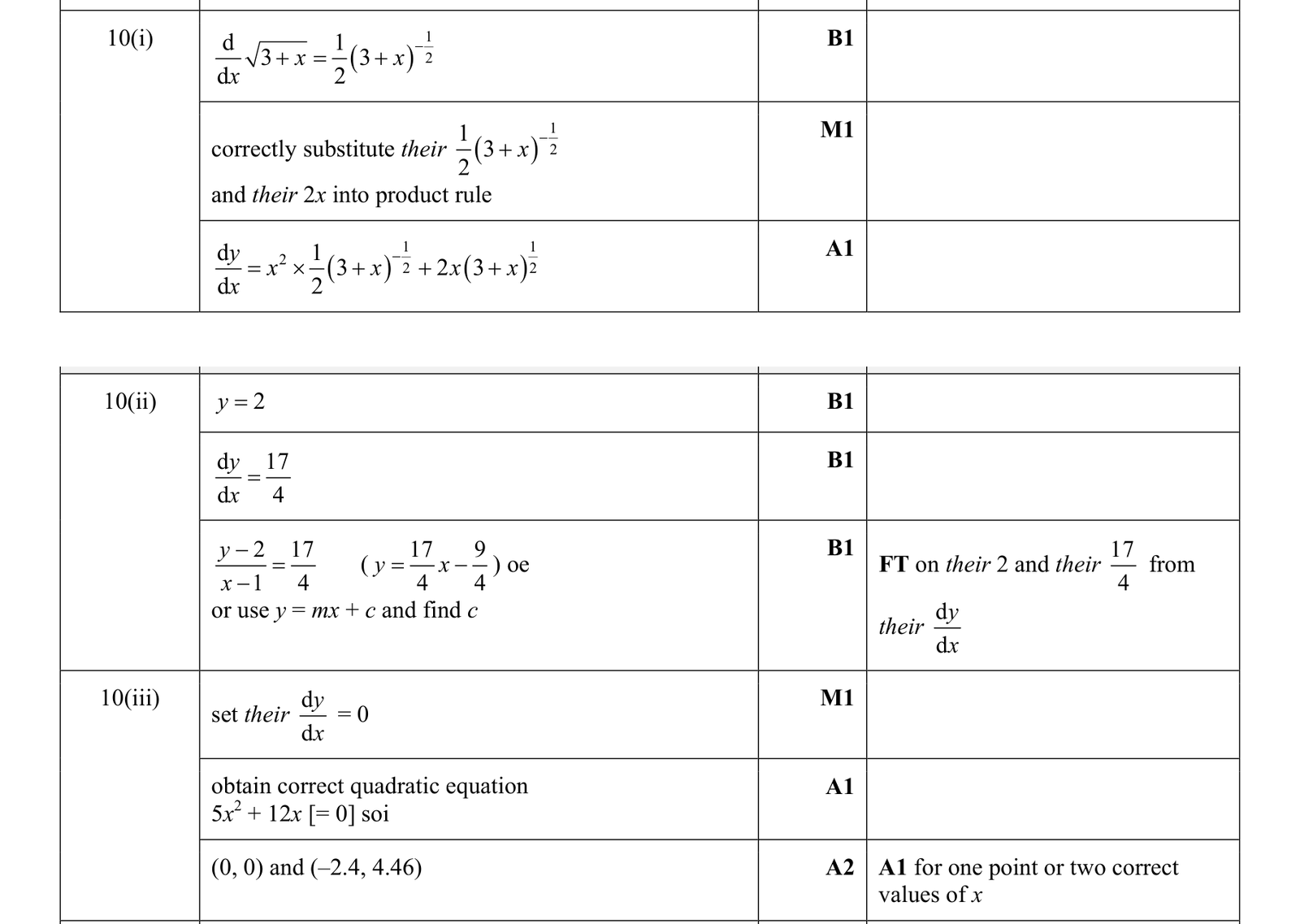
\(y=x^2\sqrt{3+x}\)
for \(x\geq-3\).
(i) Find \(\dfrac{dy}{dx}\).
(ii) Find the equation of the tangent to the curve \(y=x^2\sqrt{3+x}\) at the point where \(x=1\).
(iii) Find the coordinates of the turning points of the curve \(y=x^2\sqrt{3+x}\).
0606 P11 - Jun 2017 - Q7 - 8 marks
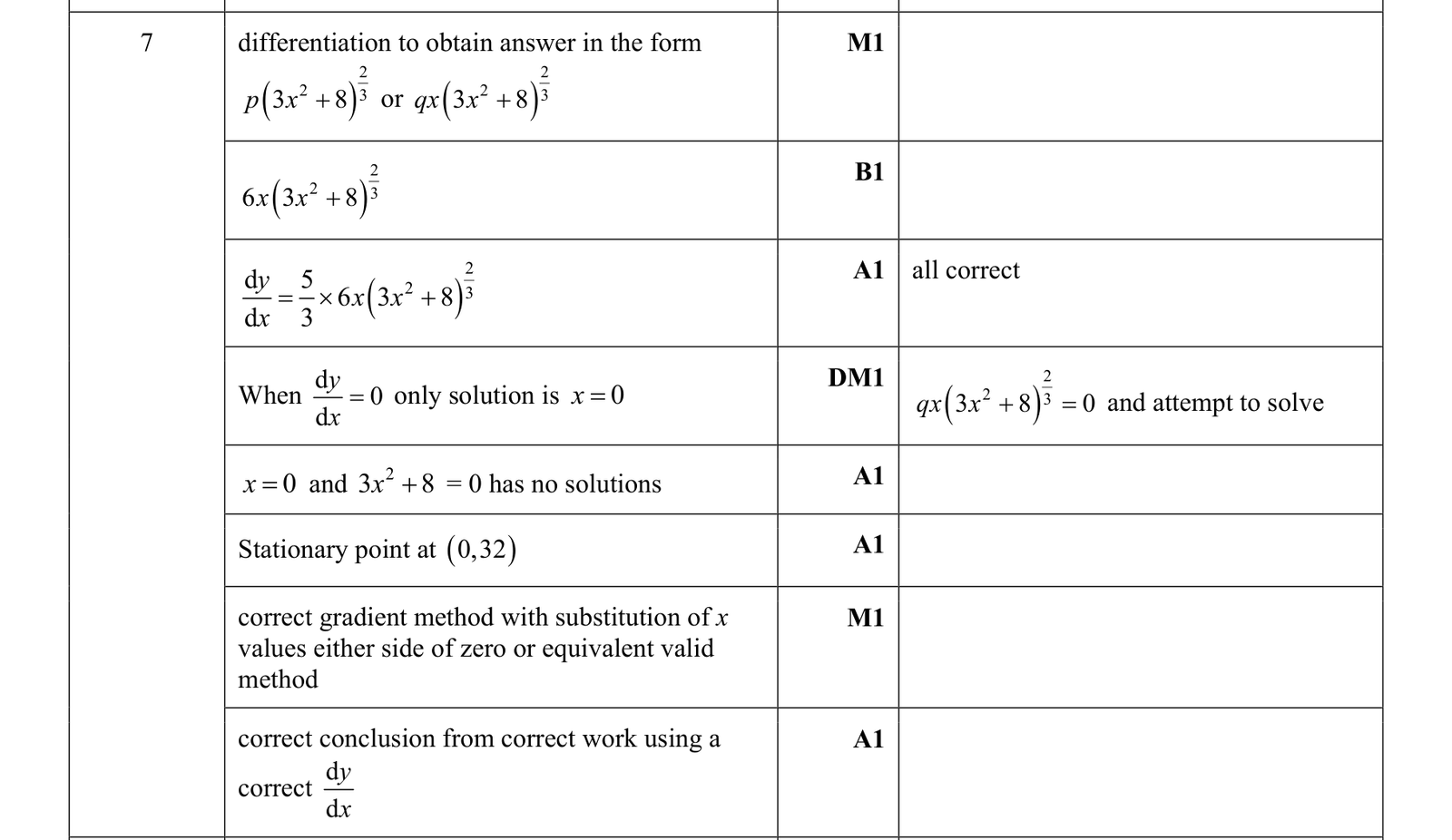
Show that the curve \(y=(3x^2+8)^{5/3}\) has only one stationary point. Find the coordinates of this stationary point and determine its nature.
0606 P21 - Nov 2025 - Q11 - 8 marks
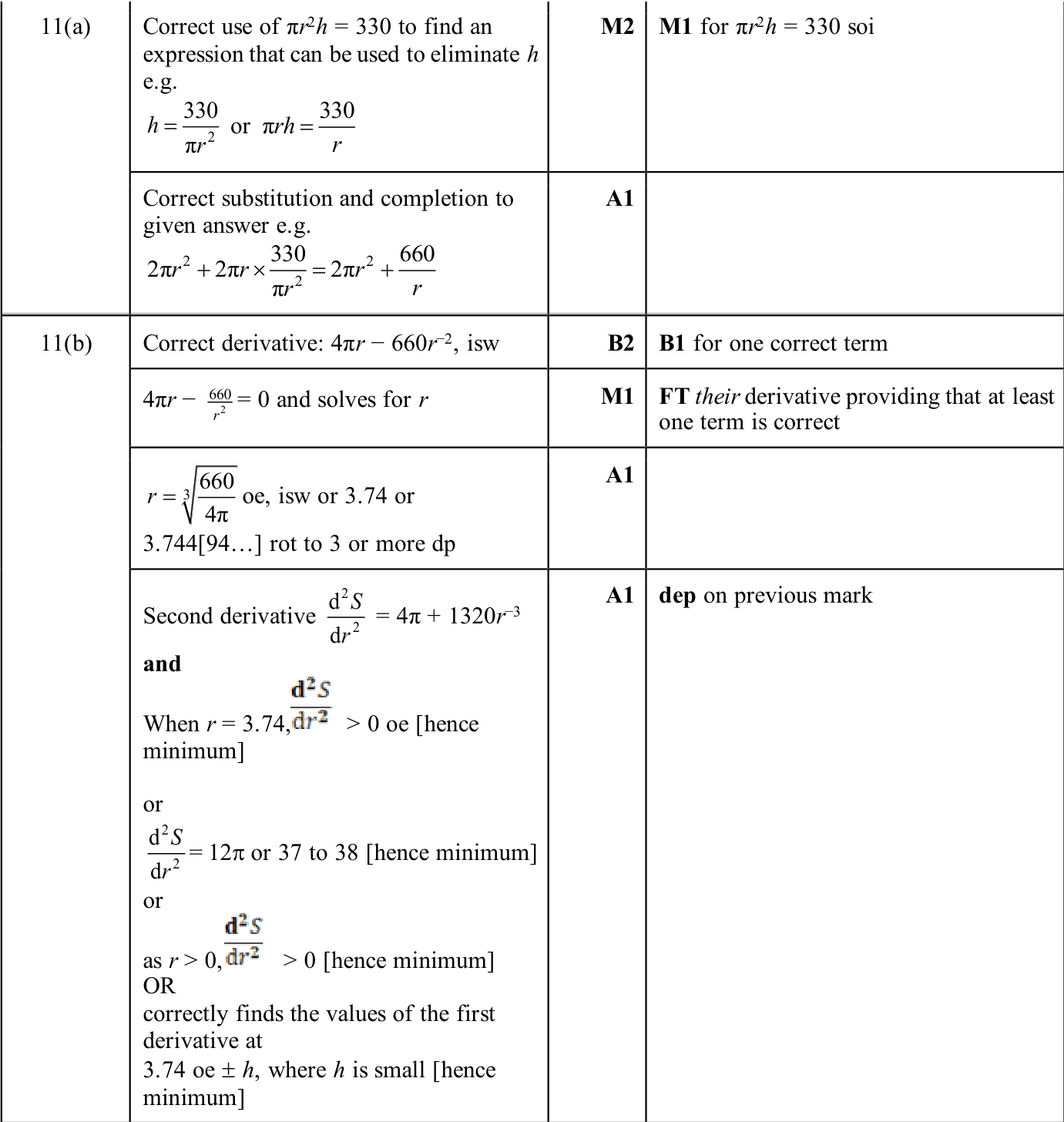
A cylinder has radius \(r\text{ cm}\) and height \(h\text{ cm}\). The total surface area, including the two ends, is \(A\text{ cm}^2\). The volume of the cylinder is \(330\text{ cm}^3\).
(a) Show that \(A=2\pi r^2+\dfrac{660}{r}\).
(b) Given that \(r\) can vary, find the value of \(r\) that gives a stationary value for \(A\) and show that this value is a minimum.
0606 P22 - Nov 2024 - Q12 - 6 marks
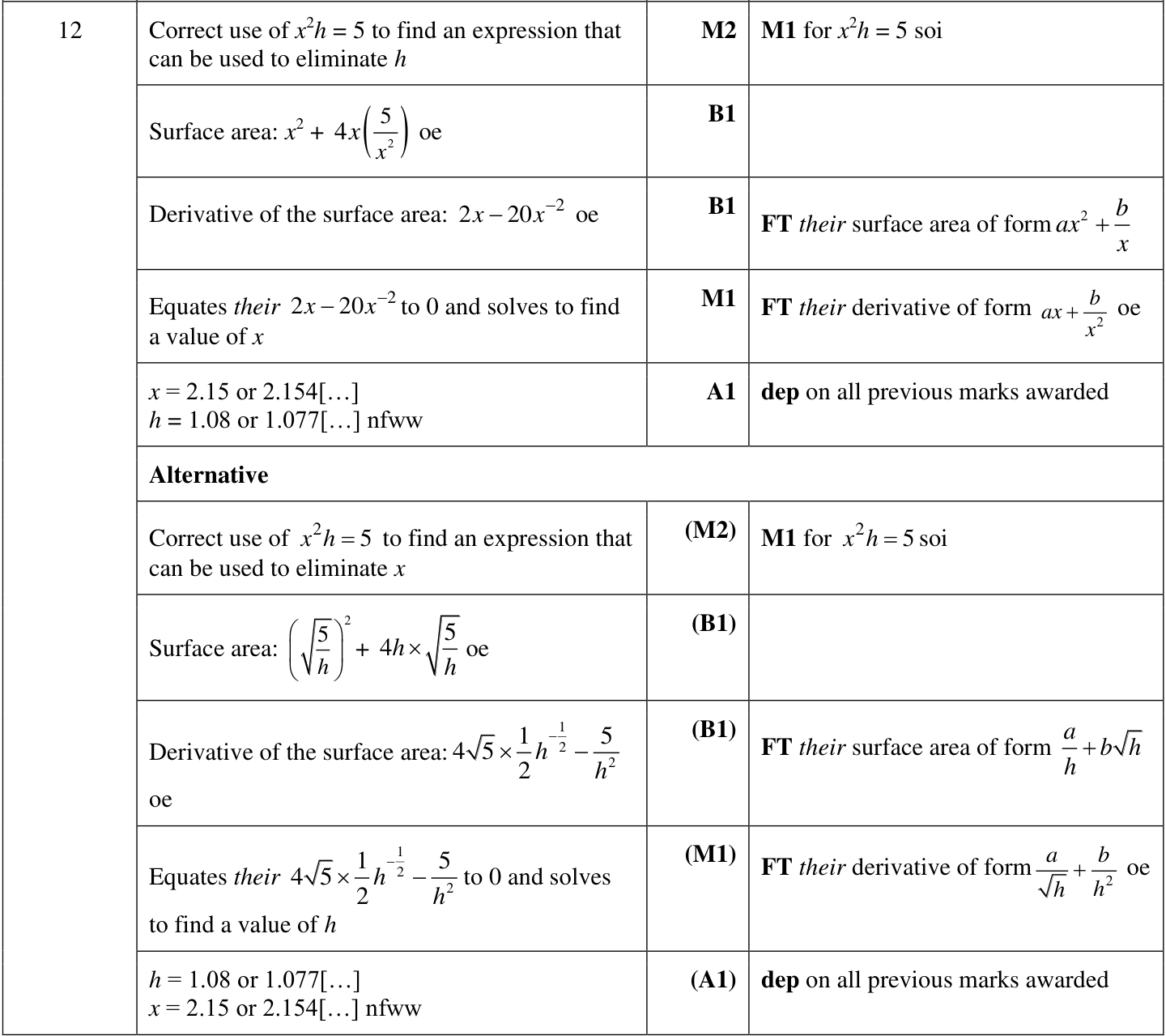
A metal tank is in the shape of a cuboid with a square base of side \(x \mathrm{~m}\) and an open top. The tank has a volume of \(5 \mathrm{~m}^{3}\). Given that \(x\) can vary, and that the area of the metal used to make the tank is a minimum, find the dimensions of the tank.
0606 P21 - Jun 2024 - Q11 - 7 marks
In this question all lengths are in centimetres.
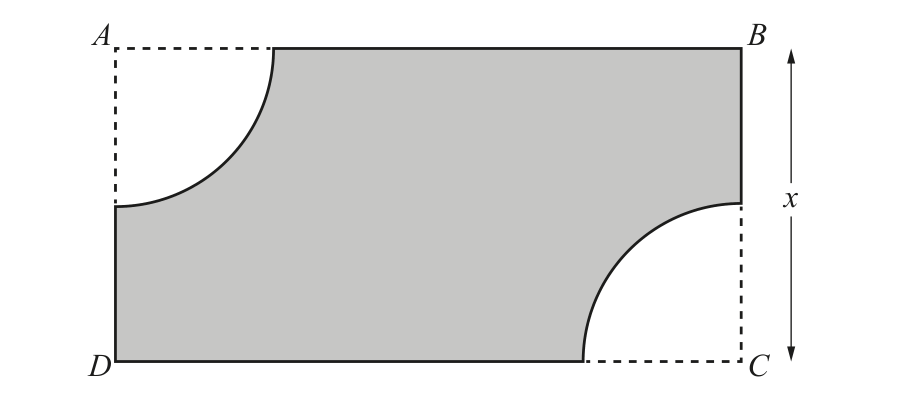
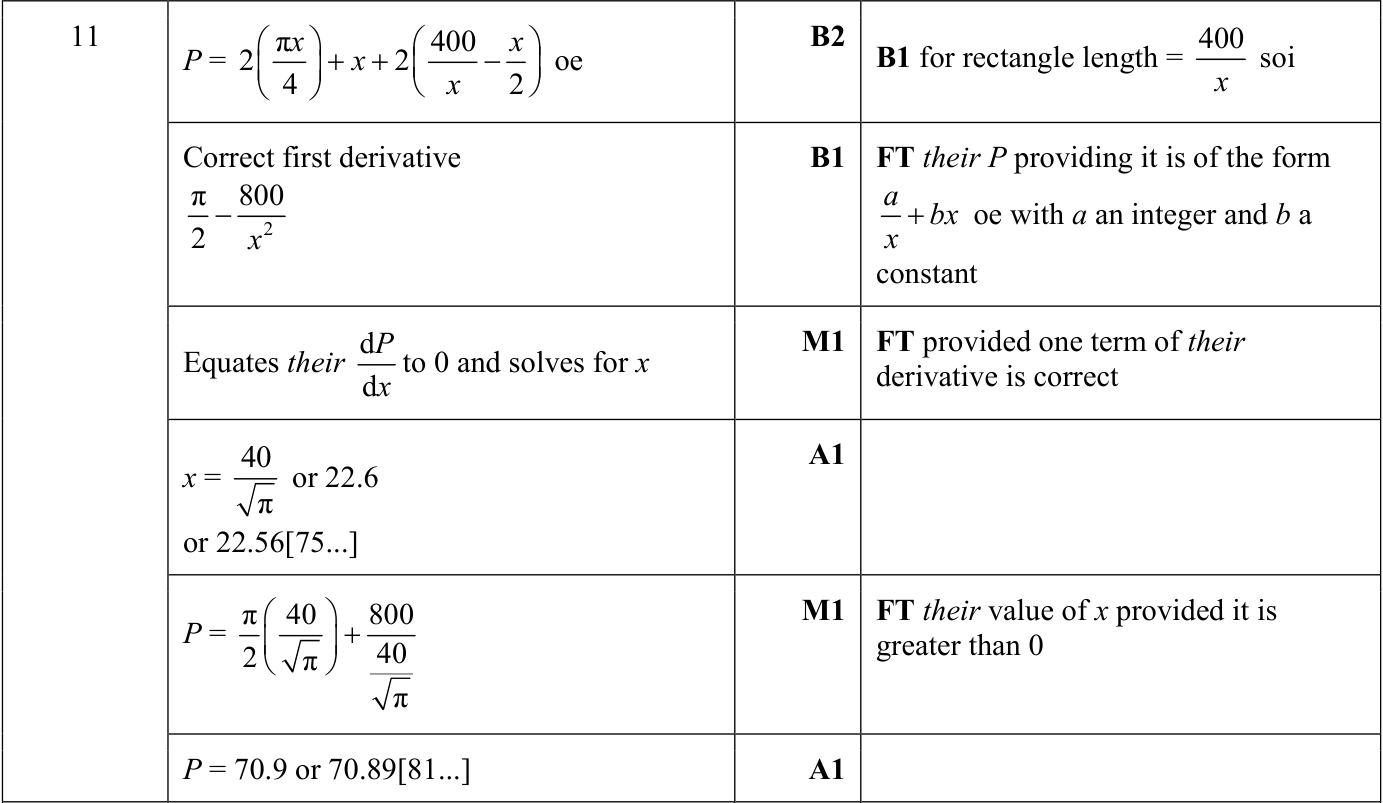
The diagram shows a rectangle \(A B C D\) with \(B C=x\). The area of the rectangle is \(400 \mathrm{~cm}^{2}\). Two identical quarter-circles of radius \(\frac{x}{2}\), with centres \(A\) and \(C\), are removed from the rectangle to make the shaded shape.
Given that \(x\) can vary, find the value of \(x\) that gives the minimum value of the perimeter of the shaded shape and hence find this minimum value.
0606 P23 - Nov 2023 - Q5 - 8 marks
The curved surface area of a cylinder with radius \(r\) and height \(h\) is \(2\pi rh\).
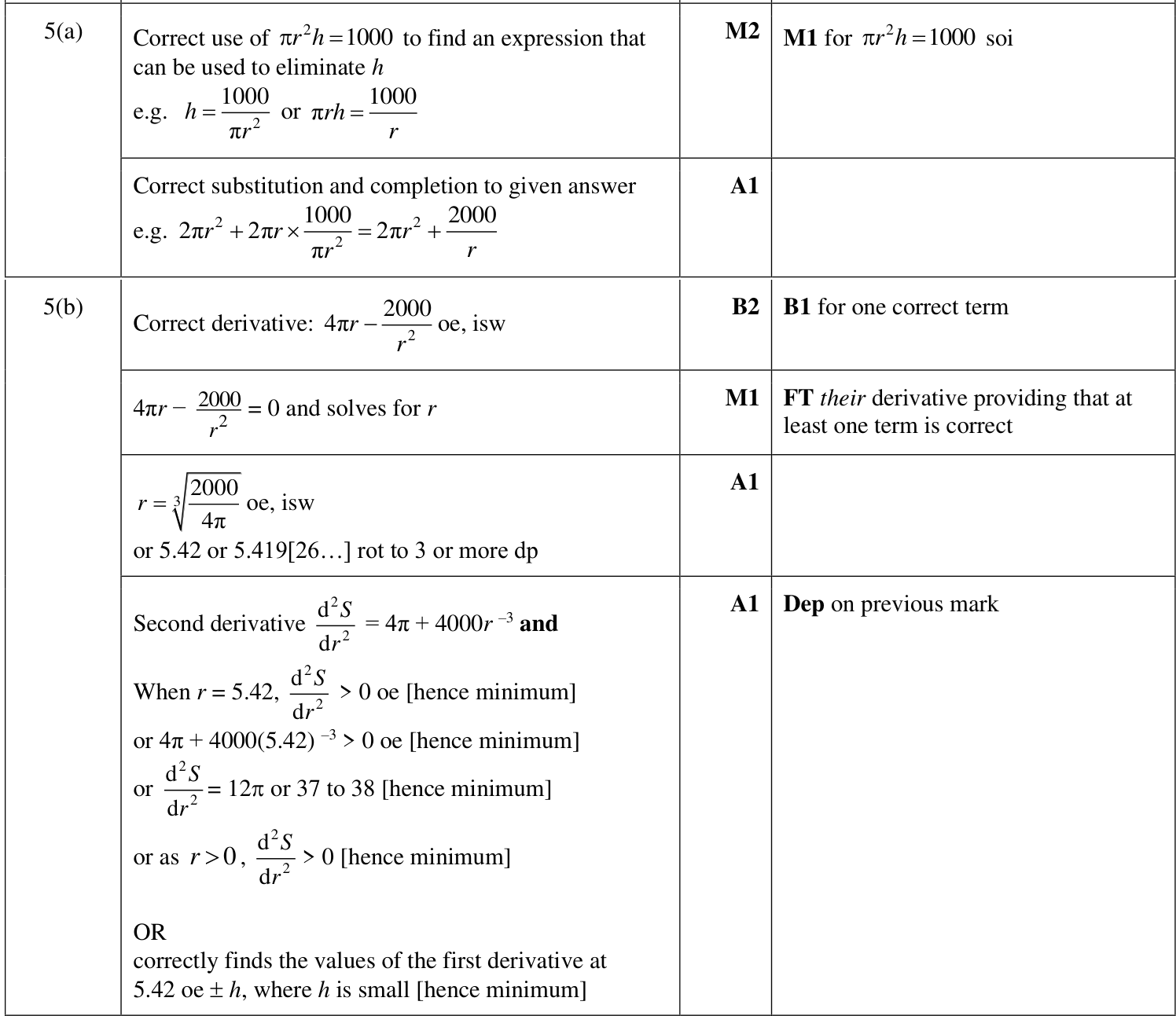
(a) A closed cylinder has volume \(1000\text{ cm}^3\). Show that its total surface area, \(S\text{ cm}^2\), is given by
\(S=2\pi r^2+\frac{2000}{r}\).
(b) Find the value of \(r\) for which the total surface area is a minimum.
0606 P22 - Mar 2022 - Q12 - 7 marks
In this question all lengths are in centimetres.
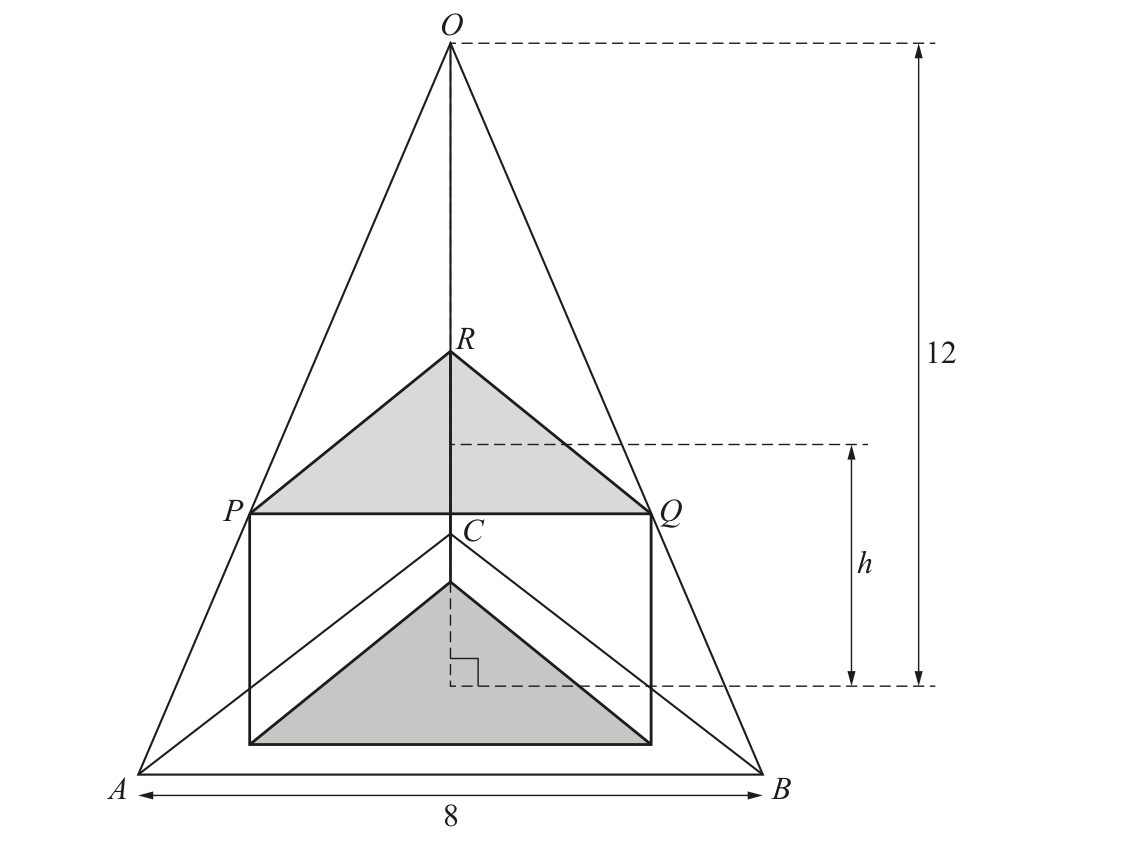
The diagram shows a right triangular prism of height \(h\) inside a right pyramid. The pyramid has a height of \(12\) and a base that is an equilateral triangle, \(ABC\), of side \(8\). The base of the prism sits on the base of the pyramid. Points \(P\), \(Q\) and \(R\) lie on the edges \(OA\), \(OB\) and \(OC\), respectively, of the pyramid \(OABC\). Pyramids \(OABC\) and \(OPQR\) are similar.
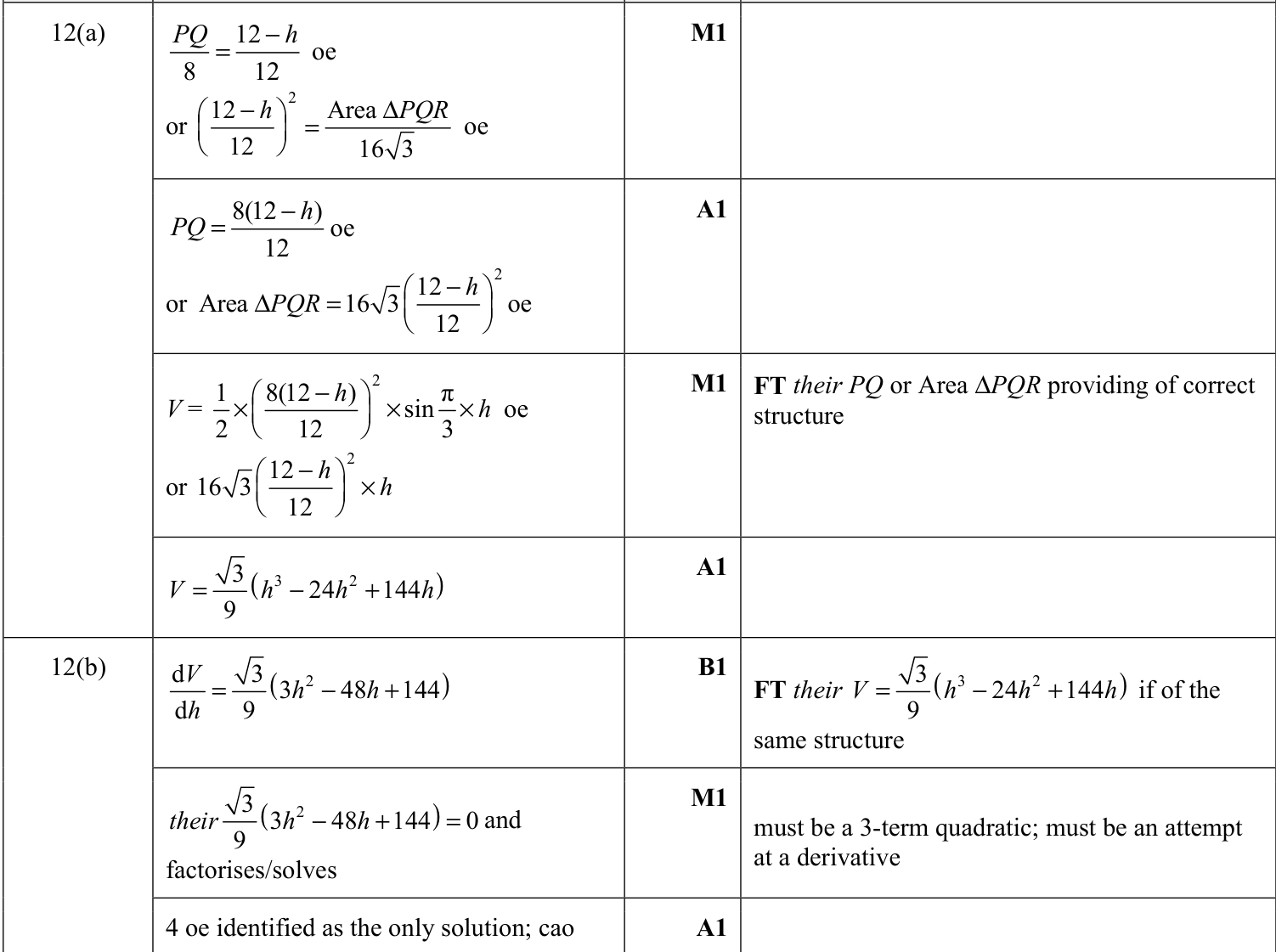
(a) Show that the volume, \(V\), of the triangular prism is given by
\(V=\frac{\sqrt3}{9}(ah^3+bh^2+ch),\)
where \(a\), \(b\) and \(c\) are integers to be found.
(b) It is given that, as \(h\) varies, \(V\) has a maximum value. Find the value of \(h\) that gives this maximum value of \(V\).
0606 P23 - Jun 2022 - Q12 - 8 marks
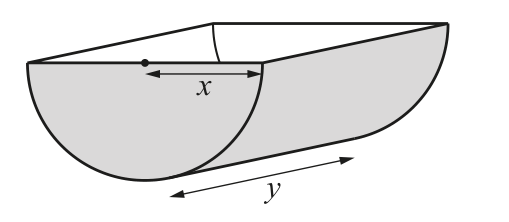
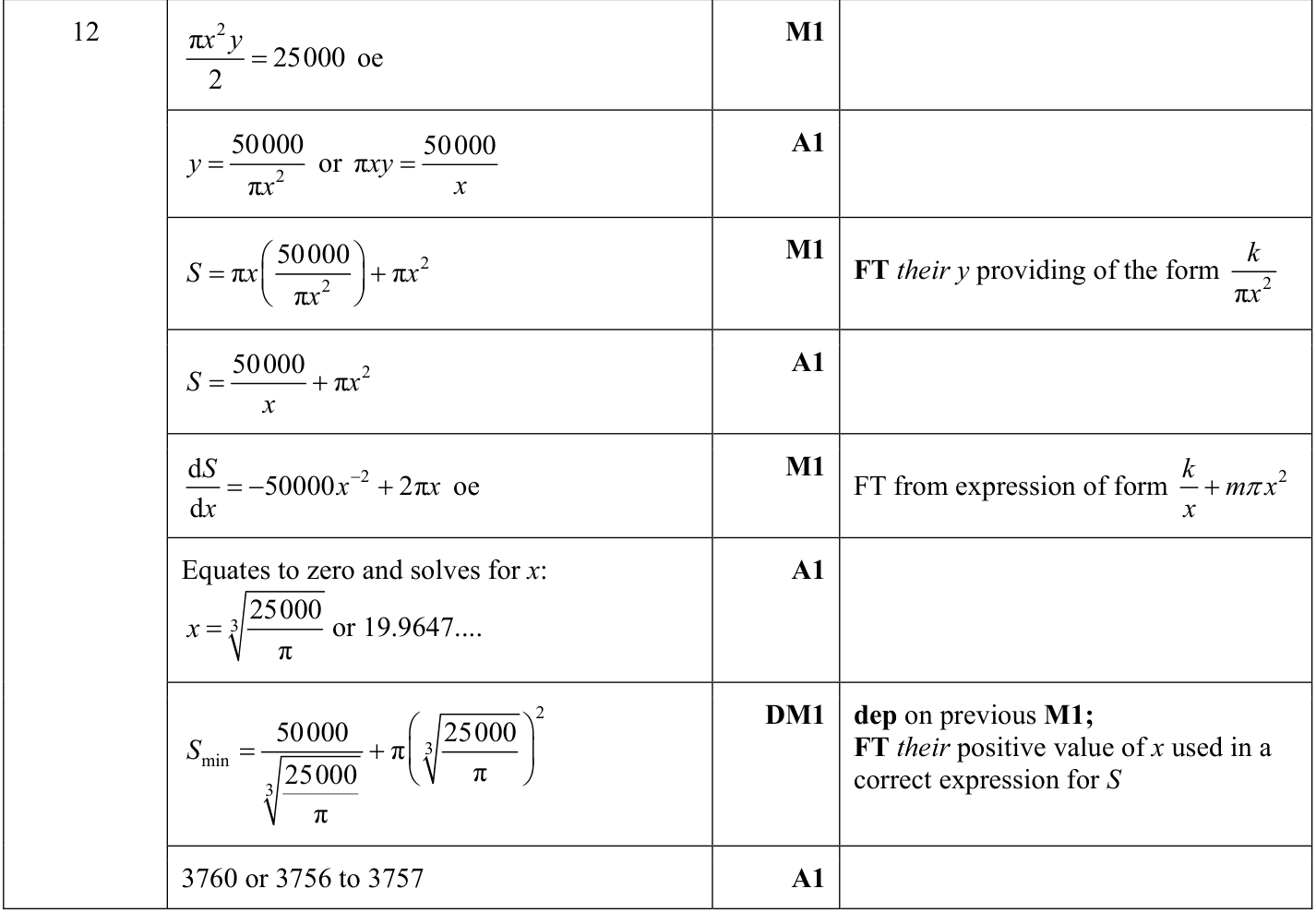
The diagram shows an open container in the shape of a half-cylinder. The length is \(y\) cm and the radius is \(x\) cm. The volume of the container is \(25000\text{ cm}^3\). Given that the outer surface area \(S\text{ cm}^2\) has a minimum value, find this minimum value.
0606 P22 - Nov 2022 - Q8 - 10 marks
In this question all lengths are in centimetres.
The volume of a cylinder with radius \(r\) and height \(h\) is \(\pi r^2h\) and its curved surface area is \(2\pi rh\).
The volume of a sphere with radius \(r\) is \(\frac43\pi r^3\) and its surface area is \(4\pi r^2\).
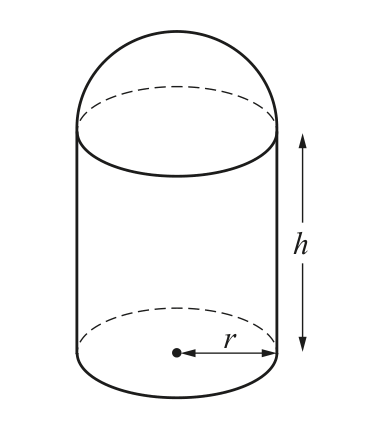
The diagram shows a solid object in the shape of a cylinder of base radius \(r\) and height \(h\), with a hemisphere of radius \(r\) on top. The total surface area of the object is \(300\text{ cm}^2\).
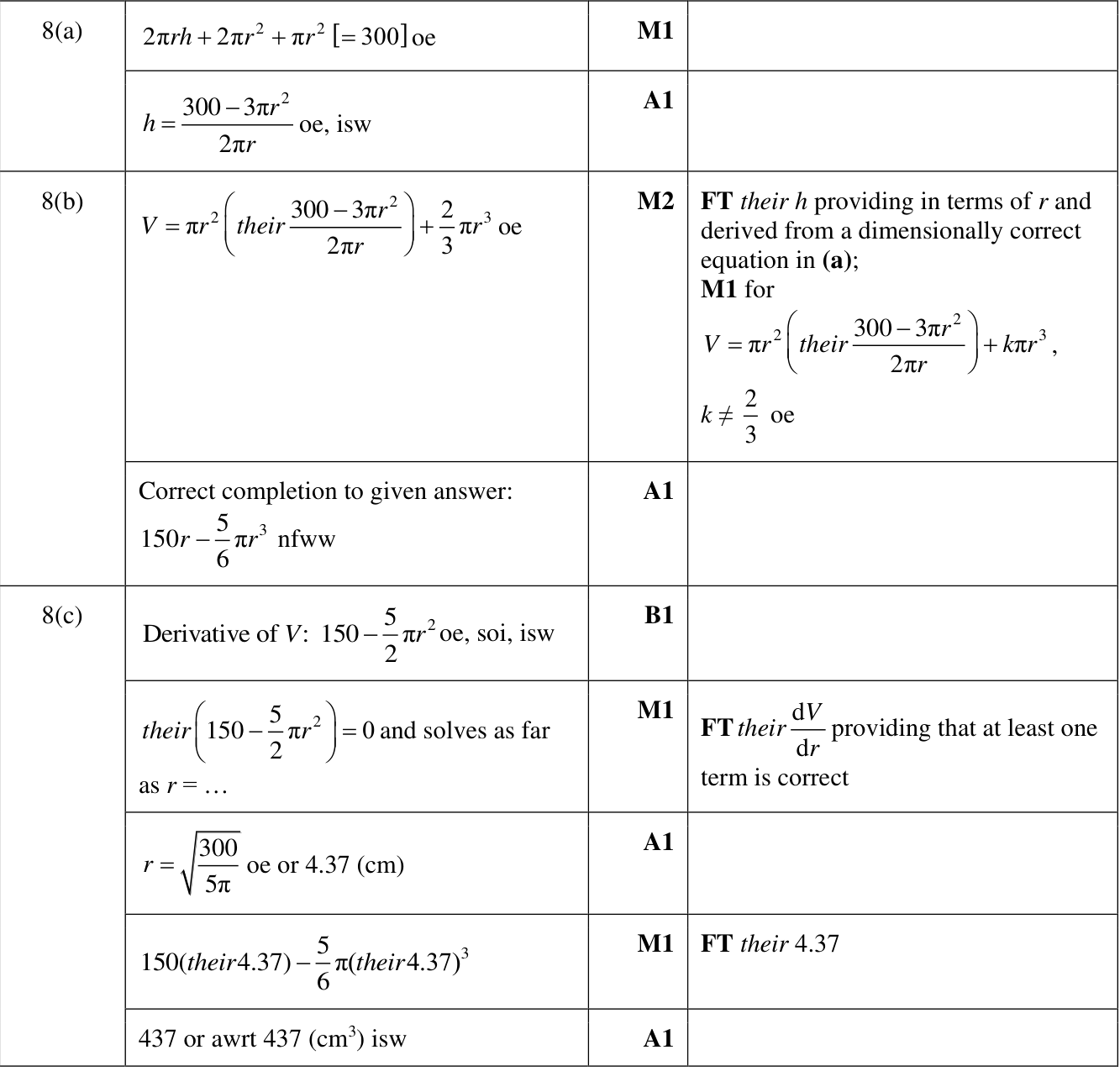
(a) Find an expression for \(h\) in terms of \(r\).
(b) Show that the volume, \(V\), of the object is
\(150r-\frac56\pi r^3.\)
(c) Find the maximum volume of the object as \(r\) varies.