Past Exam Questions
← Back0606 P11 - Nov 2018 - Q9 - 8 marks
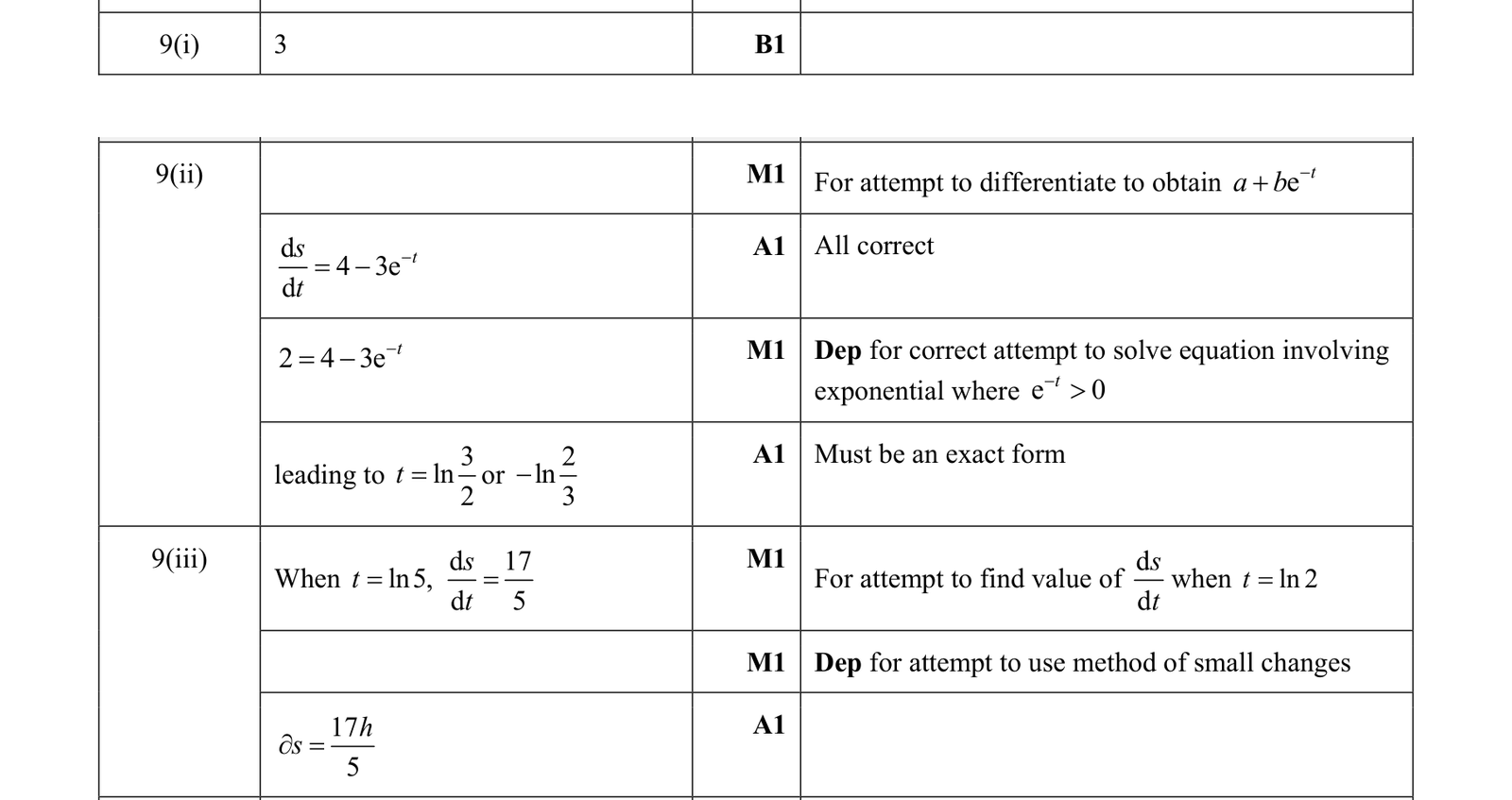
Variables \(s\) and \(t\) are such that \(s=4t+3e^{-t}\).
(i) Find the value of \(s\) when \(t=0\).
(ii) Find the exact value of \(t\) when \(\dfrac{ds}{dt}=2\).
(iii) Find the approximate increase in \(s\) when \(t\) increases from \(\ln5\) to \(\ln5+h\), where \(h\) is small.
0606 P13 - Jun 2017 - Q11 - 9 marks
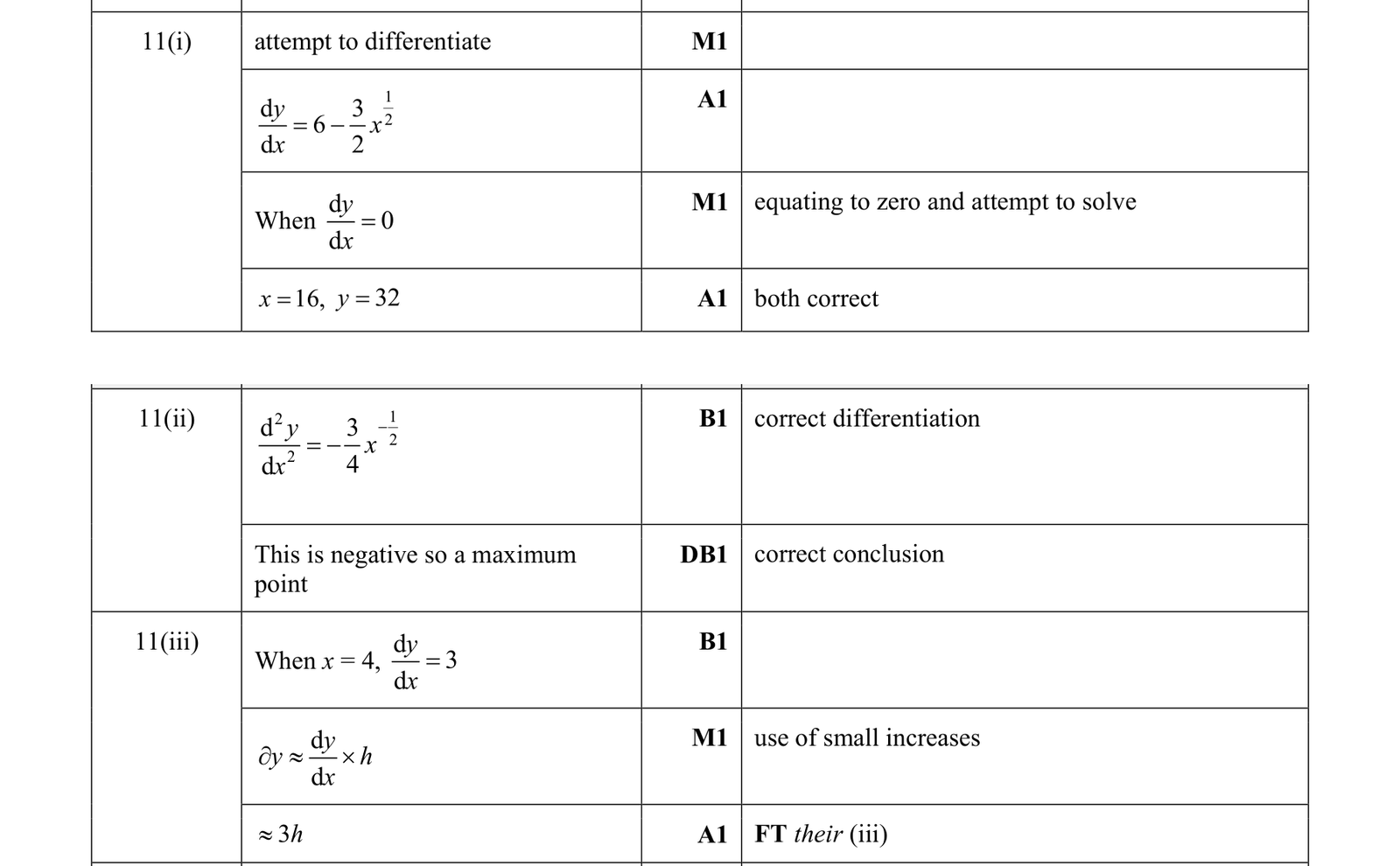
A curve has equation
\(y=6x-x\sqrt{x}.\)
(i) Find the coordinates of the stationary point of the curve.
(ii) Determine the nature of this stationary point.
(iii) Find the approximate change in \(y\) when \(x\) increases from \(4\) to \(4+h\), where \(h\) is small.
0606 P21 - Jun 2017 - Q3 - 4 marks
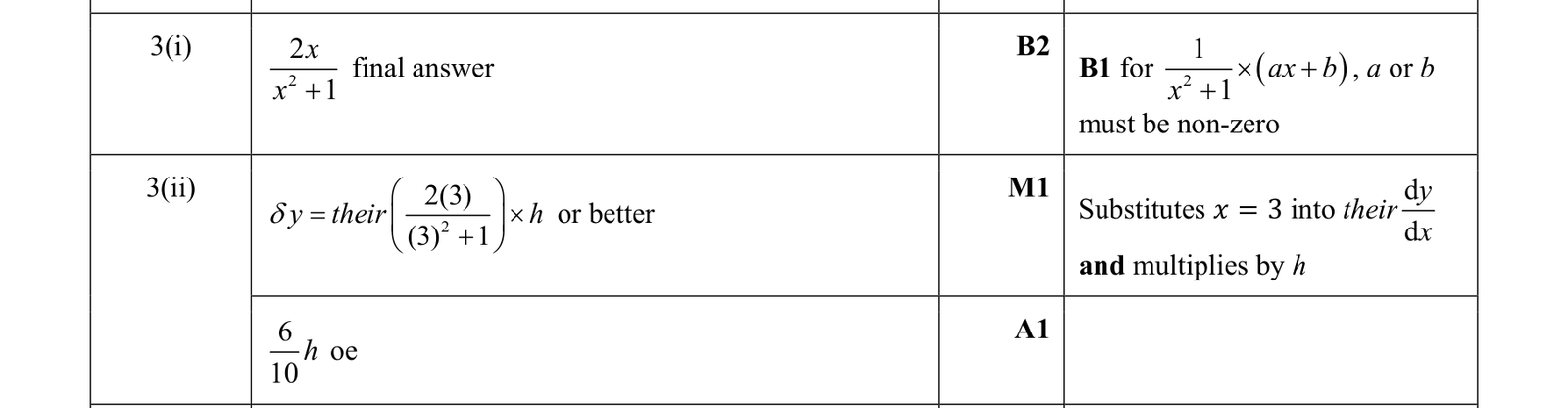
The variables \(x\) and \(y\) are such that \(y=\ln(x^2+1)\).
(i) Find an expression for \(\dfrac{dy}{dx}\).
(ii) Hence, find the approximate change in \(y\) when \(x\) increases from \(3\) to \(3+h\), where \(h\) is small.
0606 P22 - Jun 2025 - Q6 - 6 marks
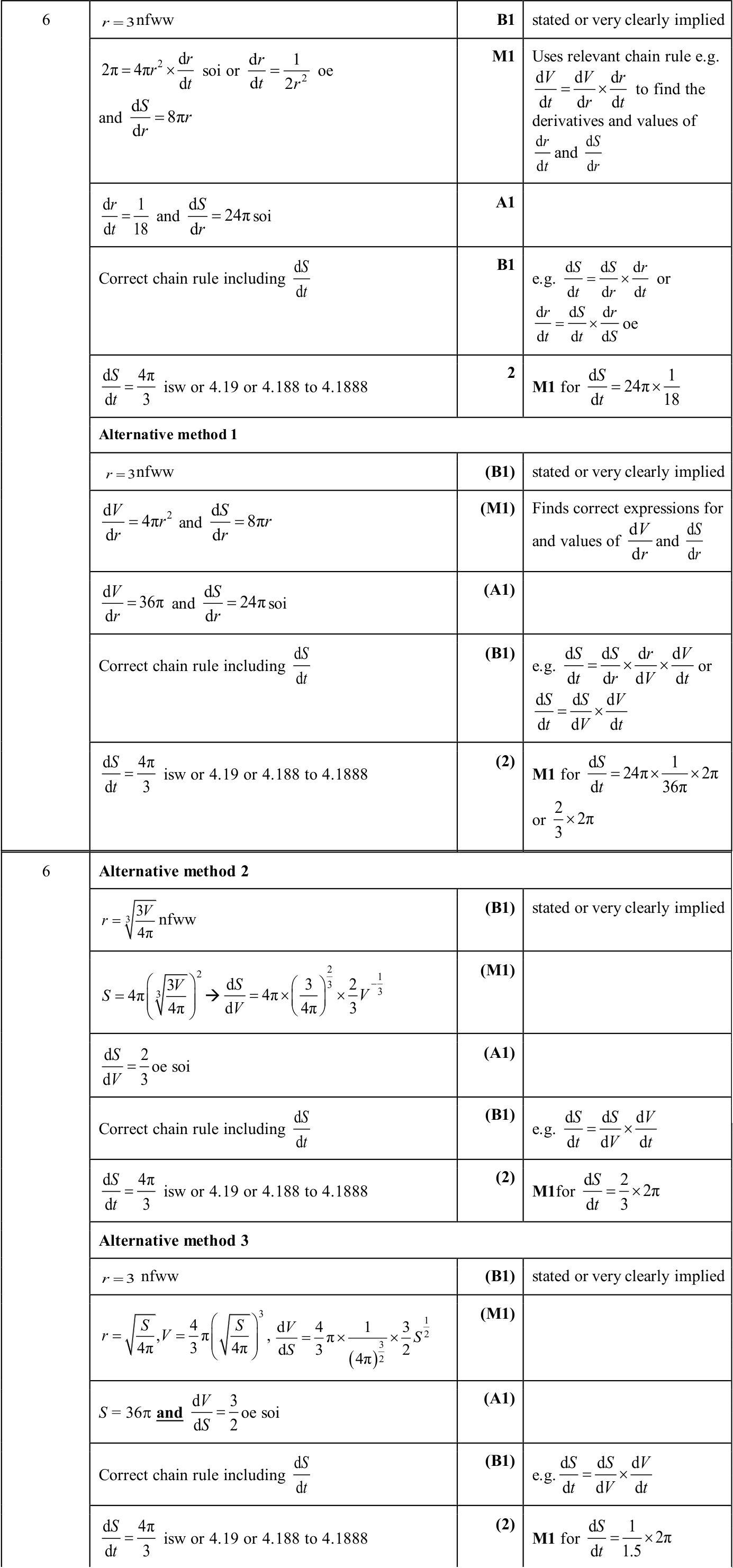
The volume, \(V\), of a sphere is increasing at the constant rate of \(2 \pi \mathrm{~cm}^{3} \mathrm{~s}^{-1}\). Find the rate of change of the surface area, \(S\), of this sphere when the volume of the sphere is \(36 \pi \mathrm{~cm}^{3}\).
0606 P22 - Mar 2024 - Q11 - 5 marks
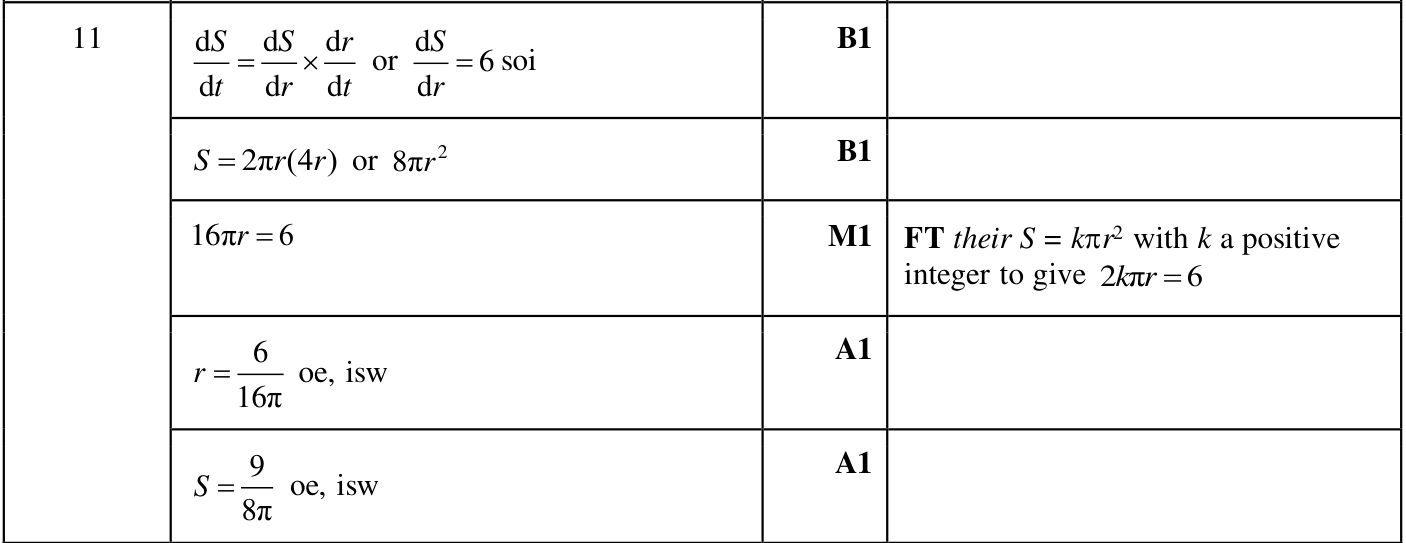
A cylinder, open at both ends, has base radius \(r \mathrm{~cm}\) and height \(4 r \mathrm{~cm}\). Its curved surface area is \(S \mathrm{~cm}^{2}\). Given that \(r\) varies with time \(t\), find \(S\) at the instant when \(\frac{\mathrm{d} S}{\mathrm{~d} t}=6 \frac{\mathrm{~d} r}{\mathrm{~d} t}\).
0606 P21 - Jun 2023 - Q5 - 4 marks
The volume \(V\text{ cm}^3\) of a sphere of radius \(r\text{ cm}\) is given by
\(V=\frac43\pi r^3.\)
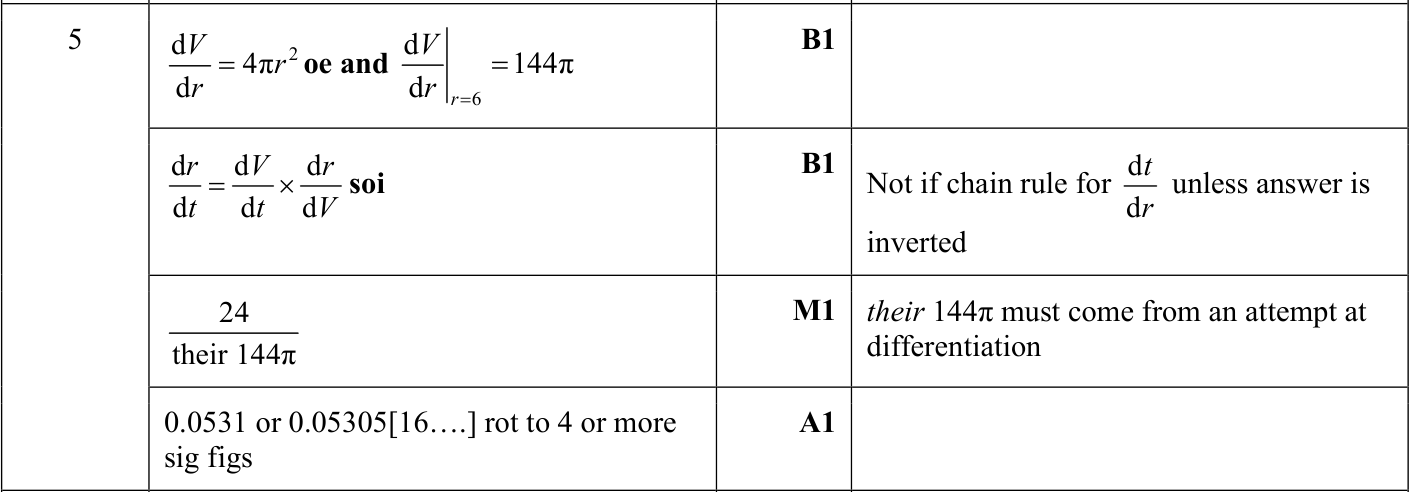
At the instant when \(r=6\), the volume is increasing at a rate of \(24\text{ cm}^3\text{s}^{-1}\). Find the rate at which the radius is increasing at this instant, giving your answer in terms of \(\pi\).
0606 P21 - Jun 2022 - Q9 - 8 marks
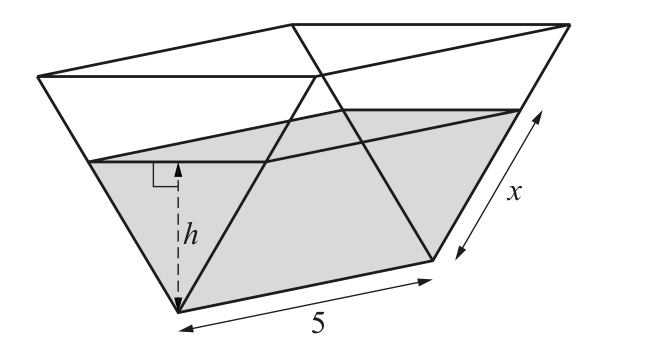
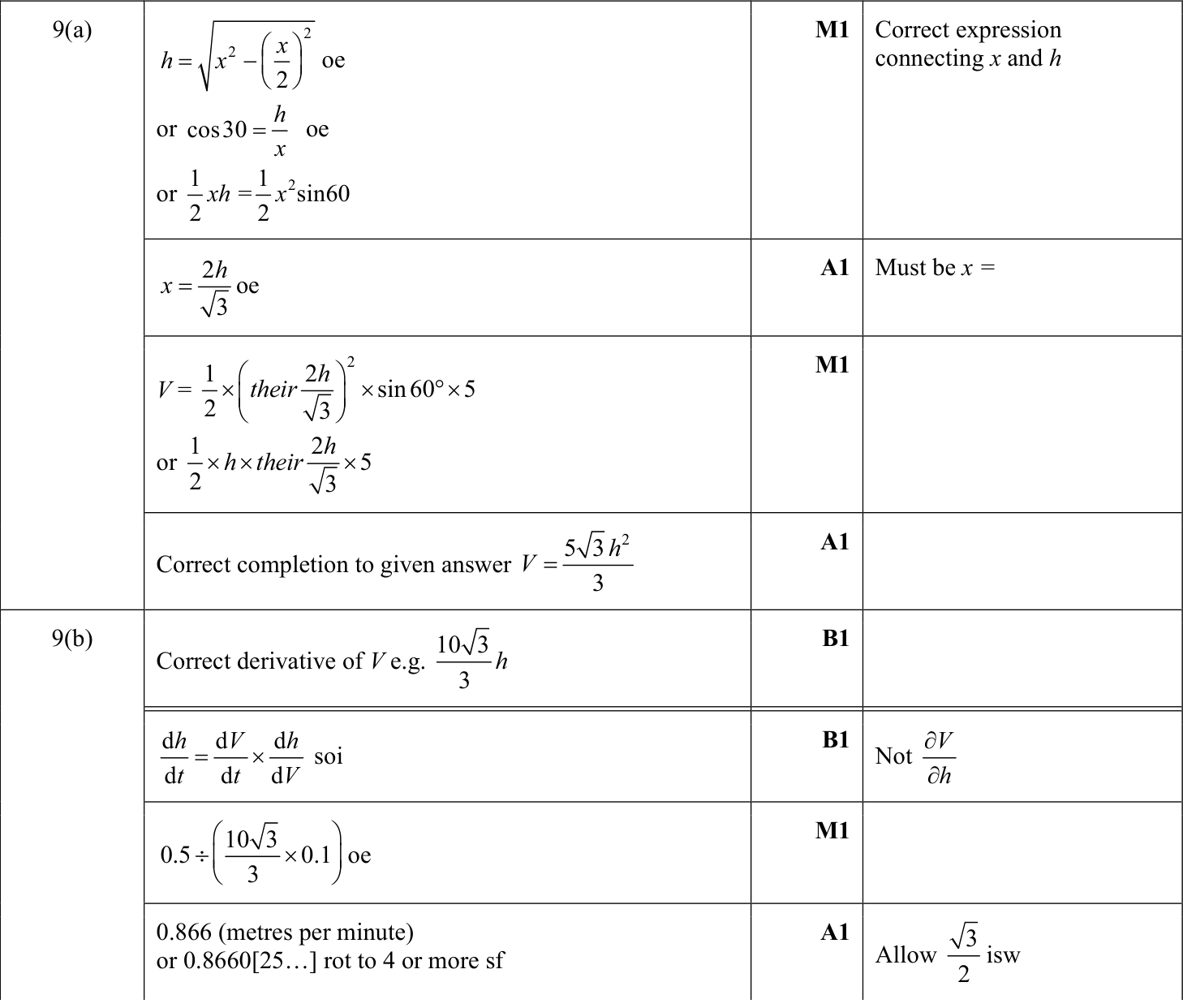
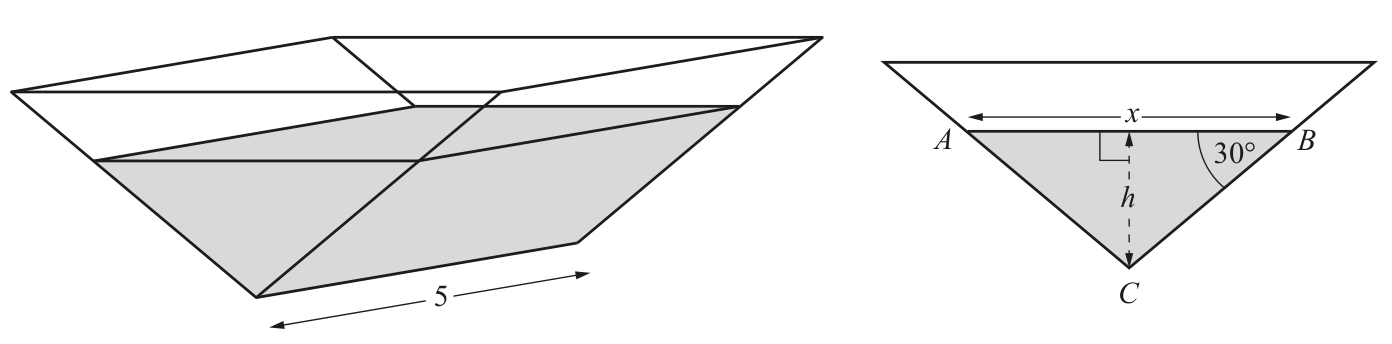
The diagram shows a container in the shape of a triangular prism. The container has length 5 m and the cross-section is an equilateral triangle. The container is being filled with water. At the instant when the depth of water is \(h\) m, the surface of the water has width \(x\) m.
(a) Show that the volume of water in the container is given by \(\displaystyle V=\frac{5\sqrt3}{3}h^2\).
(b) Water is pumped into the container at a rate of \(0.5\) m\(^3\) min\(^{-1}\). Find the rate at which the depth of the water is increasing when \(h=0.1\).
0606 P22 - Mar 2021 - Q5 - 6 marks
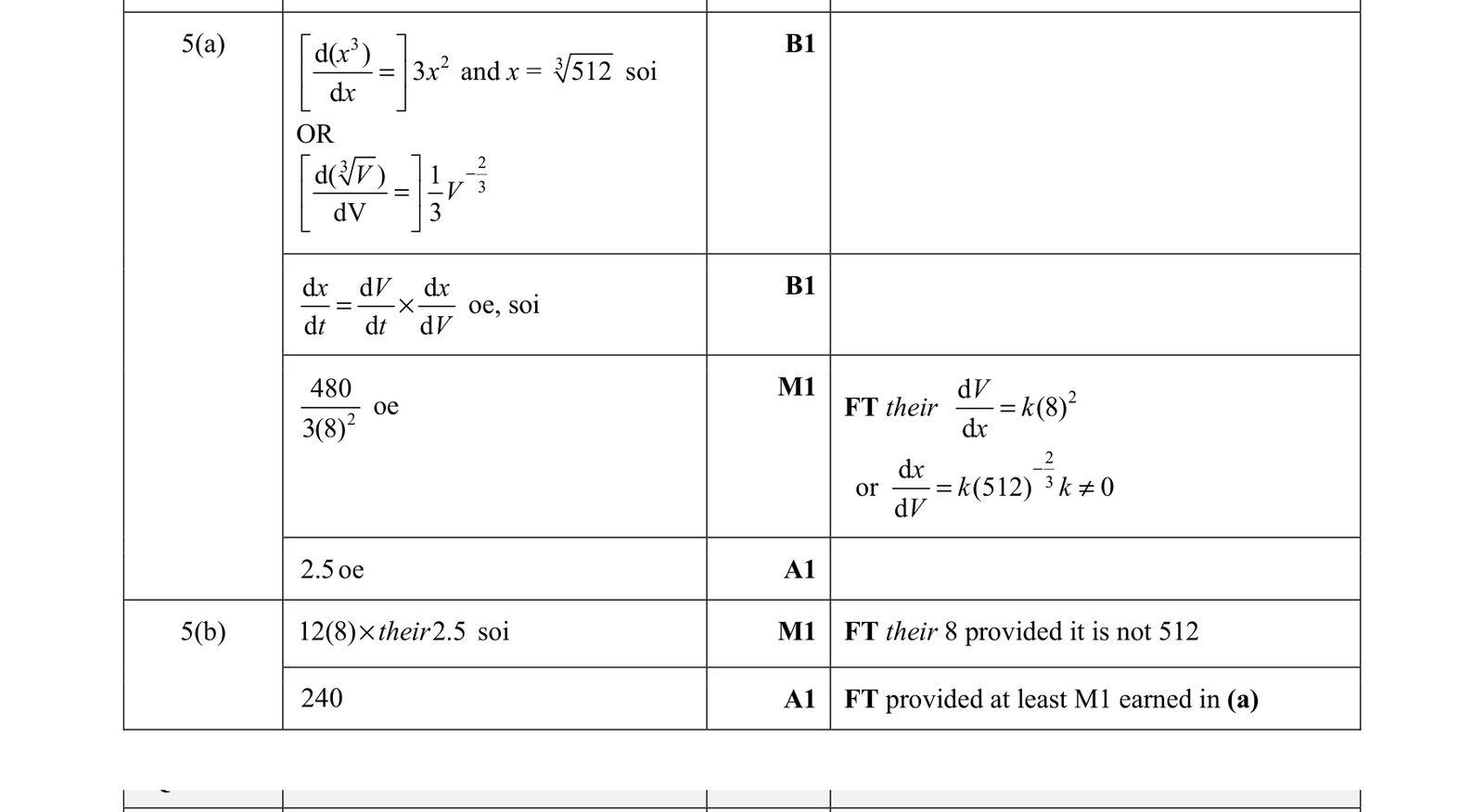
A cube of side \(x\text{ cm}\) has surface area \(S\text{ cm}^2\). The volume, \(V\text{ cm}^3\), of the cube is increasing at a rate of \(480\text{ cm}^3\text{ s}^{-1}\). Find, at the instant when \(V=512\),
(a) the rate of increase of \(x\),
(b) the rate of increase of \(S\).
0606 P11 - Jun 2020 - Q3 - 4 marks
The radius, \(r\) cm, of a circle is increasing at the rate of \(5\text{ cm s}^{-1}\). Find, in terms of \(\pi\), the rate at which the area of the circle is increasing when \(r=3\).

0606 P12 - Jun 2020 - Q2 - 4 marks
A sphere has volume \(V\text{ cm}^3\), where
\(V=\frac{4}{3}\pi r^3,\)
and \(r\) cm is the radius of the sphere.
The radius is increasing at a rate of \(0.5\text{ cm s}^{-1}\). Find, in terms of \(\pi\), the rate of change of the volume when \(r=0.25\).

0606 P21 - Jun 2019 - Q7 - 5 marks
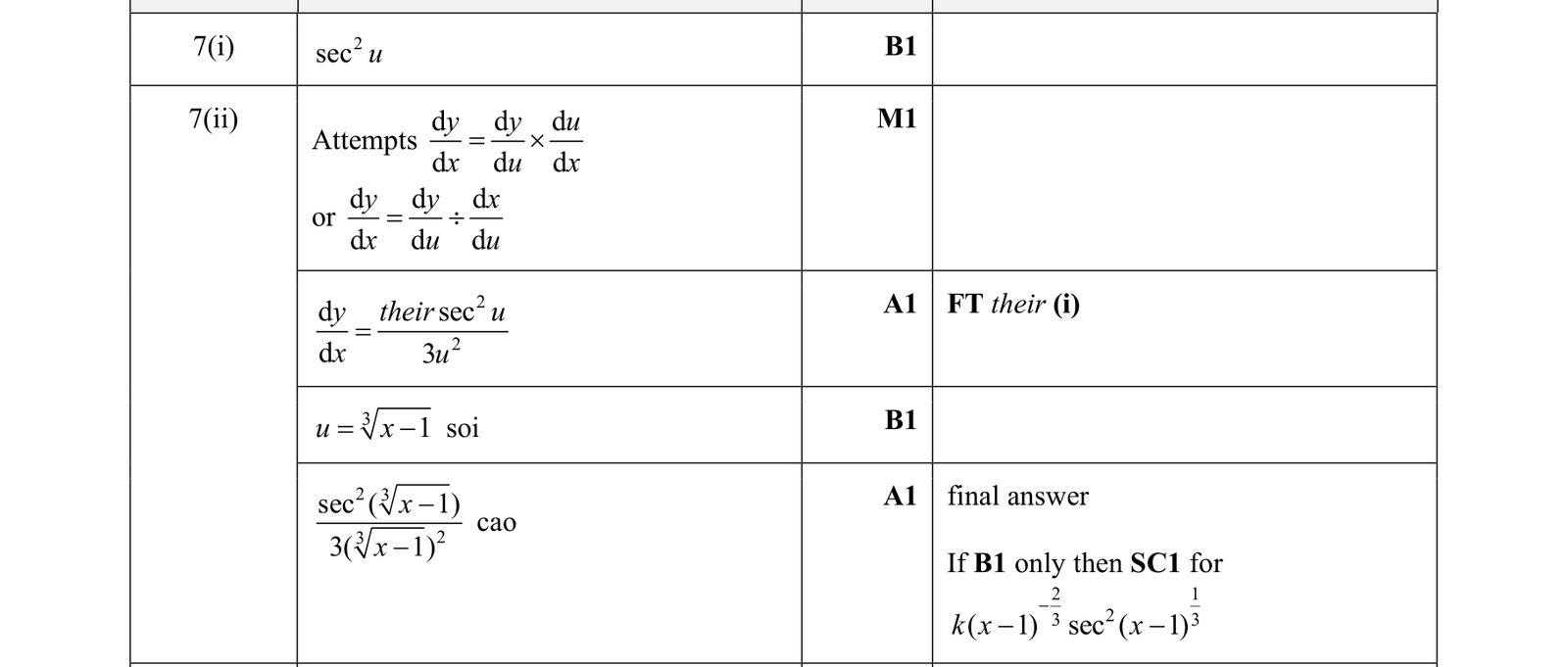
The variables \(x\), \(y\) and \(u\) are such that \(y=\tan u\) and \(x=u^3+1\).
(i) State the rate of change of \(y\) with respect to \(u\).
(ii) Hence find the rate of change of \(y\) with respect to \(x\), giving your answer in terms of \(x\).
0606 P22 - Jun 2019 - Q4 - 5 marks
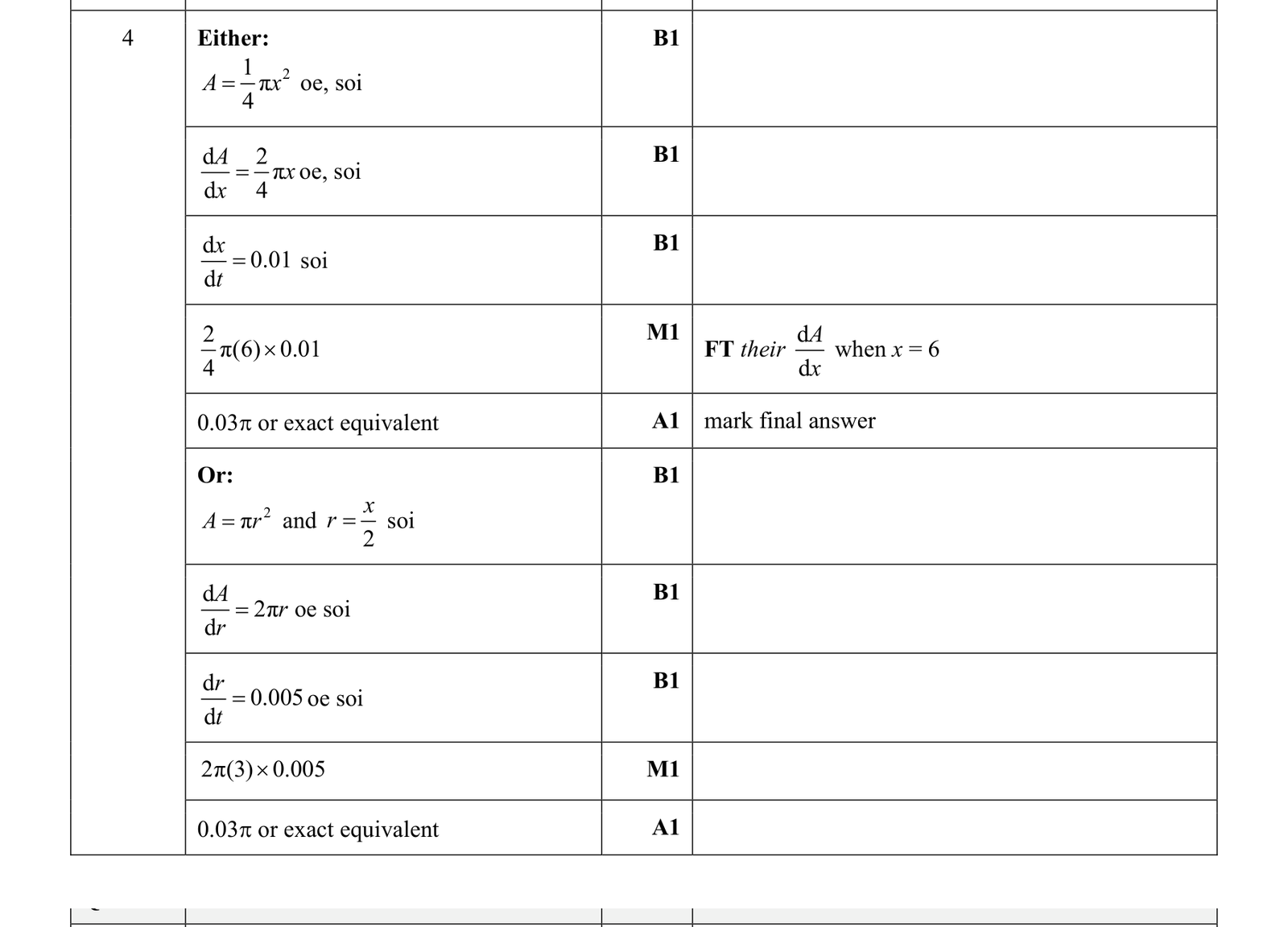
A circle has diameter \(x\) cm. The diameter is increasing at a constant rate of \(0.01\text{ cm s}^{-1}\). Find the exact rate of change of the area of the circle when \(x=6\).
0606 P22 - Mar 2018 - Q12 - 7 marks
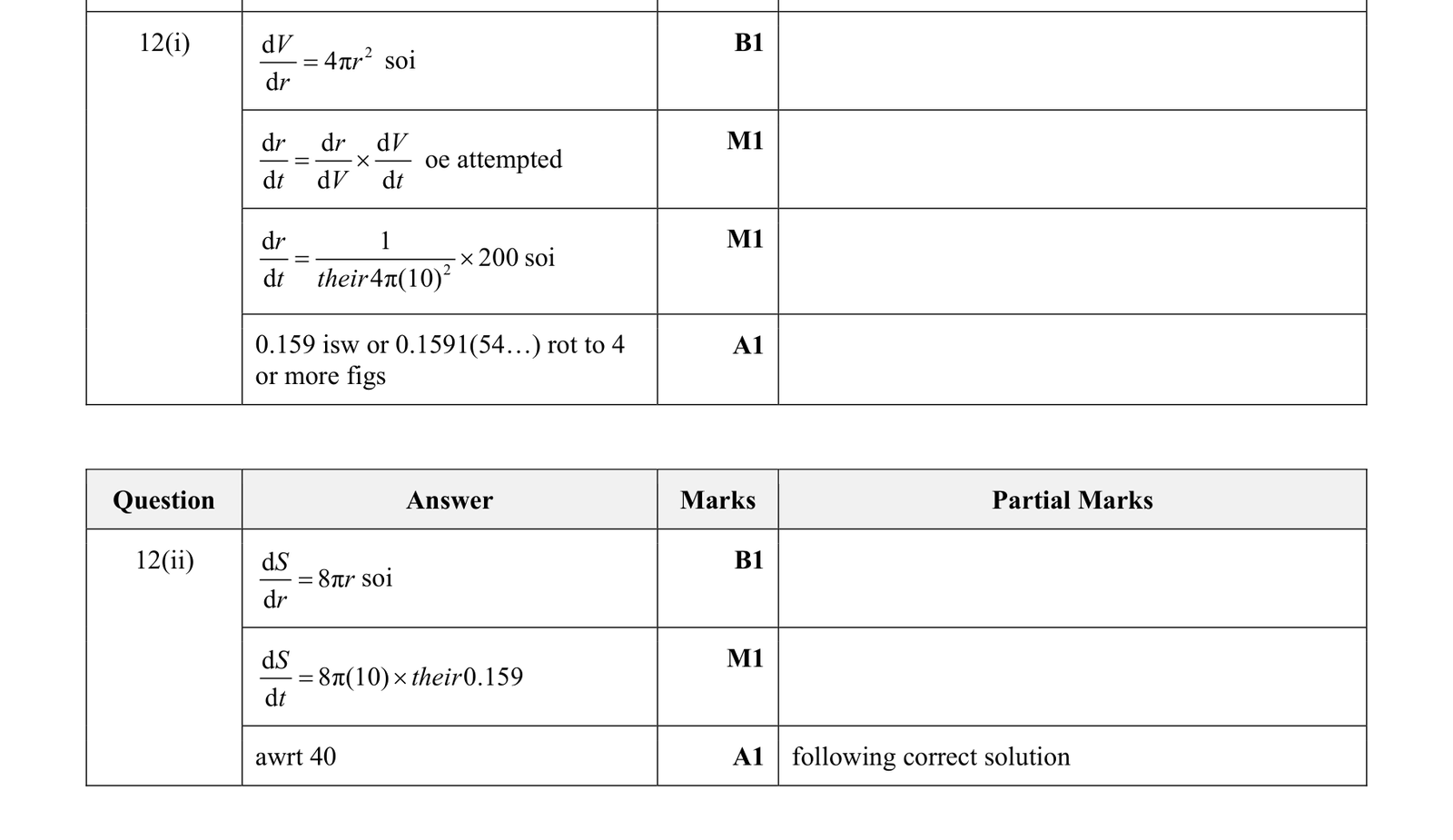
The volume, \(V\), and surface area, \(S\), of a sphere of radius \(r\) are given by \(V=\dfrac43\pi r^3\) and \(S=4\pi r^2\), respectively.
The volume of a sphere increases at a rate of \(200\text{ cm}^3\) per second. At the instant when the radius of the sphere is \(10\) cm, find
(i) the rate of increase of the radius of the sphere,
(ii) the rate of increase of the surface area of the sphere.
0606 P21 - Jun 2018 - Q12 - 9 marks
In this question all lengths are in metres.
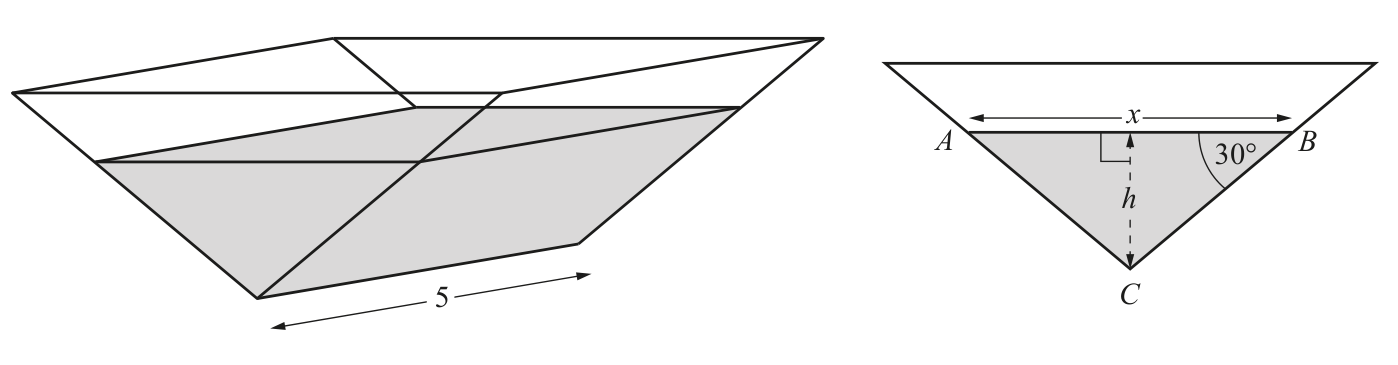
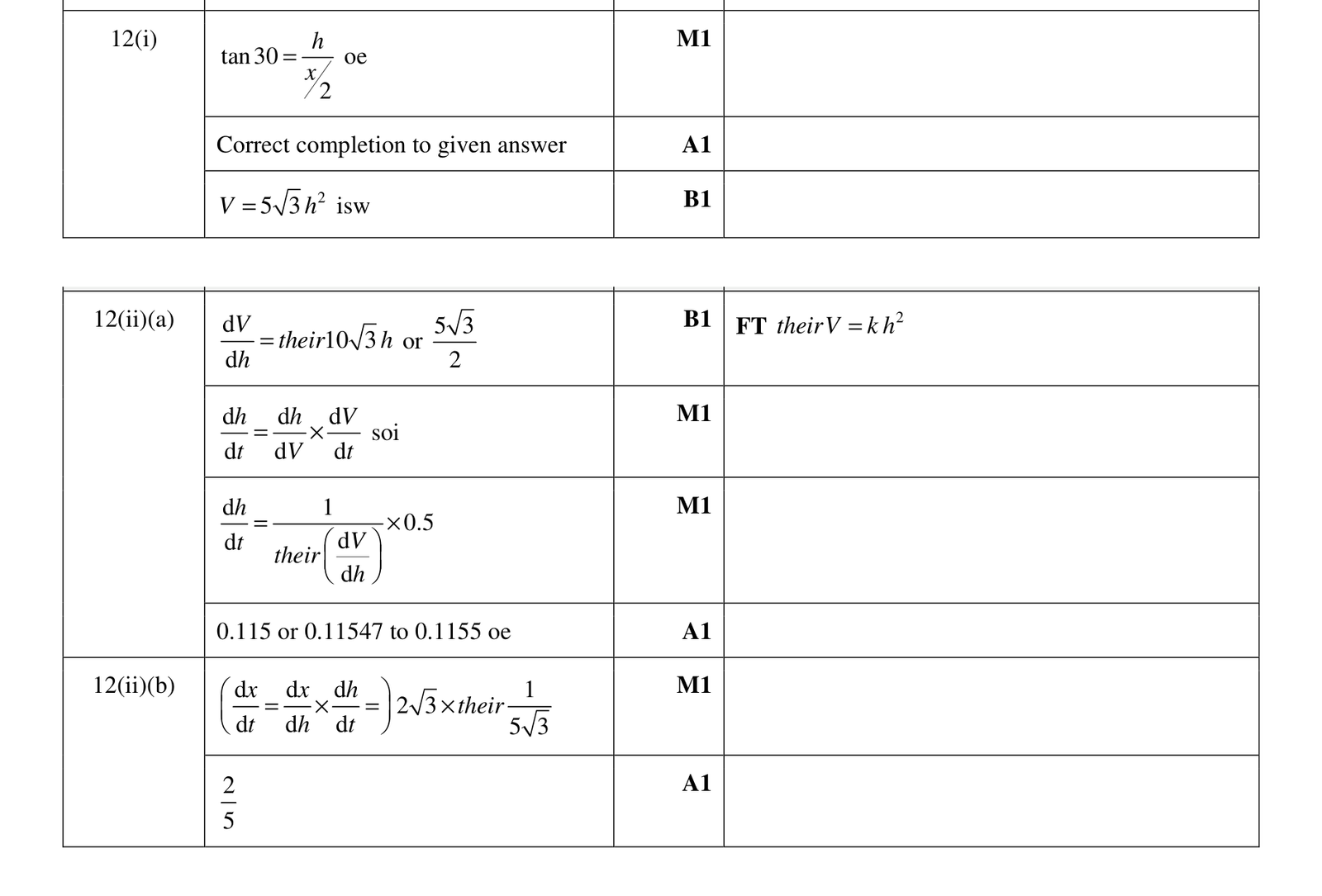
A water container is in the shape of a triangular prism. The cross-section of the water in the container is an isosceles triangle \(ABC\), with \(\angle ABC=\angle BAC=30^\circ\). The length of \(AB\) is \(x\) and the depth of water is \(h\). The length of the container is \(5\).
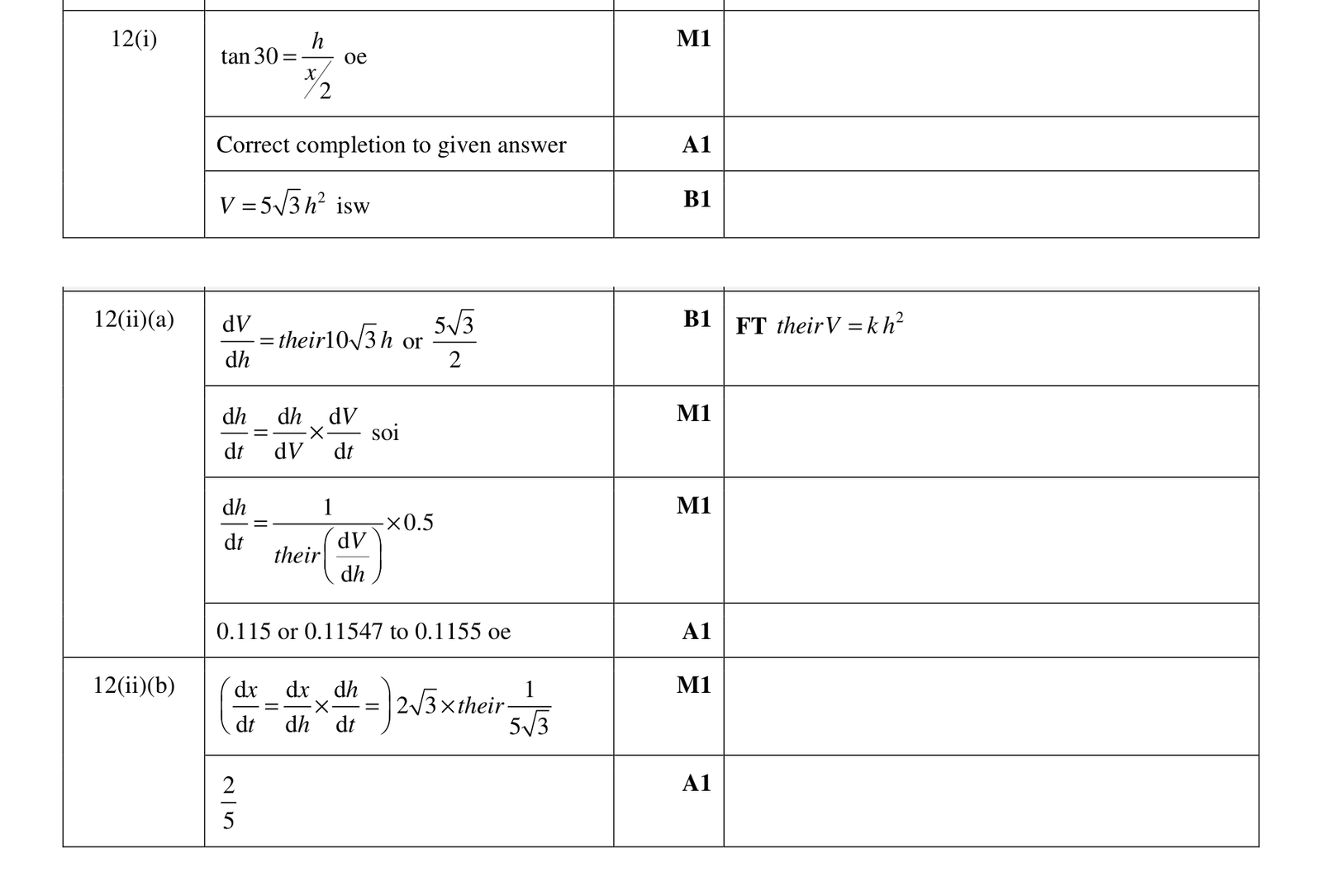
(i) Show that \(x=2\sqrt3h\) and hence find the volume of water in the container in terms of \(h\).
(ii) The container is filled at a rate of \(0.5\text{ m}^3\) per minute. At the instant when \(h=0.25\text{ m}\), find
(a) the rate at which \(h\) is increasing,
(b) the rate at which \(x\) is increasing.
0606 P22 - Jun 2018 - Q12 - 8 marks
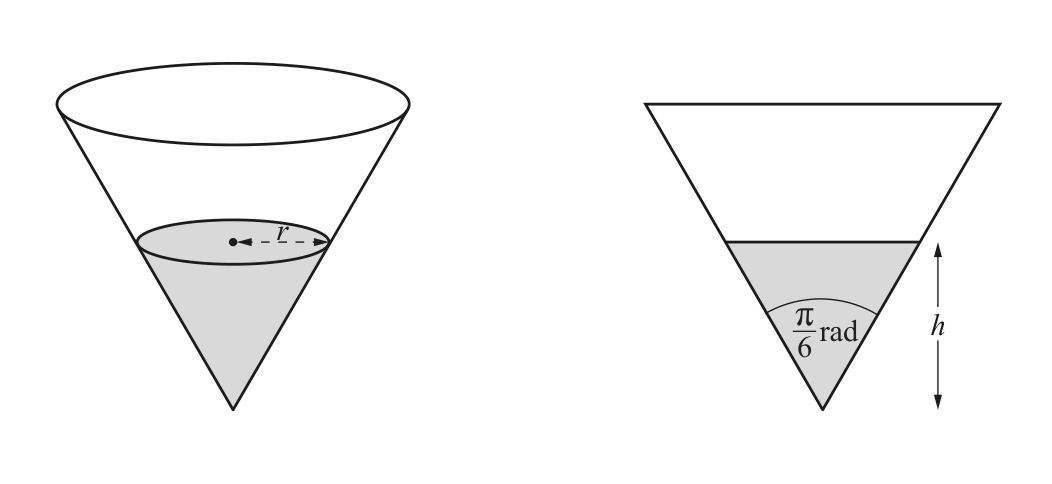
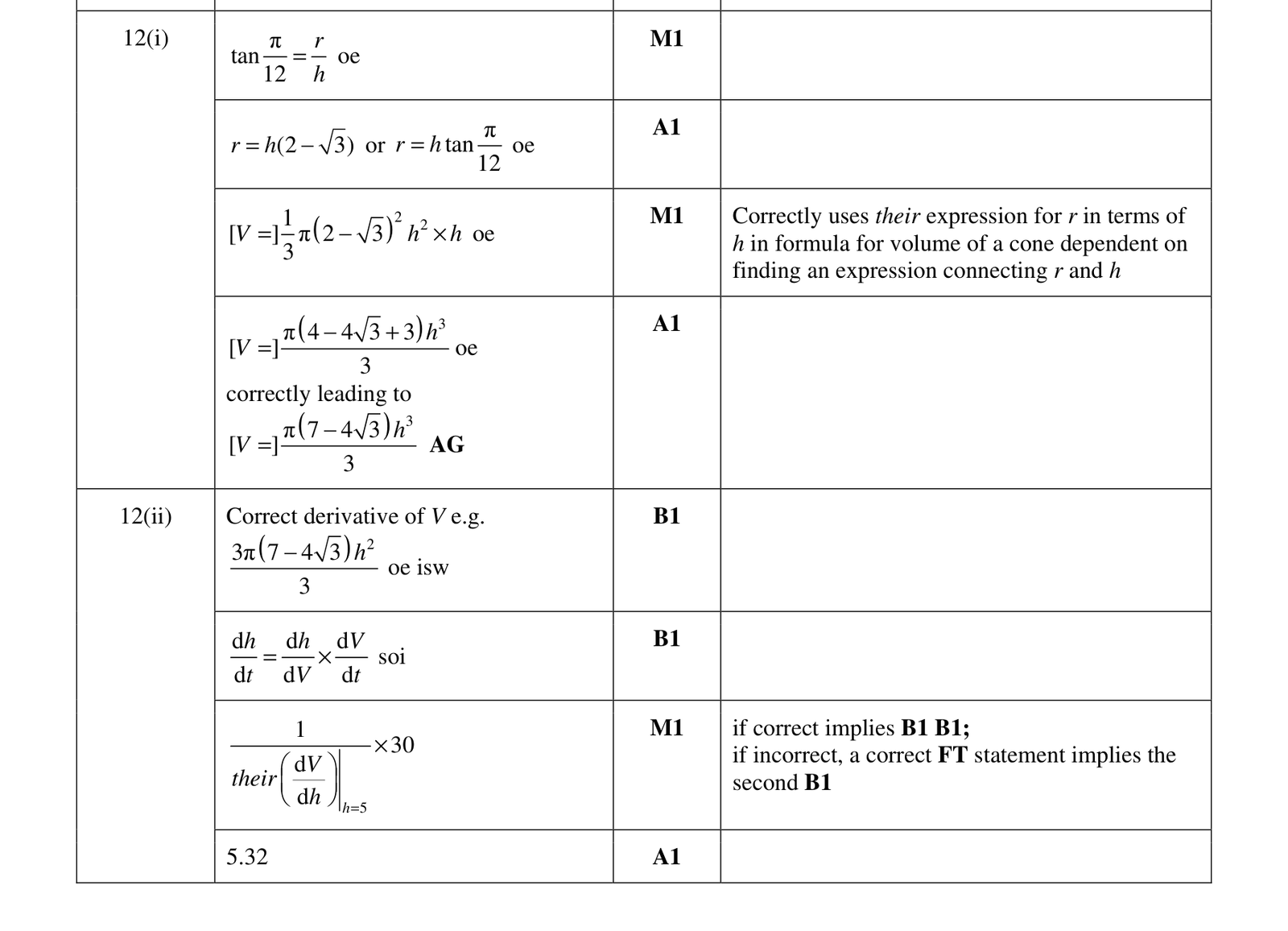
A water cup is in the shape of a cone with its axis vertical. The vertical angle of the cone is \(\frac{\pi}{6}\) radians. The depth of water in the cup is \(h\), and the surface of the water is a circle of radius \(r\).
The volume of a cone of height \(h\) and base radius \(r\) is \(V=\frac13\pi r^2h\).
It is known that
\(\sin\frac{\pi}{12}=\frac{\sqrt6-\sqrt2}{4}, \qquad \cos\frac{\pi}{12}=\frac{\sqrt6+\sqrt2}{4}, \qquad \tan\frac{\pi}{12}=2-\sqrt3.\)
(i) Find an expression for \(r\) in terms of \(h\) and show that the volume of water in the cup is
\(V=\frac{\pi(7-4\sqrt3)h^3}{3}.\)
(ii) Water is poured into the cup at a rate of \(30\text{ cm}^3\text{ s}^{-1}\). Find, correct to 2 decimal places, the rate at which the depth of water is increasing when \(h=5\).
0606 P23 - Jun 2018 - Q12 - 9 marks
In this question all lengths are in metres.
A water container is in the shape of a triangular prism. The cross-section of the water in the container is an isosceles triangle \(ABC\), with \(\angle ABC=\angle BAC=30^\circ\). The length of \(AB\) is \(x\) and the depth of water is \(h\). The length of the container is \(5\).
(i) Show that \(x=2\sqrt3h\) and hence find the volume of water in the container in terms of \(h\).
(ii) The container is filled at a rate of \(0.5\text{ m}^3\) per minute. At the instant when \(h=0.25\text{ m}\), find
(a) the rate at which \(h\) is increasing,
(b) the rate at which \(x\) is increasing.
0606 P21 - Jun 2024 - Q7 - 4 marks
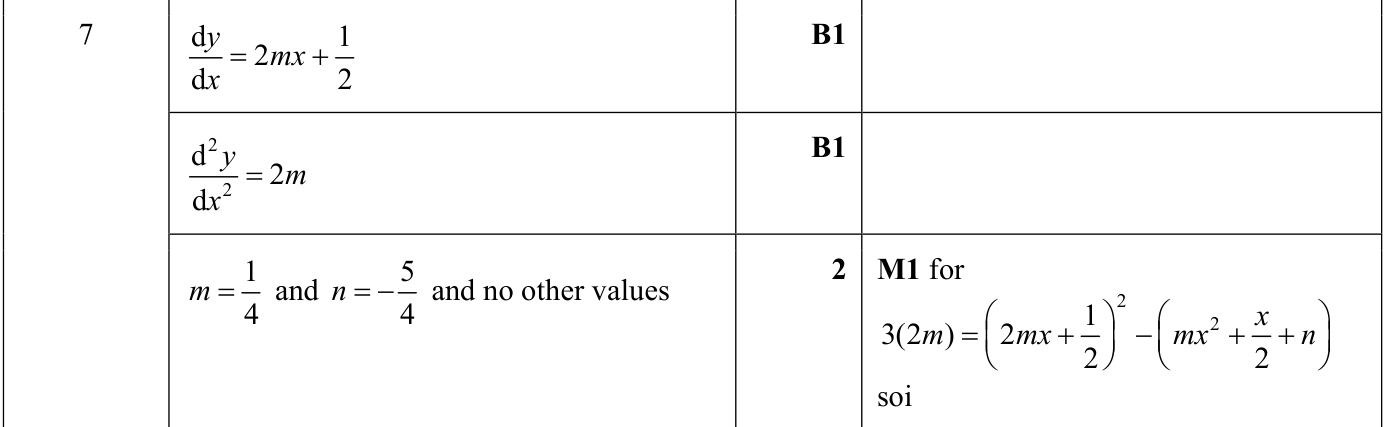
It is given that \(y=m x^{2}+\frac{x}{2}+n\), where \(m\) and \(n\) are non-zero constants. It is also given that \(3\left(\frac{\mathrm{~d}^{2} y}{\mathrm{~d} x^{2}}\right)=\left(\frac{\mathrm{d} y}{\mathrm{~d} x}\right)^{2}-y\) for all values of \(x\). Find the values of \(m\) and \(n\).
0606 P12 - Mar 2022 - Q7 - 8 marks
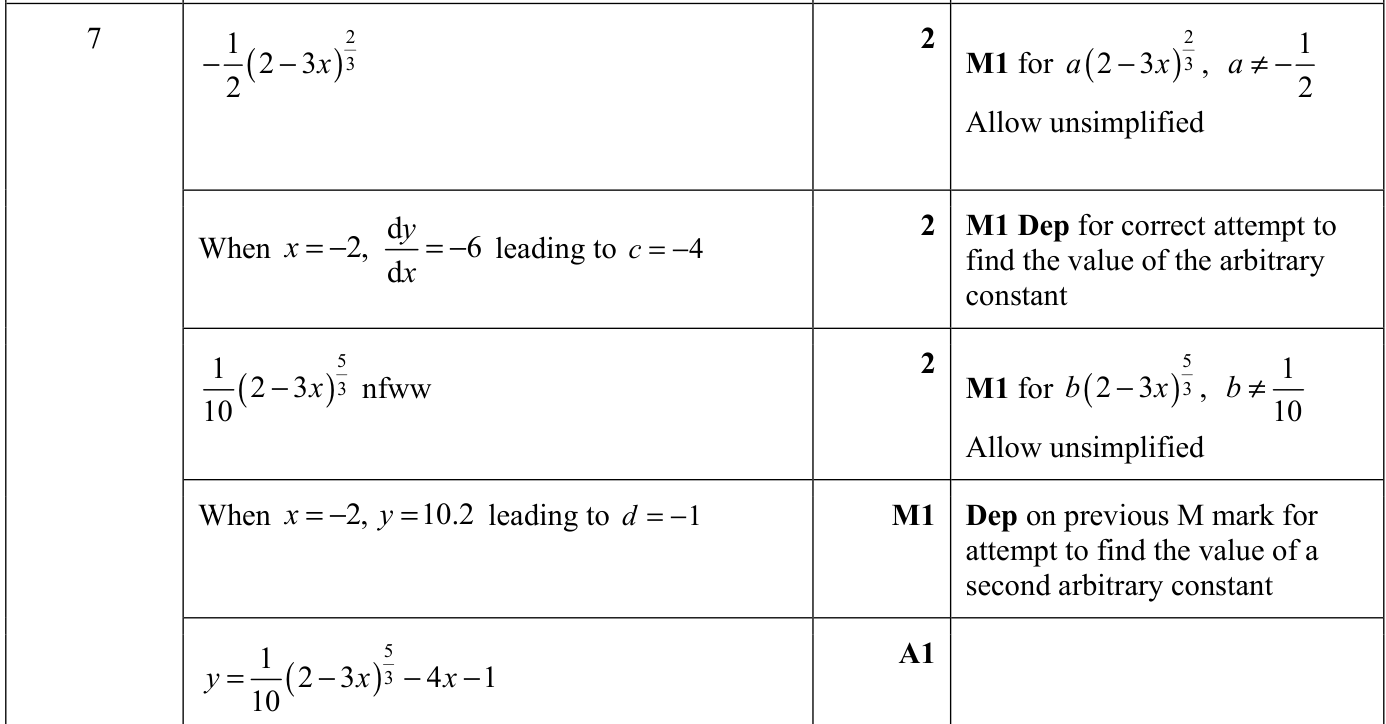
A curve \(y=f(x)\) is such that \(\displaystyle \frac{d^2y}{dx^2}=(2-3x)^{-1/3}\). The curve passes through the point \((-2,10.2)\). The gradient of the tangent to the curve at \((-2,10.2)\) is \(-6\). Find \(f(x)\).
0606 P23 - Jun 2019 - Q6 - 8 marks
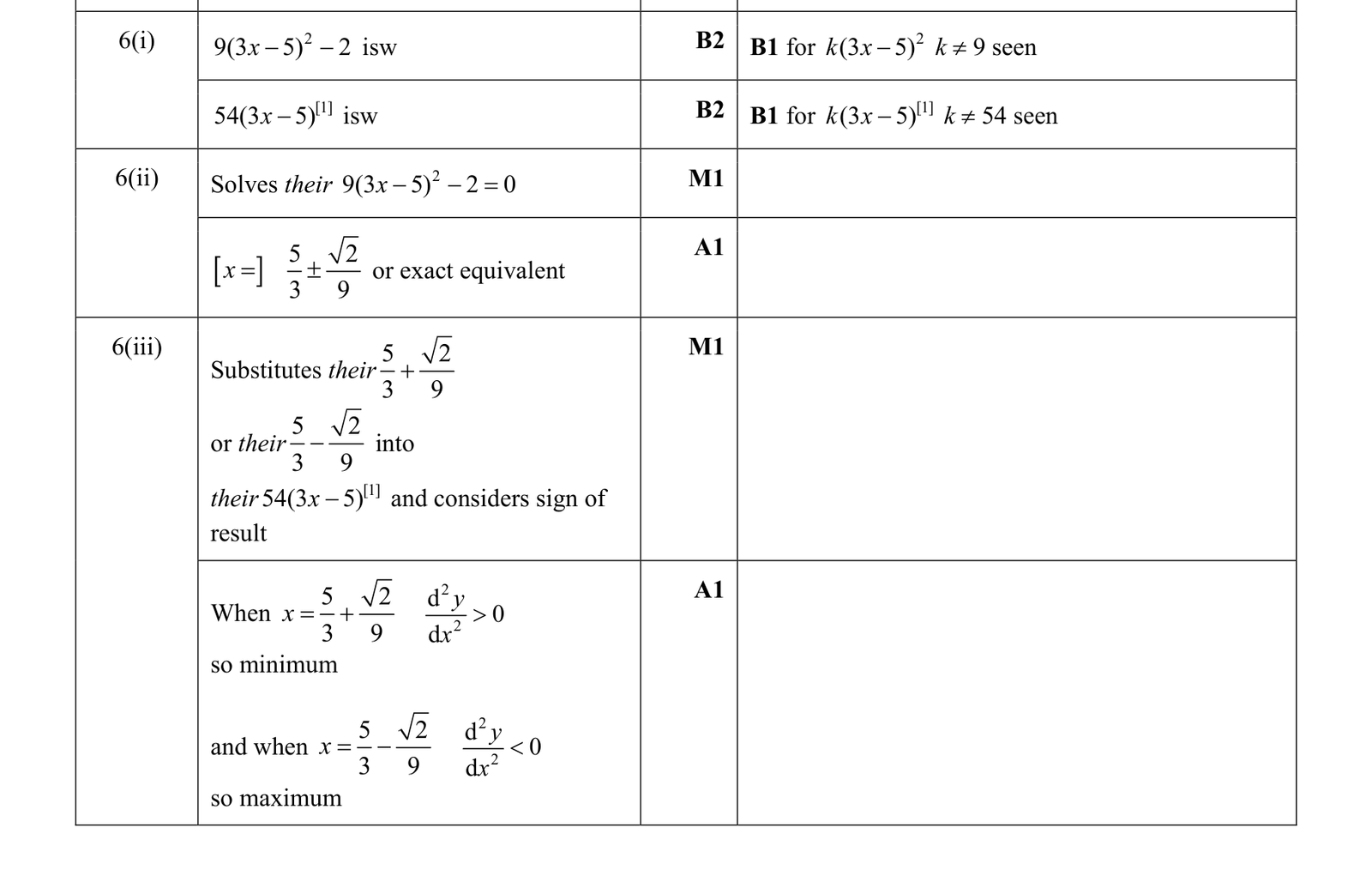
A curve has equation \(y=(3x-5)^3-2x\).
(i) Find \(\dfrac{dy}{dx}\) and \(\dfrac{d^2y}{dx^2}\).
(ii) Find the exact value of the \(x\)-coordinate of each of the stationary points of the curve.
(iii) Use the second derivative test to determine the nature of each of the stationary points.
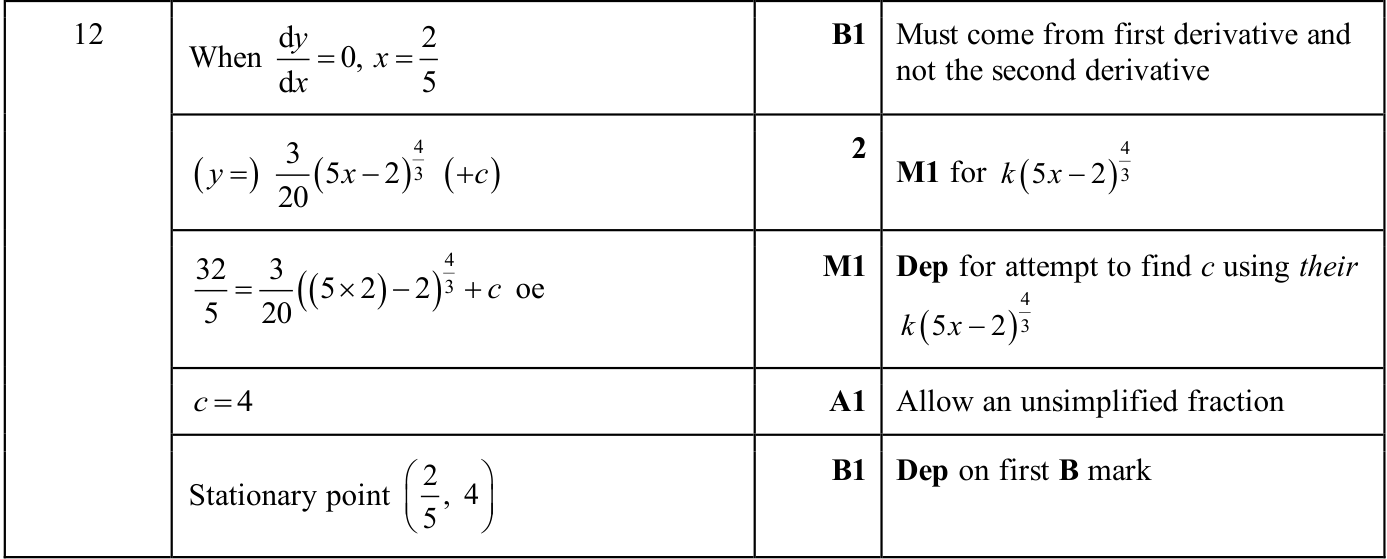
0606 P12 - Jun 2025 - Q12 - 6 marks
A curve is such that its gradient at the point \((x,y)\) is given by \((5x-2)^{\frac13}\). The curve passes through the point \(\left(2,\frac{32}{5}\right)\).
Find the coordinates of the stationary point on the curve.