Past Exam Questions
← Back0606 P22 - Nov 2021 - Q9 - 10 marks
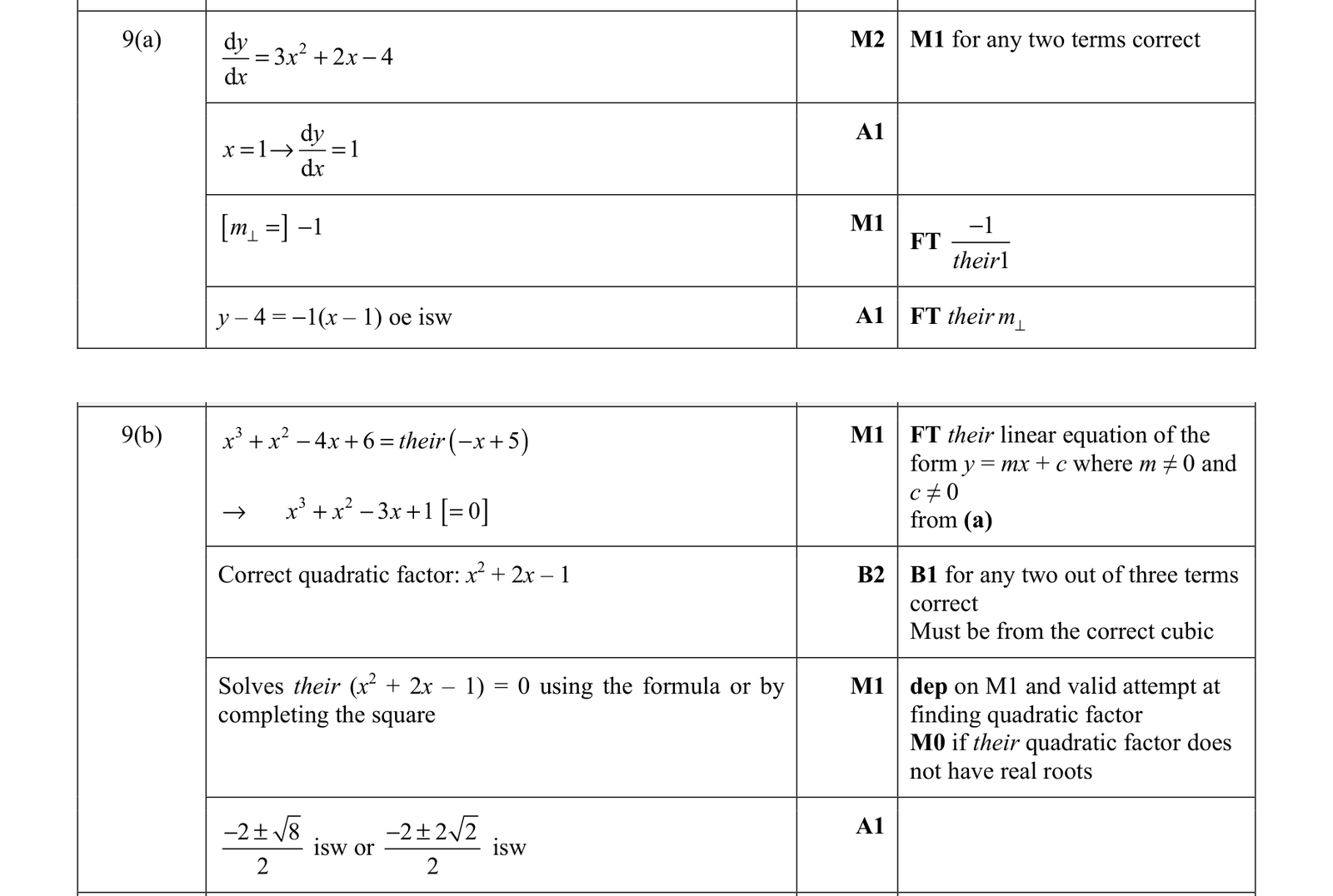
(a) Find the equation of the normal to the curve
\(y=x^3+x^2-4x+6\)
at the point \((1,4)\).
(b) Without using a calculator, find the exact \(x\)-coordinate of each of the two points where the normal cuts the curve again.
0606 P23 - Nov 2021 - Q6 - 7 marks
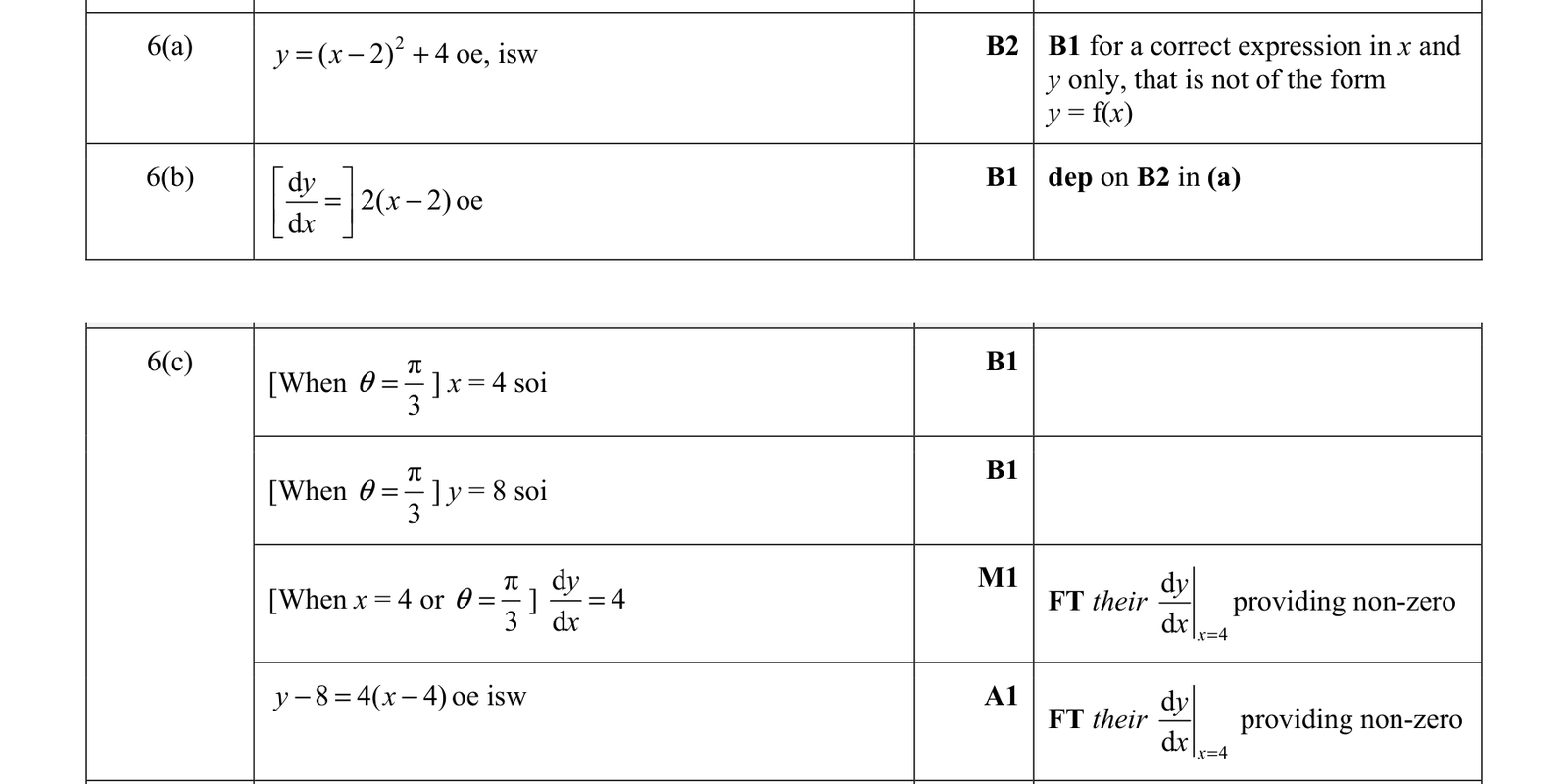
It is given that
\(x=2+\operatorname{sec}\theta,\qquad y=5+\tan^2\theta.\)
(a) Express \(y\) in terms of \(x\).
(b) Find \(\frac{dy}{dx}\) in terms of \(x\).
(c) A curve has the equation found in part (a). Find the equation of the tangent to the curve when \(\theta=\frac{\pi}{3}\).
0606 P12 - Mar 2020 - Q4 - 6 marks
The tangent to the curve
\(y=\ln(3x^2-4)-\frac{x^3}{6}\)
at the point where \(x=2\), meets the \(y\)-axis at the point \(P\). Find the exact coordinates of \(P\).

0606 P11 - Jun 2020 - Q5 - 6 marks
Find the equation of the tangent to the curve
\(y=\frac{\ln(3x^2-1)}{x+2}\)
at the point where \(x=1\). Give your answer in the form \(y=mx+c\), where \(m\) and \(c\) are constants correct to 3 decimal places.

0606 P22 - Jun 2020 - Q6 - 7 marks
(a) Find the equation of the tangent to the curve
\(2y=\tan 2x+7\)
at the point where \(x=\frac{\pi}{8}\). Give your answer in the form \(ax-y=\frac{\pi}{b}+c\), where \(a\), \(b\) and \(c\) are integers.
(b) This tangent intersects the \(x\)-axis at \(P\) and the \(y\)-axis at \(Q\). Find the length of \(PQ\).

0606 P22 - Nov 2020 - Q5 - 9 marks
Do not use a calculator in this question.
(a) Find the equation of the tangent to the curve
\(y=x^3-6x^2+3x+10\)
at the point where \(x=1\).
(b) Find the coordinates of the point where this tangent meets the curve again.

0606 P23 - Nov 2020 - Q7 - 11 marks
A curve has equation
\(y=x\cos x.\)
(a) Find \(\dfrac{dy}{dx}\).
(b) Find the equation of the normal to the curve at the point where \(x=\pi\).
(c) Find the exact value of
\(\int_0^{\frac{\pi}{6}} x\sin x\,dx.\)

0606 P11 - Jun 2019 - Q11 - 9 marks
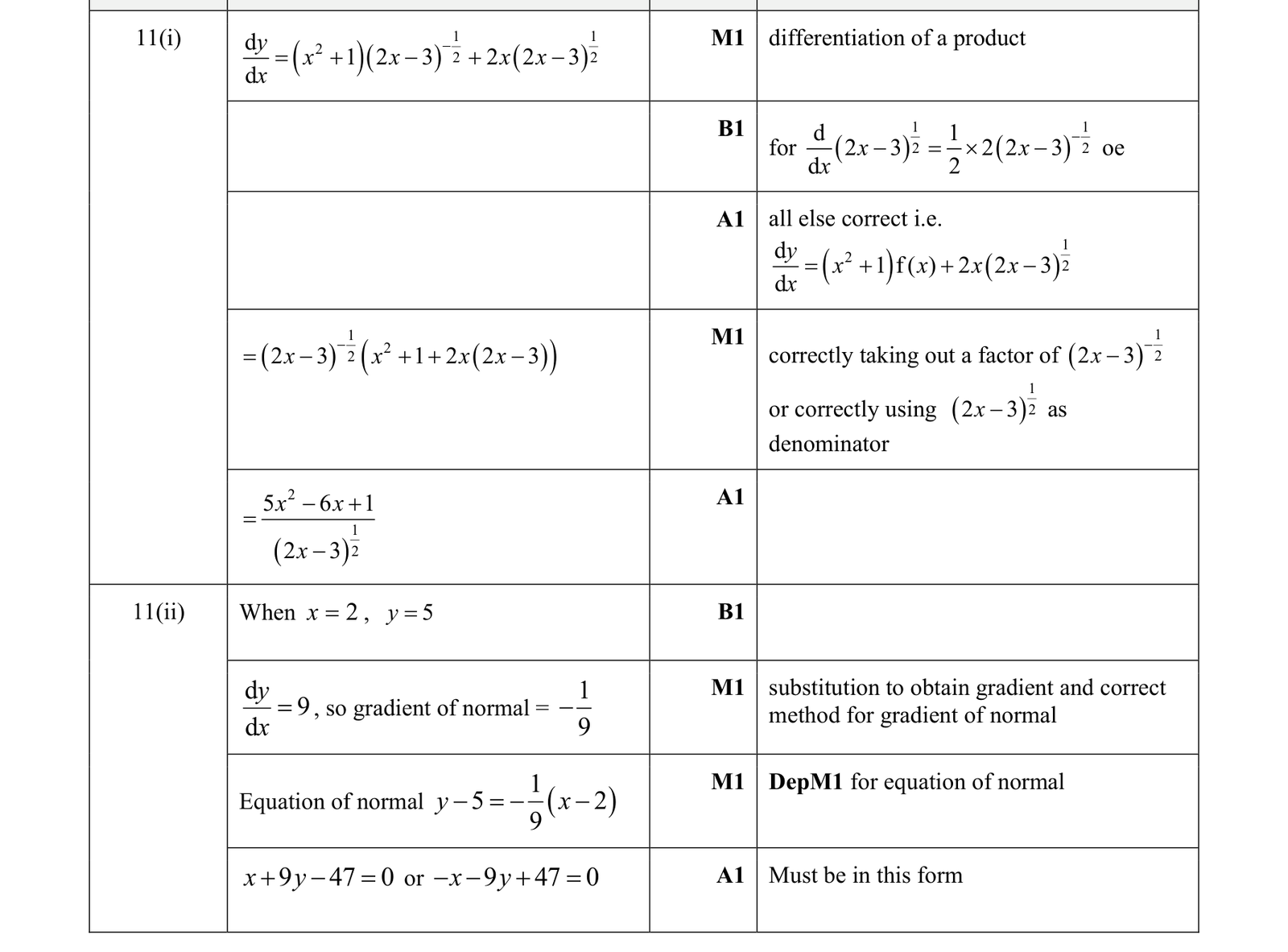
It is given that \(y=(x^2+1)(2x-3)^{1/2}\).
(i) Show that
\(\frac{dy}{dx}=\frac{Px^2+Qx+1}{(2x-3)^{1/2}},\)
where \(P\) and \(Q\) are integers.
(ii) Hence find the equation of the normal to the curve at the point where \(x=2\), giving your answer in the form \(ax+by+c=0\), where \(a\), \(b\) and \(c\) are integers.
0606 P12 - Jun 2019 - Q11 - 7 marks
The normal to the curve \(y=(x-2)(3x+1)^{2/3}\) at the point where \(x=\frac73\), meets the \(y\)-axis at the point \(P\). Find the exact coordinates of \(P\).

0606 P11 - Nov 2019 - Q6 - 5 marks
Find the equation of the normal to the curve
\(y=\sqrt{8x+5}\)
at the point where \(x=\frac12\), giving your answer in the form \(ax+by+c=0\), where \(a\), \(b\) and \(c\) are integers.

0606 P22 - Nov 2019 - Q5 - 7 marks
At the point where \(x=1\) on the curve \(\displaystyle y=\frac{k}{(x+1)^2}\), the normal has a gradient of \(\frac13\).
(i) Find the value of the constant \(k\).
(ii) Using your value of \(k\), find the equation of the tangent to the curve at \(x=2\).

0606 P13 - Nov 2018 - Q9 - 8 marks
Find the equation of the normal to the curve
\(y=\frac{\ln(3x^2+1)}{x^2}\)
at the point where \(x=2\), giving your answer in the form \(y=mx+c\), where \(m\) and \(c\) are correct to 2 decimal places. You must show all your working.

0606 P11 - Jun 2017 - Q1 - 5 marks
The line \(y=kx-5\), where \(k\) is a positive constant, is a tangent to the curve \(y=x^2+4x\) at the point \(A\).
(i) Find the exact value of \(k\).
(ii) Find the gradient of the normal to the curve at \(A\), giving your answer in the form \(a+b\sqrt5\), where \(a\) and \(b\) are constants.

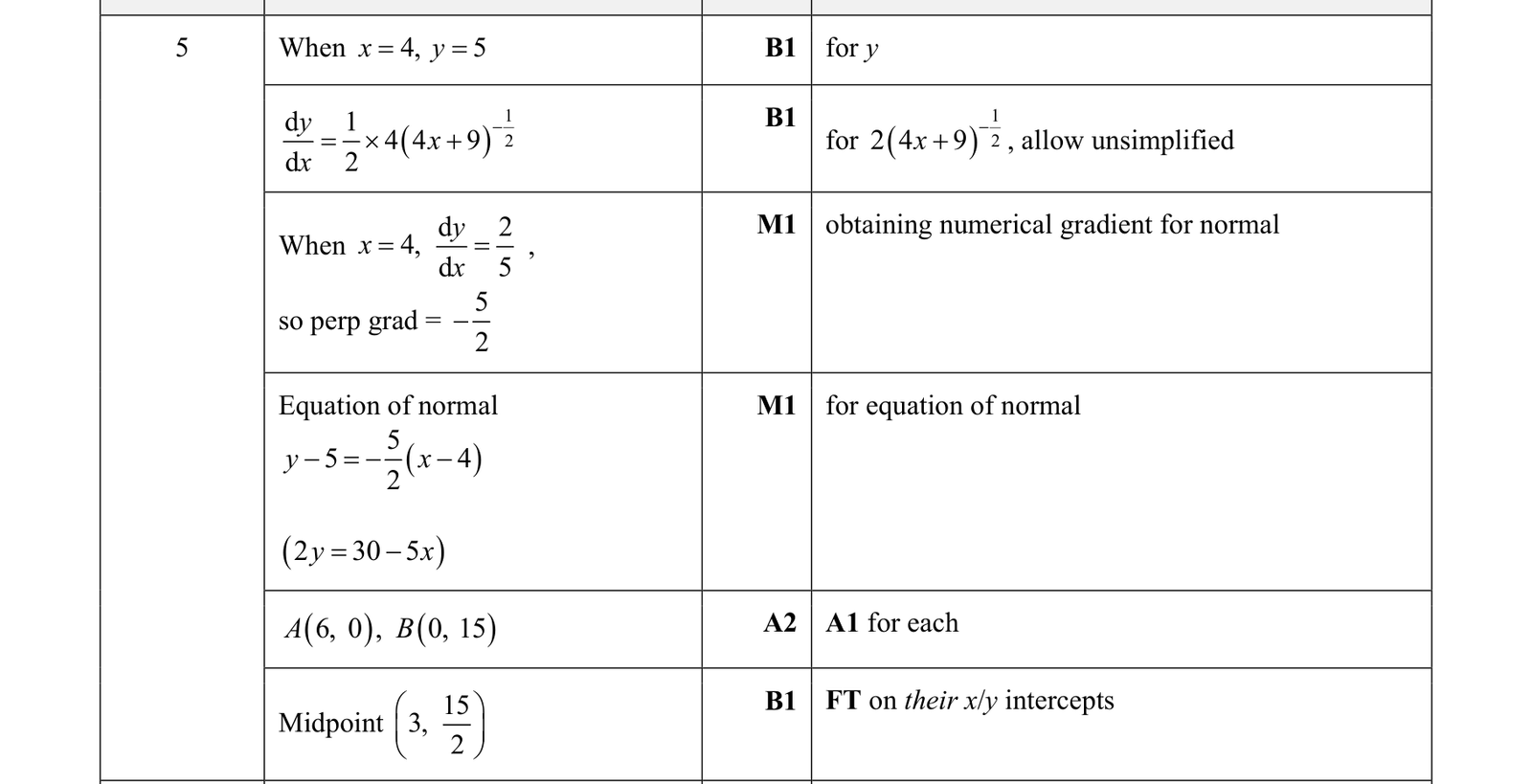
0606 P13 - Jun 2017 - Q5 - 7 marks
The normal to the curve
\(y=\sqrt{4x+9},\)
at the point where \(x=4\), meets the \(x\)- and \(y\)-axes at the points \(A\) and \(B\). Find the coordinates of the midpoint of the line \(AB\).
0606 P22 - Jun 2017 - Q4 - 6 marks
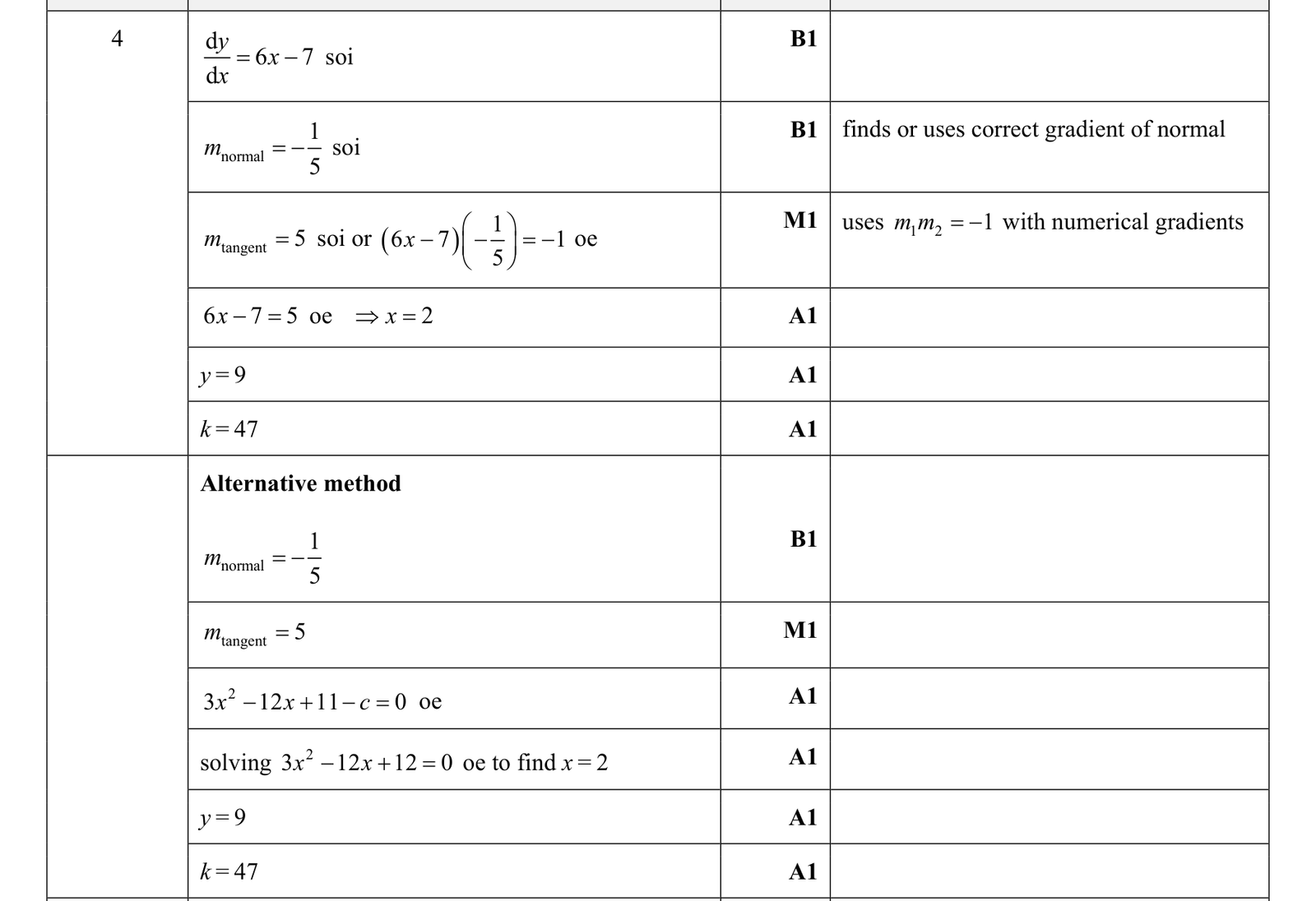
The point \(P\) lies on the curve \(y=3x^2-7x+11\).
The normal to the curve at \(P\) has equation \(5y+x=k\).
Find the coordinates of \(P\) and the value of \(k\).
0606 P13 - Nov 2025 - Q3 - 4 marks
In this question you may use the values in the table below.
| \(\theta\) radians | \(\sin\theta\) | \(\cos\theta\) | \(\tan\theta\) |
|---|---|---|---|
| \(\frac{\pi}{6}\) | \(\frac12\) | \(\frac{\sqrt3}{2}\) | \(\frac{\sqrt3}{3}\) |
| \(\frac{\pi}{3}\) | \(\frac{\sqrt3}{2}\) | \(\frac12\) | \(\sqrt3\) |
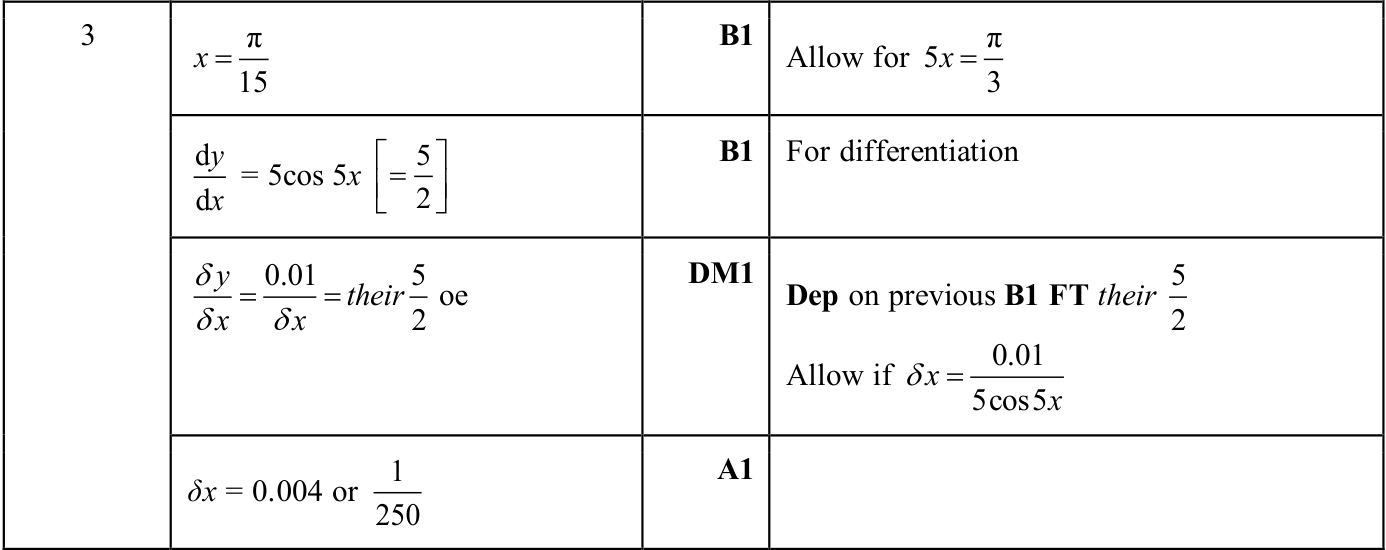
Variables \(x\) and \(y\) are related by the equation \(y=\sin5x\), where \(0\leqslant x\leqslant\frac{\pi}{10}\).
Use calculus to find the approximate change in \(x\) when \(y\) increases from \(\frac{\sqrt3}{2}\) by the small amount \(0.01\).
0606 P21 - Jun 2025 - Q5 - 4 marks
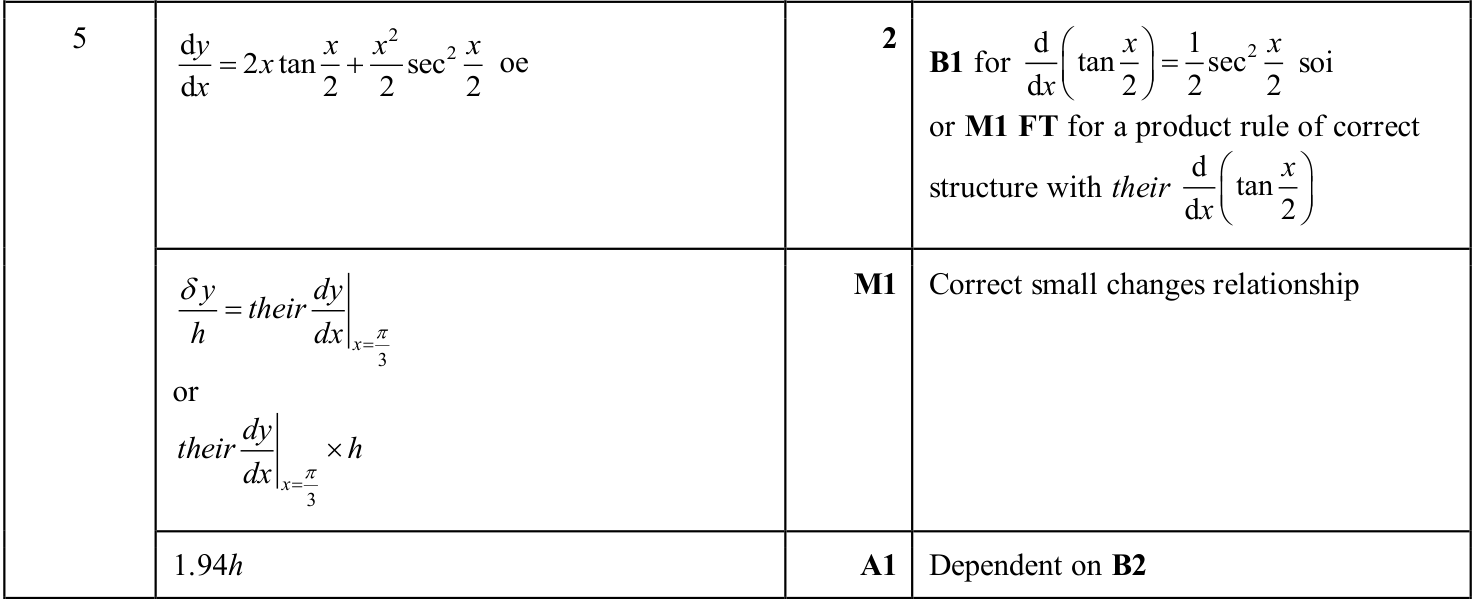
Given that \(y=x^{2} \tan \frac{x}{2}\), use calculus to find the approximate change in \(y\) as \(x\) increases from \(\frac{\pi}{3}\) to \(\frac{\pi}{3}+h\), where \(h\) is small.
0606 P23 - Jun 2025 - Q8 - 9 marks
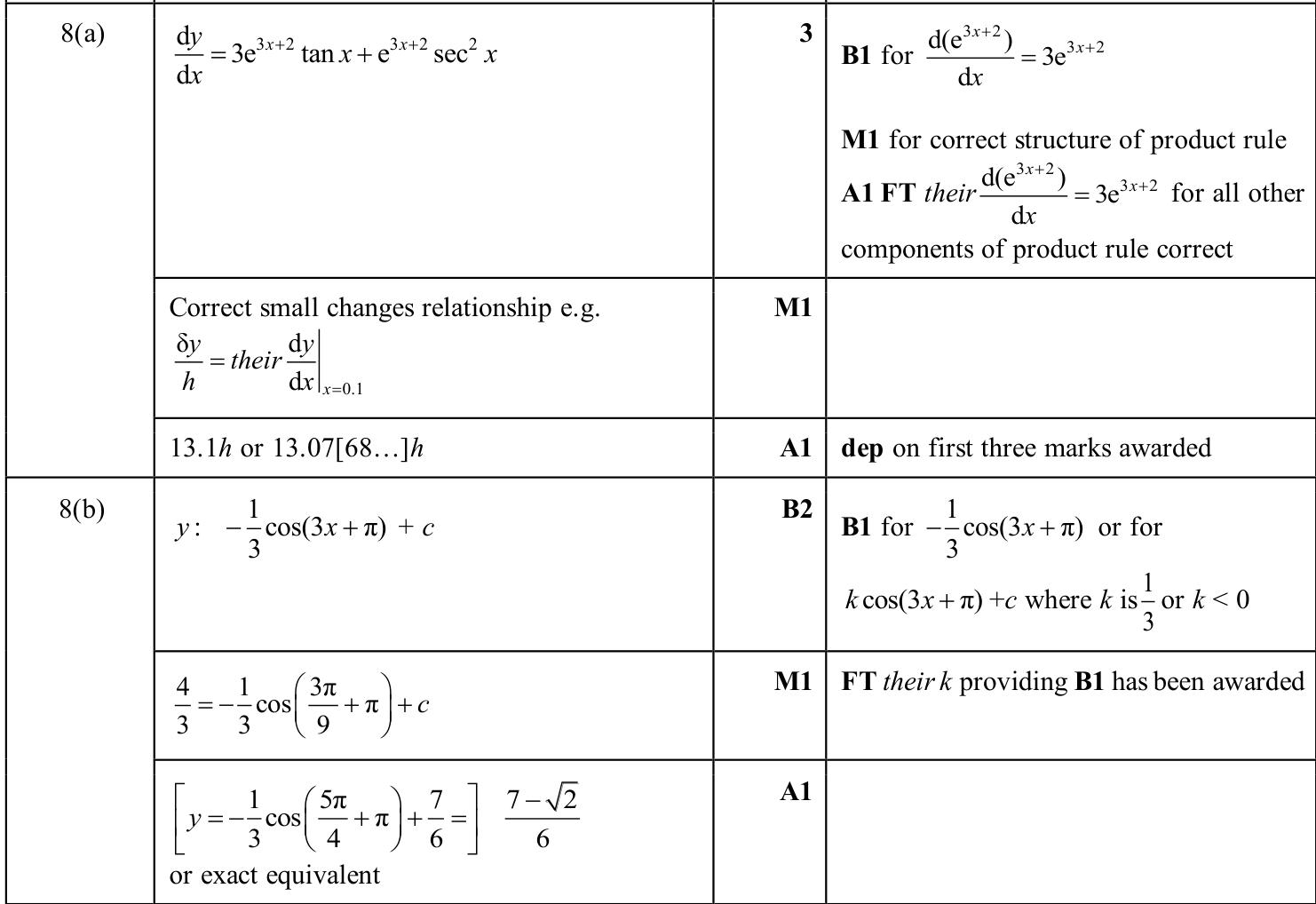
(a) It is given that \(y=\mathrm{e}^{3 x+2} \tan x\). Use calculus to find the approximate change in \(y\) as \(x\) increases from 0.1 to \(0.1+h\), where \(h\) is small.
(b) A curve is such that \(\frac{\mathrm{d} y}{\mathrm{~d} x}=\sin (3 x+\pi)\).
The curve passes through the point \(\left(\frac{\pi}{9}, \frac{4}{3}\right)\). Find the exact \(y\)-coordinate of the point on the curve where \(x=\frac{5 \pi}{12}\).
0606 P22 - Nov 2024 - Q2 - 8 marks
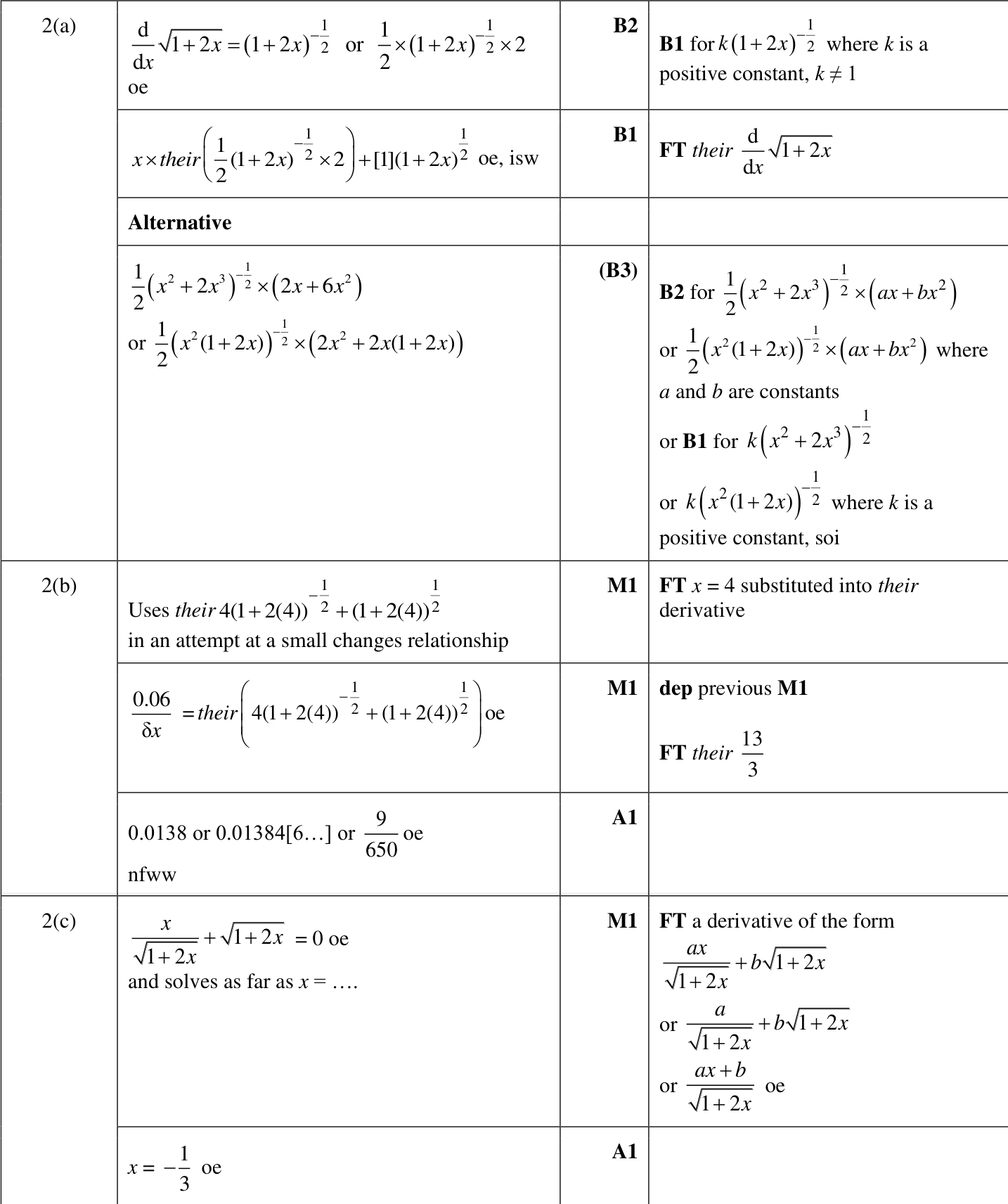
Variables \(x\) and \(y\) are related by the equation \(y=x \sqrt{1+2 x}\). (a) Find \(\frac{\mathrm{d} y}{\mathrm{~d} x}\). (b) It is given that when \(y=12, x=4\). Find the approximate change in \(x\) when \(y\) increases from 12 by the small amount 0.06 . (c) Find the \(x\)-coordinate of the stationary point on the curve \(y=x \sqrt{1+2 x}\).
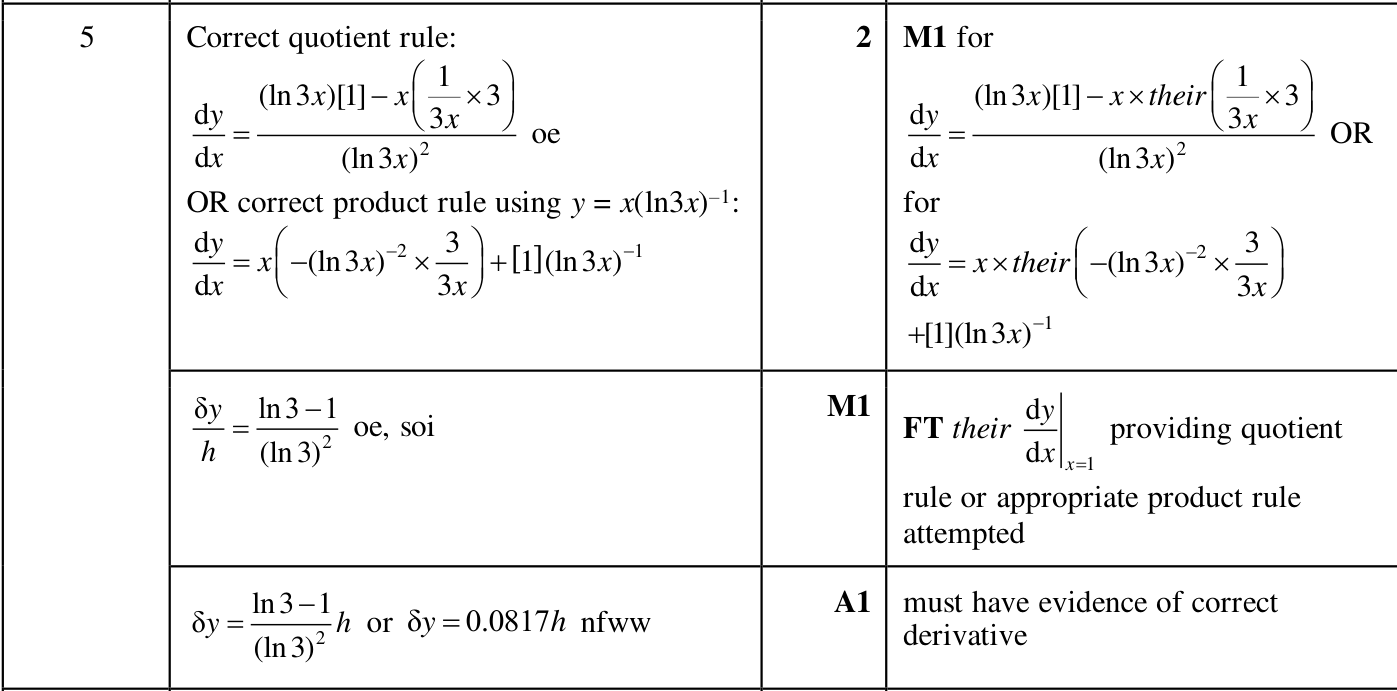
0606 P22 - Mar 2024 - Q5 - 4 marks
Variables \(x\) and \(y\) are related by the equation \(y=\frac{x}{\ln 3 x}\). Use differentiation to find the approximate change in \(y\) when \(x\) increases from 1 to \(1+h\), where \(h\) is small.