Answer: \(\displaystyle 3\pi\left(\frac{25000}{\pi}\right)^{2/3}\text{ cm}^2\), approximately \(3760\text{ cm}^2\).
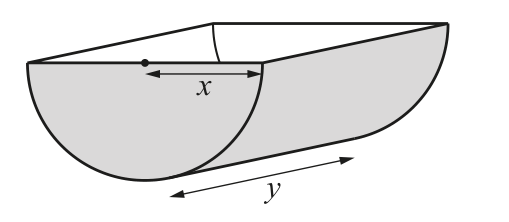
The volume of the half-cylinder is
\(\displaystyle \frac12\pi x^2y=25000\).
So
\(\displaystyle y=\frac{50000}{\pi x^2}\).
The outer surface area consists of the curved half-cylinder and the two semicircular ends:
\(S=\pi xy+\pi x^2\).
Substitute \(y=\frac{50000}{\pi x^2}\):
\(\displaystyle S=\pi x\left(\frac{50000}{\pi x^2}\right)+\pi x^2\).
Hence
\(\displaystyle S=\frac{50000}{x}+\pi x^2\).
Differentiate:
\(\displaystyle \frac{dS}{dx}=-\frac{50000}{x^2}+2\pi x\).
At the minimum, \(\frac{dS}{dx}=0\), so
\(\displaystyle 2\pi x=\frac{50000}{x^2}\).
Therefore
\(2\pi x^3=50000\),
so
\(\displaystyle x^3=\frac{25000}{\pi}\).
Substitute this value into \(S=\frac{50000}{x}+\pi x^2\). Since \(\frac{50000}{x}=2\pi x^2\) at the stationary point,
\(S_{\min}=3\pi x^2\).
Thus
\(\displaystyle S_{\min}=3\pi\left(\frac{25000}{\pi}\right)^{2/3}\).
Numerically, this is approximately
\(3760\text{ cm}^2\).